Study of Twisted Tape Inserts Segmental Application in Low-Concentrated Solar Parabolic Trough Collectors




Abstract
1. Introduction
2. Methods
2.1. Heat Transfer in Parabolic Trough Collector
2.2. CFD Model
3. Results and Discussion
3.1. Model Validation with Experimental Research
3.2. CFD Analysis Results
3.3. Twisted Tape Application Evaluation in Long Term Analysis
4. Conclusions
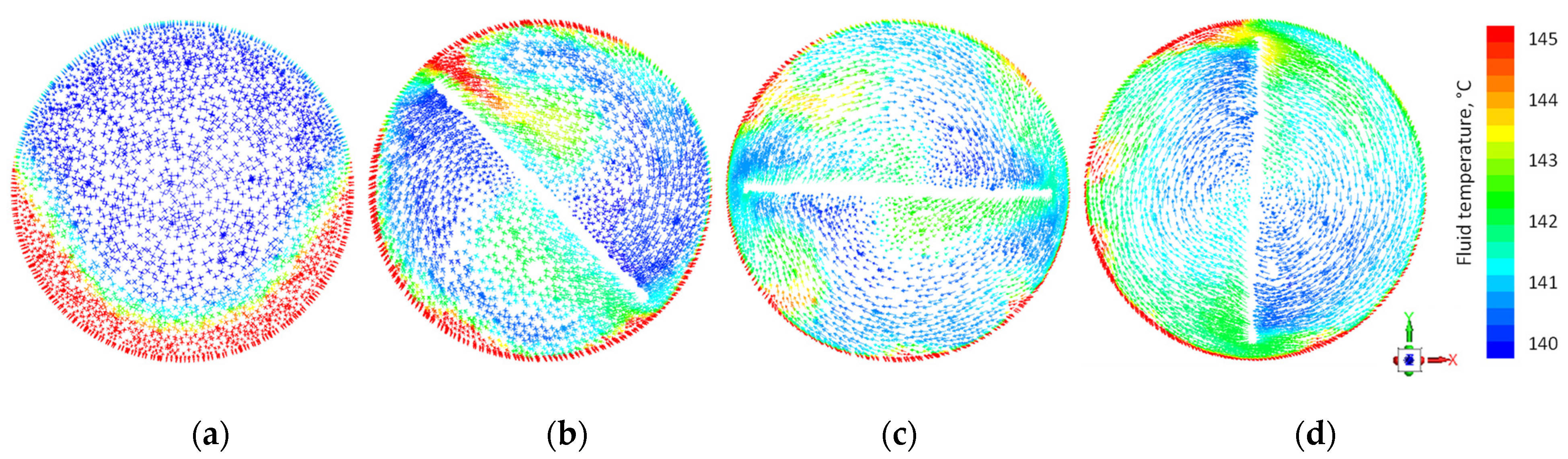
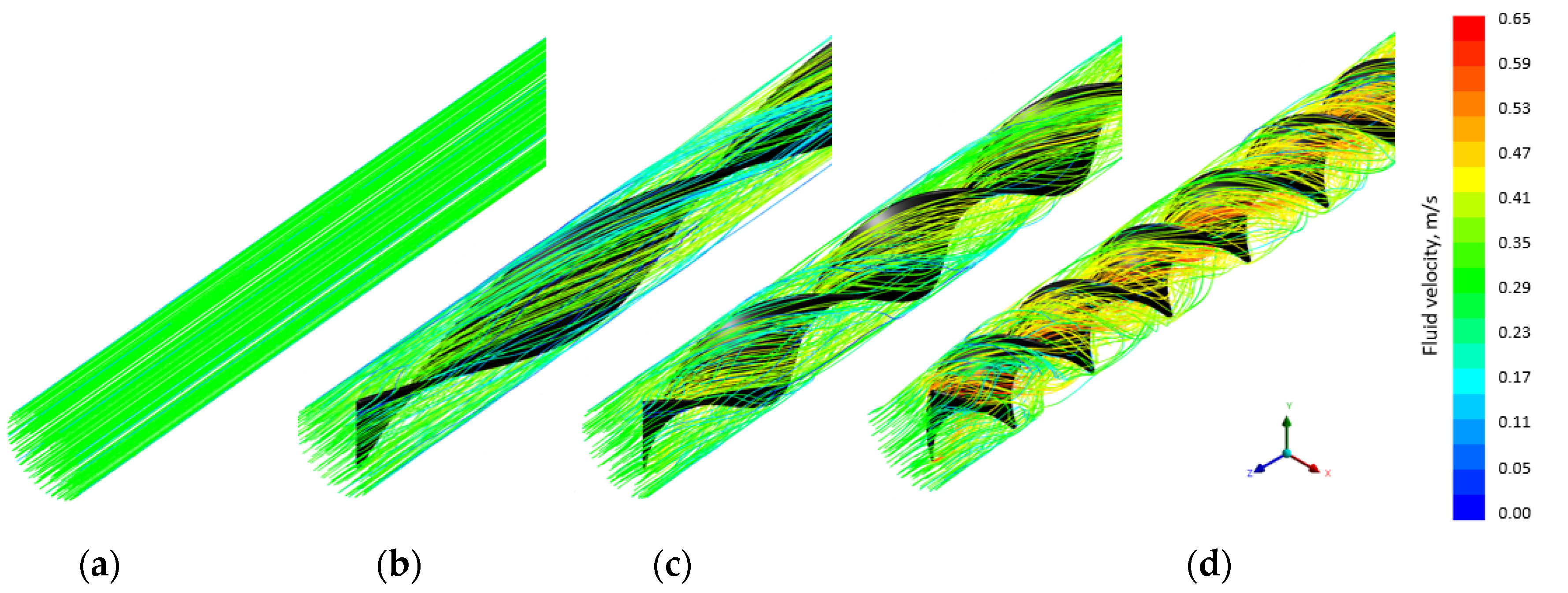
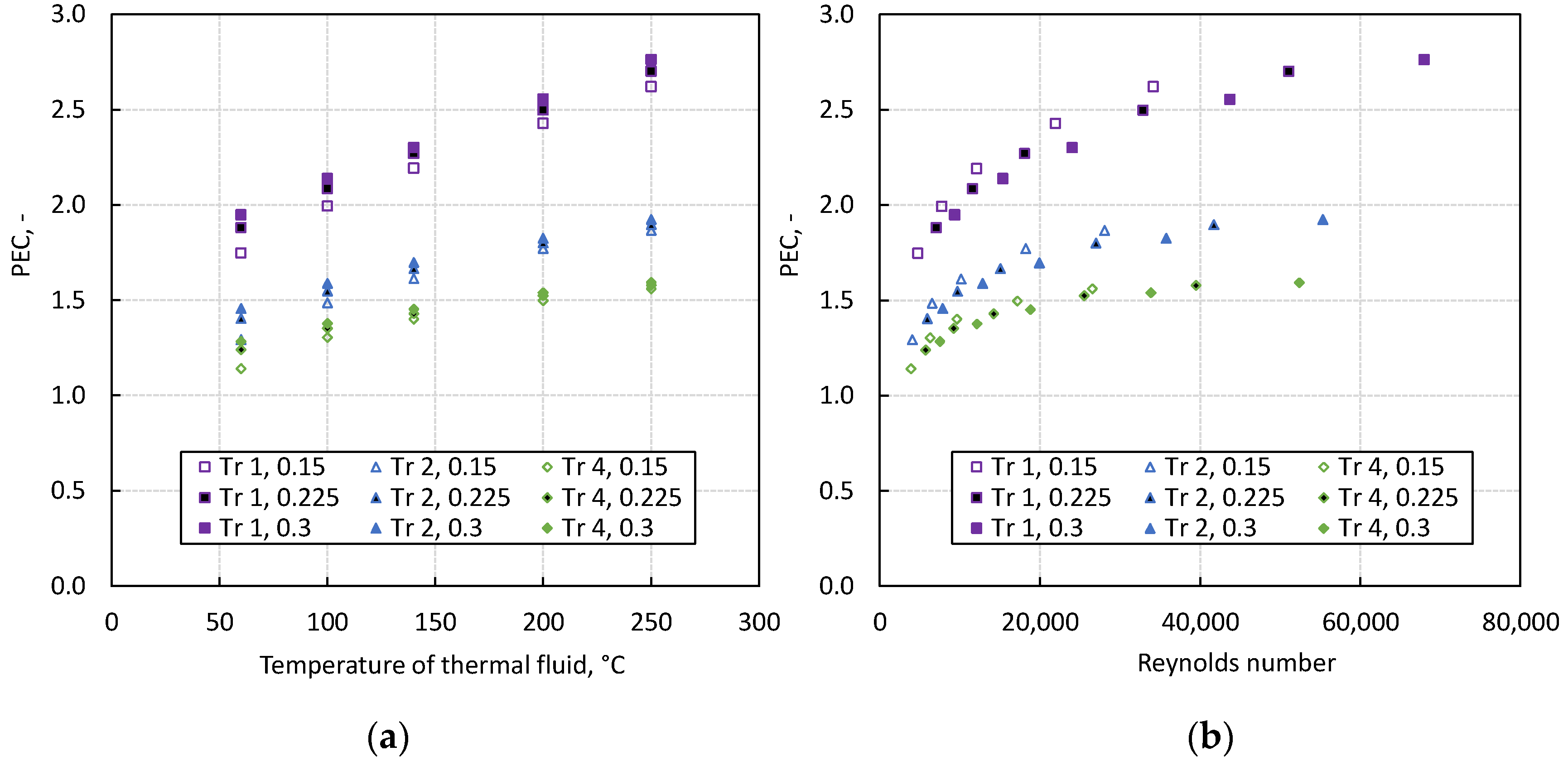
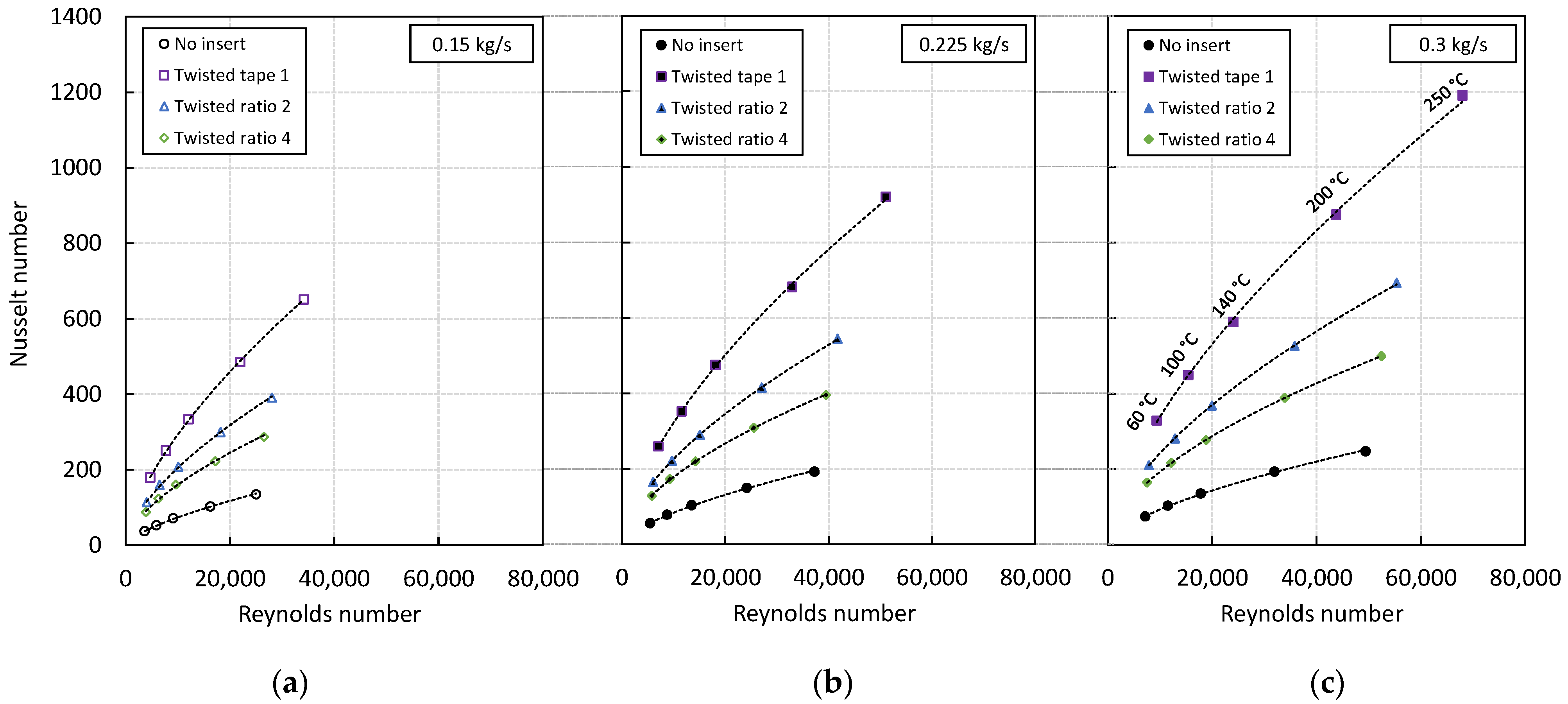
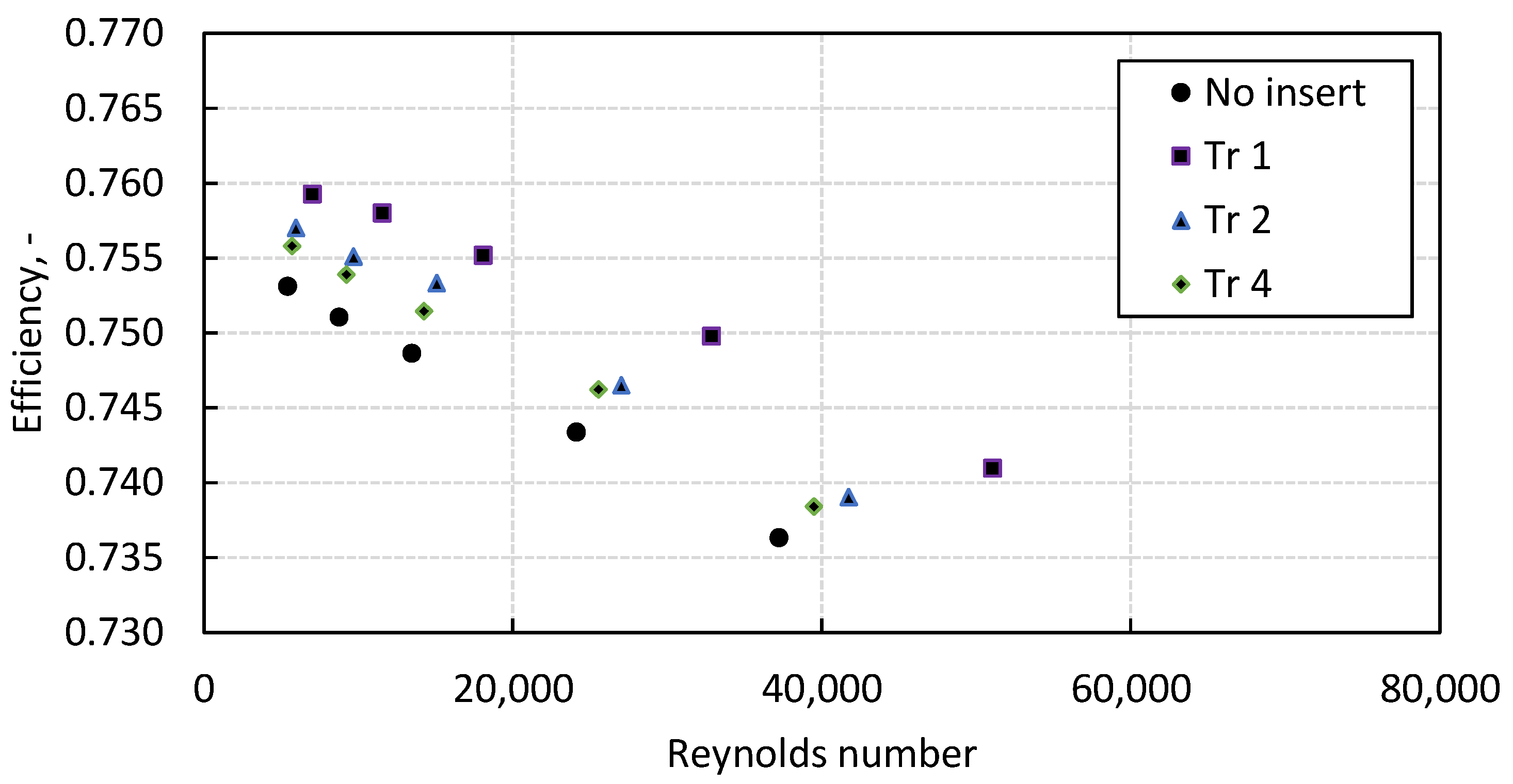
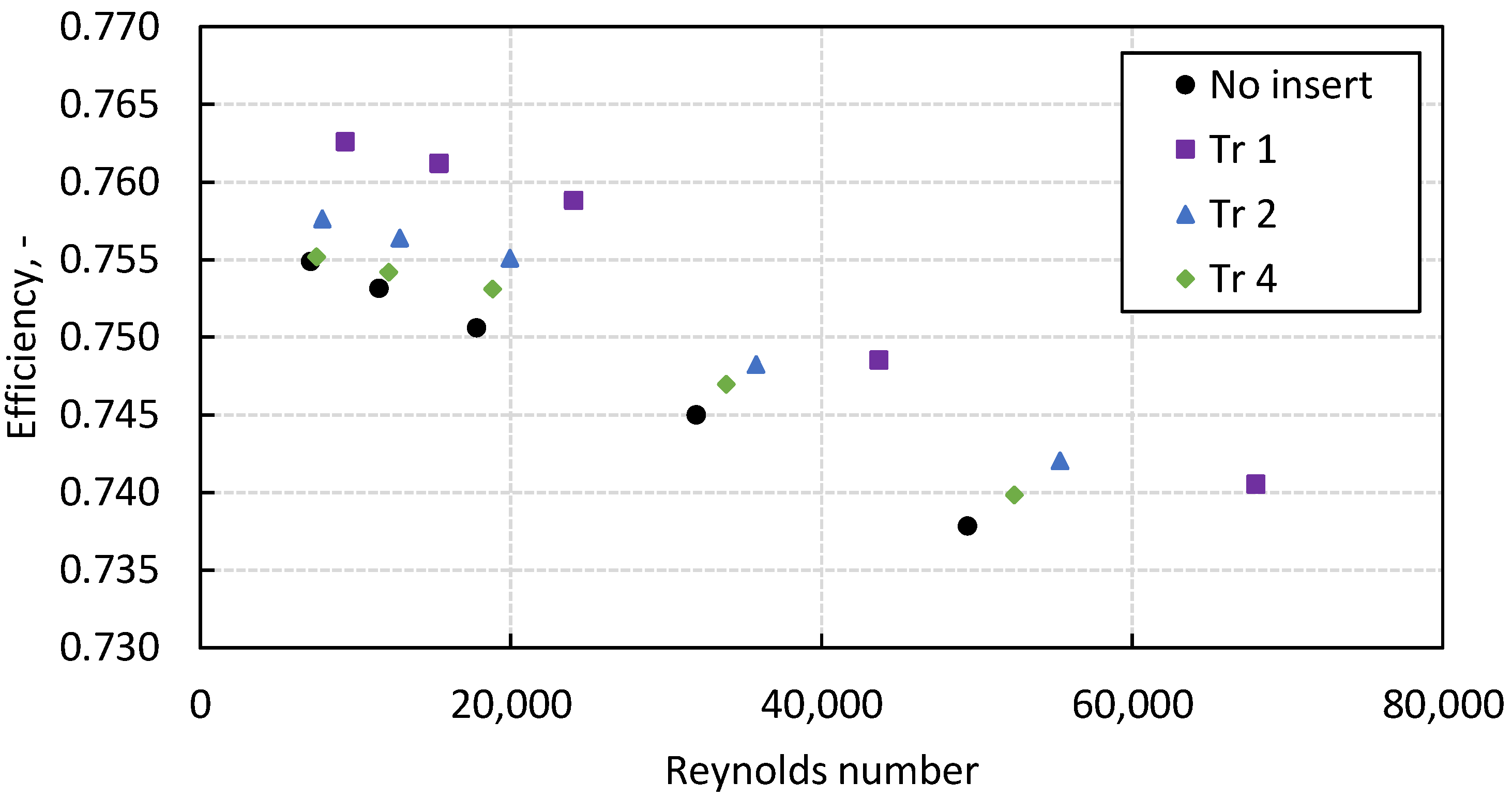
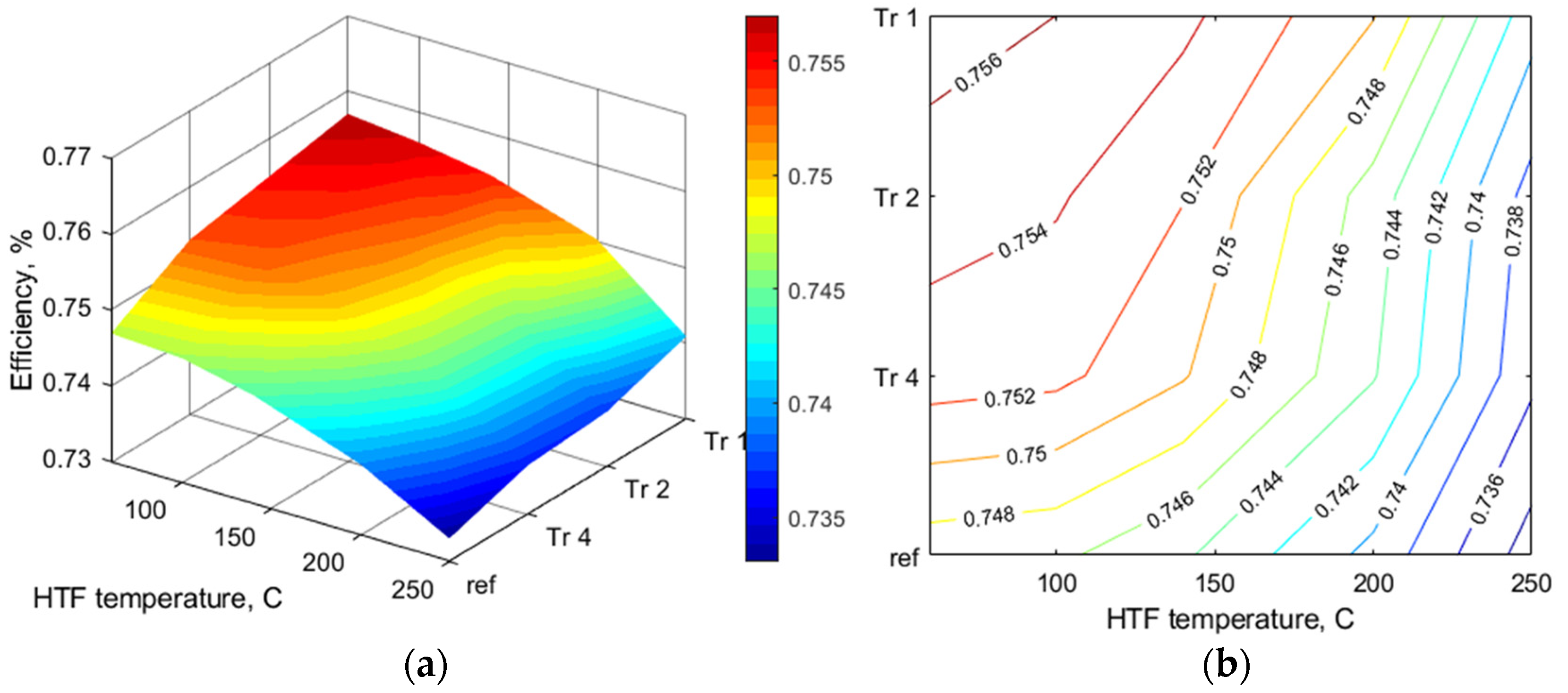
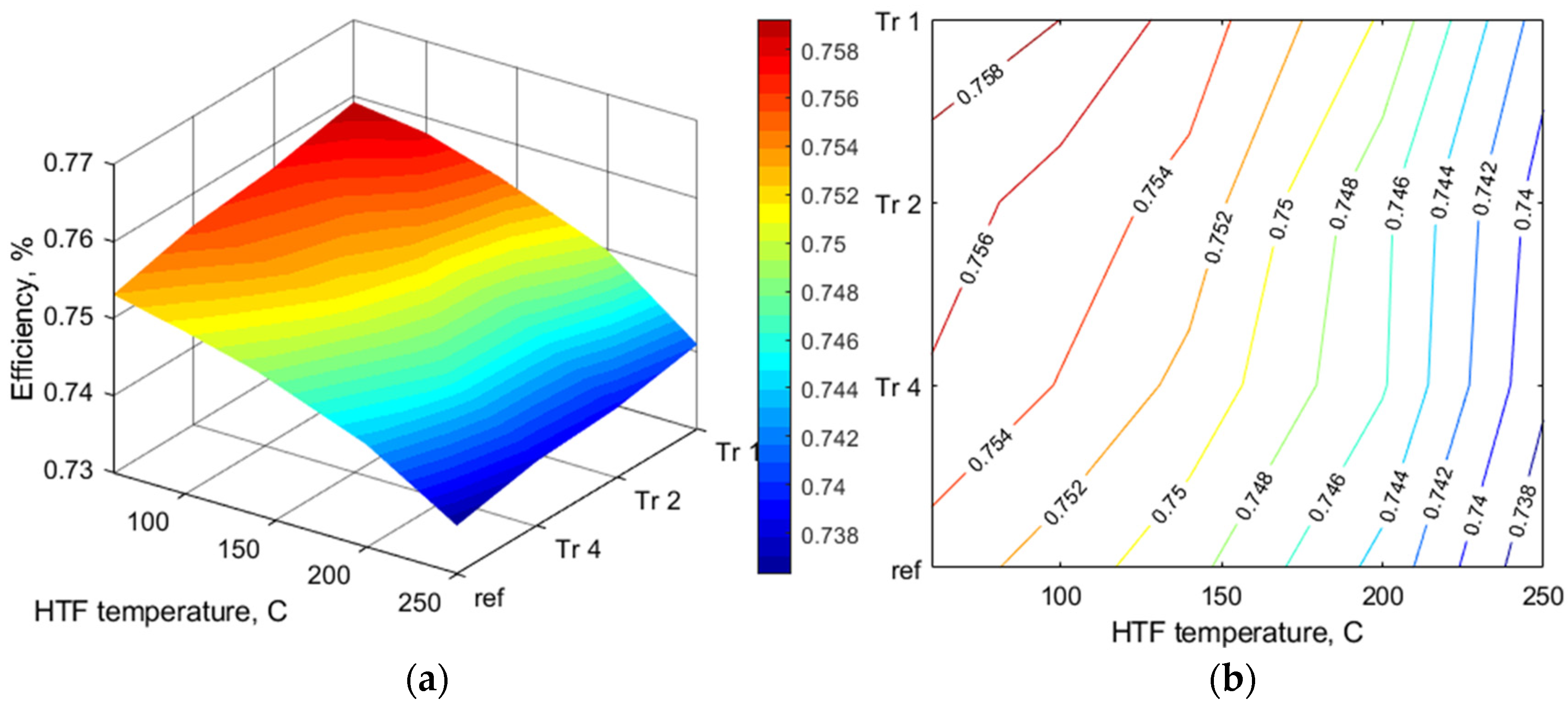
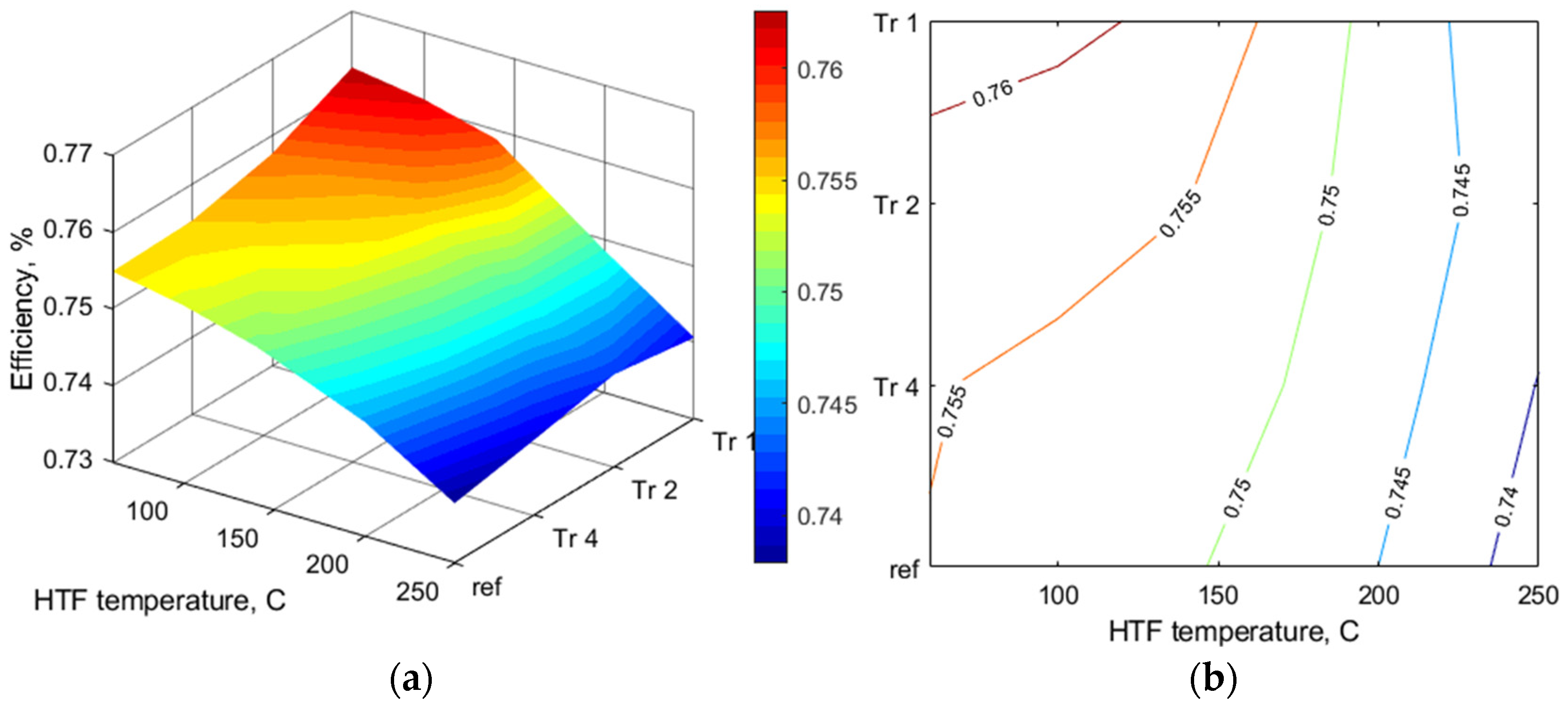
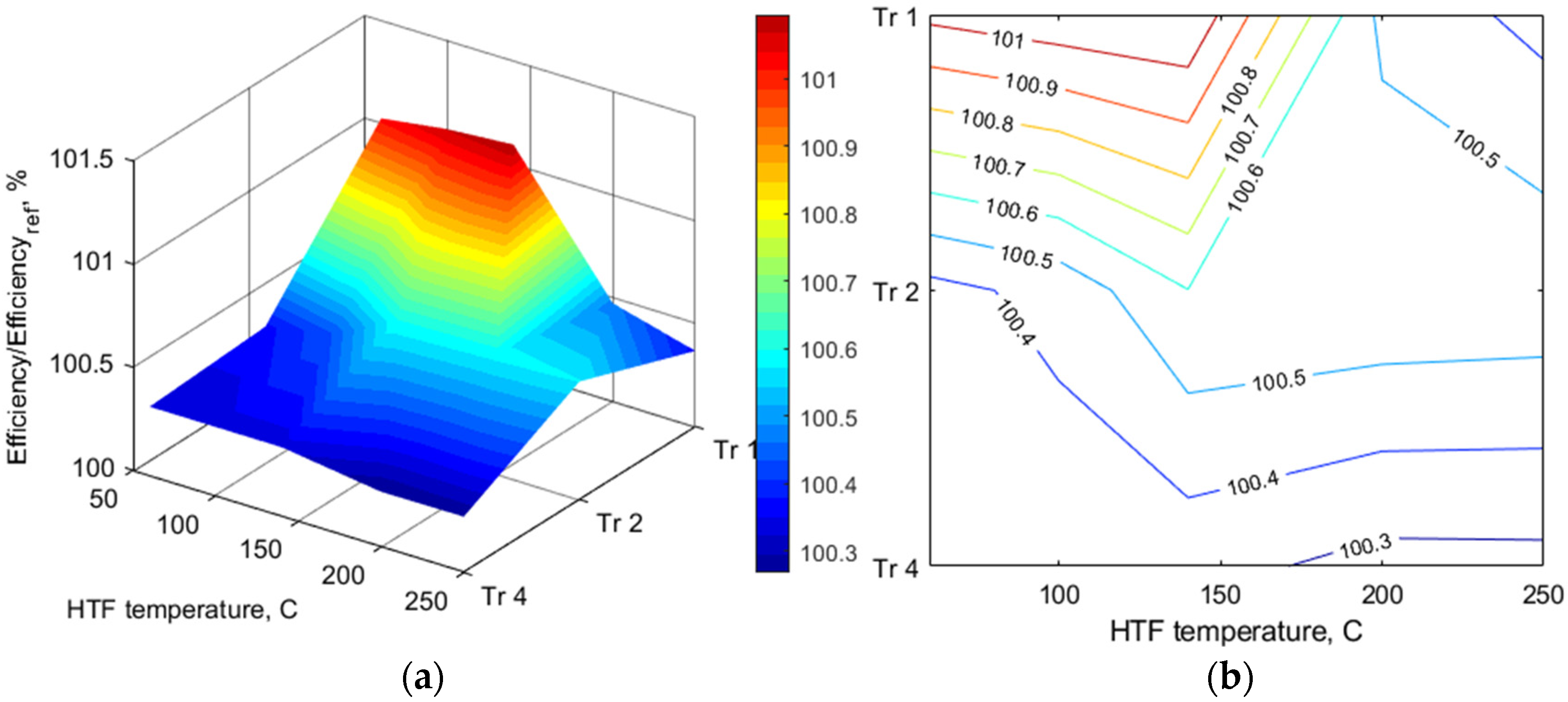
- In terms of the parameters analysed, twisted tape inserts have a beneficial effect on the operation of PTC installations through a reduction of the temperature gradient in the tubular absorbers; the implementation of a swirl flow which minimises the boundary layer; and an increase in the velocity of the fluid which, through the nature of the flow, intensifies the collection of heat by the heat transfer fluid. The maximum PTC efficiency increment was reported as 1 percentage point.
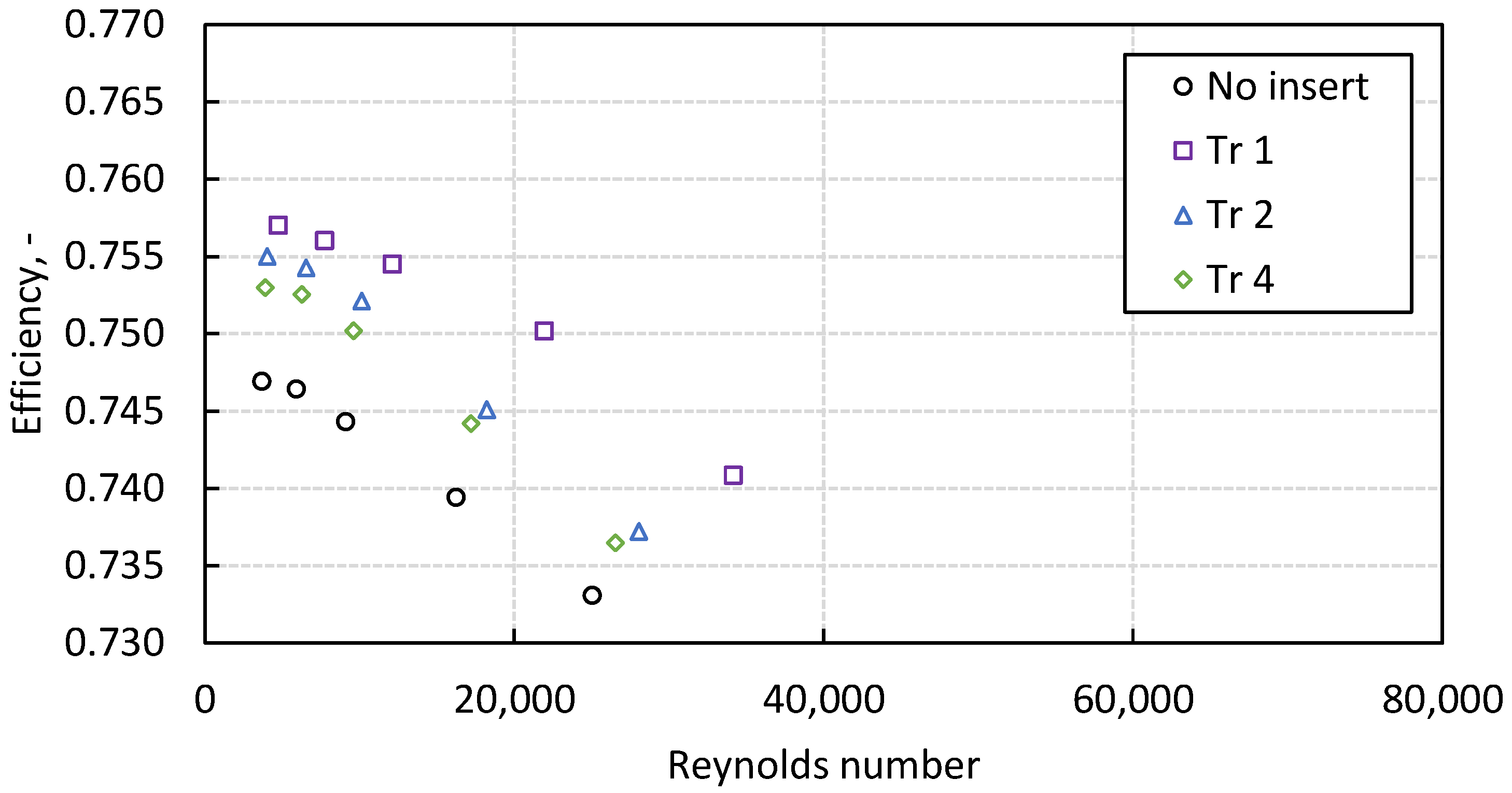
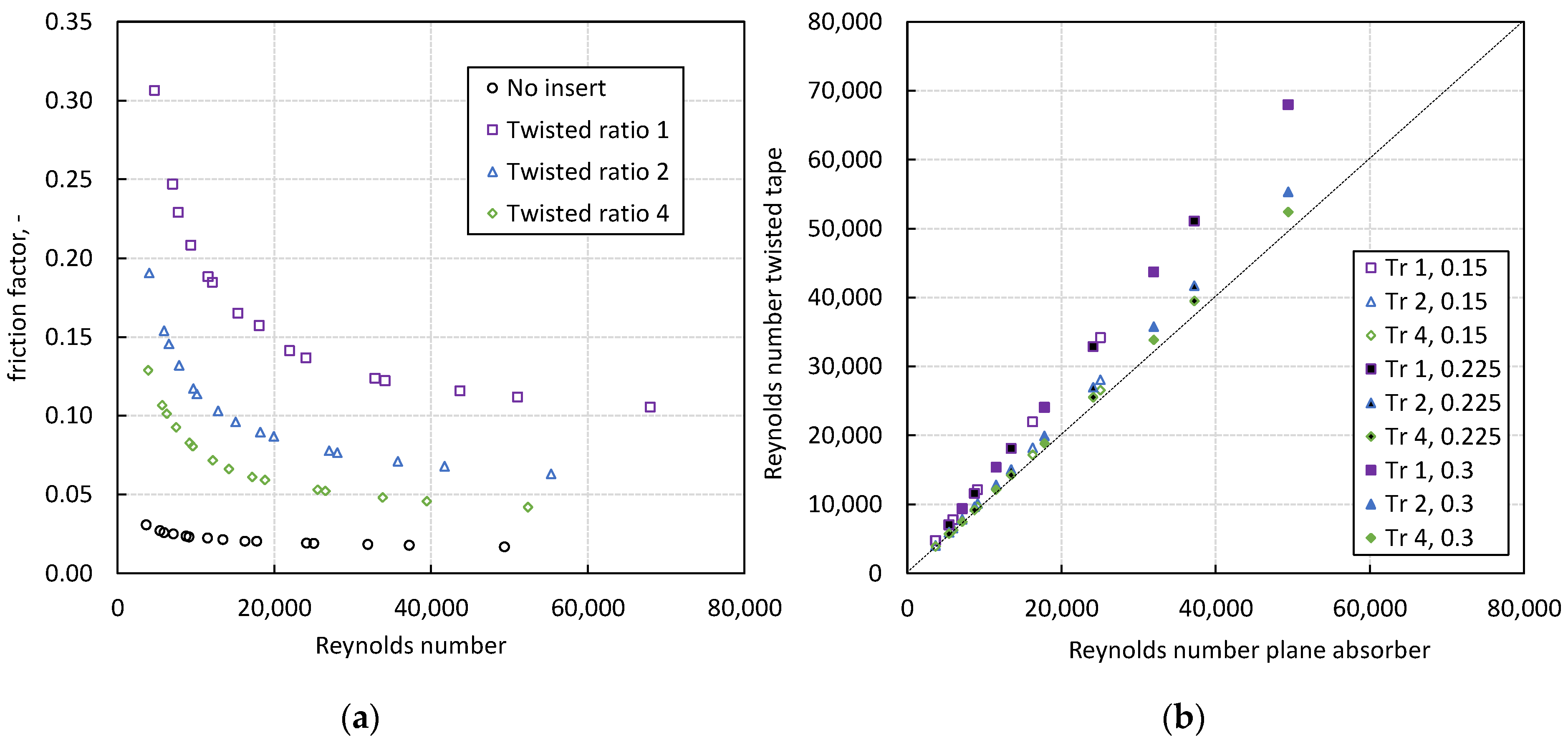
- The densest insert analysed, with twisted ratio 1, provides the highest efficiency gain. It should be noted, however, that for the upper range of the tests carried out, i.e., mass flow of 0.3 kg/s and fluid temperatures above 190 °C, by significantly increasing the pressure drop, the increased demand for the solar plant’s own needs results in a reduction in efficiency relative to insert with twisted ratio 2.
- In the search for the optimum solution, where system efficiency is maximised, it was determined that the best solution was to use an insert with a twisted ratio of 1 for the entire range except for the section where, for a mass flow of 0.3 kg/s, the fluid temperature reaches 190 °C. From this point, an insert with a twisted ratio of 2 should be used.
- The results obtained are valid for Therminol VP-1 heat transfer fluid, the geometry of a parabolic trough collector and flow parameters presented in this study.
- It is reasonable to assume that, for higher flow parameters, other inserts may prove to be optimal, so it will be necessary to extend the analyses with further assumptions to determine these parameters.
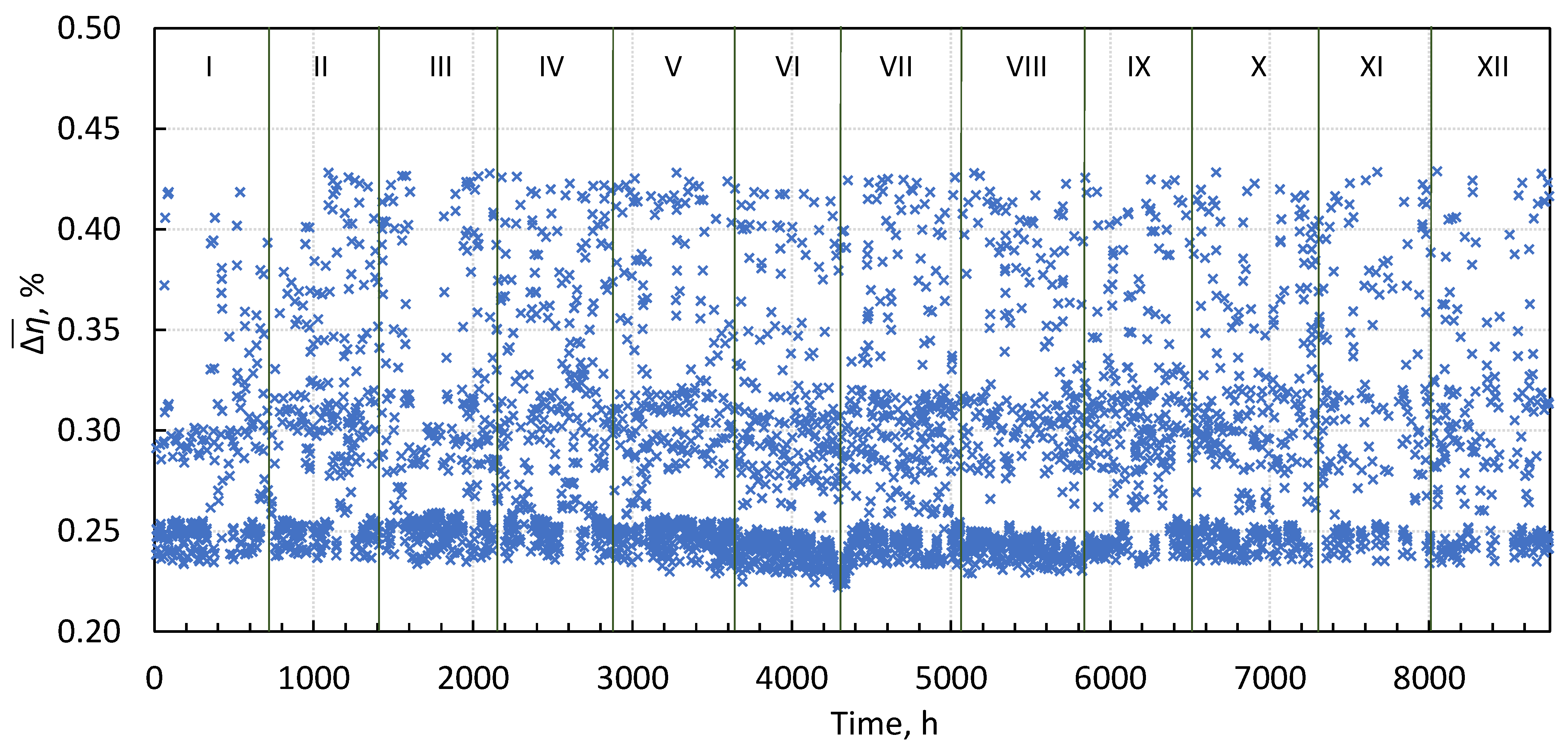
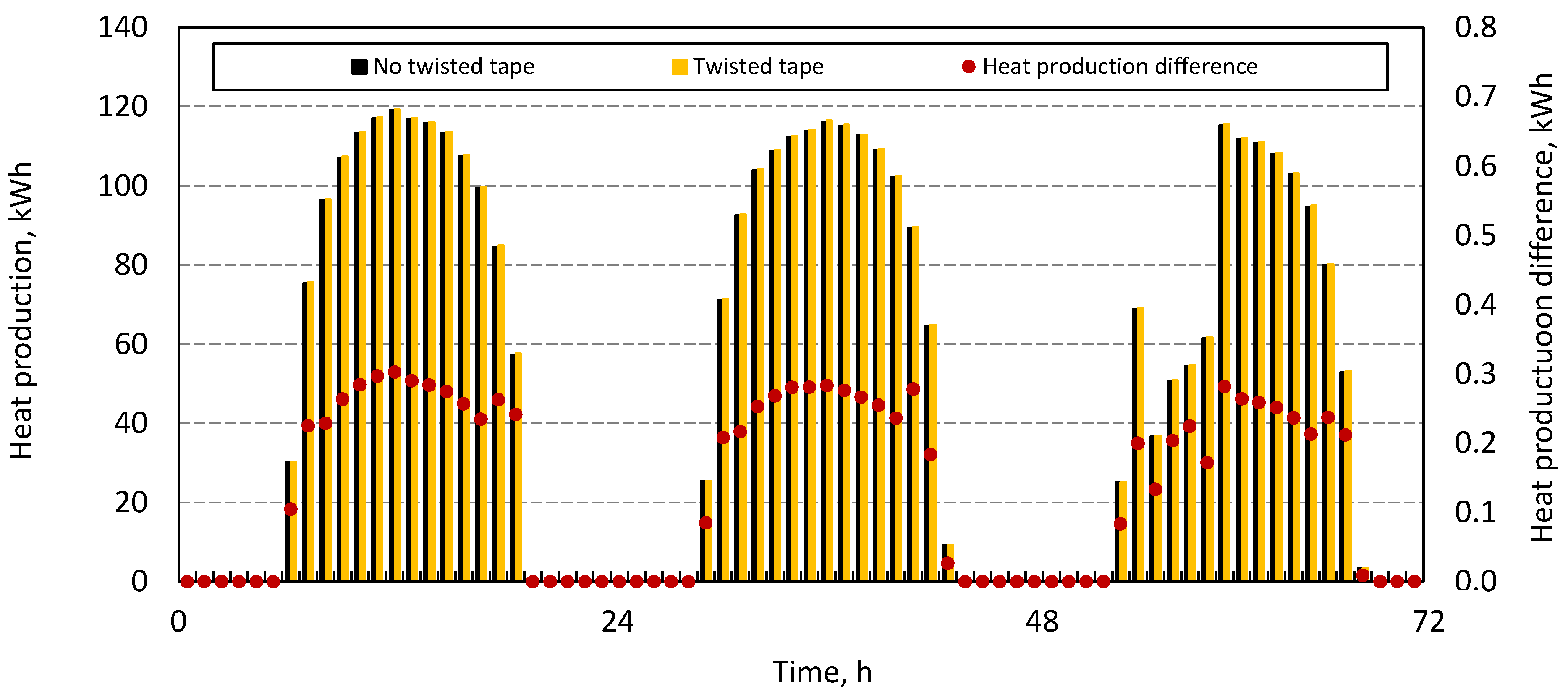
- The long-term analysis showed that by using twisted tapes in the proposed configuration, heat production increases by 0.27% which was 797.49 kWh more during 12 months of operation.
- An increase in the total pressure drop in the absorber loop will affect the need for a higher capacity pump use. Despite considering the increased pump power requirement, it is important to note the higher device price and the investment cost per twisted tape.
- The recommendation that can be drawn from these studies is, in particular, the need to consider the power gain of the pump. Additionally, based on a literature search, the authors suggest comparing the results of twisted tape applications for the same flow parameters and for the same fluid and geometry. These parameters significantly affect the obtained results. For long-term analyses, it is appropriate to consider operating parameters with a time step of one hour or less. Long-term analysis for longer periods of time, e.g., whole days, may yield uncertain results due to varying solar, temperature and wind parameters.
Author Contributions
Funding
Data Availability Statement
Acknowledgments
Conflicts of Interest
Nomenclature
| A | area, m2 |
| ALD | atomic layer deposition |
| BRDF | Bidirectional Reflectance Distribution Function |
| cp | specific heat, J/(kg·K) |
| CFD | computational fluid dynamics |
| CSP | concentrating solar power |
| CVD | chemical vapour deposition |
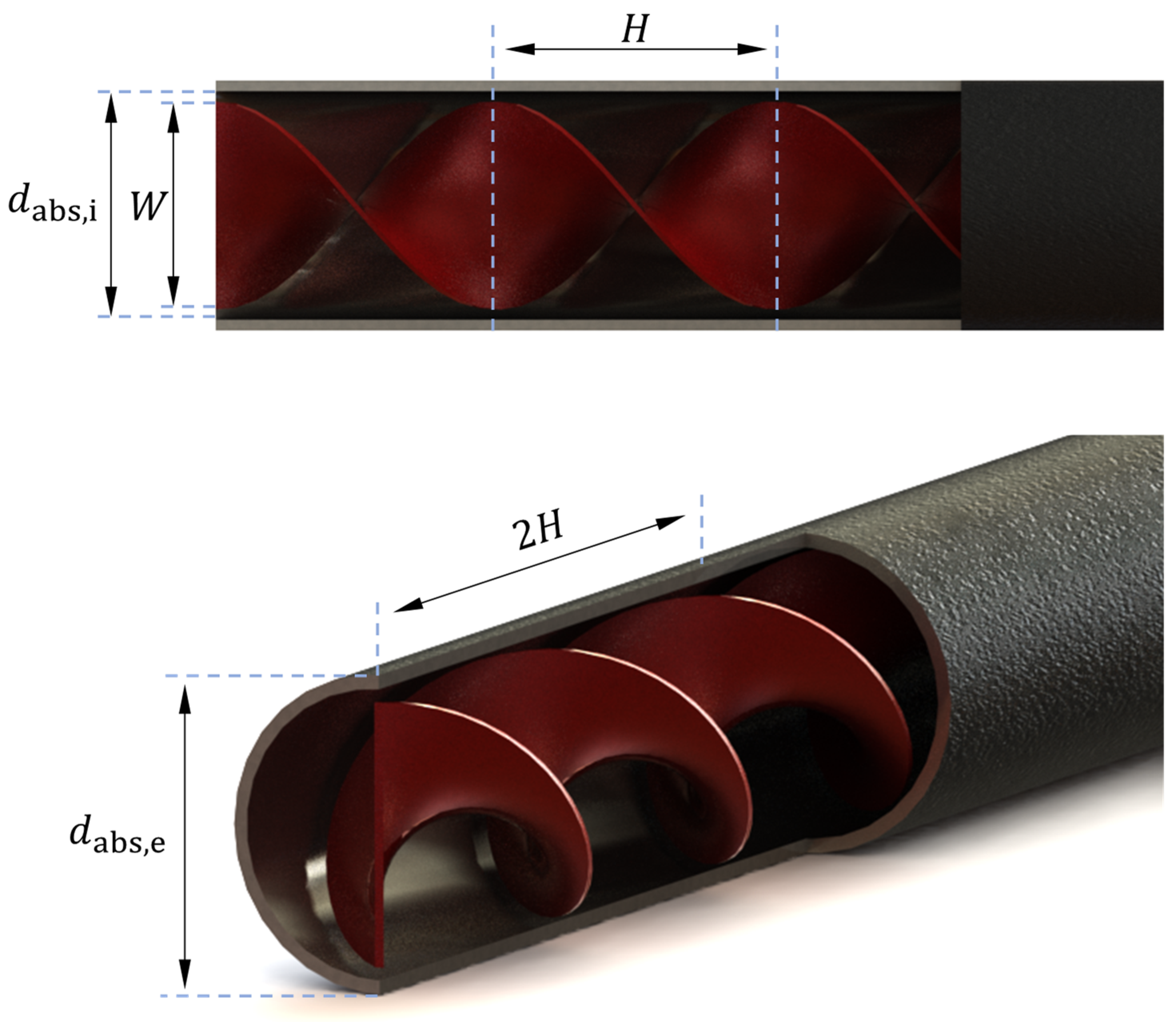
| d | diameter, m |
| dEi | incident power flux density per unit area, W/m2 |
| dLr | unit of radiant energy per unit of solid angle, W/m2sr |
| DNI | direct normal irradiance, W/m2 |
| f | friction factor, - |
| fl | focal length, m |
| G | irradiance, W/m2 |
| GUM | guide uncertainty measurement |
| H | twisted length, m |
| h | heat transfer coefficient, W/m2K |
| HMI | metal halide |
| IAM | incidence angle modifier, - |
| k | thermal conductivity, W/(m·K) |
| k | kinetic energy |
| L | length, m |
| mass flow, kg/s | |
| MCRT | Monte Carlo Ray Tracing |
| Nu | Nusselt number, - |
| P | pressure, Pa |
| PEC | performance evaluation criterion, - |
| PETG | polyethylene terephthalate glycol |
| Pr | Prandtl number, - |
| PTC | parabolic trough collectors |
| PVD | physical vapour deposition |
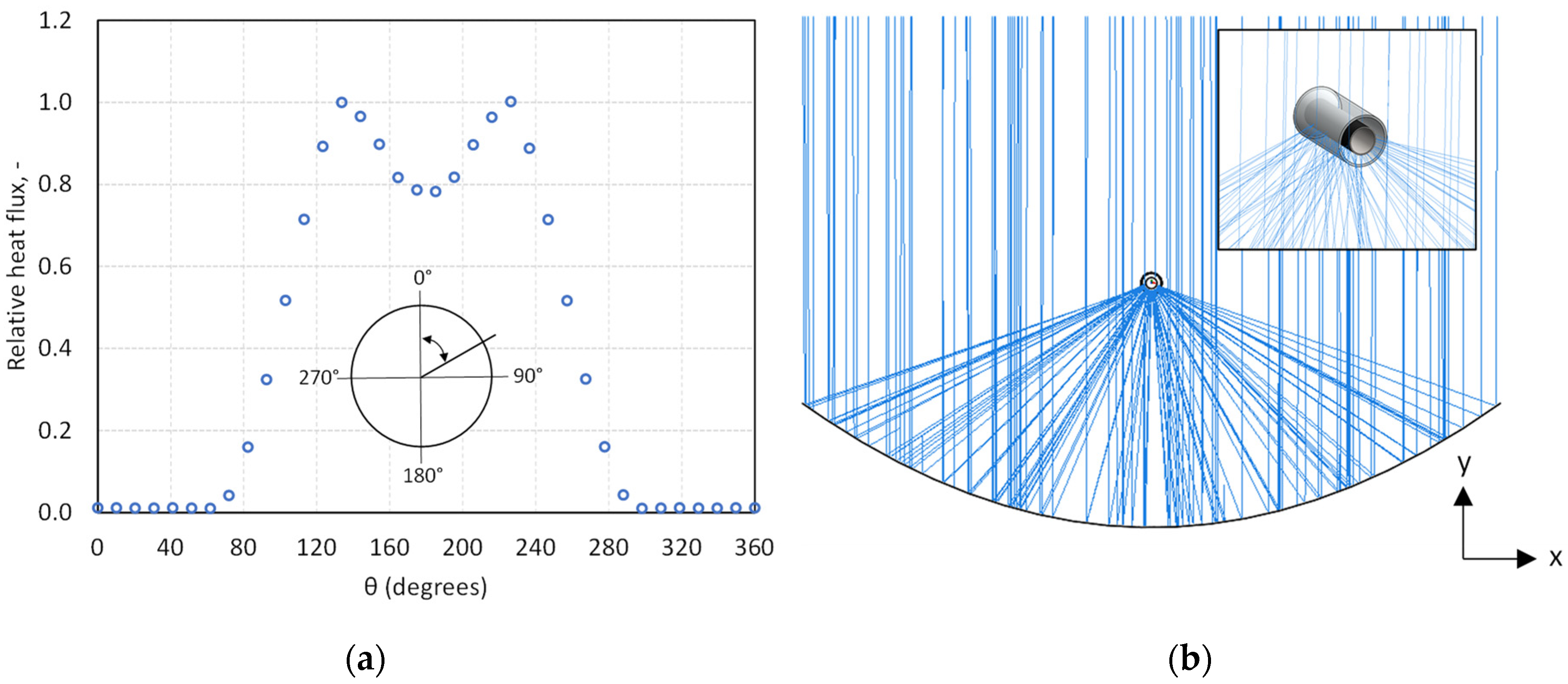
| Q | heat flux, W |
| Re | Reynolds number, - |
| T | temperature, °C |
| t | time, s |
| th | thickness, m |
| Tr | twisted ratio, - |
| u | fluid velocity, m/s |
| UDF | User Defined Function |
| W | width, m |
| Wp | required pumping power, W |
| Wr | width ratio, - |
| x | x position |
| y | y position |
| Subscripts | |
| abs | absorber |
| ap | aperture |
| c | glass envelope |
| csp | concentrated solar energy |
| e | external |
| el | reference electricity production |
| i | internal |
| in | inlet |
| loss | energy losses |
| opt | optical |
| out | outlet |
| ref | reference |
| s | solar |
| sp | non-concentrated solar energy |
| tape | twisted tape |
| u | useful |
| Greek symbols | |
| α | absorptivity, - |
| ε | emissivity, - |
| η | efficiency, - |
| θ | incidence angle, ° |
| λ | conductivity, W/(m·K) |
| ρ | density, kg/m3 |
| μ | viscosity, Pa·s |
| μe | effective viscosity, Pa·s |
| μt | turbulent viscosity, Pa·s |
| τ | transmittance, - |
| ω | specific rate of dissipation |
References
- Weiss, W.; Spörk-Dür, M. Solar Heat Worldwide 2021. Institute of Sustainable Technologies AEE, Austria. Available online: https://www.iea-shc.org/solar-heat-worldwide-2021 (accessed on 3 June 2022).
- POWER TROUGH 110®—Inventive Power. Available online: https://inventivepower.com.mx/english/power-trough-110/ (accessed on 1 May 2022).
- POWER TROUGH 250®—Inventive Power. Available online: https://inventivepower.com.mx/english/power-trough-250/ (accessed on 1 May 2022).
- Solar Heat for Industry—Solar Payback. Available online: https://www.solar-payback.com/wp-content/uploads/2017/07/Solar-Heat-for-Industry-Solar-Payback-April-2017.pdf (accessed on 3 June 2022).
- International Renewable Energy Agency Innovation Outlook: Thermal Energy Storage. Available online: www.irena.org (accessed on 3 June 2022).
- Kumar, L.; Hasanuzzaman, M.; Rahim, N.A. Global Advancement of Solar Thermal Energy Technologies for Industrial Process Heat and Its Future Prospects: A Review. Energy Convers. Manag. 2019, 195, 885–908. [Google Scholar] [CrossRef] [Scilit]
- Rackam Solar Thermal Solutions for Industrial Process Heat. Available online: https://rackam.com/en/ (accessed on 1 June 2022).
- Häberle, A.; Krüger, D. Concentrating Solar Technologies for Industrial Process Heat. In Concentrating Solar Power Technology: Principles, Developments, and Applications; Woodhead Publishing Series in Energy; Lovegrove, K., Stein, W., Eds.; Woodhead Publishing: Soston, UK, 2020; pp. 659–675. ISBN 9780128199701. [Google Scholar]
- Reflective Surfaces—Solar—Industries—Alanod. Available online: https://alanod.com/en/industries/solar/reflective-surfaces (accessed on 2 June 2022).
- Minder, S. Example of Concentrated Solar Systems (PTC) in the Dairy Industry in Switzerland. Available online: www.nep-solar.com (accessed on 2 June 2022).
- IMPLEMENTED PROJECTS—Inventive Power. Available online: https://inventivepower.com.mx/english/implemented-projects/ (accessed on 2 June 2022).
- World Map of Solar Thermal Plants|Solar Heat for Industrial Processes (SHIP) Plants Database. Available online: http://ship-plants.info/solar-thermal-plants-map?collector_type=5 (accessed on 1 June 2022).
- Renewable Power Generation Costs in 2020. Available online: https://www.irena.org/publications/2021/Jun/Renewable-Power-Costs-in-2020 (accessed on 3 June 2022).
- Gharat, P.V.; Bhalekar, S.S.; Dalvi, V.H.; Panse, S.V.; Deshmukh, S.P.; Joshi, J.B. Chronological Development of Innovations in Reflector Systems of Parabolic Trough Solar Collector (PTC)—A Review. Renew. Sustain. Energy Rev. 2021, 145, 111002. [Google Scholar] [CrossRef] [Scilit]
- Valentín, D.; Valero, C.; Egusquiza, M.; Presas, A. Failure Investigation of a Solar Tracker Due to Wind-Induced Torsional Galloping. Eng. Fail. Anal. 2022, 135, 106137. [Google Scholar] [CrossRef] [Scilit]
- Stanek, B.; Węcel, D.; Bartela, Ł.; Rulik, S. Solar Tracker Error Impact on Linear Absorbers Efficiency in Parabolic Trough Collector—Optical and Thermodynamic Study. Renew. Energy 2022, 196, 598–609. [Google Scholar] [CrossRef] [Scilit]
- Rodriguez-Sanchez, D.; Rosengarten, G. Improving the Concentration Ratio of Parabolic Troughs Using a Second-Stage Flat Mirror. Appl. Energy 2015, 159, 620–632. [Google Scholar] [CrossRef] [Scilit]
- T160 Solar Collector—Designed to Run Industrial Processes—Absolicon. Available online: https://www.absolicon.com/applying-absolicon/ (accessed on 2 June 2022).
- Noč, L.; Jerman, I. Review of the Spectrally Selective (CSP) Absorber Coatings, Suitable for Use in SHIP. Sol. Energy Mater. Sol. Cells 2022, 238, 060040. [Google Scholar] [CrossRef] [Scilit]
- Zhao, K.; Jin, H.; Gai, Z.; Hong, H. A Thermal Efficiency-Enhancing Strategy of Parabolic Trough Collector Systems by Cascadingly Applying Multiple Solar Selective-Absorbing Coatings. Appl. Energy 2022, 309, 118508. [Google Scholar] [CrossRef] [Scilit]
- Stanek, B.; Wang, W.; Bartela, Ł. A Potential Solution in Reducing the Parabolic Trough Based Solar Industrial Process Heat System Cost by Partially Replacing Absorbers Coatings with Non-Selective Ones in Initial Loop Sections. Appl. Energy 2023, 331, 120472. [Google Scholar] [CrossRef] [Scilit]
- Allam, M.; Tawfik, M.; Bekheit, M.; El-Negiry, E. Heat Transfer Enhancement in Parabolic Trough Receivers Using Inserts: A Review. Sustain. Energy Technol. Assess. 2021, 48, 101671. [Google Scholar] [CrossRef] [Scilit]
- Zaboli, M.; Ajarostaghi, S.S.M.; Saedodin, S.; Pour, M.S. Thermal Performance Enhancement Using Absorber Tube with Inner Helical Axial Fins in a Parabolic Trough Solar Collector. Appl. Sci. 2021, 11, 7423. [Google Scholar] [CrossRef] [Scilit]
- Bellos, E.; Tzivanidis, C.; Tsimpoukis, D. Thermal Enhancement of Parabolic Trough Collector with Internally Finned Absorbers. Sol. Energy 2017, 157, 514–531. [Google Scholar] [CrossRef] [Scilit]
- Bellos, E.; Tzivanidis, C. Enhancing the Performance of Evacuated and Non-Evacuated Parabolic Trough Collectors Using Twisted Tape Inserts, Perforated Plate Inserts and Internally Finned Absorber. Energies 2018, 11, 1129. [Google Scholar] [CrossRef] [Scilit]
- Jaramillo, O.A.; Borunda, M.; Velazquez-Lucho, K.M.; Robles, M. Parabolic Trough Solar Collector for Low Enthalpy Processes: An Analysis of the Efficiency Enhancement by Using Twisted Tape Inserts. Renew. Energy 2016, 93, 125–141. [Google Scholar] [CrossRef] [Scilit]
- Varun; Garg, M.O.; Nautiyal, H.; Khurana, S.; Shukla, M.K. Heat Transfer Augmentation Using Twisted Tape Inserts: A Review. Renew. Sustain. Energy Rev. 2016, 63, 193–225. [Google Scholar] [CrossRef] [Scilit]
- Seemawute, P.; Eiamsaard, S. Thermohydraulics of Turbulent Flow through a Round Tube by a Peripherally-Cut Twisted Tape with an Alternate Axis. Int. Commun. Heat. Mass. Transf. 2010, 37, 652–659. [Google Scholar] [CrossRef] [Scilit]
- Promvonge, P. Thermal Augmentation in Circular Tube with Twisted Tape and Wire Coil Turbulators. Energy Convers. Manag. 2008, 49, 2949–2955. [Google Scholar] [CrossRef] [Scilit]
- Eiamsa-ard, S.; Thianpong, C.; Eiamsa-ard, P.; Promvonge, P. Thermal Characteristics in a Heat Exchanger Tube Fitted with Dual Twisted Tape Elements in Tandem. Int. Commun. Heat. Mass. Transf. 2010, 37, 39–46. [Google Scholar] [CrossRef] [Scilit]
- Bhuiya, M.M.K.; Chowdhury, M.S.U.; Saha, M.; Islam, M.T. Heat Transfer and Friction Factor Characteristics in Turbulent Flow through a Tube Fitted with Perforated Twisted Tape Inserts. Int. Commun. Heat. Mass. Transf. 2013, 46, 49–57. [Google Scholar] [CrossRef] [Scilit]
- Alnaqi, A.A.; Alsarraf, J.; Al-Rashed, A.A.A.A. Hydrothermal Effects of Using Two Twisted Tape Inserts in a Parabolic Trough Solar Collector Filled with MgO-MWCNT/Thermal Oil Hybrid Nanofluid. Sustain. Energy Technol. Assess. 2021, 47, 101331. [Google Scholar] [CrossRef] [Scilit]
- Veera Kumar, A.; Arjunan, T.V.; Seenivasan, D.; Venkatramanan, R.; Vijayan, S.; Matheswaran, M.M. Influence of Twisted Tape Inserts on Energy and Exergy Performance of an Evacuated Tube-Based Solar Air Collector. Solar Energy 2021, 225, 892–904. [Google Scholar] [CrossRef] [Scilit]
- Hasanpour, A.; Farhadi, M.; Sedighi, K. A Review Study on Twisted Tape Inserts on Turbulent Flow Heat Exchangers: The Overall Enhancement Ratio Criteria. Int. Commun. Heat. Mass. Transf. 2014, 55, 53–62. [Google Scholar] [CrossRef] [Scilit]
- Mwesigye, A.; Bello-Ochende, T.; Meyer, J.P. Heat Transfer and Entropy Generation in a Parabolic Trough Receiver with Wall-Detached Twisted Tape Inserts. Int. J. Therm. Sci. 2016, 99, 238–257. [Google Scholar] [CrossRef] [Scilit]
- Ibarra, M.; Rovira, A.; Alarcón-Padilla, D.C.; Zaragoza, G.; Blanco, J. Performance of a 5 KWe Solar-Only Organic Rankine Unit Coupled to a Reverse Osmosis Plant. Energy Procedia 2014, 49, 2251–2260. [Google Scholar] [CrossRef] [Scilit]
- Zhao, S.S.; Gao, X.H.; Qiu, X.L.; Yu, D.M.; Tian, G.K. A Novel TiC-TiN Based Spectrally Selective Absorbing Coating: Structure, Optical Properties and Thermal Stability. Infrared Phys. Technol. 2020, 110, 103471. [Google Scholar] [CrossRef] [Scilit]
- Therminol VP-1 Heat Transfer Fluid|Therminol|Eastman. Available online: https://www.therminol.com/product/71093459 (accessed on 1 February 2022).
- Zima, W.; Cebula, A.; Cisek, P. Mathematical Model of a Sun-Tracked Parabolic Trough Collector and Its Verification. Energies 2020, 13, 4168. [Google Scholar] [CrossRef] [Scilit]
- Yilmaz, I.H.; Söylemez, M.S. Thermo-Mathematical Modeling of Parabolic Trough Collector. Energy Convers. Manag. 2014, 88, 768–784. [Google Scholar] [CrossRef] [Scilit]
- Kalogirou, S.A. A Detailed Thermal Model of a Parabolic Trough Collector Receiver. Energy 2012, 48, 298–306. [Google Scholar] [CrossRef] [Scilit]
- Pitz-Paal, R. Solar Energy—Concentrating Solar Power. In Future Energy: Improved, Sustainable and Clean Options for Our Planet; Elsevier Inc.: Amsterdam, The Netherlands, 2013; pp. 405–431. ISBN 9780080994246. [Google Scholar]
- Kalogirou, S.A. Solar Energy Collectors. In Solar Energy Engineering; Elsevier: Amsterdam, The Netherlands, 2014; pp. 125–220. [Google Scholar]
- Wirz, M.; Petit, J.; Haselbacher, A.; Steinfeld, A. Potential Improvements in the Optical and Thermal Efficiencies of Parabolic Trough Concentrators. Solar Energy 2014, 107, 398–414. [Google Scholar] [CrossRef] [Scilit]
- Çengel, Y.A.; Ghajar, A.J. Heat and Mass Transfer: Fundamentals & Applications, 4th ed.; McGraw-Hill: New York, NY, USA, 2011. [Google Scholar]
- Ammar, S.M.; Park, C.W. Validation of the Gnielinski Correlation for Evaluation of Heat Transfer Coefficient of Enhanced Tubes by Non-Linear Regression Model: An Experimental Study of Absorption Refrigeration System. Int. Commun. Heat. Mass. Transf. 2020, 118, 104819. [Google Scholar] [CrossRef] [Scilit]
- Manglik, R. Heat Transfer Enhancement. In Heat Transfer Handbook; Bejan, A., Kraus, A., Eds.; John Wiley & Sons: New York, NJ, USA, 2003; pp. 1029–1130. [Google Scholar]
- ANSYS Fluent 19.2 User’s Guide; ANSYS, Inc.: Canonsburg, PA, USA, 2013.
- Mor-Yossef, Y. A Stable, Positivity-Preserving Scheme for Cross-Diffusion Source Term in RANS Turbulence Models: Application to k-ω Turbulence Models. Comput. Fluids 2019, 191, 104234. [Google Scholar] [CrossRef] [Scilit]
- Niu, Y.; Zhang, C.; Xu, G. A Modified Anisotropic K-ω Model for Predicting Flow and Heat Transfer in a Rotating Channel. Int. J. Heat. Mass. Transf. 2018, 123, 1–15. [Google Scholar] [CrossRef] [Scilit]
- Smołka, J. User-Defined Functions Programming in Ansys Fluent. In Undamentals of Numerical Modelling of Thermal Processes in Electric Devices and Machines; Silesian University of Technology, Institute of Thermal Technology: Gliwice, Poland, 2019. [Google Scholar]
- Cabello, R.; Plesu Popescu, A.E.; Bonet-Ruiz, J.; Curcó Cantarell, D.; Llorens, J. Heat Transfer in Pipes with Twisted Tapes: CFD Simulations and Validation. Comput. Chem. Eng. 2022, 166, 107961. [Google Scholar] [CrossRef] [Scilit]
- Menter, F.R. Two-Equation Eddy-Viscosity Turbulence Models for Engineering Applications. AIAA J. 1994, 32, 1598–1605. [Google Scholar] [CrossRef] [Scilit]
- Rahman, M.M.; Vuorinen, V.; Taghinia, J.; Larmi, M. Wall-Distance-Free Formulation for SST k-ω Model. Eur. J. Mech.—B/Fluids 2019, 75, 71–82. [Google Scholar] [CrossRef] [Scilit]
- Menter, F.R.; Kuntz, M.; Langtry, R. Ten years of industrial experience with the SST turbulence model. In Turbulence, Heat and Mass Transfer 4; Begell House: New York, NY, USA, 2003; pp. 625–632. [Google Scholar]
- Moshfeghi, M.; Song, Y.J.; Xie, Y.H. Effects of Near-Wall Grid Spacing on SST-K-ω Model Using NREL Phase VI Horizontal Axis Wind Turbine. J. Wind. Eng. Ind. Aerodyn. 2012, 107–108, 94–105. [Google Scholar] [CrossRef] [Scilit]
- APEX. Breault Research Organization, Inc. 2019. Available online: http://www.breault.com/ (accessed on 3 February 2022).
- Breault Research Organization. Correlation of ASAPTM Simulation Results with Physical Components; Breault Research Organization: Tuscon, AZ, USA, 2006. [Google Scholar]
- Zhang, C.; Xu, G.; Quan, Y.; Li, H.; Song, G. Optical Sensitivity Analysis of Geometrical Deformation on the Parabolic Trough Solar Collector with Monte Carlo Ray-Trace Method. Appl. Therm. Eng. 2016, 109, 130–137. [Google Scholar] [CrossRef] [Scilit]
- Cheng, Z.D.; He, Y.L.; Cui, F.Q.; Du, B.C.; Zheng, Z.J.; Xu, Y. Comparative and Sensitive Analysis for Parabolic Trough Solar Collectors with a Detailed Monte Carlo Ray-Tracing Optical Model. Appl. Energy 2014, 115, 559–572. [Google Scholar] [CrossRef] [Scilit]
- Bartela, Ł.; Stanek, B.; Węcel, D.; Skorek-Osikowska, A. A Solar Simulator Numerical Modeling for Heat Absorption Phenomenon Research in a Parabolic Trough Collector. Int. J. Energy Res. 2021, 46, 10074–10084. [Google Scholar] [CrossRef] [Scilit]
- Kong, R.; Ambrose, M.; Spanier, J. Efficient, Automated Monte Carlo Methods for Radiation Transport. J. Comput. Phys. 2008, 227, 9463–9476. [Google Scholar] [CrossRef] [Scilit]
- Wang, W.; Aichmayer, L.; Garrido, J.; Laumert, B. Development of a Fresnel Lens Based High-Flux Solar Simulator. Solar Energy 2017, 144, 436–444. [Google Scholar] [CrossRef] [Scilit]
- Pompea, S.M.; McCall, S.H. OPTICAL COATINGS|Optical Black Surfaces. In Encyclopedia of Modern Optics; Elsevier: Amsterdam, The Netherlands, 2005; pp. 349–360. [Google Scholar]
- Martínez-Manuel, L.; Wang, W.; Laumert, B.; Peña-Cruz, M.I. Numerical Analysis on the Optical Geometrical Optimization for an Axial Type Impinging Solar Receiver. Energy 2021, 216, 119293. [Google Scholar] [CrossRef] [Scilit]
- Stanek, B.; Bartela, Ł.; Węcel, D.; Rulik, S. An Experimental Study on Parabolic Trough Collector in Simulated Conditions by Metal-Halide Solar Radiation Simulator. Arch. Thermodyn. 2022, 43, 47–61. [Google Scholar] [CrossRef] [Scilit]
- Stanek, B.; Bartela, Ł. Numerical and Experimental Study on 10 KWe Metal-Halide Solar Simulator for Parabolic-Trough Collector Testing, ECOS 2021 Conference Proceedings. In Proceedings of the 34th International Conference on Efficiency, Cost, Optimization, Simulation and Environmental Impact of Energy Systems (ECOS21), Taormina, Italy, 28 June–2 July 2021; pp. 1198–1209. [Google Scholar]
- Ho, C.K.; Mahoney, A.R.; Ambrosini, A.; Bencomo, M.; Hall, A.; Lambert, T.N. Characterization of Pyromark 2500 Paint for High-Temperature Solar Receivers. J. Sol. Energy Eng. 2014, 136, 014502. [Google Scholar] [CrossRef] [Scilit]
- JCGM Evaluation of Measurement Data-Guide to the Expression of Uncertainty in Measurement Évaluation Des Données de Mesure-Guide Pour L’expression de L’incertitude de Mesure. 2008. Available online: https://www.bipm.org/documents/20126/2071204/JCGM_100_2008_F.pdf/53384399-1e6d-b598-dd17-2831a6b5b812 (accessed on 6 March 2023).
- Sengupta, M.; Xie, Y.; Lopez, A.; Habte, A.; Maclaurin, G.; Shelby, J. The National Solar Radiation Data Base (NSRDB). Renew. Sustain. Energy Rev. 2018, 89, 51–60. [Google Scholar] [CrossRef] [Scilit]





| Parameter | Symbol | Value | Unit |
|---|---|---|---|
| Focal length | fl | 647 | mm |
| Aperture width | Wap | 1800 | mm |
| Absorber length | Labs | 1000 | mm |
| Absorber external diameter | dabs,e | 33.7 | mm |
| Absorber internal diameter | dabs,i | 30.7 | mm |
| Absorber wall thickness | thabs | 1.5 | mm |
| Absorber thermal conductivity | λabs | 15 | W/mK |
| Glass env. external diameter | dc,e | 56 | mm |
| Glass env. internal diameter | dc,i | 51 | mm |
| Glass env. wall thickness | thc | 2.5 | mm |
| Glass env. thermal conductivity | λc | 1.1 | W/mK |
| Transmittance of glass envelope | τc | 0.96 | - |
| Clean mirror reflectance | ηref | 0.9 | - |
| Dirt factor | ηdirt | 0.97 | - |
| Absorber absorptivity | αabs | 0.92 | - |
| Absorber emissivity | εabs | 0.11 | - |
| Parameter | Symbol | Correlation | Unit |
|---|---|---|---|
| Specific heat | cp | 2.7137·T + 761.88 | J/(kg·K) |
| Thermal conductivity | k | −1.36·10−4·T + 0.1773 | W/(m·K) |
| Dynamic viscosity | μ | 250,568,541·T−4.407 | Pa·s |
| Density | ρ | −0.856·T + 1316 | kg/m3 |
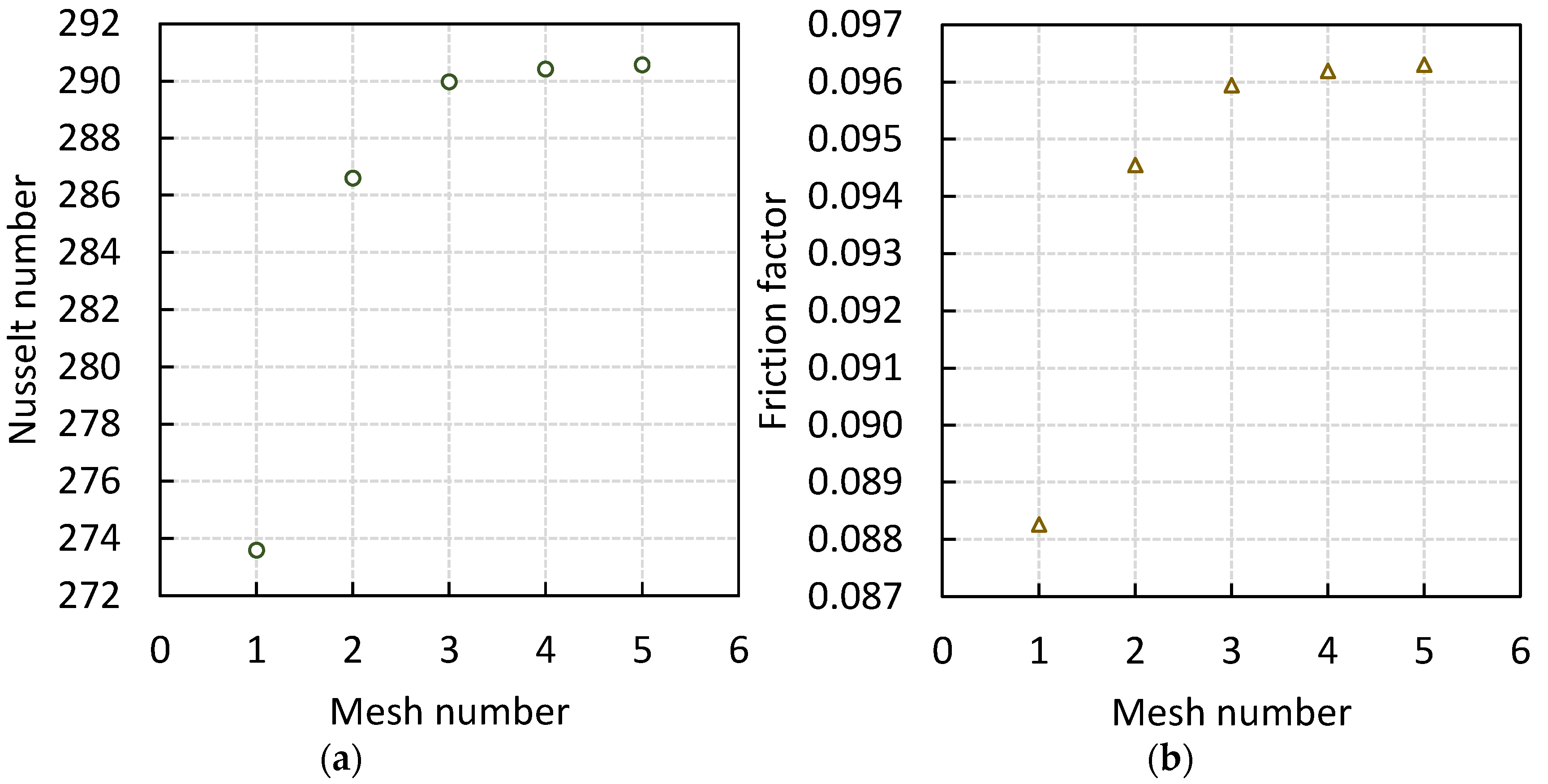
| No. | Number of Elements | Number of Nodes |
|---|---|---|
| 1 | 244,283 | 83,908 |
| 2 | 1,320,067 | 407,364 |
| 3 | 1,933,627 | 557,723 |
| 4 | 2,337,226 | 649,766 |
| 5 | 3,076,697 | 807,738 |
| Month | Amount of Solar Energy, kWh/m2/Month | Average Temperature, °C | Average Wind Speed, m/s |
|---|---|---|---|
| January | 154.17 | 8.77 | 2.06 |
| February | 174.13 | 11.47 | 1.92 |
| March | 213.03 | 14.25 | 2.01 |
| April | 173.57 | 15.30 | 2.49 |
| May | 281.52 | 22.46 | 2.24 |
| June | 294.85 | 24.44 | 2.46 |
| July | 252.75 | 27.99 | 2.36 |
| August | 272.55 | 28.17 | 1.97 |
| September | 193.01 | 25.32 | 1.96 |
| October | 179.61 | 20.11 | 1.89 |
| November | 101.79 | 13.19 | 2.63 |
| December | 113.21 | 11.91 | 2.51 |
| Month | Qref, kWh | Qtwisted tape, kWh | Qgain, kWh | |
|---|---|---|---|---|
| January | 18,856.45 | 18,906.29 | 49.84 | 0.26 |
| February | 21,269.14 | 21,328.36 | 59.21 | 0.28 |
| March | 26,043.76 | 26,114.81 | 71.05 | 0.27 |
| April | 21,187.09 | 21,246.75 | 59.67 | 0.28 |
| May | 34,334.51 | 34,427.21 | 92.71 | 0.27 |
| June | 36,093.89 | 36,188.16 | 94.27 | 0.26 |
| July | 30,320.91 | 30,403.87 | 82.96 | 0.27 |
| August | 32,821.85 | 32,909.64 | 87.79 | 0.27 |
| September | 23,526.48 | 23,591.56 | 65.08 | 0.28 |
| October | 21,943.78 | 22,004.65 | 60.87 | 0.28 |
| November | 12,418.88 | 12,454.33 | 35.45 | 0.29 |
| December | 13,756.19 | 13,794.78 | 38.59 | 0.28 |
| Summary | 292,572.92 | 293,370.41 | 797.49 | 0.27 |
Disclaimer/Publisher’s Note: The statements, opinions and data contained in all publications are solely those of the individual author(s) and contributor(s) and not of MDPI and/or the editor(s). MDPI and/or the editor(s) disclaim responsibility for any injury to people or property resulting from any ideas, methods, instructions or products referred to in the content. |
© 2023 by the authors. Licensee MDPI, Basel, Switzerland. This article is an open access article distributed under the terms and conditions of the Creative Commons Attribution (CC BY) license (https://creativecommons.org/licenses/by/4.0/).
Share and Cite
Stanek, B.; Ochmann, J.; Węcel, D.; Bartela, Ł. Study of Twisted Tape Inserts Segmental Application in Low-Concentrated Solar Parabolic Trough Collectors. Energies 2023, 16, 3716. https://doi.org/10.3390/en16093716
Stanek B, Ochmann J, Węcel D, Bartela Ł. Study of Twisted Tape Inserts Segmental Application in Low-Concentrated Solar Parabolic Trough Collectors. Energies. 2023; 16(9):3716. https://doi.org/10.3390/en16093716
Chicago/Turabian StyleStanek, Bartosz, Jakub Ochmann, Daniel Węcel, and Łukasz Bartela. 2023. "Study of Twisted Tape Inserts Segmental Application in Low-Concentrated Solar Parabolic Trough Collectors" Energies 16, no. 9: 3716. https://doi.org/10.3390/en16093716
APA StyleStanek, B., Ochmann, J., Węcel, D., & Bartela, Ł. (2023). Study of Twisted Tape Inserts Segmental Application in Low-Concentrated Solar Parabolic Trough Collectors. Energies, 16(9), 3716. https://doi.org/10.3390/en16093716