


3-D Inversion of Gravity Data of the Central and Eastern Gonghe Basin for Geothermal Exploration




Abstract
1. Introduction
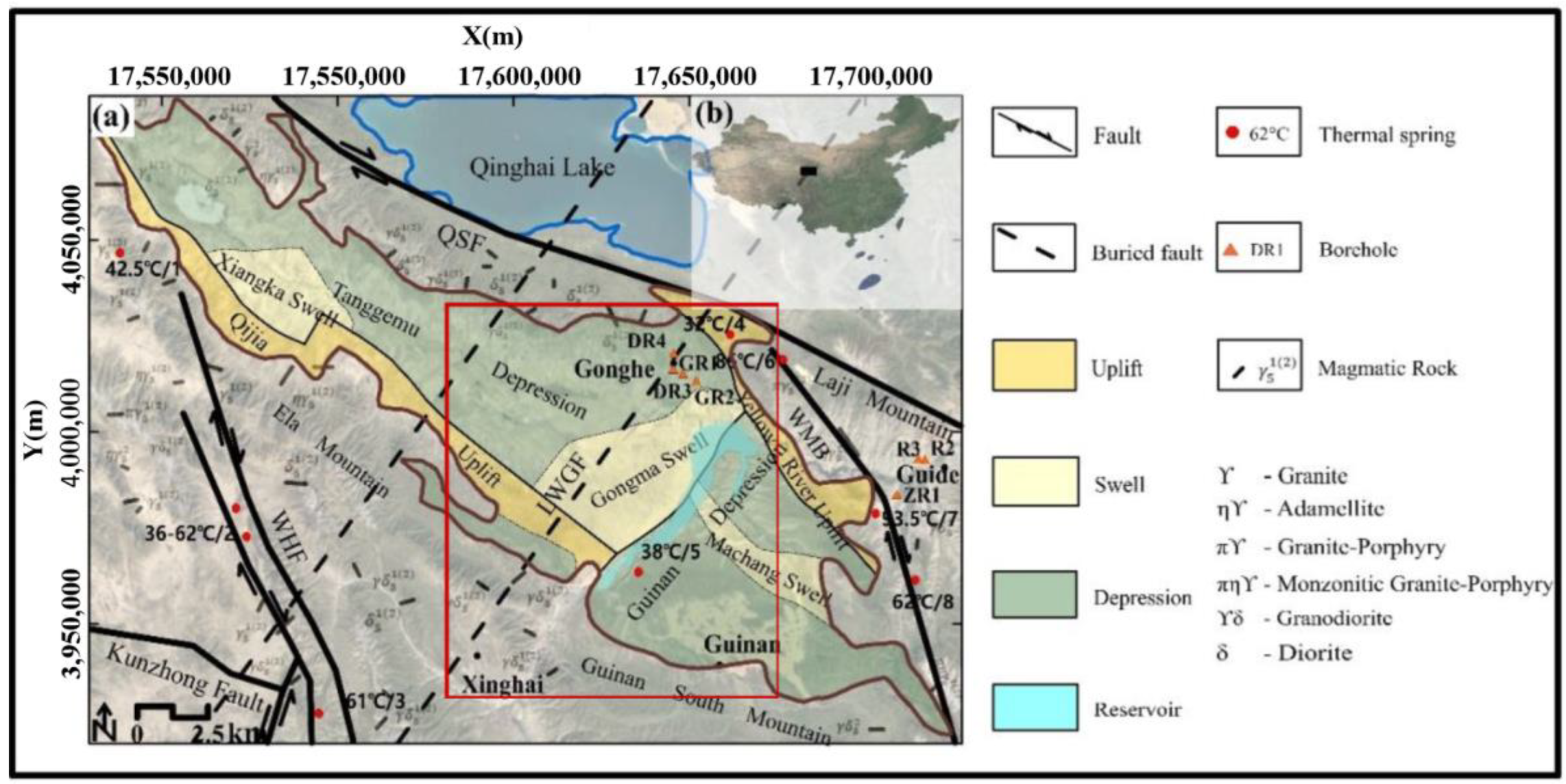
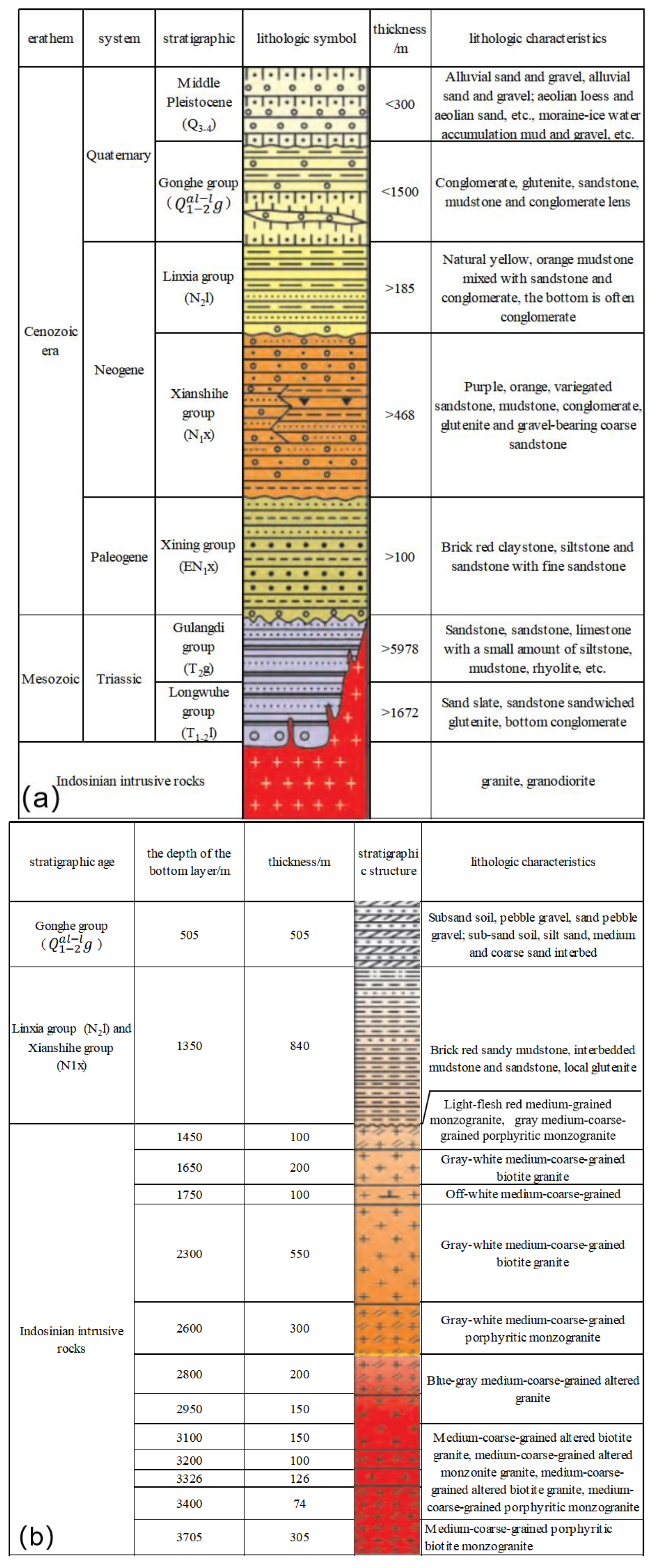
2. Geological Setting
3. 3-D Inversion of Gravity Data
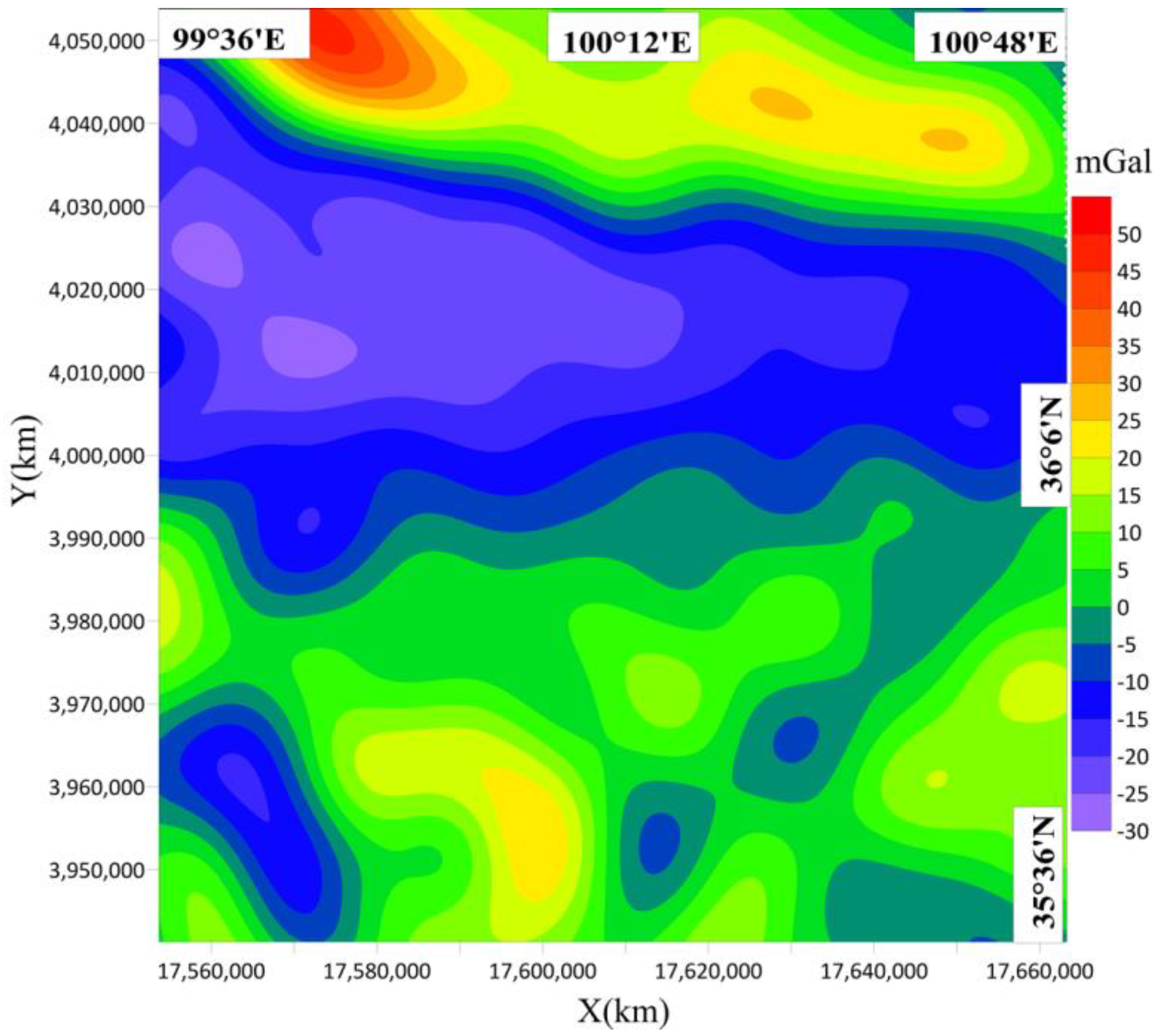
3.1. Details of the Gravity Data
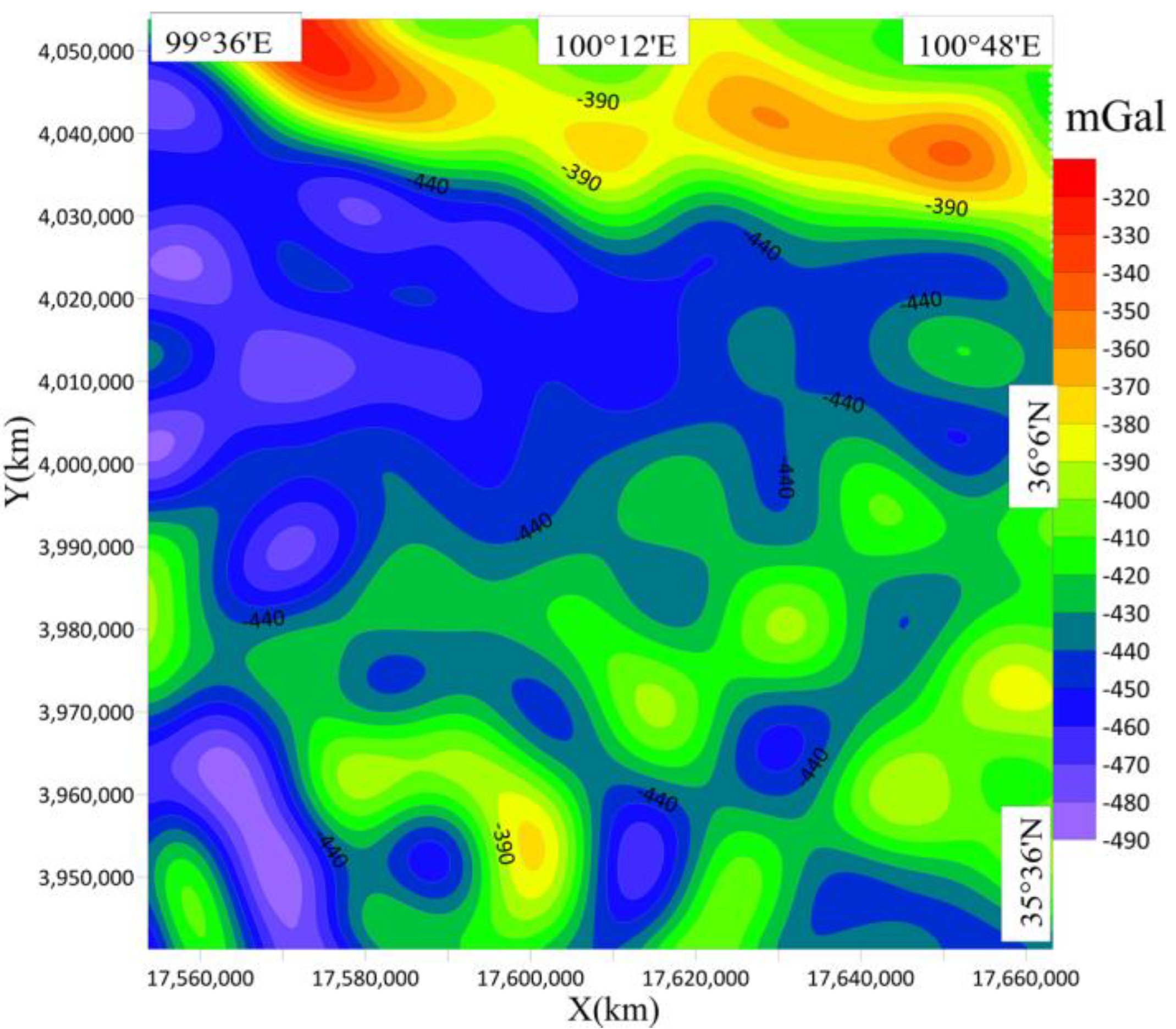
3.2. 3-D Gravity Focusing Inversion Method
| Algorithm 1: CG method |
| 1: Set Set to the maximum number of iterations. 2: while ; 3: 4: if 5: 6: else 7: 8: 9: end 10: 11: 12: 13: end 14: |
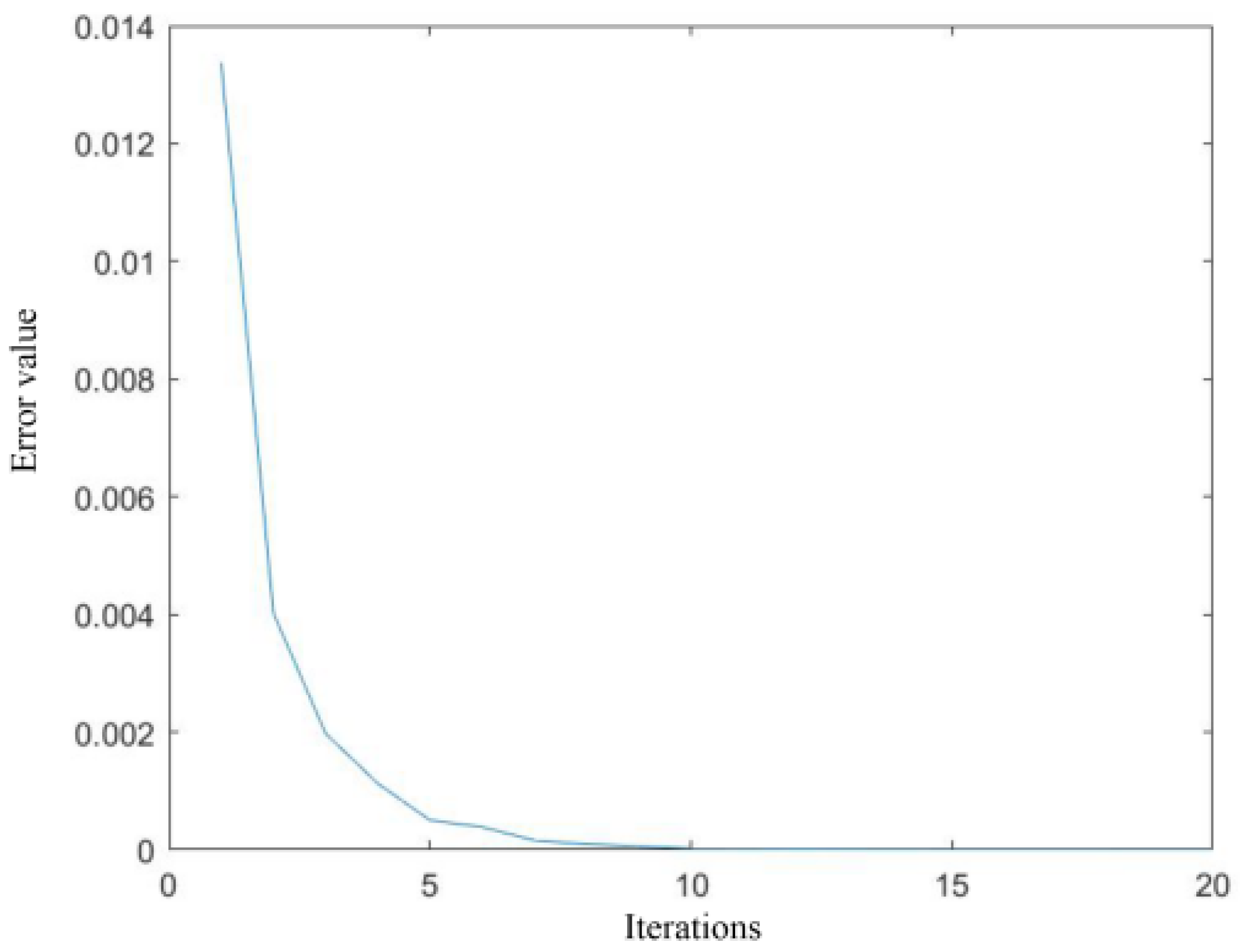
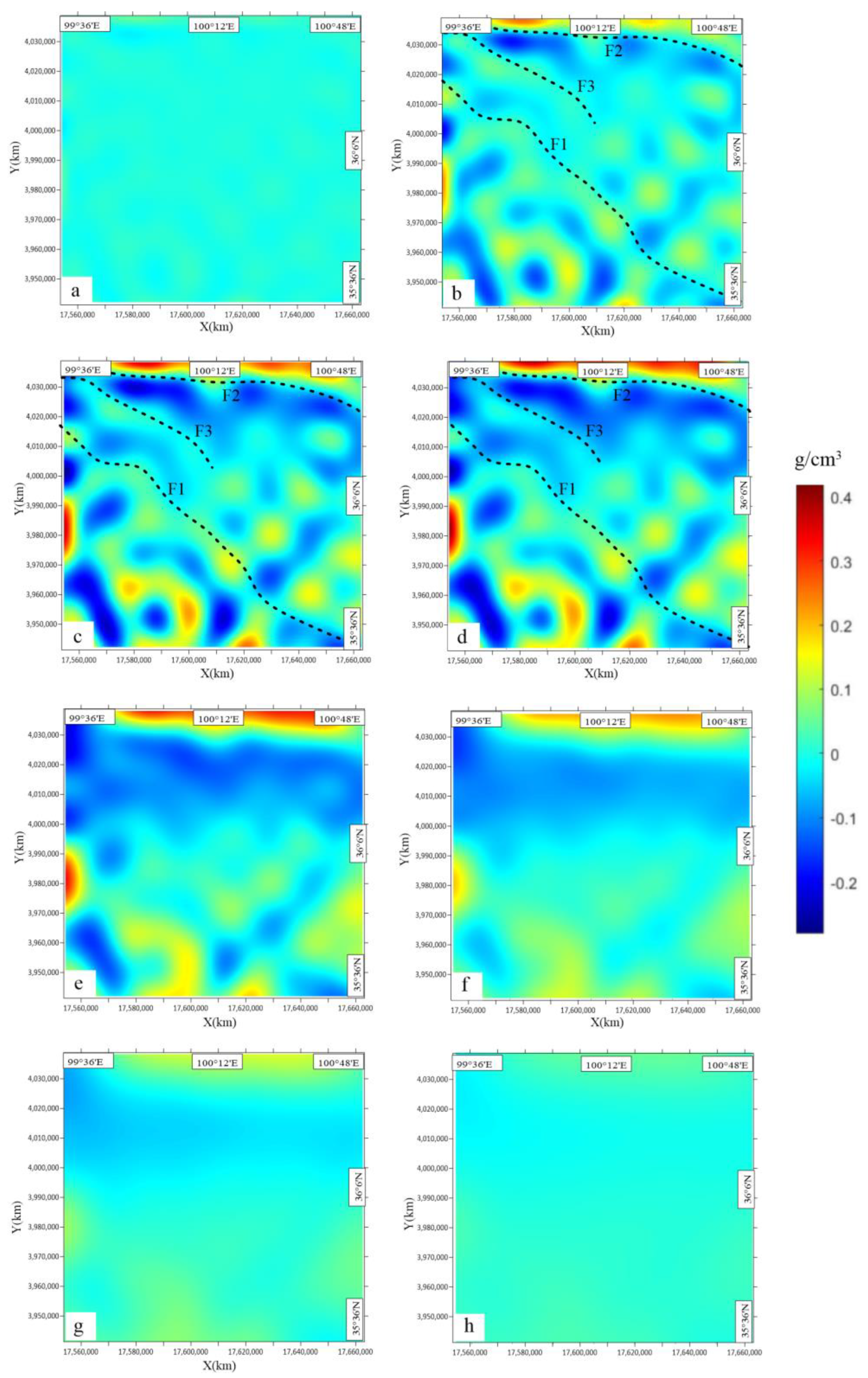
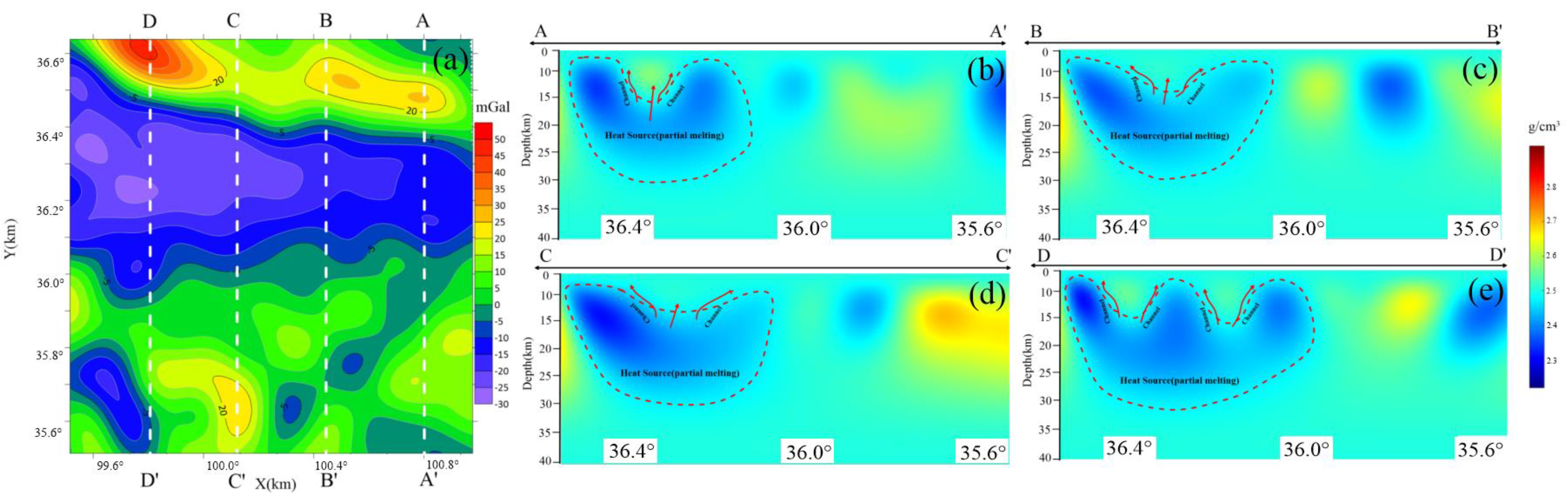
3.3. 3-D Gravity Inversion Results
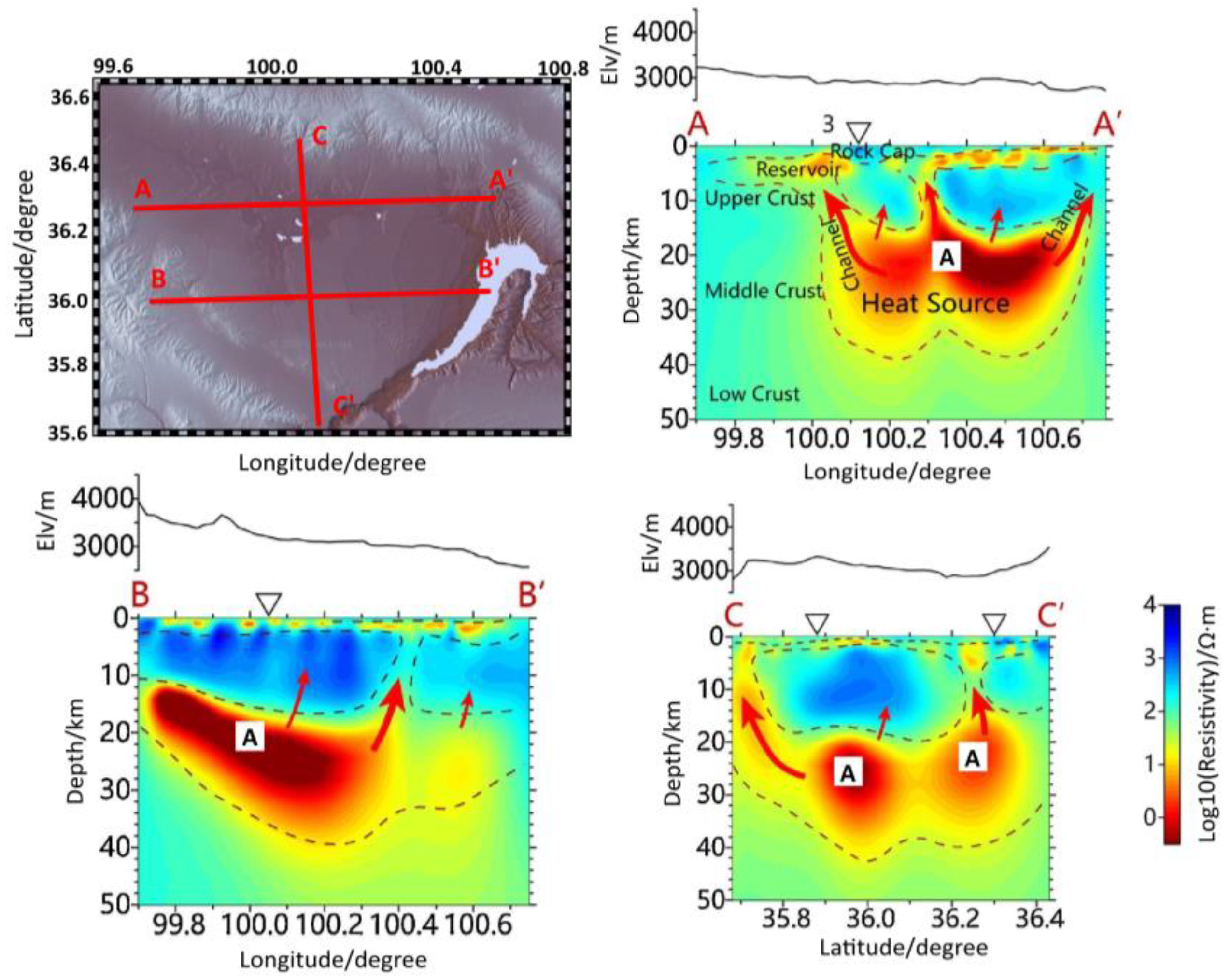
4. Discussion
5. Conclusions
Author Contributions
Funding
Data Availability Statement
Acknowledgments
Conflicts of Interest
Nomenclature
| Symbol | Quantity | Units |
| Universal gravitational constant | m3 kg−1s−2 | |
| Density | kg/m3 | |
| Height | m | |
| Bouguer gravity anomaly | mGal | |
| Classical gravity anomaly | mGal | |
| Ground observation data | mGal | |
| Density of underground sources | g/cm3 | |
| Sensitivity matrix | 10−3 cm4/s2 g | |
| The objective function of the inversion | - | |
| Data fitting function | - | |
| Model fitting function | - | |
| Regularization parameters | - | |
| Depth weighting function | - | |
| Depth of the center point of the underground space geological body | m | |
| Depth parameter | m | |
| Constant | - | |
| Model weighting matrix | - | |
| Minimum support function | - | |
| Data weighting matrix | - |
References
- Apergis, N.; Tsoumas, C. Integration properties of disaggregated solar, geothermal and biomass energy consumption in the US. Energy Policy 2011, 39, 5474–5479. [Google Scholar] [CrossRef] [Scilit]
- Kana, J.D.; Djongyang, N.; Raïdandi, D.; Nouck, P.N.; Dadjé, A. A review of geophysical methods for geothermal exploration. Renew. Sustain. Energy Rev. 2015, 44, 87–95. [Google Scholar] [CrossRef] [Scilit]
- Teke, O.; Yasar, E. Geothermal energy and integrated resource management in Turkey. Geomech. Geophys. Geo-Energy Geo-Resour. 2018, 4, 1–10. [Google Scholar] [CrossRef] [Scilit]
- White, M.; Fu, P.; McClure, M.; Danko, G.; Elsworth, D.; Sonnenthal, E.; Kelkar, S.; Podgorney, R. A suite of benchmark and challenge problems for enhanced geothermal systems. Geomech. Geophys. Geo-Energy Geo-Resour. 2018, 4, 79–117. [Google Scholar] [CrossRef] [Scilit]
- Kamm, J.; Lundin, I.A.; Bastani, M.; Sadeghi, M.; Pedersen, L.B. Joint inversion of gravity, magnetic, and petrophysical data; a case study from a gabbro intrusion in Boden, Sweden. Geophysics 2015, 80, B131–B152. [Google Scholar] [CrossRef] [Scilit]
- Wang, Z.; Zeng, Z.; Liu, Z.; Zhao, X.; Li, J.; Bai, L.; Zhang, L. Heat Flow Distribution and Thermal Mechanism Analysis of the Gonghe Basin based on Gravity and Magnetic Methods. Acta Geol. Sin. (Beijing) 2021, 95, 1892–1901. [Google Scholar] [CrossRef] [Scilit]
- Xu, T.F.; Zhang, Y.J.; Zeng, Z.F.; Bao, X.H. Technology Progress in an Enhanced Geothermal System (Hot Dry Rock). Sci. Technol. Rev. 2012, 30, 42–45, (In Chinese with English Abstract). [Google Scholar]
- Wall, H.; Schaarschmidt, A.; Kämmlein, M.; Gabriel, G.; Bestmann, M.; Scharfenberg, L. Subsurface granites in the Franconian Basin as the source of enhanced geothermal gradients: A key study from gravity and thermal modeling of the Bayreuth Granite. Int. J. Earth Sci. 2019, 108, 1913–1936. [Google Scholar] [CrossRef] [Scilit]
- Maithya, J.; Fujimitsu, Y.; Nishijima, J. Analysis of gravity data to delineate structural features controlling the Eburru geothermal system in Kenya. Geothermics 2020, 85, 101795. [Google Scholar] [CrossRef] [Scilit]
- Jiang, D.D. Inversion of Gravity and Magnetic Data and Geothermal Genesis in Changbai Mountain Volcanic Area. Ph.D. Thesis, Jilin University, Changchun, China, 2021. [Google Scholar]
- Zhang, C.; Jiang, G.; Jia, X.; Li, S.; Zhang, S.; Hu, D.; Hu, S. Parametric study of the production performance of an enhanced geothermal system: A case study at the Qiabuqia geothermal area, northeast Tibetan plateau. Renew. Energy 2018, 132, 959–978. [Google Scholar] [CrossRef] [Scilit]
- Yan, W.D. Characteristics of Gonghe Basin hot dry rock and its utilization prospects. Sci. Technol. Rev. 2015, 33, 54–57, (In Chinese with English Abstract). [Google Scholar]
- Feng, Y.F.; Zhang, X.X.; Zhang, B.; Liu, J.T.; Wang, Y.G. The geothermal formation mechanism in the Gonghe Basin: Discussion and analysis from the geological background. China Geol. 2018, 1, 331–345. [Google Scholar] [CrossRef] [Scilit]
- Zhang, C.; Jiang, G.; Shi, Y.; Wang, Z.; Wang, Y.; Li, S.; Jia, X.; Hu, S. Terrestrial heat flow and crustal thermal structure of the Gonghe-Guide area, northeastern Qinghai-Tibetan plateau. Geothermics 2018, 72, 182–192. [Google Scholar] [CrossRef] [Scilit]
- Yan, W.D.; Gao, X.Z.; Zhang, S.H.; Ma, Y.H.; Shang, X.G.; Guo, S.Y. Distribution and aggregation mechanism of geothermal energy in Gonghe basin. Northwest. Geol. 2013, 46, 223–230, (In Chinese with English Abstract). [Google Scholar]
- Zhang, S.Q.; Yan, W.D.; Li, D.P.; Jia, X.F.; Zhang, S.S.; Li, S.T.; Fu, L.; Wu, H.D.; Zeng, Z.F.; Li, Z.W.; et al. Characteristics of geothermal geology of the Qiabuqia HDR in Gonghe Basin, Qinghai Province. Geol. China 2018, 45, 1087–1102, (In Chinese with English Abstract). [Google Scholar]
- Rybach, L.; Muffler, L.J.P. Geothermal Systems: Principles and Case Histories. J. Volcanol. Geotherm. Res. 1981, 14, 399–401. [Google Scholar]
- Tang, X.; Zhang, J.; Pang, Z.; Hu, S.; Tian, J.; Bao, S. The eastern Tibetan plateau geothermal belt, western China: Geology, geophysics, genesis, and hydrothermal system. Tectonophysics 2017, 717, 433–448. [Google Scholar] [CrossRef] [Scilit]
- Zhao, X.; Zeng, Z.; Wu, Y.; He, R.; Wu, Q.; Zhang, S. Interpretation of gravity and magnetic data on the hot dry rocks (HDR) delineation for the enhanced geothermal system (EGS) in Gonghe town, China. Environ. Earth Sci. 2020, 79, 390. [Google Scholar] [CrossRef] [Scilit]
- Zhang, H.F.; Chen, Y.L.; Xu, W.C. Granitoids around Gonghe basin in Qinghai province: Petrogenesis and tectonic implications. Acta Petrol. Sin. 2006, 22, 2910–2922. [Google Scholar]
- Fang, X.; Yan, M.; Van der Voo, R.; Rea, D.K.; Song, C.; Parés, J.M.; Dai, S. Late Cenozoic deformation and uplift of the NE Tibetan Plateau: Evidence from high-resolution magnetostratigraphy of the Guide Basin, Qinghai Province. China Geol. Soc. Am. Bull. 2005, 117, 1208–1225. [Google Scholar] [CrossRef] [Scilit]
- Sun, Z.; Li, B.; Wang, Z. Exploration of the possibility of hot dry rock occurring in the Qinghai Gonghe Basin. Hydrogeol. Eng. Geol. 2011, 38, 119–124+129, (In Chinese with English Abstract). [Google Scholar]
- Feng, Y.M.; Cao, X.Z.; Zhang, R.P.; Hu, Y.X.; Pan, X.P.; Yang, J.L.; Jia, Q.Z.; Li, W.M. Tectonic evolution framework and nature of the west Qinling orogenic belt. Northwest. Geol. 2003, 1, 1–10. [Google Scholar]
- Zhang, X.T.; Yang, S.D.; Yang, Z.J. Research on Plate Tectonics of Qinghai Province: 1:1 million Qinghai Province Tectonic Map Manual. Geol. Publ. House 2007. (In Chinese with English Abstract). [Google Scholar]
- Tang, X.C.; Liu, S.S.; Zhang, D.L.; Wang, G.L.; Luo, Y.F.; Hu, S.B.; Xu, Q. Geothermal Accumulation Constrained by the Tectonic Transformation in the Gonghe Basin, Northeastern Tibetan Plateau. Lithosphere 2022, 2021, 3936881. [Google Scholar] [CrossRef] [Scilit]
- Qiang, M.; Chen, F.; Song, L.; Liu, X.; Li, M.; Wang, Q. Late Quaternary aeolian activity in Gonghe Basin, northeastern Qinghai-Tibetan Plateau, China. Quat. Res. 2013, 79, 403–412. [Google Scholar] [CrossRef] [Scilit]
- Zhong, C.; Xu, T.; Yuan, Y.; Feng, B.; Yu, H. The feasibility of clean power generation from a novel dual-vertical-well enhanced geothermal system (EGS): A case study in the Gonghe Basin, China. J. Clean. Prod. 2022, 344, 131109. [Google Scholar] [CrossRef] [Scilit]
- Liu, W.L. Drilling technical difficulties and solutions in development of Hot dry Rock geothermal energy. Adv. Pet. Explor. Dev. 2017, 13, 63–69. [Google Scholar]
- Wang, L.H.; Kang, W.H. For the first time in China in the republic of qinghai basin drill by high temperature and high quality hot implements the hot dry rock exploration breakthrough in our country experts believe that the republican basin hot buried shallow, high temperature, large scale. J. Qinghai Land. Run 2017, 4, 55. [Google Scholar]
- Cella, F. GTeC—A versatile MATLAB (super (R)) tool for a detailed computation of the terrain correction and Bouguer gravity anomalies. Comput. Geosci. 2015, 84, 72–85. [Google Scholar] [CrossRef] [Scilit]
- Balcerzak, J. Algorithms for computation of ellipsoidal geodetic coordinates from rectangular coordinates in the Gauss-Kruger projection by the method of expansions into power series. Geod. I Kartogr. 1985, 34, 23–38. [Google Scholar]
- Ince, E.S.; Franz, B.; Sven, R.; Kirsten, E.; Christoph, F.; Frank, F.; Schuh, H. ICGEM—15 Years of Successful Collection and Distribution of Global Gravitational Models, Associated Services, and Future Plans. Earth Syst. Sci. Data 2019, 11, 647–674. [Google Scholar] [CrossRef] [Scilit]
- Tikhonov, A.N.; Arsenin, V.Y. Solutions of ill-posed problems. Math. Comput. 1977, 32, 491. [Google Scholar]
- Li, Y.; Oldenburg, D.W. 3-D inversion of magnetic data. Geophysics 1996, 61, 394–408. [Google Scholar] [CrossRef] [Scilit]
- Li, Y.; Oldenburg, D.W. 3-D inversion of gravity data. Geophysics 1998, 63, 109–119. [Google Scholar] [CrossRef] [Scilit]
- Gao, X.H. The Study and Application of 3D Inversion Methods of Gravity & Magnetic and Their Gradient Tensor Data; Jilin University: Changchun, China, 2019; pp. 1–124. [Google Scholar]
- Last, B.J.; Kubik, K. Compact gravity inversion. Geophysics 1983, 48, 713–721. [Google Scholar]
- Zhu, Y.Q.; Li, D.Q.; Zhang, Q.X.; Zhang, X.; Liu, Z.J.; Wang, J.H. Characteristics of geothermal resource in Qiabuqia, Gonghe Basin: Evidence from high precision resistivity data. Ore Geol. Rev. 2022, 148, 105053. [Google Scholar] [CrossRef] [Scilit]
- Zhang, M.; Zhang, Q.S.; Qin, X. A discussion on seismogenic process of the 1990 gonghe Ms 7.0 earthquake, Qinhai. Northwest. Seismol. J. 2000, 22, 273–278. [Google Scholar]
- Song, G.; Song, X.; Li, G.; Xu, R.; Cao, W.; Zhao, C. Multi-objective Optimization of Geothermal Extraction from the Enhanced Geothermal System in Qiabuqia Geothermal Field, Gonghe Basin. Acta Geol. Sin. 2021, 95, 1844–1856. [Google Scholar]
- Zhang, C.; Hu, S.; Zhang, S.; Li, S.; Zhang, L.; Kong, Y.; Zuo, Y.; Song, R.; Jiang, G.; Wang, Z. Radiogenic heat production variations in the Gonghe basin, northeastern Tibetan Plateau: Implications for the origin of high-temperature geothermal resources. Renew. Energy 2020, 148, 284–297. [Google Scholar] [CrossRef] [Scilit]
- Artemieva, I.M.; Thybo, H.; Jakobsen, K.; Sørensen, N.K.; Nielsen, L.S.K. Heat production in granitic rocks: Global analysis based on a new data compilation. Earth Sci. Rev. 2017, 172, 1–26. [Google Scholar] [CrossRef] [Scilit]
- Beardsmore, G. The influence of basement on surface heat flow in the Cooper Basin. Explor. Geophys. 2004, 35, 223–235. [Google Scholar] [CrossRef] [Scilit]
- Yang, X.S.; Jin, Z.M. The low velocity zone resulted from crustal partial melting and its significance. Prog. Geophys. 1998, 13, 38–45, (In Chinese with English Abstract). [Google Scholar]
- Nelson, K.D.; Zhao, W.; Brown, L.D.; Kuo, J.; Che, J.; Liu, X.; Klemperer, S.L.; Makovsky, Y.; Meissner, R.J.J.M.; Mechie, J.; et al. Partially molten middle crust beneath southern Tibet: Synthesis of project INDEPTH results. Science 1996, 274, 1684–1688. [Google Scholar] [CrossRef] [Scilit] [PubMed]
- Li, S.; Unsworth, M.J.; Booker, J.R.; Wei, W.; Tan, H.; Jones, A.G. Partial melt or aqueous fluid in the mid-crust of Southern Tibet? Constraints from INDEPTH magnetotelluric data. Geophys. J. Int. 2003, 153, 289–304. [Google Scholar] [CrossRef] [Scilit]
- He, L.F.; Chen, L.; Dor, J.; Chen, R.; Yao, H. Mapping the geothermal system using AMT and MT in the Mapamyum (QP) field, Lake Manasarovar, Southwestern Tibet. Energies 2016, 9, 855. [Google Scholar] [CrossRef] [Scilit]
- Gu, Q.; Sun, J.; Shi, S.L.; Shi, Z.S. The features of highly electrical conductivity layer in north China and northwest China regions. Seismol. Geol. 1980, 2, 21–29, (In Chinese with English Abstract). [Google Scholar]
- Zhang, S.Q.; Li, X.F.; Song, J.; Wen, D.G.; Li, Z.W.; Li, D.P.; Cheng, Z.P.; Fu, L.; Zhang, L.Y.; Feng, Q.D.; et al. Analysis on the geophysical evidence for the existence of partial melting layer in the crust and the regional heat source mechanism for the hot dry rock resources of the Gonghe basin. Earth Sci. 2021, 46, 1416–1436, (In Chinese with English Abstract). [Google Scholar]
- Fleitout, L.; Froidevaux, C. Thermal and mechanical evolution of shear zones. J. Struct. Geol. 1980, 2, 159–164. [Google Scholar] [CrossRef] [Scilit]
- Yuan, X.C.; Li, L.; Jin, G.Y.; Zhu, J.H.; Lu, G.; Feng, Y.P.; Lin, X.X. Deep magnetotelluric sounding in the lhozhayangbajin area, Tibet. Acta Geol. Sin. 1985, 59, 26–32, (In Chinese with English Abstract). [Google Scholar]
- Qi, X.X.; Li, H.B.; Zhang, J.X. Relationship between Deformation-Metamorphism and Syntectonic Melting in a Ductile Shear Zone A Case Study of the Baokuhe Ductile Shear Zone in the Central Qilian Mountains. Geol. Rev. 2003, 49, 413–421. [Google Scholar]
- Hao, M.; Shen, Z.K.; Wang, Q.; Cui, D. Postseismic deformation mechanisms of the 1990 Mw 6.4 Gonghe, China earthquake constrained using leveling measurements. Tectonophysics 2012, 532, 205–214. [Google Scholar] [CrossRef] [Scilit]
- Tang, X.C.; Wang, G.L.; Ma, Y.; Zhang, D.L.; Liu, Z.; Zhao, X.; Cheng, T.J. Geological model of heat source and accumulation for geothermal anomalies in the Gonghe basin, northeastern Tibetan Plateau. Acta Geol. Sin. 2020, 97, 2052–2065, (In Chinese with English Abstract). [Google Scholar]
- Gao, J.; Zhang, H.J.; Zhang, S.Q.; Chen, X.B.; Chen, Z.P.; Jia, X.F.; Li, S.T.; Fu, L.; Gao, L.; Xin, H.L. Three-dimensional magnetotelluric imaging of the geothermal system beneath the Gonghe Basin, Northeast Tibetan Plateau. Geothermics 2018, 76, 15–25. [Google Scholar] [CrossRef] [Scilit]
- Zhang, S.S.; Zhang, L.; Tian, C.C.; Cai, J.S.; Tang, B.C. Occurrence geological characteristics and development potential of hot dry rocks in Qinghai Gonghe basin. J. Geomech. 2019, 25, 501–508, (In Chinese with English Abstract). [Google Scholar]
Disclaimer/Publisher’s Note: The statements, opinions and data contained in all publications are solely those of the individual author(s) and contributor(s) and not of MDPI and/or the editor(s). MDPI and/or the editor(s) disclaim responsibility for any injury to people or property resulting from any ideas, methods, instructions or products referred to in the content. |
© 2023 by the authors. Licensee MDPI, Basel, Switzerland. This article is an open access article distributed under the terms and conditions of the Creative Commons Attribution (CC BY) license (https://creativecommons.org/licenses/by/4.0/).
Share and Cite
Zhao, J.; Zeng, Z.; Zhou, S.; Yan, J.; An, B. 3-D Inversion of Gravity Data of the Central and Eastern Gonghe Basin for Geothermal Exploration. Energies 2023, 16, 2277. https://doi.org/10.3390/en16052277
Zhao J, Zeng Z, Zhou S, Yan J, An B. 3-D Inversion of Gravity Data of the Central and Eastern Gonghe Basin for Geothermal Exploration. Energies. 2023; 16(5):2277. https://doi.org/10.3390/en16052277
Chicago/Turabian StyleZhao, Jianwei, Zhaofa Zeng, Shuai Zhou, Jiahe Yan, and Baizhou An. 2023. "3-D Inversion of Gravity Data of the Central and Eastern Gonghe Basin for Geothermal Exploration" Energies 16, no. 5: 2277. https://doi.org/10.3390/en16052277
APA StyleZhao, J., Zeng, Z., Zhou, S., Yan, J., & An, B. (2023). 3-D Inversion of Gravity Data of the Central and Eastern Gonghe Basin for Geothermal Exploration. Energies, 16(5), 2277. https://doi.org/10.3390/en16052277

