Article

Experimental Comparison of Hub- and Roller-Type Chassis Dynamometers for Vehicle Exhaust Emissions
1
European Commission, Joint Research Centre (JRC), 21027 Ispra, Italy
2
Rototest Europe, SE-144 40 Rönninge, Sweden
*
Author to whom correspondence should be addressed.
Energies 2022, 15(7), 2402; https://doi.org/10.3390/en15072402
Submission received: 21 February 2022 / Revised: 17 March 2022 / Accepted: 20 March 2022 / Published: 24 March 2022

Abstract

The emissions of vehicles are measured in laboratories with roller-type chassis dynamometers, which simulate road driving resistances. Hub-coupled dynamometers, which are not included in the regulations for emission measurements, are commonly used for research and development purposes, for example, to assess powertrain capabilities, simulate on-road trips, and calibrate the control of individual wheels. As they do not need particular infrastructure and offer a wider range of applications, they could be a more economical alternative, especially if they could also be used for emission measurements for the type approval of vehicles. Nevertheless, the two types have not been directly compared in the literature, and, thus, their equivalency, especially regarding emission measurements, is not known. In this study, the emissions of a diesel and a gasoline plug-in vehicle were compared using the same analytical equipment and by switching only the roller and hub dynamometers. The diesel vehicle was further tested on a second roller-type dynamometer with the same driver and a second driver. The results of the two dynamometer types were very close, even though the repeatability of the measurements was very narrow. The main message of this work is that hub-type dynamometers can be used interchangeably with roller-type dynamometers. The points that need to be addressed, such as the determination of dynamic wheel radius and tire slip level, are also discussed.
Keywords: vehicle emissions; CO2; chassis dynamometer; roller dynamometer; hub dynamometer; rotational mass; tire slip; dynamic radius vehicle emissions; CO2; chassis dynamometer; roller dynamometer; hub dynamometer; rotational mass; tire slip; dynamic radius
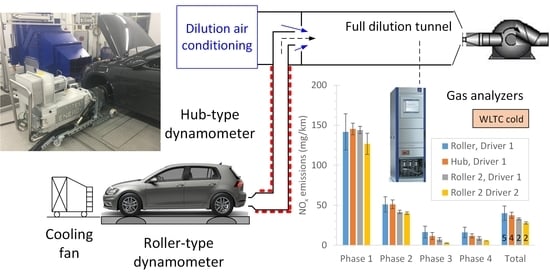
Graphical Abstract