Article

Thermal Safety Analysis of On-Site Emulsion Explosives Mixed with Waste Engine Oil
1
School of Energy Engineering, Xi’an University of Science and Technology, Xi’an 710054, China
2
North Special Energy Group, Corporation Limited, Xi’an 710061, China
*
Authors to whom correspondence should be addressed.
Energies 2022, 15(3), 895; https://doi.org/10.3390/en15030895
Submission received: 24 December 2021 / Revised: 22 January 2022 / Accepted: 25 January 2022 / Published: 26 January 2022

Abstract

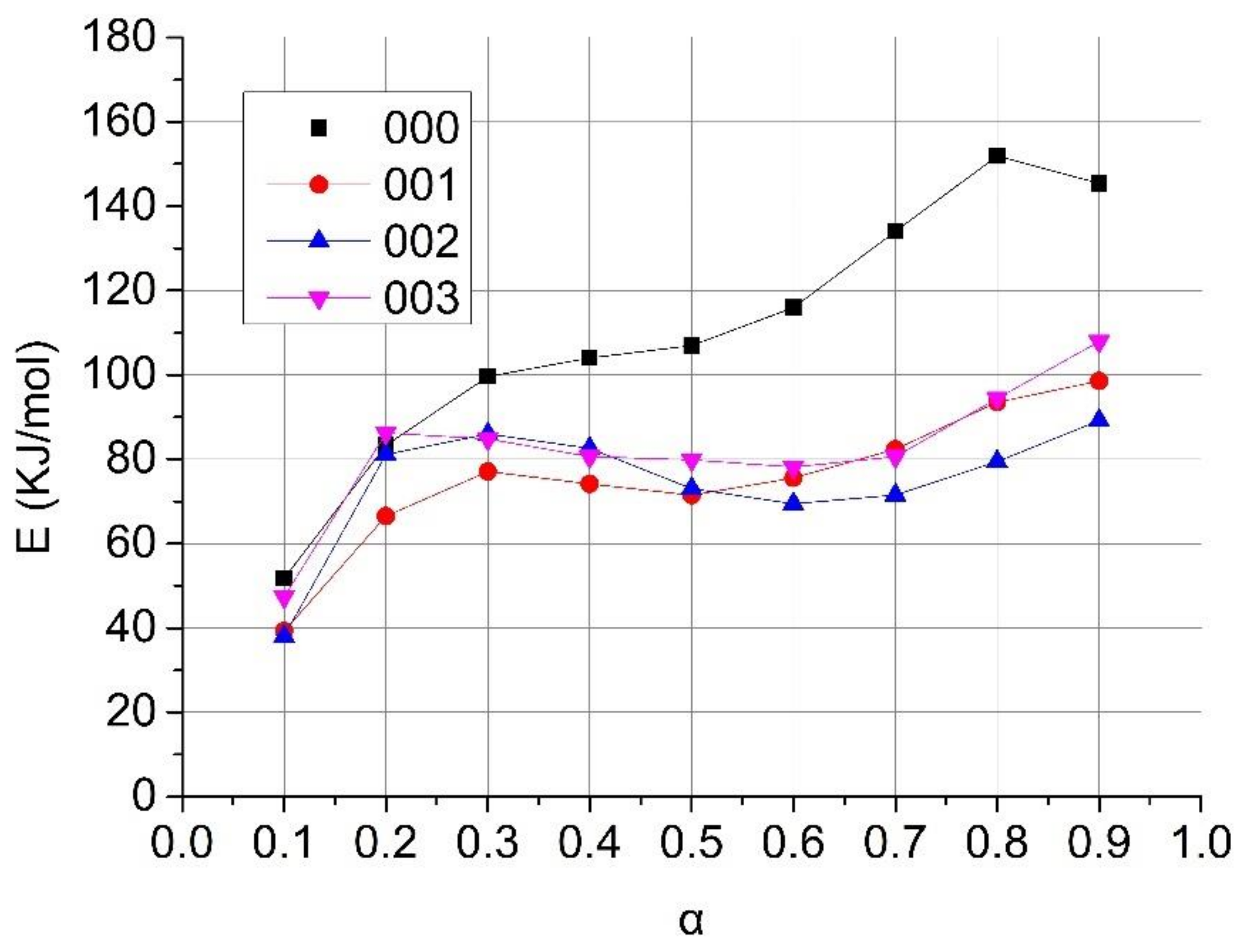
The study of the thermal safety of emulsion explosives mixed with waste engine oil is very important for the safety of these types of explosives used in mine blasting. In order to study the thermal safety of emulsion explosives mixed with waste engine oil, thermal safety tests were carried out using a Differential Scanning Calorimeter (DSC), non-isothermal kinetics, and the Flynn–Wall–Ozawa method. The results show that the minor particle impurities in the filtered waste engine oil are mainly combustibles; after adding different amounts of waste engine oil, the activation energy of the emulsion matrix decreases from 110.33 kJ/mol to 75.39 kJ/mol, 74.50 kJ/mol, and 82.23 kJ/mol, and the critical temperature for thermal explosion changes from 194.16 °C to 169.73 °C, 227.47 °C, and 208.78 °C. The addition of waste engine oil reduces the activation energy of emulsion explosives. The waste engine oil is negatively correlated with the activation energy and the thermal explosion reaction temperature of emulsion explosives, and the correlation coefficient is −0.686 and −0.333. The emulsifier is positively correlated with the critical temperature of thermal explosion of emulsion explosives, and the correlation coefficient is 0.251. The small particles in the waste engine oil create a hot spot in the emulsion explosives, which reduces the thermal safety of the emulsion explosives mixed with waste engine oil. The emulsifier reduces the droplet size of the emulsion explosive, improves the oil-water interface strength, and improves the thermal safety of the emulsion explosives mixed with waste engine oil. The thermal safety of emulsion explosives mixed with waste engine oil can be improved by reducing the proportion of the sensitizer and increasing the proportion of the emulsifier.
Keywords: emulsion explosives; waste engine oil; non-isothermal kinetics; thermal safety emulsion explosives; waste engine oil; non-isothermal kinetics; thermal safety