


Improving Kraft Pulp Mill Energy Efficiency through Low-Temperature Hydrothermal Carbonization of Biological Sludge
 ,
,  , ,
, , 
Abstract
1. Introduction
2. Materials and Methods
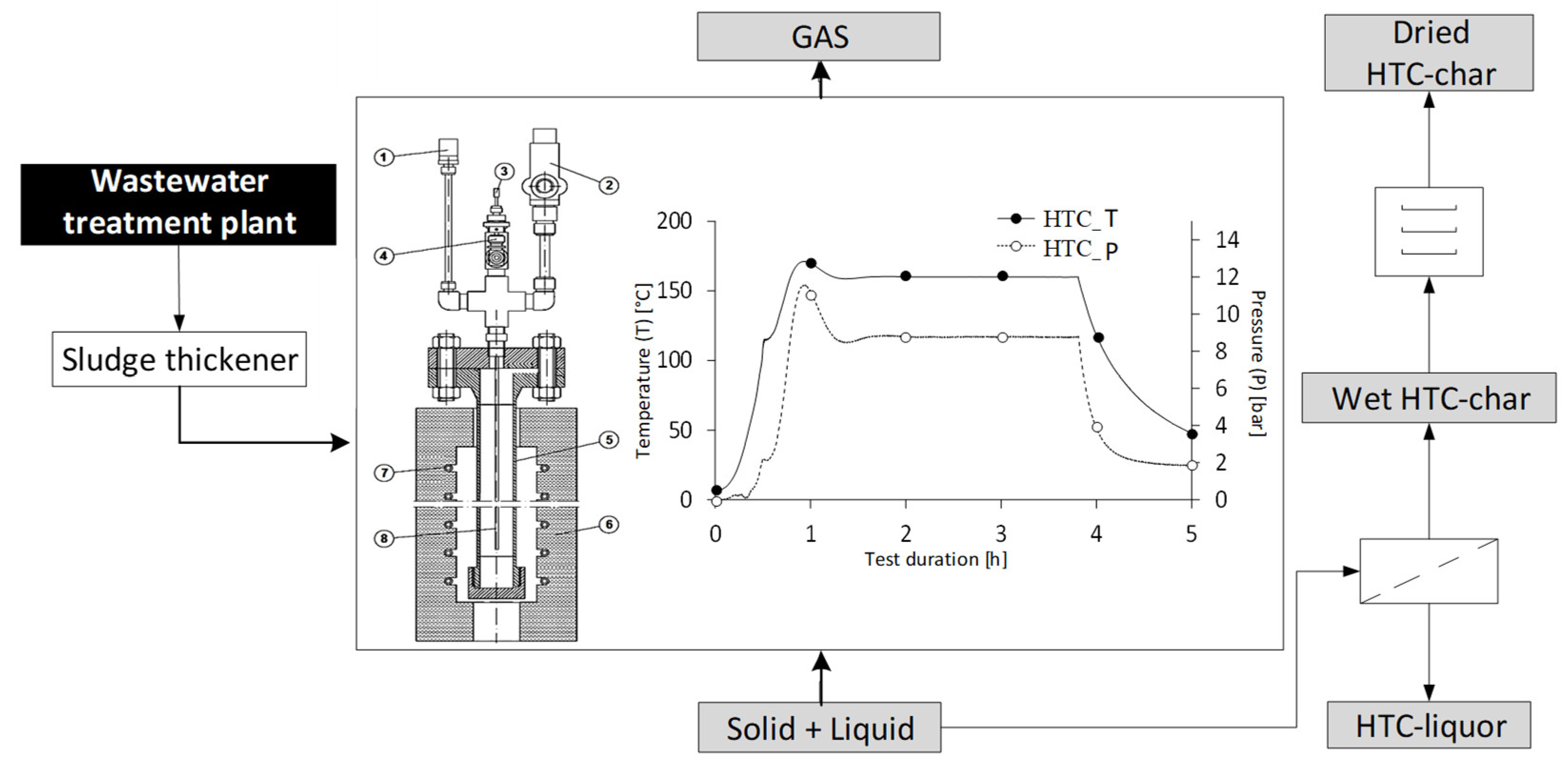
2.1. Experimental Process
2.2. Considered Pulp and Paper Mills
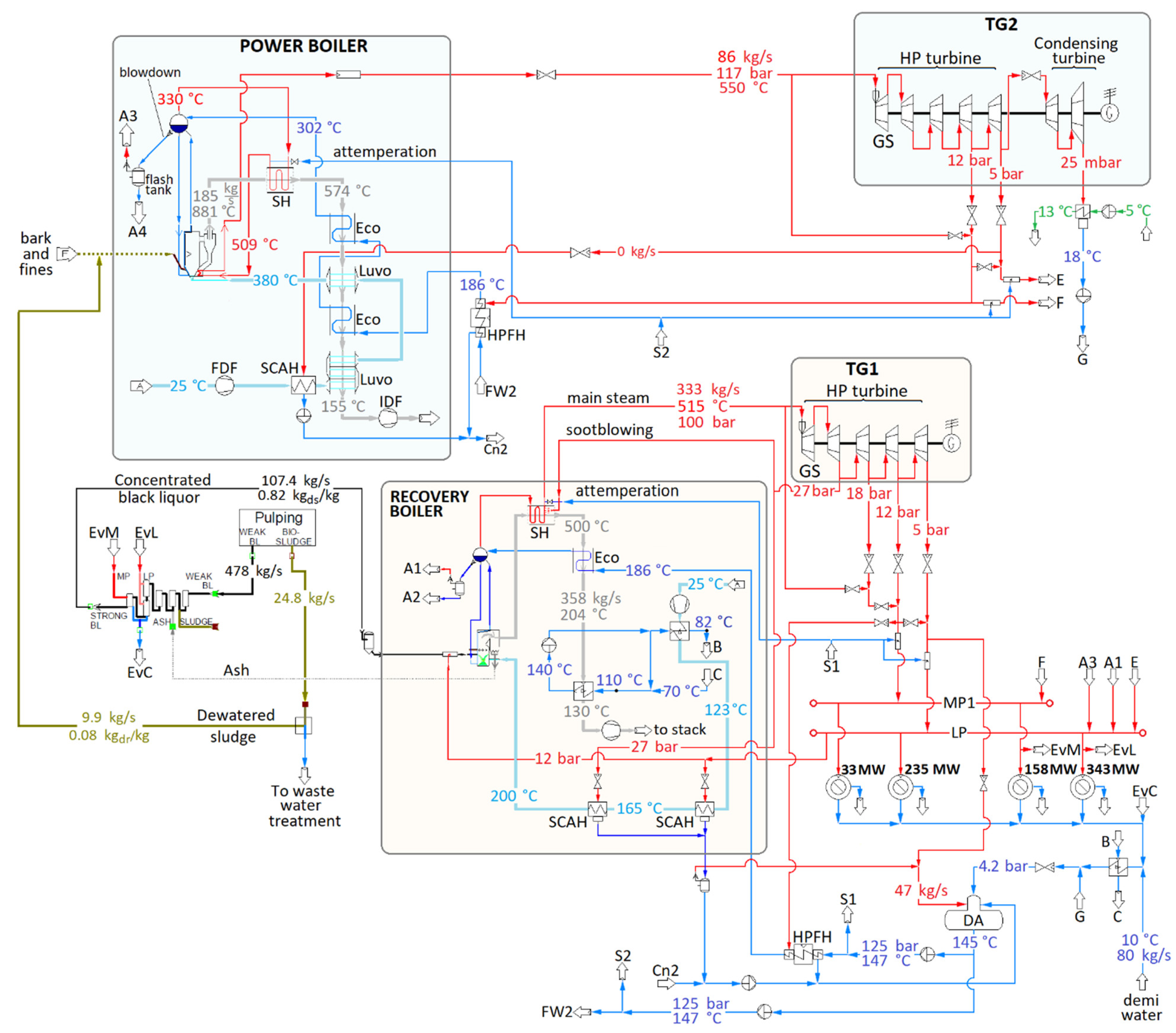
2.2.1. Boiler and Steam Cycle Models
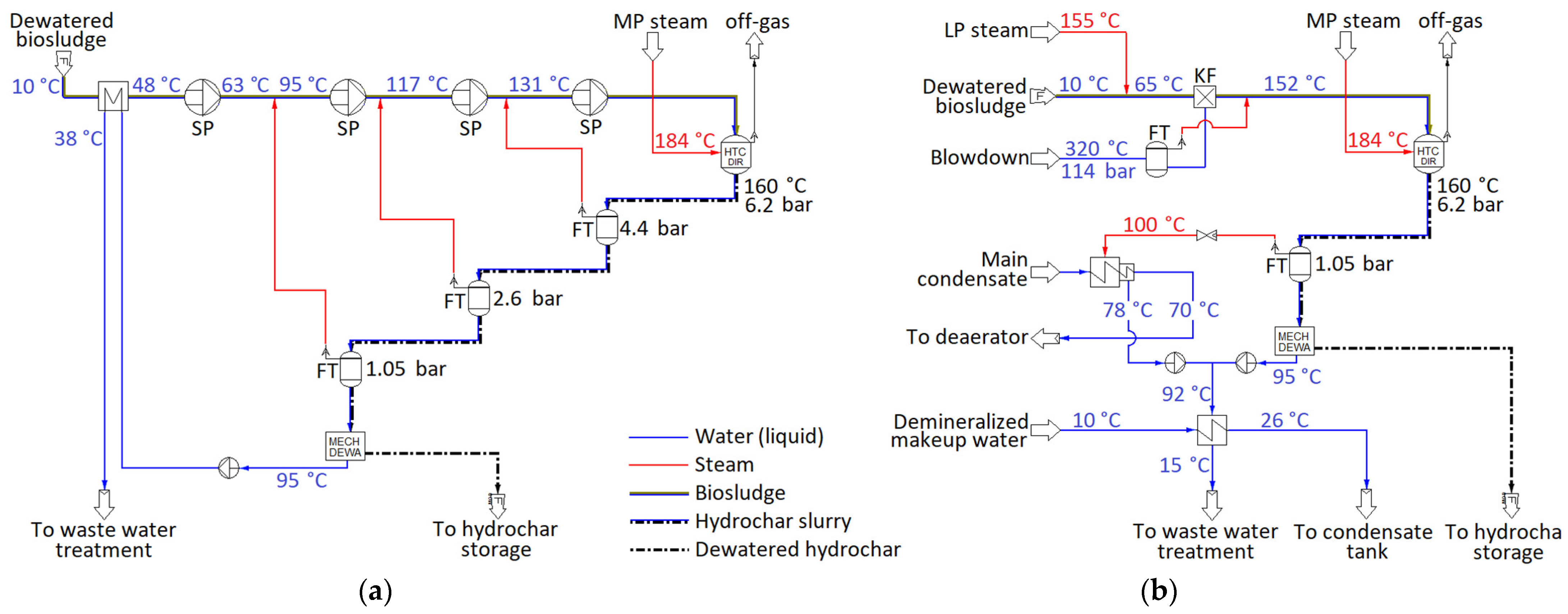
2.2.2. HTC Process Models
3. Results and Discussion
3.1. Characterization and Yields of Feedstock and Products
3.2. Plant Performance
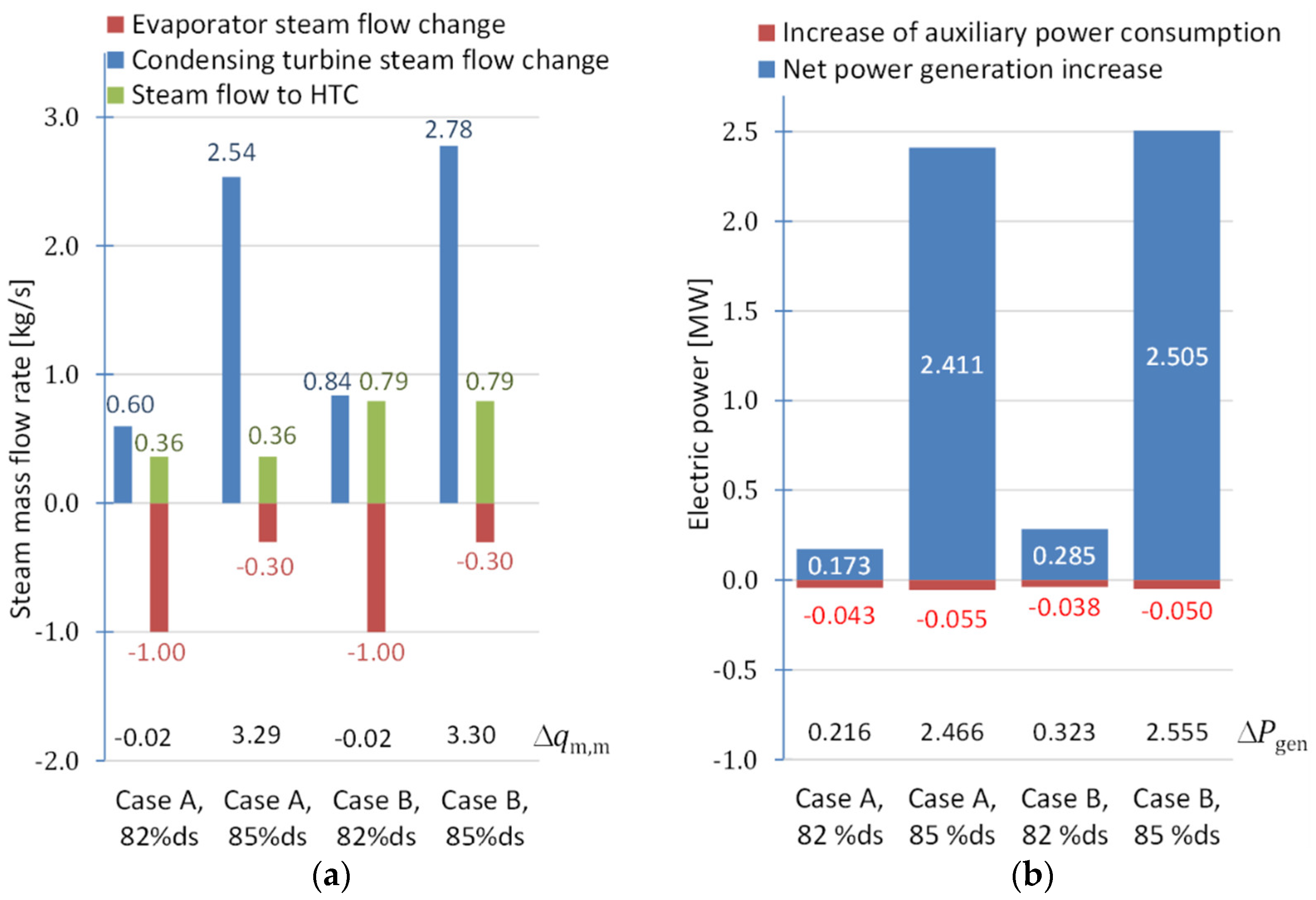
3.2.1. Case NorPulp
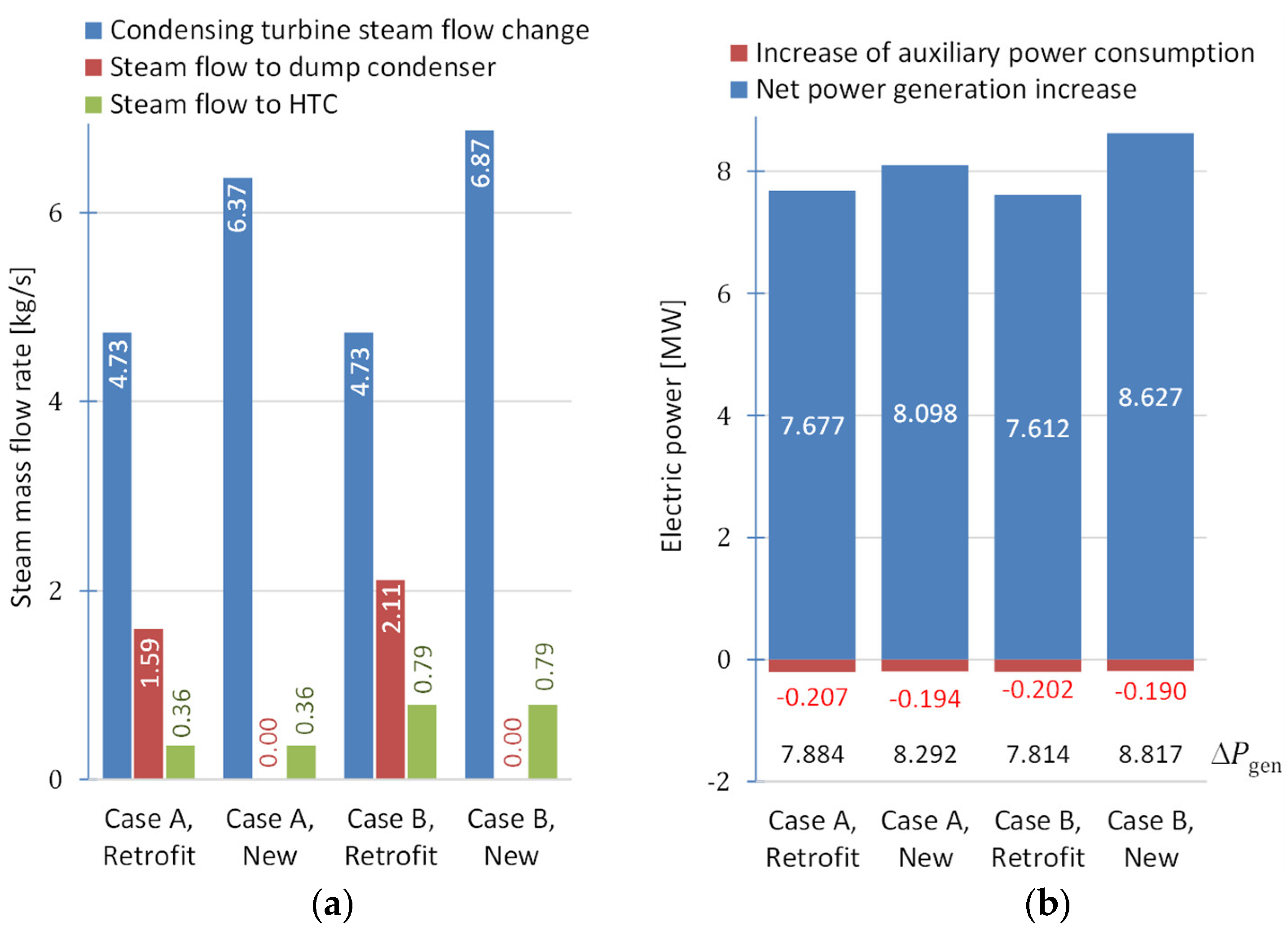
3.2.2. Case NorInt
4. Conclusions
Author Contributions
Funding
Institutional Review Board Statement
Informed Consent Statement
Acknowledgments
Conflicts of Interest
References
- Kacprzak, M.; Neczaj, E.; Fijałkowski, K.; Grobelak, A.; Grosser, A.; Worwag, M.; Rorat, A.; Brattebo, H.; Almås, Å.; Singh, B.R. Sewage sludge disposal strategies for sustainable development. Environ. Res. 2017, 156, 39–46. [Google Scholar] [CrossRef] [Scilit] [PubMed]
- Meyer, T.; Amin, P.; Allen, D.G.; Tran, H. Dewatering of pulp and paper mill biosludge and primary sludge. J. Environ. Chem. Eng. 2018, 6, 6317–6321. [Google Scholar] [CrossRef] [Scilit]
- Tarnawski, W. Emission factors for combustion of biomass fuels in the pulp and paper mills. Fibres Text. East. Eur. 2004, 12, 91–95. [Google Scholar]
- Mainardis, M.; Goi, D. Pilot-UASB reactor tests for anaerobic valorisation of high-loaded liquid substrates in friulian mountain area. J. Environ. Chem. Eng. 2019, 7, 103348. [Google Scholar] [CrossRef] [Scilit]
- Patel, K.; Patel, N.; Vaghamshi, N.; Shah, K.; Duggirala, S.M.; Dudhagara, P. Trends and strategies in the effluent treatment of pulp and paper industries: A review highlighting reactor options. Curr. Res. Microb. Sci. 2021, 2, 100077. [Google Scholar] [CrossRef] [Scilit]
- Karr, P.; Keinath, T.M. Influence of particle size on sludge dewaterability. J. Water Pollut. Control Fed. 1978, 50, 1911–1930. [Google Scholar]
- Judd, S. Chemical Sludge Conditioning—Sludge Processing. Available online: https://www.sludgeprocessing.com/sludge-conditioning/chemical-sludge-conditioning/ (accessed on 17 August 2022).
- Pöyry Environment Oy State of Sludgehandling in Finland and Competitiveness of Handling Methods; Sitra: Helsinki, Finland, 2007.
- Liimatainen, P. Alternative handling methods of the wastewater sludges in forest industry. Technical Report, LTKK-EN-B136, 2000.
- Räty, H. Techno-Economic Analysis of Sludge Dewatering. Master’s Thesis, LUT University, Lappeenranta, Finland, 2019. [Google Scholar]
- Thunberg, A. Optimizing Sludge Dewatering by Using the KemiCond® Process with the Bucher Hydraulic Filter Press—Full Scale Experiences at Käppala WWTP. Proc. Water Environ. Fed. 2010, 11, 225–235. [Google Scholar]
- Stoica, A.; Sandberg, M.; Holby, O. Energy use and recovery strategies within wastewater treatment and sludge handling at pulp and paper mills. Bioresour. Technol. 2009, 100, 3497–3505. [Google Scholar] [CrossRef] [Scilit]
- Feagley, S.E.; Valdez, M.S.; Hudnall, W.H. Papermill Sludge, Phosphorus, Potassium, and Lime Effect on Clover Grown on a Mine Soil. J. Environ. Qual. 1994, 23, 759–765. [Google Scholar] [CrossRef] [Scilit]
- Kost, D.A.; Boutelle, D.A.; Larson, M.M.; Smith, W.D.; Vimmerstedt, J.P. Papermill Sludge Amendments, Tree Protection, and Tree Establishment on an Abandoned Coal Minesoil. J. Environ. Qual. 1997, 26, 1409–1416. [Google Scholar] [CrossRef] [Scilit]
- Carpenter, A.F.; Fernandez, I.J. Pulp.p Sludge as a Component in Manufactured Topsoil. J. Environ. Qual. 2000, 29, 387–397. [Google Scholar] [CrossRef] [Scilit]
- Chong, C.; Cline, R.A. Response of Four Ornamental Shrubs to Container Substrate Amended with Two Sources of Raw Paper Mill Sludge. HortScience 1993, 28, 807–809. [Google Scholar] [CrossRef] [Scilit]
- Norrie, J.; Gosselin, A. Paper sludge amendments for turfgrass. HortScience 1996, 31, 957–960. [Google Scholar] [CrossRef] [Scilit]
- Mäkelä, M.; Benavente, V.; Fullana, A. Hydrothermal carbonization of lignocellulosic biomass: Effect of process conditions on hydrochar properties. Appl. Energy 2015, 155, 576–584. [Google Scholar] [CrossRef] [Scilit]
- Libra, J.A.; Ro, K.S.; Kammann, C.; Funke, A.; Berge, N.D.; Neubauer, Y.; Titirici, M.M.; Fühner, C.; Bens, O.; Kern, J.; et al. Hydrothermal carbonization of biomass residuals: A comparative review of the chemistry, processes and applications of wet and dry pyrolysis. Biofuels 2011, 2, 71–106. [Google Scholar] [CrossRef] [Scilit]
- Mendoza Martinez, C.L.; Sermyagina, E.; Saari, J.; Silva de Jesus, M.; Cardoso, M.; Matheus de Almeida, G.; Vakkilainen, E. Hydrothermal carbonization of lignocellulosic agro-forest based biomass residues. Biomass Bioenergy 2021, 147, 106004. [Google Scholar] [CrossRef] [Scilit]
- Funke, A.; Ziegler, F. Hydrothermal carbonization of biomass: A summary and discussion of chemical mechanisms for process engineering. Biofuels Bioprod. Biorefining 2010, 4, 160–177. [Google Scholar] [CrossRef] [Scilit]
- Hoekman, S.K.; Broch, A.; Robbins, C. Hydrothermal carbonization (HTC) of lignocellulosic biomass. Energy Fuels 2011, 25, 1802–1810. [Google Scholar] [CrossRef] [Scilit]
- Alatalo, S.M.; Repo, E.; Mäkilä, E.; Salonen, J.; Vakkilainen, E.; Sillanpää, M. Adsorption behavior of hydrothermally treated municipal sludge & pulp and paper industry sludge. Bioresour. Technol. 2013, 147, 71–76. [Google Scholar] [CrossRef] [Scilit]
- Martinez, C.L.M.; Sermyagina, E.; Vakkilainen, E. Hydrothermal Carbonization of Chemical and Biological Pulp Mill Sludges. Energies 2021, 14, 5693. [Google Scholar] [CrossRef] [Scilit]
- Harila, P.; Kivilinna, V.A. Biosludge incineration in a recovery boiler. Water Sci. Technol. 1999, 40, 195–200. [Google Scholar] [CrossRef] [Scilit]
- Kuparinen, K.; Vakkilainen, E.; Tynjälä, T. Biomass-based carbon capture and utilization in kraft pulp mills. Mitig. Adapt. Strateg. Glob. Chang. 2019, 24, 1213–1230. [Google Scholar] [CrossRef] [Scilit]
- Jüdes, M.; Vigerske, S.; Tsatsaronis, G. Optimization of the Design and Partial-Load Operation of Power Plants Using Mixed-Integer Nonlinear Programming. In Optimization in the Energy Industry; Springer: Berlin/Heidelberg, Germany, 2009; pp. 193–220. [Google Scholar] [CrossRef] [Scilit]
- Sanders, W.P. Turbine Steam Path Vol. 3a-Mechanical Design and Manufacture; PennWell: Tulsa, OK, USA, 2004. [Google Scholar]
- Traupel, W. Thermische Turbomaschinen: 1. Thermodynamisch-Strömungstechnische Berechnung; Springer: Berlin, Germany, 1966. [Google Scholar]
- Saari, J.; Kuparinen, K.; Sermyagina, E.; Vakkilainen, E.; Kaikko, J.; Sergeev, V. Effect of integration method and carbonization temperature on the performance of an integrated hydrothermal carbonization and CHP plant. BioResources 2018, 13, 5080–5110. [Google Scholar] [CrossRef] [Scilit]
- Axegård, P. C-Green‘s HTC-solution for conversion of biosludge to hydrochar. In Proceedings of the 2nd International Symposium on Hydrothermal Carbonization, Berlin, Germany, 14–16 May 2017. [Google Scholar]
- Saari, J.; Sermyagina, E.; Kaikko, J.; Haider, M.; Hamaguchi, M.; Vakkilainen, E. Evaluation of the Energy Efficiency Improvement Potential through Back-End Heat Recovery in the Kraft Recovery Boiler. Energies 2021, 14, 1550. [Google Scholar] [CrossRef] [Scilit]
- Kuokkanen, T.; Nurmesniemi, H.; Pöykiö, R.; Kujala, K.; Kaakinen, J.; Kuokkanen, M. Chemical and leaching properties of paper mill sludge. Chem. Speciat. Bioavailab. 2015, 20, 111–122. [Google Scholar] [CrossRef] [Scilit]
- Bajpai, P. Basic Overview of Pulp and Paper Manufacturing Process. In Green Chemistry and Sustainability in Pulp and Paper Industry; Springer: Cham, Switzerland, 2015; pp. 11–39. [Google Scholar] [CrossRef] [Scilit]
- Ding, L.; Ter Harmsel, M.; Yee, T.W. A geotextile tube contribution to carbon footprint savings at Tianjin Eco-City, China. In Proceedings of the 10th International International Conference on Geosynthetics (10ICG), Berlin, Germany, 21–25 September 2014; pp. 2133–2141. [Google Scholar]
- Mowla, D.; Tran, H.N.; Allen, D.G. A review of the properties of biosludge and its relevance to enhanced dewatering processes. Biomass Bioenergy 2013, 58, 365–378. [Google Scholar] [CrossRef] [Scilit]
- do Carmo Precci Lopes, A.; Mudadu Silva, C.; Pereira Rosa, A.; de Ávila Rodrigues, F. Biogas production from thermophilic anaerobic digestion of kraft pulp mill sludge. Renew. Energy 2018, 124, 40–49. [Google Scholar] [CrossRef] [Scilit]

| NorInt | NorPulp | |||
|---|---|---|---|---|
| Production | Operating hours (h/a) | 8400 | 8400 | |
| Pulp production (ADt/a) | 1.6·106 | 1.6·106 | ||
| Paper production (t/d) | 3750 | - | ||
| Biosludge | Specific production (kgds/ADt) | 15 | 10 | |
| Production (tds/d) | 60 | 40 | ||
| Dry solids xds, raw sludge (-) | 0.032 | 0.032 | ||
| Energy | Steam use, pulp mill (t/h) | 710 | 714 | |
| Steam use, paper mill (t/h) | 356 | - | ||
| Power generation (MWel,gross) | 253 | 214 | ||
| Power use, pulp mill (kWh/ADt) | 552 | 552 | ||
| Power use, paper mill (kWh/t) | 681 | - | ||
| Boiler | Boiler | KRB | CFB | KRB |
| Dry solids to boiler (tds/d) | 7611 | n/a | 7659 | |
| Dry solids xds, firing liquor (-) | 0.82 | n/a | 0.82 | |
| Main steam production (t/h) | 1196 | 310 | 1198 | |
| NorInt | NorPulp | |||
|---|---|---|---|---|
| Boiler | Boiler: | KRB | CFB | KRB |
| Fuel power (MWLHV) | 1051 | 268 | 1061 | |
| Fuel LHV (MJ/kgd) | 12.46 | 18.57 | 12.49 | |
| Excess air ratio (-) | 1.18 | 1.20 | 1.18 | |
| Feedwater temperature (°C) | 186 | 186 | 183 | |
| Flue gas flow rate * (kg/s) | 347 | 185 | 350 | |
| Flue gas stack temperature (°C) | 133 | 142 | 133 | |
| Turbine | Turbogenerator: | TG1 | TG2 | TG1 |
| Inlet temperature (°C) | 515 | 550 | 515 | |
| Inlet pressure (bar(a)) | 100 | 117 | 100 | |
| Inlet flow (kg/s) | 332.2 | 86.1 | 332.7 | |
| HP extraction (bar(a)) | 27 | - | 27 | |
| MP1 extraction (bar(a)) | 18 | 18 | 18 | |
| MP2 extraction (bar(a)) | 12 | 12 | 12 | |
| Back pressure (LP) (bar(a)) | 5 | 5 | 5 | |
| Condensing turbine flow (kg/s) | - | 25.4 | 49.1 | |
| Condenser pressure (mbar) | - | 25 | 25 | |
| Energy | Gross generator power (MWel) | 182.8 | 69.8 | 214.3 |
| production | Auxiliary power ** (MWel) | 9.0 | 5.06 | 9.2 |
| Net power generation *** (MWel) | 27.1 | 100.0 | ||
| Heat production (MP) (MWth) Heat production (LP) (MWth) | 552 187 | 345 159 | ||
| Sample | Ultimate Analysis [wt] | Proximate Analysis [wt] | HHV [MJ/kg] | MY [%] | EY [%] | |||||||
|---|---|---|---|---|---|---|---|---|---|---|---|---|
| C | H | O | N | S | MC | VM | FC | AC | ||||
| Untreated biosludge | 0.4476 | 0.0580 | 0.2619 | 0.0436 | 0.0230 | 0.9218 | 0.6916 | 0.1206 | 0.1659 | 19.145 | - | - |
| Hydrochar | 0.4543 | 0.0573 | 0.2547 | 0.0425 | 0.0228 | - | 0.6265 | 0.2046 | 0.1688 | 20.466 | 0.93 | 0.99 |
| HTC Configuration | None | Case A | Case B | |||
|---|---|---|---|---|---|---|
| Firing Liquor Dry Solids | 82% | 82% | 85% | 82% | 85% | |
| Inputs | Firing liquor flow rate (kg/s) | 108.11 | 108.054 | 104.24 | 108.054 | 104.24 |
| Black liquor dry solids HHV (MJ/kg) | 13.158 | 13.158 | 13.158 | 13.158 | 13.158 | |
| Biosludge/hydrochar dry HHV (MJ/kg) | 19.145 | 20.466 | 20.466 | 20.466 | 20.466 | |
| Firing liquor LHV (MJ/kg) | 9.805 | 9.809 | 10.257 | 9.809 | 10.257 | |
| Boiler LHV input (MW) | 1060.0 | 1059.9 | 1069.2 | 1069.2 | 1069.2 | |
| Power generation | Gross generator power (MWel) | 214.333 | 214.549 | 216.799 | 214.656 | 216.888 |
| Mill power consumption (MWel) | 105.143 | 105.143 | 105.143 | 105.143 | 105.143 | |
| Power plant auxiliary consumption (MWel) | 9.158 | 9.201 | 9.213 | 9.196 | 9.208 | |
| HTC plant power consumption (MWel) | 0 | 0.045 | 0.045 | 0.038 | 0.038 | |
| Net power generation (MWel) | 100.032 | 100.205 | 102.443 | 100.317 | 102.537 | |
| Steam production and use | Main steam production (kg/s) | 332.69 | 332.67 | 335.98 | 332.67 | 335.99 |
| 12 bar MP steam production (kg/s) | 62.42 | 62.53 | 62.70 | 62.36 | 62.54 | |
| 5 bar LP steam production (kg/s) | 135.79 | 135.04 | 135.54 | 135.64 | 136.14 | |
| Steam to condensing turbine (kg/s) | 49.12 | 49.71 | 51.65 | 49.95 | 51.89 | |
| Condensing turbine inlet pressure (bar) | 4.20 | 4.25 | 4.42 | 4.27 | 4.44 | |
| Deaerator LP steam use (kg/s) | 45.61 | 45.67 | 46.15 | 43.81 | 44.29 | |
| Evaporator MP steam use (kg/s) | 17.76 | 17.52 | 17.69 | 17.52 | 17.69 | |
| Evaporator LP steam use (kg/s) | 54.32 | 53.56 | 54.09 | 53.56 | 54.08 | |
| HTC MP steam use (kg/s) | 0 | 0.36 | 0.36 | 0.19 | 0.19 | |
| HTC LP steam use (kg/s) | 0 | 0 | 0 | 0.60 | 0.60 | |
| HTC Configuration | None | A | B | |||
|---|---|---|---|---|---|---|
| Condensing Turbine | Existing | Existing | New | Existing | New | |
| Inputs to CFB boiler | Total fuel input (kg/s) | 44.07 | 35.97 | 35.97 | 35.97 | 35.97 |
| LHVd, residues * (MJ/kgd) | 18.600 | 18.600 | 18.600 | 18.600 | 18.600 | |
| Wet-basis moisture, residues* (-) | 0.500 | 0.500 | 0.500 | 0.500 | 0.500 | |
| LHV, residues * (MJ/kg) | 8.079 | 8.079 | 8.079 | 8.079 | 8.079 | |
| Wet-basis moisture, fuel mix (-) | 0.595 | 0.505 | 0.505 | 0.505 | 0.505 | |
| Fuel mix LHV (MJ/kg) | 6.076 | 7.984 | 7.984 | 7.984 | 7.984 | |
| Boiler LHV input (MW) | 267.7 | 287.2 | 287.2 | 287.2 | 287.2 | |
| Power generation | Gross generator power, TG1 (MWel) | 182.842 | 182.776 | 182.776 | 182.706 | 182.706 |
| Gross generator power, TG2 (MWel) | 69.820 | 77.770 | 78.178 | 77.770 | 78.773 | |
| Mill power consumption (MWel) | 211.549 | 211.549 | 211.549 | 211.549 | 211.549 | |
| Auxiliary consumption, KRB + TG1 (MWel) | 8.954 | 8.952 | 8.952 | 8.954 | 8.954 | |
| Auxiliary consumption, CFB + TG2 (MWel) | 4.927 | 5.073 | 5.060 | 5.073 | 5.061 | |
| HTC plant power consumption (MWel) | 0 | 0.063 | 0.063 | 0.056 | 0.056 | |
| Net power generation (MWel) | 27.232 | 34.972 | 35.393 | 34.900 | 35.915 | |
| Steam production & use | Main steam production, CFB (kg/s) | 86.11 | 95.35 | 95.35 | 95.35 | 95.35 |
| Main steam production, KRB (kg/s) | 332.15 | 332.11 | 332.11 | 332.06 | 332.06 | |
| Steam to condensing turbine (kg/s) | 25.39 | 30.11 | 31.76 | 30.11 | 32.25 | |
| Condensing turbine inlet pressure (bar) | 4.20 | 5.00 | 5.00 | 5.00 | 5.00 | |
| Steam dumped to auxiliary condenser (kg/s) | 0 | 1.59 | 0 | 2.11 | 0 | |
| Deaerator LP steam use (kg/s) | 51.17 | 52.66 | 52.61 | 49.93 | 49.90 | |
| HTC MP steam use (kg/s) | 0 | 0.65 | 0.65 | 1.32 | 1.32 | |
| HTC LP steam use (kg/s) | 0 | 0 | 0 | 1.20 | 1.20 | |
Publisher’s Note: MDPI stays neutral with regard to jurisdictional claims in published maps and institutional affiliations. |
© 2022 by the authors. Licensee MDPI, Basel, Switzerland. This article is an open access article distributed under the terms and conditions of the Creative Commons Attribution (CC BY) license (https://creativecommons.org/licenses/by/4.0/).
Share and Cite
Saari, J.; Sermyagina, E.; Kuparinen, K.; Lipiäinen, S.; Kaikko, J.; Hamaguchi, M.; Mendoza-Martinez, C. Improving Kraft Pulp Mill Energy Efficiency through Low-Temperature Hydrothermal Carbonization of Biological Sludge. Energies 2022, 15, 6188. https://doi.org/10.3390/en15176188
Saari J, Sermyagina E, Kuparinen K, Lipiäinen S, Kaikko J, Hamaguchi M, Mendoza-Martinez C. Improving Kraft Pulp Mill Energy Efficiency through Low-Temperature Hydrothermal Carbonization of Biological Sludge. Energies. 2022; 15(17):6188. https://doi.org/10.3390/en15176188
Chicago/Turabian StyleSaari, Jussi, Ekaterina Sermyagina, Katja Kuparinen, Satu Lipiäinen, Juha Kaikko, Marcelo Hamaguchi, and Clara Mendoza-Martinez. 2022. "Improving Kraft Pulp Mill Energy Efficiency through Low-Temperature Hydrothermal Carbonization of Biological Sludge" Energies 15, no. 17: 6188. https://doi.org/10.3390/en15176188
APA StyleSaari, J., Sermyagina, E., Kuparinen, K., Lipiäinen, S., Kaikko, J., Hamaguchi, M., & Mendoza-Martinez, C. (2022). Improving Kraft Pulp Mill Energy Efficiency through Low-Temperature Hydrothermal Carbonization of Biological Sludge. Energies, 15(17), 6188. https://doi.org/10.3390/en15176188

