Article

Impact on Current-Interrupting Characteristic by Parameter Settings of Superconducting Hybrid DC Circuit Breaker

Department of Electrical Engineering, Soongsil University, 369, Sangdo-ro, Dongjak-gu, Seoul 156-743, Korea
*
Author to whom correspondence should be addressed.
Energies 2021, 14(9), 2469; https://doi.org/10.3390/en14092469
Submission received: 17 March 2021 / Revised: 10 April 2021 / Accepted: 21 April 2021 / Published: 26 April 2021
(This article belongs to the Special Issue DC Circuit Breaker Technologies State of Art)

Abstract

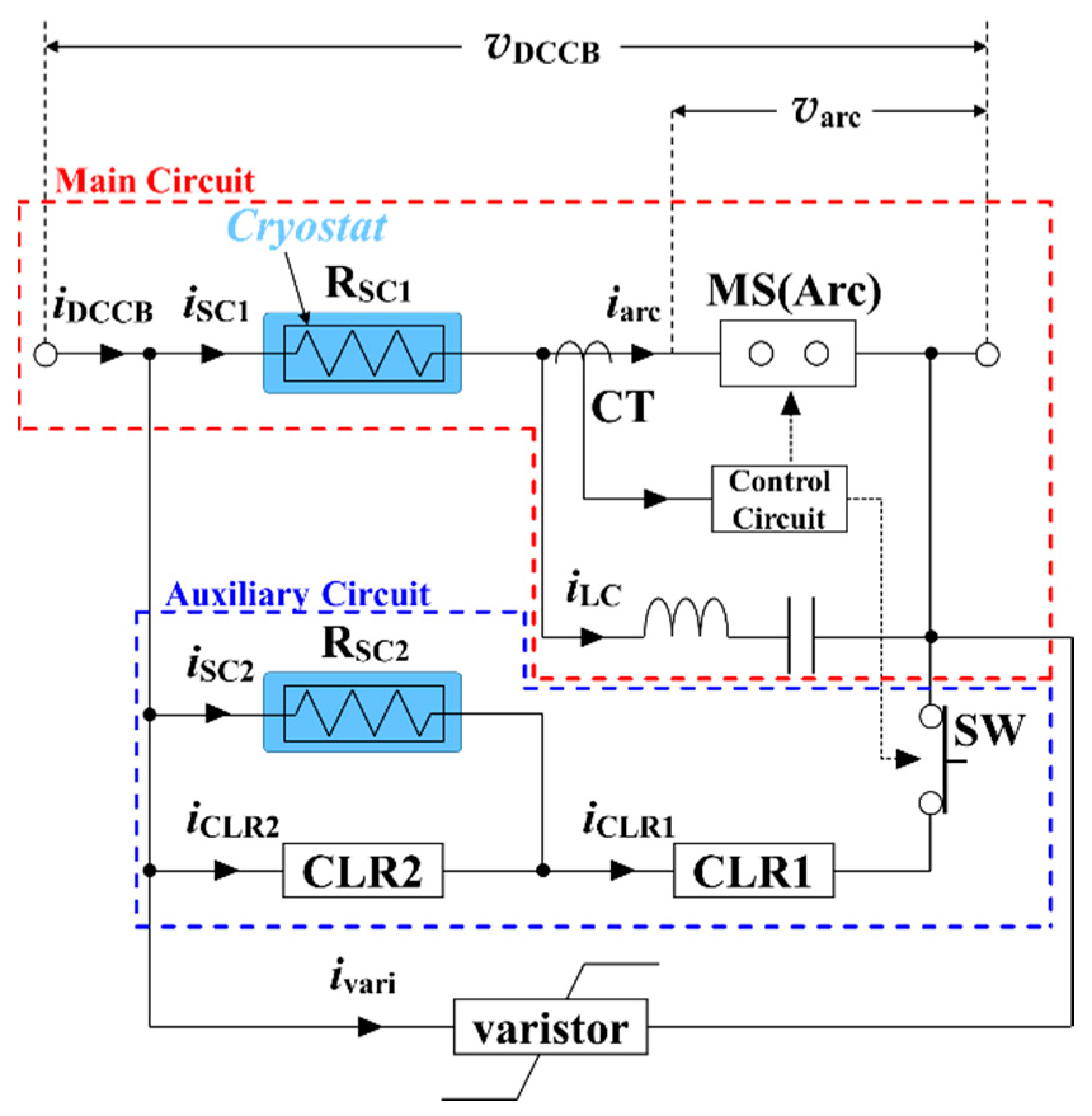
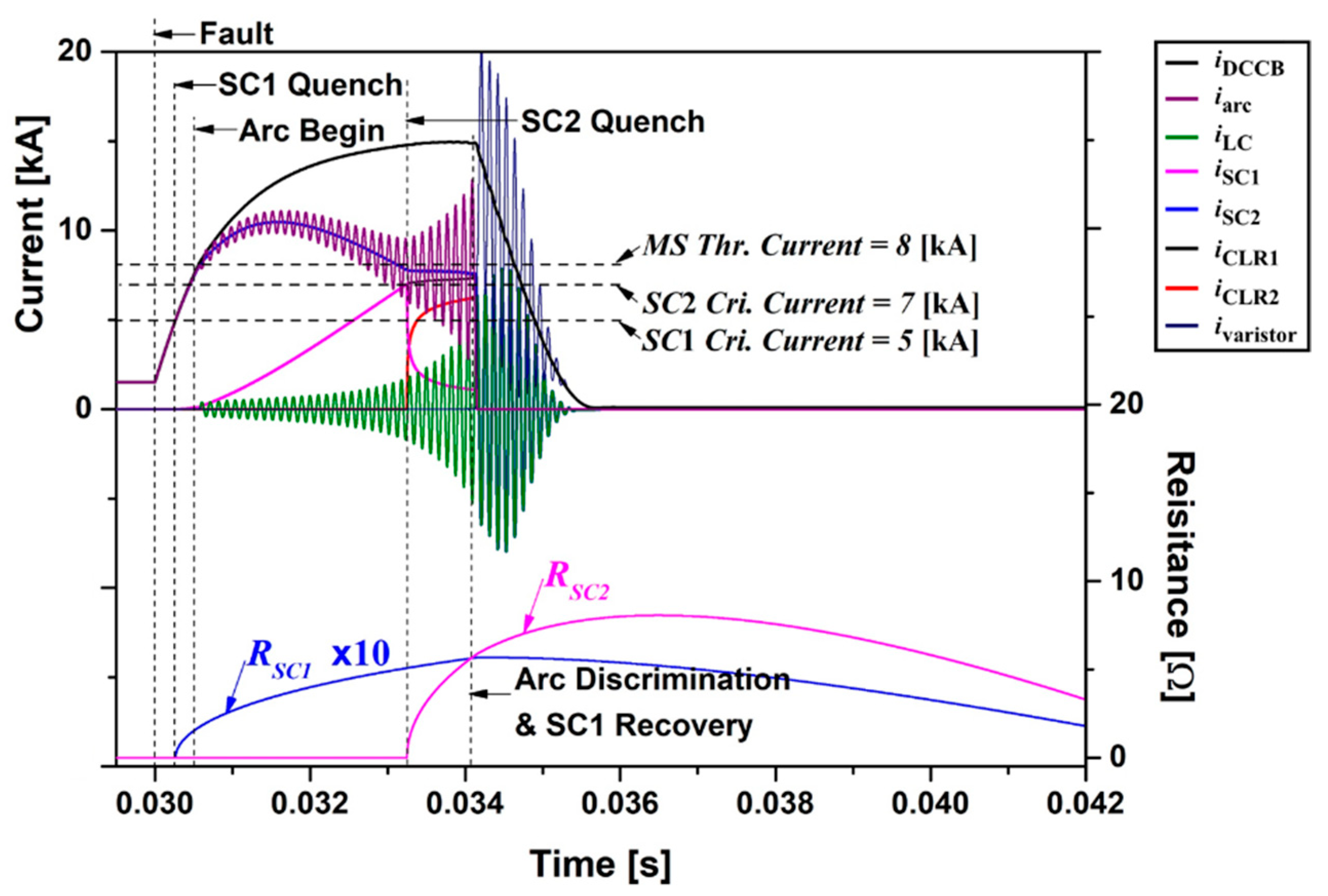
DC faults cause severe disruption in not only the DC system but also the AC system because the fault current is very large and rapidly increases. The DC circuit breaker used to separate the DC faults from the power system is still being researched, but it is very expensive due to the use of multiple power semiconductors to interrupt a large fault current in a short time. However, if the quench characteristic of a superconductor is used, the amplitude of fault current can be reduced. Therefore, it is possible to effectively interrupt a large fault current even if a relatively cheap mechanically passive DC circuit breaker is used. In the current study, a superconducting hybrid DC circuit breaker is proposed, and the limiting characteristics of each element are analyzed. By using two superconducting elements, the quench occurs sequentially twice according to the magnitude of the fault current, and the current-limiting reactor and resistance are used. If a current-limiting reactor is used in the DC system, the fault current rises slowly at the beginning of the fault, and the use of resistance can reduce the magnitude of the fault current. The inductance of the current-limiting reactor and resistance parameter settings of the hybrid DC circuit breaker was analyzed by the step-changing case method, and the interrupting characteristic of the DC circuit breaker was improved.
Keywords: superconducting hybrid DC circuit breaker; quench characteristic; step-changing case method; parameter settings superconducting hybrid DC circuit breaker; quench characteristic; step-changing case method; parameter settings