Article

Numerical Study on Influences of Drag Reducing Additive in Supercritical Flow of Kerosene in a Millichannel
1
Harbin Institute of Technology, School of Energy Science and Engineering, 92 West Dazhi Rd, Harbin 150001, China
2
Centre d’Énergétique et de Thermique de Lyon, Institut National des Sciences Appliquées de Lyon, CEDEX, F-69621 Villeurbanne, France
3
Laboratory of Thermo-Fluid Science and Nuclear Engineering, Northeast Electric Power University, Jilin 132012, China
4
School of Energy and Power Engineering, Northeast Electric Power University, Jilin 132012, China
*
Author to whom correspondence should be addressed.
Energies 2021, 14(20), 6758; https://doi.org/10.3390/en14206758
Submission received: 23 August 2021 / Revised: 24 September 2021 / Accepted: 12 October 2021 / Published: 17 October 2021
(This article belongs to the Special Issue Microfluidics and Microscale Flow and Heat/Mass Transfer)

Abstract

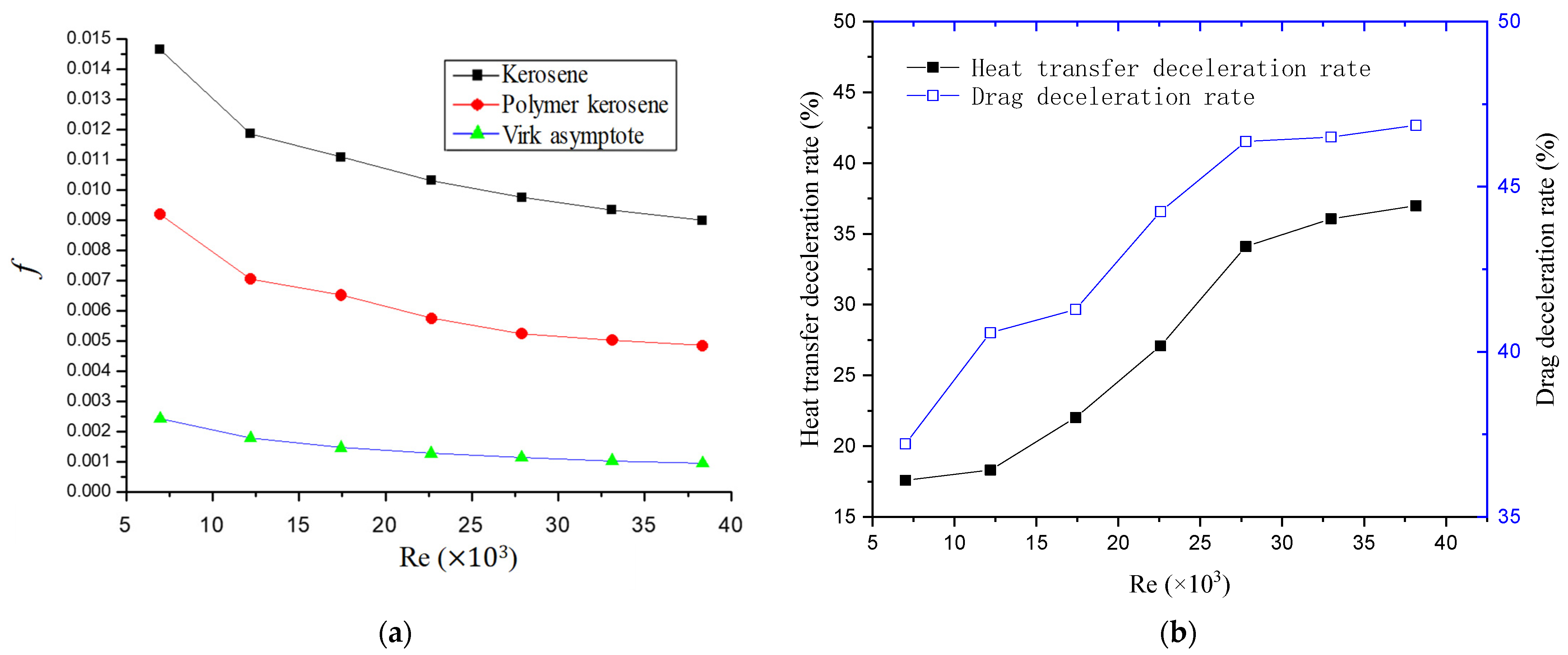
To improve the performance of a high-pressure refueling liquid oxy-kerosene engine, the influence of drag-reducing additive on the heat transfer characteristics in the supercritical flow of kerosene in a microchannel for regenerative cooling is explored. The finite-volume CFD numerical simulation method is applied using the RNG k-ε turbulence model and enhanced wall function. The current work faithfully represents the effect of the drag-reducing additive in kerosene through numerical calculations by combining a 10-component model for the physical properties of the kerosene and the Carreau non-Newtonian fluid constitutive model from rheological measurements. Results suggest that the 10-component kerosene surrogate can describe the supercritical physical properties of kerosene. The inlet temperature, inlet velocity, and the heat flux on the channel wall are driving factors for the supercritical kerosene flow and heat transfer characteristics. The pressure influence on the heat transfer is negligible. With polymer additives, the loss in pressure drop and heat transfer performance of supercritical kerosene flow decrease 46.8% and 37.5% respectively. The enhancement of engine thrust caused by reduction in pressure drop is an attractive improvement of concern.
Keywords: supercritical kerosene; polymer additive; turbulent drag reduction; flow and heat transfer supercritical kerosene; polymer additive; turbulent drag reduction; flow and heat transfer