Energy Recovery in Air Conditioning Systems: Comprehensive Review, Classifications, Critical Analysis, and Potential Recommendations

 and
and
Abstract
1. Introduction
2. Theoretical Background
3. Historical Notes
- Energy recovery systems have highly remarkable recovery systems for improving the efficiency of HVAC because they simultaneously recover latent heat, which is the heat caused by changes in phase, and sensible heat, which is the heat-related to changes in temperature where no change in phase occurs [38]. Enthalpy wheels and fixed plates with permeable materials are the types of energy recovery devices used in these systems [39,40,41].
- Heat recovery systems are unable to recover latent heat since they only recover sensible heat, although they have a significant effect on the HVAC system. The heat pipe, thermosiphon, runaround coil, and oscillating heat pipes are the types of heat recovery devices discussed in this paper [42].
3.1. Energy Recovery Systems
3.2. Heat Recovery Systems
- RW and FPHE have the highest efficiency, due to their capacity to transfer both sensible and latent heat, which increases their efficiency among other systems. Thus, RW is highly recommended. However, there are some limitations, such as the need for regular maintenance in addition to contamination, and this is why this system is not used in hospitals unless it is equipped with a filtration system.
- FPHE is a good choice, especially because it has no moving parts. However, frosting problems, high-pressure drops, and condensation build-up should be taken into consideration.
- PCM provides a great opportunity for energy storage.
- Combining PCM with other systems is recommended because PCM offers the opportunity for storing energy, and adding PCM slows the temperature rise and guarantees safe operation of the devices in the long term.
4. Research Objectives
- Providing a table about the working process and the pros and cons of each device;
- Classifying the papers using a new methodology which is:
- saved energy is used for external systems
- saved energy is used in the HVAC system equipped with the energy recovery device;
- Bringing conclusions on the reviewed papers and finding the best device based on the conclusion of each section.
5. Energy Recovery Systems
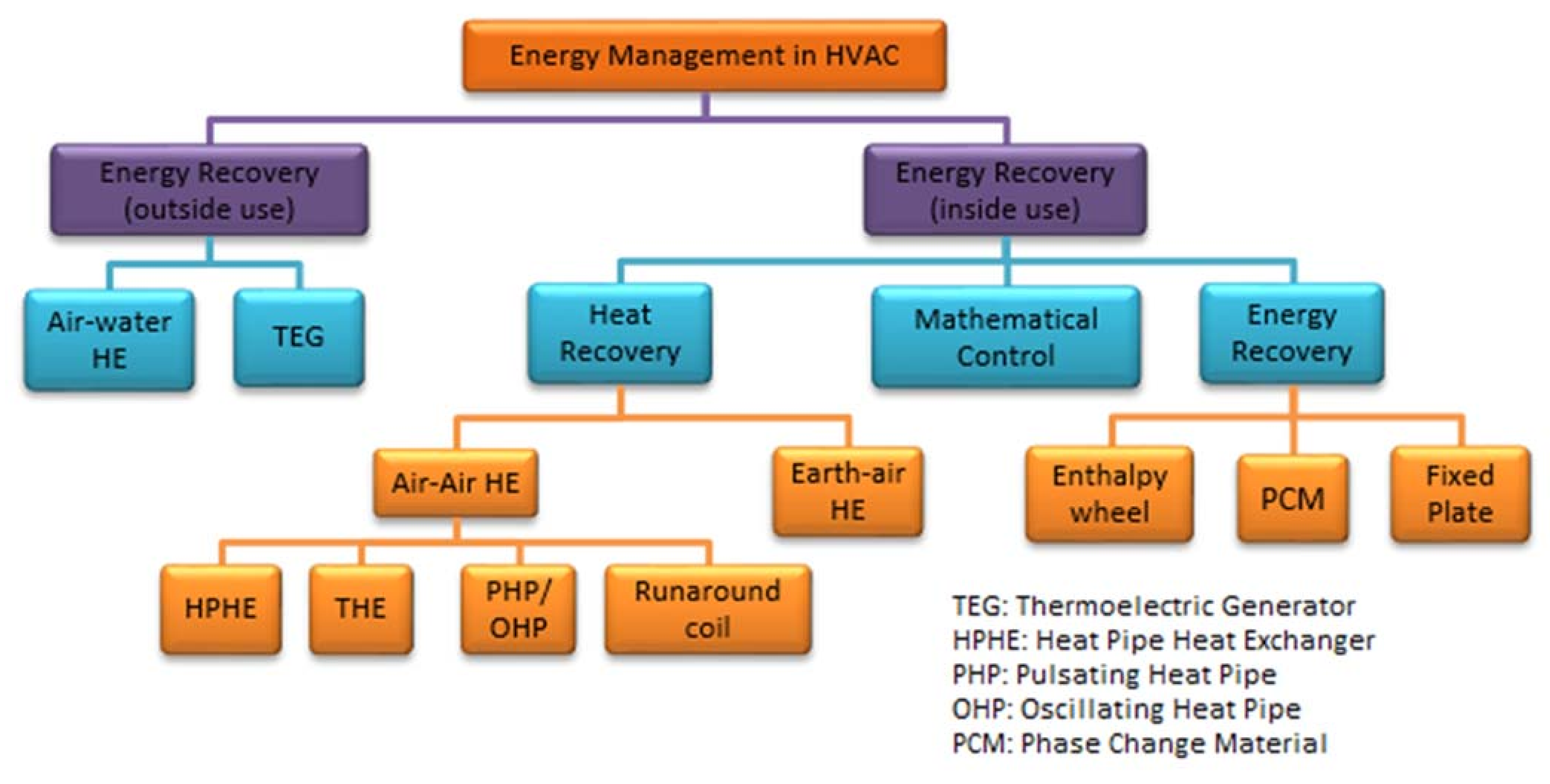
- Outside use, which means that the lost heat that is captured is used for external benefits. In other words, the saved energy is used for external systems, like generating electricity, in our case.
- Inside use, which means air saved energy is used in the HVAC system that is equipped with the energy recovery device in order to improve the efficiency and heat/cool the supply. This section is divided into:
- i.
- Heat Recovery: energy transferred in this case is just sensible heat; this energy can be transferred by different types of heat devices that will be discussed in detail in the upcoming sections.
- ii.
- Mathematical Control which is related to the controlling and predicting system, such as a smart system, with which a positive impact on saving energy has been revealed.
- iii.
- Energy Recovery or total energy recovery, which is described as total because it transfers both the latent and sensible heat; this advantage increases the efficiency and competency of the enthalpy devices in energy recovery.
5.1. Energy Recovery for Outside Use
5.1.1. Air-Water HE
- The high heat capacity of water which allows it to conduct heat at a rate which is about 25 times faster than air. Therefore, water is considered to be more efficient than air.
- The increase of the outlet temperature of the water as the load increases. This indicates that applying air to the water heat exchanger in buildings that have a high use of HVAC is very efficient.
5.1.2. Thermoelectric Generator TEG
- TEG has low efficiency due to its design.
- However, in some cases, it produces significant results due to higher gradient temperature.
- When the temperature difference increases, the value of generating electricity increases.
- TEG shows a positive effect in HVAC but some improvements should be made in order to increase its efficiency.
5.2. Energy Recovery for Inside Use
5.2.1. Heat Recovery
Air-Air HE
- Air-to-air HE decreases considerably the energy consumption, but there are some limitations according to its characteristics and specific configuration.
- Many factors affect efficiency such as working fluid, size, and climate.
- It is highly recommended to combine other systems, such as PCM, in order to overcome its overheating problem.
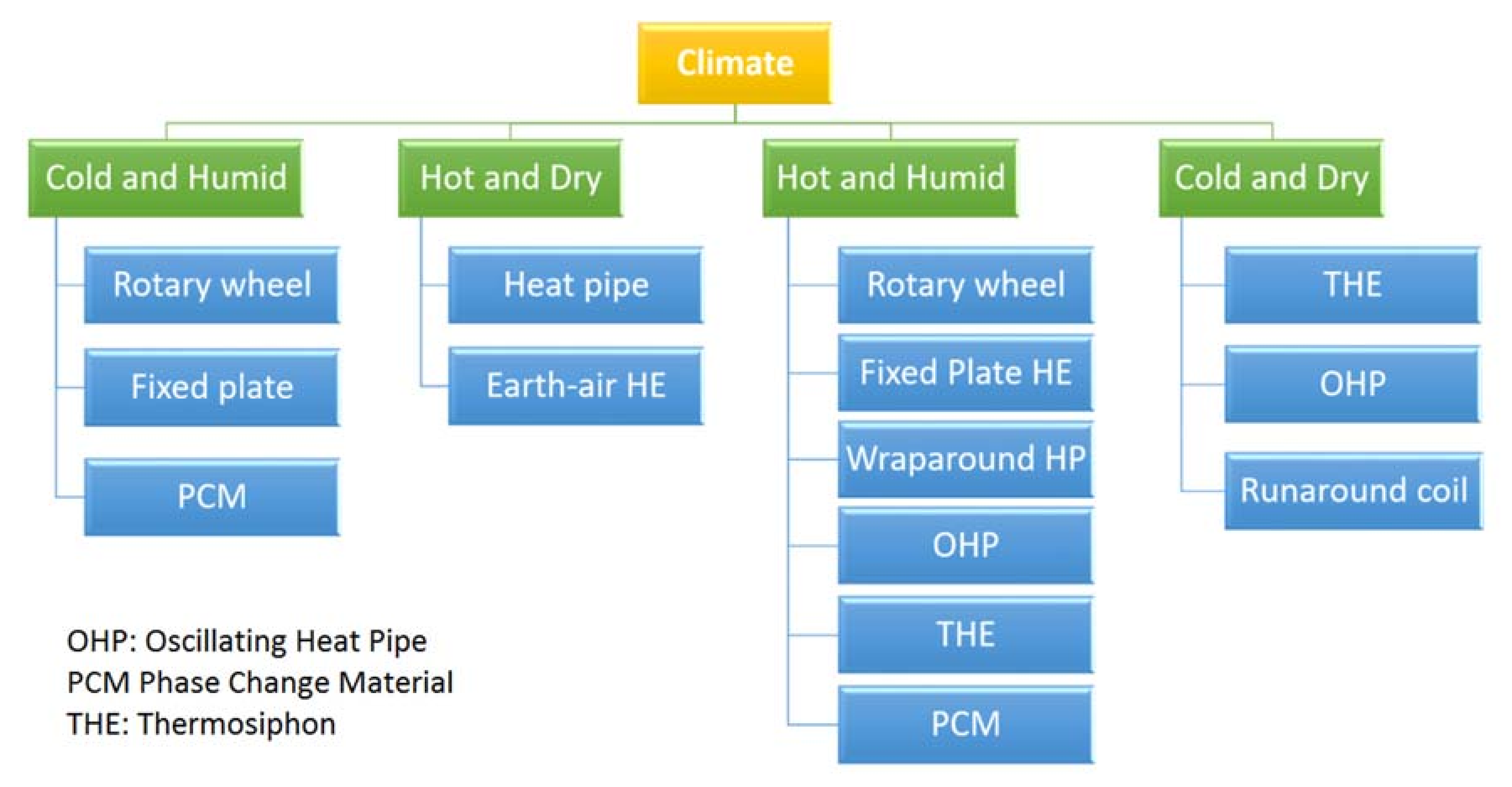
- It is noticed that OHP in continental climates can save higher energy.
- The efficiency of THE in winter is higher than in summer. It is recommended to perform a comparative study for each of THE and HPHE in different climates.
- Papers on integrating run-around coil with HVAC were not available as much as other heat recovery devices. However, it is concluded that this technology is noticed to be effective in cold climates
Earth-Air HE
- EAHE is effective in severely cold/hot weather, when the temperature is high, which results in a higher temperature gradient which means higher heat transfer.
- It is noticed that the EAHE is most efficient in hot dry climates weather.
- EAHE depends on some parameters to achieve optimum energy saving, such as the ground, soil properties, depth, climate, working fluid, geometry, and material of the pipes used. As such, location and climate should be taken into consideration.
5.2.2. Mathematical Control
5.2.3. Total Energy Recovery
Enthalpy Wheel
- EW HE is effective in HVAC applications, due to its high efficiency and ability to transfer latent and sensible energy, which can be saved.
- In addition, it was noticed that energy recovery increases when the temperature of fresh air and moisture content increases; consequently, the chance of recovering heat using EW rises.
- It is also noticed that the efficiency of RW in hot and humid climates increases.
- As such, it is recommended to study the effect of RW in a humid and cold climate. It is logical that the results will be positive where humidity has a positive effect on RW, as it recovers latent heat.
PCM
- PCM possesses a significant effect in terms of energy-saving and storage.
- The PCM+EAHE system is encouraging, especially due to its enhancement in swing temperature reduction.
- As such, it is recommended that PCM is used to aid the storage system in order to store the excess heat and discharge it gradually, such as PCM combined with HP, THE, or EAHE where PCM offers the storage which helps in extending the lifetime of the system.
Fixed Plate
- FPHE is a promising method to save energy in HVAC applications.
- It is noticed that the intake air conditions affect the performance of the system, such as increasing the airflow rate and RH, because fixed plate HE transfers latent and sensible energy.
- The shape of the fixed plate has a significant effect on the amount of recovered energy, whereby results show that the L shape fixed plate shows higher recovered energy.
- In addition, it is noticed that the amount of recovered energy is higher in humid climates than in dry and moderate climate environments.
6. Effect of Weather Conditions
7. Economic Study
8. Discussion
9. Conclusions
- Air-water HE is a very effective method to save energy. This is due to the thermal properties of water, which has a higher thermal conductivity and specific heat capacity than air. As the load increases the outlet temperature of water increases. This indicates that applying air-water heat exchangers in buildings that have a high use of HVAC is very efficient.
- TEG has low efficiency due to its design. However, it shows significant results in HVAC applications due to its main advantage, which is generating electricity from even small grade waste heat. Accordingly, this is considered a great solution in the future for decreasing the cost of power generation. However, the main challenge in TEG is to increase its efficiency.
- Smart systems have acquired high attention in HVAC for their ease of use and their significant positive effect on saving energy, but they have a high cost and require accuracy in construction.
- The most commonly used types of heat recovery are heat pipe, fixed plate, and rotary wheel devices, due to their advantages over the other devices.
- PCM provides a great opportunity for energy storage since it possesses a significant effect in terms of energy-saving and storage. Besides, the PCM + EAHE system showed significant results, which widen the research for involving PCM more in other systems, especially in regions with hot climates.
- Systems that recover sensible and latent energy (RW, FPHE, and PCM) are efficient in a humid climate. Thus, they are most efficient in a non-arid climate. However, RW and FPHE are efficient in humid climates because there is a limitation on very low temperatures that cause freezing and condensation problems. It is concluded that GHP and EAHE are applicable in hot dry-climate regions.
- Papers on integrating run-around coil with HVAC were not as commonly available as papers detailing other heat recovery devices, however, it is concluded that this technology is recognized as effective in cold climates.
- Finally, some recommendations appear:
- It is recommended that further research is undertaken that involves the smart system in heat recovery devices, where smart systems reduce energy consumption and heat recovery (HR) systems recover waste heat.
- It is recommended that hybrid heat recovery (HHR) systems are used, which means applying more than one heat recovery system at the same time.
- It is recommended that TES systems are involved more often with other HR systems, because TES system offers the storage opportunity which helps in extending the lifetime of the system. These hybrid systems could be:
- -
- PCM combined with HP, THE, TEG, or EAHE.
- -
- TEG combined with HP where HPs provides higher gradient temperature.
- -
- TEG combined with PCM, and HP.
- It was found that there was a lack of information concerning the best climatic conditions for HP. Therefore, it is recommended to do some experimental studies:
- -
- that compare the use of HP in a cold dry climate and cold humid climate;
- -
- for OHP effectiveness in a hot dry climate and compared it to a hot humid climate.
- It is recommended to design HR in the HVAC system at the beginning of the construction steps, which take into consideration the geometrical parameters of the building, location, climate, and occupants.
- The comparison was not very efficient, as there was not sufficiently consistent research that leads to more reliable results.
Author Contributions
Funding
Institutional Review Board Statement
Informed Consent Statement
Data Availability Statement
Conflicts of Interest
Nomenclature
| COP | Coefficient of Performance |
| EMS | Energy Management System |
| EW | Enthalpy Wheel |
| EAHE | Earth to Air Heat Exchanger |
| FPHE | Fixed Plate Heat Exchanger |
| HR | Heat Recovery |
| HHR | Hybrid Heat Recovery |
| HVAC | Heating, Ventilating, and Air Conditioning |
| OHP | Oscillating Heat Pipe |
| PCM | Phase Change Material |
| PHP | Pulsating Heat Pipe |
| RA | Return Air |
| RH | Relative Humidity |
| RW | Rotary Wheel |
| SA | Supply Air |
| TE | Thermoelectric |
| TEG | Thermoelectric Generator |
| TES | Thermal Energy Storage |
| THE | Thermosiphon |
| WHR | Waste Heat Recovery |
| WLHP | Wraparound Loop Heat Pipes |
References
- Chen, Y.; Zhang, D. Theory-guided deep-learning for electrical load forecasting (TgDLF) via ensemble long short-term memory. Adv. Appl. Energy 2021, 23, 100004. [Google Scholar] [CrossRef]
- Jadhav, T.; Lele, M. Theoretical energy saving analysis of air conditioning system using heat pipe heat exchanger for Indian climatic zones. Eng. Sci. Technol. 2015, 18, 669–673. [Google Scholar] [CrossRef]
- Halkos, G.E.; Gkampoura, E.-C. Reviewing Usage, Potentials, and Limitations of Renewable Energy Sources. Energies 2020, 13, 2906. [Google Scholar] [CrossRef]
- Ji, L.; Yu, Z.; Ma, J.; Jia, L.; Ning, F. The Potential of Photovoltaics to Power the Railway System in China. Energies 2020, 13, 3844. [Google Scholar] [CrossRef]
- Rehman, A.; Ghafoor, N.; Sheikh, S.; Kausar, Z.; Rauf, F.; Sher, F.; Shah, M.; Yaqoob, H. A Study of Hot Climate Low-Cost Low-Energy Eco-Friendly Building Envelope with Embedded Phase Change Material. Energies 2021, 14, 3544. [Google Scholar] [CrossRef]
- Nie, Z.; Gao, F.; Yan, C.-B. A Multi-Timescale Bilinear Model for Optimization and Control of HVAC Systems with Consistency. Energies 2021, 14, 400. [Google Scholar] [CrossRef]
- Penttinen, P.; Vimpari, J.; Junnila, S. Optimal Seasonal Heat Storage in a District Heating System with Waste Incineration. Energies 2021, 14, 3522. [Google Scholar] [CrossRef]
- Cipolletta, G.; Femine, A.D.; Gallo, D.; Luiso, M.; Landi, C. Design of a Stationary Energy Recovery System in Rail Transport. Energies 2021, 14, 2560. [Google Scholar] [CrossRef]
- Moayedi, H.; Mosavi, A. Double-Target Based Neural Networks in Predicting Energy Consumption in Residential Buildings. Energies 2021, 14, 1331. [Google Scholar] [CrossRef]
- Ramadan, M.; Ali, S.; Bazzi, H.; Khaled, M. New hybrid system combining TEG, condenser hot air and exhaust airflow of all-air HVAC systems. Case Stud. Therm. Eng. 2017, 10, 154–160. [Google Scholar] [CrossRef]
- Yang, L.; Ren, Y.; Wang, Z.; Hang, Z.; Luo, Y. Simulation and Economic Research of Circulating Cooling Water Waste Heat and Water Resource Recovery System. Energies 2021, 14, 2496. [Google Scholar] [CrossRef]
- Majumder, A.; Canale, L.; Mastino, C.; Pacitto, A.; Frattolillo, A.; Dell’Isola, M. Thermal Characterization of Recycled Materials for Building Insulation. Energies 2021, 14, 3564. [Google Scholar] [CrossRef]
- Toub, M.; Reddy, C.R.; Iii, R.D.R.; Shahbakhti, M. Integration and Optimal Control of MicroCSP with Building HVAC Systems: Review and Future Directions. Energies 2021, 14, 730. [Google Scholar] [CrossRef]
- Rismanchi, B.; Zambrano, J.M.; Saxby, B.; Tuck, R.; Stenning, M. Control Strategies in Multi-Zone Air Conditioning Systems. Energies 2019, 12, 347. [Google Scholar] [CrossRef]
- Rasouli, M.; Ge, G.; Simonson, C.J.; Besant, R.W. Uncertainties in energy and economic performance of HVAC systems and energy recovery ventilators due to uncertainties in building and HVAC parameters. Appl. Therm. Eng. 2013, 50, 732–742. [Google Scholar] [CrossRef]
- Lee, Y.; Kim, W. Development of an Optimal Start Control Strategy for a Variable Refrigerant Flow (VRF) System. Energies 2021, 14, 271. [Google Scholar] [CrossRef]
- Rosato, A.; Guarino, F.; Filomena, V.; Sibilio, S.; Maffei, L. Experimental Calibration and Validation of a Simulation Model for Fault Detection of HVAC Systems and Application to a Case Study. Energies 2020, 13, 3948. [Google Scholar] [CrossRef]
- Akbari, K.; Oman, R. Impacts of Heat Recovery Ventilators on Energy Savings and Indoor Radon in a Swedish Detached House. WSEAS Trans. Environ. Dev. 2013, 1, 24–34. [Google Scholar]
- Coraci, D.; Brandi, S.; Piscitelli, M.S.; Capozzoli, A. A multi-objective home Online Implementation of a Soft Actor-Critic Agent to Enhance Indoor Temperature Control and Energy Efficiency in Buildings. Energies 2021, 14, 997. [Google Scholar] [CrossRef]
- Avila, M.; Méndez, J.; Ponce, P.; Peffer, T.; Meier, A.; Molina, A. Energy Management System Based on a Gamified Application for Households. Energies 2021, 14, 3445. [Google Scholar] [CrossRef]
- Lee, D.; Cheng, C.-C. Energy savings by energy management systems: A review. Renew. Sustain. Energy Rev. 2015, 56, 760–777. [Google Scholar] [CrossRef]
- Michalak, P. Selected Aspects of Indoor Climate in a Passive Office Building with a Thermally Activated Building System: A Case Study from Poland. Energies 2021, 14, 860. [Google Scholar] [CrossRef]
- Bao, L.; Wang, J.; Yang, H. Investigation on the performance of a heat recovery ventilator in different climate regions in China. Energy 2016, 104, 85–98. [Google Scholar] [CrossRef]
- Smith, I.; Stosic, N.; Kovacevic, A. Applications for screw expanders. In Power Recovery from Low Grade Heat by Means of Screw Expanders; Elsevier: Amsterdam, The Netherlands, 2014; pp. 127–148. [Google Scholar]
- Couper, J.R.; Penney, W.R.; Fair, J.R.; Walas, S.M. Heat Transfer and Heat Exchangers. In Chemical Process Equipment, 3rd ed.; Elsevier: Amsterdam, The Netherlands, 2012; pp. 161–221. [Google Scholar]
- Pal, A.; Uddin, K.; Thu, K.; Saha, B.B. Environmental Assessment and Characteristics of Next Generation Refrigerants. J. Nov. Carbon Resour. Sci. Green Asia Strategy 2018, 5, 58–66. [Google Scholar] [CrossRef]
- Rackley, S.A. Low temperature and distillation systems. In Carbon Capture and Storage, 2nd ed.; Elsevier: Amsterdam, The Netherlands, 2017; pp. 227–252. [Google Scholar]
- Seyam, S. Energy and Exergy Analysis of Refrigeration Systems. In Low-Temperature Technologies; IntechOpen: London, UK, 2019. [Google Scholar]
- Ramadan, M.; El Rab, M.G.; Khaled, M. Parametric analysis of air—Water heat recovery concept applied to HVAC systems: Effect of mass flow rates. Case Stud. Therm. Eng. 2015, 6, 61–68. [Google Scholar] [CrossRef]
- Pecharsky, V.K.; Cui, J.; Johnson, D. (Magneto) caloric refrigeration: Is there light at the end of the tunnel? Philos. Trans.Math. Phys. Eng. Sci. 2016, 374, 2074. [Google Scholar] [CrossRef] [PubMed]
- Aprea, C.; Greco, A.; Maiorino, A.; Masselli, C. The Employment of Caloric-Effect Materials for Solid-State Heat Pumping. Int. J. Refrig. 2019, 19, 30396. [Google Scholar] [CrossRef]
- Nixson, M.; Paul Stephen, M.; Sam Clitus, S.; Sharoon, J.; James, D. Design of a Magneto-Caloric Refrigeration System using Gadolinium Metal Powder. Int. J. Eng. Res. Technol. 2020, 9, 659–662. [Google Scholar] [CrossRef]
- Kitanovski, A.; Plaznik, U.; Tomc, U.; Poredoš, A. Present and future caloric refrigeration and heatpump technologies. Int. J. Refrig. 2015, 57, 288–298. [Google Scholar] [CrossRef]
- Kitanovski, A. Energy Applications of Magnetocaloric Materials. Adv. Energy Mater. 2020, 10, 1903741. [Google Scholar] [CrossRef]
- Becchio, C.; Corgnati, S.P.; Vio, M.; Crespi, G.; Prendin, L.; Ranieri, M.; Vidotto, D. Toward NZEB by optimizing HVAC system configuration in different climates. Energy Procedia 2017, 140, 115–126. [Google Scholar] [CrossRef]
- Giannetti, N.; Rocchetti, A.; Saito, K.; Yamaguchi, S. Entropy parameters for desiccant wheel design. Appl. Therm. Eng. 2015, 75, 826–838. [Google Scholar] [CrossRef]
- Dodoo, A.; Gustavsson, L.; Sathre, R. Primary energy implications of ventilation heat recovery in residential buildings. Energy Build 2011, 43, 1566–1572. [Google Scholar] [CrossRef]
- Eslami, M.; Bahrami, M. Sensible and latent thermal energy storage with constructal fins. Int. J. Hydrogen Energy 2017, 42, 17681–17691. [Google Scholar] [CrossRef]
- Shen, S.; Cai, W.; Wang, X.; Wu, Q.; Yon, H. Investigation of liquid desiccant regenerator with fixed-plate heat recovery system. Energy 2017, 137, 172–182. [Google Scholar] [CrossRef]
- Ruan, W.; Qu, M.; Horton, W.T. Modeling analysis of an enthalpy recovery wheel with purge air. Int. J. Heat Mass Transf. 2012, 55, 4665–4672. [Google Scholar] [CrossRef]
- Wang, B.; Liu, Z.; Song, Q.; Wan, Y.; Ren, X. An Approach for Reducing Cutting Energy Consumption with Ultra-High Speed Machining of Super Alloy Inconel 718. Int. J. Precis. Eng. Manuf.-Green Technol. 2020, 7, 35–51. [Google Scholar] [CrossRef]
- Meshram, K.R.; Mahale, P.R.; Jadhav, T.S.; Lele, M.M. Review on Waste Heat Recovery Techniques in Air Conditioning Application. Int. J. Curr. Eng. Technol. 2016, 4, 208–212. [Google Scholar]
- Hegana, V.P.; Kulkarni, P.R. Enthalpy wheel application for heat recovery in heat exchanger. Int. J. Adv. Res. Sci. Eng. 2015, 4, 43–53. [Google Scholar]
- Nasif, M.S. Effect of utilizing different permeable material in air-to-air fixed plate energy recovery heat exchangeron energy saving. ARPN J. Eng. Appl. Sci. 2015, 10, 10153–10158. [Google Scholar]
- Breslauer, A.; Dickson, S. Heat Recovery Market for Residential and Nonresidential Applications in France; BSRIA Limited: Lille, France, 2012. [Google Scholar]
- Palombo, A. Heating and cooling energy recovery for an HVAC system: Economic analysis for the Italian climate. Int. J. Energy Res. 2001, 25, 675–688. [Google Scholar] [CrossRef]
- Nasif, M.S.; Al-Waked, R. Seasonal Weather Conditions Effect on Energy Consumption and CO2 Emission for Air Conditioning Systems Coupled with Enthalpy Energy Recovery Heat Exchanger. APCBEE Procedia 2014, 10, 42–48. [Google Scholar] [CrossRef][Green Version]
- Yau, Y.; Ahmadzadehtalatapeh, M. A review on the application of horizontal heat pipe heat exchangers in air conditioning systems in the tropics. Appl. Therm. Eng. 2010, 30, 77–84. [Google Scholar] [CrossRef]
- Yau, Y.H. The heat pipe heat exchanger: A review of its status and its potential for coolness recovery in tropical buildings. Build. Serv. Eng. Res. Technol. 2008, 29, 291–310. [Google Scholar] [CrossRef]
- Yu, Y.; An, G.; Wang, L. Major applications of heat pipe and its advances coupled with sorption system: A review. Front. Energy 2019, 13, 172–184. [Google Scholar] [CrossRef]
- Noie-Baghban, S.H.; Majideian, G.R. Waste heat recovery using heat pipe heat exchanger (HPHE) for surgery rooms in hospitals. Appl. Therm. Eng. 2000, 20, 127–1282. [Google Scholar] [CrossRef]
- Putra, N.S.D.; Anggoro, T.; Winarta, A. Experimental Study of Heat Pipe Heat Exchanger in Hospital HVAC System for Energy Conservation. Int. J. Adv.Sci. Eng. Inf. Technol. 2017, 7, 871. [Google Scholar] [CrossRef]
- Srimuang, W.; Amatachaya, P. A review of the applications of heat pipe heat exchangers for heat recovery. Renew. Sustain. Energy Rev. 2012, 16, 4303–4315. [Google Scholar] [CrossRef]
- Jouhara, H.; Almahmoud, S.; Chauhan, A.; Delpech, B.; Bianchi, G.; Tassou, S.; Llera, R.; Lago, F.; Arribas, J.J. Experimental and theoretical investigation of a flat heat pipe heat exchanger for waste heat recovery in the steel industry. Energy 2017, 141, 1928–1939. [Google Scholar] [CrossRef]
- Jain, V.; Joshi, H.; Malik, L. Thermodynamic Performance Evaluation of Heat Pipe. Int. J. Adv. Res. Innov. 2018, 6, 31–34. [Google Scholar]
- Saeed, J.; Shahid, A.; Uddin, E.; Mubashar, A. Parametric Optimization Of Heat Pipe By Component And System Analysis. Int. J. Mech. Prod. Eng. 2018, 6, 2320. [Google Scholar]
- Ahmadzadehtalatapeh, M. Improving the Energy Performance of HVAC Systems in Operating Theatres by Using Heat Recovery Devices. Int. J. Renew. Energy Res. 2014, 4, 586–592. [Google Scholar]
- Chougule, N.S.; Jadhav, T.S.; Lele, M.M. A Review on Heat Pipe for Air Conditioning applications. Int. J. Curr. Eng.Technol. 2016, 4, 204–207. [Google Scholar]
- London, A.L.; Kays, W.M. The liquid-coupled indirect transfer regenerator for gas turbine. ASME Trans. 1951, 73, 529–542. [Google Scholar]
- Mardiana-Idayu, A.; Riffat, S. Review on heat recovery technologies for building applications. Renew. Sustain. Energy Rev. 2012, 16, 1241–1255. [Google Scholar] [CrossRef]
- Wallin, J.; Madani, H.; Claesson, J. Run-around coil ventilation heat recovery system: A comparative study between different system configurations. In Proceedings of the ICAE 2010—International conference on Applied energy, Singapore, 21–23 April 2010. [Google Scholar]
- He, T.; Mei, C.; Longtin, J.P. Thermosyphon-assisted cooling system for refrigeration applications. Int. J. Refrig. 2017, 74, 165–176. [Google Scholar] [CrossRef]
- Azad, E.; Geoola, F. A design procedure for gravity-assisted heat pipe heat exchanger. J. Heat Recovery Syst. 1984, 4, 101–111. [Google Scholar] [CrossRef]
- Lee, A.B.Y. The characteristics of heat exchangers using heat pipes or thermosyphons. Heat Mass Transfer 1978, 21, 221–229. [Google Scholar] [CrossRef]
- Juengjaroennirachon, S.; Pratinthong, N.; Namprakai, P.; Suparos, T. Performance enhancement of air conditioning using thermosyphon system’s energy storage unit for cooling refrigerant before entering the condenser. J. Mech. Sci. Technol. 2017, 31, 393–400. [Google Scholar] [CrossRef]
- Zhang, L.; Pei, G.; Ji, J. Experimental study of the wickless loop thermosyphon solar water heating system under passive and active cycle mode. Int. J. Low-Carbon Technol. 2017, 12, 256–262. [Google Scholar] [CrossRef]
- Thomas, T.; Maharaja, K. Design and Analysis Of Thermosyphon Solar Air-Conditioning and Refrigeration System. Int. Res. J. Eng. Technol. 2018, 5, 3589–3595. [Google Scholar]
- Akachi, H. Structure of a Heat Pipe. U.S. Patent 4921041A, 5 May 1990. [Google Scholar]
- Lips, S.; Sartre, V.; Lefèvre, F.; Khandekar, S.; Bonjour, J. Overview of heat pipe studies during the period 2010–2015. Interfacial Phenom. HeatTransf. Begell 2016, 4, 33–53. [Google Scholar] [CrossRef]
- Chawane, P.D.; Basunathe, S.A.; Borekar, S.D. Thermal Performance of Closed Loop Pulsating Heat Pipe Using Different Working Fluid: A Review. Int. J. Eng. Sci. Invent. 2013, 2, 18–22. [Google Scholar]
- Patil, B.G.; Pachghare, P.R. Experimental Analysis Of Pulsating Heat Pipe For Air Conditioning System. Int. J. Mech. Prod. Eng. 2016, 4, 154–158. [Google Scholar]
- Maydanik, Y. Review Loop heat pipes. Appl. Therm. Eng. 2005, 25, 635–657. [Google Scholar] [CrossRef]
- Gerasimov, I.F.; Maidanik, I.F.; Dolgirev, I.E.; Kiseev, V.M.; Filippov, G.A.; Starikov, L.G. Some results of studies of low-temperature heat pipes operating against the gravitational field. J. Eng. Phys. 1976, 30, 581–586. [Google Scholar] [CrossRef]
- Akram, N.; Moazzam, U.M.; Ali, M.H.; Ajaz, A.; Saleem, A.; Kilic, M.; Mobeen, A. Improved waste heat recovery through surface of kiln using phase change material. Therm. Sci. 2018, 22, 1089–1098. [Google Scholar] [CrossRef]
- Sun, X.; Zhang, Q.; Medina, M.A.; Lee, K.O.; Liao, S. Parameter design for a phase change material board installed on the inner surface of building exterior envelopes for cooling in China. Energy Convers. Manag. 2016, 120, 100–108. [Google Scholar] [CrossRef]
- Madessa, H.B. A review of the performance of buildings integrated with Phase change material: Opportunities for application in cold climate. Energy Procedia 2014, 62, 318–328. [Google Scholar] [CrossRef]
- Agyenim, F.; Hewitt, N. Experimental investigation and improvement in heat transfer of paraffin PCM RT58 storage system to take advantage of low peak tariff rates for heat pump applications. Int. J. Low-Carbon Technol. 2012, 8, 260–270. [Google Scholar] [CrossRef]
- Rodrigues, L.T.; Gillott, M. A novel low-carbon space conditioning system incorporating phase-change materials and earth–air heat exchangers. Int. J. Low-Carbon Technol. 2013, 10, 176–187. [Google Scholar] [CrossRef]
- Guarino, F.; Dermardiros, V.; Chen, Y.; Rao, J.; Athienitis, A.; Cellura, M.; Mistretta, M. PCM thermal energy storage in buildings: Experimental study and applications. Energy Procedia 2015, 70, 219–228. [Google Scholar] [CrossRef]
- Yin, Z.; Zhiyuan, W.; Xin, W.; Yinping, Z. Optimal phase change temperature for BCHP system with PCM-TES based on energy storage effectiveness. Procedia Eng. 2017, 205, 533–539. [Google Scholar] [CrossRef]
- Darius, D.; Misaran, M.S.; Rahman, M.; Ismail, A.M.; Amaludin, A. Working parameters affecting earth-air heat exchanger (EAHE) system performance for passive cooling: A review. In Proceedings of the International Conference on Materials Technology and Energy, Miri, Malaysia, 20–21 April 2017. [Google Scholar]
- Vakiloroaya, V.; Samali, B.; Fakhar, A.; Pishghadam, K. A review of different strategies for HVAC energy saving. Energy Convers. Manag. 2014, 77, 738–754. [Google Scholar] [CrossRef]
- Pinto, A.; Rodrigues, F.; Mota, A. Geothermal contribution on southern Europe climate for energy efficiency of university buildings. Winter season. Energy Procedia 2017, 134, 181–191. [Google Scholar] [CrossRef]
- Wei, H.; Yang, D.; Guo, Y.; Chen, M. Coupling of earth-to-air heat exchangers and buoyancy for energy efficient efficient ventilation of buildings considering dynamic thermal behavior and cooling/heating capacity. Energy 2018, 147, 58–602. [Google Scholar] [CrossRef]
- Yu, Y.; Miao, R.; Miller, L.; Yang, H.; Olson, G. Recent Development and Application of Geothermal Heat Pump Systems in Cold-Climate Regions of the US: A Further Investigation. Sci. Res. Publ. 2017, 9, 625–648. [Google Scholar] [CrossRef]
- Žandeckis, A.; Kļaviņa, K.; Dzikēvičs, M.; Kirsanovs, V.; Žogla, G. Solutions for Energy Efficient and Sustainable Heating of Ventilation Air: A Review. J. Eng. Sci. Technol. Rev. 2015, 8, 98–111. [Google Scholar] [CrossRef]
- O’Connor, D.; Calautit, J.K.; Hughes, B.R. A Review of Heat Recovery Technology for Passive Ventilation Applications. Renew. Sustain. Energy Rev. 2016, 54, 1481–1493. [Google Scholar] [CrossRef]
- Shelke, V.; Yadav, R.J.; Girase, S.B. A Review of Heat Pipe Systems for Heat Recovery and Renewable Energy Application. Int. J. Curr. Eng.Technol. 2016, 4, 102–107. [Google Scholar]
- Jadhav, T.S.; Lele, M.M. A case study on energy savings in air conditioning system by heat recovery using heat pipe heat exchanger. Int. J. Res. Eng. Technol. 2014, 3, 2321–7308. [Google Scholar]
- Ali, H.M. Applications of combined/hybrid use of heat pipe and phase change materials in energy storage and cooling systems: A recent review. J. Energy Storage 2019, 26, 100986. [Google Scholar] [CrossRef]
- Lin, S.; Broadbent, J.; McGlen, R. Numerical study of heat pipe application in heat recovery systems. Appl. Therm. Eng. 2005, 25, 127–133. [Google Scholar] [CrossRef]
- Jouhara, H.; Meskimmon, R. An investigation into the use of water as a working fluid in wraparound loop heat pipe heat exchanger for applications in energy efficient HVAC systems. Energy 2018, 156, 597–605. [Google Scholar] [CrossRef]
- Nemec, P. Gravity in Heat Pipe Technology. In Gravity-Geoscience Applications, Industrial Technology and Quantum Aspect; World’s Largest Science; IntechOpen: London, UK, 2017. [Google Scholar] [CrossRef]
- Ong, K.S.; Tong, W.L. Inclination and Fill Ratio Effects on Water Filled Two-Phase Closed Thermosyphon. In Proceedings of the International 10th Pipe Heat Symposium, Taipei, Taiwan, 6–9 November 2011. [Google Scholar]
- Zaengerle, P.R. Multi-Functional, High-Performance Run Around Energy Recovery Systems in Cold Climate Zomes. In Proceedings of the Seventh International Cold Climate HVAC Conference, Calgary, AB, Canada, 12–14 November 2012. [Google Scholar]
- Alonso, M.J.; Liu, P.; Mathisen, H.M.; Ge, G.; Simonson, C. Review of heat/energy recovery exchangers for use in ZEBs in cold climate countries. Build. Environ. 2015, 84, 228–237. [Google Scholar] [CrossRef]
- Eades, W.G. Energy and water recovery using air-handling unit condensate from laboratory HVAC systems. Sustain. Cities Soc. 2018, 42, 162–175. [Google Scholar] [CrossRef]
- Wallin, J.; Madani, H.; Claesson, J. Ventilation heat recovery with run around coil: System analysis and a study on efficency improvement—Part I. In Proceedings of the Sustainability and Green Buildings, Kuwait, 3–5 October 2009. [Google Scholar]
- Yeunyongkul, P.; Sakulchangsatjatai, P.; Ghajar, A.J. Experimental Investigation of Closed Loop Oscillating Heat Pipe as the Condenser for Vapor Compression Refrigeration. In Proceedings of the International Refrigeration and Air Conditioning Conference, West Lafayette, IN, USA, 12–15 July 2010. [Google Scholar]
- Yang, H.; Khandekar, S.; Groll, M. Performance characteristics of pulsating heat pipes as integral thermal Spreaders. Int. J. Therm. Sci. 2009, 48, 815–824. [Google Scholar] [CrossRef]
- Pachghare, P.R. Effect of Inclination Angle on the Thermal Performance of Closed Loop Pulsating Heat Pipe. Int. J. Innov. Res. Sci. Technol. 2013, 3, 60–64. [Google Scholar]
- Liu, Y.; Deng, H.; Pfotenhauer, J.; Gan, Z. Design of a hydrogen pulsating heat pipe. Phys. Procedia 2015, 67, 551–556. [Google Scholar] [CrossRef]
- Yin, D.; Wang, H.; Ma, H.; Ji, Y. Operation limitation of an oscillating heat pipe. Int. J. Heat Mass Transf. 2016, 94, 366–372. [Google Scholar] [CrossRef]
- de Gracia, A.; Cabeza, L.F. Phase change materials and thermal energy storage for buildings. Energy Build. 2015, 103, 414–419. [Google Scholar] [CrossRef]
- Chen, J.; Yang, D.; Jiang, J.; Ma, A.; Song, D. Research progress of phase change materials (PCMs) embedded with metal foam (a review). Procedia Mater. Sci. 2014, 4, 369–374. [Google Scholar] [CrossRef]
- Kuta, M.; Matuszewska, D.; Wójcik, T.M. Reasonableness of phase change materials use for air conditioning—A short review. In Proceedings of the E3S Web of Conferences, Krakow, Poland, 15 March 2017. [Google Scholar]
- Tariq, S.L.; Ali, H.M.; Akram, M.A. Thermal Applications of Hybrid Phase Change Materials (Hpcms)—A Critical Review. Therm. Sci. 2020, 24, 2151–2169. [Google Scholar] [CrossRef]
- de Antonellis, S.; Intini, M.; Joppolo, C.M.; Pedranzini, F. Experimental analysis and practical effectiveness correlations ofenthalpy wheels. Energy Build. 2014, 84, 316–323. [Google Scholar] [CrossRef]
- Cuce, P.M.; Riffat, S. A comprehensive review of heat recovery systems for building applications. Renew. Sustain. Energy Rev. 2015, 47, 665–682. [Google Scholar] [CrossRef]
- Holtop, R. Heat Exchanger; Beijing Holtop Artificial Environment Technology, Co. Ltd.: Beijing, China, 2014. [Google Scholar]
- Kang, Z.; Zhou, X.; Wang, R.; Cheng, X.; Zhao, S. Research Status of Heat Recovery Device in a Train Station of Severe Cold Area. Procedia Eng. 2017, 205, 1705–1710. [Google Scholar] [CrossRef]
- Nia, F.E.; van Paassen, D.; Saidi, M.H. Mohamad Hassan Saidi, Modeling and simulation of desiccant wheel for air conditioning. Energy Build. 2006, 38, 1230–1239. [Google Scholar] [CrossRef]
- Wang, X.; Chua, H.T.; Ng, K.C. Experimental investigation of silica gel–water adsorption chillers with and without a passive heat recovery scheme. Int. J. Refrig. 2005, 28, 756–765. [Google Scholar] [CrossRef]
- Yadav, A.; Bajpai, V.K. Optimization of Operating Parameters of Desiccant Wheel for Rotation Speed. Int. J. Adv. Sci. Technol. 2011, 32, 109–116. [Google Scholar]
- O’Connor, D.; Calautit, J.K.; Hughes, B.R. A novel design of a desiccant rotary wheel for passive ventilation applications. Appl. Energy 2016, 179, 99–109. [Google Scholar] [CrossRef]
- Pinto, J.M.; Gut, J.A.W. A screening method for the optimal selection of plate heat exchanger configurations. Braz. J. Chem. Eng. 2002, 19, 433–439. [Google Scholar] [CrossRef]
- Jouhara, H.; Khordehgah, N.; Almahmoud, S.; Delpech, B.; Chauhan, A.; Tassou, S. Waste heat recovery technologies and applications. Therm. Sci. Eng. Prog. 2018, 6, 268–289. [Google Scholar] [CrossRef]
- Miró, L.; Gasia, J.; Cabeza, L.F. Thermal energy storage (TES) for industrial waste heat (IWH) recovery: A review. Appl. Energy 2016, 179, 284–301. [Google Scholar] [CrossRef]
- Nazari, M.A.; Ahmadi, M.H.; Ghasempour, R.; Shafii, M.B.; Mahian, O.; Kalogirou, S.; Wongwises, S. A review on pulsating heat pipes: From solar to cryogenic applications. Appl. Energy 2018, 222, 475–484. [Google Scholar] [CrossRef]
- Hoang, A.T. Waste heat recovery from diesel engines based on Organic Rankine Cycle. Appl. Energy 2018, 131, 138–166. [Google Scholar] [CrossRef]
- Huang, P.; Copertaro, B.; Zhang, X.; Shen, J.; Löfgren, I.; Rönnelid, M.; Fahlen, J.; Andersson, D.; Svanfeldt, M. A review of data centers as prosumers in district energy systems: Renewable energy integration and waste heat reuse for district heating. Appl. Energy 2020, 258, 114109. [Google Scholar] [CrossRef]
- Abdel-Salam, M.R.; Fauchoux, M.; Ge, G.; Besant, R.W.; Simonson, C.J. Expected energy and economic benefits, and environmental impacts for liquid-to-air membrane energy exchangers (LAMEEs) in HVAC systems: A review. Appl. Energy 2014, 127, 202–218. [Google Scholar] [CrossRef]
- Ben Romdhane, S.; Amamou, A.; Ben Khalifa, R.; Saïd, N.M.; Younsi, Z.; Jemni, A. A review on thermal energy storage using phase change materials in passive building applications. J. Build. Eng. 2020, 32, 101563. [Google Scholar] [CrossRef]
- Shehadi, M. Review of humidity control technologies in buildings. J. Build. Eng. 2018, 19, 539–551. [Google Scholar] [CrossRef]
- She, X.; Cong, L.; Nie, B.; Leng, G.; Peng, H.; Chen, Y.; Zhang, X.; Wen, T.; Yang, H.; Luo, Y. Energy-efficient and -economic technologies for air conditioning with vapor compression refrigeration: A comprehensive review. Appl. Energy 2018, 232, 157–186. [Google Scholar] [CrossRef]
- Chua, K.J.; Chou, S.; Yang, W.; Yan, J. Achieving better energy-efficient air conditioning—A review of technologies and strategies. Appl. Energy 2013, 104, 87–104. [Google Scholar] [CrossRef]
- Ramyashree, A.P.; Joel, A.D.; Rakshith, H.S.; Impha, Y.D.; Mahammad, Y.C.; Ajaygan, K.; Mustaqeem, R.; Mohammed, I.M.A.; Harsharaj, K. Heat Recovery from Air Conditioner. J. Mech. Eng. Autom. 2016, 6, 113–116. [Google Scholar]
- Okuma, T.; Radermacher, R.; Hwang, Y. A Novel Application of Thermoelectric Modules in an HVAC System Under Cold Climate Operation. J. Electron. Mater. 2012, 41, 1749–1758. [Google Scholar] [CrossRef]
- Stalin, M.J.; Krishnan, S.M.; Kumar, G.V. Efficient Usage Of Waste Heat From Air. Int. J. Adv. Eng. Technol. 2012, 4, 414–423. [Google Scholar]
- Lokapure, R.B.; Joshi, J.D. Waste Heat Recovery through Air Conditioning System. Int. J. Eng. Res. Dev. 2012, 5, 87–92. [Google Scholar]
- Aridi, R.; Faraj, J.; Ali, S.; Lemenand, T.; Khaled, M. Thermoelectric Power Generators: State-of-the-Art Heat Recovery Methods, and Challenges. Electricity 2021, in press. [Google Scholar]
- Kumar, P.M.; Kathiravan, I.; Aadhithyan, G.; Prabu, C.; Bharath, N. Electric Power Generation Using Refrigeration Waste Heat. Int. J. Res. Appl. Sci. Eng. Technol. (IJRASET) 2015, 3, 207–712. [Google Scholar]
- Damanhuri AA, M.; Abdullah MI, H.C.; Lubis AM, H.S.; Zakaria, M.Z.; Hussin MS, F.; Kasno, M.A. Development of TEG Peltier Device for Heat Harvesting from 1.5 HP Split Unit Air Conditioning System. Int. J. Appl. Eng. Res. 2018, 13, 2390–2394. [Google Scholar]
- Trinidad, P.M.P.; Carbajal, G. Potential use of Thermoelectric Generator Device for Air Conditioning System. In Proceedings of the 13th LACCEI Annual International Conference, Santo Domingo, Dominican Republic, 29–31 July 2015. [Google Scholar]
- Papakostas, K.; Kiosis, G. Heat recovery in an air-conditioning system with air-to-air heat exchanger. Int. J. Sustain. Energy 2014, 34, 221–231. [Google Scholar] [CrossRef]
- Yau, Y.H.; Ahmadzadehtalatapeh, M. Heat Pipe Heat Exchanger And Its Potential To Energy Recovery In The Tropics. Therm. Sci. 2015, 19, 1685–1697. [Google Scholar] [CrossRef]
- Firouzfar, E.; Soltanieh, M.; Noie, S.H.; Saidi, M.H. Application of heat pipe heat exchangers in heating, ventilation and air conditioning (HVAC) systems. Sci. Res. Essays 2011, 6, 1900–1908. [Google Scholar]
- Sanaye, S.; Modarrespoor, D. Thermal-Economic Multiobjective Optimization Of Heat Pipe Heat Exchanger For Energy Recovery In Hvac Applications Using Genetic Algorithm. Therm. Sci. 2014, 18, 375–391. [Google Scholar] [CrossRef]
- Ahmadzadehtalatapeh, M. An air-conditioning system performance enhancement by using heat pipe based heat recovery technology. Sci. Iran. 2013, 20, 329–336. [Google Scholar]
- Ma, G.; Zhou, F.; Liu, T.; Wang, L.; Liu, Z. Energy-Saving Evaluation of a Thermosyphon Heat Recovery Unit for an Air-Conditioning System. Heat Transf.-Asian Res. 2013, 42, 377–388. [Google Scholar] [CrossRef]
- Vanyasree, G.; Ramana, P.V. Experimental Analysis On Thermosyphon Heatpipe To Find Heat Transfer Coefficent. Int. Res. J. Eng. Technol. (IRJET) 2017, 4, 129–136. [Google Scholar]
- Mahajan, G.; Thompson, S.M.; Cho, H. Energy and cost savings potential of oscillating heat pipes for waste heat recovery ventillation. Energy Rep. 2017, 3, 46–53. [Google Scholar] [CrossRef]
- Supirattanakul, P.; Rittidech, S.; Bubphachot, B. Application of a closed-loop oscillating heat pipe with check valves (CLOHP/CV) on performance enhancement in air conditioning system. Energy Build. 2011, 43, 1531–1535. [Google Scholar] [CrossRef]
- Mahajan, G.; Cho, H.; Thompson, S.M.; Rupp, H.; Muse, K. Oscillating heat pipes for waste heat recovery in hvac systems. In Proceedings of the ASME IMECE 2015, Houston, TX, USA, 13–19 November 2015. [Google Scholar]
- Barua, P.K.; Deka, D.; Dixit, U.S. Mathematical Modelling of Change of Temperature in Pulsating Heat Pipes with Single Loops. Int. J. Energy Inf. Commun. 2011, 2, 33–52. [Google Scholar]
- Reddy, S.K.; Babu, S.A.; Arokiyaraj, C.; Naik, G.; Shukla, S.; Masamsetty, B.; Alexander, K. Air Conditioning System with Ground Source Heat Exchanger. IOSR J. Mech. Civ. Eng. (IOSR-JMCE) 2015, 12, 20–24. [Google Scholar]
- Woodson, T.; Coulibaly, Y.; Traoré, E.S. Earth-Air Heat Exchangers for Passive Air Conditioning: Case Study Burkina Faso. J. Constr. Dev. Ctries. 2012, 17, 21–32. [Google Scholar]
- Tiwari, G.N.; Singh, V.; Joshi, P.; Deo, A.; Gupta, P.A.; Shyam. Design of an Earth Air Heat Exchanger (EAHE) for Climatic Condition of Chennai, India. Open Environ. Sci. 2014, 8, 24–34. [Google Scholar]
- Congedo, P.M.; Lorusso, C.; De Giorgi, M.G.; Marti, R.; D’Agostino, D. Horizontal Air-Ground Heat Exchanger Performance and Humidity Simulation by Computational Fluid Dynamic Analysis. Energies 2016, 9, 930. [Google Scholar] [CrossRef]
- Fazlikhani, F.; Goudarzi, H.; Solgi, E. Numerical analysis of the efficiency of earth to air heat exchange systems in cold and hot-arid climates. Energy Convers. Manag. 2017, 148, 78–89. [Google Scholar] [CrossRef]
- Elhelw, M. Analysis of energy management for heating, ventilating and air-conditioning systems. Alex. Eng. J. 2016, 55, 811–818. [Google Scholar] [CrossRef][Green Version]
- Sayadi, S.; Tsatsaronis, G.; Morosuk, T. Reducing the Energy Consumption of HVAC Systems in Buildings by Using Model Predictive Control. In Proceedings of the CLIMA 2016—12th REHVA World Congress, Aalborg, Denmark, 22–25 May 2016. [Google Scholar]
- Wang, W.; Lin, Z.; Chen, J. Promoting energy efficiency of HVAC operation in large office spaces with a wifi probe enabled Markov time window occupancy detection approach. Energy Procedia 2017, 143, 204–209. [Google Scholar] [CrossRef]
- Zlatanović, I.; Gligorevic, K.; Ivanovic, S.; Rudonja, N. Energy-saving estimation model for hypermarket HVAC systems applications. Energy Build. 2011, 43, 3353–3359. [Google Scholar] [CrossRef]
- Godina, R.; Rodrigues, E.M.G.; Pouresmaeil, E.; Matias, J.C.O.; Catalao, J.P.S. Model Predictive Control Home Energy Management and Optimization Strategy with Demand Response. Appl. Sci. 2018, 8, 408. [Google Scholar] [CrossRef]
- Cotrufo, N.; Zmeureanu, R. Virtual outdoor air flow meter for an existing HVAC system in heating mode. Autom. Constr. 2018, 92, 166–172. [Google Scholar] [CrossRef]
- Aste, N.; Manfren, M.; Marenzi, G. Building Automation and Control Systems and performance optimization: A framework for analysis. Renew. Sustain. Energy Rev. 2017, 75, 13–330. [Google Scholar] [CrossRef]
- Osma, G.; Amado, L.; Villamizar, R.; Ordoñez, G. Building Automation Systems as Tool to Improve the Resilience from Energy Behavior Approach. Procedia Eng. 2015, 118, 861–868. [Google Scholar] [CrossRef]
- Hakimi, S.M. A novel intelligent control of HVAC system in smart microgrid. J. Electr. Syst. Inf. Technol. 2017, 4, 299–309. [Google Scholar] [CrossRef]
- Salsbury, T.I. A survey of control technologies in the building automation industry. IFAC Proc. 2005, 38, 90–100. [Google Scholar] [CrossRef]
- Rezeka, S.F.; Attia, A.-H.; Saleh, A.M. Management of air-conditioning systems in residential buildings by using fuzzy logic. Alex. Eng. J. 2015, 54, 91–98. [Google Scholar] [CrossRef][Green Version]
- Wang, L.; Haves, P.; Breshears, J. The Energy Saving Potential of Membrane-Based Enthalpy Recovery in Vav Systems for Commercial Office Buildings. In Proceedings of the Fifth National Conference of IBPSA-USA, Madison, WI, USA, 1–3 August 2012. [Google Scholar]
- Ali, S.M.; Naik, B.B.; Ali, M.M. Designing HVAC Systems using HRW as an ECM for Energy Efficient Buildings. Int. J. Sci. Eng. Res. 2016, 7, 245–249. [Google Scholar]
- Hussaini, S.M.; Khan, I. Designing HVAC system with and without Heat Recovery Wheel using ECO-FRESH Enthalpy wheel. Int. J. Sci. Eng. Res. 2017, 8, 854–857. [Google Scholar]
- Bellia, L.; Mazzei, P.; Minichiello, F.; Palma, D. Air Conditioning Systems With Desiccant Wheel For Italian Climates. Int. J. Archit. Sci. 2000, 1, 193–213. [Google Scholar]
- Herath, H.; Wickramasinghe, M.; Polgolla, A.; Jayasena, A.; Ranasinghe, R.; Wijewardane, M. Applicability of rotary thermal wheels to hot and humid climates. Energy Rep. 2020, 6, 539–544. [Google Scholar] [CrossRef]
- Chaiyat, N.; Kiatsiriroat, T. Energy reduction of building air-conditioner with phase change material in Thailand. Case Stud. Therm. Eng. 2014, 4, 175–186. [Google Scholar] [CrossRef]
- Madyira, D.M. Experimental study for the performance of PCM air cooling rig. Procedia Manuf. 2017, 7, 420–426. [Google Scholar] [CrossRef]
- Choi, W.-C.; Khil, B.-S.; Chae, Y.-S.; Liang, Q.-B.; Yun, H.-D. Feasibility of Using Phase Change Materials to Control the Heat of Hydration in Massive Concrete Structures. Sci. World J. 2014, 2014, 6. [Google Scholar] [CrossRef]
- Sahu, L.K.; Mondloe, D.; Garhewal, A. A review on thermal and mechanical properties of concrete containing phase change material. Int. Res. J. Eng. Technol. (IRJET) 2017, 4, 33–52. [Google Scholar]
- Zafirah, M.; Mardiana, A. Experimental investigation on the performance of an air-to-air energy recovery for building applications in hot-humid climate. J. Mech. Eng. Sci. (JMES) 2016, 10, 857–1864. [Google Scholar] [CrossRef]
- Nasif, M.S.; Al-Waked, R. Effect of air to air fixed plate enthalpy energy recovery heat exchanger flow profile on air conditioning system energy recovery. Appl. Mech. Mater. 2015, 819, 245–249. [Google Scholar] [CrossRef]
- Nasif, M.; Al-Waked, R.; Morrison, G.; Behnia, M. Membrane heat exchanger in HVAC energy recovery systems, systems energy analysis. Energy Build. 2010, 42, 1833–1840. [Google Scholar] [CrossRef]
- Nasif, M.S. Air-to-Air Fixed Plate Energy Recovery Heat Exchangers for Building’s HVAC Systems. Appl. Sci. Technol. 2018, 63, 63–71. [Google Scholar]
- Papakostas, K.; Slini, T. Effects of Climate Change on the Energy Required for the Treatment of Ventilation Fresh Air in HVAC Systems The Case of Athens and Thessaloniki. Procedia Environ. Sci. 2017, 38, 852–859. [Google Scholar] [CrossRef]
- Labban, O.; Chen, T.; Ghoniem, A.F.; Lienhard, J.H.; Norford, L.K. Next-generation HVAC: Prospects for and limitations of desiccant and membrane-based dehumidification and cooling. Appl. Energy 2017, 200, 330–346. [Google Scholar] [CrossRef]
- Tafelmeier, S.; Pernigotto, G.; Gasparella, A. Annual Performance of Sensible and Total Heat Recovery in Ventilation Systems: Humidity Control Constraints for European Climates. Buildings 2017, 7, 28. [Google Scholar] [CrossRef]
- Kassai, M.; Kajtar, L. Cooling energy saved investigation of air-to-air heat-and energy exchangers. In Proceedings of the EXPRES 2016, 8th International Symposium on Exploitation of Renewable Energy, Subotica, Serbia, 31 March–2 April 2016. [Google Scholar]
- Kassai, M. A developed method for energy saving prediction of heat-and energy recovery units. Energy Procedia 2016, 85, 311–319. [Google Scholar] [CrossRef]
- Tafelmeier, S.; Longo, G.A.; Gasparella, A. Energy and Economic Performance Analysis of Heat Recovery Devices under Different Climate Conditions. In Proceedings of the International High Performance Buildings Conference, Lecce, Italy, 17–18 November 2016; p. 196. [Google Scholar]
- Wu, X.P.; Johnson, P.; Akbarzadeh, A. A study of heat pipe heat exchanger effectiveness in an air conditioning application. In Proceedings of the 5th International Heat pipe symposium, Melbourne, Australia, 17–20 November 1996. [Google Scholar]
- Kumar, D.A. Ecofresh: For Better Indoor Air Quality. Int. J. Eng. Res. Gen. Sci. 2016, 4, 1–11. [Google Scholar]
- Bordoloi, N.; Sharma, A.; Nautiyal, H.; Goel, V. An intense review on the latest advancements of Earth Air Heat Exchangers. Renew. Sustain. Energy Rev. 2018, 89, 261–280. [Google Scholar] [CrossRef]
- Eidan, A.A.; Najim, S.E.; Jalil, J.M. Experimental Investigation of Thermosyphone Heat Exchanger on Dehumidification Enhancement for Hot and Humid Climates Used in HVAC Systems. In Proceedings of the First Conference For Engineering Sciences and Technology, Wuhan, China, 21–22 March 2015. [Google Scholar]
- Saffari, M.; De Gracia, A.; Fernández, C.; Zsembinszki, G.; Cabeza, L.F. Study on the optimum PCM melting temperature for energy savings in residential buildings worldwide. IOP Conf. Ser. Mater. Sci. Eng. 2017, 251, 012113. [Google Scholar] [CrossRef]
- Reddy, K.S.; Mudgal, V.; Mallick, T.K. Thermal Performance Analysis of Multi-Phase Change Material Layer-Integrated Building Roofs for Energy Efficiency in Built-Environment. Energies 2017, 10, 1367. [Google Scholar] [CrossRef]
- Madhumathi, A.A.; Sundarraja, B.M.C. Experimental study of passive cooling of building facade using phase change materials to increase thermal comfort in buildings in hot humid areas. Int. J. Energy Environ. 2012, 3, 739–748. [Google Scholar]
- Lingxue, L. Analysis of economic and environmental benefits of a new heat pump air conditioning system. Earth Environ. Sci. 2017, 81, 012177. [Google Scholar]
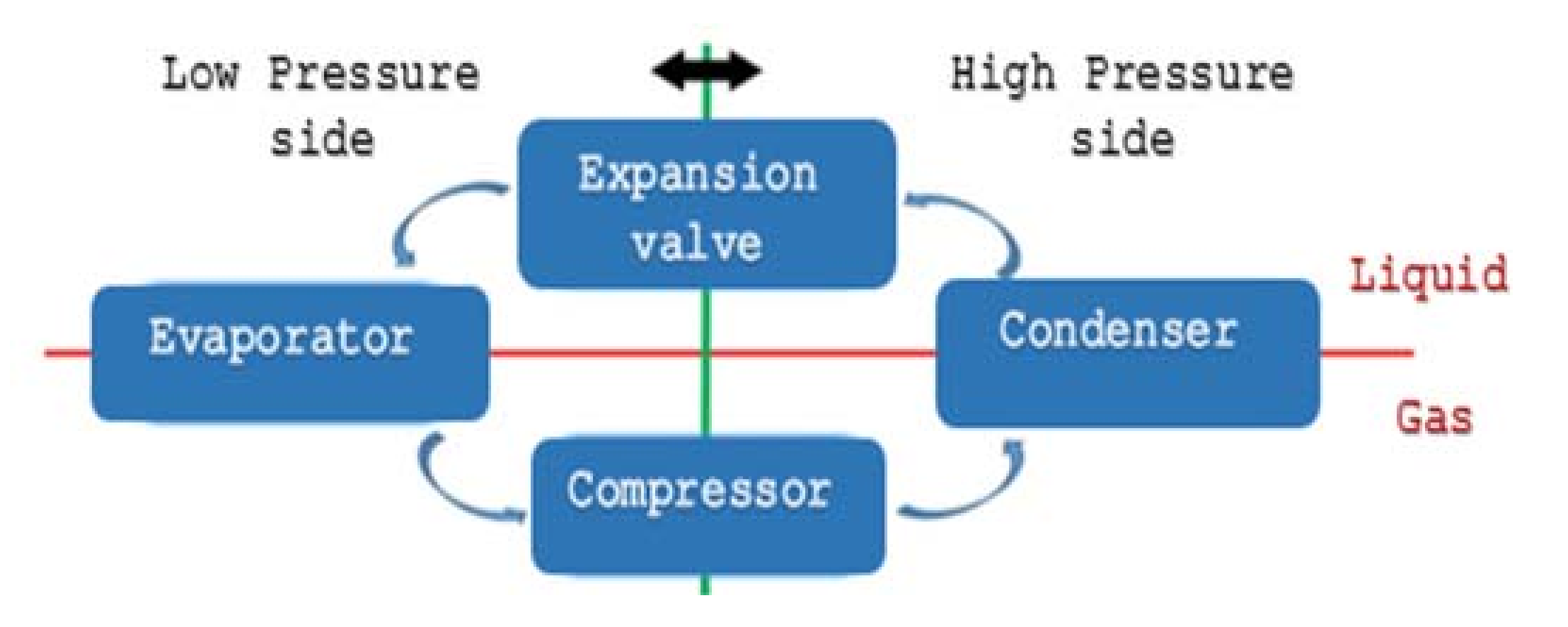
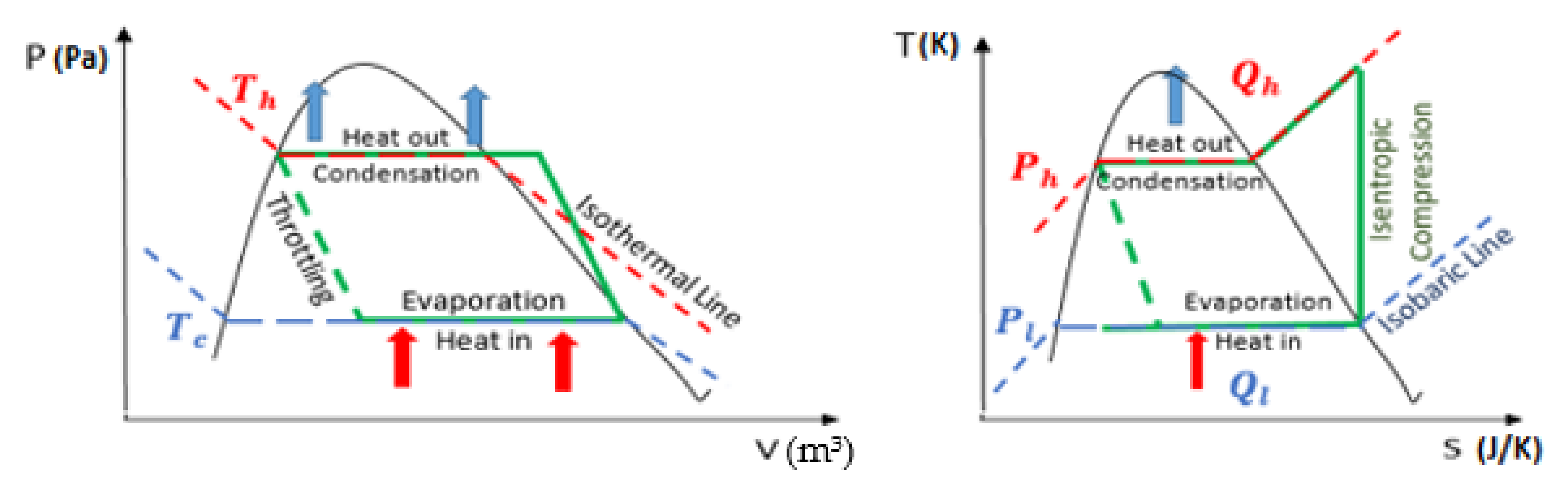



| Devices | Working Process | Advantages | Disadvantage | Parameters |
|---|---|---|---|---|
Heat Pipe | In the evaporator section, liquid in the pipe evaporates due to the temperature which is above the boiling point of the liquid; vapor then goes through an adiabatic section in a vapor form; it then reaches condenser section which returns into liquid due to the temperature which is below the dew point of the vapor; the liquid goes back to the evaporator section through the wick structure. |
| Performance of HP is affected by the operating conditions and the design of the HP [91]:
| |
Thermosiphon | The process in thermosiphon is the same as in the heat pipe, but with no wick structure. Liquid returns back to the evaporator section due to gravity; for this reason, thermosiphon is called gravity pipe or wickless heat pipe [92]. |
|
| Efficiency is affected by the design of the thermosiphon:
|
Runaround out in out in | This system consists of two or more multi-row finned tube coils linked to each other by a pump that runs the cycle. Outside air enters the supply air-handling unit (SAHU), in heating mode; pipework transfers the heat from the exhaust air-handling unit (EAHU) through the circulating fluid to the SAHU. Return air enters the EAHU and transmits its heat to the pipework then circulating fluid. Hence, heat is transmitted from the EA stream over the pipework coil to the flowing fluid, and then from the fluid over the pipework coil to the SA stream [95]. | Factors that affect runaround coil [98]:
| ||
OHP [70] | PHP is evacuated, and then slightly filled by working fluid. At the evaporator end, the tube is exposed to a high temperature, which leads to evaporating the working fluid, which increases the vapor pressure, and expansion of the bubbles in this zone. The growing bubbles push the liquid to the condenser, which is at a low temperature. The low temperature causes condensation and a further increase in pressure difference. However, because the tubes are linked, liquid and vapor bubble motion at the evaporator section push the liquid at the condenser back to the evaporator section. | Operating limitations for PHP such as [102]:
| ||
PCM | PCM is a material with high thermal energy storage (TES) density and high power capacity for charging and discharging. This material melts and solidifies at a specific temperature. When the material phase is changed from liquid to solid and vice versa, heat is captured or released. This makes PCM latent heat storage [75]. | TES by [104]:
|
| Requirements of PCM [106]:
|
Rotary Enthalpy Wheel [108] | Rotary Wheel (RW) exchanges heat and humidity from one air stream to another. The wheel rotates at a constant speed, the channel is subjected to two counter-flow arrangement streams. Outside Air (OA) enters the wheel, heat is transferred from the lower section to the Supply Air (SA), Return Air (RA) enters the lower section and transmits the heat to the wheel and leaves as Exhaust Air (EA) with lower temperature. In cooling mode, the coming air is pre-cooled and dehumidified. Moisture is given to the wheel, containing a hygroscopic substance or coated with desiccant to absorb humidity. | Enthalpy wheel depends upon [108]:
| ||
Fixed Plate | Fixed Plate Heat Exchanger (FPHE) contains a box with a set of parallel metal or plastic plates which allows the removed air to pass over the incoming air, transmitting the energy and warming it up. The two air streams are parted by the plates and do not mix. Liquid desiccant dehumidification system (LDDS) can be added to the FPHE to recover latent and sensible energy. |
|
| Parameters that affect Fixed plate [116]:
|
| Authors | Methodology | Result |
| Ramadan et al., 2015 [29] | Counter-flow concentric tube heat exchanger at the condenser is used. Hot air upcoming from the condenser warmth up the water inside the tube. | The outlet temperature of the water rises from 304 K to 347 K when the cooling load rises from 3.52 to 63.31 kW. |
| Stalin et al., 2012 [129] | One inlet and one outlet tank are used for water flow, a pump is used for circulating water from tank to the water-cooled condenser, and this procedure lasts until the desired temperature is reached. | 2.71 h are spent to raise the temperature of 350 L of water from 20 °C to 50 °C with a payback period of 6 months. |
| Lokapure et al., 2012 [130] | A refrigerant to water HE is placed between the compressor and the condenser. Water is propagated through one side of HE, and hot refrigerant gas from the compressor is transmitted over the other side. Heat is then transmitted from the hot refrigerant to the water. | Inlet water of 33 °C becomes 43 °C outlet water, the heat in the water is increased by 30.3%.The COP of the system is raised by 13.66% after using the HE with the air conditioner. |
| Authors | Methodology | Result |
|---|---|---|
| Ramadan et al., 2017 [10] | Placing a flat plate TEG of 40 × 40 cm2 horizontally where the air of the condenser is considered the heat source and the exhaust airflow is used as a cooler. | At a load of 100 kW, TEG was able to generate 90 W of electrical power |
| Kumar et al., 2015 [132] | TEG in a vertical direction facing the condenser from a side and the outside air from another side. | 30% of waste heat is recovered by the condenser side. |
| Damanhuri et al., 2018 [133] | Six Peltier were arranged between Cu plates. 3 cases were monitor depended on the temperature difference of the cooling coil and condenser temperature. | A difference temperature of 9–10 °C and the load of 1.5 hp generated 1.61 V. |
| Trinidad et al., 2015 [134] | Experimental studies on a TEG array design were held to study the energy consumption of this device. The hot air and cold air entered a square channel with a wall separating them. The hot air entered the bottom section and the cold air entered the top section. The hot side had 1850W maximum capacity while the electrical loads ranged from 390 to 760 Ω. | Results show that the application of the electrical load has a high effect on the gradient temperature between the outlet and inlet of the hot air. On the other hand, the numerical analysis indicates that this system behaves differently compared to that of a conventional counter flow heat exchanger. |
| Authors | Methodology | Results | |
|---|---|---|---|
| HPHE | Yau et al., 2015 [136] | HPHE with 2, 4, 6, and 8 numbers of rows were tested. The coil face velocity was 2 m/s and the return air temperature was at 24 °C. The results of the HPHE were recorded for one week. | The results showed that a total amount of 2885 kWh can be saved yearly; this amount can be raised to 7023 kWh per year if eight-rows HPHX was used. The volumetric flow rate is increased, and a higher amount of energy recovery is expected as the face velocity is increased, but this results in a higher-pressure drop in the coil, which decreases the effectiveness. |
| Firouzfar et al., 2011 [137] | HPHE is placed in two streams of fresh air (32–40 °C) and return air (26 °C) in AC. Ratios of mass flow rates 1, 1.5, and 2.3 were tested to observe heat transfer and change in the temperature of fresh air. | The heat transfer and effectiveness rate of both the condenser and evaporator sections were raised to 48%. | |
| Sanaye et al., 2014 [138] | A HPHE, made from copper with water as working fluid and wick structure of 10 sheets of the 100-mesh bronze screen, is placed horizontally to recover heat from the exhaust air, in heating mode, and transfers it to the cold inlet fresh air; whereas, in cooling mode, it pre-cools the hot inlet fresh air. | The optimal point is with the effectiveness of 0.774 and a total cost of $1474, with a return period of about 2.5 years. | |
| Ahmadzadehtalatapeh, 2013 [139] | TRNSYS software was used to study the hourly influence of HPHE on HVAC. Eight-row HPHE was added with an average of 22.4 °C indoor temperature and 54.5% indoor air relative humidity (RH). | The results revealed that by reheating and pre-cooling, a total amount of 236.9 MWh energy could be saved yearly. This amount results in saving $24,572 annually. | |
| THE | Firouzfar et al., 2011 [137] | 3-row THE was investigated which consists of 48 wickless heat pipes organized in 6-row. | The cooling capability for the system was improved by 20 to 32.7%. In an evaporator and condenser, the equal value of air face velocities should be avoided. |
| Guoyuan Ma et al., 2013 [140] | THE is used in an AC system for outlet air heat recovery in a shopping mall in Beijing. | The results show that the seasonal temp effectiveness (STE) is 66.08% in winter and 55.43% in summer. | |
| Jouhara et al., 2018 [92] | Wraparound loop heat pipes (WLHP), are thermosiphons which are used commercially. It depends on gravity to return the condensed liquid. HP filled with R134a and water were investigated at two different air velocities: 2.56 m/s and 2.6 m/s. | The results show that the effectiveness declines with the rise of air velocity. The effectiveness of the HP filled with water varied from 20.14% to 19.61%, whereas it varied from 13.76% to 13.25% when it is filled with R134a. This means water HP was 46 to 48%, which is greater than R134a. | |
| Vanyasreet al., 2017 [141] | Thermosiphon of an outer diameter of 16 mm, and 570 mm long is used with a working fluid de-ionized water. Different flow rates are set in the test 10 mL/s, 15 mL/s, and 20 mL/s for various heat inputs of 155 W, 200 W, 250 W, and 300 W and different inclinations 30°, 45°, and 90°. | A comparison was done on the results obtained, and it was concluded that in thermosiphon, 45° is more efficient than other inclinations when de-ionized water is used as a working fluid. | |
| PHP/OHP | Mahajan et al., 2017 [142] | OHP consists of multiple finned OHP, organized in a staggered way (to increase the heat transfer). Typical HVAC is studied at 60.96 × 45.72 cm2. The ducted air streams have a constant volumetric flow rate of 1.18 m3/s opposite to each other. The outdoor temperature is assumed to vary between −8 °C and 48.9 °C. | The results show that the OHP system is energy and cost-effective since a reduction of total average consumption was observed, around 16% yearly. OHP can save, annually, more than $2500 in cities that have continental (warm to hot summer and severe cold winter) climatic conditions |
| Supirattanakul et al., 2011 [143] | Copper tubes closed-loop (CLOHP) was used with a diameter of 2.03 mm. Indoor design temperature varies between 20 and 27 °C with 50% RH. R134a, R22, and R502 refrigerants were used as working fluids. | When R134a was used as the working fluid, heat flux increased to 5.19 kW/m2 at a temperature of 27 °C. The CLOHP/CV resulted in an increase in the surface area and the heat capacity of the base fluid. | |
| Govinda Mahajan et al., 2015 [144] | OHP-HE was studied with a 70% fill ratio of n-pentane. The performance of OHP was compared with the empty tube, i.e., at vacuum pressure having the same overall dimension. | The results indicate that OHP can recover up to 240 W of heat from the waste exhaust air stream, with a low-pressure drop of almost 62 Pa in the cold air stream. The heat transfer rate with 70% n-pentane is two times that of the evacuated OHP. | |
| Pachghare, 2016 [101] | Closed loop pulsating heat pipe (CLPHP) consists of 10 turns of copper tubes of ID = 2.0 mm and OD = 3.6 mm. The evaporator, condenser, and adiabatic sections have a length of 50 mm. Different working fluids are used as methanol, R-134a, and water. | With R134a working fluid, PHP indicates, at all orientations, better thermal performance than water and methanol. When using water as a working fluid, PHP shows a negligible inclination angle effect, whereas, with methanol, a significant effect is detected since the better thermal performance was observed in a vertical position than the horizontal one. | |
| Chawane et al., 2013 [70] | PHP performance is compared by using three different working fluids: ammonia, water, and acetone. | Water-filled devices showed higher performance as compared to R-123 and ethanol in a vertical orientation. Ammonia shows desirable characteristics for heat transfer, as it has a high freezing point. | |
| Patil et al., 2016 [71] | OHP experiment was done in three different conditions: window, indoor, and outdoor. The working fluid used has a boiling point around 25 °C to deliver a suitable temperature. | The power consumption obtained is around 109 W (less than one ceiling fan). Outlet air temperature and humidity cannot be controlled, due to the inability to control the mass flow rate of the refrigerant. | |
| Barua et al., 2011 [145] | Mathematical models of falls in temperature in the condenser section were established concerning time for different diameters D and lengths L of the pipes of the evaporator sections. | Temperatures decline exponentially. For a fixed D, the temperature drop depends on the length of the evaporator. For a fixed L, the temperature reduces faster for the smaller diameter of the pipe. | |
| Runaround coil | J. Wallin et al., 2012 [61] | A summary on increasing the performance of transferring energy through run-around coil ventilation HRS. Studies have also investigated the methods to improve heat pump units by decreasing the energy used; this was done by conducting a modified design of a three-stage heat pump to the system the heat recovery rate per year which was obtained in Stockholm. | The Annual HR rate was improved from 47% to 66%. The system shows considerable and affordable results, for the three-stage heat pump design, the payback period was 5.7 years, for the variable heat pump capacity design 6.2 years. |
| R. Zaengerle, 2012 [95] | Integrated system of energy recovery with cooling and heating devices of runaround coil studied in cold climates. | This system is very valuable to recover energy in cold climates, and, thus, decreasing the power of the fan. |
| Authors | Methodology | Results |
|---|---|---|
| Reddy et al., 2015 [146] | Air conditioning system with a ground source heat exchanger (ACSWGSHE) is developed. HE, of helical shape, is placed in a hole of 0.2 m diameter and 15 m deep. The test was done under three different conditions: (i) open hole, (ii) hole filled with water at ambient temperature, and (iii) hole filled with sand. The tube was made of copper and the refrigerant was R22. | When the borehole was filled with water, the COP rose from 2.11 to 3.72. In addition, the power consumption of the AC decreased by 29%. When the bore was filled with sand, COP decreased significantly due to low heat transfer from the condenser to the ground. The cost of the ACSWGSHE system is high. However, after a specific time, savings and energy conservation are significant. |
| Woodson et al., 2012 [147] | EAHX at 1.5 m depth was designed with varied temperature varies from 25 °C to 43 °C, a 25 m length. | The designed system cooled the inside air from the outside air by more than 7.5 °C when the temperature was 30.4 °C. |
| Tiwari et al., 2014 [148] | In a room with a height of 2.6 m, and length of 4.5 m., two designs were used: (i) Design I: 5 air changes, 0.1 m pipe diameter, pipe length is 21m. A fan of 0.3 m diameter and 66 rpm requires 90W power to operate. (ii) Design II: 5 air changes and 0.05 m pipe diameter, pipe length is 15 m. A fan of 0.3 m diameter and 66 rpm requires 90 W power to operate. | Design I provides net thermal energy of 0.29 kW in summer and 0.36 kW in winter. Design II provides net thermal energy of 0.26 kW in summer and 0.34 kW in winter. The environmental cost for Design I and Design II is $10.1 and $13.9 respectively. |
| Congedo et al., 2016 [149] | Under the summer and winter conditions of the Mediterranean climate, a horizontal air-ground heat exchanger (HAGHE) system is studied with a 5 m pipe. | The best performance was at a pipe depth of 5 m with a ground conductivity of 3 W/(mK). A gain of about 23 kWh in winter and 37 kWh in summer. |
| Fazlikhani et al., 2017 [150] | This study compared the efficiency of the earth to air heat exchanger (EAHE) systems in hot-arid (Yazd) and cold (Hamadan) climates. | In Hamadan, the system works for 225 days and saves 50.1–63.6% energy. In Yazd, it works for 294 days which results in reducing consumption by 24.5–47.9%. |
| Authors | Methodology | Results |
|---|---|---|
| Elhelw 2016 [151] | A comparison between modified bin method and cooling load temperature difference/solar cooling load factor/cooling load factor (CLTD/SCL/CLF) method. | The overall energy efficiency ratio was increased by 45.57%. The energy efficiency ratio (EER) of the modified bin method was between 14.29 and 10.58, which was higher than the EER acquired from using CLTD/SCL/CLF method 10.89. Overall EER saved 33.42%. |
| Sayadi et al., 2016 [152] | Model predictive control (MPC) is used to foresee the situations of the system. | A reduction of about 43% and 31% in energy used when using MPC. |
| Wang et al., 2017 [153] | Detection of occupancy using Wi-Fi coverage, smart devices, and sensors. | The model showed over 80% accuracy. The designed model reduced the energy consumption of HVAC significantly. |
| Zlatanovic, 2011 [154] | Simple and cheap method is used for the energy-saving estimation model (ESEM). | The results show that ESEM has a positive effect on HVAC, and 55% of electrical energy savings can be accomplished. |
| Godina et al., 2018 [155] | Model predictive control (MPC), proportional integral derivative (PID), and ON/OFF control methods in an AC. | Up to 14.2% can be saved by applying the specific model. |
| Authors | Methodology | Results |
|---|---|---|
| Wang et al., 2012 [162] | Two simple design cases of energy recovery with and without air side economizer were studied and compared to a baseline case which is without energy recovery and an airside economizer case. | An airside economizer combined with energy recovery reduced 17% of HVAC energy consumption annually, which is the highest energy benefit. In the Miami climate in summer, the design increased the COP by up to 26%. |
| Ali et al., 2016 [163] | A comparison between two cases: (i) without heat recovery wheel, (ii) with heat recovery wheel. | After using the heat recovery wheel, the energy is reduced by 15% from 11.6 tons to 9.9 tons of cooling capacity. |
| Hussaini et al., 2017 [164] | A comparison of heat load calculations with and without a heat recovery wheel for energy-efficient using Eco-Fresh enthalpy wheel software. | When using HRW for sensible heat, a total reduction in the ton of refrigeration decreased to 46.02%, which means about half of the energy can be saved. |
| Bellia et al., 2000 [165] | An application is done for retail stores, in four Italian cities. An application is done in a theatre in Rome. | The maximum and profitable savings to the corresponding traditional system have been found to be around 22%. Savings are between 23% and 43%. For both cases, the needed electric power is reduced by about 55%. |
| Herath et al., 2020 [166] | Installing enthalpy wheels (EW) to central air conditioning systems. Energy saving is calculated for various operating conditions. The payback period for involving RW in AC is calculated. | EW can recover around 20% to 40% of total energy consumption compared to a configuration with no EW in operations. Energy recovery increased when the temperature of fresh air and the moisture content increased. The payback period for an EW is obtained to be in the range of 1 to 5 years. |
| Authors | Methodology | Results |
|---|---|---|
| Chaiyat et al., 2014 [167] | PCM of paraffin waxes material, which melts at around 20 °C was used in the Thai climate for better cooling efficiency of an AC. | 9.10% of the electricity cost was saved when PCM was used. The payback period was 4.15 years. |
| Tranto et al., 2013 [78] | A hybrid conditioning system that joins EAHEs and PCMs that considers surfaces to be sources of cooling or heating. The hybrid system was studied, for 24 h, with airflow rates of 0.02, 0.04, and 0.05 m3/s | PCM alone can reduce temperature swing by 33%. The hybrid system reduced temperature swings by 40, 47, and 46%, respectively under the given flow rate. |
| Madyira, 2017 [168] | 15 plates were 10 mm separated and assembled in a Plexiglas box, air mass flow rates of 0.027, 0.061, and 0.075 kg/s were provided by an axial fan. | For 0.027 kg/s, PCM discharged about 78% of its latent energy storage. During the day, around 95% of latent storage capacity was recharged |
| Authors | Methodology | Results |
|---|---|---|
| Zafirah et al., 2016 [171] | Tests were performed in a range of airflow rates from 1 to 3 m/s and with an intake relative humidity of 70%, 80%, and 90%. | As airflow and RH rise, efficiency is reduced. The efficiency of the system varied between 40 and 74%, and the highest recovered energy was 1456 W. |
| Nasif et al., 2015 [172] | Quasi-counter-flow HE designs including L-shaped, Z-shaped, Z-shaped opposite flow heat exchanger (HE) were studied. | The results showed that L-shaped HE saved up to 75 GJ energy compared to Z-shaped and Z-shaped opposite HE. L-shaped HE recovered 90 GJ more energy compared to other HE configurations. |
| Shen et al., 2017 [39] | Fixed plate heat exchanger is united with the hybrid mass and heat transfer model in the regenerator. | 16 to 19% of the total energy consumption was recovered from the outlet air which leads to an energy-saving of about 14 to18%. |
| Nasif et al., 2010 [173] | Performance of Z type flow enthalpy membrane coupled in AC is investigated annually to measure the effectiveness of different climates. | The results showed that in a tropical (humid) climate, this system saved up to 8% of energy annual consumption. But, in a moderate climate, it spent 4% less energy than a conventional AC. |
| Nasif, 2018 [174] | Investigating the effectiveness of applying for fixed plate energy recovery heat exchangers for HVAC in buildings. | The results showed that this system recovered energy in a humid climate higher than that in moderate and dry climate conditions. |
Publisher’s Note: MDPI stays neutral with regard to jurisdictional claims in published maps and institutional affiliations. |
© 2021 by the authors. Licensee MDPI, Basel, Switzerland. This article is an open access article distributed under the terms and conditions of the Creative Commons Attribution (CC BY) license (https://creativecommons.org/licenses/by/4.0/).
Share and Cite
Aridi, R.; Faraj, J.; Ali, S.; Gad El-Rab, M.; Lemenand, T.; Khaled, M. Energy Recovery in Air Conditioning Systems: Comprehensive Review, Classifications, Critical Analysis, and Potential Recommendations. Energies 2021, 14, 5869. https://doi.org/10.3390/en14185869
Aridi R, Faraj J, Ali S, Gad El-Rab M, Lemenand T, Khaled M. Energy Recovery in Air Conditioning Systems: Comprehensive Review, Classifications, Critical Analysis, and Potential Recommendations. Energies. 2021; 14(18):5869. https://doi.org/10.3390/en14185869
Chicago/Turabian StyleAridi, Rima, Jalal Faraj, Samer Ali, Mostafa Gad El-Rab, Thierry Lemenand, and Mahmoud Khaled. 2021. "Energy Recovery in Air Conditioning Systems: Comprehensive Review, Classifications, Critical Analysis, and Potential Recommendations" Energies 14, no. 18: 5869. https://doi.org/10.3390/en14185869
APA StyleAridi, R., Faraj, J., Ali, S., Gad El-Rab, M., Lemenand, T., & Khaled, M. (2021). Energy Recovery in Air Conditioning Systems: Comprehensive Review, Classifications, Critical Analysis, and Potential Recommendations. Energies, 14(18), 5869. https://doi.org/10.3390/en14185869