


Abstract
The aims of this paper are to develop hybrid energy systems considering biomass energy sources as well as a framework and optimal configuration of hybrid systems of energy for a southern sub-urban area of Bhola district in Bangladesh, named Kukri Mukri island, and analyse the feasibility of the techno-economic prospects of these systems. In this work, electrification for the rural area is analysed for different configurations of the hybrid systems. The estimation of available resources with optimal sizing and analysis of techno-economic aspects is done through HOMER Pro software to satisfy the demand of peak load. Different configurations of hybrid energy systems, including PV/diesel, PV/wind, PV/diesel/wind, PV/wind/diesel/biomass, and wind/diesel, are analysed and compared through optimization of different energy sources in HOMER. The size of the system and components are optimized and designed depending on the net present cost (NPC) and the levelized cost of energy (LCOE). Due to the lower availability and rising cost of wind energy, the outcome of this work shows a solar-based photovoltaic (PV) as the main energy source, battery as the storage media, and diesel generator as an energy source for backup. The results indicate that LCOE is much lower for PV/wind/diesel/biomass (0.142 USD/kWh) than PV/diesel (0.199 USD/kWh), PV/wind (0.239 USD/kWh), PV/diesel/wind (0.167 USD/kWh), PV/diesel (0.343 USD/kWh), and wind/diesel (0.175 USD/kWh). Additionally, it is demonstrated from the research that the genetic algorithm (GA) process gives sustainable and cost-effective outcomes compared to HOMER.
1. Introduction
The demand for energy in Bangladesh has been rising significantly over the last decade since the population and economic development is rising rapidly. The most common form of energy is electricity, which is required to fulfil the demand for the largely rural communities, including the hilly areas [1,2]. Energy is considered an engine for the economic development of a country, especially for developing countries. It can also be used to raise the overall productivity of a country [3]. Therefore, electricity is a must to facilitate sustainable and subsequent development.
It has been approximated that around 14% of the population of the world—that is, about 1.06 billion people—are suffering from no supply of electricity. Among these people, about 41 million people in Bangladesh do not have any supply of electricity [4].
Figure 1 shows the electrification rate (%) of Bangladesh and implies that the number of people obtaining access to power (electrical energy) is increasing, although with the increase of the population, it is still lagging. Globally, conventional forms of energy, such as natural gas, oil, and coal, are used to fulfil the higher demand for electricity. However, these sources are in a state of decline due to their lower reserves and large utilization. Moreover, all these sources of energy create pollution in the fresh environment. As a consequence, it is imperative to decrease the emission of carbon dioxide (CO2) by 50–80% by the end of 2050 [5]. Emissions can be lowered by decreasing the dependency on traditional energy resources and implementing potential technologies for renewable energy sources [6,7,8]. Hence, it is essential to find sustainable sources of energy to reduce the share of conventional sources of electricity and environmental pollution. To do this, one possible solution is to promote renewable and optimal sources of energy to fulfil the growing load demand in Bangladesh as well as in the global world [9,10].
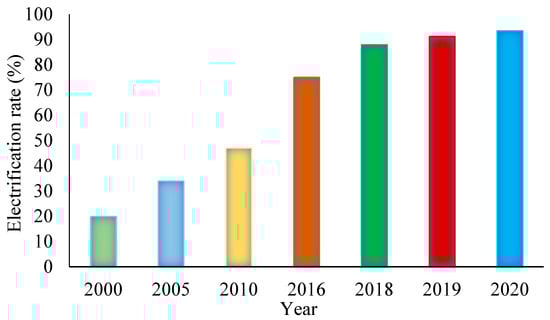
Figure 1.
Total electrification rate of Bangladesh [11].
In a similar way, the demand for electricity in the global world is increasing drastically to maintain the world economy and development [12,13]. Due to the crisis of electricity, global industry, firms, and commerce are in a state of decline. As a consequence, developing countries face an outage of a grid of about 8 h, and in many cases, this period increases to up to 18 h [3]. In addition, developing countries experience problems related to electricity demand for millions of electricity-deprived people as well as difficulties in maintaining a clean environment with economically feasible sources of energy [14,15]. A longer period for the shortage of electricity reduces the gross domestic product (GDP) for the developed and developing countries [16].
In the case of Bangladesh, the power sector has been developed significantly, which covers electricity demand through a 90% grid supply although the per capita electricity consumption is still lower (382 kWh) when compared to per capita consumption (3127 kWh) of the world [1]. However, renewable energy technologies and their implementation are not common in Bangladesh. The current scenario is not able to fulfil the growing demand for electricity throughout the country. The off-grid renewable energy sources cannot supply electricity without any interruption as they are solely dependent on environmental factors and uncertain availability [17,18]. To this end, systems of hybrid energy are considered as feasible alternative solutions for this scenario. It is considered that a solar photovoltaic (PV) source with batteries or fuel combustion-based engines are viable and financially feasible [19,20]. However, the hybrid configuration of PV/wind/diesel/biomass is rare in prior research for the off-grid communities of Bangladesh. This paper presents a framework for the rural electrification of Bangladesh by designing systems depending on available sources of energy. In particular, this paper shows hybrid systems of energy including biomass which are rare in prior research. This paper also presents optimal sizing of hybrid systems of energy to supply continuous energy to the considered area, for instance, Kukri Mukri island in Bangladesh. This study also investigates the optimal feasibility of several (six) grid-connected as well as off-grid systems for the suggested area. In addition, a comparative study of the recommended PV/wind/diesel/biomass is determined by using the HOMER Pro software (HOMER Energy, LLC) and the genetic algorithm (GA) technique. The algorithm of HOMER Pro software has the capability to evaluate and design different hybrid energy systems for off-grid and grid-connected communities by optimizing the system costs, and it can supply sensitivity analysis.
2. Overview of Power Generation Sector in Bangladesh
In Bangladesh, the demand for electricity is increasing significantly, while the maximum amount of electricity production has been around 12,893 MW until now, and considering renewable energy sources, it has been about 22,787 MW. The total capacity of the installed grid electricity was about 19,630 MW in 2020 and 18,961 MW in 2018–2019. Currently, an amount of 1160 MW of electricity is required to be imported from outside of the country to meet the demand for electricity [21]. Figure 2 depicts the rate of electricity capacity generated from different available energy sources in Bangladesh that have already been installed.
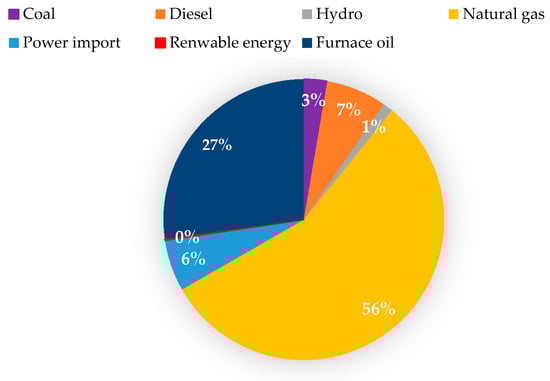
Figure 2.
Rate of installed capacity of electricity produced from different sources of energy [21].
Table 1 shows the capacity of grid electricity and the maximum production of electricity. It is shown that the amount of maximum production of electricity is lower than the grid electricity [21].

Table 1.
Quantity of grid power and the maximum amount of power production for different years in Bangladesh.
The plan for the production of the electricity of a country solely depends on the available sources of energy. In the case of Bangladesh, coal, gas, and nuclear power sources are utilized to generate power for different power plants. The generation of power capacity is expected to reach 24,000 MW by the end of 2021, 40,000 MW by the end of 2030, and 60,000 MW by the end of 2041 [21]. On the other hand, the demand for power (electrical energy) is 14,800 MW in 2020, 19,000 MW in 2021, 33,000 MW in 2030, and 52,000 MW in 2041. Additionally, per capita production of power is expected to be 510 kWh in 2020, 700 kWh in 2021, 815 kWh in 2030, and 1475 kWh in 2041 [21].
3. Prior Research on the Techno-Economic Discussion on Different Hybrid Systems of Energy
In this work, several different scientific articles have been reviewed to analyse the feasibility of the economic aspects of standalone off-grid systems for hybrid energy [22,23,24,25,26]. Additionally, a number of different grid-connected hybrid energy systems have been examined [27,28,29,30]. In different configurations of hybrid energy, PV, wind, hydro, and biomass are commonly used sources of energy based on their availability in the specified regions. In the majority of hybrid energy systems, diesel generators and batteries are used as backup sources of energy and energy storage systems, respectively. Moreover, the converter is used for the conversion from DC to AC or vice versa. In the selected off-grid region (Kukri Mukri island), hydro or water energy sources are not significantly available. Hence, different configurations of PV, wind, biomass, diesel, grid, converter, and battery are considered for this region. Table 2 presents several systems for hybrid configuration of energy including solar PV, wind, biomass, grid-connection, diesel, and battery. In the majority of these configurations, techno-economic analysis was done depending on the levelized cost of energy (LCOE), net present cost (NPC), and emissions including CO2.
Table 2.
Summary of different hybrid configuration of energy systems.
In prior research, both off-grid and grid-connected configurations are analysed where grid-integrated systems are modelled in an economical way that excess or deficiency power of hybrid systems is taken or supplied to the grid. By analysing NPC, fully renewable energy systems showed the highest cost, while the diesel with renewable energy systems had the lowest cost [42]. As a consequence, hybrid energy systems with grid integration can be considered as an economic way of electrification, especially in the power-deprived areas (rural and sub-urban) of developing countries (Bangladesh, Pakistan, and so on).
Considering the rural areas of Bangladesh where electricity supply is not sufficient due to their long-distance and dispersive location from the place of grid utility, rural people depend on traditional fuel, such as diesel generators, for electricity [43]. As a consequence, the cost of fuel and emissions is increasing while the quantity of fuel is diminishing largely. Hence, the economical alternatives are to use solar, geothermal, biomass, wind energy, and so on to decrease the dependency on traditional fuels. These fuels generate less quantity of pollution and they are available in nature [44]. However, they depends on the site selection and nature of the weather, and based on that, different configurations of hybrid energy systems can be designed for rural electrification [45]. Additionally, oversizing the system components is required to fulfil the energy demand hours that need a large amount of cost. On the other hand, the installation cost of the generator for diesel fuels is beneficial when compared to the PV and wind sources of energy. These renewable sources of energy alone cannot fulfil the required demand for energy [46]. Therefore, hybrid systems of energy including renewable and traditional sources of energy would be a feasible option for rural power systems in under-developed countries.
A number of different systems of hybrid energy, including PV/diesel, PV/wind, PV/wind/biomass, and without or with the storage media (battery), are being developed as economic solutions for remote islands and off-grid areas. Several prior researches investigate that these hybrid systems are techno-economically feasible and able to satisfy the demand for rural electrification. Previous research also shows that the effectiveness of the hybrid systems of energy is about 15 to 75%, whereas about the value is around 10% for the PV solar system.
In the community area of Sitakunda in Bangladesh, it was presented that the hybrid configuration of energy (PV/wind/battery) can reduce the LCOE and NPC by about 20%, as well as reduce diesel use by about 50% more than the diesel-fuel operated generator [47]. On another island of Bangladesh called Saint Martin, the techno-economic analysis showed that LCOE was about 0.345 USD/kWh, and NPC was 137,927 USD [48]. However, the techno-economic analysis based on PV/wind/biomass/diesel is not described in prior literature for the different off-grid communities in Bangladesh. Hence, in this work, an off-grid island of Bangladesh named Kukri Mukri is techno-economically analysed with different hybrid configurations. All these configurations are analysed based on LCOE, NPC, and emissions.
4. Methodology
4.1. Framework for the Rural Electrification
Schematic representations of the PV/wind/biomass/diesel/battery/converter, PV/wind/diesel/battery/converter, PV/biomass, PV/diesel, PV/wind/diesel, and wind/diesel system of hybrid energy are depicted in Figure 3. They were developed and designed to fulfil the demand of residential load of the small island community of Kukri Mukri in Bangladesh. In addition to these sources of energy, a biomass generator is added because biomass resources are a significant source of energy in this specified region of the community. A direct source of DC load is connected with a PV solar panel and battery storage system, while an AC load is linked with a diesel-powered generator, and wind turbine coupled with an electrical generator, biomass generator, and the residential demand of the load. A bi-directional converter is used to transform the DC of the PV array to the AC for household applications. A power storage system, such as a battery, is used to supply the shortage amount of required energy and/or store the excess energy of the system.
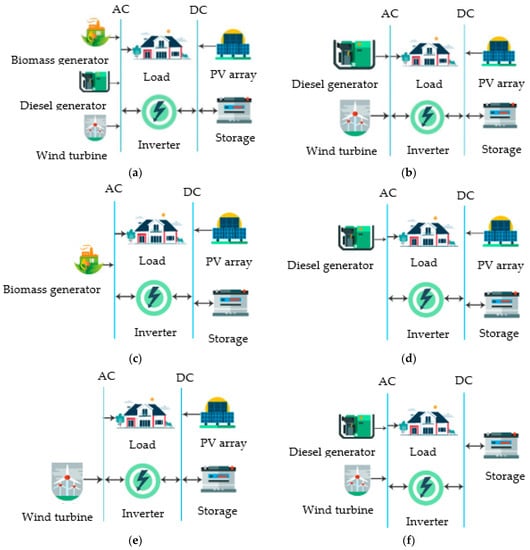
Figure 3.
Schematic representation of (a) PV/wind/biomass/diesel/battery/converter, (b) PV/wind/diesel/battery/converter, (c) PV/biomass/battery/converter, (d) PV/diesel/battery/converter, (e) PV/wind/battery/converter, and (f) wind/diesel/battery/converter hybrid energy systems.
This work shows an optimal framework for the hybrid systems of energy to satisfy the load demand of the specified off-grid community. In the majority of the prior research, economic, environmental, and social factors were not considered for rural electrification. As a consequence, a number of different projects have failed due to the ineffective usage and applications of renewable systems for energy. Therefore, the techno-economic prospects and framework of the hybrid configuration of the energy system are required for the design of the system. Figure 4 presents the suggested framework for rural electrification of the specified region. This framework consists of three major phases such as pre-HOMER analysis, optimisation using HOMER, and post-HOMER analysis.
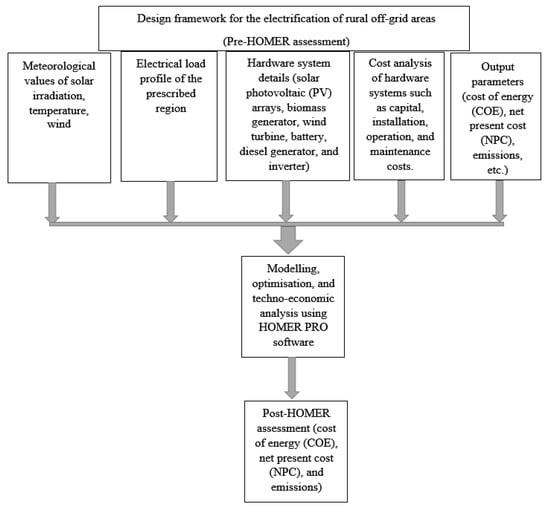
Figure 4.
Design framework for the proposed hybrid system of energy using HOMER software.
In the simulation using HOMER Pro software, costs were calculated using the balance of hybrid energy systems and their related components with the existing constraints, meteorological data, and load profile. NPC and LCOE were calculated using this software. Depending on this cost calculation, the comparative analysis of the optimal system was determined. However, HOMER Pro software alone cannot show the convergence to the solution for the optimal energy system in hybrid configuration [49]. Therefore, the comparison with the outcomes from GA can provide an acceptable idea of the quality of HOMER Pro software and their validation. The optimization and sensitivity analysis using HOMER Pro software provides the scope for the evaluation of the economic and technological feasibility of the hybrid configuration of energy systems, especially for off-grid regions. It can evaluate several variables and processes, but the simulated results are generally limited to minimization of NPC and LCOE [50].
4.1.1. Pre-HOMER Analysis
The initial analysis of the design configuration and framework is the pre-HOMER assessment to ensure the sustainable capacity of infrastructures. It is not possible to design and model a successful hybrid system to fulfil the required demand for load unless there is thorough documentation of the specified residential, community, and energy requirements. Hence, an analysis of the socio-economic aspects, energy resources, and load requirements of the prescribed off-grid area is required to be determined and it is considered as the first step. This process will help to identify the exact load demand for that region and the available energy sources that can be utilized to meet this requirement. This will also help to execute a successful project for the hybrid systems of energy for off-grid rural communities in developing nations.
4.1.2. Techno-Economic Analysis
The next step of pre-HOMER assessment is the techno-economic analysis through the use of load demand and meteorological data. This analysis is calculated using the data obtained from the office of the grid, the renewable source of energy available at the specified area, the required components for the hybrid energy systems, and detailed analysis for the HOMER simulation. There is other software that can be utilized for the optimal and sizing analysis of the hybrid configuration of systems for renewable energy, such as Hybrid2, iHOGA, TRNSYS, INSEL, and RET Screen, although HOMER obtained significant popularity due to its capability of designing grid systems through reliable renewable energy systems.
4.1.3. Sensitivity Analysis
In the third stage, the sensitivity analysis of the designed off-grid area is required to be done to confirm the findings of the substance. By considering the review of the power sector of Bangladesh, a sensitivity analysis was done based on the variables of the price of the PV, battery, diesel, etc. These variables are able to provide a good insight into the determination of the energy systems for the off-grid community. Sensitivity analysis is done by the replication and adjustment of the output of the simulation with the desired sensitivity variables.
4.1.4. Robustness of the Designed Off-Grid System
This work also identifies the robustness of the designed hybrid systems of energy. To do this, determination of the energy from the proposed hybrid system is required to be identified to find whether it is sufficient to fulfil the required demand of the load. To implement a successful hybrid system of energy, it is required to find the techno-economic aspects and financial scope of the configuration of that system.
In addition, to check the robustness technically, the generation of energy during the month of maximum and minimum loads are determined. In general, the maximum load is obtained in the month of June, while the lowest load demand is found in the month of January in Bangladesh.
4.2. Proposed Framework Implementation for the Hybrid Energy System
4.2.1. Load Profile and Meteorological Data
This work was done considering the remote island named Kukri Mukri (21°55′ N, 90°38′ E) in Bangladesh, which is considered an off-grid area. The data of solar irradiation, as presented in Figure 5, was obtained from the database of the HOMER Pro software. The average solar irradiation is 4.76 kWh/m2·d (0.198 kWh/m2·h), and the highest and lowest temperatures are usually 29.78 and 21.28 °C in the month of June as well as January, respectively, as shown in Figure 6. However, due to clouds, irradiation of solar energy is not available throughout daylight time, as shown in Figure 5. This happens mostly during the months of October to December. On the other hand, the mean speed of wind of the area is 5.28 m/s, as shown in Figure 7.
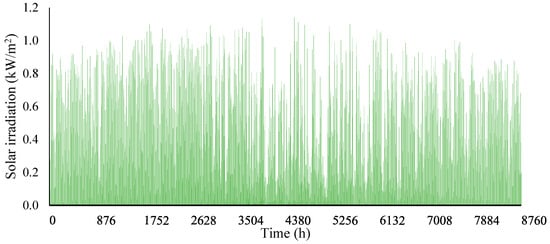
Figure 5.
Solar irradiation data of the considered Kukri Mukri island.
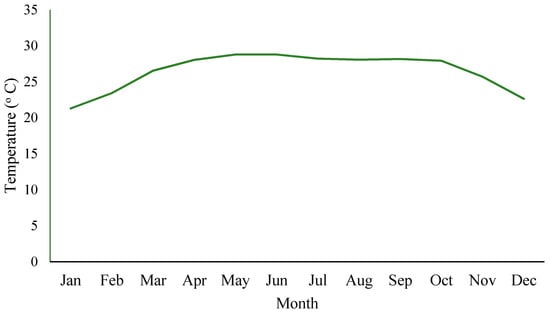
Figure 6.
Temperature profile for the selected region of Kukri Mukri island.
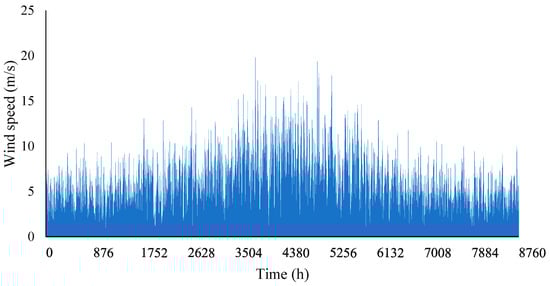
Figure 7.
Wind speed data of the considered Kukri Mukri island.
It is considered that the load demand for daily usage for a single household consists of approximately 5–6 members. In general, the demand of load is calculated using a grid-integrated household metre area as presented in Table 3. The demand of load for the daily usage of prime components is 3.69 kWh, which is multiplied by 60 to get the total amount of demand of load (221.4 kWh/d) of that specific area in Kukri Mukri island. In the HOMER Pro software, the demand of peak load (residential load) and the hourly resolution was selected for the month of July and 8760 h for a year, respectively. HOMER evaluates the profile of load based on peak load and type of load demand. HOMER Pro software determines the balance of power per hourly time steps (1 h) to fulfil the necessary load, as presented in Figure 8.
Table 3.
Load calculation for a single household in Kukri Mukri island.
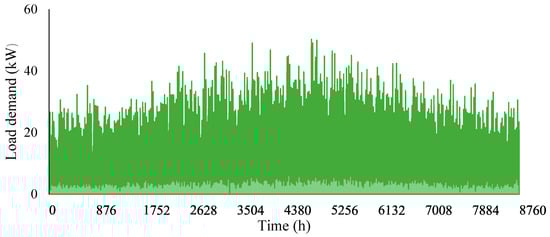
Figure 8.
Time variant load profile of the chosen region of the Kukri Mukri island.
4.2.2. Modelling of PV Cell
The output power from PV cell is determined using Equation (1) [1,51].
where Prated is defined as the rated capacity of PV module (400 W), DF is known as the factor of derating (88%), G is incident solar irradiations in kW/m2, GS is standard solar irradiation in kW/m2, αP is coefficient of the solar power (−0.35%/°C), TC is the temperature of the PV cell in °C, and TS is the standard PV cell temperature (25 °C).
The temperature of the PV cell is obtained using the following Equation (2) [1,51].
where is defined as temperature (atmospheric) (°C), τα is known as transmittance−absorbance, and ηPV is the efficiency of the PV cell (22.60%). The value of (τα/UL) is determined from the data provided by the manufacturer. The value of τα is considered to be around 0.9. By considering this value, the temperature of the PV cell can be obtained using Equation (3).
4.2.3. Hardware Components for Modelling
In this work, different hardware components were used including PV, the turbine for wind energy, biomass and diesel generator, battery, and converter. The detailed specifications of these components are presented in Table 4. Figure 9 and Figure 10 show the amount of power generation for the month of June and January for the study area through the use of different sources of energy.
Table 4.
Technical specifications of the required components for modelling of hybrid energy systems.
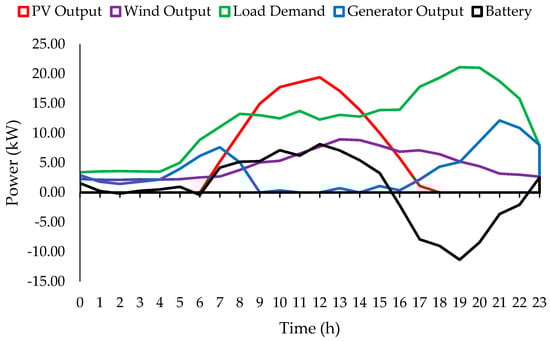
Figure 9.
Hourly average generation of power in the month of January.
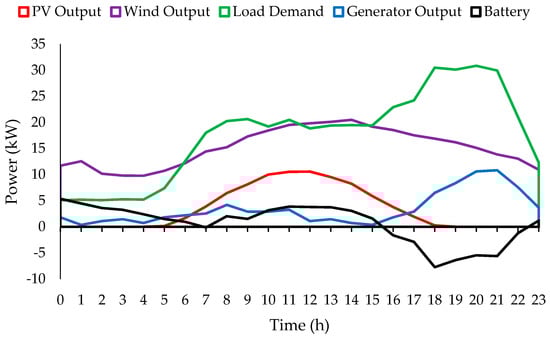
Figure 10.
Hourly average generation of power in the month of June.
4.2.4. Diesel Generator Modelling
The diesel fuel consumption can be calculated using Equation (4).
where F1 is the coefficient of intercept, F2 is the fuel curve slope, RD is the rated diesel generator capacity, and PD is the outcome of the diesel-operated generator at that time [1,51]. The density and lower heating value (LHV) of diesel fuel is assumed to be 820 kg/m3 and 43,200 kJ/kg, respectively. The fuel cost of diesel fuel is considered from the available price at the local market, which is around 0.75 USD/L. The specified area is linked to Dhaka-Barishal, and the distance in mileage from Barishal to Kukri Mukri island is around 130 km. All the transportation costs are considered based on this distance.
The operating efficiency diesel-fuel-operated generator is determined using the prescribed Equation (5).
4.2.5. Modelling of Batteries
In the hybrid energy system design, the storage component is significant equipment that is used to maintain a constant voltage during the period of less production of power. In general, a Li-ion type battery is utilized for the purpose of power storage. The maximum amount of discharge of battery can be obtained using the equation as follows:
In a similar way, the amount of maximum power can be obtained using Equation (7).
where Nm is defined as the capacity (maximum) of the battery in kWh, NI is the initial available energy on the storage system, r is the ratio of the capacity of the selected battery, Δt is the time length in hours, NT is the available energy in the battery bank (in total), and c is the battery rate constant.
4.2.6. Grid Connection
The power generation from solar energy may be higher than the required load demand. In that case, the excess quantity of energy is usually sold to the system of the grid. In contrast, during the shortage of electricity, the necessary quantity of energy is provided from the grid connection. Therefore, the net amount of power (electrical energy) is equal to the supplied and purchased amount of energy during the period of load demand that can be presented using the following equations.
where GEC is the charges of energy in kWh when the net amount of generation is obtained on a monthly (q) basis. Ej. net (G),p,q is the net amount of purchased energy (kWh) from the connection of grid, and gecG,p and gecS,p are the power and selling price in USD/kWh.
GEC ΣΣEj. net (G),p,qgecG,p if Ej.net(G), p,q ≥ 0
GEC Σ ΣEj. net (G),p,qgecS,p if Ej.net(G), p,q > 0
4.2.7. Bi-Directional Converter
AC and DC buses are added through a bi-directional inverter. The power output of the converter can be determined through Equation (10), where Pin represents the power input provided to the selected inverter and ηinv is the efficiency of inverter. The HOMER Pro software determines the inverter capacity based on the flow of energy from DC to AC.
Pout = Pinηinv
4.2.8. Biomass Generator
Biomass is available on the study island and is a significant source of energy. It mainly consists of organic-type materials such as wood, human waste, animal residues, animal foods, and so on. In the absence of oxygen, this source of energy can generate combustible fuels such as methane (CH4). In addition, they generate CO2. The feasibility analysis of biomass energy sources for the study area shows that this source is suitable to produce electricity. The generation of power is mostly done in a biomass plant through the use of an internal combustion engine (diesel engine). The overall system efficiency of electricity generation can be calculated through the prescribed equation [52].
where Poutput presents the output of the generated electrical power (W), Pauxiliary presents the needed power (W) for different electrical components including the compressor, pumps, and so on, Pnet is the effective amount of electrical power (W), and (Input biomass)LHV shows the input amount of biomass at LHV (MJ/kg).
4.2.9. Objective Function and GA
The cost (LCOE and NPC) of different configurations of hybrid systems of energy is determined by using HOMER Pro software and GA method. The major functions (objective) are both NPC and LCOE. The minimum LCOE can be obtained using the ratio of the current value of total cost incurred throughout their lifespan and total extracted energy during that period. This can be expressed through the following equation [3].
where . is the minimum value of the LCOE (USD/kWh), while . is defined as NPC in total. CRF represents the total amount of capital recovery factor, . is the rate of annual discount, presents plant life, and is the generated energy from the integrated system of hybrid renewable energy.
In a similar way, the minimum value of NPC can be obtained through the ratio of the summation of capital, operational and maintenance cost, and replacement cost to the amount of total recovery factor.
It is considered that the system with the lowest NPC possesses the lowest LCOE as well. In this analysis, mainly operation, replacement, capital, and maintenance costs are considered, while piping, fabrication, control system tasks are not considered for the techno-economic analysis. Table 5 shows the associated costs of different components including the capital, replacement, operation, and maintenance costs. In this research, input parameters are set economically; for example, the rate of inflation, nominal discount, real discount, and exchange rate are set to 2%, 8%, 5.88%, and 85.17, respectively, as shown in Table 6.
Table 5.
Costs of different components used as input during the optimization method for different hybrid energy system configurations [1,51,53,54].
Table 6.
Input variables and economic input rate.
To find the techno-economic and optimal analysis of the selected region, mainly PV, diesel generator, biomass generator, wind turbine, battery, and converter are used as decision variables where the following constraints are maintained for the feasibility study.
NPV,min ≤ NPV ≤ NPV,max
NBiomass.G,min ≤ NBiomass.G ≤ NBiomass.G,max
NBattery,min ≤ NBattery ≤ NBattery,max
NDiesel.G,min ≤ NDiesel.G ≤ NDiesel.G,max
Ninverter,min ≤ Ninverter ≤ Ninverter,max
The minimum and maximum limits of these constrains are provided in Table 5. In this research, the probability of loss of supply of power is also considered as the parameter for system reliability where supply of power loss probability ≤ (supply of power loss probability)desired.
Moreover, the validation and optimization of different configurations of hybrid energy systems are done through the technique of GA. It is used to minimize NPC with zero percentage of supply of power loss probability. The objective function for this analysis has been developed through a MATLAB M-file, where the basis is the current load demand and the energy balance of different components of hybrid systems of energy. In the objective function, economic, technical, and environmental data have been incorporated, with the population size at 300 and maximum generation at 1000. The supply of power loss probability is evaluated for each population. The population that is unable to fulfil the constraint condition of the supply of power loss probability is removed from the next generation to proceed until reaching the maximum amount of generation.
4.2.10. Potential Configurations and Solutions
In this work, by analysing the available energy sources, resources, and available components for the study area, there are six configurations considered, including PV/diesel, PV/wind, PV/biomass, wind/diesel, PV/diesel/wind, and PV/wind/diesel/biomass. Figure 3 represents different components and their related configurations for the study area.
5. Simulation Results, Optimization, and Discussion
The software HOMER Pro is used to simulate different systems of hybrid energy. In this research work, NPC and LCOE are used to identify different optimal configurations to find techno-economic analysis and feasibility study.
5.1. Economic Configurations
The techno-economic analysis present in Table 7 infers that that NPC and LCOE for the configuration of PV/wind/diesel/biomass are significantly low (0.142 USD/kWh and 239,494.50 USD) when compared to the other hybrid energy system configurations including PV/wind (0.239 USD/kWh and 403,236.60 USD), PV/diesel (0.199 USD/kWh and 334,797.8 USD), PV/biomass (0.343 USD/kWh and 576,945.2 USD), wind/diesel (0.175 USD/kWh and 294,727.10 USD), and PV/wind/diesel (0.167 USD/kWh and 280,991.80 USD). The reason is that the corresponding annualized costs (capital, operation and maintenance, and replacement costs) of PV/wind/diesel/biomass systems are lower when compared to the other five configurations of an energy system in hybrid configuration (Table 8). Hence, GA is applied to obtain the optimal and economic solution for PV/wind/diesel/biomass and compare the results with the corresponding HOMER Pro software solution (Table 7 and Figure 11). Therefore, a PV/wind/diesel/biomass energy system in hybrid configuration can be suggested for the studied off-grid remote area.
Table 7.
Summarized cost of optimisation for different hybrid energy systems using HOMER and GA.
Table 8.
Annualized cost of different hybrid systems of energy.
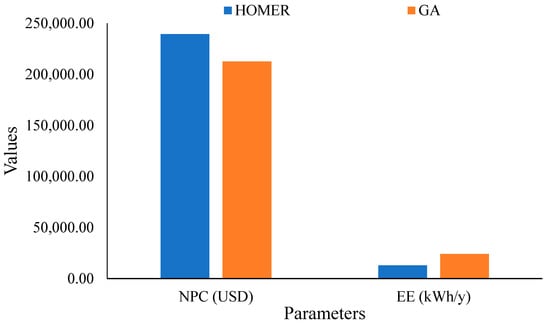
Figure 11.
Comparisons of net present cost (NPC) and excess energy (EE) for HOMER and genetic algorithm analysis for the same hybrid system of energy (PV/wind/diesel/biomass).
It is shown in Table 8 that the capital cost for the recommended hybrid system of energy is mostly due to PV (9069 USD) while that of resource cost is 6739 USD. However, the capital cost of the diesel-operated generator is not much higher because the fuel cost of diesel is usually higher (170,780 USD). Figure 12 depicts the summary of the overall costs of the recommended PV/wind/diesel/biomass hybrid energy system for the studied area. Figure 12 shows that most of the capital costs (34.29%) are associated with the PV cell of the suggested PV/wind/diesel/biomass hybrid system of energy. On the other hand, the capital costs associated with generators for biomass, diesel fuels, and batteries were 24.97% and 29.07% respectively. In the case of replacement cost, PV could need little to no cost, while battery and generators combined require approximately 74.5% costs. In this research, a 40% discharge was set for the batteries for their lifetime. Additionally, a salvage value is shown as negative as it includes the net outflow of cash necessary for removing different components used for different hybrid systems of energy.
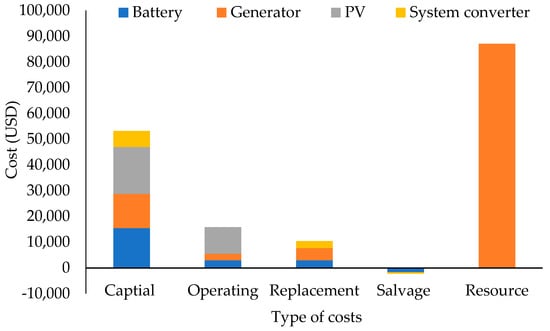
Figure 12.
Costs associated with different required components for the recommended PV/wind/diesel/biomass hybrid energy system.
5.2. Emissions Analysis
The emissions analysis of different configurations shows that the PV/wind/diesel/biomass configuration has a significantly lower amount of emissions when compared to PV/diesel or wind/diesel hybrid configurations, as presented in Table 9. It is seen that the amount of carbon monoxide (CO), unburnt hydrocarbon, and nitrogen oxide (NOx) of PV/wind/diesel/biomass are slightly higher than the PV/wind/diesel configuration. This is due to biomass being combusted in the absence of oxygen in gasifiers to generate electricity using diesel generators. Therefore, a certain amount of feed materials remains un-burnt and generates CO, unburnt hydrocarbon, particulate matter, and NOx. Figure 13 shows CO2 emissions for different hybrid energy systems. It is shown in Figure 12 that the highest amount (45,607 kg/y) of CO2 was generated for PV/diesel hybrid energy configurations, while the lowest amount (18,049 kg/y) was obtained for the recommended configuration of PV/wind/diesel/biomass.
Table 9.
Comparison of emission analysis of different hybrid energy system configurations.
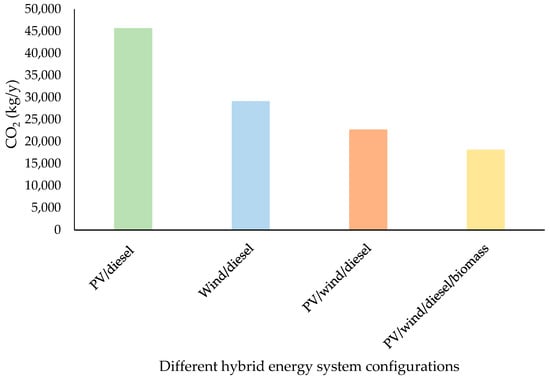
Figure 13.
CO2 emissions from different hybrid energy systems.
5.3. Sensitivity Analysis of PV/Wind/Diesel/Biomass Energy System Configuration
In the techno-economic analysis of this research, there are a few uncertainties associated with different configurations of systems. The major uncertainties are the demand of load, solar radiation, wind speed, price of diesel fuel, and efficiency of the converter. HOMER software usually considers these uncertainty parameters as well as hardware during the analysis. The cost of PV and diesel have effects on NPC and LCOE. The highest and lowest value of LCOE was 0.17188 USD/kWh and 0.12496 USD/kWh, respectively. These values were found at a 40% increase and a reduction in PV with a constant price of diesel fuel of 0.767 USD/L.
Figure 14 shows the effects of the variation of different components on NPC and LCOE. The baseline scenario was considered as 100% for the values (LCOE: 0.142 USD/kWh, NPC: 239,494.50 USD), as shown in Table 7 for the suggested hybrid configuration of the PV/wind/diesel/biomass hybrid system of energy. It is shown in Figure 14 that the interest rate affects NPC and LCOE where different percentages show the percentage decreasing or increasing from the baseline value (100%). It is also shown in the figures that battery storage costs also have effects on the LCOE and NPC for PV/wind/diesel/biomass hybrid energy system configurations.
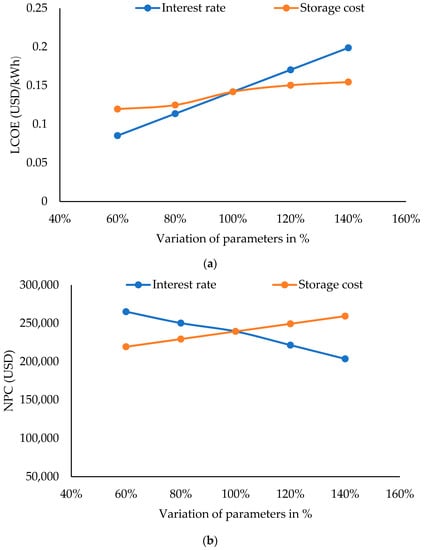
Figure 14.
Effects of various components on (a) LCOE and (b) NPC for a PV/wind/diesel/biomass hybrid system of energy.
6. Conclusions
This work builds a hybrid system for rural energy framework for an off-grid region (Kukri Mukri island) using available resources for energy to fulfil the necessity for energy. The proposed framework can be implemented in any rural area based on the available sources of energy. The load profile, assessment of energy sources, and profile of the socio-economic state have been examined for the prescribed study area. The corresponding economic and technical aspects, as well as feasibility analysis, have also been done for different off-grid configurations. This hybrid system of energy configurations can meet the demand for electricity for rural communities.
In the majority of the rural areas in Bangladesh, access to power (electrical energy) is limited for only a few hours a day. Hence, it is required to maintain a continuous supply of electricity for off-grid community people. To do this, different hybrid systems of energy configurations, such as PV/wind, PV/diesel, PV/biomass, wind/biomass, PV/wind/diesel, and PV/wind/diesel/biomass, have been analysed with their techno-economic aspects and environmental impacts. It is obtained that a PV/wind/diesel/biomass configuration can meet the electricity demand for the study area with less environmental emissions. This configuration of a hybrid system of energy can be used for both purposes if it generates additional electricity that is possible to sell to the grid, while a deficiency of power (electrical energy) can be bought from the system of grid, although this configuration can meet the required load demand for that off-grid community. This study proposed optimal sizing for the hybrid system depending on NPC and LCOE. The recommended configuration is PV/wind/diesel/biomass, and this is based on optimal solutions and cost analysis aspects. By the integration of the grid with the PV/wind/diesel configuration, it can be provided as an alternative solution, while the PV/wind/diesel/biomass configuration can be used solely for the studied off-grid community. However, the access of grid integration does not require a large amount of capital cost for the selected area. The basis of selecting the most optimal solution is to model and design a hybrid system that can satisfy the power requirement throughout 24 h (a day). In this case, a PV/wind/diesel/biomass configuration can meet the electricity demand with additional (excess) electricity of 13,042 kWh/y, and the LCOE and NPC are 0.142 USD/kWh and 239,494.50 USD, respectively. To implement this configuration, a PV cell with a capacity of 400 W, a battery of 1300 kW, a wind turbine of 10 kW, a biomass gasifier of 5 kW, a bi-directional converter of 1 kW, and a diesel generator of a capacity of 45 kW are required. This system of configuration is robust and reliable. The current framework has been developed by considering a rural area of Bangladesh, although it can be applied to any off-grid rural community globally.
7. Future Recommendations
This paper develops optimal models for different hybrid sources of energy for off-grid communities in developing countries, such as Bangladesh. The models have been developed using HOMER Pro software and validated through a genetic algorithm (GA). However, the multi-objective algorithms can also be applied to find and develop optimal models and techno-economic analyses of different hybrid sources of energy that can be considered as future research. Other different algorithms can reduce the overall energy costs as well as emissions that will eventually provide optimal models for hybrid energy sources.
Author Contributions
All the authors of this research have contributed significantly to the work submitted. Conceptualization, M.E.H., F.R. and M.A.; experimentation and methodology, T.N.S., M.T.I., R.M.R. and F.R.; data analysis, M.E.H., M.A. and F.R.; original draft writing and preparation, F.R. and T.N.S.; review and editing, M.E.H. and M.A. All authors have read and agreed to the published version of the manuscript.
Funding
This research received no external funding.
Institutional Review Board Statement
Not applicable.
Informed Consent Statement
Not applicable.
Data Availability Statement
All data are available in the paper.
Acknowledgments
The authors would like to acknowledge the infrastructural support provided by the Department of Mechanical Engineering, Rajshahi University of Engineering & Technology, Bangladesh.
Conflicts of Interest
The authors declare no conflict of interest.
Nomenclature
| BD | Discharge of battery |
| DF | Factor of derating (%) |
| EE | Excess energy (kW/y) |
| F1 | Coefficient of intercept |
| F2 | Fuel curve slope |
| G | Solar irradiations (kW/m2) |
| GA | Genetic algorithm |
| GEC | Charges of energy (kWh) |
| GS | Standard solar irradiation (kW/m2) |
| MinNPC | Minimum value of NPC |
| NBiomass, G | Number of biomass generators |
| NBattery | Number of batteries |
| NDiesel, G | Number of diesel generators |
| Ninverter | Number of inverters |
| NPV | Number of photovoltaic cells |
| NPC | Net present cost (USD) |
| PD | Outcome of the diesel operated generator at that time |
| Prated | Rated capacity of PV module (W) |
| HOMER | Hybrid optimization model for electric renewables |
| LCOE | Levelized cost of energy (USD/kWh) |
| LHV | Lower heating value (MJ/kg) |
| MinLCOE | Minimum value of LCOE |
| PV | Photovoltaic |
| RD | Rated diesel generator capacity |
| TC | Temperature of the PV cell (°C) |
| TS | Standard PV cell temperature (°C) |
Greek Letters
| αP | Coefficient of the solar power |
| ηPV | Efficiency of the PV cell (%) |
| τα | Transmittance−absorbance |
References
- Das, B.K.; Hasan, M.; Rashid, F. Optimal sizing of a grid-independent PV/diesel/pump-hydro hybrid system: A case study in Bangladesh. Sustain. Energy Technol. Assess. 2021, 44, 100997. [Google Scholar] [CrossRef]
- Hoque, E.; Rashid, F.; Aziz, M. Gasification and Power Generation Characteristics of Rice Husk, Sawdust, and Coconut Shell Using a Fixed-Bed Downdraft Gasifier. Sustainability 2021, 13, 2027. [Google Scholar] [CrossRef]
- Ali, F.; Ahmar, M.; Jiang, Y.; AlAhmad, M. A techno-economic assessment of hybrid energy systems in rural Pakistan. Energy 2021, 215, 119103. [Google Scholar] [CrossRef]
- Mohn, K. The gravity of status quo: A review of IEA’s World Energy Outlook. Econ. Energy Environ. Policy 2020, 9. [Google Scholar] [CrossRef]
- Knutti, R.; Rogelj, J.; Sedláček, J.; Fischer, E.M. A scientific critique of the two-degree climate change target. Nat. Geosci. 2016, 9, 13–18. [Google Scholar] [CrossRef] [Green Version]
- Rad, M.A.V.; Ghasempour, R.; Rahdan, P.; Mousavi, S.; Arastounia, M. Techno-economic analysis of a hybrid power system based on the cost-effective hydrogen production method for rural electrification, a case study in Iran. Energy 2020, 190, 116421. [Google Scholar] [CrossRef]
- Yang, G.; Zhai, X. Optimal design and performance analysis of solar hybrid CCHP system considering influence of building type and climate condition. Energy 2019, 174, 647–663. [Google Scholar] [CrossRef]
- Patel, A.M.; Singal, S.K. Optimal component selection of integrated renewable energy system for power generation in stand-alone applications. Energy 2019, 175, 481–504. [Google Scholar] [CrossRef]
- Ishraque, M.F.; Shezan, S.A.; Nur, J.N.; Islam, M.S. Optimal Sizing and Assessment of an Islanded Photovoltaic-Battery-Diesel Generator Microgrid Applicable to a Remote School of Bangladesh. Eng. Rep. 2021, 3, e12281. [Google Scholar] [CrossRef]
- Bala, B.; Siddique, S.A. Optimal design of a PV-diesel hybrid system for electrification of an isolated island—Sandwip in Bangladesh using genetic algorithm. Energy Sustain. Dev. 2009, 13, 137–142. [Google Scholar] [CrossRef]
- Ak, N.; Demirbas, A. Promising sources of energy in the near future. Energy Sources Part A Recover. Util. Environ. Effects 2016, 38, 1730–1738. [Google Scholar] [CrossRef]
- Armaroli, N.; Balzani, V. Towards an electricity-powered world. Energy Environ. Sci. 2011, 4, 3193–3222. [Google Scholar] [CrossRef]
- Burgess, R.; Greenstone, M.; Ryan, N.; Sudarshan, A. Demand for Electricity on the Global Electrification Frontier; Cowles Foundation for Research in Economics, Campus Press, Yale University: New Haven, CT, USA, 2020. [Google Scholar]
- Hoque, M.E.; Rashid, F.; Prodhan, M.; Arman, A. Analysis of Energy Consumption and Efficiency to Reduce Power Losses in Industrial Equipment. In Proceedings of the International Conference on Mechanical Engineering, Dhaka, Bangladesh, 18–20 December 2017. [Google Scholar]
- Mallik, A.; Arefin, M.A.; Rashid, F.; Asfaquzzaman, M. Solar based plugged-in hybrid engine driven rickshaw (auto-rickshaw) & its feasibility analysis for Bangladesh. In Proceedings of the International Conference on Mechanical, Industrial and Materials Engineering, RUET, Rajshahi, Bangladesh, 28–30 December 2017. [Google Scholar]
- EIA, U. U.S. energy information administration. Int. Energy Outlookt 2008, 11, 1–3. [Google Scholar]
- Raghuwanshi, S.S.; Arya, R. Reliability evaluation of stand-alone hybrid photovoltaic energy system for rural healthcare centre. Sustain. Energy Technol. Assess. 2020, 37, 100624. [Google Scholar] [CrossRef]
- Li, C.; Zhou, D.; Wang, H.; Lu, Y.; Li, D. Techno-economic performance study of stand-alone wind/diesel/battery hybid system with different battery technologies in the cold region of China. Energy 2020, 192, 116702. [Google Scholar] [CrossRef]
- Huang, Z.; Lu, Y.; Wei, M.; Liu, J. Performance analysis of optimal designed hybrid energy systems for grid-connected nearly/net zero energy buildings. Energy 2017, 141, 1795–1809. [Google Scholar] [CrossRef]
- Salameh, T.; Ghenai, C.; Merabet, A.; Alkasrawi, M. Techno-economical optimization of an integrated stand-alone hybrid solar PV tracking and diesel generator power system in Khorfakkan, United Arab Emirates. Energy 2020, 190, 116475. [Google Scholar] [CrossRef]
- Mondal, A.H.; Boie, W.; Denich, M. Future demand scenarios of Bangladesh power sector. Energy Policy 2010, 38, 7416–7426. [Google Scholar] [CrossRef]
- Veilleux, G.; Potisat, T.; Pezim, D.; Ribback, C.; Ling, J.; Krysztofiński, A.; Ahmed, A.; Papenheim, J.; Pineda, A.M.; Sembian, S.; et al. Techno-economic analysis of microgrid projects for rural electrification: A systematic approach to the redesign of Koh Jik off-grid case study. Energy Sustain. Dev. 2020, 54, 1–13. [Google Scholar] [CrossRef]
- Odou, O.D.T.; Bhandari, R.; Adamou, R. Hybrid off-grid renewable power system for sustainable rural electrification in Benin. Renew. Energy 2020, 145, 1266–1279. [Google Scholar] [CrossRef]
- Dhundhara, S.; Verma, Y.P.; Williams, A. Techno-economic analysis of the lithium-ion and lead-acid battery in microgrid systems. Energy Convers. Manag. 2018, 177, 122–142. [Google Scholar] [CrossRef]
- Yahyaoui, I.; Atieh, A.; Serna, A.; Tadeo, F. Sensitivity analysis for photovoltaic water pumping systems: Energetic and economic studies. Energy Convers. Manag. 2017, 135, 402–415. [Google Scholar] [CrossRef] [Green Version]
- Halabi, L.M.; Mekhilef, S.; Olatomiwa, L.; Hazelton, J. Performance analysis of hybrid PV/diesel/battery system using HOMER: A case study Sabah, Malaysia. Energy Convers. Manag. 2017, 144, 322–339. [Google Scholar] [CrossRef]
- Raturi, A.; Singh, A.; Prasad, R.D. Grid-connected PV systems in the Pacific Island Countries. Renew. Sustain. Energy Rev. 2016, 58, 419–428. [Google Scholar] [CrossRef]
- Lau, K.; Muhamad, N.A.; Arief, Y.Z.; Tan, C.; Yatim, A. Grid-connected photovoltaic systems for Malaysian residential sector: Effects of component costs, feed-in tariffs, and carbon taxes. Energy 2016, 102, 65–82. [Google Scholar] [CrossRef]
- Ramli, M.A.; Hiendro, A.; Sedraoui, K.; Twaha, S. Optimal sizing of grid-connected photovoltaic energy system in Saudi Arabia. Renew. Energy 2015, 75, 489–495. [Google Scholar] [CrossRef]
- Adaramola, M.S. Viability of grid-connected solar PV energy system in Jos, Nigeria. Int. J. Electr. Power Energy Syst. 2014, 61, 64–69. [Google Scholar] [CrossRef]
- Aziz, A.S.; Tajuddin, M.F.N.; Adzman, M.R.; Mohammed, M.F.; Ramli, M.A. Feasibility analysis of grid-connected and islanded operation of a solar PV microgrid system: A case study of Iraq. Energy 2020, 191, 116591. [Google Scholar] [CrossRef]
- Das, B.K.; Zaman, F. Performance analysis of a PV/Diesel hybrid system for a remote area in Bangladesh: Effects of dispatch strategies, batteries, and generator selection. Energy 2019, 169, 263–276. [Google Scholar] [CrossRef]
- Kumar, J.; Suryakiran, B.; Verma, A.; Bhatti, T. Analysis of techno-economic viability with demand response strategy of a grid-connected microgrid model for enhanced rural electrification in Uttar Pradesh state, India. Energy 2019, 178, 176–185. [Google Scholar] [CrossRef]
- Baseer, M.; Alqahtani, A.; Rehman, S. Techno-economic design and evaluation of hybrid energy systems for residential communities: Case study of Jubail industrial city. J. Clean. Prod. 2019, 237, 117806. [Google Scholar] [CrossRef]
- Ahmad, J.; Imran, M.; Khalid, A.; Iqbal, W.; Ashraf, S.R.; Adnan, M.; Ali, S.F.; Khokhar, K.S. Techno economic analysis of a wind-photovoltaic-biomass hybrid renewable energy system for rural electrification: A case study of Kallar Kahar. Energy 2018, 148, 208–234. [Google Scholar] [CrossRef]
- Alharthi, Y.Z.; Siddiki, M.K.; Chaudhry, G.M. Resource Assessment and Techno-Economic Analysis of a Grid-Connected Solar PV-Wind Hybrid System for Different Locations in Saudi Arabia. Sustainability 2018, 10, 3690. [Google Scholar] [CrossRef] [Green Version]
- Yilmaz, S.; Dincer, F. Optimal design of hybrid PV-Diesel-Battery systems for isolated lands: A case study for Kilis, Turkey. Renew. Sustain. Energy Rev. 2017, 77, 344–352. [Google Scholar] [CrossRef]
- Park, E. Potentiality of renewable resources: Economic feasibility perspectives in South Korea. Renew. Sustain. Energy Rev. 2017, 79, 61–70. [Google Scholar] [CrossRef]
- Prado, A.D.V.; Camargo, E.O.; Vides-Prado, C.; Orozco, I.H.; Chenlo, F.; Candelo, J.E.; Sarmiento, A.B. Techno-economic feasibility analysis of photovoltaic systems in remote areas for indigenous communities in the Colombian Guajira. Renew. Sustain. Energy Rev. 2018, 82, 4245–4255. [Google Scholar] [CrossRef]
- Becerra, M.; Morán, J.; Jerez, A.; Cepeda, F.; Valenzuela, M. Wind energy potential in Chile: Assessment of a small scale wind farm for residential clients. Energy Convers. Manag. 2017, 140, 71–90. [Google Scholar] [CrossRef]
- Islam, S.; Akhter, R.; Rahman, M.A. A thorough investigation on hybrid application of biomass gasifier and PV resources to meet energy needs for a northern rural off-grid region of Bangladesh: A potential solution to replicate in rural off-grid areas or not? Energy 2018, 145, 338–355. [Google Scholar] [CrossRef]
- Hafez, O.; Bhattacharya, K. Optimal planning and design of a renewable energy based supply system for microgrids. Renew. Energy 2012, 45, 7–15. [Google Scholar] [CrossRef]
- Lau, K.; Yousof, M.; Arshad, S.; Anwari, M.; Yatim, A.H. Performance analysis of hybrid photovoltaic/diesel energy system under Malaysian conditions. Energy 2010, 35, 3245–3255. [Google Scholar] [CrossRef]
- Bhattacharyya, S. Mini-grid based electrification in Bangladesh: Technical configuration and business analysis. Renew. Energy 2015, 75, 745–761. [Google Scholar] [CrossRef] [Green Version]
- Brka, A.; Kothapalli, G.; Al-Abdeli, Y.M. Predictive power management strategies for stand-alone hydrogen systems: Lab-scale validation. Int. J. Hydrogen Energy 2015, 40, 9907–9916. [Google Scholar] [CrossRef]
- Agustín, J.L.B.; Dufo-López, R. Simulation and optimization of stand-alone hybrid renewable energy systems. Renew. Sustain. Energy Rev. 2009, 13, 2111–2118. [Google Scholar] [CrossRef]
- Nandi, S.; Ghosh, H.R. A wind–PV-battery hybrid power system at Sitakunda in Bangladesh. Energy Policy 2009, 37, 3659–3664. [Google Scholar] [CrossRef]
- Islam, A.K.M.S.; Rahman, M.; Mondal, A.H.; Alam, F. Hybrid energy system for St. Martin Island, Bangladesh: An optimized model. Procedia Eng. 2012, 49, 179–188. [Google Scholar] [CrossRef] [Green Version]
- Weinand, J.M.; Scheller, F.; McKenna, R. Reviewing energy system modelling of decentralized energy autonomy. Energy 2020, 203, 117817. [Google Scholar] [CrossRef]
- Sen, R.; Bhattacharyya, S. Off-grid electricity generation with renewable energy technologies in India: An application of HOMER. Renew. Energy 2014, 62, 388–398. [Google Scholar] [CrossRef]
- HOMER Pro. 2020. Available online: https://www.homerenergy.com/products/pro/docs/latest/index.html (accessed on 20 December 2020).
- Singh, A.; Baredar, P. Techno-economic assessment of a solar PV, fuel cell, and biomass gasifier hybrid energy system. Energy Rep. 2016, 2, 254–260. [Google Scholar] [CrossRef] [Green Version]
- Cano, A.; Arévalo, P.; Jurado, F. Energy analysis and techno-economic assessment of a hybrid PV/HKT/BAT system using biomass gasifier: Cuenca-Ecuador case study. Energy 2020, 202, 117727. [Google Scholar] [CrossRef]
- Saheli, M.A.; Fazelpour, F.; Soltani, N.; Rosen, M.A. Performance analysis of a photovoltaic/wind/diesel hybrid power generation system for domestic utilization in winnipeg, manitoba, canada. Environ. Prog. Sustain. Energy 2019, 38, 548–562. [Google Scholar] [CrossRef]
Publisher’s Note: MDPI stays neutral with regard to jurisdictional claims in published maps and institutional affiliations. |
© 2021 by the authors. Licensee MDPI, Basel, Switzerland. This article is an open access article distributed under the terms and conditions of the Creative Commons Attribution (CC BY) license (https://creativecommons.org/licenses/by/4.0/).