Article

Testing Non-Linear Nexus between Service Sector and CO2 Emissions in Pakistan


1
School of Economics, Huazhong University of Science and Technology, Wuhan 430074, China
2
School of Business, Huzhou University, Huzhou 313000, China
3
Department of Environmental Science and Resource Management, Mawlana Bhashani Science and Technology University, Santosh, Tangail 1902, Bangladesh
*
Author to whom correspondence should be addressed.
Energies 2020, 13(3), 526; https://doi.org/10.3390/en13030526
Submission received: 22 December 2019 / Revised: 7 January 2020 / Accepted: 14 January 2020 / Published: 21 January 2020
(This article belongs to the Section C: Energy Economics and Policy)

Abstract

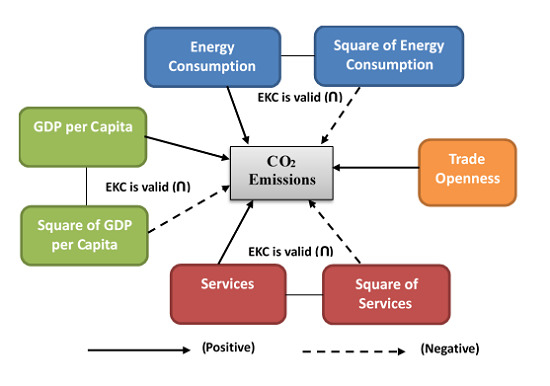
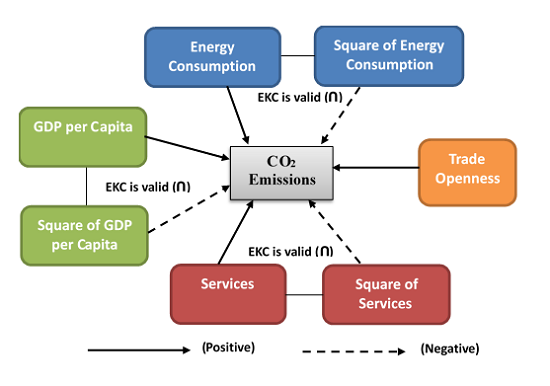
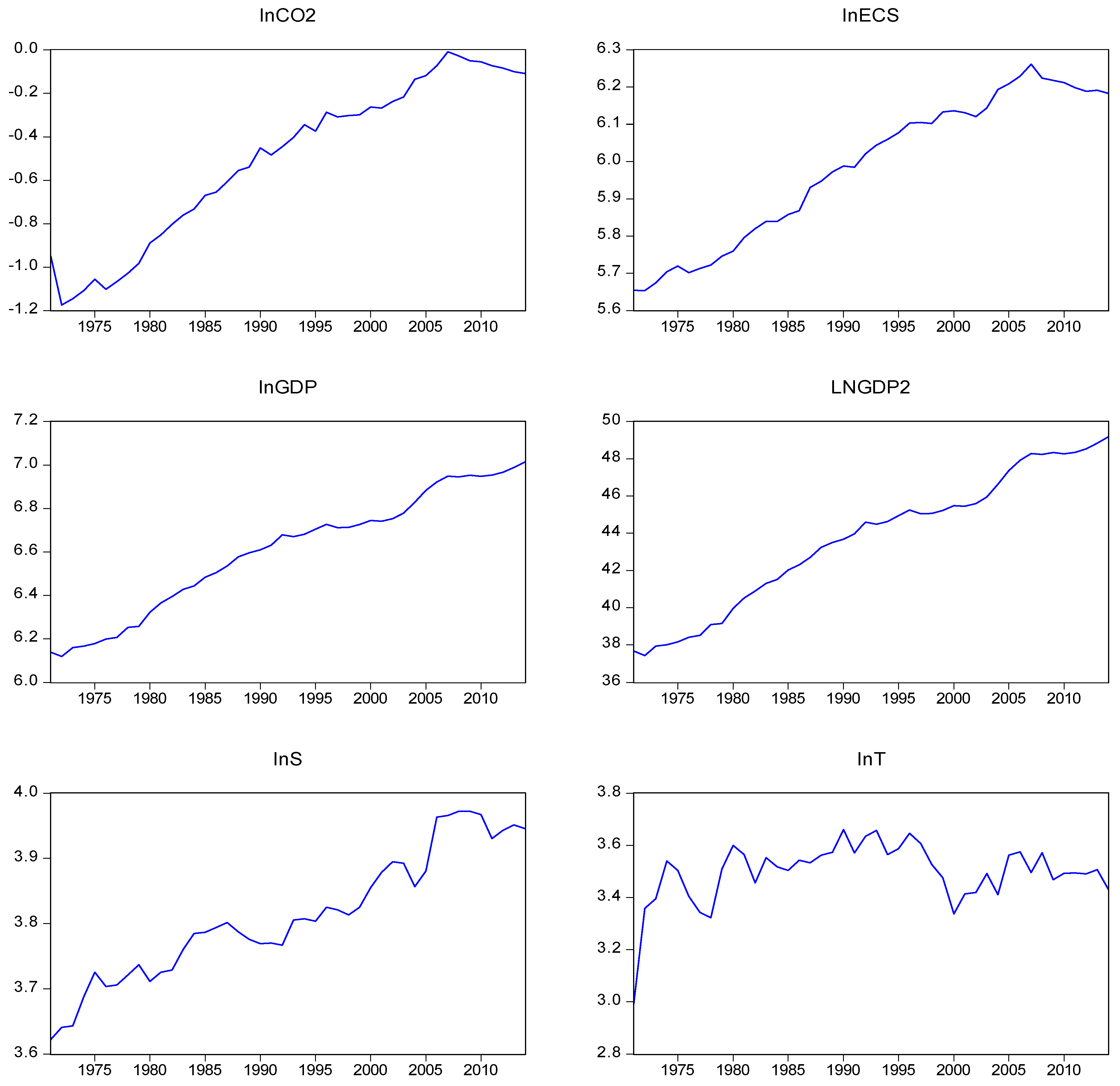
Our pioneer study is aimed at investigating the role of the service sector in affecting sustainable environment in Pakistan. Using time series data over 1971–2014 and applying an autoregressive distributive lag (ARDL) model with structural break analysis, we establish a long-term equilibrium relationship of carbon dioxide (CO2) emissions with energy consumption, income level, services and trade openness. Our findings support a service-induced environmental Kuznets curve (EKC) hypothesis in Pakistan. The income level sharply raises environmental degradation at the early stage; however, after reaching a certain threshold, it improves environmental quality but at a lower rate. There exists an inverted U-shaped nexus between services and CO2 emissions, which implies that the service sector is less energy-intensive in terms of mitigating pollution in Pakistan. Moreover, the energy consumption has an inverted U-shaped effect on carbon emissions, which implies energy efficiencies and adoption of renewable energy has reduced pollution in the long run. The trade openness increases CO2 emissions in both the short term and long term. The quadratic term of income level has a negatively inelastic impact on CO2 emissions, which implies a very slow rate of improvement in environmental quality. On the other hand, the quadratic term of services shows a highly elastic impact on pollution, which induces the EKC hypothesis. Our robustness checks such as fully modified ordinary least squares (FMOLS), dynamic ordinary least squares (OLS), and Toda and Yamamoto (TY) causality tests further confirm the existence of the service-induced EKC hypothesis in Pakistan. Moreover, there exists a unidirectional causality from energy consumption to CO2 emissions, a bidirectional causal relationship between economic growth and CO2 emissions, and a unidirectional causal linkage between services and CO2 emissions. Lastly, we discuss certain policy implications for designing appropriate environmental and energy policies to mitigate the pollution in Pakistan.
Keywords: CO2 emissions; economic growth; EKC hypothesis; service sector; structural change hypothesis CO2 emissions; economic growth; EKC hypothesis; service sector; structural change hypothesis
Graphical Abstract