Article

Numerical and Physical Simulation of Heat Transfer Enhancement Using Oval Dimple Vortex Generators—Review and Recommendations

1
Department of Heat Engineering and Power Machinery, Kazan National Research Technical University named after A. N. Tupolev–KAI, 10 K.Marx.str., 420111 Kazan, Russia
2
Department of Aero and Aircraft Flight Dynamics, Saint Petersburg State University of Civil Aviation, 38 Pilotov Street, 196210 Saint Petersburg, Russia
*
Author to whom correspondence should be addressed.
Energies 2020, 13(20), 5243; https://doi.org/10.3390/en13205243
Submission received: 10 August 2020 / Revised: 3 September 2020 / Accepted: 25 September 2020 / Published: 9 October 2020
(This article belongs to the Special Issue Enhancement of Heat Transfer in Power Plants)

Abstract

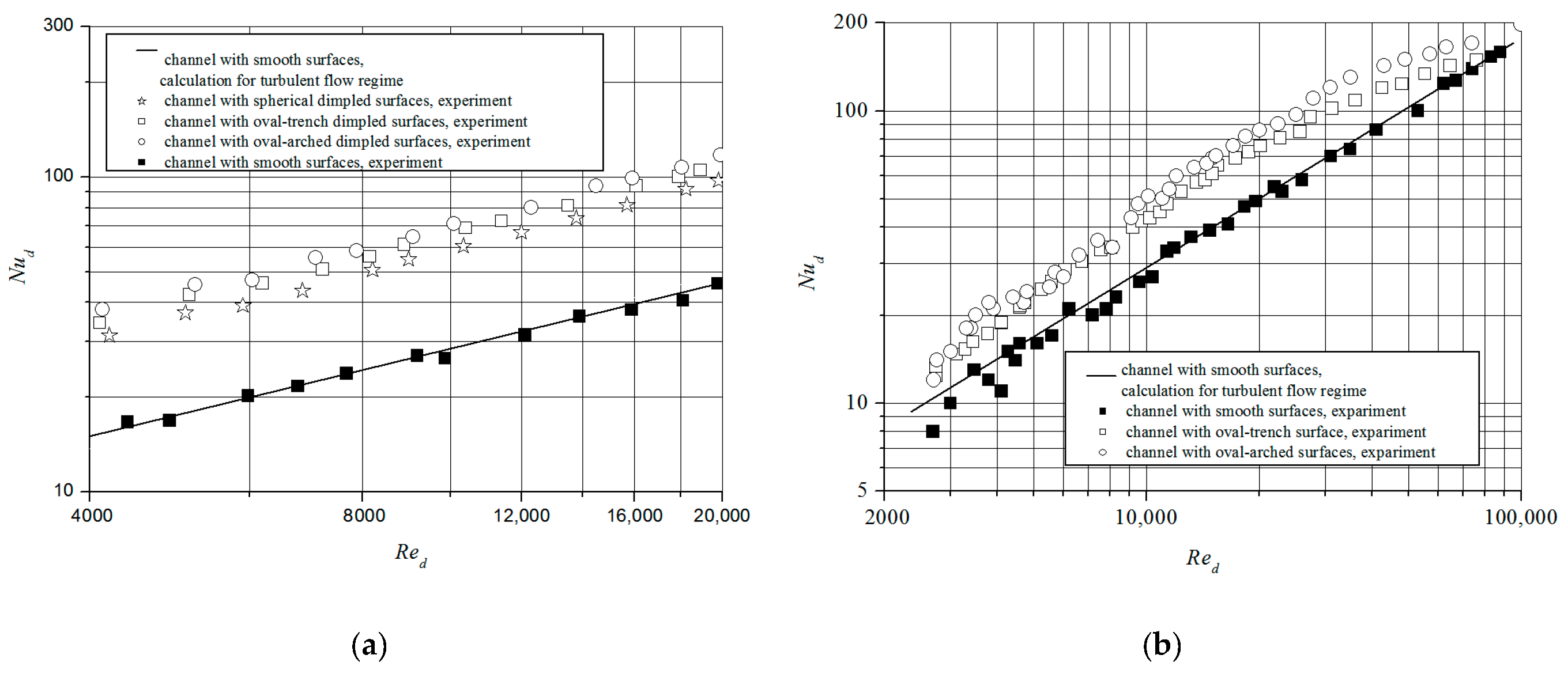
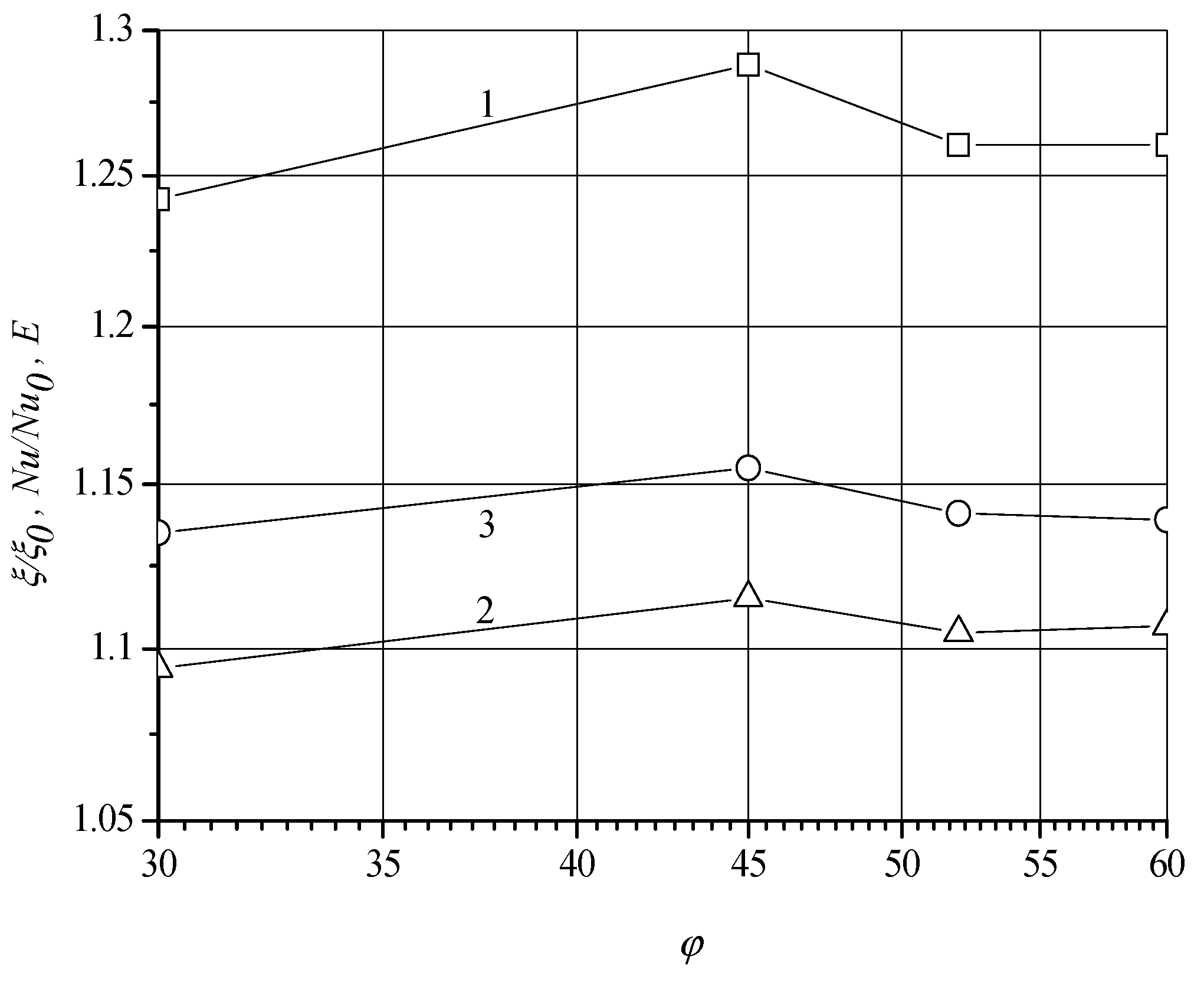
Vortex generation and flow disruption in heat exchanger passages by means of surface modification is a widely used passive heat transfer augmentation technique. The present paper contains the results of numerical and experimental studies of the hydraulic resistance and heat transfer in the rectangle duct with oval-trench- and oval-arc-shaped dimples applied to the heat transfer surface. For the turbulent flow in the duct (Pr = 0.71, Red = 3200–9 × 10⁴—for heat transfer determination and Red = 500–104—for the friction factor measurements), rational geometrical parameters of the oval-trench dimple were determined: relative elongation of dimple l/b = 5.57–6.78 and relative depth l/b = 5.57–6.78, while the value of the attack angle to the mean flow was fixed φ = (45–60)°. The comparison of the experimental and numerical modeling for the flow in the narrow duct over the surface with a single- and multi-row dimple arrangement has revealed a good agreement. It was found that the average heat transfer coefficient magnitudes in such ducts could be increased 1.5–2.5 times by means of single and multi-row dimple application on the heat transfer surface. The heat transfer augmentation for the surfaces with the oval-arched dimples was found to be 10% greater than the one for the oval-trench dimples. The corresponding friction factor augmentation was found to be 125–300% in comparison to the smooth surface duct. The obtained experimental data were used for the data generalization. Derived generalized equation allows for predicting the friction factor and heat transfer coefficient values for the flow over the single-row oval-trench simple arrangement. The maximal deviation of the experimental data from the proposed equations was found to be 20%. The application of the artificial neural networks for predicting the hydraulic resistance and heat transfer augmentation in such ducts was presented.
Keywords: heat transfer enhancement; hydraulic resistance; efficiency; numerical simulation; experiment; vortex generators; oval dimples heat transfer enhancement; hydraulic resistance; efficiency; numerical simulation; experiment; vortex generators; oval dimples
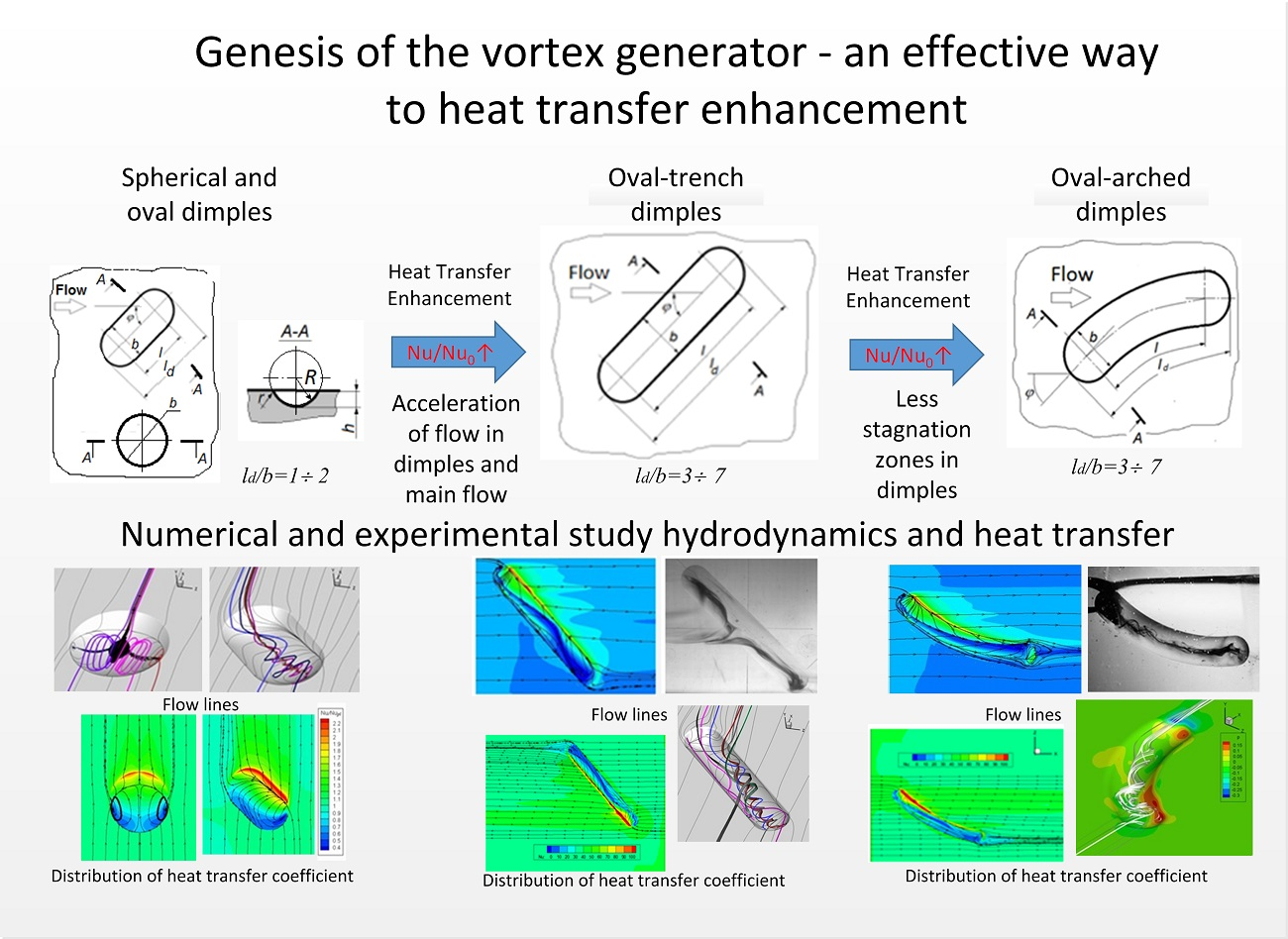
Graphical Abstract