Generator Maintenance Scheduling Method Using Transformation of Mixed Integer Polynomial Programming in a Power System Incorporating Demand Response

Abstract
1. Introduction
2. GMS Problem Incorporating Reliability-Based DR, Must-Run Units, and Blackstart Units
2.1. Reliability-Based DR Model for the GMS Problem
2.2. Must-Run Unit Constraints for the Power System in the GMS Problem
2.3. Blackstart Unit Constraint for the Power System in the GMS Problem
2.4. GMS Problem Formulation Considering Reliability-Based DR, Must-Run Units, and Blackstart Units
- Supply reserve requirement constraintwhere PDR is the effective capacity of the reliability-based DR during the scheduling period, which represents the reliability-DR capacity adjusted by the historical performance data for the load reduction of the reliability-based DR.
- Maintenance window constraintswhere Mi,j is the time set in which the maintenance for the j-th schedule of generator i may be performed, termed an adjustable period in this paper; Xi,j,d is the binary variable for the status of the j-th maintenance schedule for generator i on day d; and OPi is the set of maintenance schedules of generator i.
- Maintenance outage duration constraintswhere Di,j is the maintenance outage duration in the j-th maintenance schedule for generator i; and si,j,d and fi,j,d are the binary variables for the beginning and end of the j-th maintenance schedule for generator i on day d, respectively.
- Maintenance exclusion constraintwhere gs is the set of generators for which simultaneous maintenance is impossible.
- Sequence and interval constraint for maintenance scheduleswhere gp is the set of maintenance schedules of the generators for which the sequence and interval for maintenance must be maintained; αk,l is the interval between the l-th maintenance schedule of generator k and the j-th maintenance schedule of generator i; and Ngp is the number of generators in gp.
- Must-run unit constraints
- Blackstart unit constraint
3. GMS Method Based on Transformation of Mixed Integer Polynomial Programming with Constraints for Reliability-Based DR, Must-Run Units, and Blackstart Units
3.1. Formulation of the GMS Problem Objective Function Using the Transformation of Mixed Integer Polynomial Programming Method
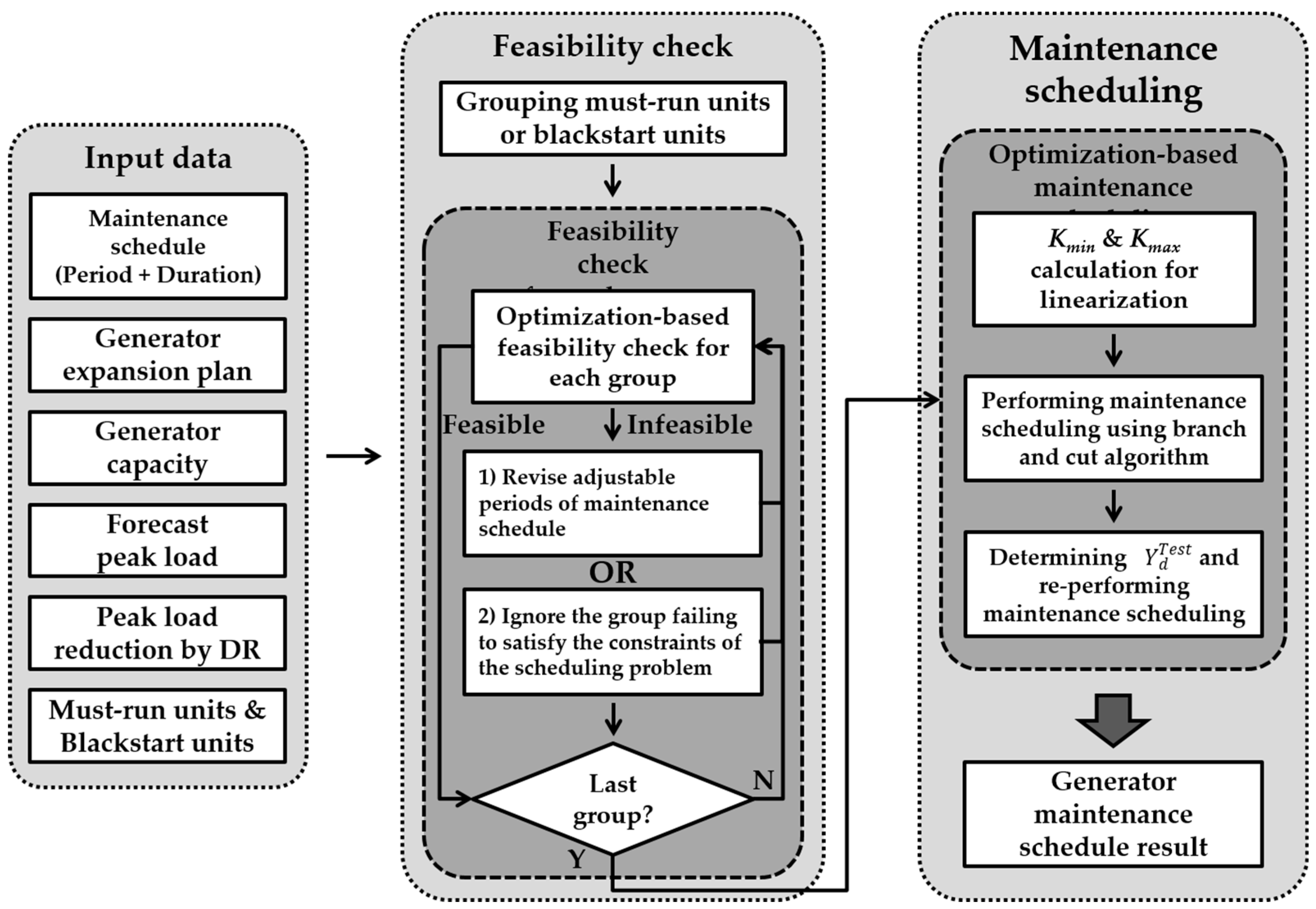
3.2. GMS Algorithm Considering Constraints for Reliability-Based DR and Power System
- Feasibility check problem constraints for must-run units:
- Maintenance window constraints: (11), (12);
- maintenance outage duration constraints: (13)–(16);
- maintenance exclusion constraint: (17);
- sequence and interval constraint for maintenance schedules: (18);
- must-run unit constraints: (19)–(21).
- Feasibility check problem constraints for blackstart units:
- Maintenance window constraints: (11), (12);
- maintenance outage duration constraints: (13)–(16);
- maintenance exclusion constraint: (17);
- sequence and interval constraint for maintenance schedules: (18);
- blackstart unit constraints: (22).
4. Test Results
- (1)
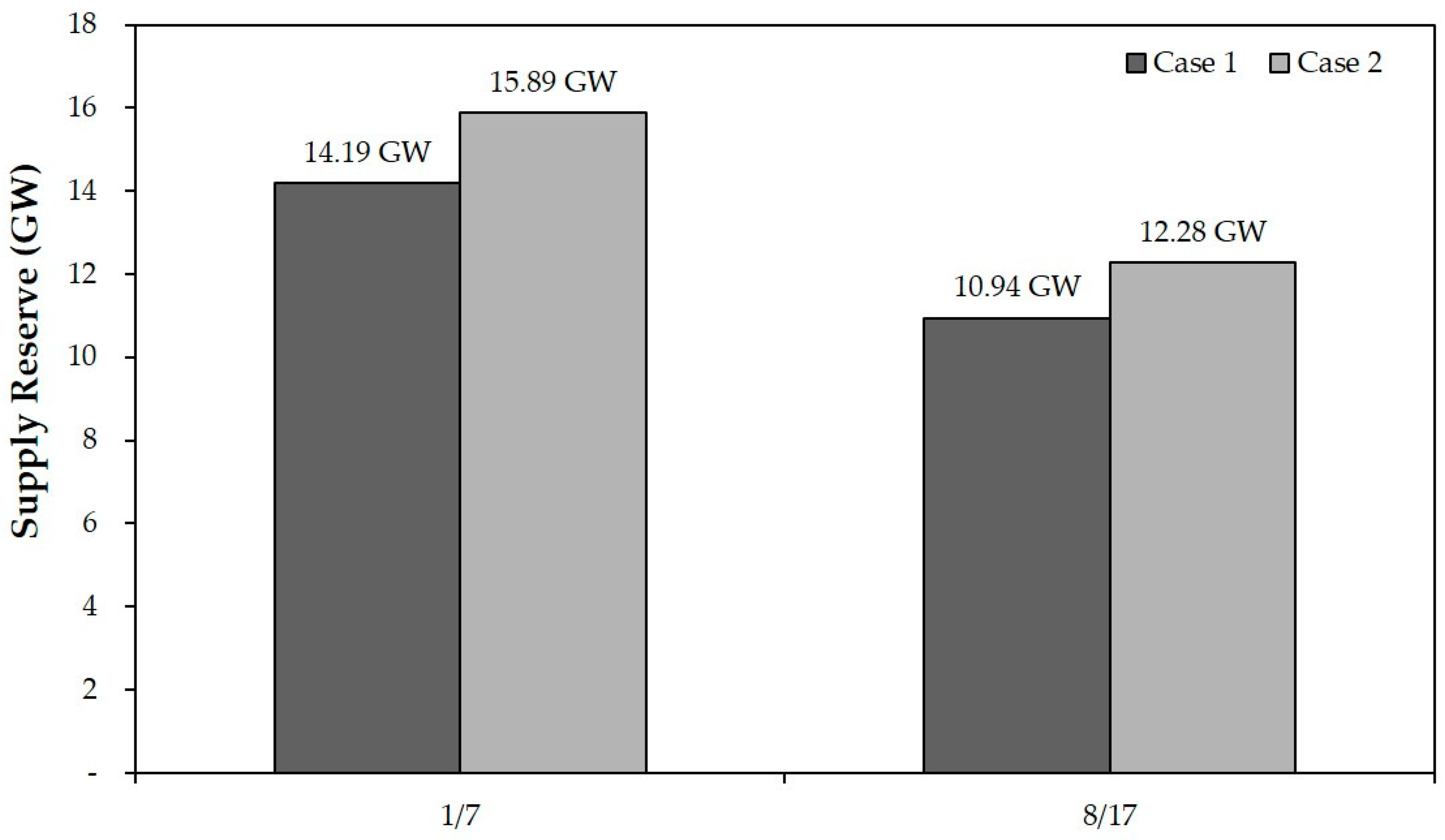
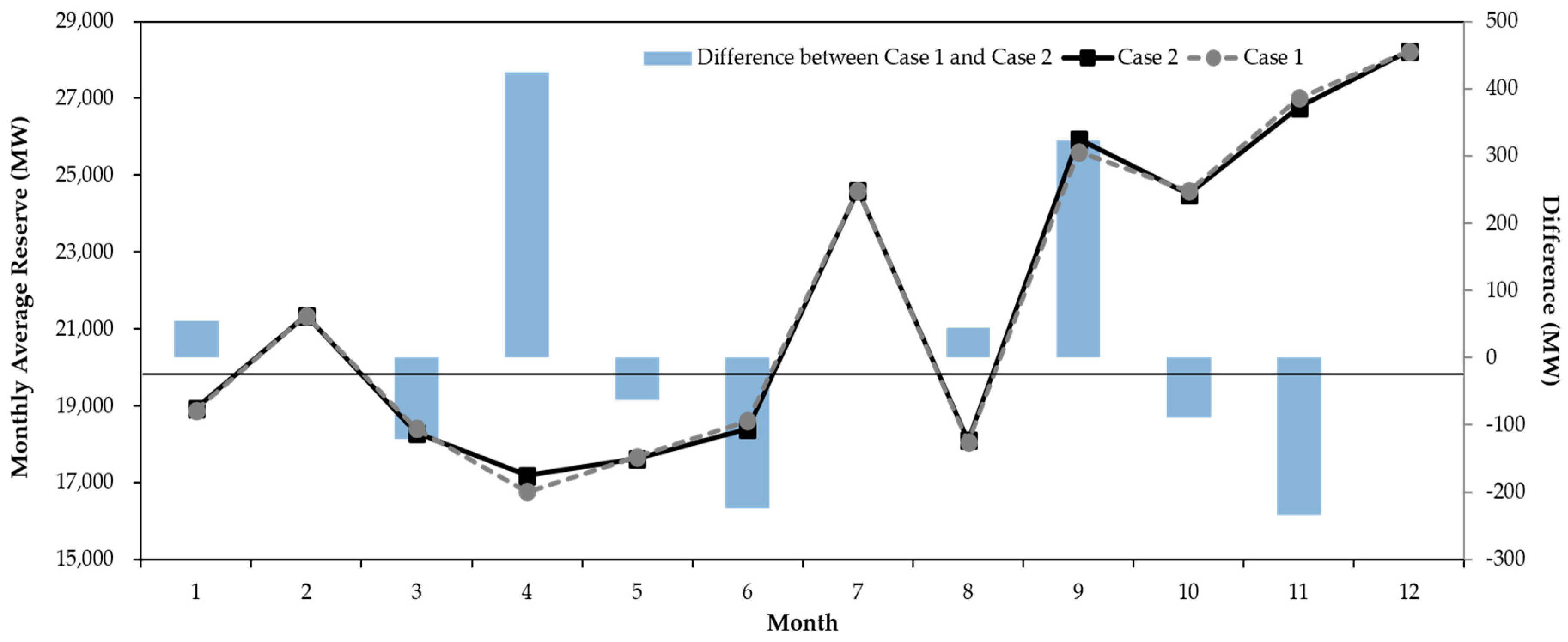
- Case 1: The maintenance schedule results for the 2016 Korean power system reported in [25] were used;
- (2)
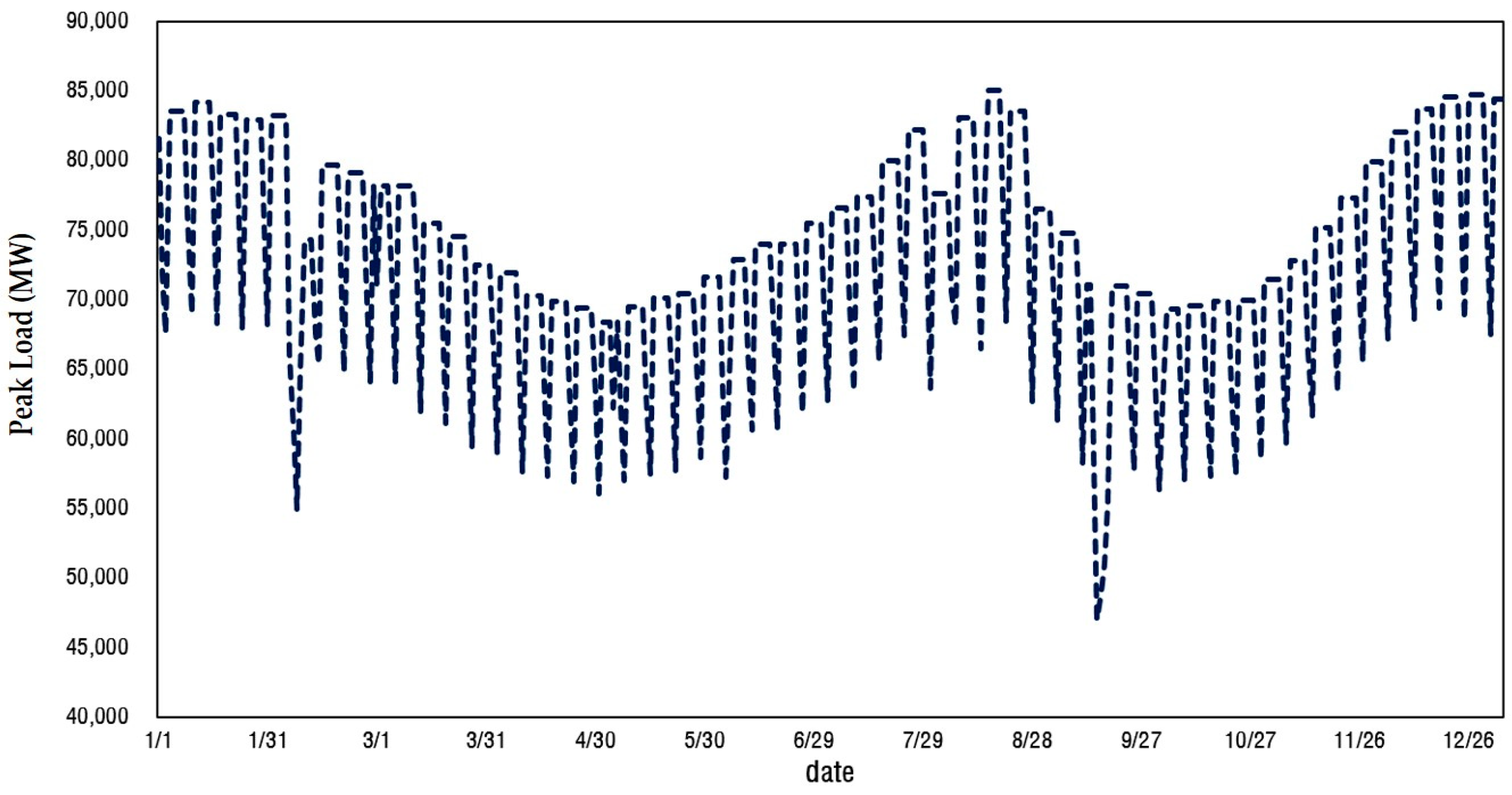
- Case 2: The optimal maintenance schedule results for the 2016 Korean power system were determined using the generator maintenance scheduling method proposed in this study.
5. Conclusions
Author Contributions
Acknowledgments
Conflicts of Interest
References
- Choi, J.; Tran, T.; El-Keib, A.A.; Thomas, R.; Oh, H.; Billinton, R. A Method for Transmission System Expansion Planning Considering Probabilistic Reliability Criteria. IEEE Trans. Power Syst. 2005, 20, 1606–1615. [Google Scholar] [CrossRef]
- Leite da Silva, A.M.; Manso, L.A.F.; Flavio, S.A.; da Rosa, M.A.; Resende, L.C. Composite Reliability Assessment of Power Systems with Large Penetration of Renewable Sources. In Reliability and Risk Evaluation of Wind Integrated Power Systems; Billinton, R., Karki, R., Verma, A.K., Eds.; Springer: London, UK, 2013; Volume 1, pp. 107–128. [Google Scholar]
- Zurn, H.H.; Quintana, V.H. Several Objective Criteria for Optimal Generator Preventive Maintenance. IEEE Trans. Power Syst. 1977, 96, 984–992. [Google Scholar] [CrossRef]
- Kralj, B.; Rajakovic, N. Multiobjective Programming in Power System Optimization: New Approach to Generator Maintenance Scheduling. Int. J. Elec. Power Energ. Syst. 1994, 16, 211–220. [Google Scholar] [CrossRef]
- Yare, Y.; Venayagamoorthy, G.K. Optimal Maintenance Scheduling of Generators Using Multiple Swarms-MDPSO Framework. Eng. Appl. Artif. Intel. 2010, 23, 895–910. [Google Scholar] [CrossRef]
- Lindner, B.G. Bi-objective Generator Maintenance Scheduling for a National Power Utility. Ph.D. Thesis, Stellenbosch University, Stellenbosch, South Africa, 2017. [Google Scholar]
- Suresh, K.; Kumarappan, N. Hybrid Improved Binary Particle Swarm Optimization Approach for Generation Maintenance Scheduling Problem. Swarm Evol. Comput. 2013, 9, 69–89. [Google Scholar] [CrossRef]
- Liu, Q.; Wang, R.; Zhang, Y.; Wu, G.; Shi, J. An Optimal and Distributed Demand Response Strategy for Energy Internet Management. Energies 2018, 11, 215. [Google Scholar] [CrossRef]
- Mollahassani-pour, M.; Abdollahi, A.; Rashidinejad, M. Investigation of Market-Based Demand Response Impacts on Security-Constrained Preventive Maintenance Scheduling. IEEE Syst. J. 2015, 9, 1496–1506. [Google Scholar] [CrossRef]
- Mollahassani-pour, M.; Rashidinejad, M.; Abdollahi, A.; Forghani, M.A. Demand Response Resources’ Allocation in Security-Constrained Preventive Maintenance Scheduling via MODM Method. IEEE Syst. J. 2017, 11, 1196–1207. [Google Scholar] [CrossRef]
- Ou, T.C. A Novel Unsymmetrical Faults Analysis for Microgrid Distribution Systems. Int. J. Elec. Power Energ. Syst. 2012, 43, 1017–1024. [Google Scholar] [CrossRef]
- Ou, T.C. Ground Fault Current Analysis with a Direct Building Algorithm for Microgrid Distribution. Int. J. Elec. Power Energ. Syst. 2013, 53, 867–875. [Google Scholar] [CrossRef]
- Ou, T.C.; Hong, C.M. Dynamic Operation and Control of Microgrid Hybrid Power Systems. Energy 2014, 66, 314–323. [Google Scholar] [CrossRef]
- Ou, T.C.; Su, W.F.; Liu, X.Z.; Huang, S.J.; Tai, T.Y. A Modified Bird-Mating Optimization with Hill-Climbing for Connection Decisions of Transformers. Energies 2016, 9, 671. [Google Scholar] [CrossRef]
- Perez-Canto, S.; Rubio-Romero, J.C. A Model for the Preventive Maintenance Scheduling of Power Plants Including Wind Farms. Reliab. Eng. Syst. Safe. 2013, 119, 67–75. [Google Scholar] [CrossRef]
- Reihani, E.; Sarikhani, A.; Davodi, M.; Davodi, M. Reliability based Generator Maintenance Scheduling Using Hybrid Evolutionary approach. Int. J. Elec. Power Energ. Syst. 2012, 42, 434–439. [Google Scholar] [CrossRef]
- Satoh, T.; Nara, K. Maintenance Scheduling by Using Simulated Annealing Method. IEEE Trans. Power Syst. 1991, 6, 850–857. [Google Scholar] [CrossRef]
- Schlünz, E.B.; Van Vuuren, J.H. An Investigation into the Effectiveness of Simulated Annealing as a Solution Approach for the Generator Maintenance Scheduling Problem. Int. J. Elec. Power Energy Syst. 2013, 53, 166–174. [Google Scholar] [CrossRef]
- Balaji, G.; Balamurugan, R.; Lakshminarasimman, L. Mathematical Approach Assisted Differential Evolution for Generator Maintenance Scheduling. Int. J. Elec. Power Energy Syst. 2016, 82, 508–518. [Google Scholar] [CrossRef]
- Glover, F. Improved Linear Integer Programming Formulations of Nonlinear Integer Programs. Manag. Sci. 1975, 22, 455–460. [Google Scholar] [CrossRef]
- Westerlund, T.; Harjunkoski, I.; Isaksson, J. Solving a production optimization problem in a paper-converting mill with MILP. Comput. Chem. Eng. 1998, 22, 563–570. [Google Scholar] [CrossRef]
- Ou, T.C.; Lu, K.H.; Huang, C.J. Improvement of Transient Stability in a Hybrid Power Multi-System Using a Designed NIDC (Novel Intelligent Damping Controller). Energies 2017, 10, 488. [Google Scholar] [CrossRef]
- Padberg, M.; Rinaldi, G. A Branch-and-cut Algorithm for the Resolution of Large-Scale Symmetric Traveling Salesman Problems. SIAM Rev. 1991, 33, 60–100. [Google Scholar] [CrossRef]
- Ministry of Knowledge Economy. The 6th Basic Plan for Long-Term Electricity Supply and Demand (2013–2017); Ministry of Knowledge Economy: Sejong, Korea, 2013. [Google Scholar]
- Korea Power Exchange. 2016–2017 Electricity Supply and Demand Outlook and Generator Maintenance Plan (Draft); Korea Power Exchange: Naju, Korea, 2015. [Google Scholar]



| Generator | Effective Capacity (PDR) of Reliability-Based DR | Supply Reserve Requirement | |
|---|---|---|---|
| Number | Total Capacity | ||
| 242 | 98.7 GW | 1.3 GW | 5000 MW |
| Group Number | Must-Run Unit | Capacity | Number of Required Must-Run Units | Reference Capacity for Combined Cycle Generator |
|---|---|---|---|---|
| 1 | Coal-fired#1 | 250 MW | 2 | - |
| Coal-fired#2 | 250 MW | |||
| Coal-fired#3 | 329 MW | |||
| 2 | Combined-cycle#1 | 526 MW | 2 | 250 MW |
| Gas-turbine#1 | 286 MW | |||
| Coal-fired#3 | 329 MW |
| Units | Adjustable Period | Revised Period |
|---|---|---|
| Coal-fired#1 | 2016.03.21–2016.05.02 | 2016.02.25–2016.04.04 |
| 2016.09.20–2016.10.07 | 2016.09.10–2016.09.22 | |
| Coal-fired#2 | 2016.05.19–2016.06.03 | 2016.05.19–2016.06.03 |
| 2016.10.22–2016.12.04 | 2016.10.22–2016.12.04 | |
| Coal-fired#3 | 2016.03.25–2016.04.11 | 2016.04.25–2016.05.12 |
| 2016.09.30–2016.10.21 | 2016.09.30–2016.10.21 | |
| Feasibility | Infeasible (Simultaneous maintenance of Coal-fired#1 and Coal-fired#3) | Feasible |
| Units | Adjustable Period | Revised Period |
|---|---|---|
| Combined-Cycle#1 | 2016.04.07–2016.04.16 | 2016.04.05–2016.04.14 |
| 2016.05.13–2016.05.15 | 2016.05.13–2016.05.15 | |
| Gas-Turbine#1 | 2016.04.18–2016.04.27 | 2016.04.15–2016.04.24 |
| Coal-Fired#3 | 2016.03.25–2016.04.11 | 2016.04.25–2016.05.12 |
| Feasibility | Infeasible (Simultaneous maintenance of Combined-cycle#1 and Coal-fired#3) | Feasible |
| Case | Total Number of Schedules | Number of Adjusted Schedules | Adjustment Rate | ||
|---|---|---|---|---|---|
| For Must-Run Unit Constraints | For Blackstart Unit Constraints | For Supply Reserve Variation Reduction | |||
| Case 1 | 389 | 9 | 0 | 48 | 15% |
| Case 2 | 9 | 0 | 68 | 20% | |
| Case | Value of Objective Function | Computation Time | Feasibility |
|---|---|---|---|
| Case w/proposed method (Case 2) | 1.90 × 10¹¹ | 10 s | Feasible |
| Case w/MINLP | 1.88 × 10¹¹ | 130 s | Infeasible (Some constraints are violated) |
© 2019 by the authors. Licensee MDPI, Basel, Switzerland. This article is an open access article distributed under the terms and conditions of the Creative Commons Attribution (CC BY) license (http://creativecommons.org/licenses/by/4.0/).
Share and Cite
Jo, H.-C.; Ko, R.; Joo, S.-K. Generator Maintenance Scheduling Method Using Transformation of Mixed Integer Polynomial Programming in a Power System Incorporating Demand Response. Energies 2019, 12, 1646. https://doi.org/10.3390/en12091646
Jo H-C, Ko R, Joo S-K. Generator Maintenance Scheduling Method Using Transformation of Mixed Integer Polynomial Programming in a Power System Incorporating Demand Response. Energies. 2019; 12(9):1646. https://doi.org/10.3390/en12091646
Chicago/Turabian StyleJo, Hyung-Chul, Rakkyung Ko, and Sung-Kwan Joo. 2019. "Generator Maintenance Scheduling Method Using Transformation of Mixed Integer Polynomial Programming in a Power System Incorporating Demand Response" Energies 12, no. 9: 1646. https://doi.org/10.3390/en12091646
APA StyleJo, H.-C., Ko, R., & Joo, S.-K. (2019). Generator Maintenance Scheduling Method Using Transformation of Mixed Integer Polynomial Programming in a Power System Incorporating Demand Response. Energies, 12(9), 1646. https://doi.org/10.3390/en12091646