Research on Micro-Grid Group Intelligent Decision Mechanism under the Mode of Block-Chain and Multi-Agent Fusion


Abstract
1. Introduction
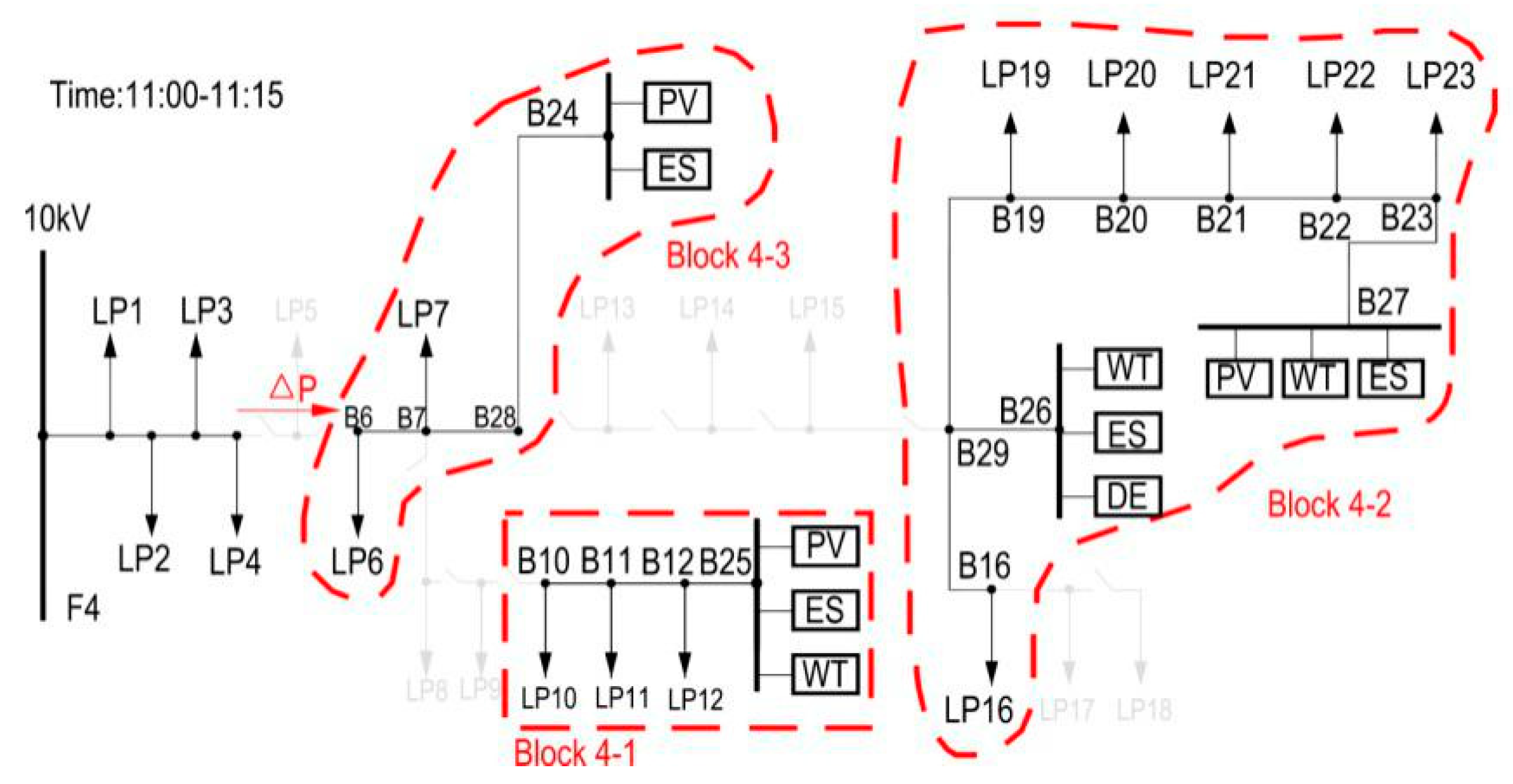
- Improve the traditional way of topology optimization using distributed algebraic algorithm. Innovatively, the intelligent contract is guided by the optimal adjustment of the controllable load, and the micro-grid dual-loop mobile topology model is built by the combination of block-chain and multi-agent. It improves the complexity of communication topology and reduces the redundant interaction between agents.
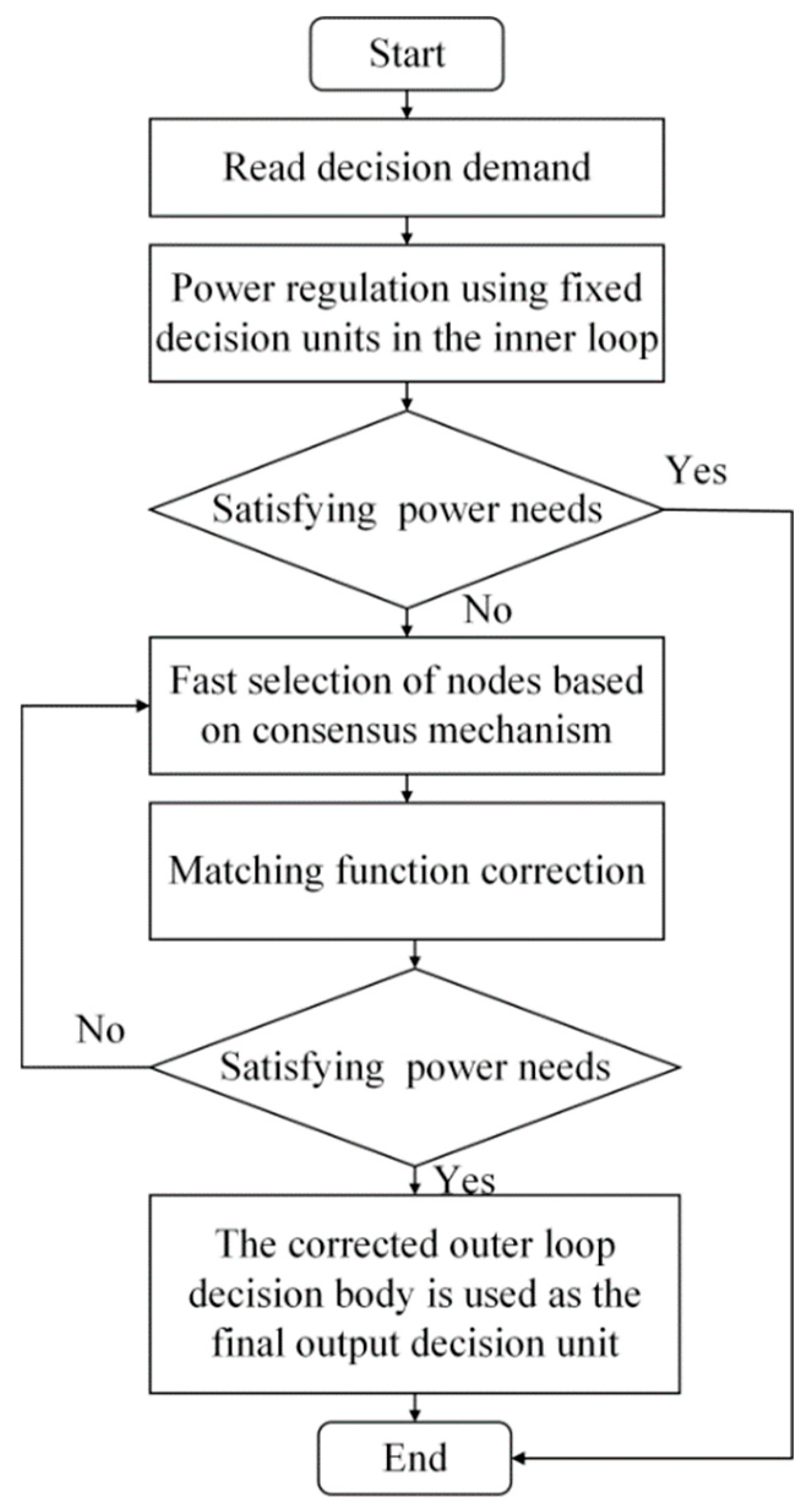
- Design a fast selection strategy of power supply nodes based on consensus mechanism, and use the double-loop matching degree function to correct the decision body determined by the dual-loop mobile topology model of the micro-grid in real time. It is in line with the actual running condition of the node and has guiding significance for the actual engineering planning problem.
- Set up a bi-level model of group intelligent decision-making under the decentralized mechanism. The upper layer takes the maximum risk-reward amount as the optimization goal, and on this basis, innovatively introduces the distributed account book and consensus mechanism to improve the evolutionary game algorithm in the block-chain. Under the premise of ensuring the credibility of individual decision-making, the task rationality is evaluated; the lower level is controlled by the maximum controllable load, and the hybrid game is used to solve the learning algorithm. By introducing the block-chain decentralized block decision, non-convex optimization problem for multi-task decision making with high quality.
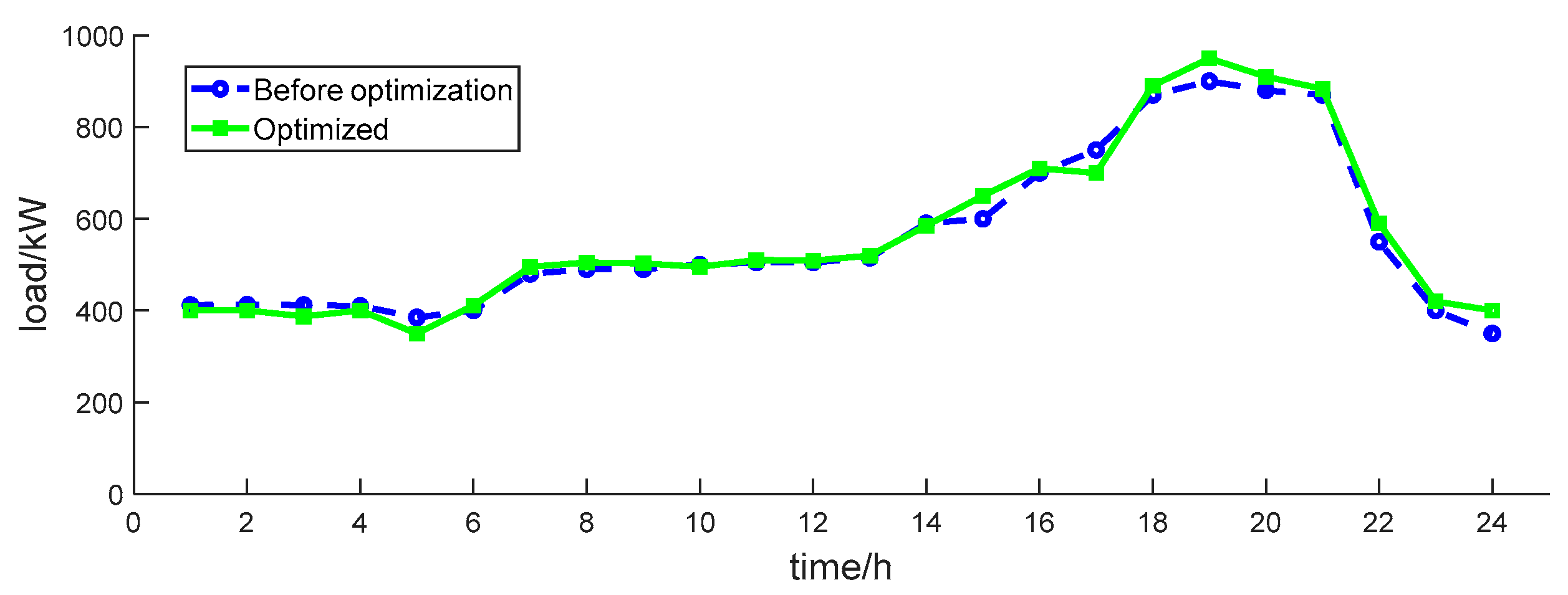
- Using the above model to optimize the intelligent decision-making of controllable load groups in Beijing Jin-feng Micro-grid Park.
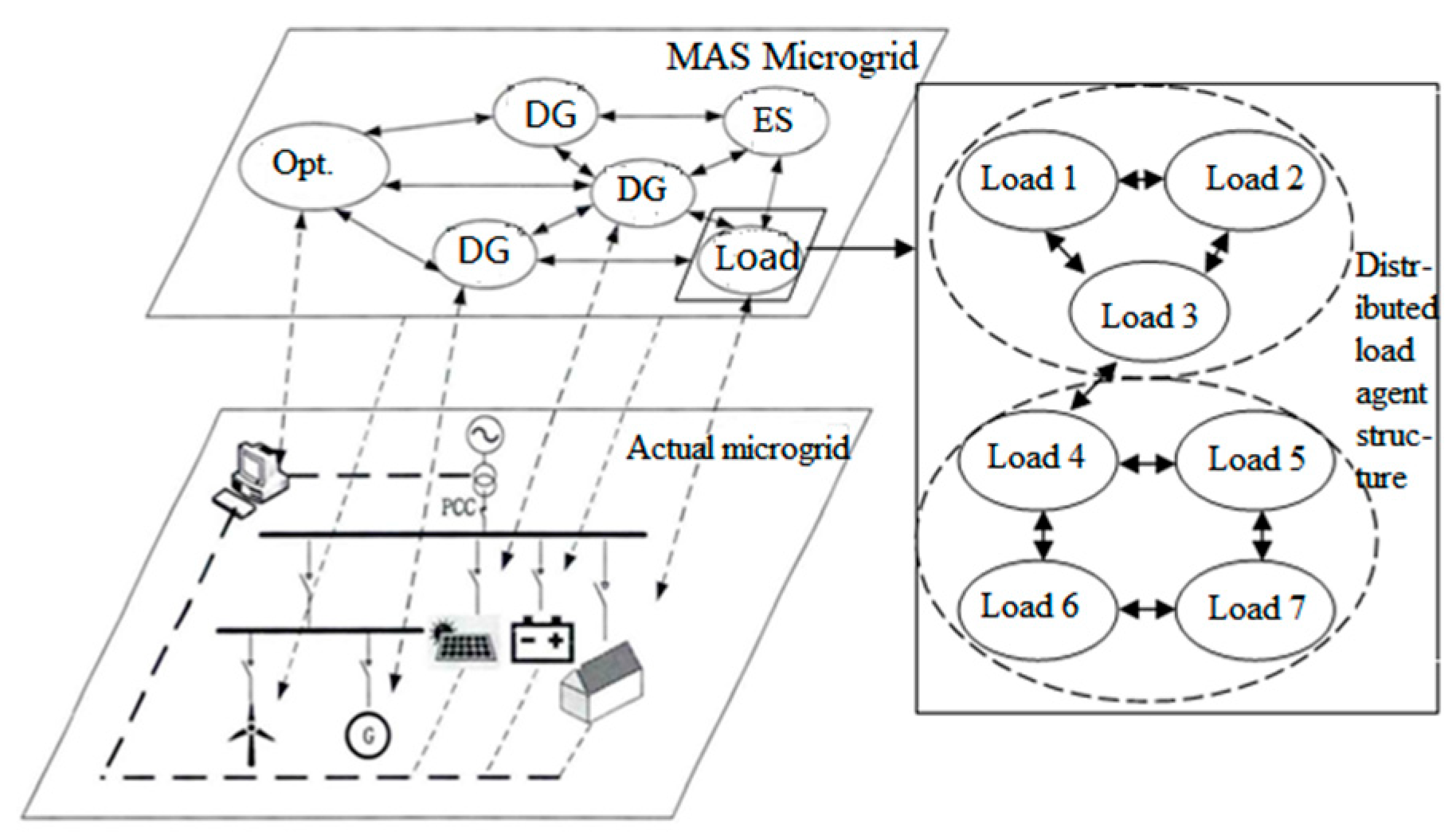
2. Multi-Agent Interaction Network Model
2.1. Interaction Model
2.2. Flexible Load Model
- {Washing machine + Air conditioning} Agent
- {Dishwasher + Electric water heater} Agent
- {Washing machine + Dishwasher + Air conditioning} Agent
- {Washing machine + Air conditioner + Microwave + Electric water heater} Agent
3. Double-Loop Mobile Topology in Block-Chain and Multi-Agent Fusion Mode
3.1. Topology Execution Rules
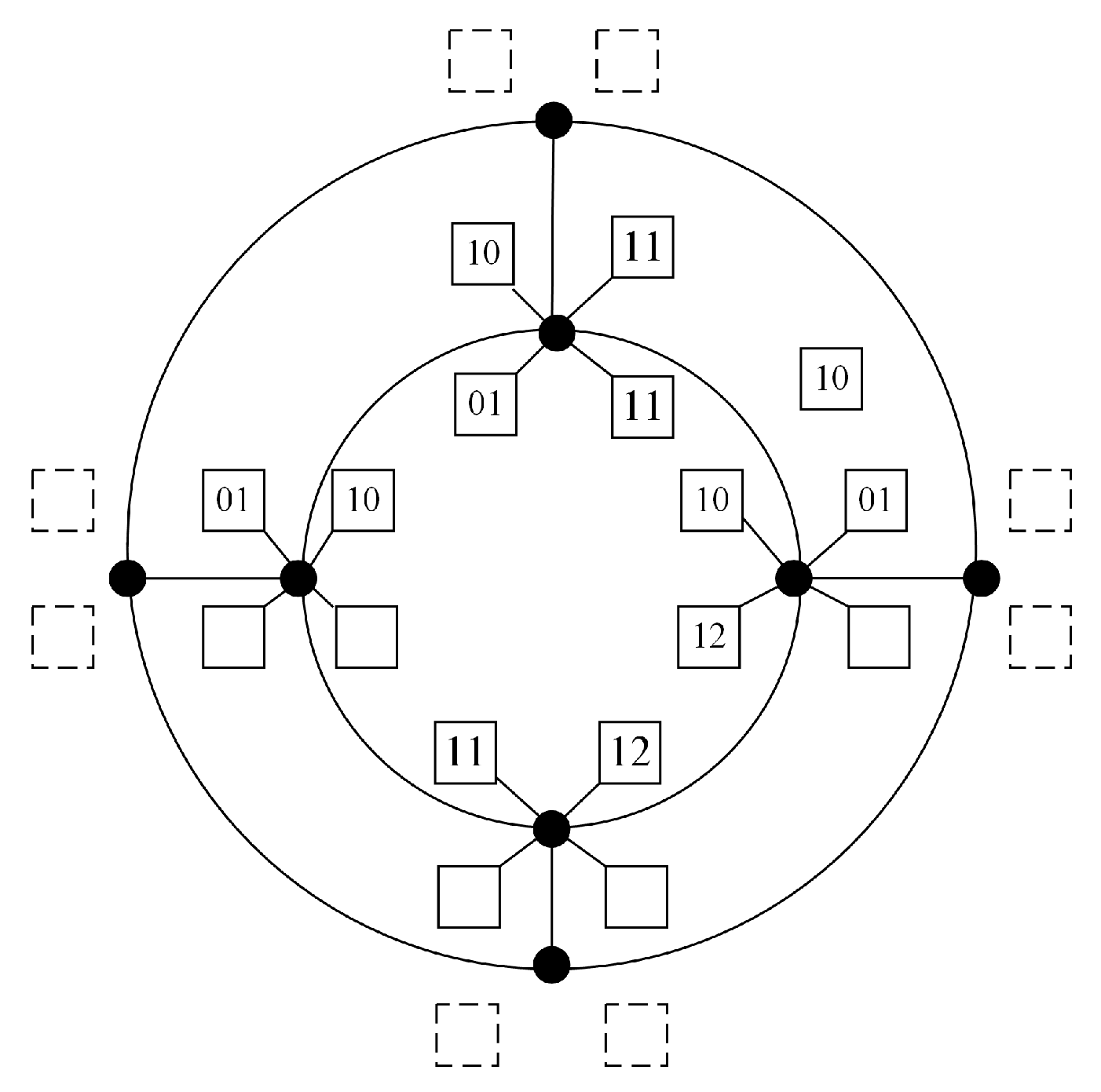
- Agent Receive data through neighborswhere denotes association information received by the agent in the topology; and are the decision bodies separated by the inner ring, respectively, and as a multi-agent, is the number of iterations of the topology discovery algorithm, and is the number of iterations of the distributed differential evolution algorithm DE/rand/1/bin, is the communication topology of the system at the th iteration of the agent ,and is the load adjustment amount obtained by the agent from the neighbor agent .
- Mismatch estimationwhere is the local estimate of the power mismatch, is the average power mismatch of the agent , and is the branch step size. When the is satisfied, the decision body in the agent needs to be corrected by the outer ring, where is the current flowing through the agent, and is used as an indicator for judging whether to perform the outer ring correction.
- Update the local action valuewhere is the joint state of the neighbor agent, is the joint action of the neighbor agent, is the fitness when the action is taken at the th time in state , , is the average power generation cost estimate, and is the agent’s output ratio, is the updated local power value.
- Feasible power generation combinationwhere and are the controllable output power values of the agent and the agent , respectively, and the value is between .
3.2. Fast Selection Strategy for Nodes Based on Consensus Mechanism
3.2.1. Consensus Mechanism Competition Billing Rights
- The transfer transaction is sent to the Bit-coin network, and all the mining pools collect all transaction records;
- Each pool calculates the random number on the basis of the original transaction data and serves as the block header;
- Constantly adjusting the value so that the entire block calculates the value that satisfies the consensus rule;
- Once a certain mine pool calculates the correct value, the mining is successful. The mine pool obtains the billing rights and corresponding rewards. It broadcasts through the whole network and informs other mine pools to confirm that it has been added to its own block list.
- Receive the next transfer record.
3.2.2. Node Quick Selection Strategy
- Judging that the decision-making body of the outer ring can adjust the output change value.where is the output power of each decision-making body of the outer ring, which changes continuously with time. is the demand output power in the micro-grid, which changes continuously with time. is the control parameter, the analog function is the same as the Hash value in the consensus mechanism, and can play a guiding role, .
- Calculate the probability of stability of the adjustable outputwhere is the stable output power value of the outer ring agent at time .
- Estimate the entropy value and determine the nodewhere is the number of neighbor nodes of the agent ,.
3.3. Matching Degree Function Correction
3.4. Validation Check
4. Group Decision-Making Bi-Level Model under the Decentralized Mechanism
4.1. Upper Decision Model
- The amount of default risk income generated by the distributed power/power user’s predicted deviation from its output/load resulting in poor performance capability.where is a distributed energy derating factor, which is used to describe the influence of external environmental factors on distributed energy output, is the maximum output power of distributed energy or the maximum adjustable output of power users, is the actual output of distributed power or power users, is the predicted output of distributed power or power users, is the proportion of distributed energy output, and is the total amount of regulatable resources.
- The amount of liquidity risk income generated by poor real-time distributed decision-making in the case of delay, error, and failure in information transmission.where is the channel capacity, indicating the maximum information rate that the channel can transmit without error, is the repair request, is the processing request, is the decision benefit under normal communication, and is the decision benefit under fault communication. and refer specifically to decision delays under channel delay and channel failure, respectively. is the hash value after hexadecimal conversion to decimal when using SHA256 algorithm. The hash value in the block-chain is a fixed-length, numerically unique, and irreversible message digest that can be used as a unique identifier for the file.
- The amount of maturity risk income generated by different blocks in the reverse solution to the SHA-256 problem for competing for the billing rights.where is the output power of the distributed power source before competing for the billing right, is the output power after the distributed power source competes for the billing right, is the calculation time lag, and is the calculated start time.
- Compensation for damage caused by user equipment damage and power interruption during the process of correcting the topology matching degree.where is the matching deviation, is the individual decision credibility, is the risk value coefficient, and is the compensation time difference, which can be expressed as , is the depreciation expense of the equipment in the fault state, is the depreciation expense of the equipment under normal conditions, is the electric energy cost under the interruption of the power supply condition, and is the electric energy cost under the normal power supply condition.
- Distributed power supply can regulate output limitationwhere is the distributed energy adjustable power of node , is the adjustable power upper limit, and is the rated power.
- Decision credibility constraintEach block in the block-chain consists of a block header and a block body [30]. The block body is responsible for recording all transaction information for a period of time before, and the block header contains the hash value of the previous block, and the block can be implemented. Most of the functions of the chain, the block header and the block body are connected by the Merkle root. The Merkle root is the root node of the transaction Merkle tree, which can help each node in the block-chain network to quickly verify the existence and correctness of the transaction. Therefore, the introduction of Merkle root in this paper greatly improves the operational efficiency and scalability of intelligent decision-making process while characterizing the credibility of individual decision-making. Merkle is proportional to . The larger the value, the higher the credibility of individual decision-making.
- Decision credibility calculation formula iswhere is the decision evaluation coefficient, and is the Merkel root value after hexadecimal conversion to decimal using the SHA256 algorithm. It is obtained by hashing the hash of the data block and the hash of the data block and then performing the hash operation., , and are the experience, familiarity, and estimation of the scene, respectively. , , and respectively represent the corresponding proportions.
4.2. Lower Decision Model
- Interact power constraints with the distribution networkwhere is the maximum allowed transmission power and is the minimum allowed transmission power.
- Price cap incentive ruleswhere is the electricity price cost, is the profit rate, is the electricity price subsidy rate, is the power regulation efficiency growth rate (day operating cost reduction rate), and is the adjustment performance proportional coefficient.
- Power supply price constraint on demand side biddingThe power supply price of the demand side bid should not exceed its marginal cost. Marginal costs guide an efficient power supply structure and recover all costs.where is the unit compensation price of the demand side bid, is the demand side bid load reduction, and PG,i is the active input of node .
5. Solving Algorithm
5.1. Evolutionary Game Algorithm Based on Block-Chain Consensus Mechanism
5.2. Mixed Game Reinforcement Learning Algorithm
5.2.1. Algorithm Description
- Calculate the reward functionwhere is the minimum value of the objective function of the optimal individual in the k-th iteration of the i-th agent, is the j-th individual in the i-th agent, the objective function in the k-th iteration, and is a positive multiple, is a correction coefficient that guarantees that the reward function is positive, and is the state action pair set of the optimal individual in the k-th iteration of the i-th agent.
- Update the knowledge matrixwhere is the reward function for transitioning from state to when action occurs, subscript i is the i-th agent, and subscript m is the m-th binary bit, is the learning factor, is the output ratio of the agent, is the knowledge increment, and is the population size in one iteration.
- Evolutionary game strategy updateUsing the rule, the left side of the equation indicates the probability that Agent i will mimic the neighbor Agent h policy [33]. In each iteration, the algorithm looks for Agent h in the block i that has the maximum social benefit of the micro-grid after the controlled load is adjusted. When , the knowledge matrix of the player i in block h is copied with the probability .
- Output conditionwhere is the maximum number of iterations.
5.2.2. Validity Test
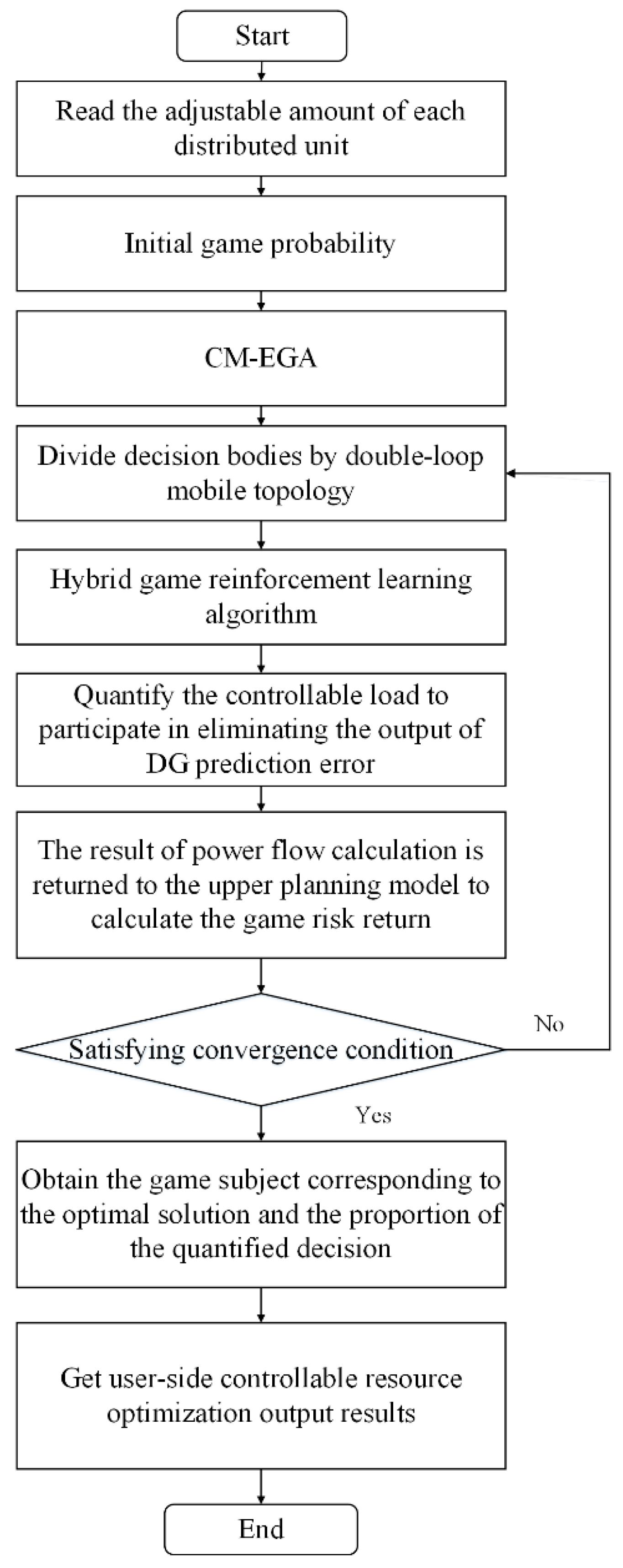
5.3. Two Level Model Solving Algorithm
6. Examples and Analysis of Planning Results
7. Conclusions
Author Contributions
Funding
Conflicts of Interest
References
- Yu, T.; Cheng, L.F.; Zhang, X.S. Weak Centralized Micro-NET Based on Information-Physical-Social System Integration and Group Machine Learning: Theoretical Research and Analysis of Key Scientific Issues. China Sci. Soc. Sci. 2019, 49, 1–29. [Google Scholar]
- Wang, J.R.; Li, X.L.; Li, Y.T. Event-Based Consensus Control of Multi-Agent Systems with Input Saturation Constraint. In Proceedings of the 2018 Chinese Control and Decision Conference, Shen Yang, China, 9–11 June 2018. [Google Scholar]
- Jiang, Z.Q.; Jin, Y. Distributed Dynamic Scheduling for Cyber-Physical Production Systems Based on a Multi-Agent System. IEEE Access 2018, 6, 1855–1869. [Google Scholar] [CrossRef]
- Zhang, Y.; Fan, Y.; Yang, Y.; Chen, J. Multi-Agent Tracking Control with Dynamic Leader Based on Event-Triggered Control. In Proceedings of the 2018 Chinese Control Conference, Wu Han, China, 25–27 July 2018. [Google Scholar]
- Liu, Y.F.; Zhao, Y. Specified-time containment tracking for multi-agent systems: An optimal control approach. In Proceedings of the 2017 Chinese Control and Decision Conference, Chong Qing, China, 28–30 May 2017. [Google Scholar]
- Tan, H.R.; Wu, M.; Huang, Z.W. Coordinated control for multi-agent systems based on networked predictive control schemes. In Proceedings of the 2016 Chinese Control and Decision Conference, Yin Chuan, China, 28–30 May 2016. [Google Scholar]
- Lu, X.B.; Zhang, J.; Zhou, J. Flocking control of multi-agent based on self-adaptively weighting observers driven only by local position measurements. In Proceedings of the 2017 Chinese Control and Decision Conference, Chong Qing, China, 28–30 May 2017. [Google Scholar]
- Lu, X.N.; Guerrero, J.M.; Sun, K. An improved droop control method for DC micro-grids based on low bandwidth communication with DC bus voltage restoration and enhanced current sharing accuracy. IEEE Trans. Power Electron. 2014, 29, 1800–1812. [Google Scholar] [CrossRef]
- Xu, Y.L.; Li, Z.C. Distributed optimal resource management based on the consensus algorithm in a micro-grid. IEEE Trans. Ind. Electron. 2015, 62, 2584–2592. [Google Scholar] [CrossRef]
- Zhu, W.; Wang, D.D.; Zhou, Q.H. Leader-Following Consensus of Multi-Agent Systems via Adaptive Event-Based Control. J. Syst. Sci. Complex. 2019, 32, 846–856. [Google Scholar] [CrossRef]
- Ababii, V.; Sudacevschi, V.; Munteanu, S.; Bordian, D. Multi-agent cognitive system for optimal solution search. In Proceedings of the 2018 International Conference on Development and Application Systems, Suceava, Romania, 24–26 May 2018. [Google Scholar]
- Lipo, M.; Shaoyan, G. Consensus of Linear Multi-Agent Systems with Persistent Disturbances via Distributed Output Feedback. J. Syst. Sci. Complex. 2019, 32, 835–845. [Google Scholar]
- Wang, W.; Liang, H.J.; Zhang, Y.H.; Tieshan, L. Adaptive cooperative control for a class of nonlinear multi-agent systems with dead zone and input delay. Nonlinear Dyn. 2019, 96, 2707–2719. [Google Scholar] [CrossRef]
- Wang, L.; Chen, Q.; Xi, J.X. Guaranteed-performance Consensualization for High-order Multi-agent Systems with Intermittent Communications. Int. J. Control Autom. Syst. 2019, 17, 1084–1095. [Google Scholar] [CrossRef]
- Wang, Z.X.; Fei, M.R.; Du, D.J.; Zheng, M. Decentralized Event-Triggered Average Consensus for Multi-Agent Systems in CPSs with Communication Constraints. IEEE/CAA J. Autom. Sin. 2015, 2, 248–257. [Google Scholar]
- Wang, Z.H.; Xu, J.J.; Zhang, H.S. Consensus Seeking for Discrete-time Multi-agent Systems with Communication Delay. IEEE/CAA J. Autom. Sin. 2015, 2, 151–157. [Google Scholar]
- Christophe, V.; Sylvain, B.; Michel, K. Distributed event-triggered control strategies for multi-agent formation stabilization and tracking. Automatica 2019, 4, 110–116. [Google Scholar]
- Qin, Z.H.; He, X.X.; Li, G.; Wu, Y.M. Robust adaptive consensus of nonstrict-feedback multi-agent systems with quantized input and unmodeled dynamics. Inf. Sci. 2019, 5, 134–145. [Google Scholar] [CrossRef]
- Kai, L.; Wang, S. Distributed Coordination Method of Micro-grid Economic Operation Optimization Based on Multi-Agent System. In Proceedings of the International Conference on Power System Technology: Towards Green, Efficient and Smart Power System, Sfax, Tunisia, 25–27 March 2014; pp. 3135–3140. [Google Scholar]
- Zhang, P.; Li, C.; Zhang, Q. Grid Multi-Agent System Scheduling Model Based on Demand Response Scheduling Capacity Reporting Strategy Game. Trans. China Electr. Soc. 2017, 19, 170–179. [Google Scholar]
- Ding, L. Research on Distributed Control of Micro-Grid Based on Multi-Agent System; North University of Technology: Beijing, China, 2018. [Google Scholar]
- Wang, H. Research on Multi-Agent Coordinated Control Strategy in Smart Grid; Tianjin University of Technology: Tianjin, China, 2019. [Google Scholar]
- Zhou, H. Research on Key Issues of Source-Charge Interaction in New Energy Power System; North China Electric Power University: Beijing, China, 2016. [Google Scholar]
- Muntasir, A.; Brendan, N.; Maria, F. Heuristic Resource Search in a Self-Organised Distributed Multi Agent System; Spring: Berlin, Germany, 2012. [Google Scholar]
- Zeng, D.; Yao, J.G.; Yang, S.C.; Wang, K.; Zhou, J.; Li, Y.P. Modeling of price-based demand response optimization scheduling based on safety constraints in wind power consumption. Proc. CSEE 2014, 34, 5571–5578. [Google Scholar]
- Ming, D.; Luo, K.; Bi, R. Micro-grid energy coordinated control strategy based on multi-agent system in island mode. Autom. Electr. Power Syst. 2013, 37, 1–8. [Google Scholar]
- Yang, Z.G. CBR-ANN Intelligent Decision Support Method and Application; South China University of Technology: Guangzhou, China, 2007. [Google Scholar]
- Sheng, W.X.; Shi, C.K.; Sun, J.P. Characteristics and Research Framework of Automatic Demand Response in Intelligent Power Consumption. Autom. Electr. Power Syst 2013, 37, 1–7. [Google Scholar]
- Tang, Q.F.; Liu, N.; Zhang, J.H. User-side automatic response mechanism and key issues considering generalized demand side resources. Power Syst. Prot. Control 2014, 42, 138–147. [Google Scholar]
- Xerox Alto. Bitcoins the Hard Way: Using the Raw Bitcoin Protocol [EB/OL]. 2014. Available online: http://www.righto.com/2014/02/bitcoins-hard-way-using-raw-bitcoin.html (accessed on 17 March 2019).
- Yao, J.F.; Zhang, X.L. Research on Environmental Pollution of Iron and Steel Enterprises Based on Evolutionary Game. Value Eng. 2012, 31, 319–320. [Google Scholar]
- Szabó, G.; Fáth, G. Evolutionary games on graphs. Phys. Rep. Rev. Sect. Phys. Lett. 2007, 446, 97–216. [Google Scholar] [CrossRef]
- Ding, M.; Ma, K.; Bi, R. Multi-agent network based energy coordination control of multi-micro network. Power Syst. Prot. Control 2013, 41, 1–8. [Google Scholar]
- Li, S.B. Multi-Objective Cluster Control and Distributed Formation Topology Optimization for Multi-Agent Systems; Yanshan University: Qinhuangdao, China, 2011. [Google Scholar]
- Xu, J.X. Task Assignment and Collaboration of Multi-Agent Systems in Dynamic Environment; Jiangnan University: Wuxi, China, 2009. [Google Scholar]
- Wang, L.Z.; Zhou, J.; Hu, W.J. Evaluation and Assignment of MKV Combat Task Based on Particle Swarm Optimization Algorithm. Comput. Simul. 2019, 28, 73–76. [Google Scholar]
- Gong, X.L.; Zheng, X.R.; Fang, J.C.; Liu, G. Optimized layout methods based on optimization algorithms for DPOS. Aerosp. Sci. Technol. 2018, 10, 484–496. [Google Scholar] [CrossRef]
- Gong, G.J.; Zhang, T.; Wei, P.F. Research on intelligent internet transaction and collaborative scheduling system based on blockchain. Proc. CSEE 2019, 39, 1278–1289. [Google Scholar]
- Wang, J.; Zhou, N.C.; Wang, Q.G.; Wang, P. Direct trading mode and strategy of micro-grid based on block-chain and continuous double auction mechanism. Proc. CSEE 2019, 38, 72–84. [Google Scholar]
- Xie, H.L.; Zheng, Y.N. The Micro-grid Economic Dispatching Model Based on Energy Block-chain Network. J. North China Electr. Power Univ. 2019, 46, 17–25. [Google Scholar]
- Wang, W.; Li, Y.C.; Zhao, S.N.; Chen, H. Key Technologies of Distributed Energy Transaction Based on Block-chain. Autom. Electr. Power Syst. 2019, 43, 53–63. [Google Scholar]
- Li, Q.S.; Tang, X.Y.; Zhao, Q.M. Application Analysis of Weak Centralized Block-chain Technology in Energy Internet Trading System. Power Big Data 2019, 22, 22–27. [Google Scholar]
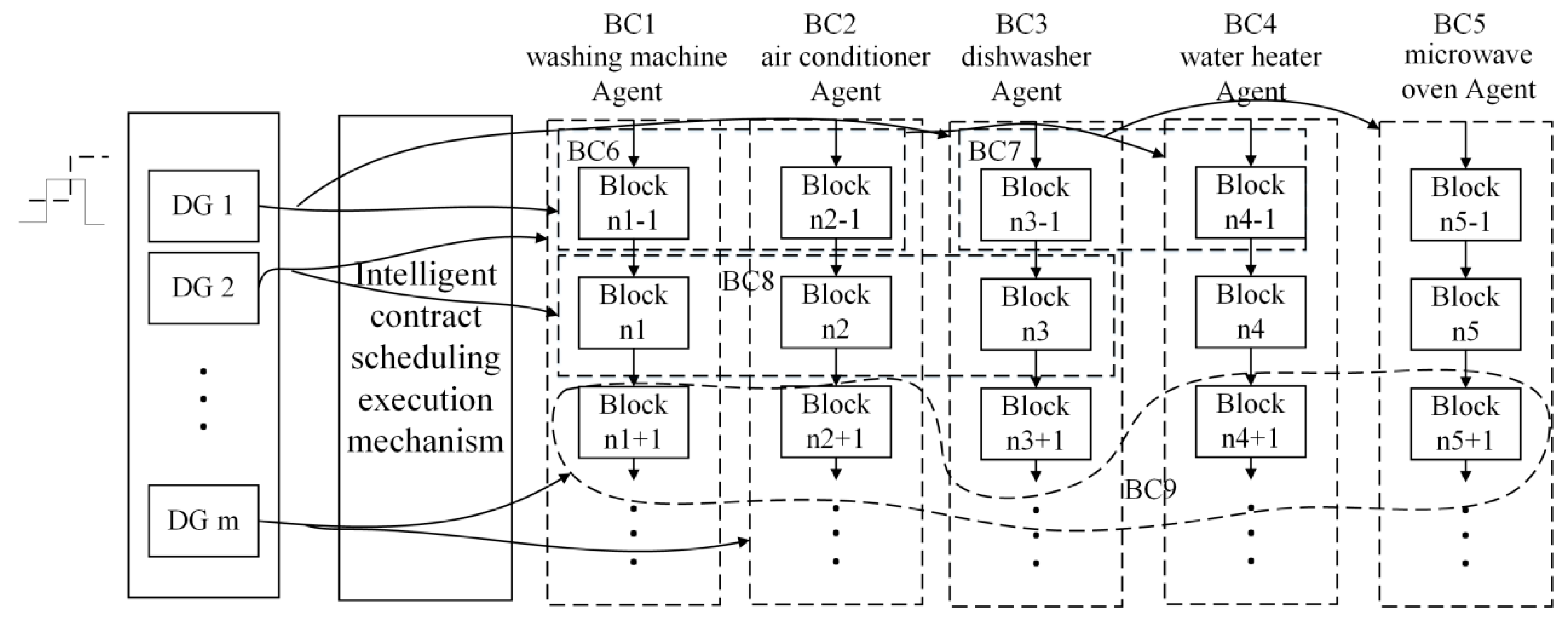


| Private Chain | Alliance Chain |
|---|---|
| Washing machine decision chain (BC1) | Washing machine + Air conditioning transaction chain (BC6) |
| Air conditioning decision chain (BC2) | |
| Dishwasher decision chain (BC3) | Electric water heater + dishwasher trading chain (BC7) |
| Electric water heater decision chain (BC4) | Air conditioner + Washing machine + Dishwasher trading Chain (BC8) |
| Microwave oven decision chain (BC5) | Washing machine + Microwave + Air conditioning + Electric water heater trading chain (BC9) |
| Object | Parameter Type | Value |
|---|---|---|
| Wind Turbines | Cut-in wind speed (m/s) | 4 |
| Cut-out wind speed (m/s) | 25 | |
| Rated wind speed (m/s) | 12 | |
| Power Coefficient | 0.60 | |
| Photovoltaic Array | Power-temperature coefficient | 0.043% |
| PV array panel temperature (°C) under standard conditions | 45.5 | |
| Number of series units of PV modules | 70 | |
| Number of parallel units of PV modules | 30 | |
| Diesel generators | Rated power (kW) | 200 |
| Minimum output (kW) | 16 | |
| Energy storage battery | Rated capacity (kWh) | 500 |
| SOC min | 0.2 | |
| SOC max | 0.9 | |
| Charge/discharge power (kW) | −60/60 | |
| Charge/discharge efficiency | 0.92/0.93 | |
| Distribution network | Interactive power (kW) | −300/400 |
| Decision Subject | Number of Interactions | Redundancy Rate | Communication Efficiency |
|---|---|---|---|
| Multi-agent | 11 | 1.33 | 68.1% |
| Multi-agent+ block-chain | 4 | 0.97 | 76.7% |
| Electricity Price | Time Slot | Buy Electricity Price (yuan/kWh) | Sell Electricity Prices (yuan/kWh) |
|---|---|---|---|
| Valley time | 22:00–5:00 | 0.17 | 0.13 |
| Flat time | 6:00–7:00 | 0.49 | 0.38 |
| 11:00–12:00 | |||
| 17:00 | |||
| Peak time | 8:00–10:00 | 0.83 | 0.65 |
| 13:00–16:00 | |||
| 18:00–21:00 |
| Decision Unit | Decision Ratio | ||
|---|---|---|---|
| 16:00–17:00 | 20:00–21:00 | 23:00–0:00 | |
| Washing machine + air conditioner | 14.3% | 18.78% | 29.45% |
| Electric water heater + dishwasher | 9.67% | 19.42% | 14.9% |
| Air conditioning + washing machine + dishwasher | 19.08% | 20.9% | 30.4% |
| Washing machine + microwave + air conditioner + electric water heater | 56.95% | 40.9% | 25.25% |
| Optimization Method | Peak Load Power Consumption (kW·h/day) | Micro-Grid Daily Operating Costs (yuan) |
|---|---|---|
| Multi-agent | 21.28 million | 9635.20 |
| Hybrid game reinforcement learning algorithm | 1974 million | 9294.11 |
| Decision Making Method | Micro-grid Daily Operating Cost (yuan) | Multitasking Execution Efficiency | System Energy Consumption |
|---|---|---|---|
| Multi-agent | 9846.52 | 62.59% | 41.34% |
| Group intelligence decision | 9397.20 | 84.15% | 30.28% |
© 2019 by the authors. Licensee MDPI, Basel, Switzerland. This article is an open access article distributed under the terms and conditions of the Creative Commons Attribution (CC BY) license (http://creativecommons.org/licenses/by/4.0/).
Share and Cite
Fu, X.; Wang, H.; Wang, Z.; Shi, Z.; Yang, W.; Ma, P. Research on Micro-Grid Group Intelligent Decision Mechanism under the Mode of Block-Chain and Multi-Agent Fusion. Energies 2019, 12, 4196. https://doi.org/10.3390/en12214196
Fu X, Wang H, Wang Z, Shi Z, Yang W, Ma P. Research on Micro-Grid Group Intelligent Decision Mechanism under the Mode of Block-Chain and Multi-Agent Fusion. Energies. 2019; 12(21):4196. https://doi.org/10.3390/en12214196
Chicago/Turabian StyleFu, Xiaolin, Hong Wang, Zhijie Wang, Zhong Shi, Wanhao Yang, and Pengchi Ma. 2019. "Research on Micro-Grid Group Intelligent Decision Mechanism under the Mode of Block-Chain and Multi-Agent Fusion" Energies 12, no. 21: 4196. https://doi.org/10.3390/en12214196
APA StyleFu, X., Wang, H., Wang, Z., Shi, Z., Yang, W., & Ma, P. (2019). Research on Micro-Grid Group Intelligent Decision Mechanism under the Mode of Block-Chain and Multi-Agent Fusion. Energies, 12(21), 4196. https://doi.org/10.3390/en12214196