Abstract
In future dc distributed power systems, high performance high voltage dc-dc converters with redundancy ability are welcome. However, most existing high voltage dc-dc converters do not have redundancy ability. To solve this problem, a wide load range zero-voltage switching (ZVS) three-level (TL) dc-dc converter is proposed, which has some definitely good features. The primary switches have reduced voltage stress, which is only Vin/2. Moreover, no extra clamping component is needed, which results simple primary structure. Redundancy ability can be obtained by both primary and secondary sides, which means high system reliability. With proper designing of magnetizing inductance, all primary switches can obtain ZVS down to 0 output current, and in addition, the added conduction loss can be neglected. TL voltage waveform before the output inductor is obtained, which leads small volume of the output filter. Four secondary MOSFETs can be switched in zero-current switching (ZCS) condition over wide load range. Finally, both the primary and secondary power stages are modular architecture, which permits realizing any given system specifications by low voltage, standardized power modules. The operation principle, soft switching characteristics are presented in this paper, and the experimental results from a 1 kW prototype are also provided to validate the proposed converter.
1. Introduction
The dc distribution, with several good features, e.g., high system stability, high conversion and transmission efficiency, high flexibility and easy system control [1,2,3], seems to be the most attractive solution for future power systems with the increasing percentage of renewable energy sources, such as photovoltaic, wind power, and fuel cells. To improve the overall performance of a dc distribution, high dc input voltage is preferred. Therefore, dc-dc converters for high voltage dc distributions with good input and output characteristics, simple and compact circuit structure, good efficiency performance have already become hot issues in the power electronics society [4]. The main challenge caused by high dc input voltage is how to select proper power devices to fulfill power conversion task without system performance and reliability compensating [4]. Full bridge (FB) dc-dc topology with high voltage rating MOSFETs and IGBTs may be directly used in high voltage dc-dc conversion, but, high conduction loss and worse switching characteristics of these high voltage rating power devices may greatly degrade the conversion efficiency and power density. Moreover, high voltage dynamic transition would cause some electrical-magnetic compliable (EMC) problems, which is not preferred in the designing and producing procedure of the high input dc-dc power converters. Therefore, using series connected low voltage rating and high-performance power modules to sustain high dc bus voltage is still the best solution in high voltage dc-dc applications. Several good research papers have been published, and these solutions can be concluded into two kinds, which are TL dc-dc converters [5,6,7,8,9,10,11,12,13,14,15,16,17,18,19] and input series cells dc-dc converters [20,21,22,23,24,25,26,27,28,29,30,31,32]. The first TL dc-dc converter was proposed in [5], which is a diode clamped half bridge (HB) dc-dc converter. In [5], the voltage stress on each primary switch is only Vin/2, and the primary switches can obtain zero-voltage switching (ZVS) with limited load range. A series of zero-voltage and zero-current switching (ZVZCS) TL dc-dc converters were proposed in [6], and the primary switches in this converter can achieve ZVZCS operation over wide load range; furthermore, a simple switching scheme is used in these converters, which makes these topologies more convenient to industrial customers. Then, many other good research results have been reported in following main aspects: new topologies for special applications [8,9,10], wide range soft switching technologies [6,10,11,12,13,14,15,16], and converters with reduced volume of the input and output filters [16,17,18,19]. All above mentioned papers have made the TL dc-dc converters more applicable.
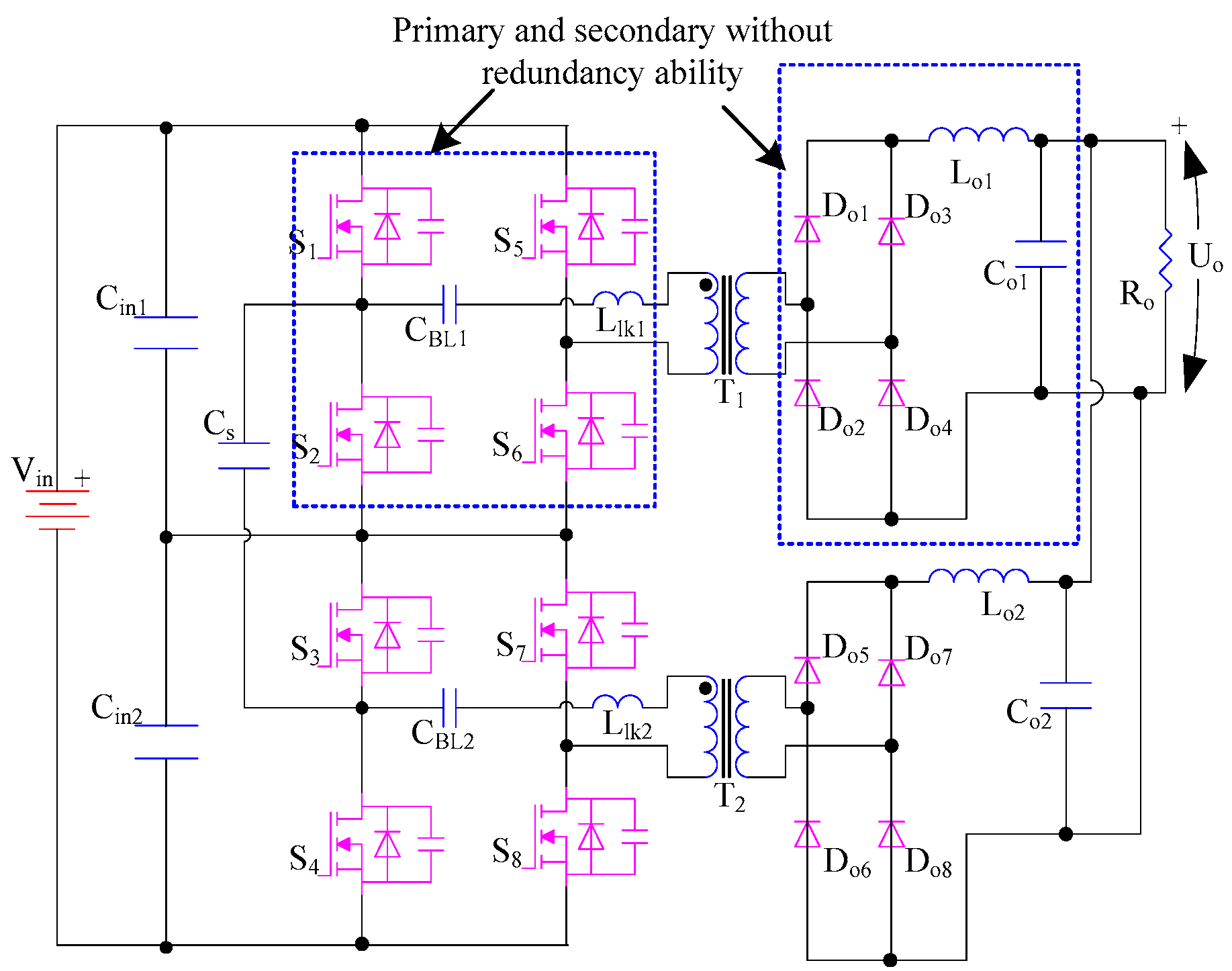
Input series cells dc-dc converter (ISCDC) is another solution for high voltage dc-dc conversion, which is composed of several series connected cells to reduce the voltage stress on the primary switches. Compared to TL dc-dc converters, ISCDCs have a simple and compact primary circuit due to its modular structure, which is attractive to high input industrial applications. In [20,21], ISCDCs based on forward or fly-back cells were proposed, which can reduce the voltage stress on the primary switches. The main drawback of these converters is hard switching operation, which results low power transferring efficiency. Some resonant ISCDCs were presented in [22,23], and these converters can achieve good soft switching characteristics, as well as low voltage stress on the primary switches. Half bridge (HB) based ISCDCs were reported and analyzed in [24,25,26], and some of these converters have input voltage auto-balance ability. Input-series output-parallel dc-dc converters (ISOPDCs) are new type ISCDCs, which are considered as the most promising choice due to its truly modular structure, which means normal two-level modules can be directly connected for special high voltage applications [27,28]. The main challenge of ISOPDCs is the input voltage balance problem, which can be solved by many control strategies [29,30,31] with increased cost and circuit complexity. In [32], a flying capacitor is added to achieve input voltage auto-balance ability, which makes the ISOPDC more applicable [32]. Figure 1 shows the ISOPDC in [32], which is composed of two two-level FB cells series connected in the primary side and parallel connected in the secondary side. Two FB cells are synchronously switched with the PS switching scheme, and a flying capacitor is used to obtain auto-voltage balance ability.
Figure 1.
ISOPDC in [32].
However, limitations still exist. As shown in Figure 1, the midpoint voltage is still highly dependent on the states of the input series and output parallel connected modules. Any errors occurring in each module, i.e., S1 is broken, would cause the converter halting due to the voltage of the input capacitors cannot be balanced again, which means the primary and secondary sides of the converter in Figure 1 having no redundancy ability. In fact, this is a common problem of most ISCDCs. In addition, the converter in Figure 1 has some other disadvantages: the secondary rectifier voltage waveforms are still two-level, which needs a large output filter to minimize the output current ripple, and a large input EMI filter is also required; the ZVS load range is narrow, which results in high power loss especially under the light load condition. Therefore, it is still a worthy task to find new high voltage dc-dc converters with redundancy ability, modular structure, simple input voltage balance circuit, reduced volume of the output and input filters, and good soft switching characteristics.
In this paper, a wide load range ZVS high voltage dc-dc converter with redundancy ability, modular structure, simple input voltage balance circuit, reduced volume of the output and input inductors is proposed and investigated. The outline of this paper is concluded as follows. In Section 2, the configuration of the proposed converter is presented. Normal operation principle is discussed in Section 3. And in Section 4, module failure operation principle is analyzed to prove the redundancy ability. Some important technical issues are analyzed in Section 5. Experimental results are presented and discussed in Section 6. The main conclusions are given in the last section.
2. Circuit Configuration
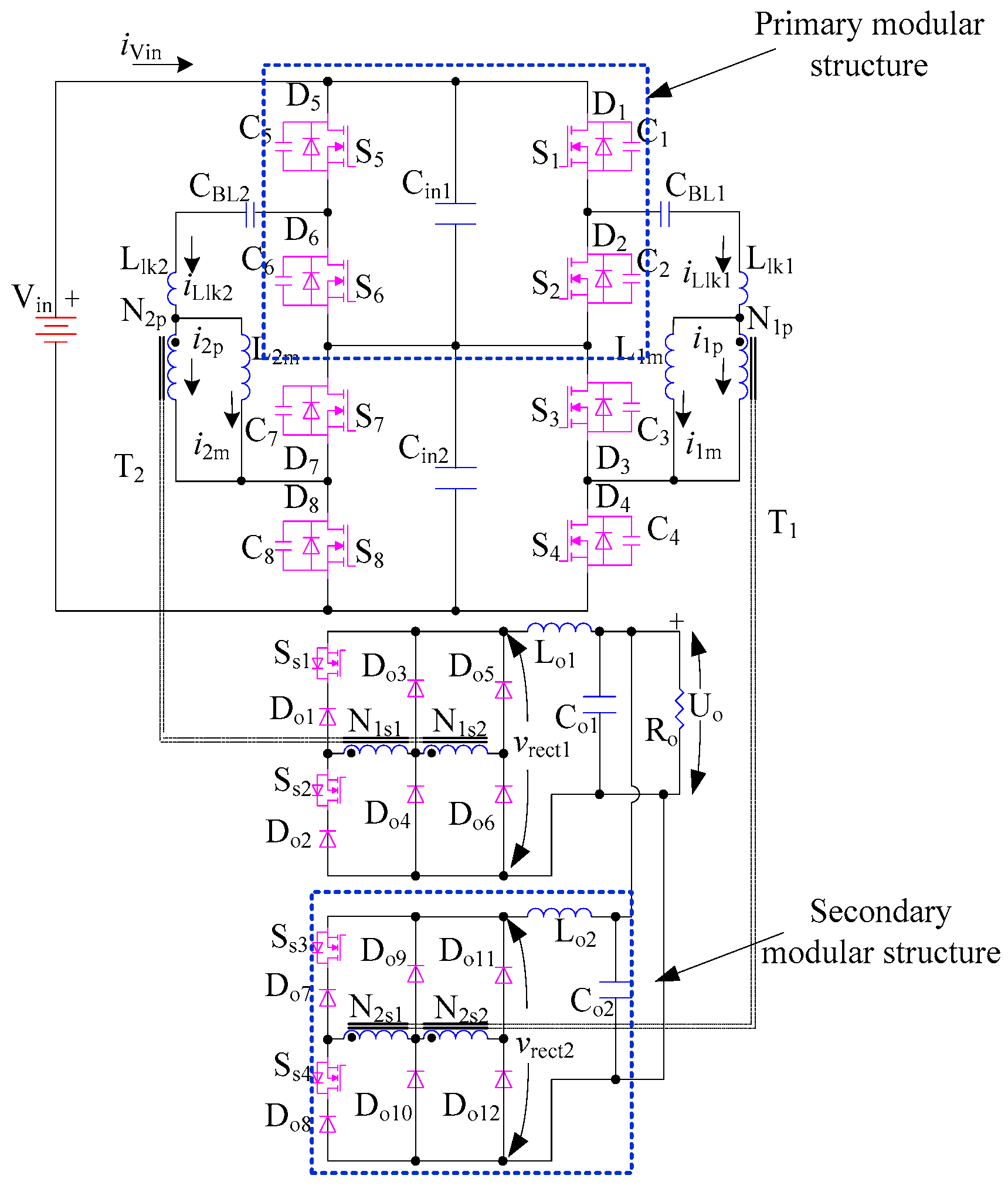
Figure 2 shows the presented circuit. In the primary side, Cin1 and Cin2 are the input capacitors with the same value, which are used to split the input voltage. S1-S8 are the primary switches; D1-D8 are the anti-parallel diodes of S1-S8, and C1-C8 are corresponding parasitic capacitors of the primary switches. During the operation, OFF voltages across S1-S8 are directly clamped by Cin1 and Cin2, thus, no extra clamping component is needed. CBL1 and CBL2 are two dc blocking capacitors, which is series connected with N1p and N2p. Llk1 and Llk2 are the leakage inductors of the transformers; L1m and L2m are magnetic inductors of the transformers, which is designed to a specific value to help the ZVS of S1-S8. In the secondary side, two parallel-connected rectifier modules are included. The first rectifier module is built of Ss1-Ss2, Do1-Do6, Lo1 and Co1; while, the secondary module is composed of Ss3-Ss4, Do7-Do12, Lo2 and Co2.
Figure 2.
Proposed high voltage zero-voltage switching (ZVS) dc-dc converter with redundancy ability.
3. Normal Operation
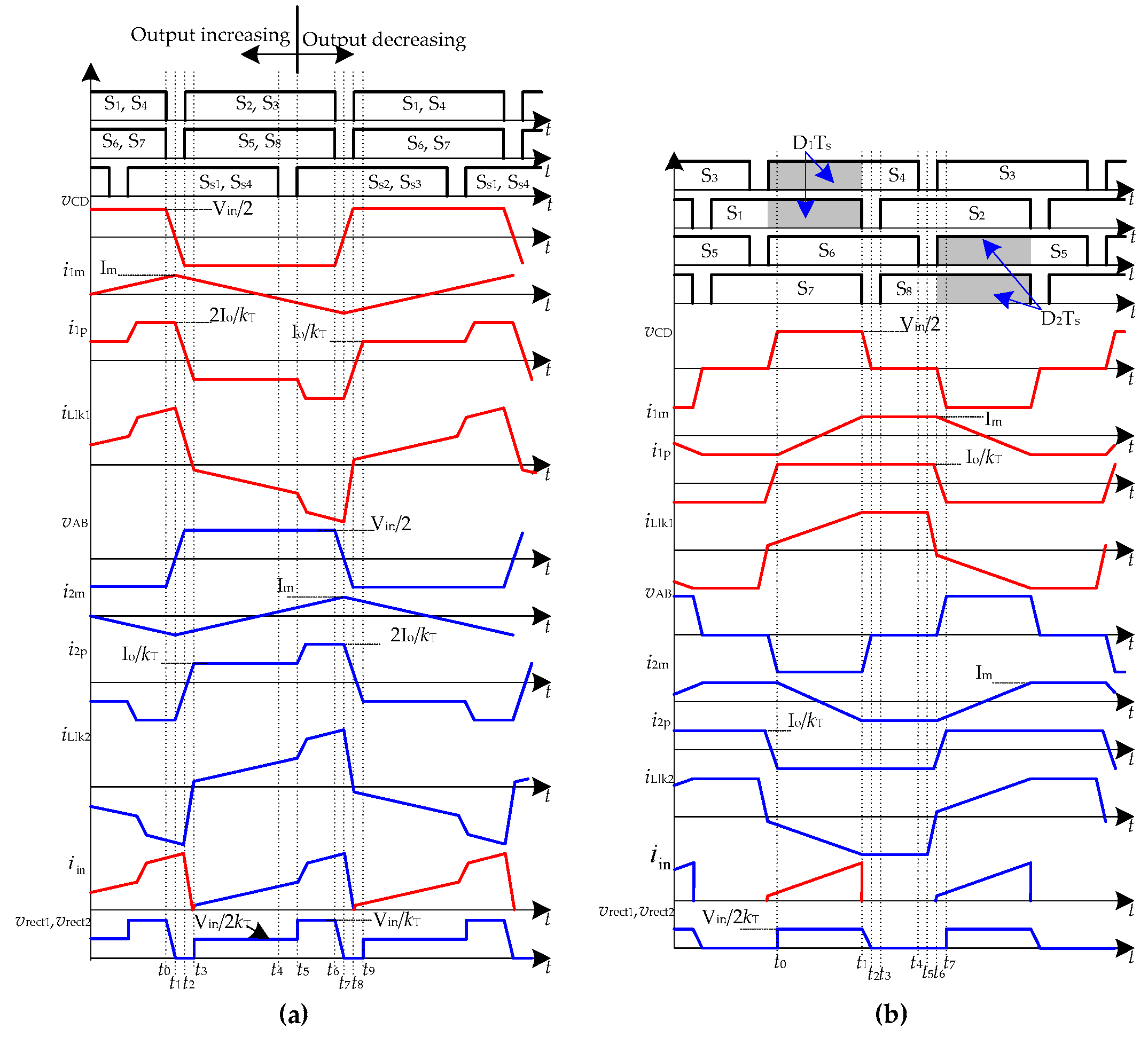
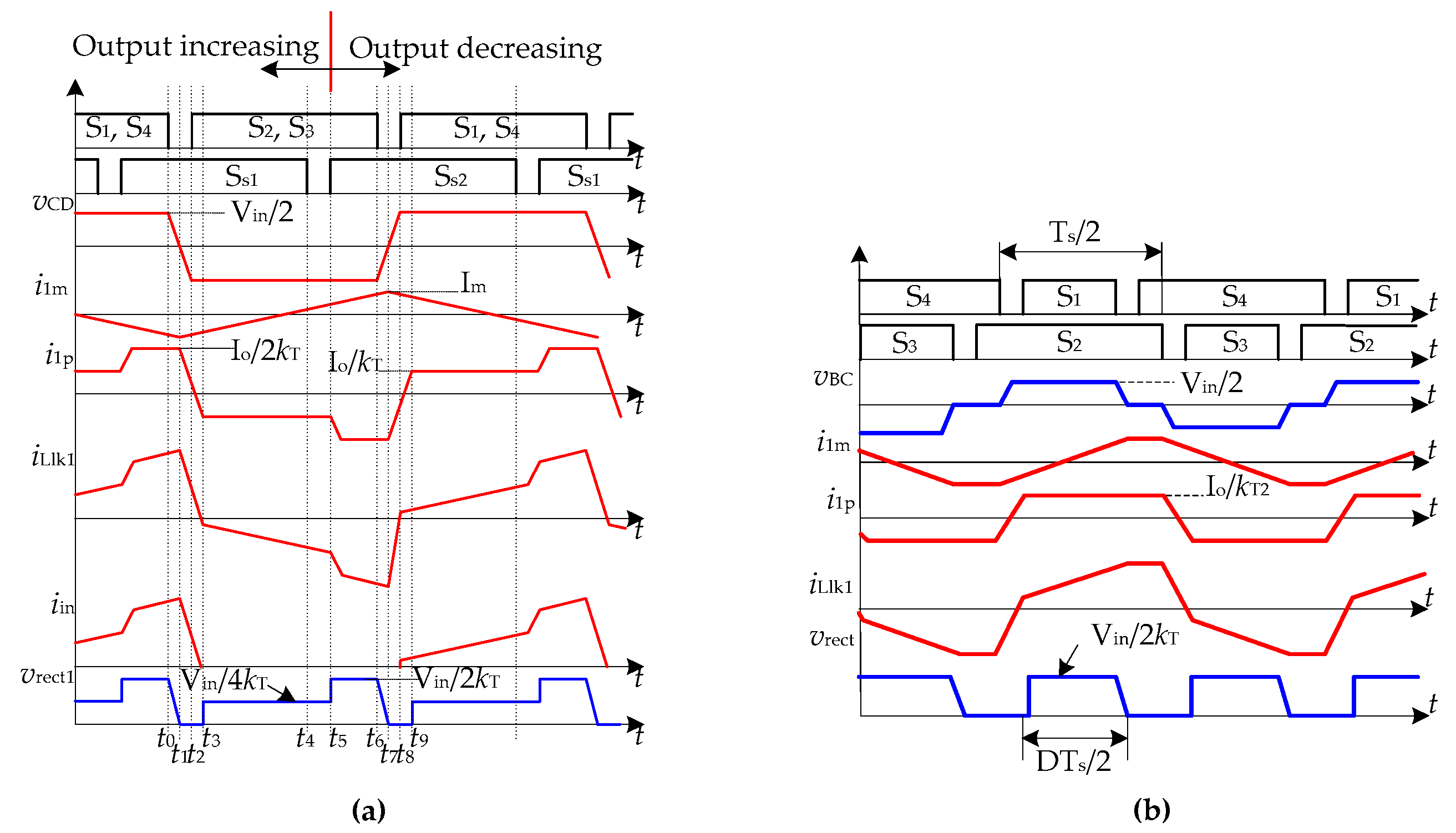
Before the discussion, some assumptions are concluded as follows: (1) the on-resistance of the primary switches are neglected; (2) the voltage ripple on Cin1, Cin2, CBL1 and CBL2 can be neglected due to high capacitance; (3) the output capacitance of the power devices is identical, and is represented by Co; (4) Llk1 and Llk2 are identical, and are represented by Llk; (5) L1m and L2m are identical, and are represented by Lm; (6) N1p is identical to N2p, and N1s1 = N1s2 = N2s1 = N2s2; (7) kT = N1p/N1s1 = N2p/N2s1; (8) the current ripple of iLo1 and iLo2 is neglected; (9) With proper controlling, the output currents of the two paralleled connected modules can be identical, and the controlling method is not discussed in this paper. Therefore, iLo1 = iLo2. iLo1 and iLo2 are represented by Io ; (10) iin is identical to iVin + iCin, and its AC content is defined as . During the normal operation, the proposed converter can be controlled in the secondary side and primary side modulation modes. Figure 3 depicts the key waveforms, Table 1 and Table 2 show the switching status in each stage.
Figure 3.
Key waveforms: (a) secondary side modulation; (b) primary side modulation.
Table 1.
Switching scheme in the first half switching period (secondary side modulation mode).
Table 2.
Switching scheme in the first half switching period (secondary side modulation mode).
3.1. Secondary Side Modulation
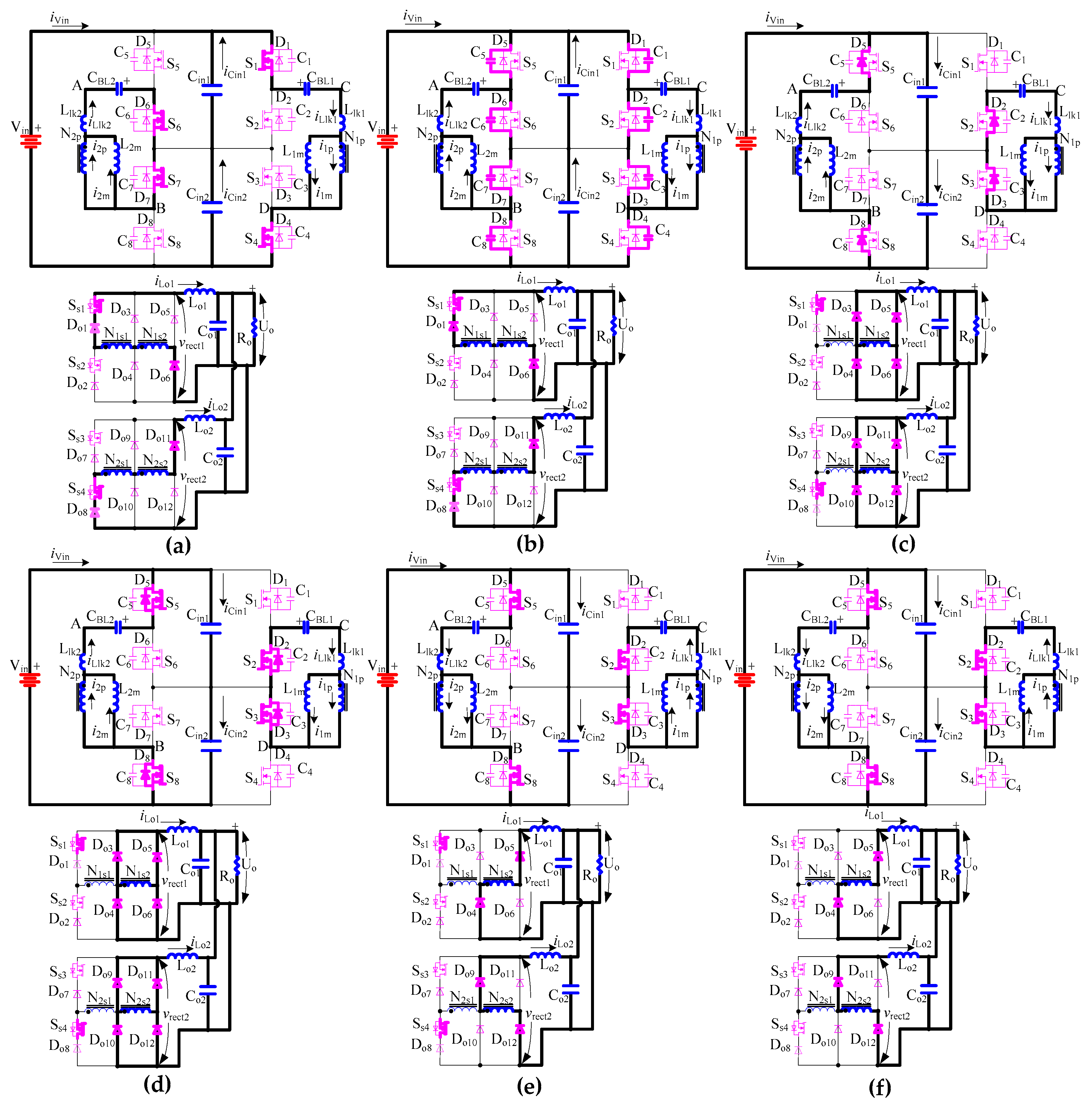
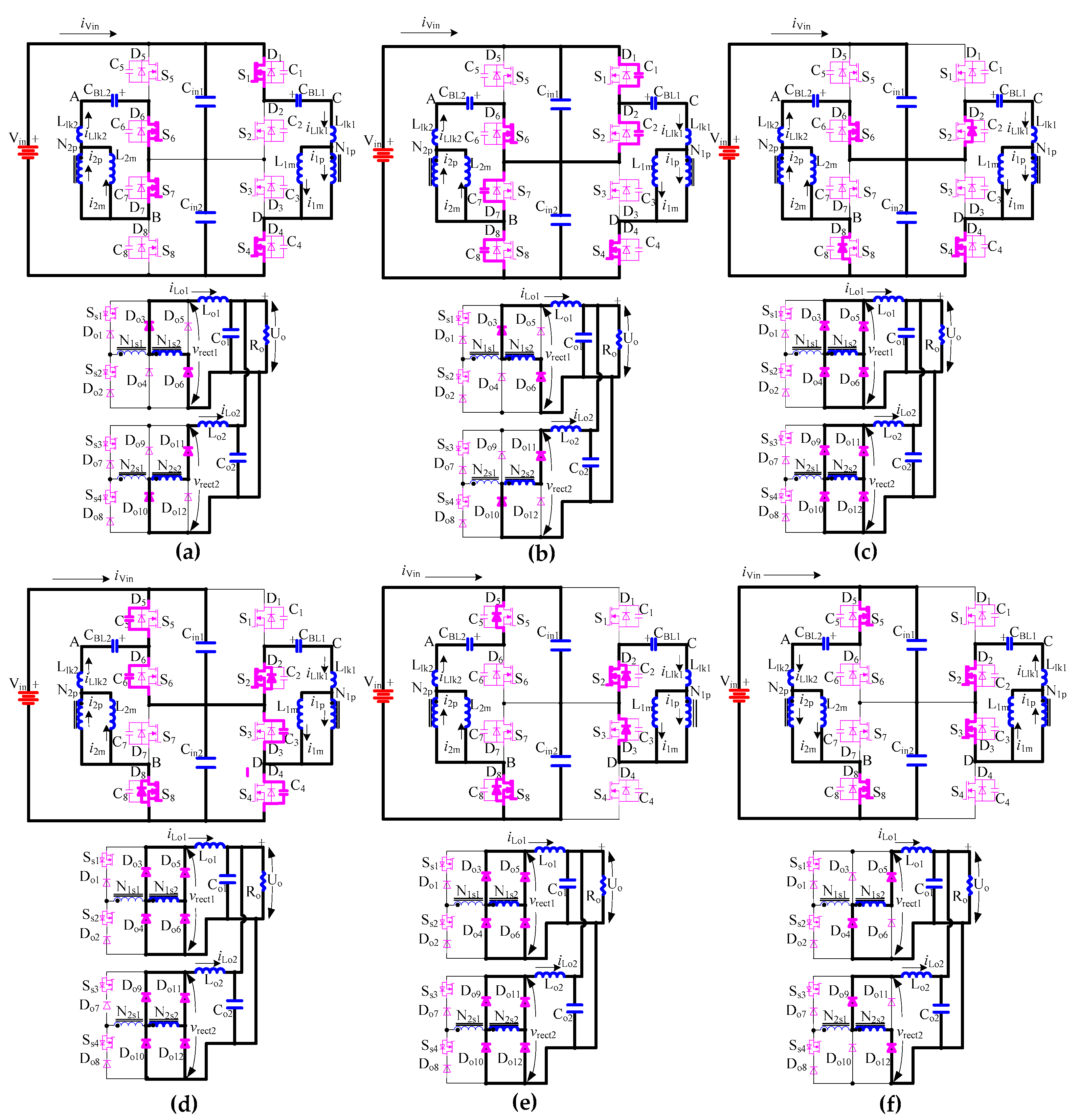
As shown in Figure 3a, the primary switches can be divided into two groups. The first group is S1, S4, S6 and S7; while another group is S2, S3, S5 and S8. The switches in each group are switched ON and OFF synchronously, and the switches in different groups are switched in the complementary mode. In the secondary side, Ss2 and Ss3 are switched ON and OFF synchronously; while Ss1 and Ss4 are switched ON and OFF synchronously. Ss1 and Ss3 are switched in the complementary mode with Ss2 and Ss4. Vo can be regulated by the phase angel between gate signals of Ss1 and S1, Ss3 and S5. When these angles equal 180°, Vo = Vin/(2kT). There are 12 operation stages in one switching cycle, and the operation stages in the first half switching cycle are illustrated in Figure 4.
Figure 4.
Operation stages of the secondary modulation: (a) stage 1; (b) stage 2; (c) stage 3; (d) stage 4; (e) stage 5; (f) stage 6.
Stage 1 [Figure 4a]: before t0, the circuit is stable. Input source powers the load. In the primary side, S1, S4, S6 and S7 are ON; vCD = Vin/2, and vAB = −Vin/2; i1p = 2Io/kT, and i2p = −2Io/kT. iLlk1 and iLlk2 are
iin = iVin + iCin1 with the value of iLlk1. The DC content of iin flows from the input source to the primary sides of the transformers directly. iCin1 is partial AC content of iin depends on the reactance distribution of the input source and input capacitors. As iCin1 is identical to iCin2, the midpoint voltage of Cin1 and Cin2 is constant during this period. vS2 and vS5 are clamped by Cin1, and vS3 and vS8 are clamped by Cin2.
In the secondary side, Ss1 and Ss4 are ON; Do1, Do6, Do8 and Do11 are conducted; vrect1 = vrect2 = Vin/kT.
Stage 2 [Figure 4b, t0-t1]: At t0, S1, S4, S6 and S7 are switched OFF. In the primary side, the slope rates of i1m and i2m are very slow, and the absolute value of these currents is constant value Im. Therefore, the absolute value of iLlk1 and iLlk2 during this period is
iLlk1 charges C1 and C4, discharges C2 and C3; while iLlk2 charges C6 and C7, discharges C5 and C8. vS1, vS4, vS6 and vS7 are
vS2, vS3, vS5 and vS8 are
According to (4) and (5), the voltage of S1-S8 is lower than Vin/2, before the end of this stage.
This stage lasts until vS1 is Vin/2, and the interval is
iCin1 is identical to iCin2, which is iLlk1−iLlk2, and under ideal condition, this value is zero. Therefore, the midpoint voltage of Cin1 and Cin2 can also be stabled during this period.
In the secondary side, Ss1 and Ss4 are ON; Do1, Do6, Do8 and Do11 are conducted; vrect1 = vrect2 = 2vCD(t)/kT = 2|vAB (t)|/kT.
Stage 3 [Figure 4c, t1-t2]: At t1, D2, D3, D5 and D8 are ON. In the primary side, vCD = −Vin/2, and vAB = Vin/2; L1m and L2m sustain negative voltage, and i1m and i2m are
iLlk1 and iLlk2 are
iin = iVin + iCin1 with the value of iLlk2. The DC content of iin will flow from the input source to the primary sides of the transformers directly. iCin1 is partial AC content of iin depends on the reactance distribution of the input source and input capacitors. As iCin1 is identical to iCin2, the midpoint voltage of Cin1 and Cin2 is constant during this period. vS1 and vS6 are clamped by Cin1, and vS4 and vS7 are clamped by Cin2. S2, S3, S5 and S8 should be gated after t1 to achieve ZVS operation.
In the secondary side, Do3-Do6 and Do9-Do12 are ON to free-wheel the secondary currents. vrect1 = vrect2 = 0.
Stage 4 [Figure 4d, t2-t3]: At t2, S2, S3, S5 and S8 are switched ON with ZVS. In the primary side, i1m, i2m, i1p and i2p keep increasing in the reverse direction, and the increasing slope are defined as (13) to (16). iin = iVin + iCin1 with the value of iLlk2. iCin1 is partial AC content of iin depends on the reactance distribution of the input source and input capacitors. As iCin1 is identical to iCin2, the midpoint voltage of Cin1 and Cin2 is constant during this period. vS1 and vS6 are clamped by Cin1, and vS4 and vS7 are clamped by Cin2.
In the secondary side, Do3-Do6 and Do9-Do12 are conducted to free-wheel the secondary currents. Ss1 and Ss4 are ON. As the currents through Ss1 and Ss4 are 0, thus, Ss1 and Ss4 can achieve ZCS turned on after this period. vrect1 and vrect2 are zero.
Stage 5 [Figure 4e) t3-t4]: At t3, the absolute value of i1p and i2p is Io/kT. In the primary side, S2, S3, S5 and S8 are ON; vCD =−Vin/2, and vAB = Vin/2; i1p = −Io/kT, and i2p = Io/kT. i1m and i2m are
iLlk1 and iLlk2 are
iin = iVin + iCin1 with the value of iLlk2. iCin1 is partial AC content of iin depends on the reactance distribution of the input source and input capacitors. As iCin1 is identical to iCin2, the midpoint voltage of Cin1 and Cin2 is constant during this period. vS1 and vS6 are clamped by Cin1, and vS4 and vS7 are clamped by Cin2.
In the secondary side, Do4, Do5, Do9 and Do12 are conducted; vrect1 = vrect2 = Vin/(2kT).
Stage 6 [Figure 4f, t4-t5]: At t4, Ss1 and Ss4 are OFF with zero-current switching (ZCS). After t5, the circuit will be operated into the secondary switching period, and detail analyses are not provided here for the sake of simplicity.
The ideal output-input voltage ratio in this mode is
3.2. Primary Side Modulation
When the phase angle between Ss1 and S1 is 180°, the secondary side modulation mode cannot further change the output voltage. To regulate output voltage down to zero, the converter must be controlled into the primary side modulation mode. In this mode, the secondary switches Ss1-Ss4 are OFF; the primary switches are divided into two groups, which are S1 to S4 and S5 to S8. As shown in Figure 3b, the primary switches in each group are switched in the PS switching scheme, and S1 and S6 are switched with the same phase angle. D1 and D2 are duty ratios of S1-S4 and S5-S8, and with symmetrical switching pattern, D1 = D2. The output voltage is varied with the value of D1 and D2, when D1 = D2 = 0, the output voltage is zero. The key waveforms of this mode are depicted in Figure 3b, and the operation stages in the first half switching cycle are illustrated in Figure 6.
Stage 1 [Figure 5a]: before t1, the circuit is operated in steady condition. Input source powers the load. In the primary side, S1, S4, S6 and S7 are ON; vCD = Vin/2, and vAB =−Vin/2; i1p = −Io/kT, and i2p = Io/kT.
Figure 5.
Operation stages of the primary side modulation mode: (a) stage 1; (b) stage 2; (c) stage 3; (d) stage 4; (e) stage 5; (f) stage 6.
iLlk1 and iLlk2 are
iin = iVin + iCin1 with the value of iLlk1. iCin1 is formed by partial AC content of iin depends on the reactance distribution of the input source and input capacitors. As iCin1 is identical to iCin2, the midpoint voltage of Cin1 and Cin2 is constant during this period. vS2 and vS5 are clamped by Cin1, and vS3 and vS8 are clamped by Cin2.
In the secondary side, Ss1-Ss4 are OFF; Do3, Do6, Do10 and Do11 are conducted; vrect1 = vrect2 = Vin/(2kT).
Stage 2 [Figure 5b, t1-t2]: At t1, S1 and S7 are switched OFF. In the primary side, S1 and S7 can obtain zero-voltage turned OFF due to existence of C1 and C7. i1m and i2m reach their maximum absolute value Im. Therefore, the absolute values of iLlk1 and iLlk2 are
iLlk1 charges C1, discharges C2; while iLlk2 charges C7, discharges C8. vS1 and vS7 are
vS2 and vS8 are
According to (19) and (20), vS1, vS2, vS7 and vS8 is lower than Vin/2 before the end of this stage.
This stage ends until vS1 and vS7 is Vin/2, and the time is
iCin1 is identical to iCin2, which is iLlk1-iLlk2, and with symmetrical switching sequence iCin1 is zero. Therefore, the midpoint voltage of Cin1 and Cin2 is constant during this period.
In the secondary side, Do3, Do6, Do10 and Do11 are conducted; vrect1 = vrect2 = vCD(t)/kT = |vAB (t)|/kT.
Stage 3 [Figure 5c, t2-t4]: At t2, D2 and D8 are on. In the primary side, vCD = vAB = 0; i1m and i2m keep constant value Im; i1p and i2p are with the same absolute value |Io/kT|, During this period, iLlk1 and iLlk2 are
iCin1 is identical to iCin2 with the value of iLlk1-iLlk2, thus, with symmetrical switching cycle, iCin1 and iCin2 are zero, which means stable midpoint voltage of input capacitors can be achieved. Therefore, the midpoint voltage of Cin1 and Cin2 is constant during this period. vS1 and vS5 are clamped by Cin1, and vS3 and vS7 are clamped by Cin2. S2 and S8 should be gated after t2 to achieve ZVS operation, and according to Figure 3b, S2 and S8 are switched at t3.
In the secondary side, Do3-Do6 and Do9-Do12 are ON to free-wheel the secondary currents. vrect1 = vrect2 = 0.
Stage 4 [Figure 5d, t4-t5]: At t4, S4 and S6 are switched OFF. In the primary side, S4 and S6 can obtain zero-voltage turned OFF due to C4 and C6. The primary currents keep constant during this stage. iLlk1 charges C4, discharges C3; while iLlk2 charges C6, discharges C5. vS4 and vS5 are
vS3 and vS6 are
This stage ends until vS4 and vS6 are Vin/2, and the time is
iCin1 is identical to iCin2 with the value of iLlk1-iLlk2, thus, with symmetrical switching cycle, the currents flowing through Cin1 and Cin2 are zero, which means stable midpoint voltage of input capacitors can be achieved. Therefore, the midpoint voltage of Cin1 and Cin2 is constant during this period.
In the secondary side, Do3-Do6 and Do9-Do12 are ON to free-wheel the secondary currents. vrect1= vrect2 = 0.
Stage 5 [Figure 5e, t5-t6]: At t5, D3 and D5 are ON. In the primary side, vCD = −Vin/2, and vAB = Vin/2; negative voltage is applied on magnetic inductors, and i1m and i2m are
iLlk1 and iLlk2 are
iin = iVin + iCin1 with the value of iLlk2. iCin1 is partial AC content of iin depends on the reactance distribution of the input source and input capacitors. As iCin1 is identical to iCin2, the midpoint voltage of Cin1 and Cin2 is constant during this period. vS1 and vS6 is clamped by Cin1, and vS4 and vS7 is clamped by Cin2. S3 and S5 should be gated after t5 to achieve ZVS operation, and according to Figure 3b, S3 and S5 are switched at t6.
In the secondary side, Do3-Do6 and Do9-Do12 are ON to free-wheel the secondary currents. vrect1 = vrect2 = 0.
Stage 6 [Figure 5f, t6-t7]: At t7, i1p equals −Io/kT, and i2p equals Io/kT; the free-wheeling mode is over. Input source powers the load. In the primary side, S2, S3, S5 and S8 are ON; vCD =−Vin/2, and vAB = Vin/2. iin = iVin + iCin1 with the value of iLlk1. iCin1 is partial AC content of iin depends on the reactance distribution of the input source and input capacitors. As iCin1 is identical to iCin2, the midpoint voltage of Cin1 and Cin2 is constant during this period. vS1 and vS3 are clamped by Cin1, and vS4 and vS7 are clamped by Cin2.
In the secondary side, Ss1-Ss4 are OFF; Do4, Do5, Do9 and Do12 are conducted; vrect1 = vrect2 = Vin/(2kT).
The ideal output-input voltage ratio in this mode is

4. Module Failure Operation
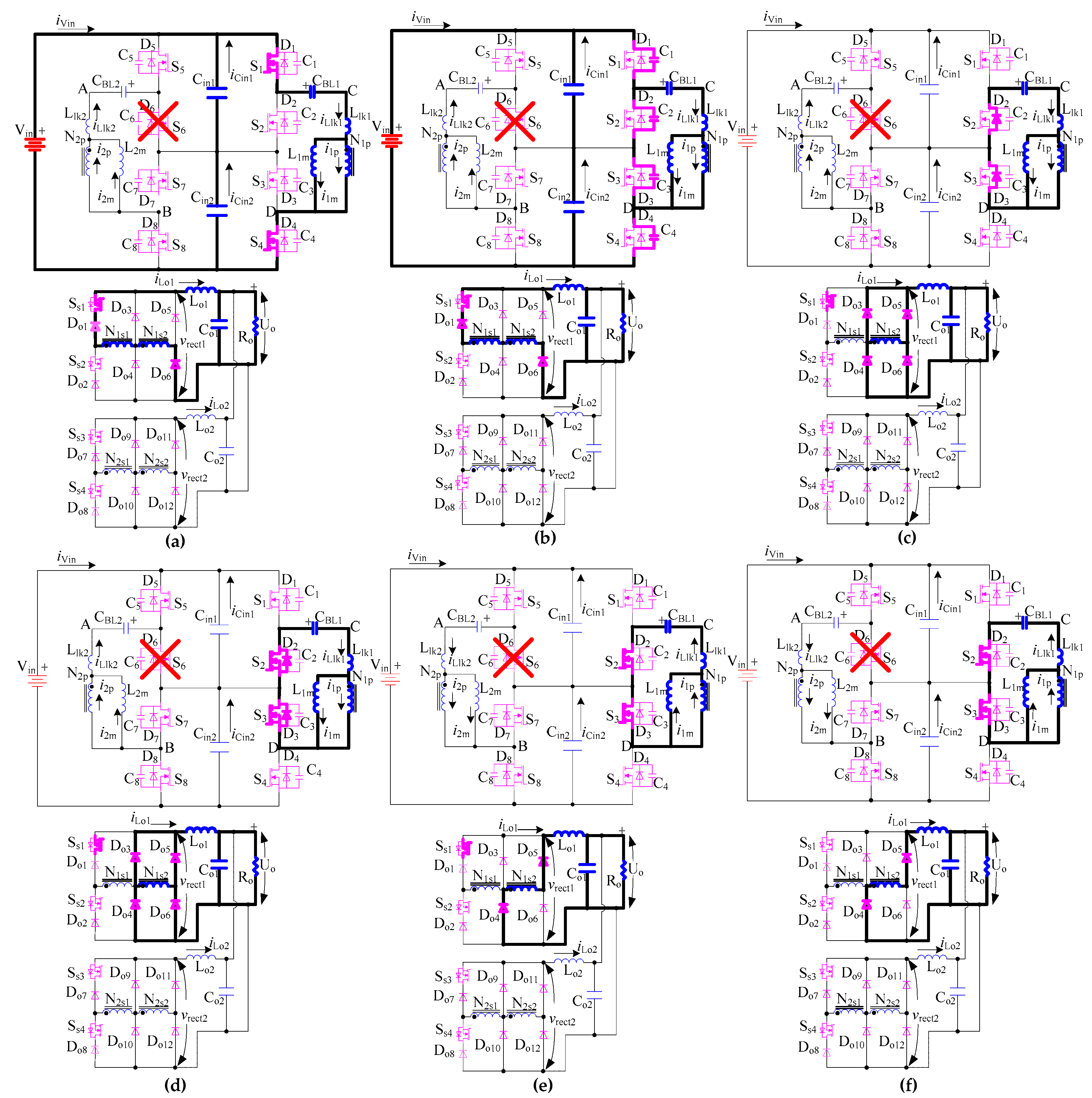
The most important feature of the proposed converter is the redundancy ability for the primary and secondary sides. In this part, the operation principle of module failure operation is briefly described to illustrate the redundancy ability. To simplified the description, S6 is set to be broken, which causes a primary module failure. It should be pointed out that the proposed converter can also be operated with a secondary module failure. During the module failure operation, the proposed converter can also be operated in the secondary and primary side modulation switching schemes according to the output voltage, and key waveforms are given in Figure 6. The switching scheme of the secondary side modulation is illustrated in Table 3.
Figure 6.
Key waveforms: (a) secondary modulation; (b) primary modulation.
Table 3.
Switching scheme in the first half switching period (secondary side modulation mode).
4.1. Secondary Side Modulation
Figure 6a and Figure 7 show the key waveforms and operation stages of the secondary side modulation. As shown in Figure 6a, S6 is broken due to some unknown reasons. In the primary side, S5-S8 are stop, and S1-S4 are switched in the mode which is identical to the secondary operation mode of normal operation. According to Figure 7, the input capacitor currents remain zero during stages 3 to 6, the mid-point voltage of the input capacitors are balanced during these stages. In addition, during stages 1 and 2, the input capacitor currents are identical to partial AC content of iin, thus, the mid-point voltage of the input capacitors are also balance during stages 1 and 2. Therefore, a stable mid-point voltage can be obtained during the first switching cycle, and in the secondary half switching cycle, the same conclusion can also be achieved. The primary waveforms of vCD, iLlk1, i1m and i1p are quite similar to that of the normal operation, which is not analyzed here for the sake of simplicity. The OFF voltage of the primary switches is clamped by Cin1 and Cin2, which is not higher than Vin/2.
Figure 7.
Stages of the secondary side modulation in failure mode: (a) stage 1; (b) stage 2; (c) stage 3; (d) stage 4; (e) stage 5; (f) stage 6.
In the secondary side, the down cell is stop, and the up cell operates in the same pattern with that of the normal operation, and detail analysis is not provided here for the sake of simplicity.
4.2. Primary Side Modulation
During the primary side operation, the proposed converter can be treated as a conventional TLDC in [8]. Figure 6b illustrates key waveforms. The output can be regulated down to zero by switching scheme in Figure 6b. The operation principle about this procedure is not provided here for the sake of simplicity and detail information can reference [8].
4.3. Output Range of the Module Failure Operation
The output voltage of the module failure mode is quite similar to that of the normal operation. When Vin/kT ≥ Vo > Vin/2kT, the proposed converter is operated in the secondary side modulation, the output voltage is varied from Vin/kT to Vin/2kT with the duty ratio D; When Vin/2kT ≥ Vo > 0, the proposed converter is operated in the primary side modulation, the output voltage is varied Vin/2kT to 0 with the duty ratio D.
5. Technical Analysis
5.1. ZVS of the Primary Switches
The soft switching characteristics of the normal and module failure operation are quite similar, thus, only the soft switching characteristics of the normal operation are analyzed in the following parts.
5.1.1. Secondary Side Modulation
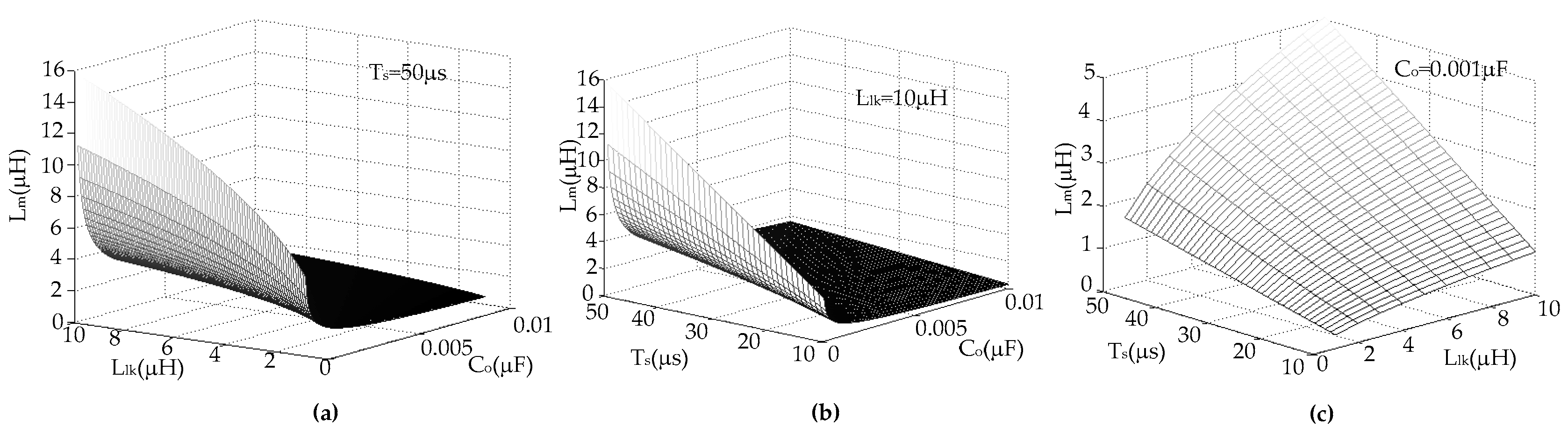
When the converter is operated in the secondary side modulation mode, the primary switches can obtain ZVS down to zero load current with proper designing of iim, I = 1 and 2. And the Lm should observe following equation [19]
Figure 8 shows the required magnetizing inductance versus Co, Llk and Ts. It should be pointed out that Im is irrelevant to the load current and increased with input voltage, hence, there is still enough energy stored in the leakage inductance to ensure ZVS for all primary switches under no loads or high input condition. Consequently, the proposed converter will have higher efficiency compared to its competitors under light loads and high input applications.
Figure 8.
Required Lm to obtain ZVS versus Co, Llk and Ts: (a) Ts = 50 μs; (b) Llk = 10 μH; (c) Co = 0.001 μF.
5.1.2. Primary Side Modulation
During the primary side modulation, the primary switches are switched in the PS mode, S1, S4, S6 and S7 are controlled as the leading leg switches; while S2, S3, S5 and S8 are switched as the lagging leg switches. Just as traditional PS FB converter, the leading leg switches can be switched with ZVS easily, and the ZVS criteria is
where Lip’ is the sum of Llki and kT2Loi, with the help of the output inductance and magnetic inductance, these switches can be achieved ZVS down to no-load easily.
S2, S3, S5 and S8 are lagging leg switches, and with proper designing of Lim, i = 1 and 2, these switches can also be achieved ZVS down to no-load.
5.1.3. ZVS Load Range
The minimum ZVS load currents for the two operation modes are concluded in Table 4.
Table 4.
Zero-voltage switching (ZVS) load range of the secondary and primary side modulation (Im = 60%Ip, rate).
As illustrated in Table 4, with the help of the magnetizing currents, all the primary switches can obtain ZVS down to 0 load currents, furthermore the added conduction loss in the secondary side modulation are quite smaller than that of the primary side modulation. Therefore, it is recommended that the proposed converter should be designed to operate into the secondary side modulation mode during most operation situations, and only to operate into the primary side modulation mode in some abnormal situation, such as overload, to regulated output down to zero.
5.2. ZCS of the Secondary Switches
During the secondary side modulation, all secondary switches can obtain ZCS independent of the load condition [19]. Ss1 is selected as an example. As shown in Figure 3a, Ss1 is on at this stage. But, the current flowing through Ss1 is zero due to the reverse voltage applied to Do1. As shown in Figure 3b, Sse1 is switched off at zero current. Therefore, the switching loss of the secondary switches can be minimized.
5.3. Output Inductance
The reduction of the output inductance with TL secondary rectified voltage waveform has been discussed in [19]. According to these references, the required output inductance of the converters with TL secondary rectified voltage waveform is about one-third of that of conventional two-level converters. Therefore, the volume of the output filter in the proposed converter can be significantly reduced.
5.4. Voltage Balance Principle of the Input Capacitors
The initial voltage across the input capacitors is Vin/2 due to the configuration of the proposed converter. During the operation, the voltage across the input capacitors can be maintained if this capacitor can observe charge balance principle over each switching cycle. Table 5 and Table 6 show the currents of the input capacitors, as proved in Table 5 and Table 6, with symmetrical switching scheme, the input capacitors voltage can be stable properly. Detail descriptions have been provided in Section 3.
Table 5.
Currents of the input capacitors during the secondary side modulation.
Table 6.
Currents of the input capacitors during the primary side modulation.
5.5. Comparison
The circuit and performance of the proposed converter and the converter in [32] are compared in this part, and the circuit of the converter for comparison is provided in Figure 1, and the detail operation principle about this converter can reference [32]. Table 7 and Table 8 illustrate the components and performance comparison.
Table 7.
Components comparison.
Table 8.
Performance comparison.
5.5.1. Redundancy Ability
Compared to the converter in Figure 1, the redundancy ability is an obvious advantage of the proposed converter, which ensures higher system reliability. As shown in Figure 1, the primary side is built of two series connected modules, and the converter must be shut down when one primary switch is broken due to the remained switches would suffer higher voltage stress. However, as shown in Figure 6 and Figure 7, the proposed converter can still be operated safely when one primary switch is broken.
5.5.2. Components Comparison
The primary side components number of the proposed converter is similar to that of the converter in Figure 1, and as proved in pervious sections, OFF voltage across each primary switch is directly clamped by the input capacitors, thus no added clamping device is required. The secondary structure of the proposed converter is a little complex than that of the converter in Figure 1 to achieve TL secondary rectified waveforms, which would result reduced volume of input and output filter. In addition, according to Table 8, the system dynamic response of the proposed converter is higher than that of the converter in Figure 1. As shown in Table 8, the voltage stress on the primary switches of the proposed converter and the converter in Figure 1 are identical with the value of Vin/2, thus, these two converters are well suitable for high input voltage dc-dc power conversion.
5.5.3. Soft Switching Characteristics
With proper designing, the ZVS load range of the primary switches in the proposed converter is down to zero, which is better for wide load range applications. Furthermore, the turn-off switching loss can be reduced by increasing output capacitance of the primary switches. However, as depicted in [32], the lagging switches in Figure 1 cannot achieve wide ZVS load range due to only the energy stored in the leakage inductance can be used [32]. And the turn-off switching loss cannot be optimized due to limited ZVS load range of the lagging switches. As illustrated in Table 8, the proposed converter features have better soft switching characteristics, which means higher power conversion efficiency especially under light load and high input voltage operation.
5.5.4. Power Loss
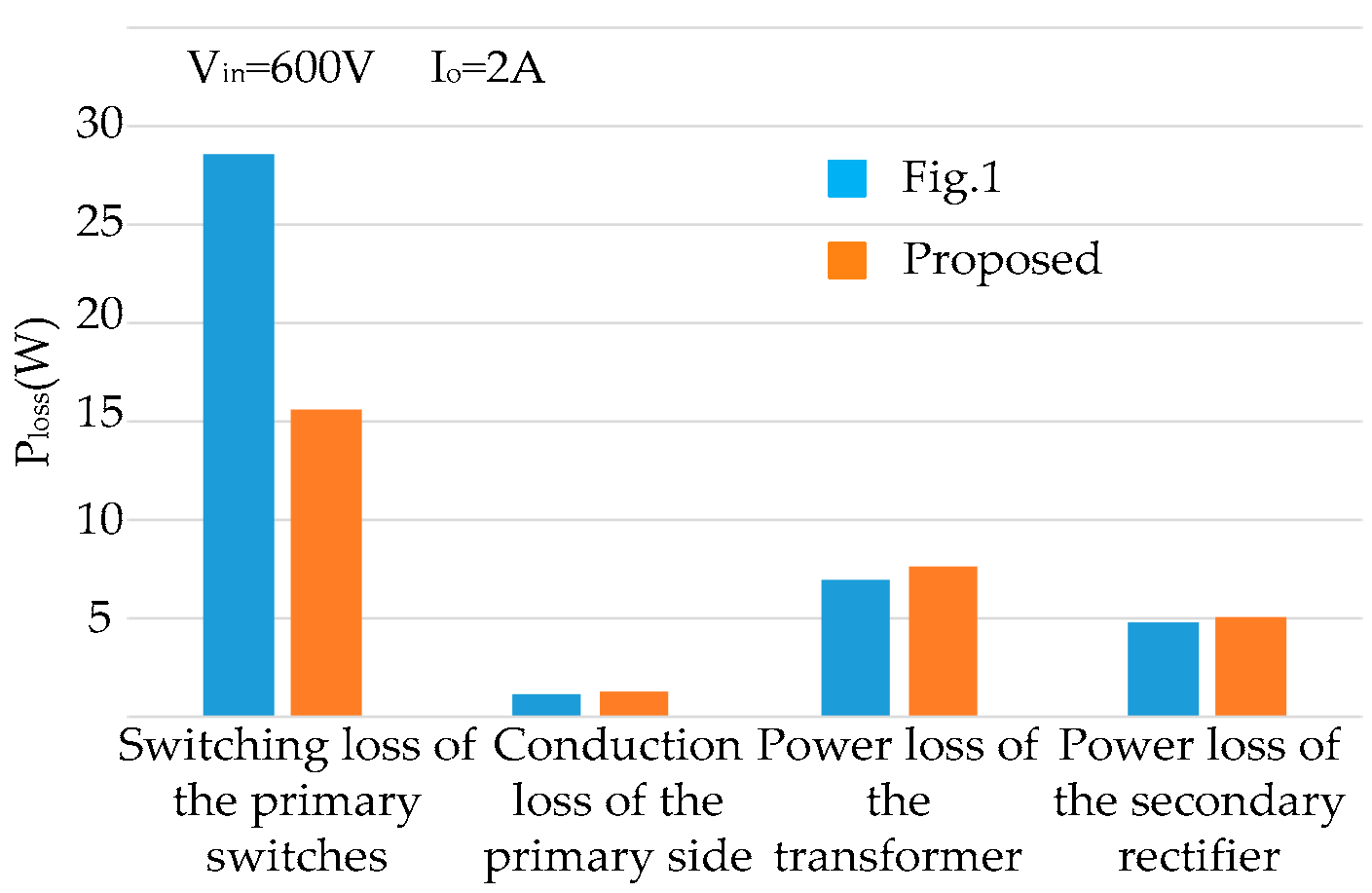
The power loss distributions of the proposed converter and the converter in Figure 1 are compared in Figure 9. The data is obtained by power analyzer (PW60001), and the converters for comparison are operated with Vin = 600 V and Io = 2 A. As shown in Figure 9, the proposed converter has lower power loss due to good switching loss of MOSFETs, which is an attractive characteristic of the proposed converter. As illustrated in Figure 9, the conduction loss of the proposed converter is a little higher than that of Figure 1 due to higher magnetizing current and extra secondary MOSFETs. Therefore, the expected efficiency of the proposed converter is better.
Figure 9.
Power loss distribution.
6. Experimental Results
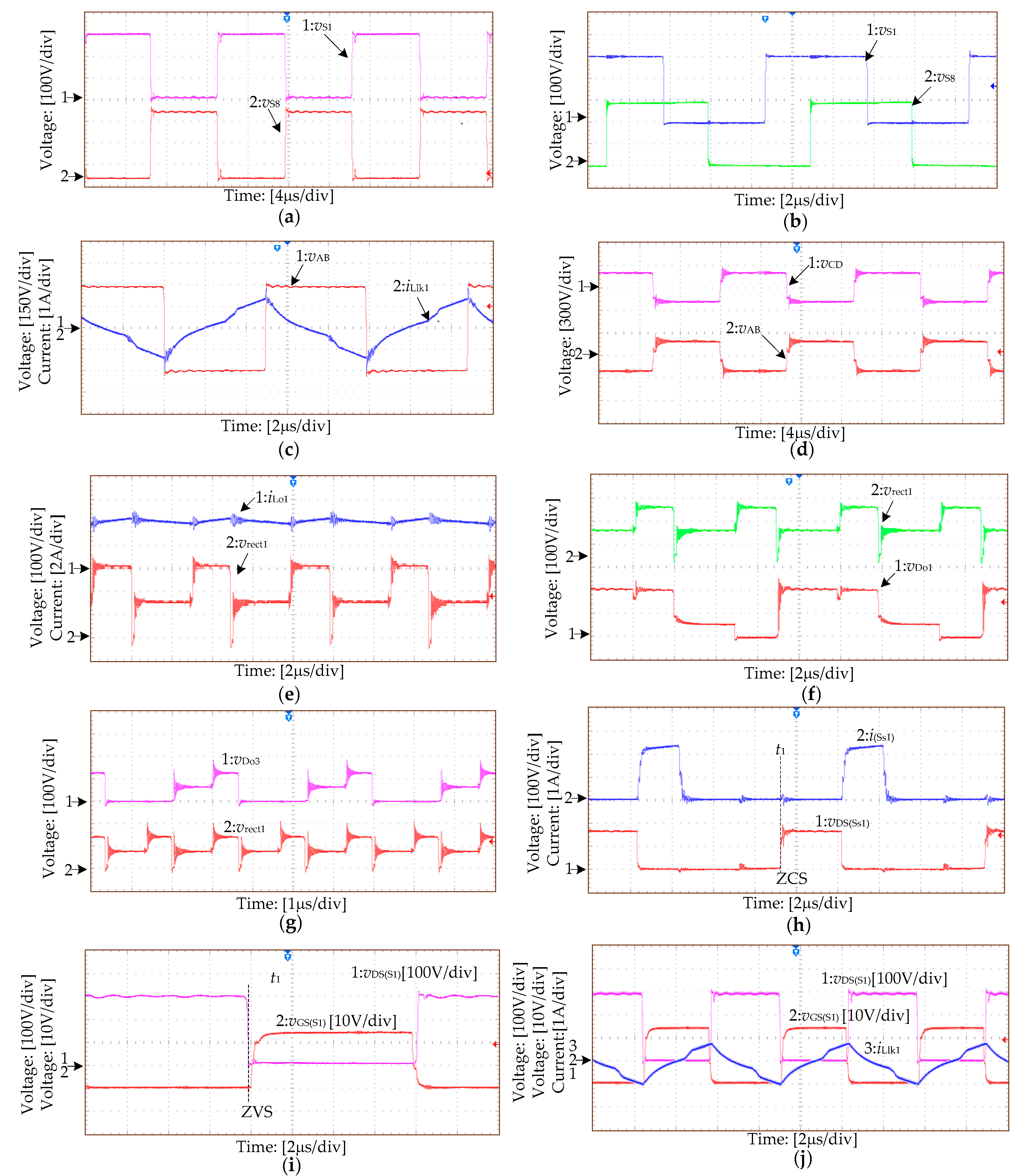
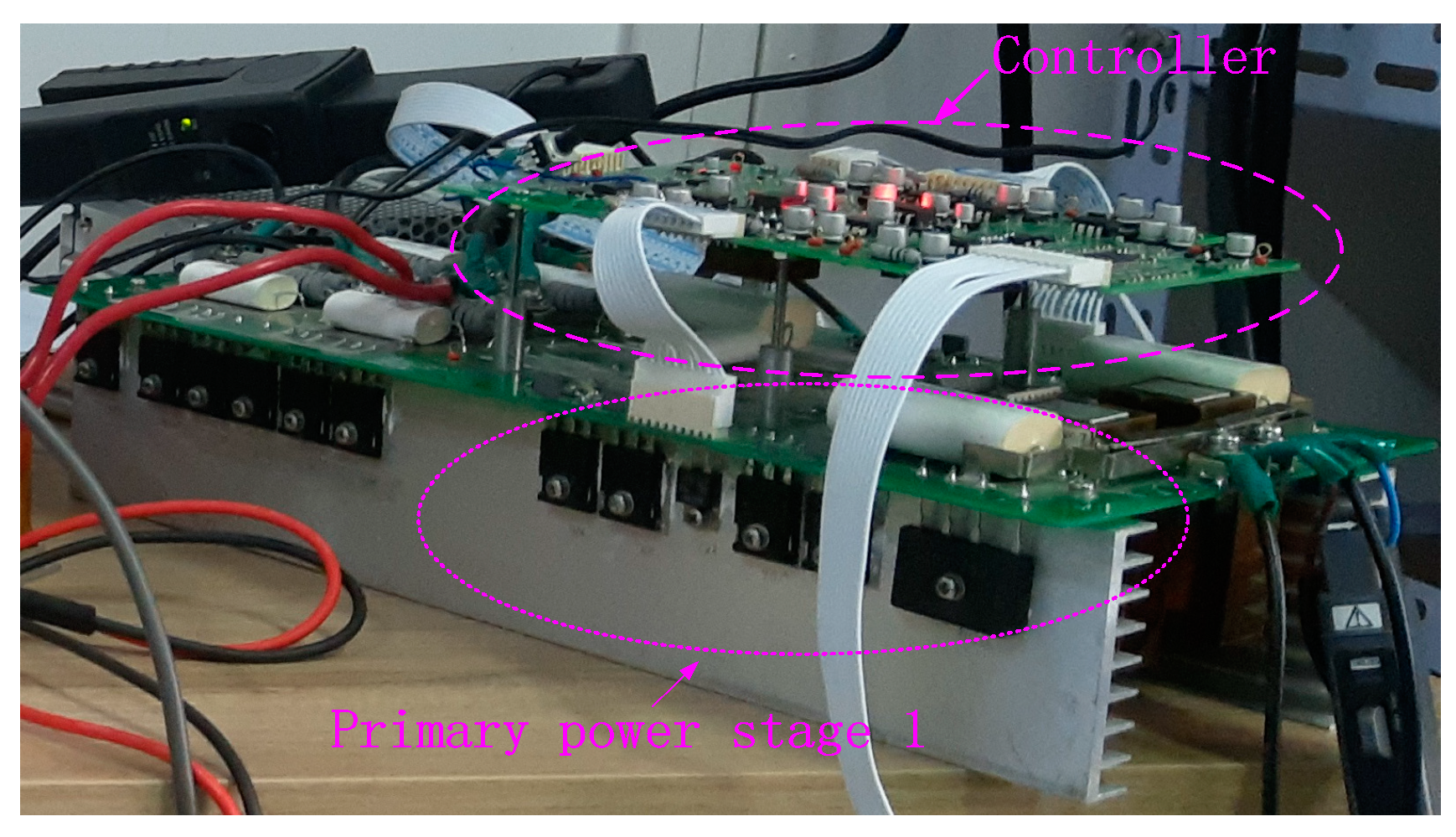
The performance of the proposed converter is verified by a 1kW prototype, and the main parameters of the prototype are provided in Table 9. Figure 10 and Figure 11 give some experimental results. Figure 12 illustrated the prototype, and the control signals for the switches are generated by two UCC 3895s in synchronized mode. In the efficiency experiment, the power loss of control circuit and cooler system are considered. The proposed converter has several operation modes, and some key waveforms of these operation modes are quite similar. Therefore, only some typical experimental results are selected to validate the proposed converter for the sake of simplicity.
Table 9.
Parameters of the prototype.
Figure 10.
Experimental results: (a) vS1 and vS8 during the secondary side modulation (Normal operation); (b) vS1 and vS8 during the primary side modulation (Normal operation); (c) vAB and iLlk1 during the secondary side modulation (Normal operation); (d) vCD and vAB during the secondary side modulation (Normal operation); (e) iLo1 and vrect1 during the secondary side modulation (Normal operation); (f) vDo1 and vrect1 during the secondary side modulation (Normal operation); (g) vDo3 and vrect1 during the secondary side modulation (Normal operation); (h) ZCS of Ss1; (i) ZVS of S1 with zero load current; (j) vDS(S1) , vGS(S1) and iLlk1 during the secondary side modulation (Failure mode operation).
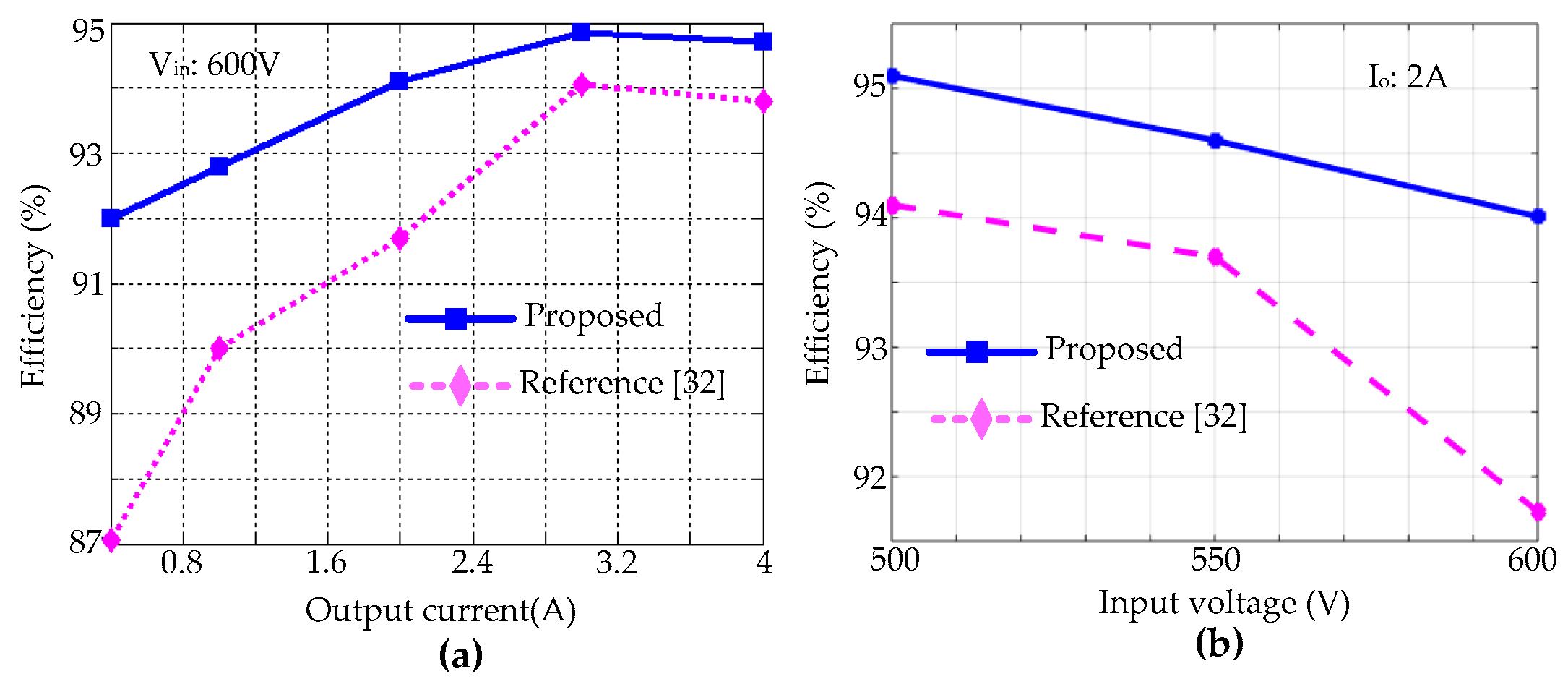
Figure 11.
Efficiency comparison: (a) Efficiency with constant Vin and variable Io; (b) Efficiency with constant Io and variable Vin.
Figure 12.
Photo of the prototype.
As shown in Figure 10a, OFF voltage across the primary switches in the proposed converter is even in the secondary side modulation mode, and the midpoint voltage of the input capacitors is stable and equals Vin/2. Figure 10b proves the voltage stress across the primary switches and the midpoint voltage of the input capacitors is also even and stable in the primary side modulation mode.
As proved in Figure 10c, the voltage applied to the primary coils is Vin/2, and iLlk1 is not a constant value because i1m is enlarged to help ZVS of the primary switches. As i1m is not in phase with load current, the added primary RMS current is smaller. Thus, the added conduction loss is also smaller. As proved in Figure 10d, the duty ratio of vBC is 100% and uncontrolled during the whole operation stages, which means zero primary circulating current.
As depicted in Figure 10e, the secondary rectified voltage is a TL waveform, which significantly reduces the volume of the output filter. The output voltage is adjusted by changing the time of high output voltage level. As there is no free-wheeling time, the input current ripple is also smaller. The voltages across the rectifier diodes are shown in Figure 10f,g.
The waveforms of the drain-source voltage and current of Ss1 are shown in Figure 10h, and it is clearly that Ss1 can obtain ZCS. The ZVS characteristics of the primary switches in the proposed converter are test with zero load current. The waveforms of the gate signals and the drain-source voltage of switch S1 is depicted in Figure 10i. In Figure 10i, the gate-source voltage of S1 is much lower than the threshold voltage when the drain-source voltage of S1 decreases to zero, thus, S1 can obtain ZVS.
Figure 10j gives some experimental results of the failure mode operation, and it is similar to that of normal operation. From Figure 10j, we can conclude the proposed converter can be operated into the failure mode operation. Other waveforms in the failure mode operation is not provided in this paper for the sake of simplicity.
Figure 11a shows the efficiency comparison under different load current with 600V input voltage, and the comparison is carried out under the same base line. As all primary switches can obtain ZVS in wide load range, the proposed converter has higher efficiency with smaller load. In Figure 11b, the efficiency results under constant Io and variable Vin condition are shown, and the proposed converter can obtain more optimum high input efficiency owing to the ZVS operation can still be assured with increasing of the input voltage.
7. Conclusions
A wide load range ZVS high voltage dc-dc converter is proposed and analyzed in this paper. From above theoretical and experimental analysis, the advantages of the proposed converter can be concluded as follows: Low voltage stress on the primary switches with auto-balanced ability; Redundancy ability for the primary and secondary sides, which ensures high system reliability; Modular structure for the primary and secondary sides; Full ZVS load range for the primary switches, and less primary conduction loss is added; TL secondary rectified voltage waveform can be obtained, which reduce the volume of input and output filter size. The added secondary switches can obtain ZCS independent of the load current.
The main disadvantage of the proposed converter is that the VA rating of the transformers in the proposed converter is a little higher than that of Figure 1 under variable input and constant output condition.
Author Contributions
Conceptualization, Y.S.; validation, Y.S. and Z.X.; investigation, Z.X.; writing—original draft preparation, Y.S.; writing—review and editing, Y.S. and Z.X.
Funding
This research was funded by [Natural Science Foundation of Shaanxi University of Science and Technology] grant number [2016XSGG08].
Conflicts of Interest
The authors declare no conflict of interest.
References
- Kakigano, H.; Miura, Y.; Ise, T. Low-Voltage bipolar-Type DC micro grid for super high quality distribution. IEEE Trans. Power Electron. 2010, 12, 3066–3075. [Google Scholar] [CrossRef]
- Anand, S.; Fernandes, B.G. Reduced-Order model and stability analysis of low-Voltage DC micro grid. IEEE Trans. Ind. Electron. 2013, 11, 5040–5049. [Google Scholar] [CrossRef]
- Salomonsson, D.; Soder, L.; Sannino, A. An adaptive control system for a DC micro grid for data centers. IEEE Trans. Ind. Appl. 2008, 6, 1910–1917. [Google Scholar] [CrossRef]
- Ruan, X.; Li, B.; Chen, Q.; Tan, S.; Chi, K.T. Fundamental Considerations of Three-Level DC–DC Converters: Topologies, Analyses, and Control. IEEE Trans. Circuits Syst. I 2008, 11, 3733–3743. [Google Scholar] [CrossRef]
- Pinheiro, J.R.; Barbi, I. The three-Level ZVS PWM converter—A new concept in high-Voltage DC-to-DC conversion. In Proceedings of the 1992 International Conference on Industrial Electronics, Control, Instrumentation, and Automation, San Diego, CA, USA, 13 November 1992; pp. 173–178. [Google Scholar]
- Ruan, X.; Zhou, L.; Yan, Y. Soft-Switching PWM three-level converters. IEEE Trans. Power Electron. 2001, 5, 612–622. [Google Scholar] [CrossRef]
- Agostini, E.; Barbi, I. Three-Phase Three-level PWM DC-DC Converter. IEEE Trans. Power Electron. 2011, 7, 1847–1856. [Google Scholar] [CrossRef]
- Ghodke, D.V.; Chatterjee, K.; Fernandes, B.G. Modified Soft-Switched Three-Phase Three-level DC-DC Converter for High-Power Applications Having Extended Duty Cycle Range. IEEE Trans. Ind. Electron. 2012, 9, 3362–3372. [Google Scholar] [CrossRef]
- Lee, I.; Cho, S.; Moon, G. Three-Level Resonant Converter with Double LLC Resonant Tanks for High-Input-Voltage Applications. IEEE Trans. Ind. Electron. 2012, 9, 3450–3463. [Google Scholar]
- Shi, Y.; Yang, X. Wide Range Soft Switching PWM Three-Level DC–DC Converters Suitable for Industrial Applications. IEEE Trans. Power Electron. 2014, 2, 603–616. [Google Scholar]
- Shi, Y.; Xi, J.; Wang, X.; Gui, X.; Yang, X. Large Power ZVZCS Full Bridge Three-Level DC-DC Converter with Wide Operation Range and Its Application in Sapphire Crystal Furnace Power Supply. IEEE J. Emerg. Sel. Top. Power Electron. 2019. [Google Scholar] [CrossRef]
- Shi, Y. Wide Load Range Capacitor Clamped ZVZCS Half Bridge Three-level DC-DC Converter with Two Unsymmetrical Bi-directional Switches. Energies 2019, 12, 2362. [Google Scholar] [CrossRef]
- Shi, Y.; Wang, X.; Gui, X.; Xi, J.; Yang, X. Wide Load Range ZVZCS Three-Level DC-DC Converter with Compact Structure. IEEE Trans. Power Electron. 2019, 6, 5032–5037. [Google Scholar] [CrossRef]
- Shakib, S.S.I.; Mekhilef, S. A Frequency Adaptive Phase Shift Modulation Control Based LLC Series Resonant Converter for Wide Input Voltage Applications. IEEE Trans. Power Electron. 2017, 12, 8360–8370. [Google Scholar] [CrossRef]
- Shakib, S.S.I.; Mekhilef, S.; Nakaoka, M. Dual bridge LLC resonant converter with frequency adaptive phase-shift modulation control for wide voltage gain range. In Proceedings of the 2017 IEEE Energy Conversion Congress and Exposition, Cincinnati, OH, USA, 1 October 2017; pp. 2265–2271. [Google Scholar]
- Shi, Y.; Yang, X. Zero-Voltage Switching PWM Three-Level Full-Bridge DC-DC Converter with Wide ZVS Load Range. IEEE Trans. Power Electron. 2013, 10, 4511–4524. [Google Scholar] [CrossRef]
- Kim, D.Y.; Kim, J.K.; Moon, G.W. A Three-Level Converter with Reduced Filter Size Using Two Transformers and Flying Capacitors. IEEE Trans. Power Electron. 2013, 1, 46–53. [Google Scholar] [CrossRef]
- Shi, Y.; Yang, X. Soft Switching PWM Cascaded Three-Level Combined DC–DC Converters with Reduced Filter Size and Wide ZVS Load Range. IEEE Trans. Power Electron. 2015, 12, 6604–6616. [Google Scholar] [CrossRef]
- Shi, Y.; Yang, X. Wide Load Range ZVS Three-Level DC–DC Converter: Four Primary Switches, Capacitor Clamped, Two Secondary Switches, and Smaller Output Filter Volume. IEEE Trans. Power Electron. 2016, 5, 3431–3443. [Google Scholar] [CrossRef]
- Park, K.B.; Moon, G.W.; Youn, M.J. Series-Input series-Rectifier interleaved forward converter with a common transformer reset circuit for high-input-voltage applications. IEEE Trans. Power Electron. 2011, 11, 3242–3253. [Google Scholar] [CrossRef]
- Qain, T.; Lehman, B. Coupled input-Series and output-Parallel dual interleaved flyback converter for high input voltage application. IEEE Trans. Power Electron. 2008, 1, 88–95. [Google Scholar] [CrossRef]
- Li, W.; He, Y.; He, X.; Sun, Y.; Wang, F.; Ma, L. Series asymmetrical half-Bridge converters with voltage auto balance for high input-Voltage applications. IEEE Trans. Power Electron. 2013, 8, 3665–3674. [Google Scholar] [CrossRef]
- Sun, T.T.; Chung, H.S.H.; Ioinovici, A. A high-Voltage DC-DC converter with Vin/3—Voltage stress on the primary switches. IEEE Trans. Power Electron. 2007, 6, 2124–2137. [Google Scholar]
- Sun, T.T.; Wang, H.; Chung, H.S.H.; Tapuhi, S.; Ioinovici, A. A high voltage ZVZCS DC-DC converter with low voltage stress. IEEE Trans. Power Electron. 2008, 6, 2630–2647. [Google Scholar]
- Wang, H.; Chung, H.S.H.; Ioinovici, A. A class of high-input low output voltage single-Step converters with low voltage stress on the primary-side switches and high output current capacity. IEEE Trans. Power Electron. 2011, 6, 1659–1672. [Google Scholar] [CrossRef]
- Giri, R.; Choudhary, V.; Ayyanar, R.; Mohan, N. Common-Duty-Ratio control of input-Series connected modular DC-DC converters with active input voltage and load-Current sharing. IEEE Trans. Ind. Appl. 2006, 4, 1101–1111. [Google Scholar] [CrossRef]
- Shi, J.; Luo, J.; He, X. Common-Duty-Ratio control of input-Series output-Parallel connected phase-Shift full-Bridge DC-DC converter modules. IEEE Trans. Power Electron. 2011, 11, 3318–3329. [Google Scholar] [CrossRef]
- Ayyanar, R.; Giri, R.; Mohan, N. Active input-Voltage and load-Current sharing in input-Series and output-Parallel connected modular DC-DC converters using dynamic input-Voltage reference scheme. IEEE Trans. Power Electron. 2004, 6, 1462–1473. [Google Scholar] [CrossRef]
- Kimball, J.W.; Mossoba, J.T.; Krein, P.T. A stabilizing, high performance controller for input series-Output parallel converters. IEEE Trans. Power Electron. 2008, 3, 1416–1427. [Google Scholar] [CrossRef]
- Chen, W.; Zhang, K.; Ruan, X. A input-Series- and output-Parallel connected inverter system for high-Input-Voltage applications. IEEE Trans. Power Electron. 2009, 9, 2127–2137. [Google Scholar] [CrossRef]
- Grbovic, P.J. Master/slave control of input-Series- and output-Parallel connected converters: Concept for low-Cost high-Voltage auxiliary power supplies. IEEE Trans. Power Electron. 2009, 2, 316–328. [Google Scholar] [CrossRef]
- Li, W.; Jiang, Q.; Mei, Y.; Li, C.; Deng, Y.; He, X. Modular Multilevel DC/DC Converters with Phase-Shift Control Scheme for High-Voltage DC-Based Systems. IEEE Trans. Power Electron. 2015, 1, 99–107. [Google Scholar] [CrossRef]
© 2019 by the authors. Licensee MDPI, Basel, Switzerland. This article is an open access article distributed under the terms and conditions of the Creative Commons Attribution (CC BY) license (http://creativecommons.org/licenses/by/4.0/).