Next Article in Journal
Analysis and Mitigation of Subsynchronous Resonance in a Korean Power Network with the First TCSC Installation
Next Article in Special Issue
Improved Performance of a PV Integrated Ventilated Façade at an Existing nZEB
Previous Article in Journal
An Automatic Classification Method of Well Testing Plot Based on Convolutional Neural Network (CNN)
Previous Article in Special Issue
Investigation and Evaluation of Primary Energy from Wind Turbines for a Nearly Zero Energy Building (nZEB)
 
 
Retraction published on 12 August 2021, see Energies 2021, 14(16), 4932.
Article

RETRACTED: Simulation and Analysis of Various Ventilation Systems Given in an Example in the Same School of Indoor Air Quality


by
Katarzyna Gładyszewska-Fiedoruk
1,*,
Vasyl Zhelykh
2 and
Andrii Pushchinskyi
2
1
Department of HVAC Engineering, Faculty of Civil Engineering and Environmental Engineering, Bialystok University of Technology, 15-351 Bialystok, Poland
2
HGSV Department, Department of Heat and Gas Supply and Ventilation, Institute of Building and Environmental Engineering, Lviv Polytechnic National University, 79013 Lviv, Ukraine
*
Author to whom correspondence should be addressed.
Energies 2019, 12(15), 2845; https://doi.org/10.3390/en12152845
Submission received: 15 April 2019 / Revised: 18 June 2019 / Accepted: 22 July 2019 / Published: 24 July 2019
(This article belongs to the Special Issue Innovations-Sustainability-Modernity-Openness in Energy Research 2019)

Abstract

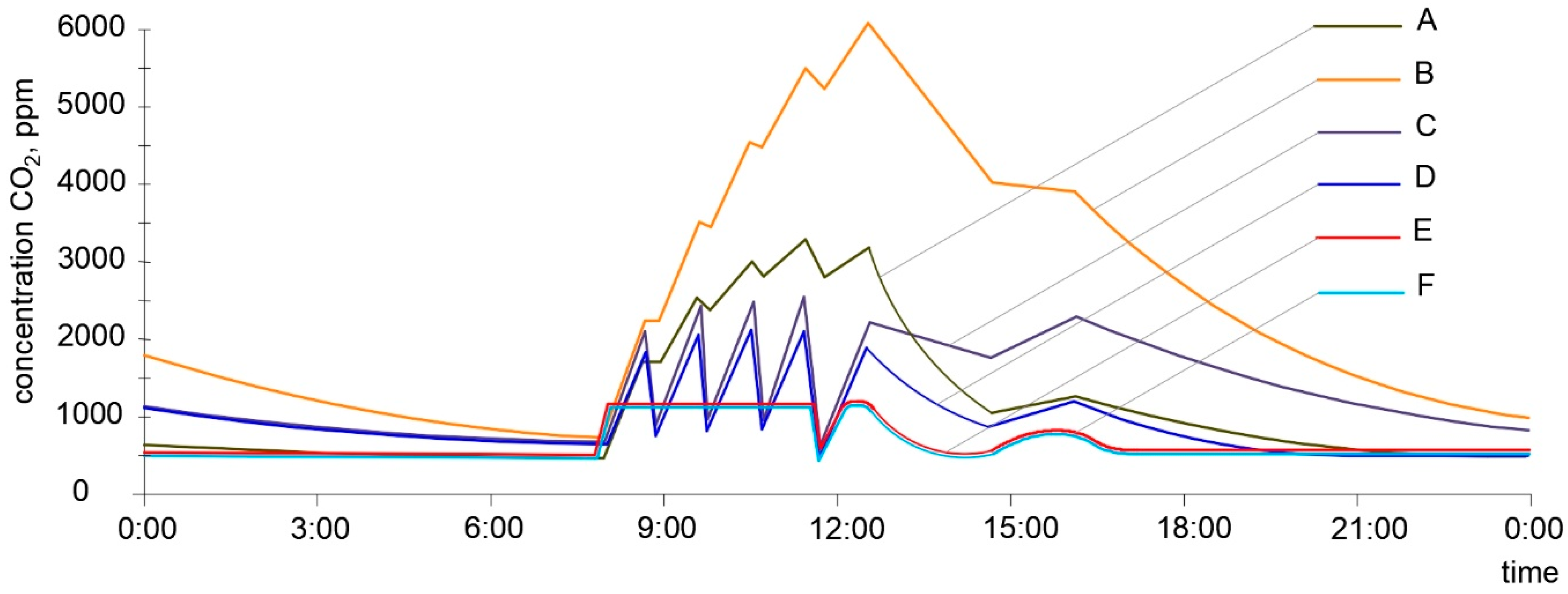
The quality of internal air is one of the factors that affect the pace and quality of knowledge acquisition. Therefore, it is important that classrooms have high quality of air. Using computer simulation, the effect of various building ventilation variants on air quality in classrooms was analyzed. Two criteria were analyzed and six variants of ventilation. The analysis was carried out using the CONTAMW program, used for multi-zone analysis of ventilation and air quality in a building. As an indicator of air quality, the concentration of carbon dioxide in school halls was adopted. The analyses show that natural ventilation is not able to provide proper air exchange. Regular airing of classrooms during breaks can reduce the carbon dioxide concentration to 2500 ppm, however, there is a significant reduction in indoor temperature (even below 10 °C). The best control over the internal environment can be obtained by using a supply–exhaust ventilation system with heat recovery. Obtaining a higher stabilization of ventilation is achieved by supplying additional energy to drive fans, however, this is only a small amount of energy compared to the cost of heat for heating the building (maximum 2%).
Keywords: indoor air quality; ventilation systems; concentration of carbon dioxide indoor air quality; ventilation systems; concentration of carbon dioxide