Article

A Robust Prescriptive Framework and Performance Metric for Diagnosing and Predicting Wind Turbine Faults Based on SCADA and Alarms Data with Case Study


1
Department of Civil and Environmental Engineering, University College Cork, Cork T12 K8AF, Ireland
2
Department of Mechanical, Biomedical and Manufacturing Engineering, Cork Institute of Technology, Cork T12 P594, Ireland
*
Author to whom correspondence should be addressed.
Energies 2018, 11(7), 1738; https://doi.org/10.3390/en11071738
Submission received: 9 May 2018 / Revised: 20 June 2018 / Accepted: 25 June 2018 / Published: 3 July 2018
(This article belongs to the Section A: Sustainable Energy)

Abstract

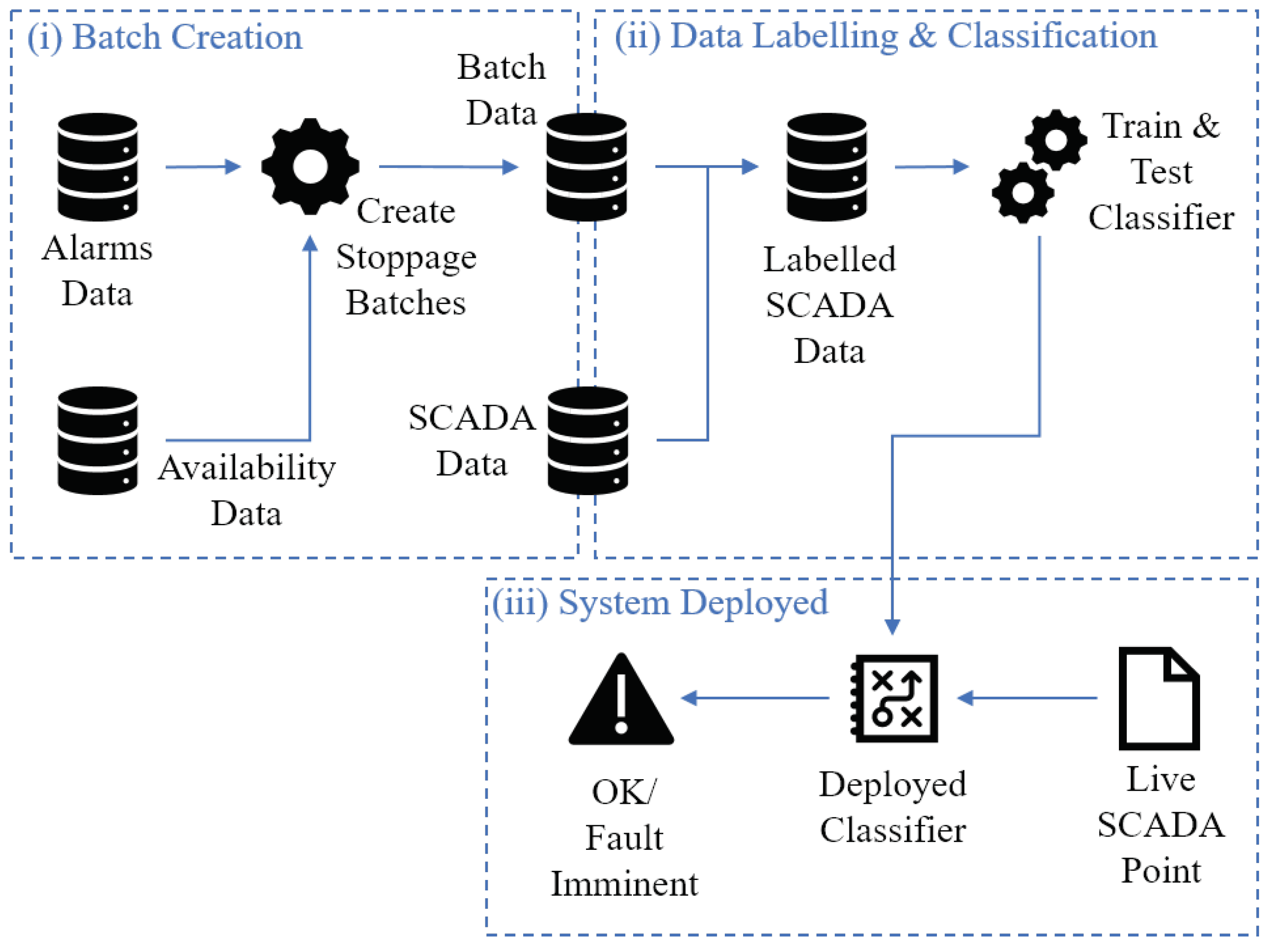
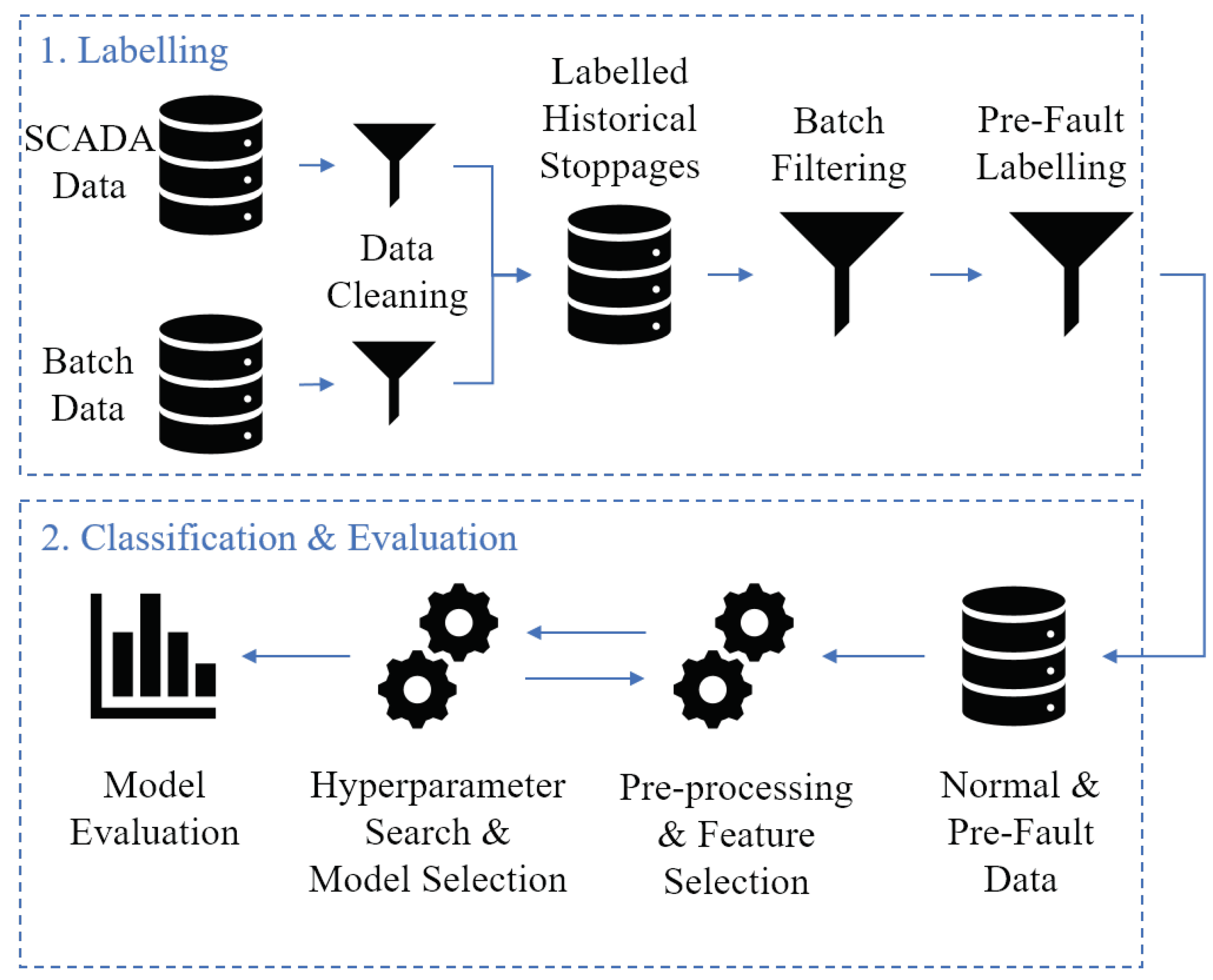
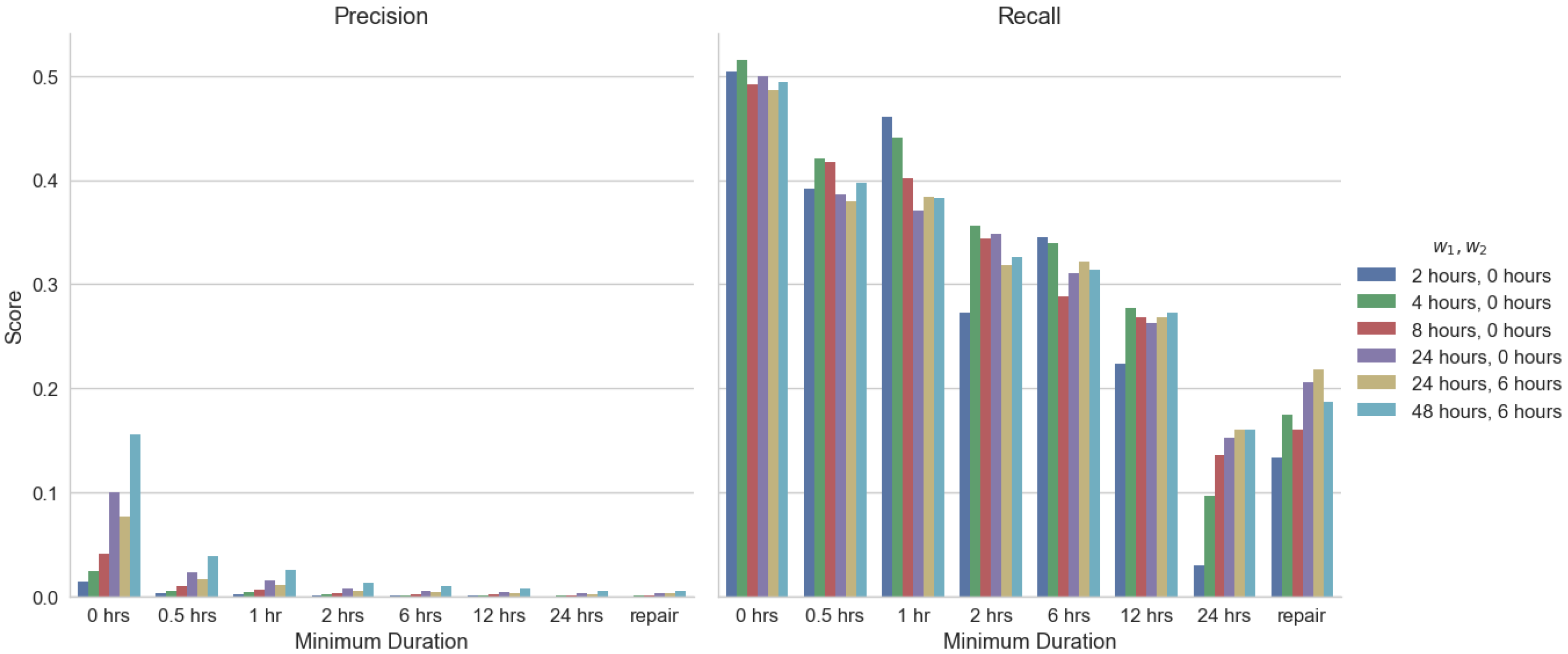
Using 10-minute wind turbine supervisory control and data acquisition (SCADA) system data to predict faults can be an attractive way of working toward a predictive maintenance strategy without needing to invest in extra hardware. Classification methods have been shown to be effective in this regard, but there have been some common issues in their application within the literature. To use these data-driven methods effectively, historical SCADA data must be accurately labelled with the periods when turbines were down due to faults, as well as with the reason for the fault. This can be manually achieved using maintenance logs, but can be highly tedious and time-consuming due to the often unstructured format in which this information is stored. Alarm systems can also help, but the sheer volume of alarms and false positives generated complicate efforts. Furthermore, a way to implement and evaluate the field deployed system beyond simple classification metrics is needed. In this work, we present a prescribed and reproducible framework for: (i) automatically identifying periods of faulty operation using rules applied to the turbine alarm system; (ii) using this information to perform classification which avoids some of the common pitfalls observed in literature; and (iii) generating alerts based on a sliding window metric to evaluate the performance of the system in a real-world scenario. The framework was applied to a dataset from an operating wind farm and the results show that the system can automatically and accurately label historical stoppages from the alarms data. For fault prediction, classification scores are quite low, with precision of 0.16 and recall of 0.49, but it is envisaged that this can be greatly improved with more training data. Nonetheless, the sliding window metric compensates for the low raw classification scores and shows that 71% of faults can be predicted with an average of 30 h notice, with false alarms being active for 122 h of the year. By adjusting some of the parameters of the fault prediction alerts, the duration of false alarms can be drastically reduced to 2 h, but this also reduces the number of predicted faults to 8%.
Keywords: wind turbines; scada data; fault prognostics; machine learning; random forests wind turbines; scada data; fault prognostics; machine learning; random forests