Computational Fluid Dynamics Approach to Predict the Actual Wind Speed over Complex Terrain


Abstract
1. Introduction
2. Overview of Noma Wind Park, Kagoshima Prefecture
3. Numerical Simulation Technique and Set-up
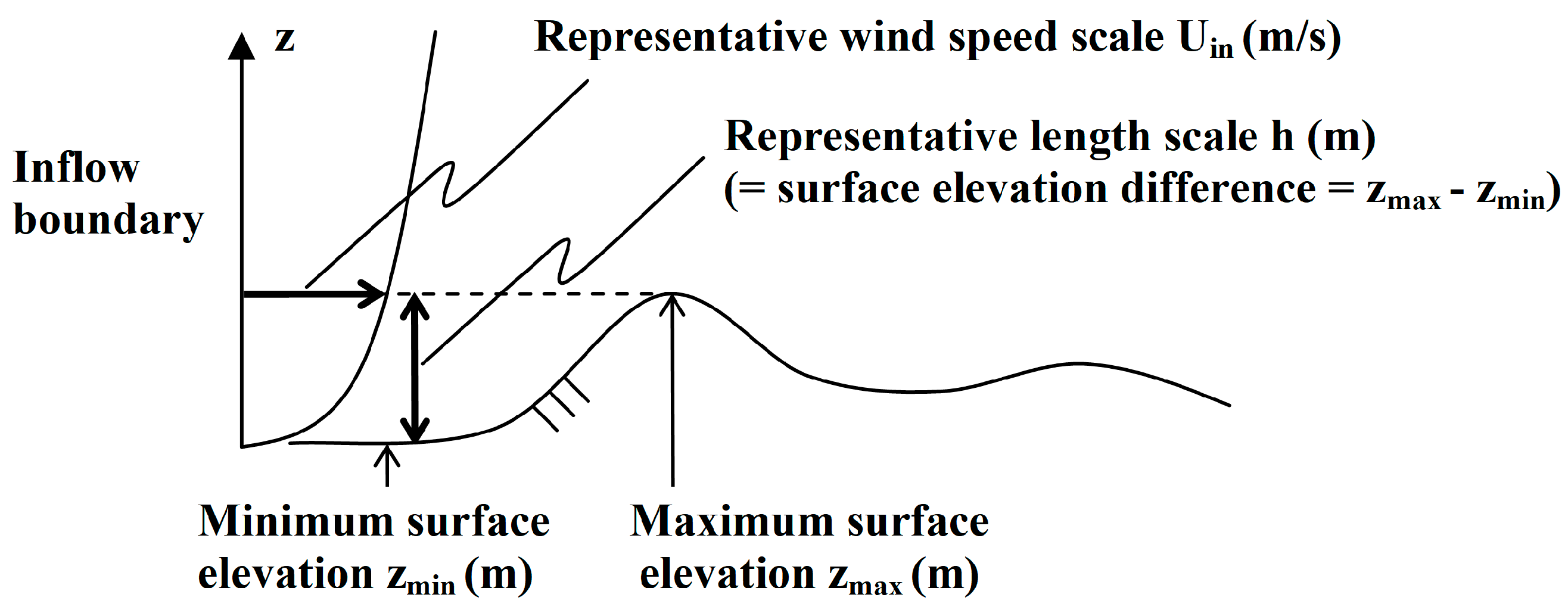
4. Procedure for Predicting Actual Wind Speed
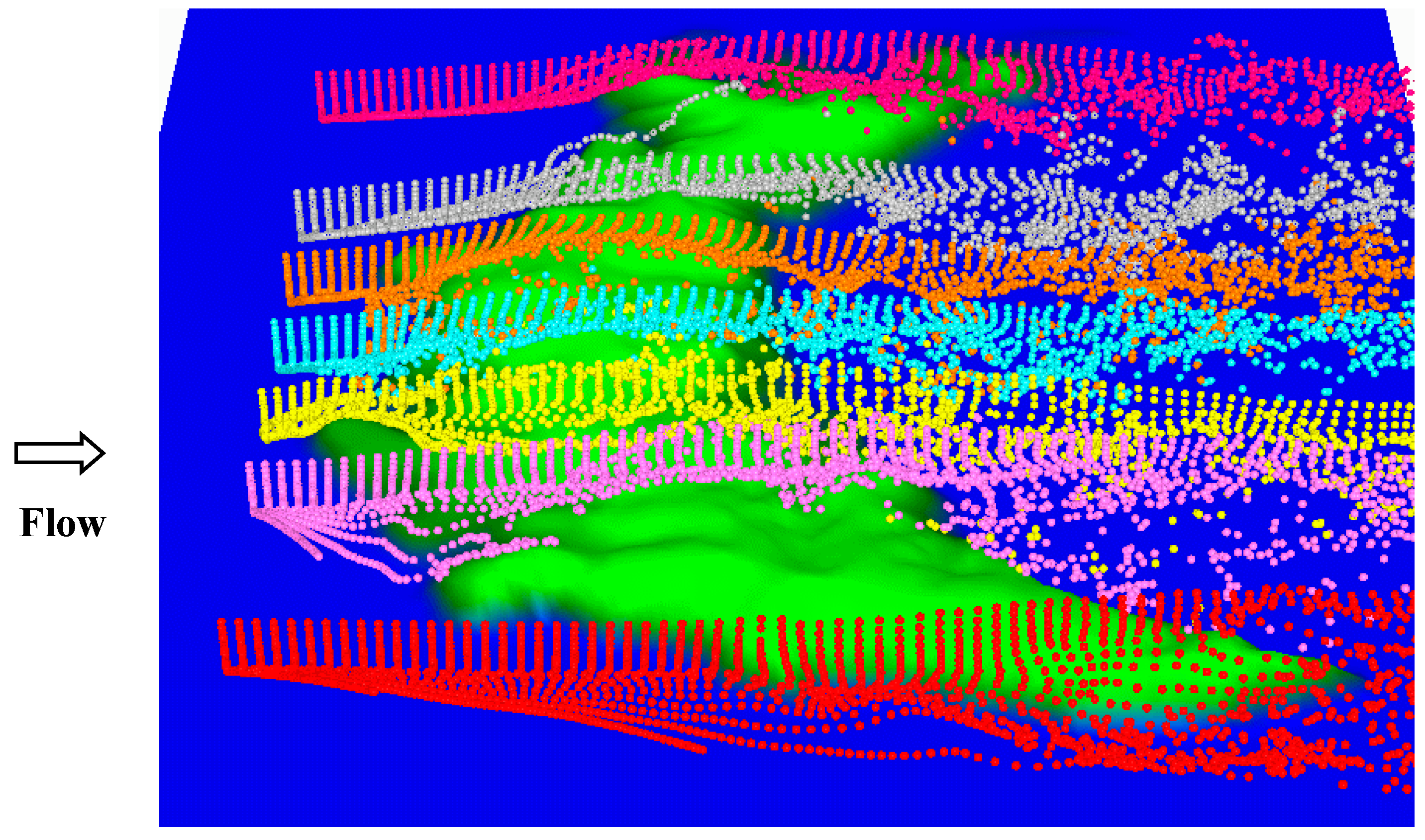
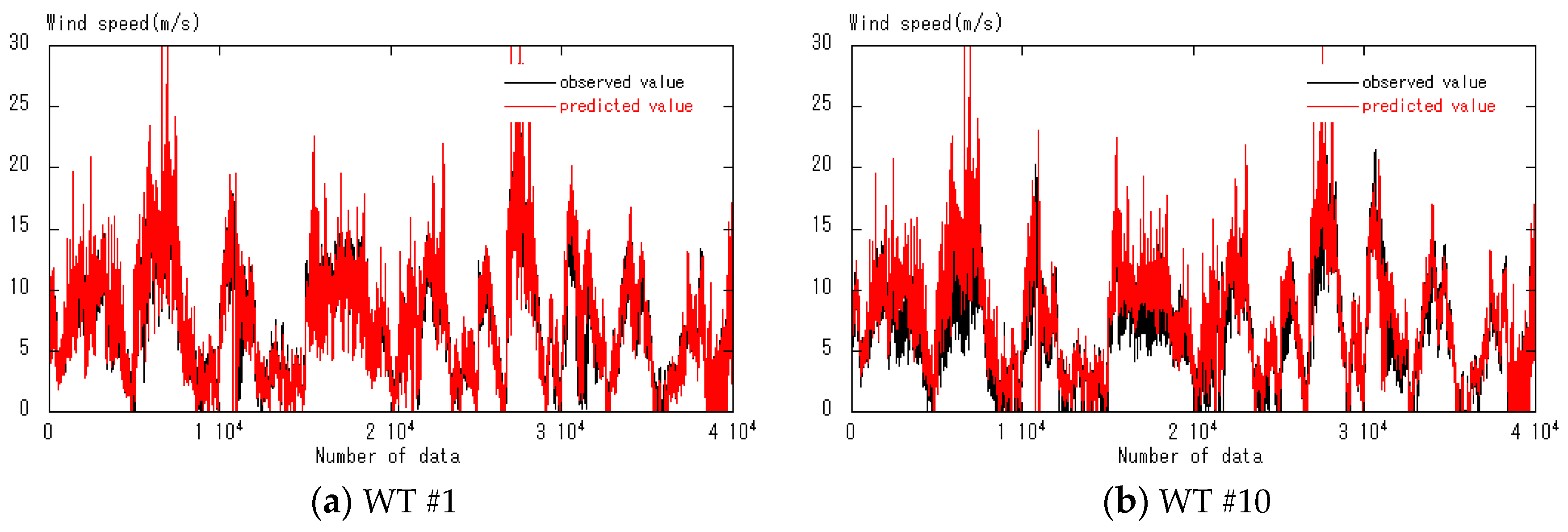
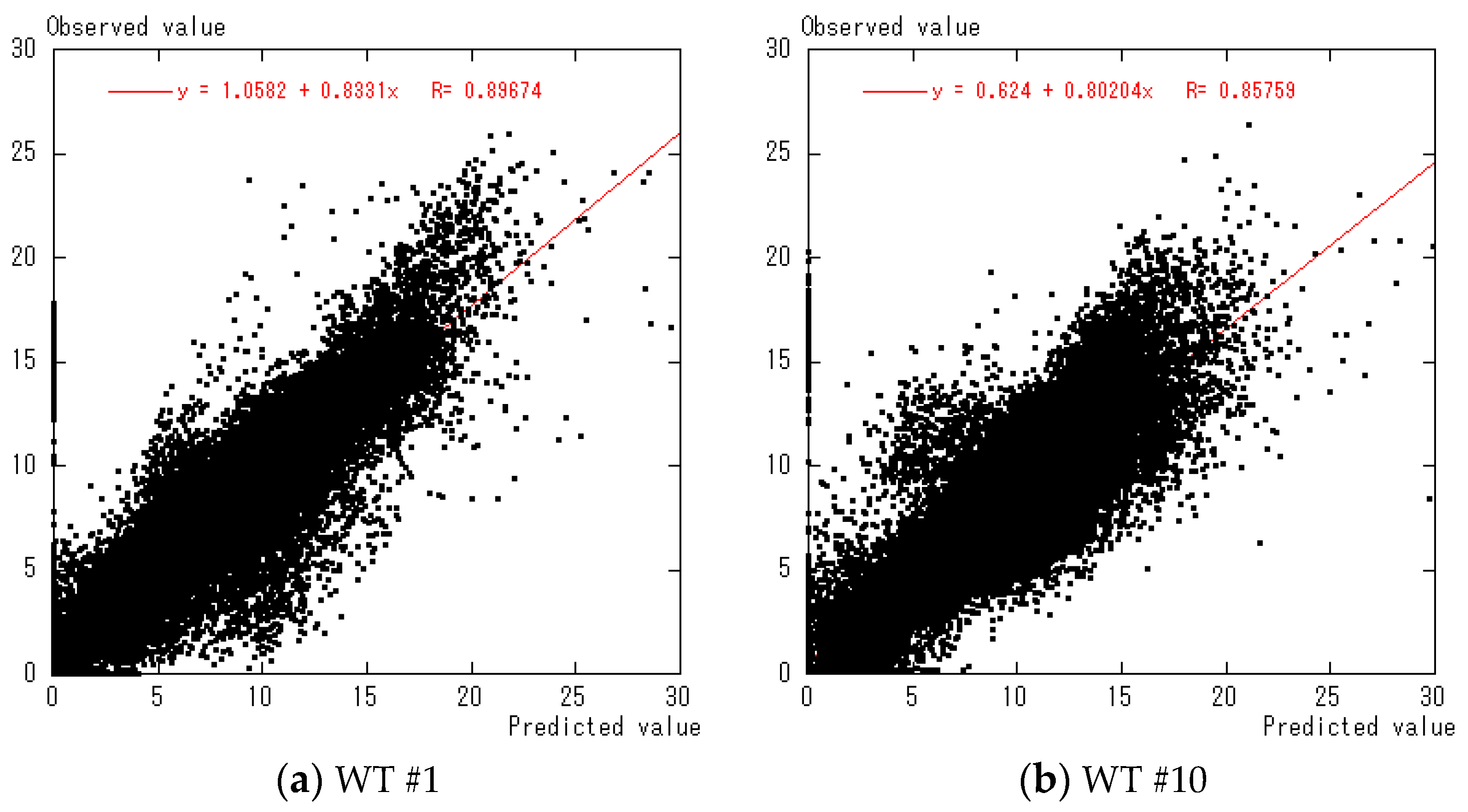
5. Results and Discussion
6. Conclusions
Funding
Acknowledgments
Conflicts of Interest
References
- Palma, J.M.L.M.; Castro, F.A.; Ribeiro, L.F.; Rodrigues, A.H.; Pinto, A.P. Linear and nonlinear models in wind resource assessment and wind turbine micro-siting in complex terrain. J. Wind Eng. Ind. Aerodyn. 2008, 96, 2308–2326. [Google Scholar] [CrossRef] [Scilit]
- Berg, J.; Mann, J.; Bechmann, A.; Courtney, M.S.; Jørgensen, H.E. The Bolund experiment, part I: Flow over a steep, three-dimensional hill. Bound.-Layer Meteorol. 2011, 141, 219–243. [Google Scholar] [CrossRef] [Scilit]
- Bechmann, A.; Sørensen, N.N.; Berg, J.; Mann, J.; Réthoré, P.-E. The Bolund experiment, part II: Blind comparison of microscale flow models. Bound.-Layer Meteorol. 2011, 141, 245–271. [Google Scholar] [CrossRef] [Scilit]
- Prospathopoulos, J.M.; Politis, E.S.; Chaviaropoulos, P.K. Application of a 3D RANS solver on the complex hill of Bolund and assessment of the wind flow predictions. J. Wind Eng. Ind. Aerodyn. 2012, 107, 149–159. [Google Scholar] [CrossRef] [Scilit]
- Diebold, M.; Higgins, C.; Fang, J.; Bechmann, A.; Parlange, M.B. Flow over hills: A large-eddy simulation of the Bolund case. Bound.-Layer Meteorol. 2013, 148, 177–194. [Google Scholar] [CrossRef] [Scilit]
- Porté-Agel, F.; Wu, Y.-T.; Chen, C.-H. A Numerical Study of the Effects of Wind Direction on Turbine Wakes and Power Losses in a Large Wind Farm. Energies 2013, 6, 5297–5313. [Google Scholar] [CrossRef] [Scilit]
- Yeow, T.S.; Cuerva, A.; Conan, B.; Pérez-Álvarez, J. Wind tunnel analysis of the detachment bubble on Bolund Island. J. Phys. Conf. Ser. 2014, 555, 012021. [Google Scholar] [CrossRef] [Scilit]
- Yeow, T.S.; Cuerva-Tejero, A.; Pérez-Álvarez, J. Reproducing the Bolund experiment in wind tunnel. Wind Energy 2015, 18, 153–169. [Google Scholar] [CrossRef] [Scilit]
- Chaudhari, A.; Hellsten, A.; Hämäläinen, J. Full-Scale Experimental Validation of Large-Eddy Simulation of Wind Flows over Complex Terrain: The Bolund Hill. Adv. Meteorol. 2016. [Google Scholar] [CrossRef] [Scilit]
- Conan, B.; Chaudhari, A.; Aubrun, S.; van Beeck, J.; Hämäläinen, J.; Hellsten, A. Experimental and numerical modelling of flow over complex terrain: The Bolund hill. Bound.-Layer Meteorol. 2016, 158, 183–208. [Google Scholar] [CrossRef] [Scilit]
- Sessarego, M.; Shen, W.Z.; van der Laan, M.P.; Hansen, K.S.; Zhu, W.J. CFD Simulations of Flows in a Wind Farm in Complex Terrain and Comparisons to Measurements. Appl. Sci. 2018, 8, 788. [Google Scholar] [CrossRef] [Scilit]
- Astolfi, D.; Castellani, F.; Terzi, L. A Study of Wind Turbine Wakes in Complex Terrain through RANS Simulation and SCADA Data. J. Sol. Energy Eng. 2018, 140, 031001. [Google Scholar] [CrossRef] [Scilit]
- Uchida, T. LES Investigation of Terrain-Induced Turbulence in Complex Terrain and Economic Effects of Wind Turbine Control. Energies 2018, 11, 1530. [Google Scholar] [CrossRef] [Scilit]
- Uchida, T. Computational Fluid Dynamics (CFD) Investigation of Wind Turbine Nacelle Separation Accident over Complex Terrain in Japan. Energies 2018, 11, 1485. [Google Scholar] [CrossRef] [Scilit]
- Uchida, T.; Ohya, Y. Latest Developments in Numerical Wind Synopsis Prediction Using the RIAM-COMPACT CFD Model-Design Wind Speed Evaluation and Wind Risk (Terrain-Induced Turbulence) Diagnostics in Japan. Energies 2011, 4, 458–474. [Google Scholar] [CrossRef] [Scilit]
- Uchida, T. Large-Eddy Simulation and Wind Tunnel Experiment of Airflow over Bolund Hill. Open J. Fluid Dyn. 2018, 8, 30–43. [Google Scholar] [CrossRef]
- Uchida, T. High-Resolution LES of Terrain-Induced Turbulence around Wind Turbine Generators by Using Turbulent Inflow Boundary Conditions. Open J. Fluid Dyn. 2017, 7, 511–524. [Google Scholar] [CrossRef]
- Uchida, T. High-Resolution Micro-Siting Technique for Large Scale Wind Farm Outside of Japan Using LES Turbulence Model. Energy Power Eng. 2017, 9, 802–813. [Google Scholar] [CrossRef]
- Uchida, T. CFD Prediction of the Airflow at a Large-Scale Wind Farm above a Steep, Three-Dimensional Escarpment. Energy Power Eng. 2017, 9, 829–842. [Google Scholar] [CrossRef]
- Uchida, T.; Ohya, Y. Verification of the Prediction Accuracy of Annual Energy Output at Noma Wind Park by the Non-Stationary and Non-Linear Wind Synopsis Simulator, RIAM-COMPACT. J. Fluid Sci. Technol. 2008, 3, 344–358. [Google Scholar] [CrossRef] [Scilit]
- Uchida, T.; Ohya, Y. Micro-siting Technique for Wind Turbine Generators by Using Large-Eddy Simulation. J. Wind Eng. Ind. Aerodyn. 2008, 96, 2121–2138. [Google Scholar] [CrossRef] [Scilit]
- Uchida, T.; Maruyama, T.; Ohya, Y. New Evaluation Technique for WTG Design Wind Speed using a CFD-model-based Unsteady Flow Simulation with Wind Direction Changes. Model. Simul. Eng. 2011. [Google Scholar] [CrossRef] [Scilit]
- Kim, J.; Moin, P. Application of a fractional-step method to incompressible Navier-Stokes equations. J. Comput. Phys. 1985, 59, 308–323. [Google Scholar] [CrossRef] [Scilit]
- Kajishima, T. Upstream-shifted interpolation method for numerical simulation of incompressible flows. Bull. Jpn. Soc. Mech. Eng. B 1994, 60, 3319–3326. (In Japanese) [Google Scholar] [CrossRef] [Scilit]
- Kawamura, T.; Takami, H.; Kuwahara, K. Computation of high Reynolds number flow around a circular cylinder with surface roughness. Fluid Dyn. Res. 1986, 1, 145–162. [Google Scholar] [CrossRef] [Scilit]
- Smagorinsky, J. General circulation experiments with the primitive equations, Part 1, Basic experiments. Mon. Weather Rev. 1963, 91, 99–164. [Google Scholar] [CrossRef] [Scilit]
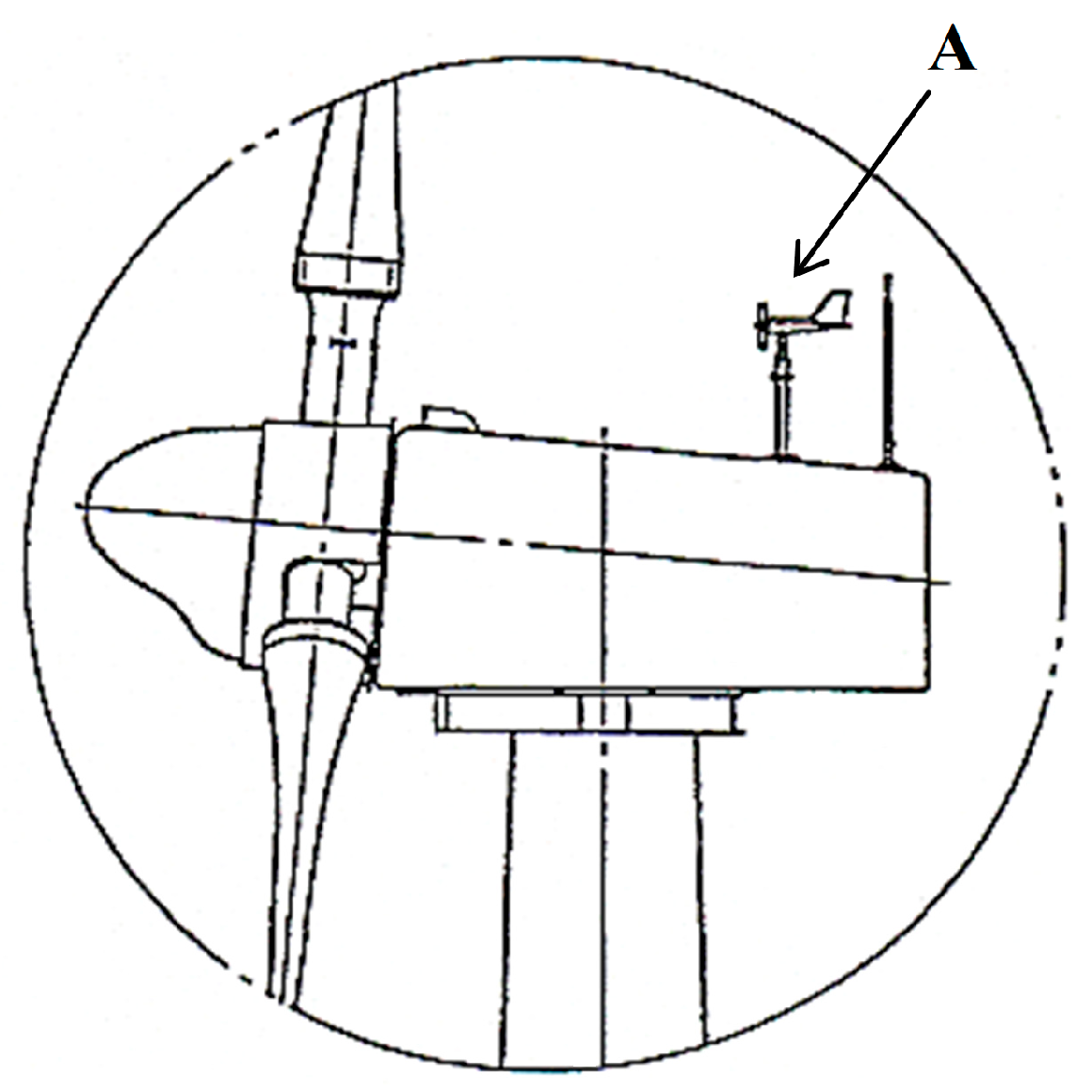
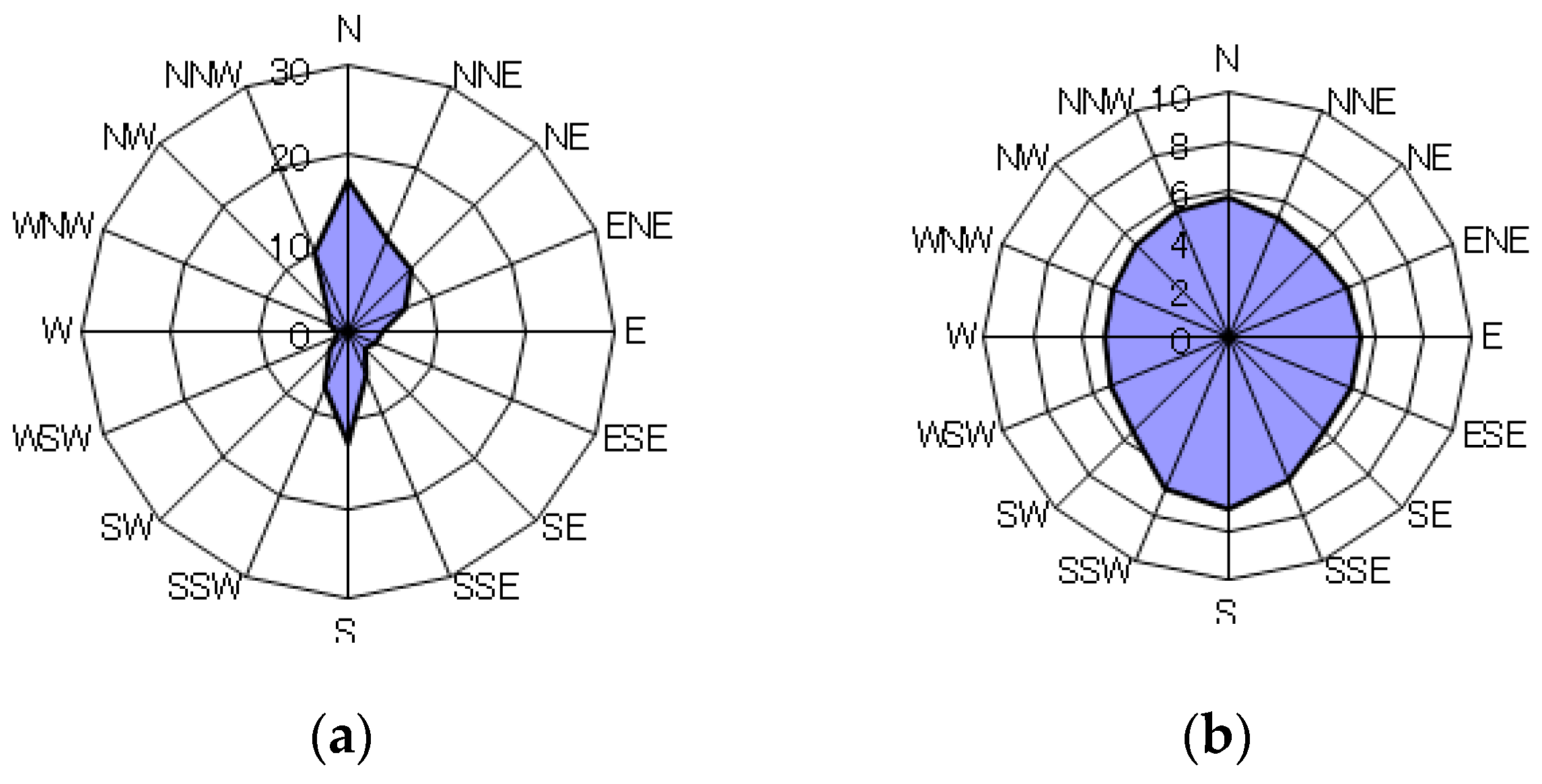
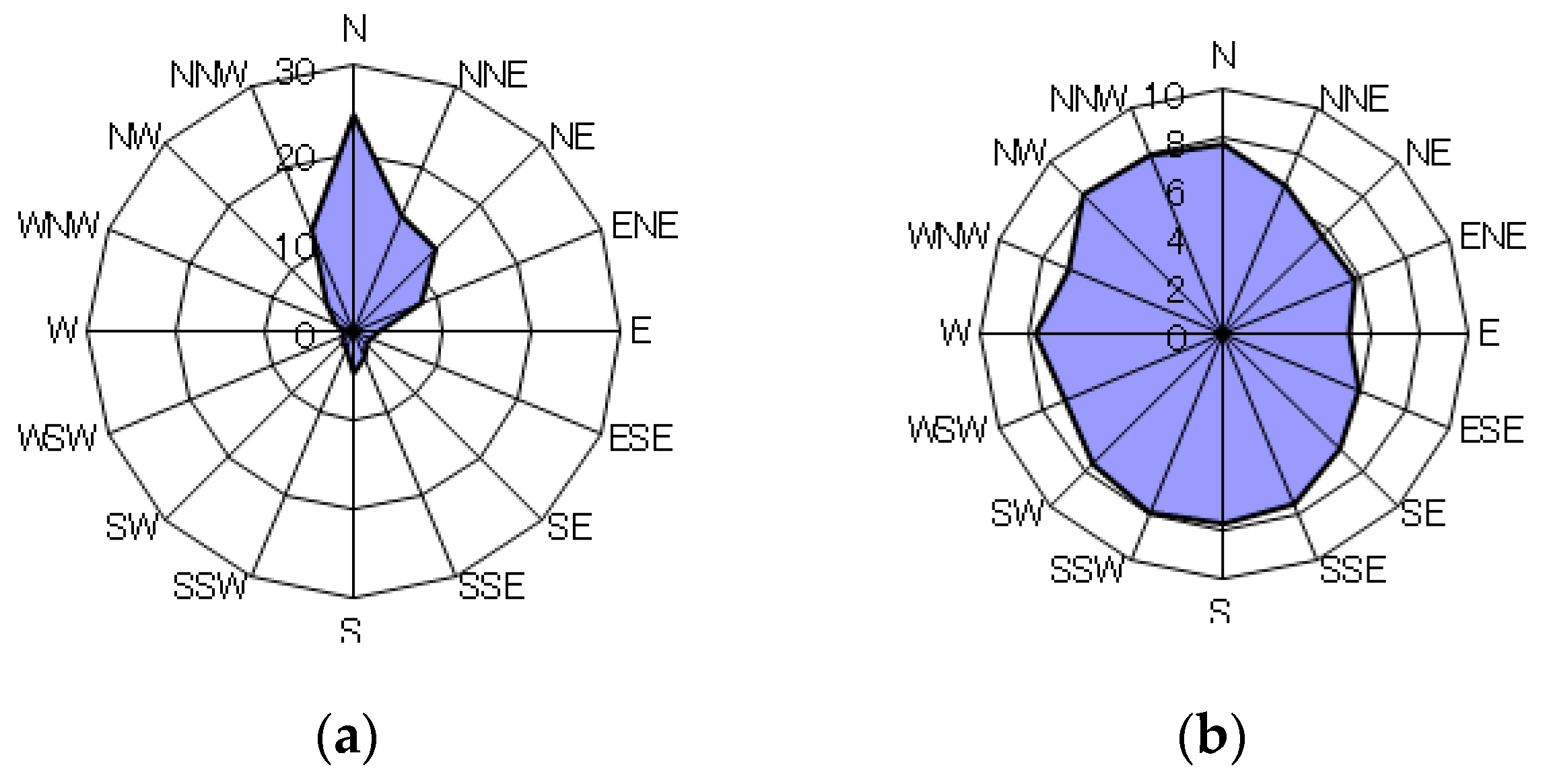
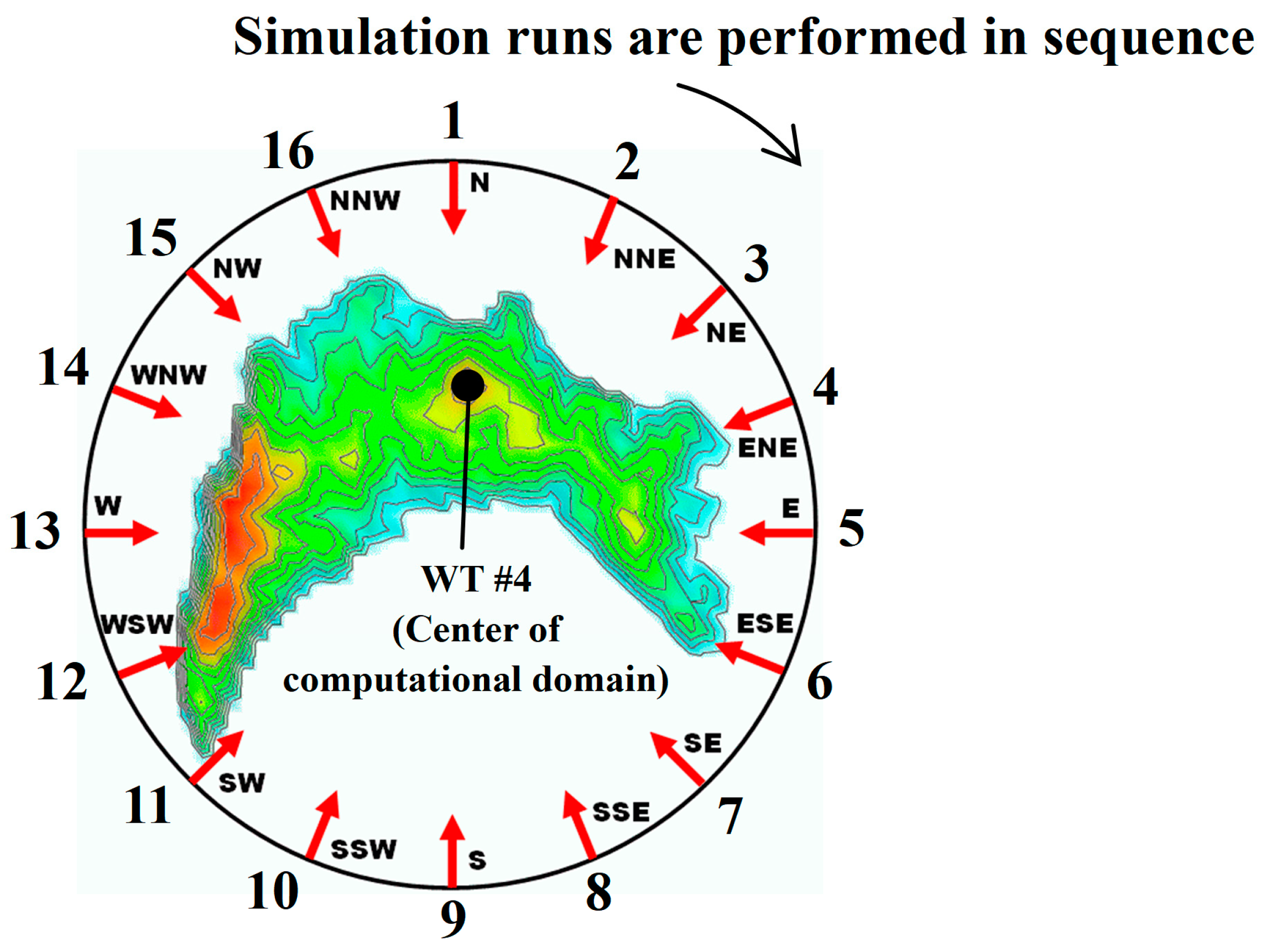
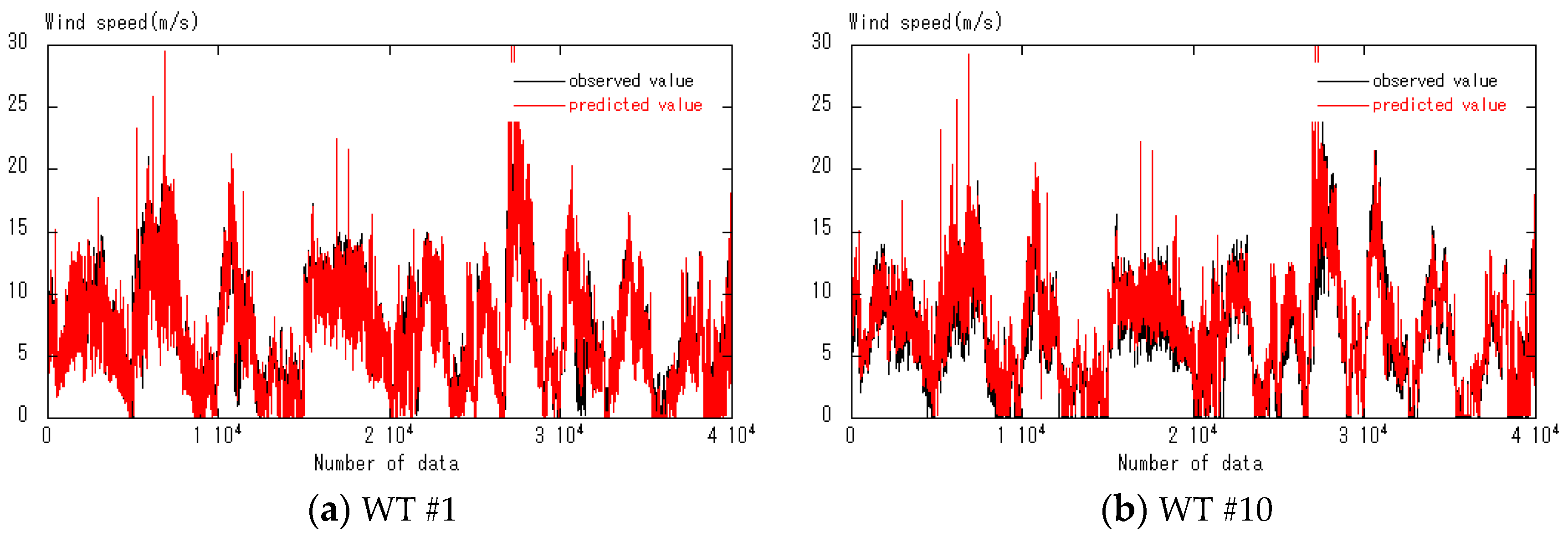
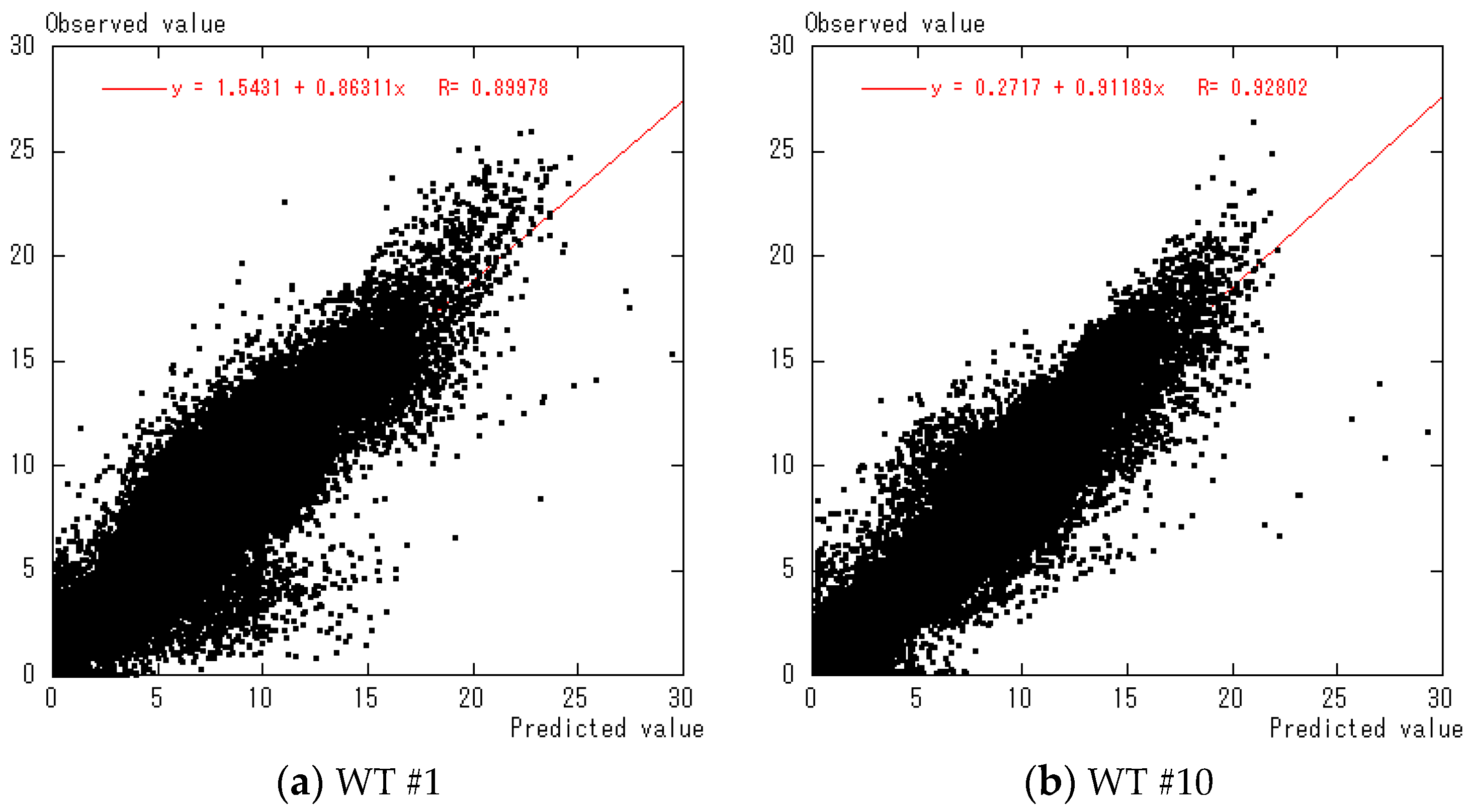
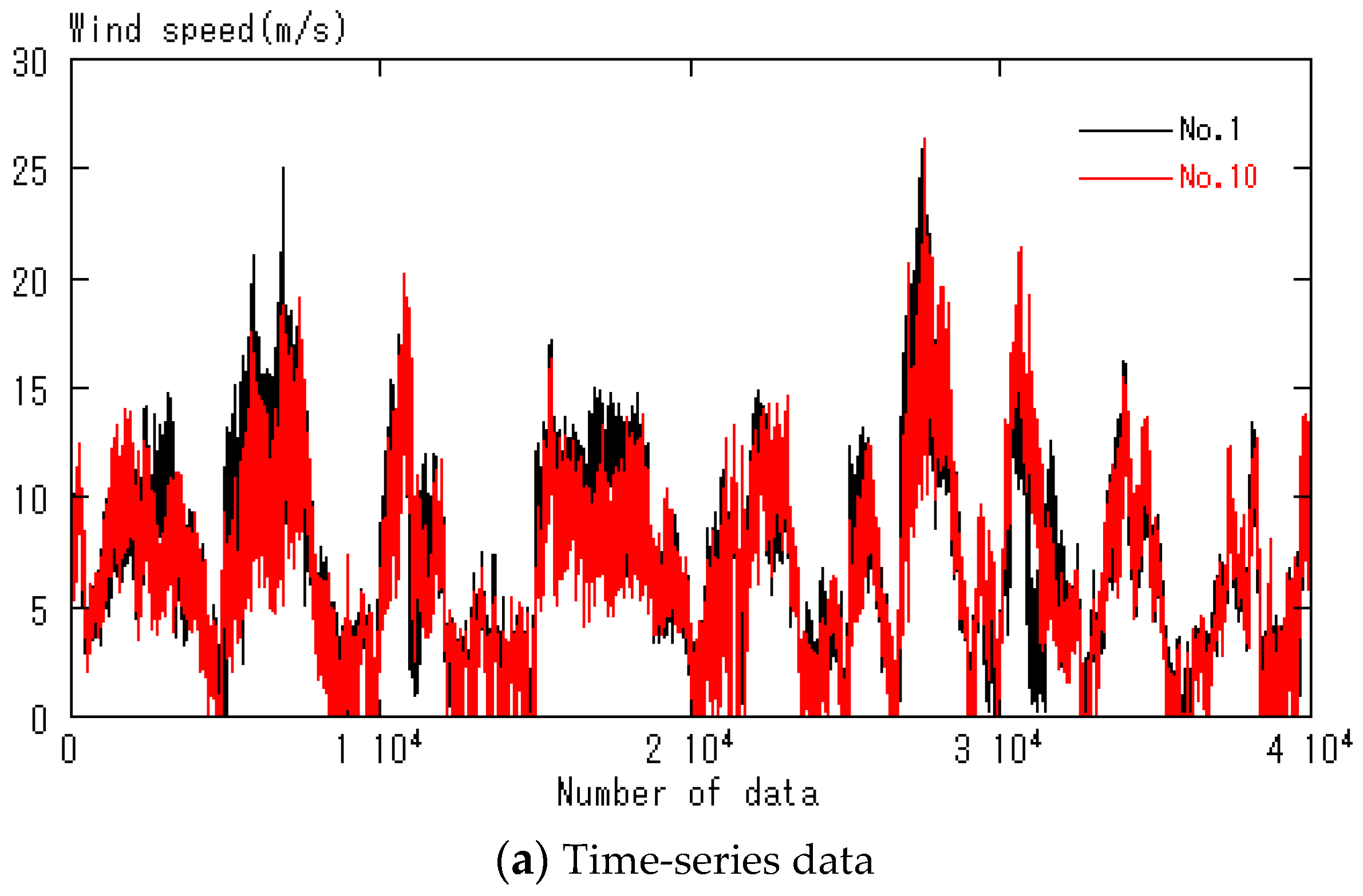

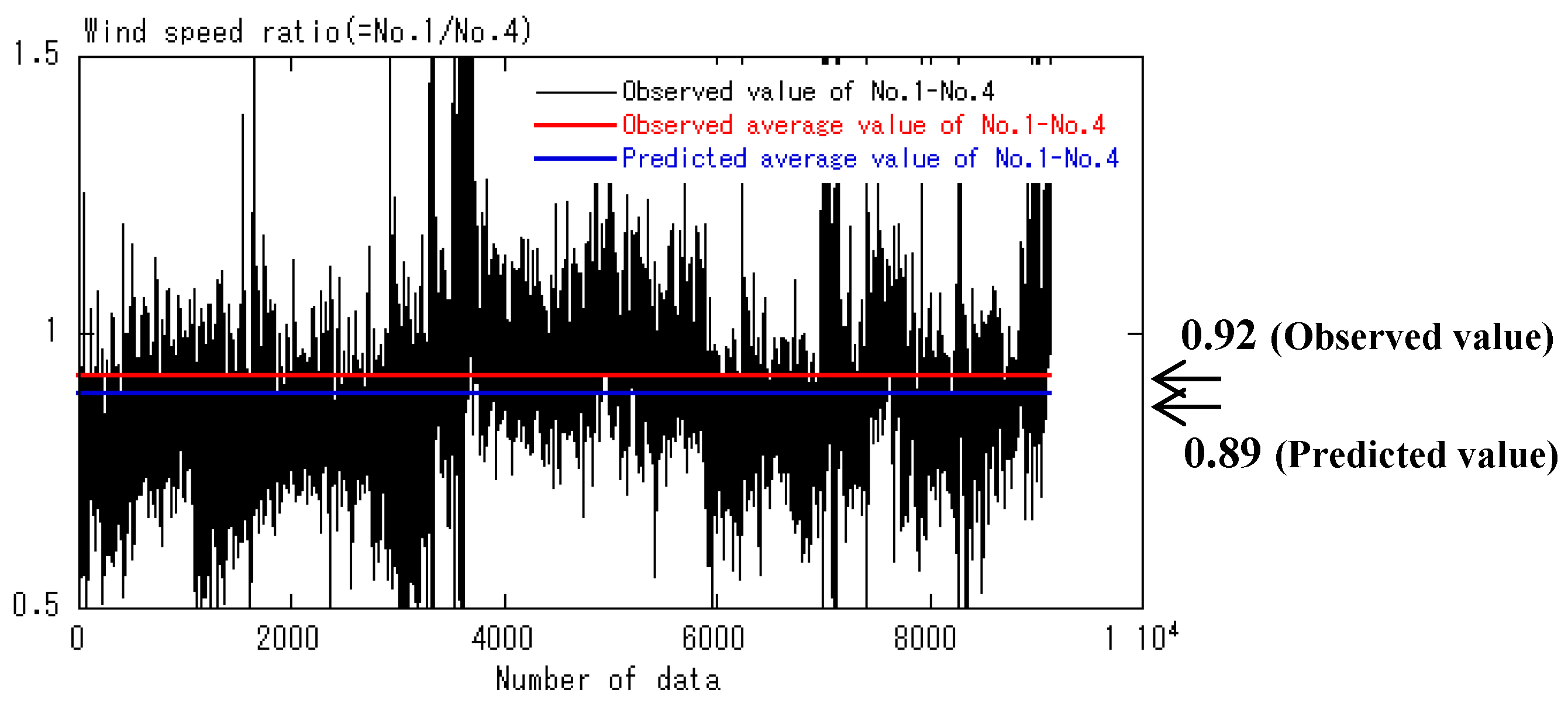


| Item | WT #1–#5 | WT #6–#10 |
|---|---|---|
| Output | 300 kW/WT | |
| Generator type | Induction | Synchronous |
| Cut-in speed | 3.5 m/s | 2.5 m/s |
| Rated wind speed | 14.4 m/s | 14.0 m/s |
| Cut-out speed | 24 m/s | 25 m/s |
| Rotor diameter | 29 m | 30 m |
| Tower height | 30 m (WT #4:45 m) | 30 m (WT #6:45 m) |
| Number | Hub-Height (Tower Height) | Surface Elevation of WT Site |
|---|---|---|
| WT #1 | 30 m | 100 m |
| WT #2 | 92 m | |
| WT #3 | 109 m | |
| WT #4 | 45 m | 122 m |
| WT #5 | 30 m | 102 m |
| WT #6 | 45 m | 117 m |
| WT #7 | 30 m | 88 m |
| WT #8 | 95 m | |
| WT #9 | 92 m | |
| WT #10 | 109 m |
| (a) Reference Point: WT #4 | ||||
| February 2003 | Observed Wind Speed (m/s) | Predicted Wind Speed (m/s) | Relative Error (%) | Correlation Coefficient |
| WT #1 | 7.27 | 7.45 | 2.56 | 0.90 |
| WT #2 | 7.07 | 7.24 | 2.31 | 0.89 |
| WT #3 | 7.91 | 7.60 | 3.92 | 0.93 |
| WT #5 | 7.11 | 7.45 | 4.84 | 0.91 |
| WT #6 | 7.39 | 7.83 | 5.90 | 0.92 |
| WT #7 | 6.35 | 7.06 | 11.28 | 0.83 |
| WT #8 | 6.78 | 7.40 | 9.09 | 0.90 |
| WT #9 | 6.17 | 7.20 | 16.62 | 0.84 |
| WT #10 | 6.57 | 7.41 | 12.84 | 0.86 |
| Average | 6.96 | 7.40 | 6.42 | 0.89 |
| (b) Reference Point: WT #6 | ||||
| February 2003 | Observed Wind Speed (m/s) | Predicted Wind Speed (m/s) | Relative Error (%) | Correlation Coefficient |
| WT #1 | 7.27 | 6.63 | 8.74 | 0.90 |
| WT #2 | 7.07 | 6.32 | 10.71 | 0.87 |
| WT #3 | 7.91 | 6.48 | 18.09 | 0.92 |
| WT #5 | 7.11 | 7.73 | 6.80 | 0.92 |
| WT #6 | 7.39 | 7.07 | 0.54 | 0.92 |
| WT #7 | 6.35 | 6.80 | 7.10 | 0.92 |
| WT #8 | 6.78 | 7.02 | 3.58 | 0.96 |
| WT #9 | 6.17 | 6.80 | 10.22 | 0.92 |
| WT #10 | 6.57 | 6.90 | 5.13 | 0.93 |
| Average | 6.96 | 6.86 | 2.73 | 0.92 |
| Reference Point: WT #4 | Horizontal Separation Distance (m) | Reference Point: WT #6 | Horizontal Separation Distance (m) |
|---|---|---|---|
| WT #1–WT #4 | approx. 560 | WT #1–WT #6 | approx. 760 |
| WT #2–WT #4 | approx. 280 | WT #2–WT #6 | approx. 530 |
| WT #3–WT #4 | approx. 140 | WT #3–WT #6 | approx. 350 |
| WT #5–WT #4 | approx. 180 | WT #4–WT #6 | approx. 300 |
| WT #6–WT #4 | approx. 300 | WT #5–WT #6 | approx. 140 |
| WT #7–WT #4 | approx. 420 | WT #7–WT #6 | approx. 140 |
| WT #8–WT #4 | approx. 430 | WT #8–WT #6 | approx. 240 |
| WT #9–WT #4 | approx. 630 | WT #9–WT #6 | approx. 350 |
| WT #10–WT #4 | approx. 800 | WT #10–WT #6 | approx. 500 |
| Reference Point: WT #4 | Elevation Difference (m) | Reference Point: WT #6 | Elevation Difference (m) |
|---|---|---|---|
| WT #1–WT #4 | 37 | WT #1–WT #6 | 32 |
| WT #2–WT #4 | 45 | WT #2–WT #6 | 40 |
| WT #3–WT #4 | 28 | WT #3–WT #6 | 23 |
| WT #5–WT #4 | 35 | WT #4–WT #6 | 5 |
| WT #6–WT #4 | 5 | WT #5–WT #6 | 30 |
| WT #7–WT #4 | 49 | WT #7–WT #6 | 44 |
| WT #8–WT #4 | 42 | WT #8–WT #6 | 37 |
| WT #9–WT #4 | 45 | WT #9–WT #6 | 40 |
| WT #10–WT #4 | 28 | WT #10–WT #6 | 23 |
© 2018 by the author. Licensee MDPI, Basel, Switzerland. This article is an open access article distributed under the terms and conditions of the Creative Commons Attribution (CC BY) license (http://creativecommons.org/licenses/by/4.0/).
Share and Cite
Uchida, T. Computational Fluid Dynamics Approach to Predict the Actual Wind Speed over Complex Terrain. Energies 2018, 11, 1694. https://doi.org/10.3390/en11071694
Uchida T. Computational Fluid Dynamics Approach to Predict the Actual Wind Speed over Complex Terrain. Energies. 2018; 11(7):1694. https://doi.org/10.3390/en11071694
Chicago/Turabian StyleUchida, Takanori. 2018. "Computational Fluid Dynamics Approach to Predict the Actual Wind Speed over Complex Terrain" Energies 11, no. 7: 1694. https://doi.org/10.3390/en11071694
APA StyleUchida, T. (2018). Computational Fluid Dynamics Approach to Predict the Actual Wind Speed over Complex Terrain. Energies, 11(7), 1694. https://doi.org/10.3390/en11071694