Article

Charge Equalization Controller Algorithm for Series-Connected Lithium-Ion Battery Storage Systems: Modeling and Applications

1
Department of Electrical Power Engineering, Universiti Tenaga Nasional, Kajang 43000, Malaysia
2
Department of Electrical & Electronic Engineering, University of Chittagong, Chittagong 4331, Bangladesh
3
Institute of Climate Change, Universiti Kebangsaan Malaysia, Bangi 43600, Selangor, Malaysia
4
Department of Electrical, Electronic and Systems Engineering, Universiti Kebangsaan Malaysia, Bangi 43600, Selangor, Malaysia
*
Author to whom correspondence should be addressed.
Energies 2017, 10(9), 1390; https://doi.org/10.3390/en10091390
Submission received: 21 August 2017 / Revised: 3 September 2017 / Accepted: 7 September 2017 / Published: 13 September 2017
(This article belongs to the Section D: Energy Storage and Application)

Abstract

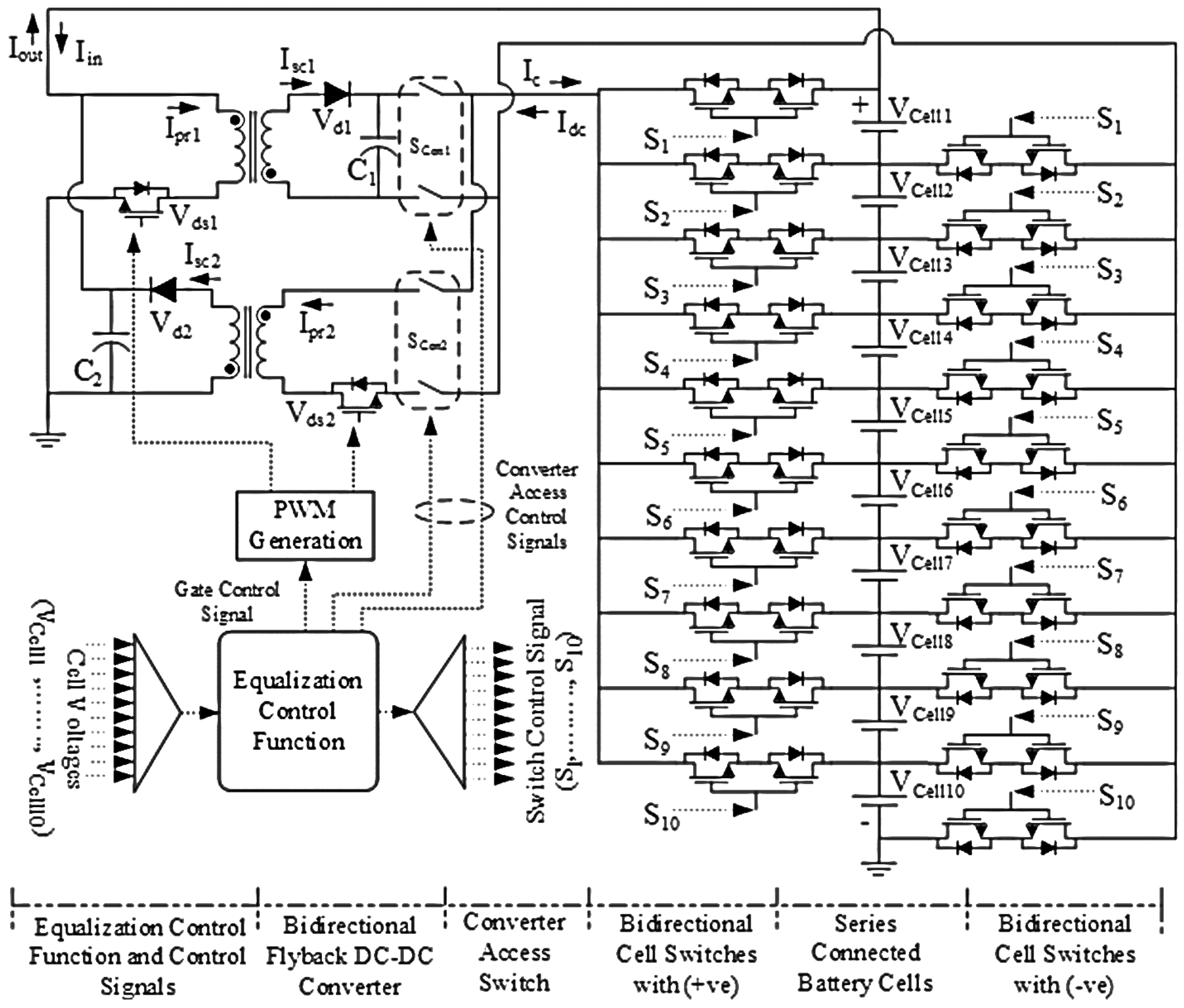
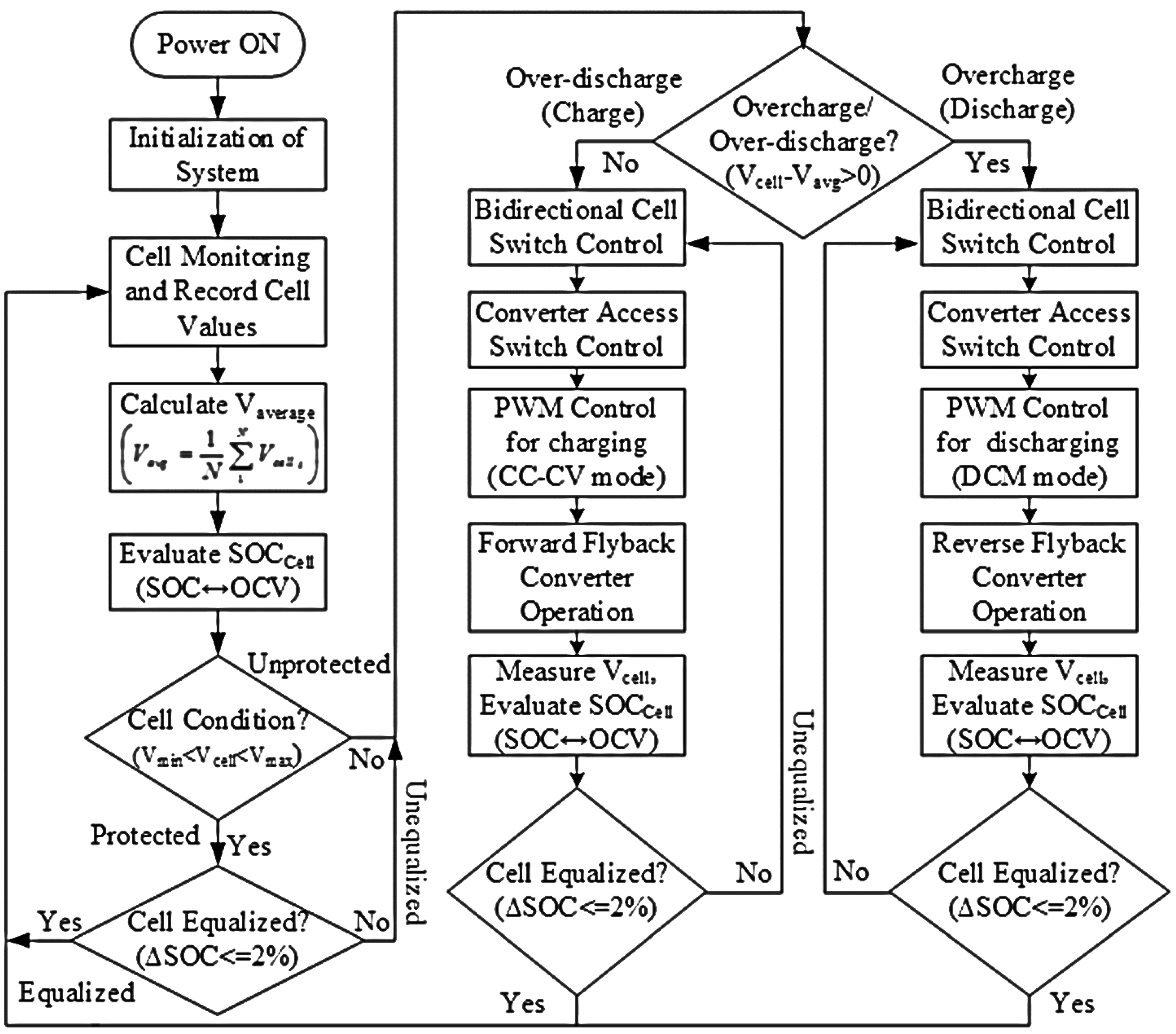
This study aims to develop an accurate model of a charge equalization controller (CEC) that manages individual cell monitoring and equalizing by charging and discharging series-connected lithium-ion (Li-ion) battery cells. In this concept, an intelligent control algorithm is developed to activate bidirectional cell switches and control direct current (DC)–DC converter switches along with pulse width modulation (PWM) generation. Individual models of an electric vehicle (EV)-sustainable Li-ion battery, optimal power rating, a bidirectional flyback DC–DC converter, and charging and discharging controllers are integrated to develop a small-scale CEC model that can be implemented for 10 series-connected Li-ion battery cells. Results show that the charge equalization controller operates at 91% efficiency and performs well in equalizing both overdischarged and overcharged cells on time. Moreover, the outputs of the CEC model show that the desired balancing level occurs at 2% of state of charge difference and that all cells are operated within a normal range. The configuration, execution, control, power loss, cost, size, and efficiency of the developed CEC model are compared with those of existing controllers. The proposed model is proven suitable for high-tech storage systems toward the advancement of sustainable EV technologies and renewable source of applications.
Keywords: charge equalization controller; control algorithm; modeling; state of charge; lithium-ion battery; sustainable energies charge equalization controller; control algorithm; modeling; state of charge; lithium-ion battery; sustainable energies