Review

Facial Contouring in Orthognathic Surgery: The Role of Facial Implants

by
Gabriel Conceição Brito
1,
Márcio de Moraes
1,
Leonardo Faverani
1 and
Sergio Olate
1,2,*
1
Division of Oral and Maxillofacial Surgery, Department of Oral Diagnosis, Piracicaba School of Dentistry, State University of Campinas, São Paulo 13414-903, Brazil
2
Center for Research in Morphology and Surgery (CEMyQ), University of La Frontera, Temuco 4780000, Chile
*
Author to whom correspondence should be addressed.
Craniomaxillofac. Trauma Reconstr. 2026, 19(1), 2; https://doi.org/10.3390/cmtr19010002
Submission received: 20 November 2025 / Revised: 17 December 2025 / Accepted: 19 December 2025 / Published: 24 December 2025
(This article belongs to the Special Issue Innovation in Oral- and Cranio-Maxillofacial Reconstruction)

Abstract

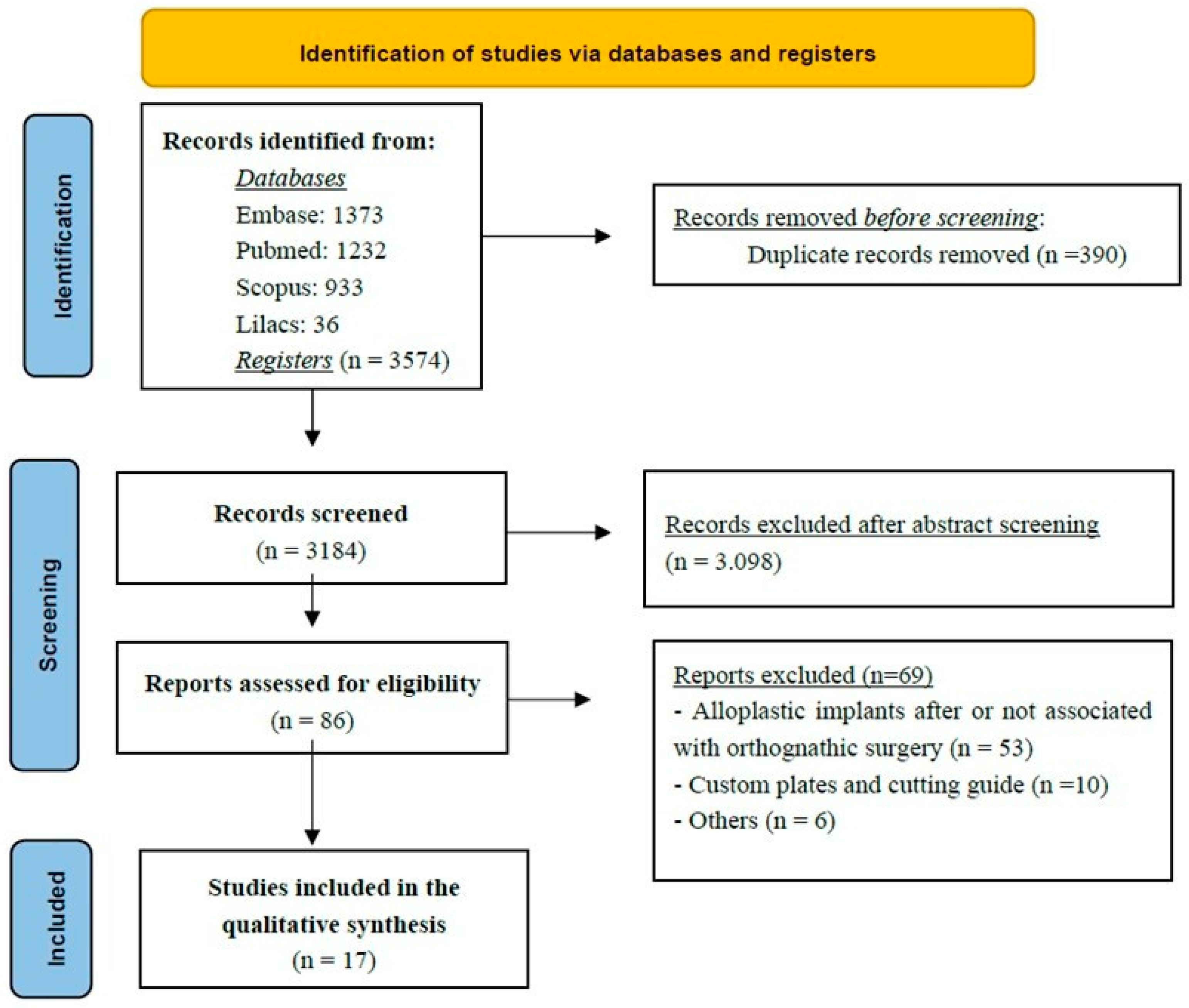
Orthognathic surgery restores functional balance and facial esthetics in patients with dentofacial deformities. The use of adjunctive facial implants—made from materials such as porous polyethylene, titanium, or polyetheretherketone (PEEK)—has increased to enhance contour and projection, although standardized guidelines for their selection and integration remain scarce. Following PRISMA-ScR guidelines, a systematic search of PubMed, Scopus, Embase, and LILACS identified studies reporting facial implants placed concomitantly with orthognathic surgery. Eligible studies included case reports, case series, observational studies, clinical trials, and reviews involving human patients, without language or date restrictions. Seventeen studies published between 1998 and 2025 met the inclusion criteria, comprising retrospective and prospective designs, case series, and one technical note. Implants were used in the malar, infraorbital, paranasal, chin, mandibular body, and angle regions. Materials included PEEK, porous polyethylene, silicone, hydroxyapatite, polymethylmethacrylate, and titanium. PEEK was mainly used for patient-specific implants, while porous polyethylene was commonly used as stock implants. Follow-up time, outcome reporting, and study design varied widely, reflecting substantial methodological heterogeneity and predominantly observational evidence. As a result, outcomes were primarily reported qualitatively, limiting comparative assessment and long-term inference. Overall, the available literature suggests that alloplastic facial implants may serve as useful adjuncts to orthognathic surgery for contour enhancement, with outcomes influenced by implant design, surgical expertise, fixation, and soft tissue conditions. However, the current evidence base remains limited, underscoring the need for standardized outcome measures, comparative studies, and longer follow-up to better inform clinical decision-making and future research.
Keywords: facial implants; orthognathic surgery; facial esthetic facial implants; orthognathic surgery; facial esthetic