Next Article in Journal
A Comparison of Rearfoot Motion Control and Comfort between Custom and Semicustom Foot Orthotic Devices
Previous Article in Journal
Relationship of Body Mass Index, Ankle Dorsiflexion, and Foot Pronation on Plantar Fascia Thickness in Healthy, Asymptomatic Subjects
 
 
Journal of the American Podiatric Medical Association is published by MDPI from Volume 116 Issue 1 (2026). Previous articles were published by another publisher in Open Access under a CC-BY (or CC-BY-NC-ND) licence, and they are hosted by MDPI on mdpi.com as a courtesy and upon agreement with American Podiatric Medical Association.
Article

The Flat-Footed Child—To Treat or Not to Treat. What Is the Clinician to Do?

by
Angela Margaret Evans
Division of Health Sciences, Podiatry Research Group, School of Health Sciences, University of South Australia, City East Campus, North Terrace, Adelaide, South Australia, Australia 5000
J. Am. Podiatr. Med. Assoc. 2008, 98(5), 386-393; https://doi.org/10.7547/0980386
Published: 1 September 2008

Abstract

Background: This article addresses the treatment of pediatric flatfoot with foot orthoses and explores the existing knowledge from an evidence-based perspective. Methods: Studies investigating the use of foot orthoses for pediatric flatfoot were reviewed and ranked on the evidence hierarchy model according to research designs. Clinical guidelines and efficacy rating methods were also reviewed. Results: Three randomized controlled trials exist, and a systematic review and possible meta-analysis of these studies is in progress. The results of these studies, although not definitive for the use of orthoses for pediatric flatfoot, provide useful direction. Clinical guidelines for the management of flatfoot are a useful supplement for clinical decision making and have been enhanced. Conclusion: This article presents a pragmatic and evidence-based clinical care pathway for clinicians to use for pediatric flatfoot. It uses a simple “traffic light” framework to identify three subtypes of pediatric flatfoot. The clinician is advised to 1) treat symptomatic pediatric flatfoot, 2) monitor (or with discretion simply treat) asymptomatic nondevelopmental pediatric flatfoot, and 3) identify and advise asymptomatic developmental pediatric flatfoot. (Children with juvenile arthritis should receive customized foot orthoses.) This approach will dispel much of the contention surrounding the use of foot orthoses in children.

Children’s flatfoot is a common concern and a regular presentation in pediatric health-care settings.[1,2] Despite this, there is no universally accepted definition of pediatric flatfoot, although consistent inclusions are the attributes of a valgus heel and a flattened medial longitudinal arch.[3] It is accepted that flat feet are of different types and may be painful or nonpainful, flexible or rigid, functional or nonfunctional.
Prevalence estimates have a broad range, which is understandable given the lack of and variations in specific definitions. Garcia-Rodriguez et al[4] summarized studies and reported that estimates as low as 2.7% to 12.3% or even higher are reported in the literature. Recent prevalence research by Pfeiffer et al[5] investigated 835 children aged 3 to 6 years and found that flatfoot was associated with children’s age, sex, and body weight. There was an inverse relationship between age and flat feet (3 year olds, 54%; 6 year olds, 24%) and a predisposition for flat feet in boys (boys, 52%; girls, 36%). Body weight was directly related to flat feet, encountered in 51% of overweight children, 62% of obese children, and 42% of children with normal body weight.
This same study[5] found that approximately 10% of children were using some form of foot support (orthotic device) and yet only 1% to 2% were overtly symptomatic. The authors commented that although treatment for pediatric flatfoot seems to abound, it was their opinion that “greater than 90% of the treatments were unnecessary.”[5] The issue of treating pediatric flatfoot with orthotic devices has long been the subject of contentious debate.[1,6-8] To address this issue, it is important to assiduously review the available scientific literature.

Methods

The literature was reviewed to identify studies that have investigated the use of foot orthoses as part of conservative treatment of pediatric flatfoot. The literature was then structured in keeping with the hierarchical levels of evidence as described by Sackett et al.[9,10] Research compliant with the evidence-based hierarchy was collated (Table 1).[1,11-20] It is useful to examine these studies in terms of the strength of the findings proffered. The strongest evidence is derived from individual randomized controlled trials, with the optimal recommendation for clinical practice being derived from a systematic review based on a meta-analysis of a variety of randomized controlled trials. Table 1 illustrates that most of the investigative studies performed to date offer uncertain recommendations to the clinician.
To provide a complete review of the available evidence and because there is a relative paucity of investigations, this article presents all of the available studies in reverse order of their position in the evidence hierarchy. The studies occupying the three lowest evidence levels are shown in Table 2.[13,15-22] These studies consist of small samples, have disparate age groups, and lack control groups for comparison with the orthosis or shoe intervention groups. Owing to inherently poor research designs, none of these studies provide results that are able to be generalized or that are any more certain than would potentially occur by chance. It is important that good-quality research be made available to provide recommendations for clinical practice. Poor-quality research designs provide limited results and are potentially misleading for clinicians who need well-founded studies to guide their practice.
Table 3 summarizes the best available research addressing the use of foot orthoses for pediatric flatfoot in the form of three randomized controlled trials.[11,12,14] Customized foot orthoses were found to be beneficial for pain, function, and quality of life in children with rheumatoid arthritis. However, in more typical clinical cases, ie, otherwise well children with flat or pronated feet prescribed foot orthoses, there was no significant difference in foot structure, physical activity, motor skills, or self-perception. Both of these studies[11,12] reported that orthoses seemed to help children who were experiencing foot or leg pain. However, this was an observed finding rather than a more formally reported result.
The systematic review for nonsurgical interventions for pediatric pes planus is currently published as a protocol in the Cochrane Database of Systematic Reviews.[1] Once completed, this meta-analysis of the randomized controlled trials in Table 3 and other clinical trials (presently being searched and translated for eligibility) will provide the best recommendation for clinical practice based on the available scientific evidence.

Discussion

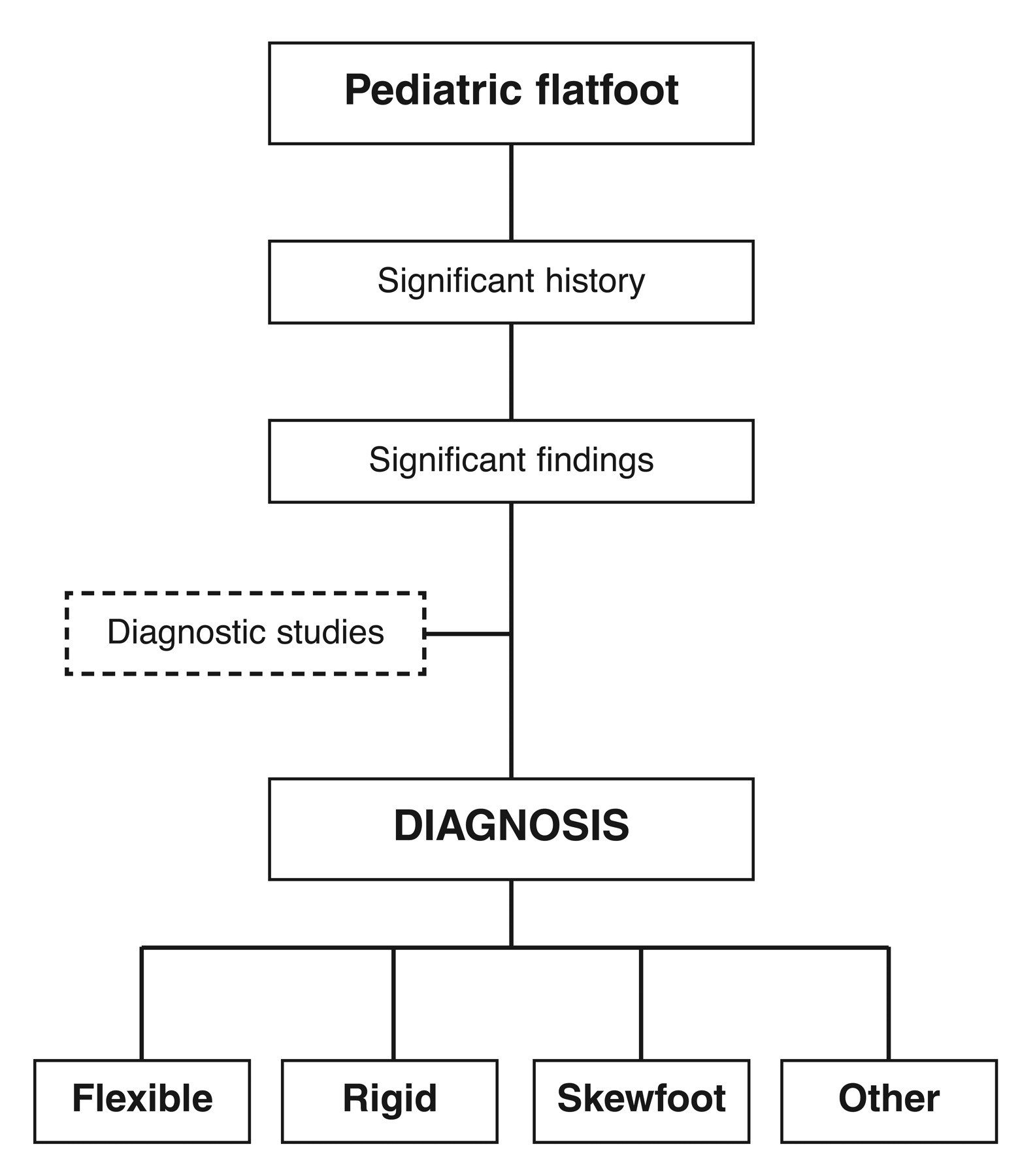
In light of the current situation, in which there is inadequate scientific research data to provide sound direction for clinicians confronted with pediatric flatfoot, there is a need for a directive clinical framework. Such an eventuality of inconclusive recommendations from research findings occurs in the management of many conditions. Sometimes there is simply insufficient research to perform a meta-analysis, yet the clinician still requires practical guidelines with which to manage patients. Such guidelines are formulated at the consensus of expert clinicians’ espoused best practice and subsequently give rise to clinical care pathways. The existence of guidelines is not new for the management of pediatric flatfoot,[2,3,6] and they have most recently been modified and appended to by Harris et al[8] (Fig. 1).

Pediatric Flatfoot Guidelines

The American College of Foot and Ankle Surgeons developed clinical-care pathways for the diagnosis and treatment of pediatric flatfoot.[8] This consensual document is a greatly improved and more refined approach than has been taken previously[2,3,6,23,24] and is represented in Figure 1.
These guidelines sensibly approach the pediatric flatfoot presentation from the broader context of significant history and findings before reaching a structured diagnosis (and well before contemplating treatment). The taking of a thorough and structured history is important in all clinical situations. In the case of pediatric flatfoot, significant findings may include age (it is expected that young children have flat feet and that this reduces with age[25]), family history (a positive history of problematic familial flat feet raises suspicion), associations (ligament laxity or hypotonia increases joint compensation), symptoms (the symptomatic child requires treatment), trauma (altered structures may alter foot function), activity (impeded versus not impeded), systems review (cerebral palsy, muscular dystrophies, and atrophies), and treatment (has this been previously implemented, was it successful, and is it still required).
A similarly structured checklist approach is then taken to reveal any significant clinical findings: arch shape with weightbearing (the arch of a flexible flatfoot will be reduced with weightbearing, in contrast to a rigid flatfoot, which will not change, or a normal foot, which will retain an arch when loaded), range of motion (reduced range of motion may indicate a coalition, and increased range of motion may indicate hypermobility; asymmetry of ranges, eg, hemiplegia, should prompt a neurologic review), tender areas (typically the medial ankle region, the talonavicular joint, or the first metatarsophalangeal joint may be palpably tender; seronegative conditions need to be investigated if joints are erythematous or swollen), gait (the presence of a limp, marked asymmetry, or altered angle of gait can alert the clinician; gait needs to be examined shod and barefoot because footwear selection often improves gait function), and diagnostic studies (radiography, computed tomography, magnetic resonance imaging, bone scan, and laboratory tests [eg, radiography/computed tomography: reduced range of motion—tarsal coalition?; blood test: joint pain and swelling—arthritis?]).
The focus of these guidelines is rightly centered on an accurate diagnosis. As Figure 1 illustrates,[8,26] the diagnosis of pediatric flatfoot per se is too coarse, and one of the four suggested subtypes must be designated. In reality, rigid flatfoot and skewfoot are obvious presentations that are unlikely to be missed. These two subtypes also occur with less frequency than flexible flatfoot. I believe that there is insufficient attention given to the “other” subtype, which will nearly always be an intrinsic part of flexible flatfoot. The differential diagnostic factors that must be considered fall under four main categories: neurologic (eg, cerebral palsy and hypotonia), muscular (eg, muscular dystrophy or atrophy), genetic (eg, Down syndrome and Marfan syndrome), and collagen (eg, Ehlers Danlos syndrome and ligament laxity). It is this type of pediatric flatfoot (ie, flexible flatfoot with or without “other” inclusions as opposed to the easily differentiated rigid or skewed subtypes) that is most typically seen in the clinical setting and is, therefore, perhaps better referred to as “typical flexible flatfoot.”

Enhancing the Pediatric Flatfoot Guidelines

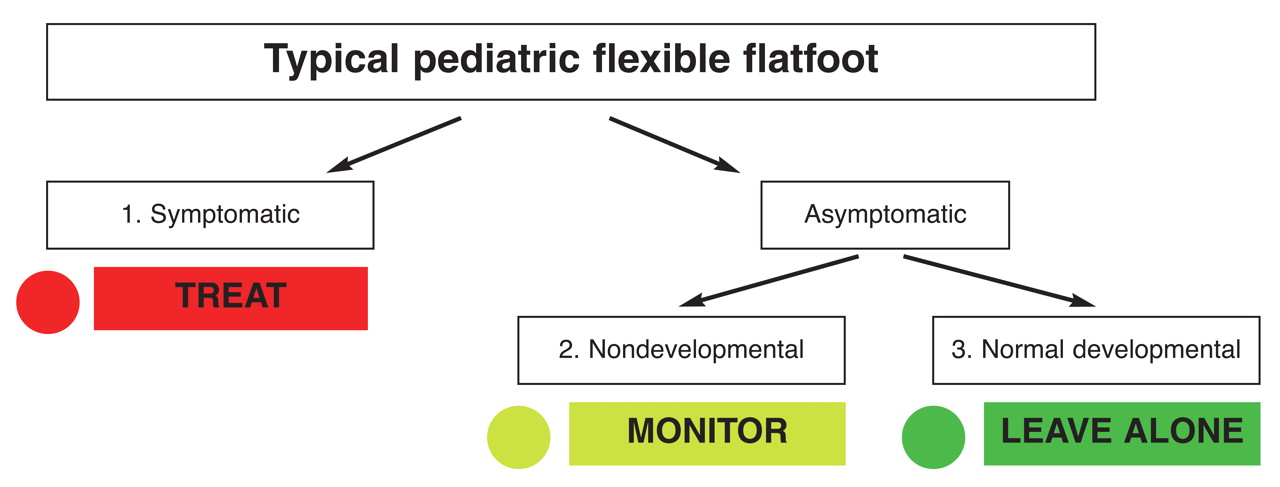
Typical flexible flatfoot can also be usefully subdivided on the bases of symptoms and development (Fig. 2). Typical flexible flatfoot that is symptomatic is a noncontentious presentation because it must be treated to ameliorate the child’s symptoms. As part of this management, the clinician should reconsider any of the “other” factors (ie, neurologic, muscular, genetic, and collagen) that may have previously been clinically dormant. Generally, the presentation of typical flexible flatfoot is not painful, hence some of the contention regarding the use of orthotic therapy in such cases.
Asymptomatic typical flexible flatfoot, although perhaps a more difficult (and, thus, controversial) entity in terms of decision making, can also be usefully subdivided on the basis of morphological development. It is developmentally expected that the child’s foot structure is inversely proportional to age in terms of “flatness” (arch height and heel eversion) up to approximately 8 years of age.[25] In the developmental years, this mild structural deformity reduces with age, in contrast to its nondevelopmental counterpart, which is seen to increasingly deform with the child’s increasing age. This is where the clinical concern arises. Will this aberrant physiologic feature become symptomatic? Should it be treated “just in case,” from a preventive point of view?
Rather than adopting an absolute position on this issue, it is more expedient to monitor these perplexing cases and to manage them according to the broader context in which they present, even if not overtly symptomatic. Clearly, children who present with a positive family history of painful flat feet at an older age and display markedly flat feet themselves raise greater future suspicion than children in whose families such findings seem sporadic and the foot structure only mildly flattened.
In the absence of directive symptoms, the characteristics of structural foot deformity are focused on asymptomatic, nondevelopmental typical flexible flatfoot. The attributes to observe, assess, consider, and, importantly, monitor (rather than blithely, and perhaps prematurely, intervene), as recommended by Harris et al,[8] are summarized in Table 4.[5,27] These are very subjective signs to assess, and although there can be wisdom in taking a “strength in numbers” approach (ie, the more coexisting features, the stronger the likelihood of the structure being so), there is also merit in using objectivity where possible.
The measurement of foot posture in children is much less investigated than in adults. However, some studies[28,29] have addressed this issue, and the best available clinical measures of structural foot posture in children are reported. These are summarized, together with interrater reliability results, in Table 5.
There needs to be judicious weighting of the gathered information by the clinician from which reareasoned clinical plans emerge. At this point (and not withstanding rigid flatfoot or skewfoot), there are really just three typical flexible flatfoot subtypes to distinguish: symptomatic, asymptomatic/nondevelopmental, and asymptomatic/developmental.
Identification of each subtype largely directs clinical management planning (Fig. 2). It is important that the most cost-effective options be used if orthoses are indicated. There are many low-cost generic orthoses that provide good positional support of the child’s flatfoot and relief of presenting symptoms. It behooves the clinician to use methods that are the most effective and least expensive when managing these cases. Footwear advice is essential and may be all that is required in some situations. Simple in-shoe wedging techniques are also effective.[13] There are many orthotic options available, and, in my experience, only a small percentage of pediatric flatfoot cases require customized (and, hence, more expensive) foot orthoses.

Clinical Monitoring of Treatment Efficacy

If orthoses of any mode are to be used, it is good practice for the efficacy to be examined and demonstrated for ongoing use to be justified. Two very useful methods of monitoring treatment efficacy of an individual patient, as frequently occurs in the clinical setting, are the single-case experimental design and the patient-generated index. Each method is briefly discussed, and the reader is referred to the cited sources for further detail.

Single-Case Experimental Design.

This is a useful research tool for the clinical setting that can identify cause-effect relationships and yet obviates large sample sizes. The single-case experimental design can be easily incorporated into clinical recording and provides useful information about treatment efficacy. Although the single-case experimental design has limitations in terms of the level of evidence that results,[30] it uses the principles of “control” to establish proof of a causal relationship. Single-case experimental designs allow conclusions to be drawn about the effects of an intervention based on the responses of a single subject under controlled conditions.[13]

Patient-Generated Index.

This is a quality-of-life measure that is patient centered and that addresses an individual’s expectations and goals versus experiences of clinical management outcomes. It is well acknowledged that “disease” outcome measures are often too narrow and do not address satisfaction or feelings.[31] There is often a place for measures that are less physical but more meaningful to the patient.[32]
The patient-generated index involves the patient (in this case, the child with flat feet and his or her parents) specifying areas affected by the problem, eg, poor running, leg aches after activity, shoe wear/ comfort, and angle of gait. The child and parents are then asked to rate each item’s effect (on a scale from 1 to 10) and then to weight the importance of each item. The index score (effects × weighted importance) reflects reality versus clinical expectations and is very useful for pretreatment and posttreatment comparisons.[33] Using this method, a broader individualized range of affected areas is assessed at baseline and in response to treatment measures.
Using the single-case experimental design and the patient-generated index reduces the presumption that treatment, rather than natural resolve, has benefited the patient. When monitored methodically, it is possible to identify treatments that are demonstrably efficacious, thereby eliminating unnecessary interventions. This approach will remove much of the criticism of “overprescription” of foot orthoses in children with typical flat feet.

Conclusion

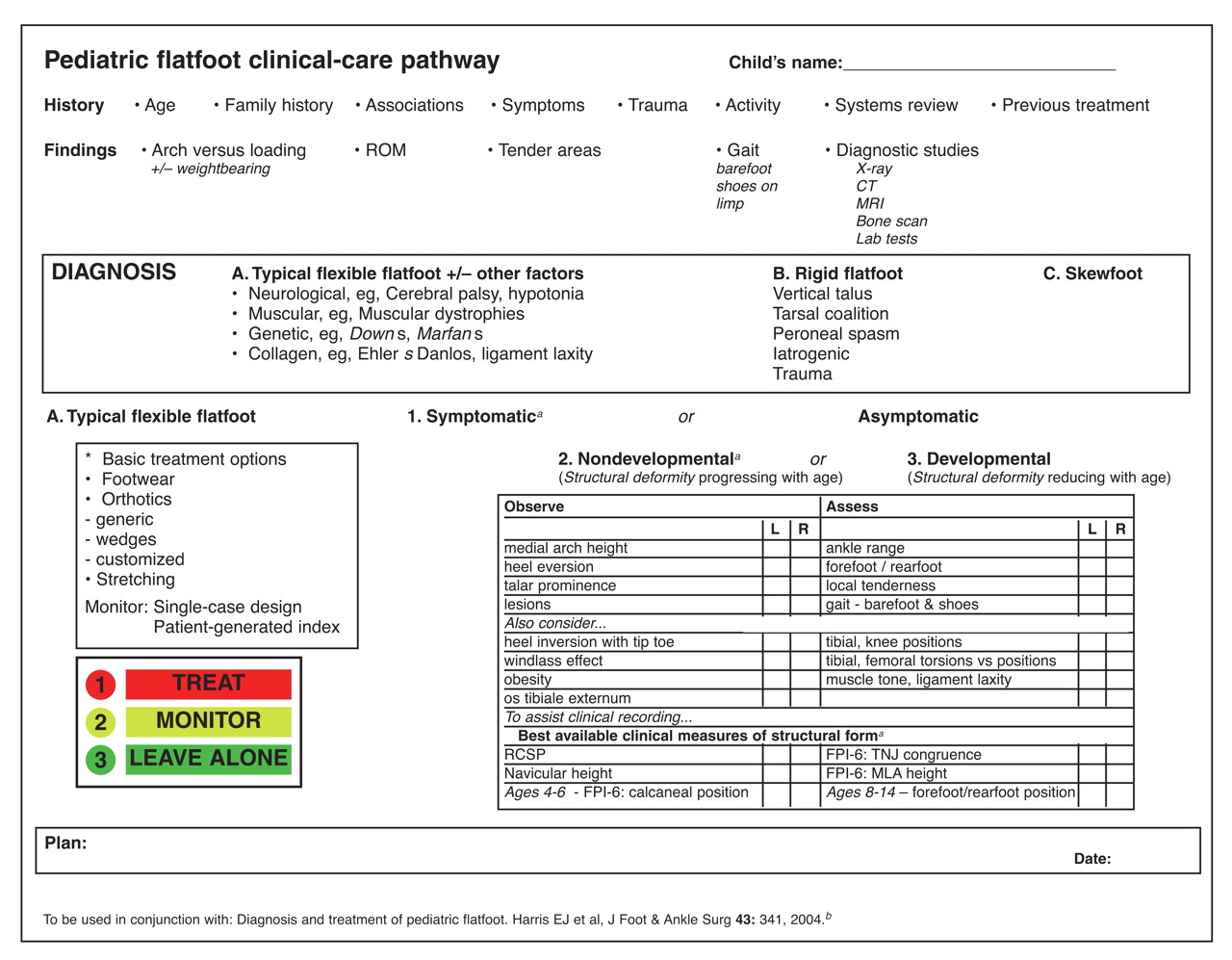
When managing the pediatric flatfoot in clinical practice, it is important that a consistent and evidence-based approach be used. The framework for this method is provided by the clinical care pathway in Figure 3. Built on a “traffic light” framework,[34,35] it provides simple recognition and direction for pediatric flatfoot cases.
The clinician can first diagnose the flatfoot type in the context of significant history and findings. Second, identification of the flatfoot subtype, ie, typical flexible flatfoot, rigid flatfoot, or skewfoot, is then made. Notwithstanding the less common rigid flatfoot and skewfoot, typical flexible flatfoot can then be assessed on the basis of symptoms and morphologic development. The clinician is basically directed one of three ways: 1) to treat the typical flexible flatfoot that is symptomatic (footwear, stretching exercises, or orthoses [usually generic])—the “red light”; 2) to monitor and simply treat (footwear, stretching exercises, or orthoses) typical flexible flatfoot that is asymptomatic but displaying nondevelopmental foot morphological structures for age. This is decided at the experienced clinician’s discretion—the “yellow light”; and 3) to acknowledge, advise, and discharge the typical flexible flatfoot that is normally transient and developmental—the “green light.”
Used consistently, this care pathway (Fig. 3) provides great clarity in terms of the diagnosis and management of pediatric flatfoot. This approach currently summarizes the best available evidence-based clinical practice for this condition.

Table 1 . Schematic Hierarchy of Evidence and Compliant Research
Japma 98 00386 t001
Table 2 . Characteristics of the Studies at the Lowest Evidence Levels and of Good-Quality Randomized Controlled Trials
Japma 98 00386 t002
Table 3 . Comparison and Collation of the Three Existing Randomized Controlled Trials for Foot Orthoses and Pediatric Flatfoot
Japma 98 00386 t003
Table 4 . Subjective Features of Foot Posture that May Assist the Clinician in Monitoring Foot Morphologic Change over Time
Japma 98 00386 t004
Table 5 . Objective Measures with Tested Reliability in the Pediatric Foot
Japma 98 00386 t005
Figure 1 . Modified from Harris et al.[8] this algorithm emphasizes the diagnosis of pediatric flatfoot in a broader context of significant history and findings. The designated subtypes of flatfoot refine diagnosis and are the foundation of the model directing treatment as developed herein and as seen in Figure 2.
Japma 98 00386 g001
Figure 2 . Typical flatfoot is the most frequent pediatric flatfoot presentation to the clinician. This pathway indicates the two necessary subdivisions to be made based on symptoms and morphologic development. Three flatfoot subtypes arise from this approach and direct management accordingly. Symptomatic typical flexible flatfoot (type 1) is treated (footwear, stretching, or orthoses) to alleviate symptoms. Efficacy of treatment can be assessed by using a single-case experimental design or a patient-generated index. Asymptomatic, nondevelopmental typical flexible flatfoot (type 2) is monitored over time to determine whether morphologic features deteriorate. This type can be treated (footwear, stretching, or orthoses) and should use a patient-generated index to justify any intervention. Asymptomatic, developmental typical flexible flatfoot (type 3) is acknowledged and advised regarding general foot health and discharge.
Japma 98 00386 g002
Figure 3 . This clinical-care pathway for the pediatric patient focuses on diagnosis of flatfoot subtypes and directs management accordingly. The “traffic light” model serves to clarify much of the confusion for clinicians and parents alike. Abbreviations: ROM, range of motion; RCSP, resting calcaneal stance position; TNJ, talonavicular joint; MLA, medial longitudinal arch; FPI-6, foot posture index-6. aAbnormal, requires treatment/monitoring. bAdapted from Evans et al.[28]
Japma 98 00386 g003
Financial Disclosure: None reported.
Conflict of Interest: None reported.

References

  1. Rome K, Ashford RL, Evans A: Non-surgical interventions for paediatric pes planus. .Cochrane Database Syst Rev2007. ;(1):CD006311..
  2. Sullivan JA: Pediatric flatfoot: evaluation and management. .J Am Acad Orthop Surg7::44. ,1999. .
  3. Staheli LT: Evaluation of planovalgus foot deformities with special reference to the natural history. .JAPMA77::2. ,1987. .
  4. Garcia-Rodriguez A, Martin-Jimenez F, Carnero-Varo M, et al: Flexible flat feet in children: a real problem?. Pediatrics103::e84. ,1999. .
  5. Pfeiffer M, Kotz R, Ledl T, et al: Prevalence of flat foot in preschool-aged children. .Pediatrics118::634. ,2006. .
  6. Staheli LT: Planovalgus foot deformity: current status. .JAPMA89::94. ,1999. .
  7. Aharonson Z, Arcan M, Steinback TV: Foot-ground pressure pattern of flexible flatfoot in children, with and without correction of calcaneovalgus. .Clin Orthop Relat Res278::177. ,1992. .
  8. Harris EJ, Vanore JV, Thomas JL, et al: Diagnosis and treatment of pediatric flatfoot. .J Foot Ankle Surg43::341. ,2004. .
  9. Sackett DL: Rules of evidence and clinical recommendations on the use of antithrombotic agents. .Chest89::2. ,1986. .
  10. Sackett DL, Straus SE, Richardson WS, et al: Evidence-Based Medicine: How to Practice and Teach EBM, Churchill Livingstone, Oxford, England. ,2000. .
  11. Wenger DR, Mauldin D, Speck G, et al: Corrective shoes and inserts as treatment for flexible flatfoot in infants and children. .J Bone Joint Surg Am71::800. ,1989. .
  12. Whitford D, Esterman A: A randomized controlled trial of two types of in-shoe orthoses in children with flexible excess pronation of the feet. .Foot Ankle Int28::715. ,2007. .
  13. Evans AM: Relationship between “growing pains” and foot posture in children: single-case experimental designs in clinical practice. .JAPMA93::111. ,2003. .
  14. Powell M, Seid M, Szer IS: Efficacy of custom foot orthoses in improving pain and functional status in children with juvenile idiopathic arthritis: a randomized trial. .J Rheumatol32::943. ,2005. .
  15. Redmond AC: The effectiveness of gait plates in controlling in-toeing symptoms in young children. .JAPMA90::70. ,2000. .
  16. Jay RM, Schoenhaus HD, Seymour C, et al: The Dynamic Stabilizing Innersole System (DSIS): the management of hyperpronation in children. .J Foot Ankle Surg34::124. ,1995. .
  17. Penneau K, Lutter LD, Winter RB: Pes planus: radiographic changes with foot orthoses and shoes. .Foot Ankle2::299. ,1982. .
  18. Bordelon RL: Correction of hypermobile flatfoot in children by molded insert. .Foot Ankle1::143. ,1980. .
  19. Bleck EE, Berzins UJ: Conservative management of pes valgus with plantar flexed talus, flexible. .Clin Orthop Relat Res122::85. ,1977. .
  20. Mereday C, Dolan CM, Lusskin R: Evaluation of the University of California Biomechanics Laboratory shoe insert in “flexible” pes planus. .Clin Orthop Relat Res82::45. ,1972. .
  21. Camin M, Vangelista A, Cosentino A, et al: Early and delayed orthotic treatment in congenital metatarsus varus: effectiveness of two types of orthoses. .Eura Medicophys40::285. ,2004. .
  22. Kilmartin TE, Wallace WA: The significance of pes planus in juvenile hallux valgus. .Foot Ankle13::53. ,1992. .
  23. Valmassy RL: “Biomechanical evaluation of the child,” in Clinical Biomechanics of the Lower Extremities, p 246, Mosby, St Louis. ,1996. .
  24. Ganley JV: Podopediatrics: the past, present, and future challenge. .JAPMA77::393. ,1987. .
  25. Gould N, Moreland M, Alvarez R, et al: Development of the child’s arch. .Foot Ankle9::241. ,1989. .
  26. Evans AM: “The Flat Footed Child: To Treat or Not to Treat: What Is the Clinician to Do?” in Book of Abstracts: 22nd Australasian Podiatry Conference, May 8–12, 2007, p 15..
  27. Evans AM, Scutter S: Sagittal plane range of motion of the pediatric ankle joint: a reliability study. .JAPMA96::418. ,2006. .
  28. Evans AM, Copper AW, Scharfbillig RW, et al: Reliability of the foot posture index and traditional measures of foot position. .JAPMA93::203. ,2003. .
  29. Evans AM, Scutter SD, Iasiello H: Measuring the paediatric foot: a criterion validity and reliability study of navicular height in 4-year-old children. .The Foot13::76. ,2003. .
  30. Portney LG, Watkins MP: Foundations of Clinical Research: Applications to Practice, Prentice Hall Health, Upper Saddle River, NJ. ,2000. .
  31. Ruta DA, Garratt AM, Leng M, et al: A new approach to the measurement of quality of life: the patient-generated index. .Med Care32::1109. ,1994. .
  32. Carr AJ, Higginson IJ: Are quality of life measures patient centred?. BMJ322::1357. ,2001. .
  33. Patel KK, Veenstra DL, Patrick DL: A review of selected patient-generated outcome measures and their application in clinical trials. .Value Health6::595. ,2003. .
  34. Phillips P, Evans A: One pair must last a lifetime: foot care and diabetes. .Aust Fam Physician31::259. ,2002. .
  35. Evans AM, Phillips P: Traffic lights: a new, user-friendly classification structure for the diabetic foot. .Australas J Podiatr Med32::133. ,1998. .