Fashion footwear has been implicated in foot disorders in females.[
1] In an observational study of 1,000 women at a large shopping mall, approximately 43% were wearing flip-flops and only approximately 21% were wearing athletic shoes (T.J.C., unpublished data, 2005). These observations warrant further investigation of flip-flops and their possible link to destabilization and higher peak plantar pressures compared with athletic shoes and bare feet in the general female population.
Multiple studies have already established that athletic shoes are a stable option for at-risk populations, such as elderly patients and those with diabetes.[
2-
5] In two studies[
3,
5] of elderly populations, a greater risk of fall was associated with sandals than with athletic shoes. In addition, high plantar pressures have been correlated to an increased risk of foot deformity,[
6-
18] such as callosities and ulcers, particularly in the diabetic and insensate population. Although this correlation is adequately supported by the current literature, a literature search did not produce any research that looked at peak plantar pressures in individuals wearing flip-flops.
By comparing peak plantar pressures of the foot while wearing flip-flops versus the stable athletic shoe and bare feet, this preliminary study provides direction for future investigations regarding shoes in the female population. This information may be useful for podiatric physicians as they guide their female patients in shoe selection postoperatively and on a daily basis.
We hypothesize that flip-flops incur higher peak plantar pressures underneath the hallux, the metatarsal heads, and the calcaneus during the gait cycle as compared to athletic shoes. In addition, walking in flip-flops may be no different than walking barefoot, and, therefore, it is hypothesized that no difference exists between the peak plantar pressures created by wearing flip-flops versus by being barefoot.
Methods
With approval from the Midwestern University Institutional Review Board (Glendale, Arizona), 10 women were enrolled in this pilot study based on the following inclusion criteria: size 7 shoe, body mass index (calculated as weight in kilograms divided by the square of the height in meters) less than 25, and lack of foot pain. The mean age of the subjects was 24.6 years, and the mean body mass index was 20.76 kg/m
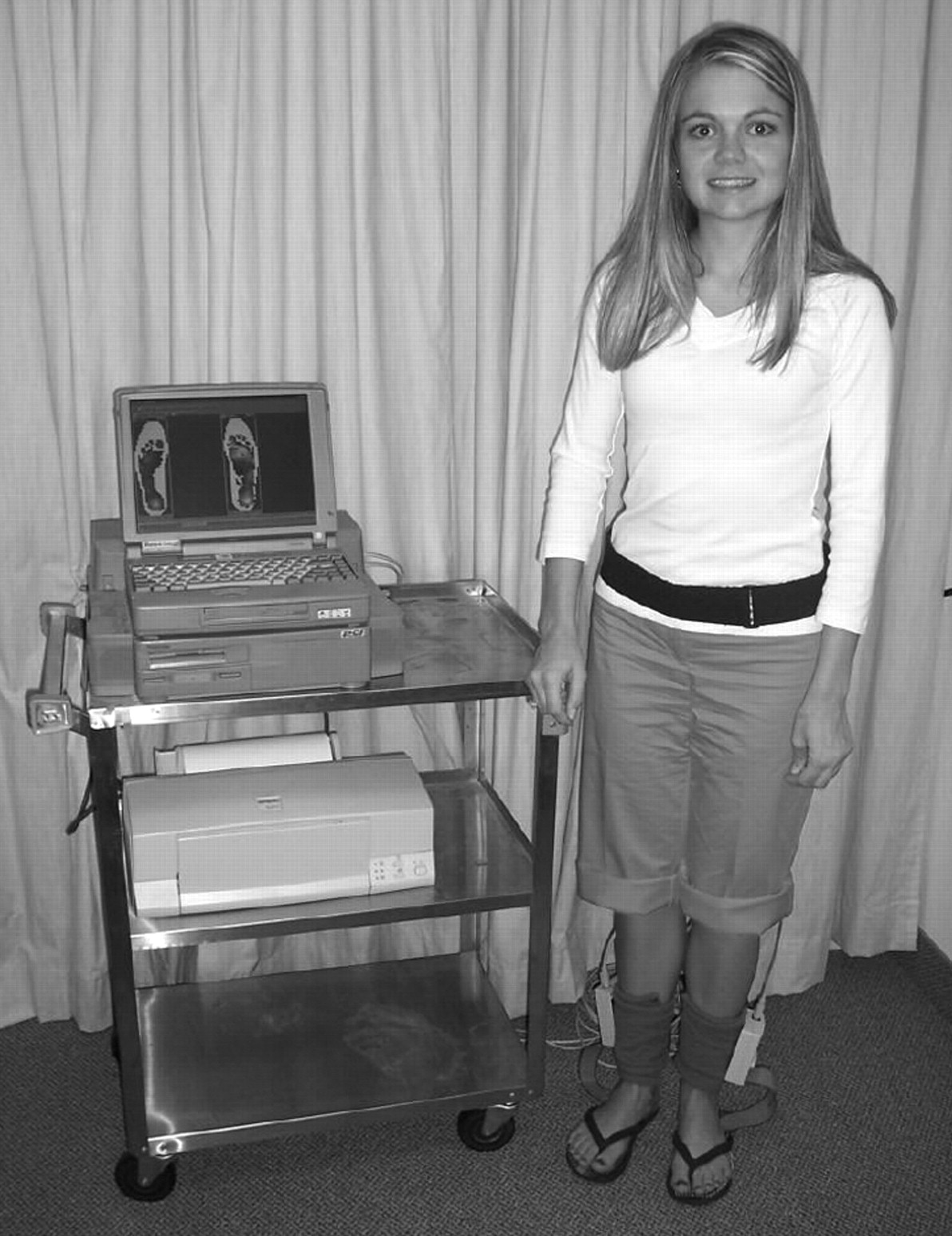
2. Subjects were tested with an in-shoe pressure measurement system (F-Scan Version 3.8; Tekscan Inc, South Boston, Massachusetts) (
Fig. 1). This system has been found to produce reliable data for pressures underneath the metatarsal heads, the hallux, and the calcaneus.[
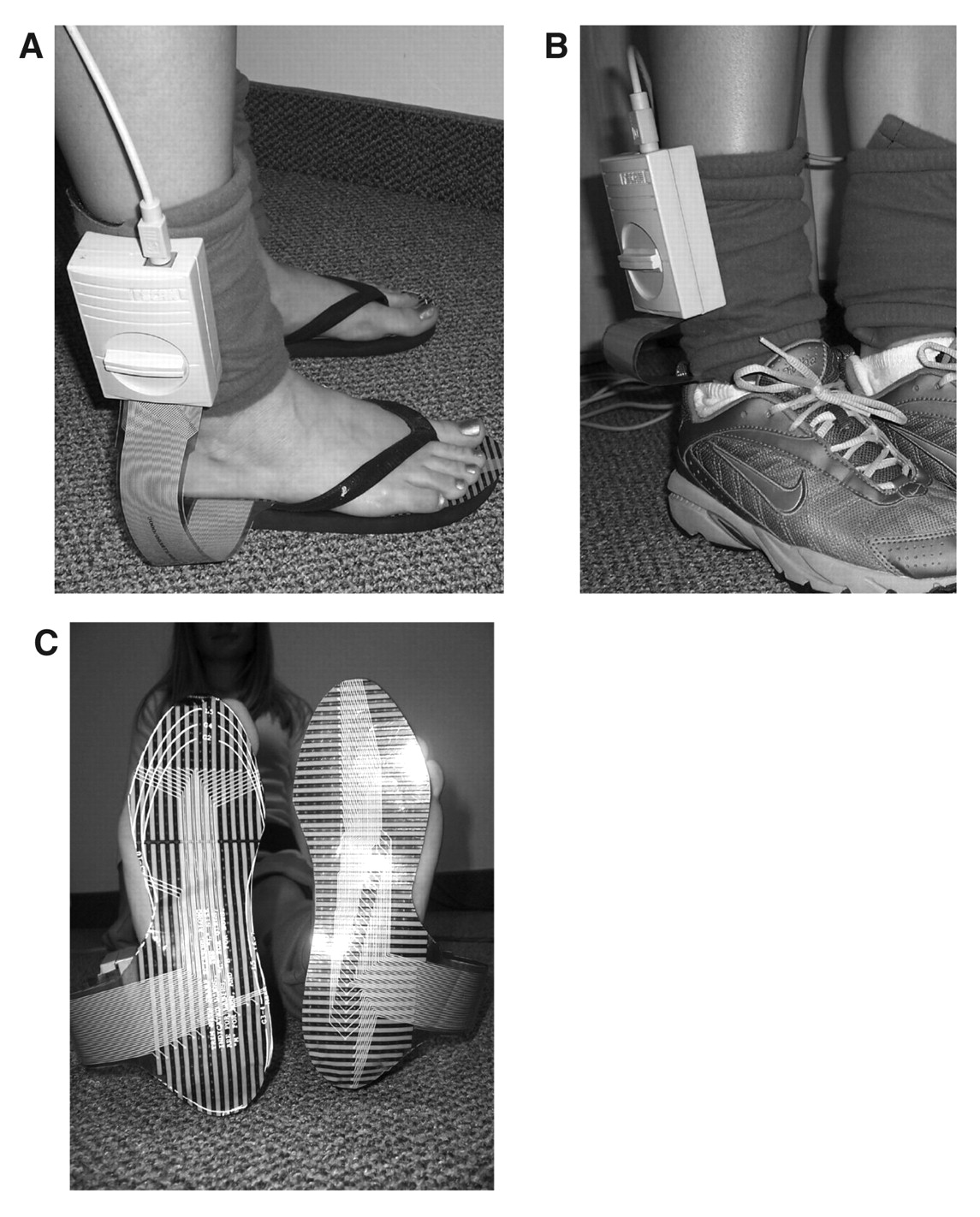
19] With this in-shoe pressure data collection system, subjects were recorded walking in flip-flops, in athletic shoes, and barefoot (
Fig. 2). Shoe type was standardized and consisted of a size 7 pair of J Crew (New York, New York) rubber flip-flops (Fig. 2A
) and a size 7 pair of Nike (Beaverton, Oregon) running shoes (Fig. 2B
). Sensors were trimmed to fit a size 7 shoe. Sensors for flip-flops were customized by using a hole punch to allow for passage of the thong portion of the shoe through the sensor (Fig. 2A
). During the barefoot recordings, the sensors were secured to the subject’s feet with double-sided tape, and a standardized thin cotton sock was worn to hold the sensor in place during ambulation.
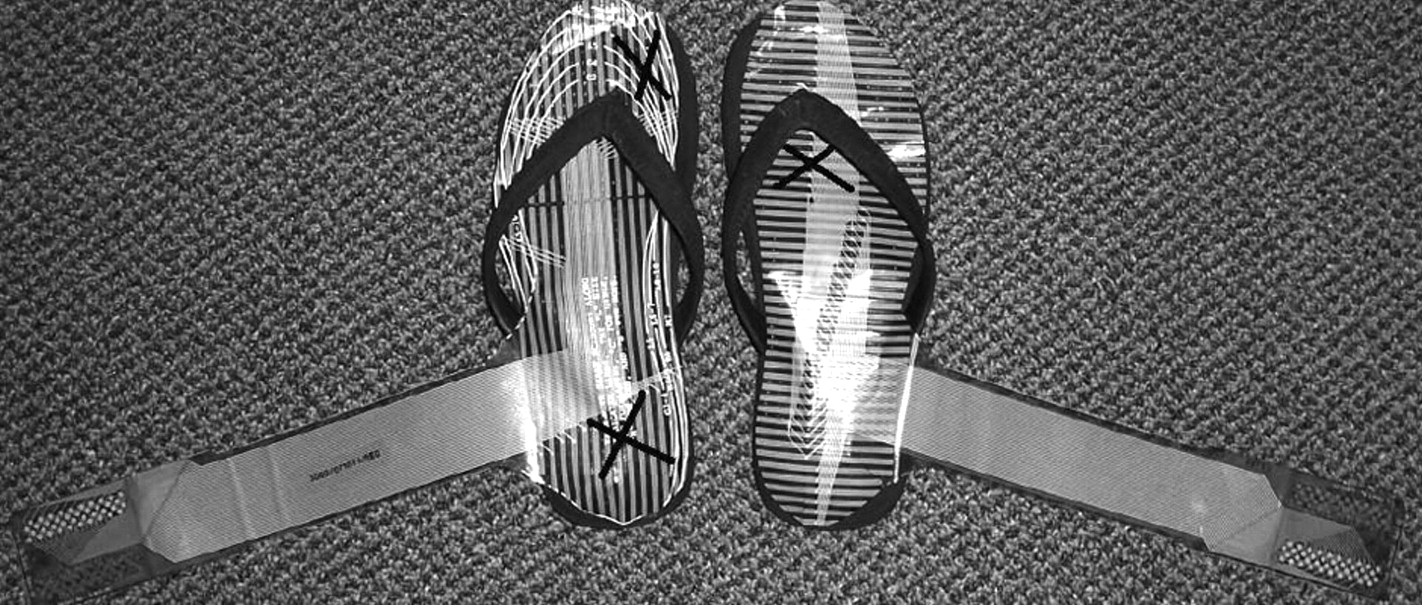
Three recordings were made for each subject in each type of shoe. One recording consisted of the patient walking at her own pace the entire length of the cord, which ran from the in-shoe sensor to the F-scan docking station, measuring 30 feet in length. Sensors were calibrated for each patient before the recording for each shoe type. Peak pressures were gathered from the recordings for the hallux, the metatarsal heads, and the calcaneus (
Fig. 3). A standardized box was designed with the F-scan computer software for the right and left hallux, the metatarsal heads, and the calcaneus. These boxes were applied to the appropriate area of the scanned image, and a graphical representation of the pressures within this box was generated by the F-scan computer software. The peak pressure at each of these points was located on the graph and recorded. The peak pressure was documented for each recording in each shoe type, and the average of the three recordings for the same shoe type was calculated, resulting in one peak pressure for each shoe type for each subject. Right and left feet were analyzed separately because the same sensor was consistently used for either the right or the left foot.
These data were analyzed by using one-way analysis of variance (ANOVA) and computer software (JMP version 5.1; SAS Institute Inc, Cary, North Carolina) to determine whether there was a difference in peak pressures between flip-flops and athletic shoes, flip-flops and bare feet, or bare feet and athletic shoes.
Results
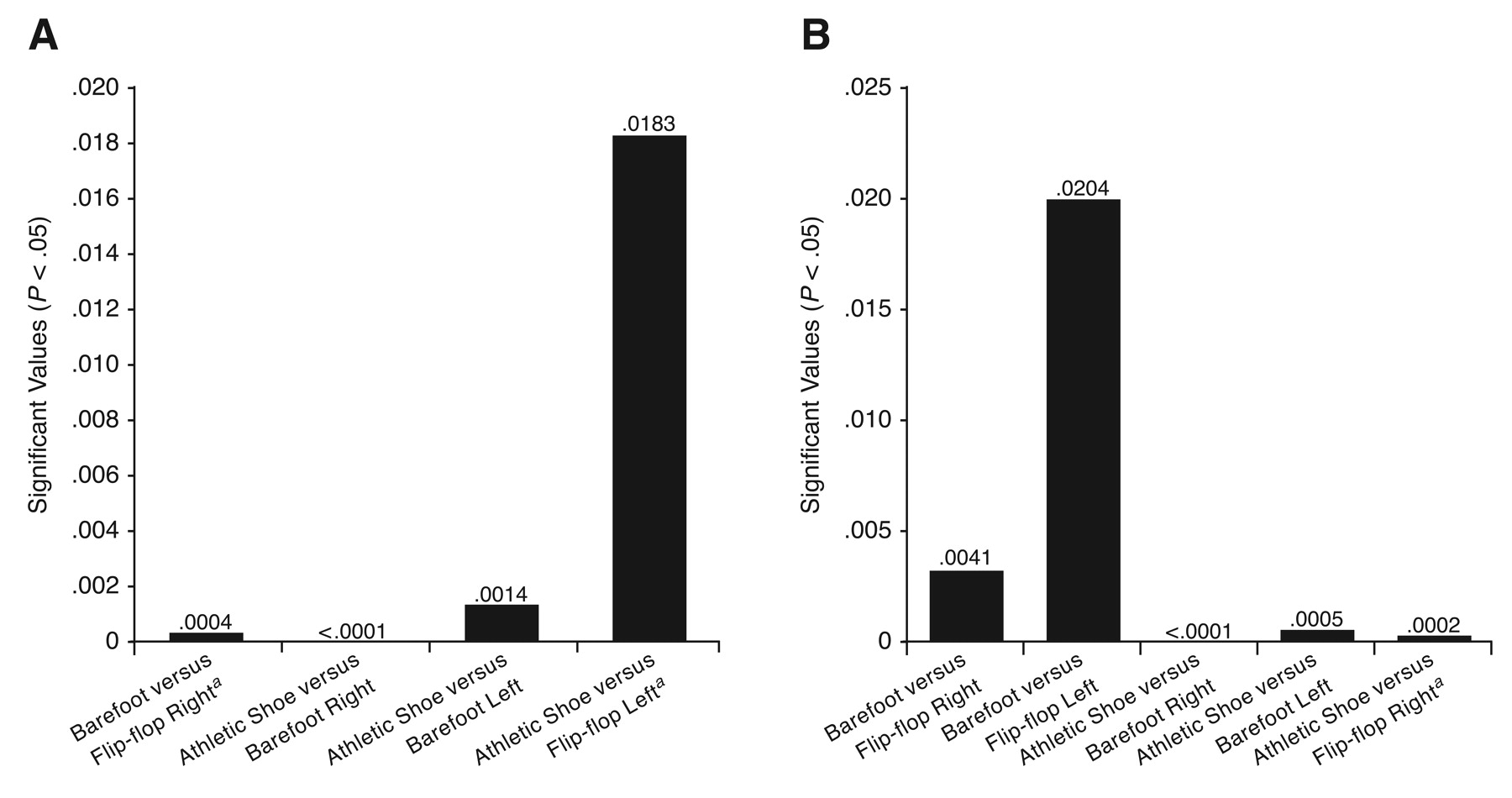
Nine of the 18 one-way ANOVA calculations yielded significant results (
P < .05) (
Fig. 4). When looking at all nine significant ANOVA cases, flip-flops always had higher peak plantar pressures than athletic shoes, and bare feet always had higher pressures than athletic shoes and flip-flops. Stated another way, flip-flops, when significantly different in peak plantar pressure, were always higher than athletic shoes but lower than bare feet. In addition, peak plantar pressures were never statistically significantly different for any shoe comparison underneath the hallux.
Peak pressures measured underneath either the metatarsal heads or the calcaneus yielded significant results each time, but pressures underneath the hallux never yielded a significant result. Three comparisons were significant on only one foot, as opposed to the other significant comparisons, which were significant on the right and left feet (
Fig. 4).
Discussion
These preliminary data reveal several important trends that indicate that peak plantar pressures are highest while walking barefoot compared with walking in athletic shoes and flip-flops and are higher in flip-flops than in athletic shoes under the metatarsal heads and the calcaneus (Fig. 5). Also noteworthy is the finding that peak plantar pressures were significantly different underneath the metatarsal heads and the calcaneus but never underneath the hallux. These findings reject the thought that persons may alter their gait by gripping with their hallux while walking in flip-flops; instead, it is clear that pressures change mainly under the metatarsal heads and the calcaneus.
These results indicate that, as suspected, athletic shoes reduce plantar pressures; however, flip-flops may also provide some pressure-reducing benefits compared with walking barefoot. Therefore, we accept the first hypothesis that flip-flops create significantly higher peak plantar pressures underneath the metatarsal heads and the calcaneus, but we reject the hypothesis that there is no difference between the peak plantar pressures created when wearing flip-flops versus walking barefoot. These observations are important because high plantar pressures are implicated in multiple foot abnormalities, such as bunions, metatarsalgia, limited joint mobility, calluses, and ulceration.[
6-
18] Therefore, although athletic shoes are typically the ideal, stable shoes of choice, flip-flops may protect the metatarsals and the calcaneus from the high plantar pressures of walking barefoot.
Yet, foot deformities are also precipitated by fashion footwear, of which flip-flops may be included.[
1] Frey[
1] found that 53% of young females indicated that style was the most important factor when choosing shoes. This being the case, it is paramount that podiatric physicians be able to educate their female patients about the fine line between being fashionable and developing pathologic abnormalities, particularly in high-risk groups.
Note that the statistical significance between different shoes was apparent in only one foot in three of the comparisons made in the subjects studied (
Fig. 4). This may have been due to chance alone because this study was not designed to investigate this parameter; however, human asymmetry and its contribution to gait and peak plantar pressures may be worth investigating considering this observation.
The limitations of this study include the small sample size, the small age range of the subjects, and the healthy profile of the subjects. As a pilot study, we believe that even with these shortcomings, the significant data are useful to clinicians aiming to validate their shoe recommendations. Finding a significant difference between these different types of shoes with such a small sample of healthy individuals demonstrates that this may be only the tip of the iceberg. A small sample was used in an effort to determine whether a relationship between the shoes and peak plantar pressure existed, providing direction for future investigation in this arena. A larger age range, particularly older subjects, along with the inclusion of comorbidities may actually demonstrate even larger differences in peak plantar pressures between the footwear tested in this pilot study.
Conclusion
This preliminary study demonstrated that flip-flops have higher peak plantar pressures under the metatarsal heads and the calcaneus compared with athletic shoes. In addition, it has been demonstrated that flip-flops reduce pressures in these areas compared with walking barefoot.
These findings are important because they indicate that flip-flops, a fashionable choice of shoes among women, are a potential deforming force, confirming that they are a less than ideal shoe option compared with athletic shoes. However, their limited pressure-reducing properties may implicate them as protective compared with walking barefoot. More importantly, the confirmation of significantly higher peak plantar pressures in flip-flops than in athletic shoes provides the podiatric clinician yet one more tool with which to encourage patients, both high and low risk, to choose their shoes wisely. The correlation between peak plantar pressures and foot deformities should be emphasized to patients, and, specifically, flip-flops as such a deforming force should not be overlooked when discussing footwear with female patients.
Figure 1
.
F-Scan Version 3.8 pressure measurement system.
Figure 1
.
F-Scan Version 3.8 pressure measurement system.
Figure 2
.
In-shoe pressure measurement system on a subject wearing flip-flops (A), wearing athletic shoes (B), and barefoot (C).
Figure 2
.
In-shoe pressure measurement system on a subject wearing flip-flops (A), wearing athletic shoes (B), and barefoot (C).
Figure 3
.
Peak pressure points evaluated (indicated by “X”).
Figure 3
.
Peak pressure points evaluated (indicated by “X”).
Figure 4
.
A, One-way analysis of variance results comparing intershoe peak plantar pressures under the calcaneus (A) and under the metatarsal heads (B) (significant at P < .05). Only significant results are shown. aComparisons were significant on only one foot.
Figure 4
.
A, One-way analysis of variance results comparing intershoe peak plantar pressures under the calcaneus (A) and under the metatarsal heads (B) (significant at P < .05). Only significant results are shown. aComparisons were significant on only one foot.