In hospital inpatients, underlying systemic disease and comorbidities can influence length of stay and the goals leading to successful discharge. The present case report demonstrates the importance of thorough evaluation and early intervention in these patients. In particular, appropriate vascular assessment, including measurement of ankle-brachial index, is essential to successful rehabilitation: “The ankle to brachial pressure index (ABI or ABPI) remains the cornerstone of non-invasive assessment in patients with peripheral arterial disease (PAD).”[
1](p443)
Case Report
A 66-year-old man was admitted to an inpatient rehabilitation ward for the management of muscular groin pain after a fall. Two years previously, he had experienced a cerebrovascular accident that did not require hospital admission. The patient reported that his right leg and foot had “folded underneath him” when he fell backward. He described difficulty in walking due to increasing soreness of the right hallux. The podiatry department evaluated the patient in accordance with the guidelines described by Diacogiorgis.[
2]
Initial screening revealed no obvious signs of trauma. Skin integrity was adequate, with the skin intact on all aspects of the feet and lower legs. The patient’s skin felt warm, and the color was normal. Limited hair growth was noted on the feet and lower legs. A neurologic examination revealed intact protective sensation, vibratory perception, reflexes, and proprioception.
The treating podiatrist initially thought that the pain was neurologic because the patient had described sharp, shooting pains. On closer inspection, however, the pain seemed present only on the distal medial aspect of the right hallux. The pain remained the same whether the toe was moved or was stationary. Passive and active range of motion values at the first metatarsophalangeal joint, midtarsal joints, subtalar joint, and ankle joint on static testing were within the reference ranges. The patient could not bear weight on the right hallux during transfer from a bed to a chair and vice versa.
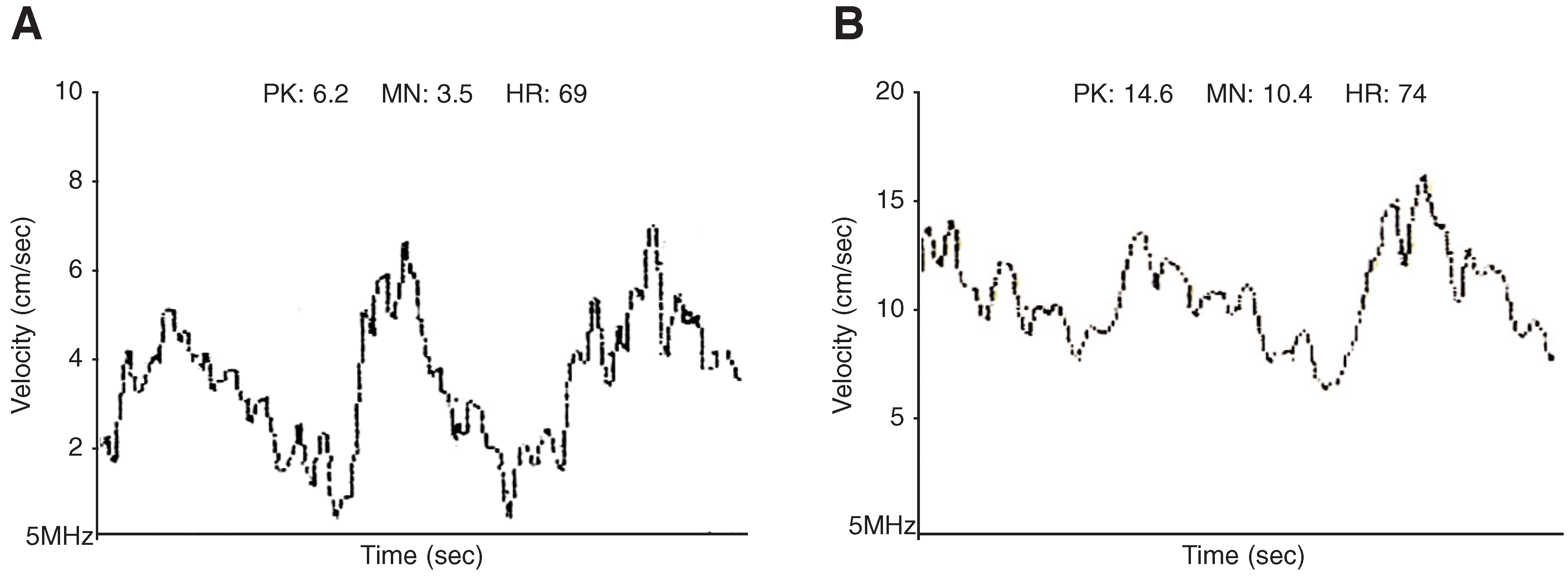
Given the sharp nature of the pain, radiography was performed to determine whether the patient had suffered a fracture, a stress fracture, or a bony break. The radiograph revealed no evidence of fracture or joint effusion. Podiatric vascular assessment was completed using a unidirectional ultrasound Doppler device with a 5-MHz probe and a pressure cuff to obtain readouts of the right dorsalis pedis (
Fig. 1A) and right posterior tibial (
Fig. 1B) arteries and ankle-brachial indexes. The Doppler waveforms and ankle-brachial indexes were interpreted according to methods outlined by Baker and Rayman.[
3] The dorsalis pedis and posterior tibial arteries displayed similar characteristics, with the amplitude of the different waveforms being the only main difference. The peak flow velocity of the posterior tibial artery was higher than that of the dorsalis pedis artery (14.6 cm/sec
versus 6.2 cm/sec). Note that both these readings are valid; that is, the heart rate was detected and evaluated. The flow of the dorsalis pedis and posterior tibial arteries was audible but consisted of one low-pitched sound. This monophasic response could have been an indication of disease. The patient had no known heart conditions that may have contributed to the poor Doppler readings. Both the dorsalis pedis and posterior tibial arteries demonstrated decreased amplitude and loss of diastolic forward flow. The width of both waveforms indicated the possible presence of peripheral vascular disease. The posterior tibial artery was either totally occluded and supplied with minimal collateral blood flow or severely stenotic. The dorsalis pedis artery was stenotic.
Following guidelines provided by Aboyans et al,[
4] Cuarana et al,[
1] and Grasty,[
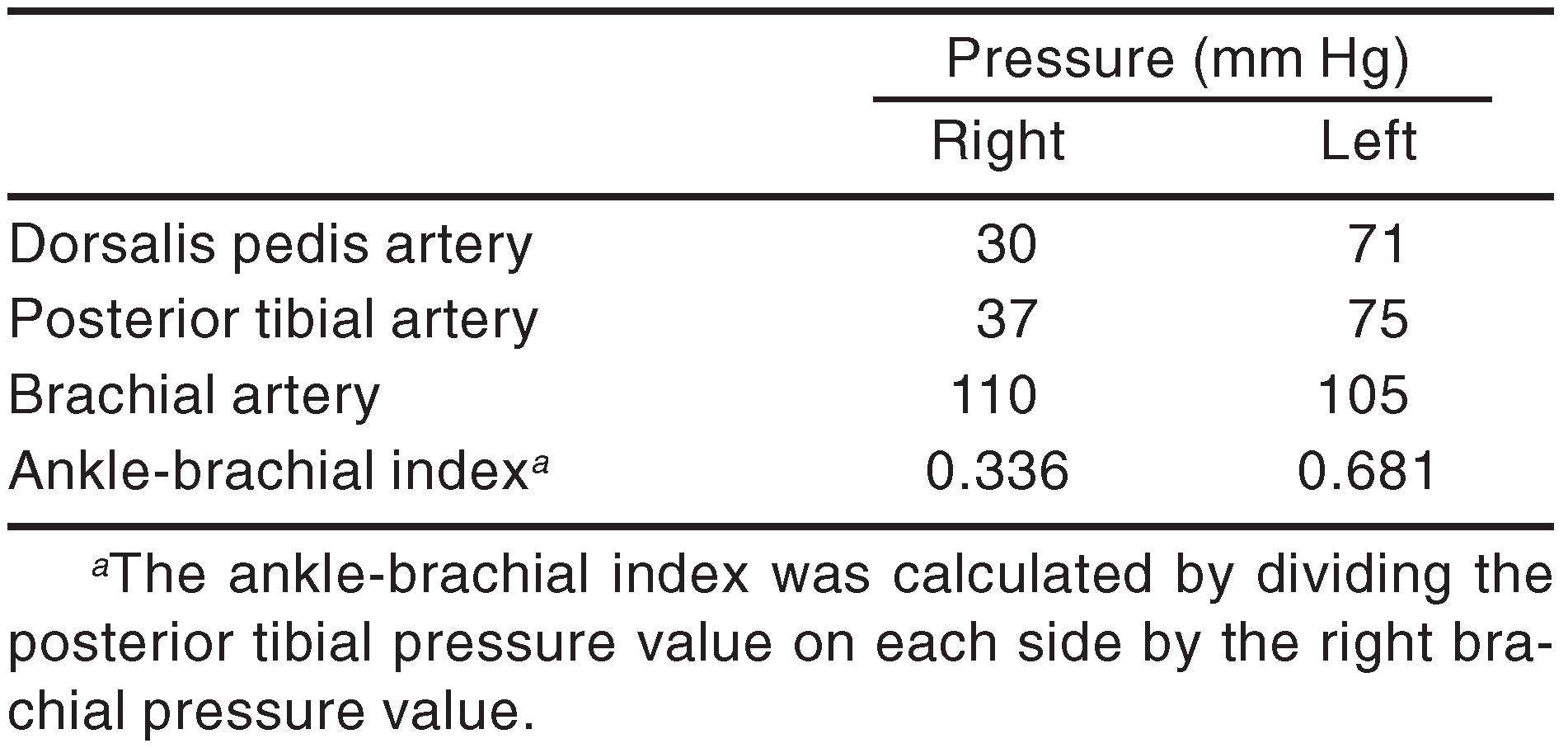
5] the higher of the dorsalis pedis and posterior tibial artery pressures in each foot and the higher of the brachial pressures were used to calculate the ankle-brachial index. The patient’s ankle and brachial pressures are shown in
Table 1. The ankle-brachial index was 0.34 on the right and 0.68 on the left. The patient was referred for vascular assessment and possible treatment.
The patient underwent duplex Doppler arteriography of the right leg, which yielded a pulse wave pattern that was monophasic throughout. Severe atheromatous change was noted in the abdominal aorta and iliofemoral artery. At this stage it was concluded that there was obstruction with collateral circulation. The anterior tibial artery was occluded near its origin. The posterior tibial artery was a normal-sized vessel and was the dominant artery supply to the foot, extending well below the ankle joint. The patient then underwent angiography of the right leg, which confirmed the findings of duplex Doppler arteriography.
The patient underwent a femoral-to-femoral crossover graft in order to salvage the right leg. Because there was some concern about inadequate flow to the left common femoral artery, angiography was again performed before the graft procedure. Only mild stenosis was found, allowing the operation to continue as planned.
This operation to revascularize the right leg was successful, and the patient made a steady recovery. After the operation, an improved ankle-brachial index of 0.68 was found on the right side. After discharge, the patient was able to walk safely without pain and conduct all activities of daily living without difficulty. Required footwear and foot-care education were provided, and the patient was followed up at regular intervals.
Discussion
This case has several interesting features, including the fairly normal appearance of the right lower limb and foot on initial presentation, the need for a comprehensive foot assessment, and use of the ankle-brachial index to detect severe underlying chronic ischemia. Its mode of calculation has been discussed widely in the literature, and the most appropriate form was adopted for this case.[
1,
4]
For such assessments to be performed appropriately and efficiently, the podiatrist must ensure that the techniques are evidence based. Podiatrists disagree as to the appropriate procedure for interpreting the results of handheld Doppler ultrasound devices and measuring the ankle-brachial index. In the present case, the handheld Doppler printouts showed decreased velocity in the dorsalis pedis and posterior tibial arteries (
Fig. 1).
Controversy exists as to how predictive the handheld Doppler waveforms are independent of other aspects of vascular assessment. Although the literature on handheld Doppler devices is limited, Campbell et al,[
6] in a double-blind prospective study, showed that Doppler probes can detect patent distal vessels when routine arteriography does not. In the present case, these printouts in conjunction with the ankle-brachial index results indicated the presence of severe peripheral artery disease, especially on the right side, which contributed to the patient’s symptoms.
Raspovic[
7] presented ankle-brachial index values in relation to a population whose primary diagnosis was diabetes mellitus. An ankle-brachial index less than 0.9 was identified as a risk factor for the presence of underlying peripheral artery disease. Cuarana et al[
1] refer to the International Consensus Document definition of critical limb ischemia, which states that an ankle-brachial index of 0.5 to 0.9 is almost always consistent with intermittent claudication. Ankle-brachial index has also been shown to be predictive of significant underlying vascular complications, such as stroke, cardiovascular disease, and even death.[
1]
In the present case, the individual systolic pressure values for the dorsalis pedis and posterior tibial arteries were significantly lower than normal. The systolic pressure value for the right posterior tibial artery was 37 mm Hg. According to the International Consensus Document definition for absolute pressures (as cited in Cuarana et al[
1]), the patient would fall into the category of critical limb ischemia, that is, tissue loss and absolute pressure of less than 40 mm Hg. Furthermore, the patient’s ankle-brachial index value of 0.34 was borderline for the definition of critical limb ischemia. The minimum clinically significant difference in ankle-brachial index is 0.15.[
1] In the present case, the difference between the right and left sides was 0.34, warranting the vascular referral and the subsequent surgery.