Plantar warts are extremely common and are often very painful. Although they typically do not cause serious health problems, the pain, inconvenience, and cost associated with the treatment of warts can be substantial. Warts are caused by human papillomavirus, a double-stranded DNA virus with 8,000 base pairs.[
1,
2] More than 100 types of human papillomavirus have been identified on the basis of the extent of DNA homology.[
3] Plantar warts are caused by human papillomavirus subtypes 1, 2, 4, and 10, with types 2 and 4 composing most of the mosaic-type plantar warts and type 1 found in isolated deep plantar warts.[
3–
5] Type 1 human papillomavirus has been shown to have the highest viral particle density, an important factor in the transmission of plantar warts.[
5]
Human papillomavirus is transmitted between hosts through direct contact. For infection and replication to occur, the virus requires a compromised skin surface.[
1,
5,
6] The virus attacks the granular and keratin layers of the epidermis, and viral DNA and protein production occur in the upper spinous layer, with final virus assembly occurring in the granular layer. The viral genome does not become integrated with the host cell DNA; instead, it remains free in the nucleus of the cell.[
1,
2]
For centuries, people have been infected by human papillomavirus and have been faced with the daunting task of finding ways to eradicate these lesions. Plantar warts often show resistance to a multitude of treatments. They can quickly return after being frozen at nearly −195°C, vaporized by CO
2 laser, or surgically excised.[
4,
7–
11] The most commonly used topical agent, salicylic acid, may be effective in only two of every five warts treated daily for 6 weeks.[
7] One of the most successful treatments for plantar warts has been the intralesional injection of bleomycin sulfate, with one study[
7] reporting a success rate of 99.23% after one to three injections of bleomycin into 1,052 warts at an Australian air force base. In other literature,[
12–
29] documented success rates range from 26% to 90%. This broad range is largely due to different application techniques and physician experience. Here we describe a method of preparation and a technique for the local injection of bleomycin that has proved to be very effective in eradicating plantar warts resistant to other treatments.
Bleomycin sulfate is a cytotoxic sulfur-containing polypeptide mixture of glycoproteins[
13,
14] that can be separated by chromatography into two main fractions: bleomycin A and B. These fractions can be further separated into the subfractions bleomycin A1-6 and B1-5. Of these, A2 and B2 are the main components in commercially available bleomycin (Blenoxane; Bristol-Myers Oncology Division, Evansville, Indiana).[
15] Bleomycin was first isolated from the soil fungus
Streptomyces verticellus in 1969, and it was found to have antibacterial, antitumoral, and antiviral properties.[
15–
19] Since its discovery, bleomycin has been used systemically as a single agent and in combination for the treatment of various neoplasms, including lymphoma, squamous cell carcinoma, and testicular carcinoma.[
15] Its effects occur through the inhibition of DNA synthesis and the lesser inhibition of RNA and protein synthesis.[
20,
21] Systemic bleomycin alters DNA metabolism by causing strand scission and elimination of purine and pyrimidine bases.[
15,
17,
21–
23]
In the 1970s, it was found that systemic bleomycin therapy eradicated warts, and it soon became used as a local therapeutic injection. However, many clinicians are unfamiliar with its use, efficacy, posttreatment course, and complications. After local injection into warts, bleomycin causes vascular microthrombosis and hemorrhagic necrosis of the warts, followed by a reduction in wart size and detachment.[
26–
29]
Bleomycin is soluble in water and methanol and is absorbed by all routes.[
30] Its plasma clearance after intravenous administration is rapid.[
30–
32] Bleomycin is primarily detoxified through renal excretion by an inactivating enzyme, and it has been shown to have a half-life of 2 hours in patients with normal renal function.[
17,
30] This inactivating hydrolase shows reduced activity in the skin.[
17] Therefore, there is increased binding of bleomycin to skin tissue, and the high concentrations are slowly inactivated, causing full cytotoxic effects locally.[
26] Bleomycin injections are typically less painful than other surgical treatment modalities, do not require weekly treatment, do not require protective dressing, and do not cause scarring. These benefits, combined with its high success rate, make bleomycin an excellent treatment option for plantar warts. We have not experienced a better treatment option for recalcitrant warts.
Methods
Patients
A total of 62 patients (39 men and 23 women) aged 18 to 64 years were treated (Table 1
). All of the patients had recalcitrant warts that had failed to respond to one or more treatments, including salicylic acid, chemical cautery, electrodessication, cryotherapy, fluorouracil, cantharidin, imiquimod (Aldara cream; 3M, St Paul, Minnesota), surgical curettage, and excision.
Table 1.
Demographic Characteristics of the 62 Treated Patients
Table 1.
Demographic Characteristics of the 62 Treated Patients
Methods and Technique
Our standard injection technique uses a 27-gauge needle and a 3-mL syringe with a 1.5-U/mL solution of bleomycin. This solution is prepared by adding 10 mL of 0.5% bupivacaine hydrochloride (Marcaine; Abbott Laboratories, Abbott Park, Illinois) with epinephrine 1:200,000 to 15 U of bleomycin, producing a concentration of 1.5 U of bleomycin per milliliter of prepared solution. Bleomycin is typically supplied in 15- or 30-U vials of sterile lyophilized material, and it must be refrigerated. This prepared solution can be refrigerated for reuse; the solution used in this study was refrigerated for more than 6 months without any evidence of limitation in the active ingredient. In a review of the literature, a 1.0-U/mL solution with sterile saline or water was commonly used.[
7,
13,
26–
30] We believe that the increase in strength from 1.0 to 1.5 U/mL may make a moderate difference in cure rates without affecting safety. Furthermore, we typically inject twice the usual amount of bleomycin (1 mL
versus 0.5 mL for a 1-cm lesion) of this increased strength, increasing the overall concentration of the injection.
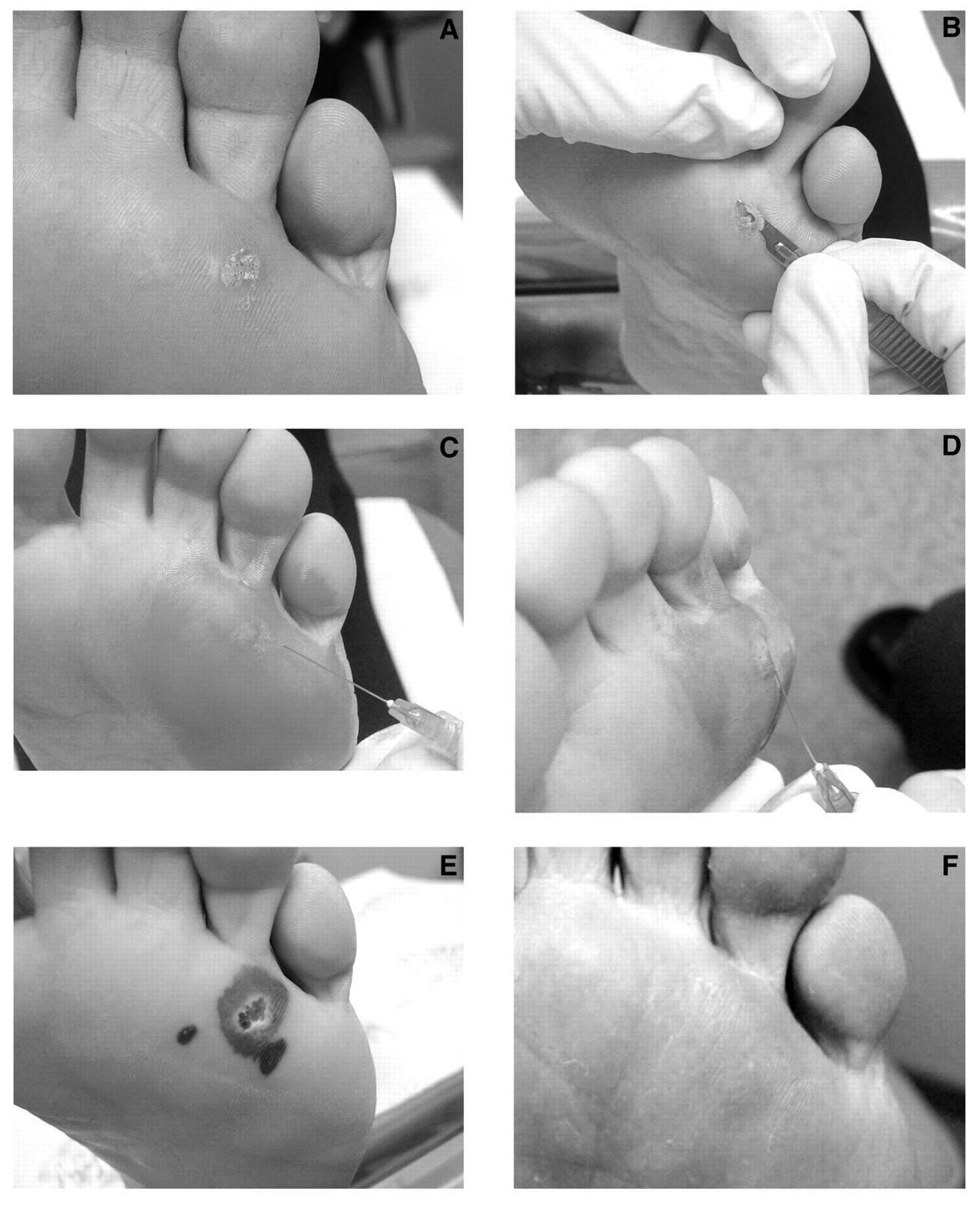
Before injection, the hyperkeratotic tissue overlying the wart should be debrided minimally, just to uncover the peripheral extent of the lesion (Fig. 1
). Care is taken not to cause pinpoint bleeding, which would result in escape of the bleomycin solution. Initially, the skin is cleansed with isopropyl alcohol, and local anesthesia is achieved with a 50:50 mixture of 2% lidocaine plain and 0.5% bupivacaine hydrochloride plain. This local anesthetic block is similar to that performed before surgical excision or laser treatments. If multiple plantar warts are present, a posterior tibial block is also performed. The skin is then prepared with povidone-iodine solution (Betadine; Purdue Pharma LP, Stamford, Connecticut). The bleomycin needle is then subdermally introduced approximately 0.5 cm from the lesion at a 5° to 10° angle with the bevel up. The needle is then advanced into the lesion while infiltrating. The solution should not be introduced into the subcutaneous tissue. The needle is advanced using a “fanning” technique in a V formation to encompass the entire lesion. Care is taken to infiltrate 0.5 cm beyond the borders of the wart to ensure that all of the viral tissue is affected. We believe that this technique of injecting around the periphery of the wart is crucial to preventing recurrence.
Figure 1.
Patient 1. A, Plantar warts before bleomycin treatment. B, Debridement of the plantar warts. C, Injection of bleomycin solution with the needle bevel up. D, Blanching of the skin noted as the injection is carefully extended 0.5 cm beyond the verruca border. E, Two weeks after injection, a black eschar has formed, demarcating the tissue injected with bleomycin. F, Six months after injection, there is no sign of wart or scar.
Figure 1.
Patient 1. A, Plantar warts before bleomycin treatment. B, Debridement of the plantar warts. C, Injection of bleomycin solution with the needle bevel up. D, Blanching of the skin noted as the injection is carefully extended 0.5 cm beyond the verruca border. E, Two weeks after injection, a black eschar has formed, demarcating the tissue injected with bleomycin. F, Six months after injection, there is no sign of wart or scar.
In response to the epinephrine in the solution, blanching of the skin surrounding and encompassing the wart will occur. This is helpful in ensuring that an adequate injection is performed. In addition, the epinephrine may assist in eradicating the virus by causing frank vasoconstriction of the multiple capillaries present with warts. Typically, only one portal is used to limit leaking of bleomycin and to allow more solution in the lesions. Other authors have reported a multiple-portal or multiple-puncture technique, which may be less than ideal owing to the escape of fluid.
The dose varies according to the size of the lesion and ranges from 0.25 to 1.0 mL per injection, up to a maximum dose of 3 mL. On average, a 1-cm lesion received 1 mL of injectional fluid. This dose is twice the amount typically used in other documented bleomycin studies (a 1-cm lesion received 0.2–0.5 mL), with an increase in concentration of 50% (1.5 U/mL versus 1.0 U/mL). Therefore, our overall dose may be up to threefold larger than that used in other documented studies. We observed a strong safety profile with this increased dose, with no increase in adverse events.
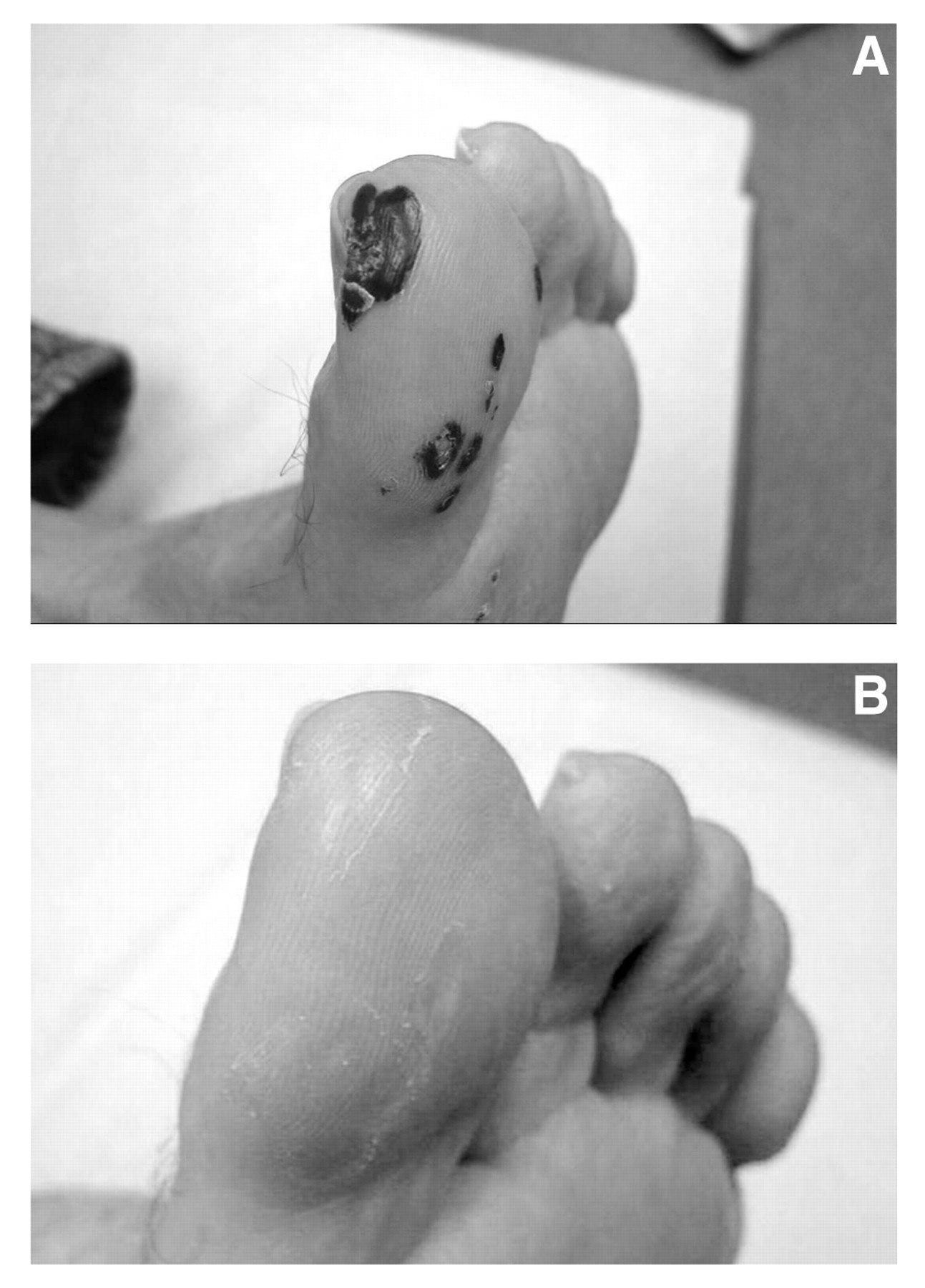
Patients are instructed to keep a simple dry dressing over the wart and injection site and to return to the clinic after 2 weeks for debridement. An accommodative pad (donut pad) may also be applied for comfort. Four patients were placed in surgical shoes owing to the number of lesions injected, and the remainder used normal footwear. At the return visit 1 or 2 weeks later, the black eschar and blood blisters are pared, and the area is examined closely for residual wart(s) and signs of infection (Fig. 2
). Commonly, after paring of the eschar, a mild ulceration is noted, with subsequent bloody drainage from the blister, and the patient is instructed to apply a simple dressing with antibiotic ointment over the wound. This area will typically heal within a few days.
Figure 2.
Patient 2. A, Two weeks after bleomycin injection of multiple verrucous lesions, the black eschar and blood blisters are ready to be debrided. B, Six months after bleomycin treatment, there is complete resolution of the warts.
Figure 2.
Patient 2. A, Two weeks after bleomycin injection of multiple verrucous lesions, the black eschar and blood blisters are ready to be debrided. B, Six months after bleomycin treatment, there is complete resolution of the warts.
Adverse Events and Clinical Response
Many patients experienced pain during and after intralesional bleomycin injection. However, patients who had previously experienced treatment failure with surgical excision of warts or laser therapy had significantly less pain with bleomycin treatment. Pain was transient and typically resolved after 3 days, but it was severe for two patients. One patient who complained of severe pain had an interdigital wart, which could be a more painful location for injection. Occasionally, pain increased after 1 week because of the prominent blister that generally forms after injection. The bleomycin injection site develops erythema perilesionally the day after the injection and then blackens and becomes thrombotic. A black eschar or blood blister is evident after a couple of days and is an important clinical sign of resolution.
The only adverse event noted was superficial infection in two patients that resolved without incident after treatment with oral antibiotics. One of these infections occurred in a poorly compliant patient who did not return to the clinic for the initial follow-up visits. Toxicity problems were not encountered, although they have been reported.[
33] The reported adverse events associated with intralesional bleomycin injection include Raynaud’s phenomenon, nail dystrophy, and nail loss.[
7,
13,
15,
19]
Results
Of the 62 patients treated with bleomycin injections for single or multiple warts (a total of 178 warts), 54 (87%) had complete resolution after 6 months (Table 2
). Twelve of the 62 patients required a second injection. All of the patients who did not experience resolution observed a decrease in the number and size of lesions. There were eight recurrences. Seven of the eight failures were in human immunodeficiency virus–positive (HIV+) patients. Thirty-two patients (52%) were HIV+. In the HIV+ population, verruca plantaris is common and is associated with increased severity, recurrence, and morbidity.[
34–
37]
Discussion
We report a new subdermal injection technique for bleomycin, which has been effective in eradicating plantar warts resistant to other treatments. A total of 62 patients were treated, all of whom had recalcitrant warts and had experienced failure of one or more treatments. The amount of bleomycin injected was twice that used by most other researchers (1 mL versus 0.5 mL for a 1-cm lesion), and the concentration was increased by 50% (1.5 U/mL versus 1.0 U/mL). We believe that these modifications improve the cure rate for recalcitrant warts without increasing the frequency of adverse events. All of the patients had a decrease in the number and size of lesions, and 54 patients experienced complete resolution.
Conclusion
We conclude that intralesional bleomycin sulfate is an efficacious, safe, and viable treatment for verruca plantaris. This study showed an overall cure rate of 87% of recalcitrant warts. We believe that the appropriate technique and an increase in the quantity and concentration of bleomycin can improve cure rates without affecting safety. In our series, most failures occurred in immunocompromised patients with HIV. Our overall success rate might have increased further with a third or fourth injection, as has been documented in other studies.
Table 2.
Success Rates 6 Months After Bleomycin Treatment
Table 2.
Success Rates 6 Months After Bleomycin Treatment