Background
The first American Podiatric Medical Association (APMA) study of walking in cities was conducted in 2002.
[1] It examined ten criteria, including the best available statistic for comparing walking in cities: the percentage of residents who walk to work without using any other form of transportation. That measure was suggested in other research.
[2] The nine other measures used to compare cities included surrogate measures of walking activities, such as the number of parks and health clubs in the city. Negative conditions, such as crime rates and poor air quality, were also included. However, only one of the ten criteria directly measured walking: the “walk-to-work” statistic.
In the second APMA study, conducted in 2003,
[3] the number of work-related walking activities was increased from one to three with inclusion of the percentage of residents who bicycle to work and use public transportation to get to work, in addition to the walk-to-work statistic used in 2002. Three other criteria of walking in cities were included in addition to walking to work: US Census Bureau data on the number of exercise sessions per month, the number of miles walked in each session, and the number of minutes walked per exercise session. However, only 6 of the 20 criteria directly measured walking.
Many additional measures of walking were discovered for use in the 2004 study. This study used 14 variables, 11 of which were direct measures of walking activities.
Methods for analyzing and comparing walking activity evolved from 2002 to 2004. Absent a single “pure” measure of all of the walking activities that occur in a city, expert rankings of the ten study criteria were used to compare the cities in 2002. The weighted scores were then combined into one composite rank for each city.
[1] In 2003, factor analysis was used to combine the 20 study variables into one composite score for comparisons instead of expert rankings. The results primarily reflected the work-related walking and exercise measures.
[3]A more complex statistical analysis was used in the 2004 study. The weights used for combining the 14 criteria were derived from factor analysis, as was the case in 2003. However, in 2004, factor analysis was used to identify three separate factors related to different styles of walking and reasons for walking. Cities were then compared on each of the three dimensions and on a single composite rank derived by combining the three factor scores for each city. In 2003, a single walking factor was used to compare the cities. The 2004 study also substantially increased the number of cities being compared.
Results
Cities were found to have different “walking factor profiles,” or distinctive patterns of walking activities in which they were strong or weak. Examples are cities with very active residents (eg, Seattle, Washington) versus cities where population density and public transportation encourage walking to work (eg, Boston, Massachusetts) versus cities where sports, exercise, and fitness are prevalent (eg, Denver, Colorado).
The best walking cities of 2004 were selected in four different ways: 1) the top 20 best walking cities in the United States; 2) the best cities for walking for three different purposes; 3) the 20 best walking cities by population size; and 4) the best walking cities by geographic region. Lists of the top 20 best walking cities in the United States and the best cities for walking for three different purposes appear in the following subsections, together with the reasons why the cities were selected.
Top 20 Best Walking Cities in the United States, 2004
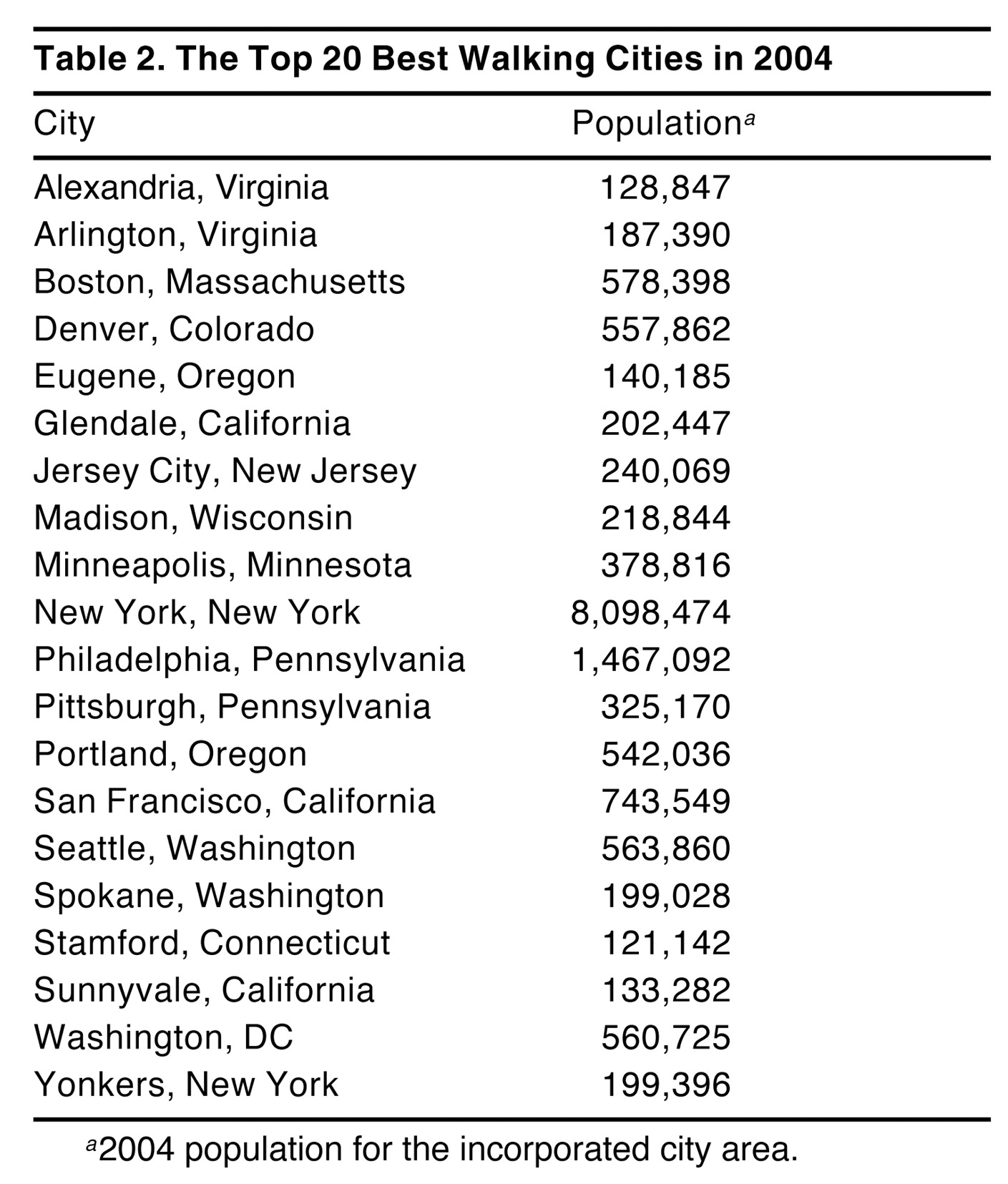
The 20 best walking cities in the United States were selected from among all 200 cities in the study, taking into account their ranks on the three indices of walking in combination. The top cities are listed in alphabetical order in
Table 2, with their respective populations.
Table 2.
The Top 20 Best Walking Cities in 2004
Table 2.
The Top 20 Best Walking Cities in 2004
Cities were selected for different reasons. Seattle, Portland, and Eugene were selected primarily for the active lifestyles of their residents. Seattle and Portland ranked high for active lifestyles, whereas Eugene was selected because of the active lifestyles of its residents and the high percentage of residents who walk for work-related reasons.
Major metropolitan areas like New York City, Washington, DC, Philadelphia, and San Francisco ranked lower in active lifestyles but were selected because of the high percentages of their residents who walk for work-related reasons and for the high percentages of their residents who play sports or exercise at least once a week and walk for fitness. Jersey City was selected primarily for the high percentage of residents who walk for work-related reasons.
Arlington, Alexandria, and Sunnyvale were selected because of high rankings on the active lifestyles of their residents and for the percentages of residents who play sports or exercise at least once a week and walk for exercise. Madison was selected for the active lifestyles of its residents and for the high percentage of residents who walk for work-related reasons. Spokane, Stamford, and Glendale each had high ranks for active lifestyles.
Boston and Denver ranked low on active lifestyles but made the top 20 list for different reasons. Boston (similar to Pittsburgh and Minneapolis) was selected for work-related walking more than for the percentage of residents who play sports or exercise at least once a week and walk for exercise. Denver was selected for the percentage of residents who play sports or exercise at least once a week and walk for exercise more than for work-related walking. Yonkers made the national top 20 list by ranking high on all of the walking factors used in this study.
Best Cities for Walking for Three Different Purposes, 2004
In 2004, cities were also ranked based on the reasons their residents walk and their patterns of walking. The top ten cities that ranked highest on active lifestyles, walking for fitness and exercise, and work-related walking were identified.
Ten Cities Best for Active Lifestyles.
The top ten cities best for people who lead active lifestyles that involve walking activities were (in alphabetical order) Arlington; Eugene; Fort Collins, Colorado; Henderson, Nevada; Irvine, California; Madison; Naperville, California; Portland; Seattle; and Thousand Oaks, California.
Seattle, one of the fittest cities in the country, ranked first in the study of the 200 cities for active lifestyles. Its residents ranked very high in walking for exercise, going to the beach or lakes, going to museums, hiking and backpacking, and purchasing athletic shoes. Portland ranked high in active lifestyles based on the percentage of its residents walking for exercise, going to the beach or lakes, going to museums, hiking and backpacking, and purchasing athletic shoes. Naperville ranked high on dog ownership and ownership of baby strollers—basic conditions for walking the dog and airing the baby.
Some of the highest rankings were found for Arlington, a city usually included with statistics on the Washington, DC, area but well deserving the honor of being selected on its own. Indeed, Arlington ranked second on the active lifestyles index because it ranked first on walking for exercise, going to the beach or lakes, going to museums, and hiking and backpacking. Only lower ranks on dog ownership and ownership of baby strollers kept Arlington from being selected over Seattle for active lifestyles.
Ten Cities Best for Fitness Walking and Exercise.
Another set of ten cities was selected as best for walking for exercise and for the percentage of residents who play sports or exercise at least once a week. Seattle and Arlington, two cities from the list of top cities for active lifestyles, were selected again. The top ten cities for fitness walking and frequent sports or exercise were (in alphabetical order) Alexandria; Arlington; Atlanta, Georgia; Lakewood, Colorado; Metairie, Louisiana; New York City; San Francisco; Seattle; St. Petersburg, Florida; and Washington, DC.
Alexandria ranked first on this index of fitness and exercise, New York City ranked second, and Arlington ranked third. Cities that ranked very high on walking for fitness included Alexandria, San Francisco, Atlanta, Seattle, and Washington, DC. Cities that ranked high on the percentage of residents who play sports or exercise at least once a week included New York City, Lakewood, and Metairie.
Additional Findings
In addition to the top 20 best walking cities in the nation and the top 10 cities on the three individual walking factors, lists of the best walking cities in 2004 were also developed for three city size groups and for four geographic regions.
Regional Analysis.
The best walking cities in 2004 by region were as follows (in alphabetical order): 1) Northeast—Boston; Elizabeth, New Jersey; Jersey City; New Haven; New York City; Philadelphia; Pittsburgh; Stamford; Worcester, Massachusetts; and Yonkers; 2) South—Alexandria; Arlington; Atlanta; Austin, Texas; Baltimore, Maryland; Lexington-Fayette, Kentucky; Raleigh, North Carolina; Richmond, Virginia; Tallahassee, Florida; and Washington, DC; 3) Midwest—Chicago; Columbus, Ohio; Des Moines, Iowa; Lincoln, Nebraska; Madison; Minneapolis; Sioux Falls, South Dakota; Springfield, Missouri; St. Paul, Minnesota; and Sterling Heights, Michigan; and 4) West —Denver; Eugene; Fort Collins; Glendale; Portland; Salt Lake City, Utah; San Francisco; Seattle; Spokane; and Sunnyvale.
Population Size Analysis.
The best walking cities in 2004 by population size were as follows (in alphabetical order): 1) Cities with Populations Greater than 500,000—Austin, Baltimore, Boston, Denver, New York City, Philadelphia, Portland, San Francisco, Seattle, and Washington, DC; 2) Cities with Populations of 200,000 to 500,000—Atlanta; Glendale; Jersey City; Lexington-Fayette; Madison; Minneapolis; Paradise, Nevada; Pittsburgh; Raleigh; and Tacoma, Washington; and 3) Cities with Populations Less than 200,000—Alexandria, Arlington, Eugene, Fort Collins, Richmond, Salt Lake City, Spokane, Stamford, Sunnyvale, and Yonkers.
Discussion
In 2004, cities in less populated areas had a better chance of being recognized as best for walking than they did in previous studies. The sample of cities being compared was increased from 125 cities in 2003 to 200 cities in 2004. Previous APMA studies were limited to large metropolitan areas for which data were readily available on walking to work and walking conditions: the 50 largest US cities in 2002, from which the top 10 cities were selected, and the 125 largest US cities in 2003, from which the top 16 cities were selected. Analyses were conducted by geographic region in 2003 to allow the inclusion of some smaller cities, but the best walking city selections were still dominated by cities in large metropolitan areas. Expanding the sample size for the cities in 2004 allowed more of the smaller cities in the United States to compete for the title of “Best Walking City.”
Furthermore, the 2004 study included incorporated cities instead of cities designated as standard metropolitan statistical areas by the US Census Bureau.
[4] Use of data on incorporated cities provided a better measure of core city statistics than the diffuse measures for standard metropolitan statistical areas that combined data from urban centers with data from nearby cities, towns, and suburban areas and that prevented such adjacent cities and towns from being separately considered. Thus the data in the 2004 study consisted of counts of people engaged in various walking activities in areas defined by the specific geographic limits of each incorporated city. This highly precise system of measurement (with data available down to the level of a city block) derives from the Applied Geographic Solutions, Inc database and its sophisticated software designed for use in geographic mapping studies.
The effect of comparing incorporated cities instead of standard metropolitan statistical areas was to allow a smaller city, such as Arlington, near Washington, DC, to be properly recognized as a best walking city in its own right based on the healthy lifestyle activities of its residents, instead of being combined into the large standard metropolitan statistical area known as the Washington, DC, metropolitan area. In turn, this approach allowed the central city of Washington, DC, to be recognized for its work-related walking activities and use of public transportation.
The measures used by APMA to compare cities have evolved over time. Although data were previously available on walking to work and exercising in cities, measures of other reasons for walking and other walking activities were not available, or if available, they existed only for a few very large cities or were collected only at a national or state level, precluding city comparisons. Absent other measures of walking, previous APMA studies included measures of climate, crime, and walking destinations (eg, parks) as surrogate measures of walking and walking conditions rather than data on the number of people who actually walked in these facilities and under these conditions. Some of these variables, such as crime and climate, actually proved to be unrelated to the walking measures. Because the landmark 2002 APMA study used only one walking measure, it failed to take into account the sizable number of people who walk in cities for reasons other than work.
The 2003 study improved on the matter by using three measures of walking for exercise and three work-related walking measures. The 2004 study included many more pure measures of actual walking behavior and walking purposes instead of conditions and destinations potentially related to walking. To expand the inquiry into walking in cities beyond walking for work and walking for exercise, a wide range of measures were examined, including walking-related lifestyle variables. Thus the 2004 study included new measures of walking for general purposes, such as walking for health, walking for fitness, and walking for exercise, as well as walking for specific purposes, such as playing golf, hiking and backpacking, going to museums, and going to beaches or lakes. Smaller cities benefited from the consideration of new walking variables, such as playing golf, hiking and backpacking, and going to lakes and beaches, as activities that were unrelated to work-related walking and central city activities such as going to museums and zoos. Because the 2004 study substantially increased the scope of inquiry by adding many new measures of walking, the net result was a “new look” at walking in America, a view no longer limited to walking to work and formal exercise or to walking in big cities only.
Finally, the 2004 analysis was based on a model of different patterns of and reasons for walking, that is, the three factors of lifestyle activities, fitness and exercise, and work-related walking. This approach further allowed smaller cities to compete on grounds other than walking related to work and organized exercise sessions.
Secondary analysis of the 2003 data indicated that exercise was a factor separate from work-related walking, and the 2004 study expanded on this finding. Nonetheless, there remains room for improvement. The need for better measures of walking in cities has been cited by several researchers.
[2],
[6] Research indicates that people walk for a variety of reasons not yet addressed in these studies. Walking to go shopping and run errands (which we did not measure) was the most frequent reason for walking found in one study,
[7] whereas walking to work (which we did measure) was the least frequent reason for walking. Although exercise is a common reason people walk, other popular reasons for walking include for fun rather than exercise (which has been measured for only a few activities, such as hiking and playing golf). It is still difficult to compare cities based on all of the walking activities that occur, such as shopping, walking children to school, and walking for recreational purposes, such as nature photography and birding. As a result, the extent of walking in cities is still underestimated.
One final issue involves the fundamental definition of what is meant by “best walking” for a city. Does the term imply having the best facilities (eg, sidewalks and low pedestrian danger rates) and the best destinations that attract walkers (eg, quaint shops, monuments, zoos, and museums)? Or does best walking imply the extent to which residents actually walk in their city? Previous studies included measures of each type. The 2004 study was designed to emphasize the actual walking behaviors of residents rather than the city facilities, destinations, or walking conditions. Travel agents might favor the latter, whereas health-care professionals might favor the former. It is reasonable to conclude that further research is warranted in the search for more perfect measures of walking in cities that will ensure fairness in future walking city competitions.
Still absent from consideration are cities with populations less than 100,000. As a result, communities with unique walking activities have gone unrecognized, such as growing retirement communities for active seniors and golf-related tourist cities. Expanding the city sample size is another logical progression in the evolution of the best walking city investigation.
Epilogue
Previous research on walking is troubling in that it has shown that over time, walking has decreased in the United States (and in Canada, Europe, and Australia), as suburban development necessitates the increased use of automobiles and reduces the opportunity for people to walk to work or to shop.
[2] A study in Britain found that people in urban areas walk more than those in suburban or rural areas.
[8] Given the increasing prevalence of obesity, a major public health problem, efforts to understand and increase walking in cities as a healthful, inexpensive exercise are invaluable. Such efforts could be beneficial to the economy by helping cities to encourage tourism and consumer behavior.
Continuing research on the conditions that increase (and decrease) walking activity in cities is timely and promises to make a significant contribution to addressing some of the nation’s important social and economic issues. The positive nature of this program (“Best Cities”) reflects well on APMA, compared with the typical “urban sprawl” announcements that primarily attack cities for their failure to control suburban development.
The continuing favorable publicity accorded the APMA program by major media outlets attests to the popular interest in the subject of best walking cities. For example, the best walking cities from the 2002 study were profiled in an article on the top 10 walking cities in the United States,
[9] and 12 of the 16 best walking cities selected in 2003 were profiled in an article on the top 12 walking cities in the United States.
[10]Different lists of the 20 best walking cities by size were compiled from the 2004 data by
Prevention magazine for the 10 best walking cities with more than 500,000 population and the 10 best walking cities with populations of 500,000 or less.
[11]