Next Article in Journal
Three-Dimensional Reconstruction of Magnetic Resonance Images of a Displaced Flexor Hallucis Longus Tendon in Hallux Valgus
Previous Article in Journal
Bone Matrix Therapy for Aneurysmal Bone Cysts
 
 
Journal of the American Podiatric Medical Association is published by MDPI from Volume 116 Issue 1 (2026). Previous articles were published by another publisher in Open Access under a CC-BY (or CC-BY-NC-ND) licence, and they are hosted by MDPI on mdpi.com as a courtesy and upon agreement with American Podiatric Medical Association.
Article

Congenital Malalignment of the Great Toenails in a Pair of Monozygotic Twins

by
Esin Özdemir
*,
Seher Bostanci
,
Aynur Akyol
,
Pelin Ekmekci
and
Erbak Gürgey
Department of Dermatology, Ankara University, Ankara, Turkey
*
Author to whom correspondence should be addressed.
J. Am. Podiatr. Med. Assoc. 2005, 95(4), 398-400; https://doi.org/10.7547/0950398
Published: 1 July 2005

Abstract

Congenital malalignment of the great toenails is the lateral deviation of the long axis of nail growth relative to the distal phalanx. The nails grow slowly, with thickening, curving, and transverse ridging. We describe a pair of 3-year-old monozygotic female twins with congenital malalignment of the great toenails complicated by ingrowing and paronychia. Although there are a few cases without any family history, congenital malalignment is believed to be inherited through an autosomal-dominant gene of variable expression. This report provides further evidence of the heritability of the disease.

The term congenital malalignment of the great toenails was introduced by Baran and Bureau, [1] who defined it as the lateral deviation of the long axis of nail growth relative to the distal phalanx. The nails are darker and shorter than normal and tend to be pointed laterally. This angulation makes the nail more prone to trauma. [2] The nails grow slowly, with thickening, curving, transverse ridging, or shedding of the nail plate. [2,3] The major complication of the malalignment is the embedding of the nail plate into the lateral nail fold, causing an ingrown toenail, which is otherwise rare in infancy. [3]

Case Report

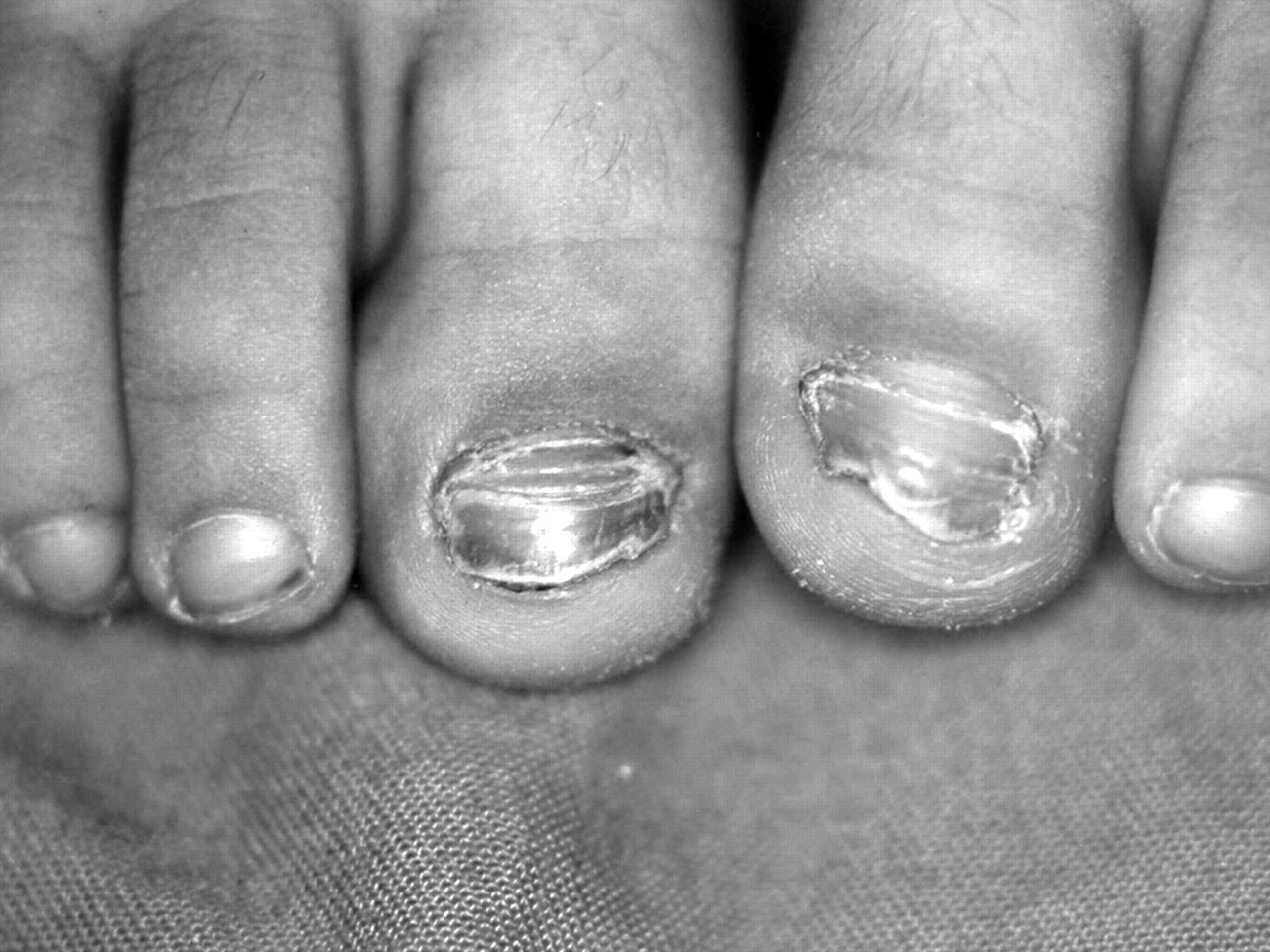
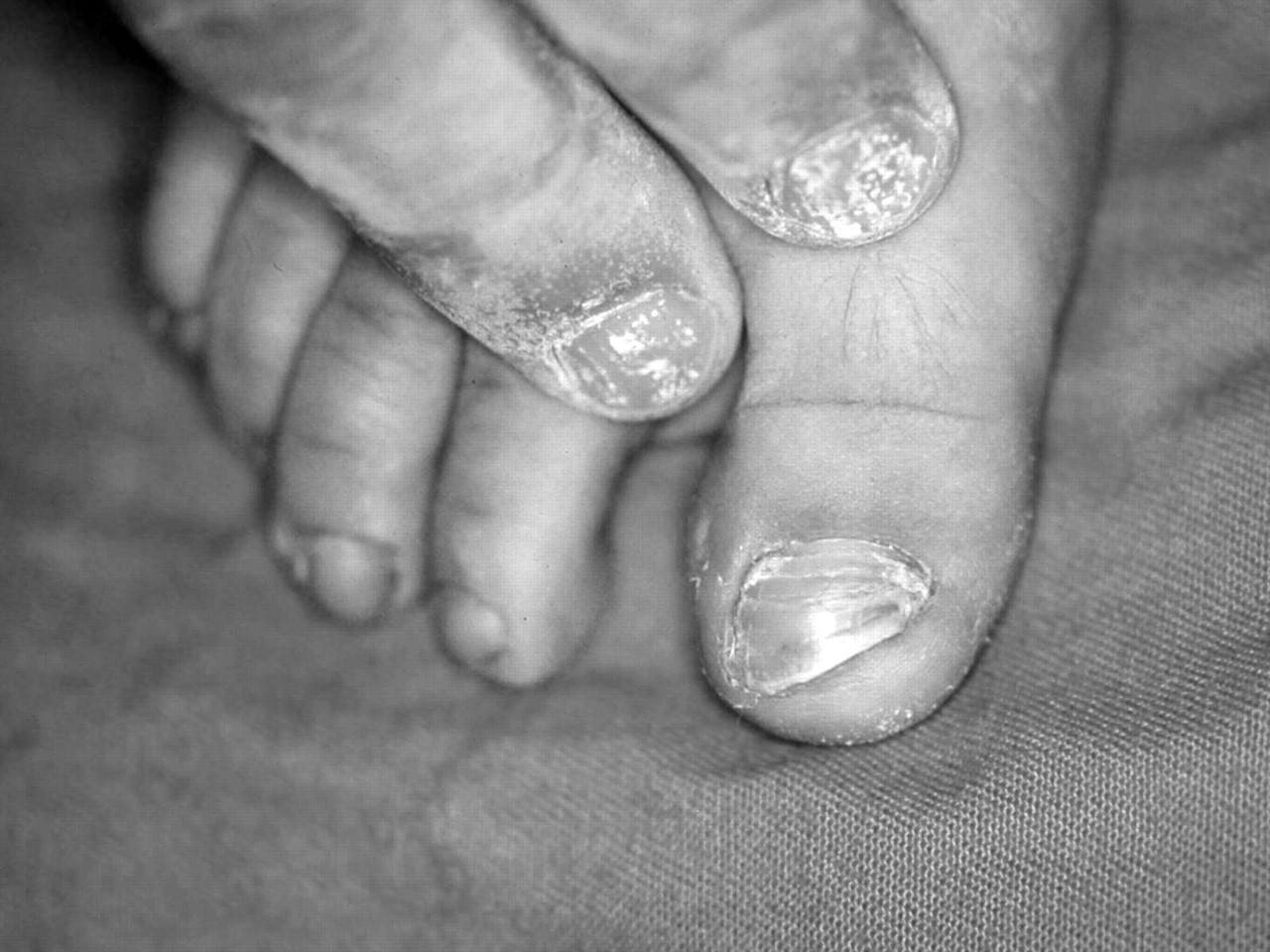
A pair of 3-year-old monozygotic female twins was seen for ingrown toenails, which had been present at birth. The nail plates showed slight lateral deviation of the long axes and a variable degree of dystrophy in terms of discoloration, transverse ridging, and thickening (Figs. 1 and 2). Ingrowing was evident on the medial and lateral sides of the patients’ right and left great toenails. Erythema and tenderness were observed on the nail folds. The twins’ mother observed that the affected toenails grew more slowly than the other nails and rarely needed trimming. Radiographs revealed no subungual pathology. Both of the twins were otherwise healthy except for an orthopedic surgery for pes equinovarus. There was no history of trauma to the toenails. The mother and the mother’s aunt had also experienced ingrown toenails since childhood. The HLA antigens of the patients were the same, indicating that they were monozygotic twins, as follows: A2, B35, B63, Bw4, Bw6, Cw4, Cw7, DR4, DR11, DR52, DR53, and DQ7. Previously, they had been treated with topical antibiotic ointments and antiseptic foot baths. Because the patients still had symptomatic ingrown toenails complicating congenital malalignment, partial matrix cauterizations were performed, with a 1-min application of 10% sodium hydroxide. The details of the procedure have been described previously. [4] At a follow-up visit 1 year after surgery, the patients’ toenails were dystrophic in shape but free of any symptoms of in-growing.
Figure 1. Congenital malalignment of the great toenails in one of the monozygotic twins (aged 3 years).
Japma 95 00398 g001
Figure 2. Congenital malalignment and dystrophy of the toenail in the other twin.
Japma 95 00398 g002

Discussion

Congenital malalignment of the great toenails usually appears at birth or soon thereafter. [2,3] Since the condition was first recognized in 1979, there has been controversy concerning its etiology, that is, whether it is inherited [2,3,5-9] or is acquired as a result of fetal intrauterine positioning. [10]
Malalignment may occur sporadically, but it is usually related to a positive family history. In the studies by Dawson, [7] Cohen et al, [6] and Bailie and Evans, [8] one or more family members of the patients were affected by the disorder. Furthermore, congenital malalignment was observed in four pairs of monozygotic twins reported in the literature. [2,3,11] Our patients are the fifth reported pair of monozygotic twins with congenital malalignment. These observations imply an abnormality of the nail matrix that may be transmitted by an autosomal-dominant gene of variable expression. [3,5] In addition, recently a patient with Rubinstein-Taybi syndrome, which is caused by an autosomal-dominant mutation, was reported to have congenital malalignment of the toenails. [12] In some patients with congenital malalignment, onychogryphosis (excessive thickening of the nail) is observed, which supports the idea of involvement of genetic factors because onychogryphosis is not expected to occur in infants. [2] In the literature, congenital malalignment of the index fingernail is also described, frequently accompanied by bone abnormalities; this condition is also suggested to involve hereditary factors. [13] Intrauterine positioning is thought by some to be involved in development of congenital malalignment of the great toenails; however, as Barth et al [2] mentioned, all of the toenails would be expected to be malaligned if this were the case.
The degree of malalignment and accompanying nail dystrophy may be minimal, moderate, or severe. [2] In a review by Baran and Haneke, [14] it is emphasized that the obliquely positioned nail usually has sharply downward-bent lateral margins, often digging into the lateral nail fold and distal nail bed. Superimposed traumatic effects, such as those caused by walking or crawling, contribute to ingrown toenails. It is suggested that these nails are attached to the nail matrix but not to the nail bed. Therefore, the tip and pulp tissue dislocate dorsally during gait to form a distal nail wall, which makes the nail unable to grow to normal length. Moreover, transverse ridging over the entire nail plate, discoloration, and thickening (oyster shell–like nail plate growth) are probably due to repeated trauma to the matrix. [11,14]
Depending on the severity of the condition, congenital malalignment may either improve spontaneously or require treatment, especially when it leads to ingrown toenails. [2,3,15] Spontaneous cure may be explained by the hypothesis that as the bony phalanx grows and enlarges, it moves together with the overlying adherent matrix, which may change the direction of nail growth. [9] Another hypothesis is the existence of a ligamentous structure corresponding to a dorsal expansion of the lateral ligament of the distal interphalangeal joint. [16] This ligament is connected to the nail matrix, and spontaneous cure may be due to the change in physical properties of this ligament.
In our patients, lateral deviation of the toenails was slight, but dystrophy and ingrowing, for which we performed chemical matrix cauterization, were prominent. This report of a pair of monozygotic twins provides further evidence to support the hypothesis that congenital malalignment of the toenails is an inherited condition.

References

  1. Baran R, Bureau H: Congenital malalignment of the big toenail. .Clin Exp Dermatol4::359. ,1979. .
  2. Barth JH, Dawber RPR, Ashton RE, et al: Congenital malalignment of great toenails in two sets of monozygotic twins. .Arch Dermatol122::379. ,1986. .
  3. Harper KJ, Beer WE: Congenital malalignment of the great toenails: an inherited condition. .Clin Exp Dermatol11::514. ,1986. .
  4. Ozdemir E, Bostanci S, Ekmekci P, et al: Chemical matricectomy with 10% sodium hydroxide for the treatment of ingrowing toenails. .Dermatol Surg30::26. ,2004. .
  5. Cohen PR: Congenital malalignment of the great toenails: case report and literature review. .Pediatr Dermatol8::43. ,1991. .
  6. Cohen JL, Scher RK, Pappert AS: Congenital malalignment of the great toenails. .Pediatr Dermatol8::40. ,1991. .
  7. Dawson TAJ: An inherited nail dystrophy principally affecting the great toenails. .Clin Exp Dermatol4::309. ,1979. .
  8. Bailie FB, Evans DM: Ingrowing toenails in infancy. .BMJ2::737. ,1978. .
  9. Baran R: Significance and management of congenital malalignment of the big toenail. .Cutis58::181. ,1996. .
  10. Hendricks WM: Congenital ingrown toenails. .Cutis24::393. ,1979. .
  11. Baran R, Bureau H: Congenital malalignment of the big toe-nail as a cause of ingrowing toe-nail in infancy: pathology and treatment (a study of thirty cases). .Clin Exp Dermatol8::619. ,1983. .
  12. Balci S, Bostanci S, Ekmekci P, et al: A 15-year-old boy with Rubinstein-Taybi syndrome associated with severe congenital malalignment of the toenails. .Pediatr Dermatol21::44. ,2004. .
  13. Murray SC, Dawber RPR, Khumalo N: Congenital malalignment of the left index fingernail. .Br J Dermatol144::901. ,2001. .
  14. Baran R, Haneke E: Etiology and treatment of nail malalignment. .Dermatol Surg24::719. ,1998. .
  15. Handfield-Jones SE, Harman RRM: Spontaneous improvement of congenital malalignment of the great toe nails. .Br J Dermatol118::305. ,1988. .
  16. Guero S, Guichard S, Fraitag SR: Ligamentary structure of the base of the nail. .Surg Radiol Anat16::47. ,1994. .