The Austin bunionectomy was first outlined in 1968 [
1], with details of the operation first published in 1981 [
2]. Today, it is a commonly performed procedure for the correction of moderate hallux valgus deformities that produces generally favorable results [
3]. The operation as performed in this study [
4] is fundamentally designed to reduce a mildly to moderately high inter-metatarsal angle and to improve the alignment of the hallux by adductor hallucis tenectomy, lateral sesamoidal ligament release, and tightening of the medial joint capsule.
Plantar pressure measurement provides the podiatric physician and researcher with an objective means of quantifying certain parameters of foot dynamics that may be applicable to clinical practice as a means of monitoring foot function before and after an intervention. Although the literature contains reports of differences in dynamic plantar peak pressure distribution between normal and hallux valgus feet, little if any consensus can be detected in the published research (
Table 1) [
5–
11]. The variation in findings may be explained largely by the use of different force platform equipment and measurement techniques. Change in plantar pressure distribution after surgical intervention to address hallux valgus deformity has received relatively scant attention in the literature. Pressure changes after the Keller arthroplasty have been reported by several authors [
5,
6,
12], with differing results. The effects of proximal first metatarsal osteotomies on plantar pressure distribution have also been variously reported [
12–
14], as have the outcomes of the Wilson sliding osteotomy [
6,
15]. The influence on plantar pressure distribution of a few proximal osteotomies has been described, including an undefined aggressive subcapital osteotomy [
16], a distal crescentic osteotomy [
10], and a chevron osteotomy [
9]. Unfortunately, the latter report combined the effects of a closing base wedge osteotomy with the chevron osteotomy without separating the two procedures into specific groups. Understandably, because a range of surgical procedures were performed and various force platforms were used, the outcomes of all of the published investigations show little consistency in results. At the time of this writing, to our knowledge, no detailed investigation of plantar pressure changes after a standardized Austin bunionectomy has been reported.
Table 1.
Reported Relative Magnitude of Peak Pressures in Hallux Valgus Feet Compared with Normal Feet.
Table 1.
Reported Relative Magnitude of Peak Pressures in Hallux Valgus Feet Compared with Normal Feet.
Materials and Methods
Subjects
Thirty-six healthy volunteers (36 feet), mostly podiatric colleagues and nursing personnel, were recruited as control subjects and screened by interview to exclude any history of significant foot or lower-limb pathology in the preceding 12 months and by physical examination for signs of any obvious foot or gait abnormalities. Control subjects were excluded from the study if clinical signs of pes valgus, pes cavus, or forefoot pathology, such as hallux valgus or hallux limitus, were noted. No attempt was made to differentiate between male and female subjects, because previous studies [
17–
19] have observed few differences in plantar pressure measurements between sexes.
Thirty-one subjects (44 feet) with hallux valgus were recruited from the private practices of local podiatrists. Hallux valgus subjects all had signs and symptoms of first metatarsophalangeal joint deformity of sufficient severity for them to seek advice and subsequently undergo corrective foot surgery. Hallux valgus was defined radiographically, with the hallux abductus angle being equal to or greater than 20°, as measured from a weightbearing dorsoplantar radiograph, without concomitant clinical evidence of hallux limitus. Subjects were excluded from the study if they had a history of previous related foot surgery or inflammatory joint disease. After approval was received from the Human Research Ethics Committee of Curtin University of Technology, written consent was obtained from each control and surgical subject. Each hallux valgus patient underwent a modified Austin bunionectomy procedure using a standardized surgical technique, under general anesthesia. Subject demographic information is listed in
Table 2.
Table 2.
Demographic Characteristics of the Control and Hallux Valgus Groups.
Table 2.
Demographic Characteristics of the Control and Hallux Valgus Groups.
Equipment
An EMED SF-4 (version 2.1) capacitance mat transducer system (Novel Gmbh, Munich, Germany), with a platform dimension of 420 × 417 mm and a sensor area of 360 × 190 mm, mounted flush with the floor surface at the center of a 10-m raised walkway, was used for data collection. The platform comprised 2,736 individual sensors at a density of 4/cm2 and acquired data at a sampling rate of 50 Hz.
Plantar Pressure Data Collection
Each subject was allowed to become familiar with the testing procedure by walking over the platform at his or her own self-selected comfortable pace several times. To prevent targeting, subjects were instructed not to look down at the platform but to look ahead at a fixed position distant from the platform. Each control subject had data collected from the left foot using the two-step method outlined by Meyers-Rice et al [
20], which has been demonstrated to provide data at least as reliable as the more traditional midgait method of data collection [
21]. Data were collected from the feet of subjects on whom surgical correction was to be performed in the same manner, and for the purposes of statistical analyses, each foot thereafter was treated as a single subject.
Each person’s initial position was determined such that the individual started walking with the foot opposite that being tested, with the test foot making contact with the platform on the second step from the initial position. Several trials of each foot were then performed for each person, and, after discarding any aberrant footprints, a minimum of three footprints were kept for further analysis. The recording of plantar pressure measurements using the EMED systems has been found to afford good-to-excellent levels of reliability for most force and pressure variables, particularly when the mean result of three or more trials is used [
22–
24]. Plantar pressure measurement data from control subjects were collected at the beginning of the trial and again 24 months later. Data from hallux valgus subjects were collected before and 3, 6, 12, 18, and 24 months after surgery.
Radiographic Data
Weightbearing dorsoplantar radiographs were taken of surgical subjects before and a minimum of 24 months after surgery. Although the same radiographer at the same radiologic practice did not take each radiograph, a standardized technique with subjects in a relaxed standing position was used. Essential radiographic measurements were made of metatarsus primus varus, hallux abductus, and first metatarsal protrusion distance.
Data and Statistical Analysis
The forefoot of each subject was divided into six regions or masks using the Novel-Ortho software (version 08.7) AutoMask program (Novel Gmbh) to include the first through fifth metatarsal heads and the hallux. The Novel-Win software (version 08.7) Group-Mask program (Novel Gmbh) was then used to group together three recorded trials of each subject into a single data file. Each data file thus formed was subsequently analyzed using the Novel-Win GroupMask Evaluation program. Data were generated and transferred to an Excel 97 spreadsheet (Microsoft Corp, Redmond, Washington) for statistical analysis using SPSS version 10.0 for Windows (SPSS Science, Chicago, Illinois) in accordance with Coakes and Steed [
25]. Although measurements of peak pressure, pressure–time integral, contact time, maximum force, and force–time integral for the various masks were collected and analyzed, for logistical reasons, only the mean results for peak pressure measurements are presented here.
Results
Control Data
To assess the intrarater reliability of measurement for the various pressure data, intraclass correlation coefficients (ICCs) were calculated from three trials of 36 subjects using a two-way mixed-effects model, absolute agreement definition, single-measure ICC. The results indicated good-to-excellent consistency of measurement [
26] of all regions of the forefoot tested, with ICCs ranging from 0.73 to 0.97.
To examine for any statistical relationship between subject variables such as age or body mass index with various plantar pressure variables, bivariate correlation matrices were generated using the Pearson product moment correlation coefficient, with a significance level (two-tailed) of
P < .05. No significant correlation was found between either of these variables and any pressure variable tested, including peak pressure (
Table 3).
To test for a statistical relationship between sex and plantar pressure variables of the forefoot as measured at the commencement of the experiment, an independent t-test was conducted, which showed no significant difference for sex with any pressure variable in any region of the forefoot. To test for significant differences in pressure variables in control subjects between 0 and 24 months, paired t-tests were conducted, with a significance level of P < .05. Although most areas of the forefoot showed no changes in peak pressure, the fourth and fifth metatarsal head areas were subject to small but significant decreases in peak pressure during the 24 months of observation.
Table 3.
Correlation of Age and Body Mass Index (BMI) with Peak Pressure Values in the Control Group.
Table 3.
Correlation of Age and Body Mass Index (BMI) with Peak Pressure Values in the Control Group.
Hallux Valgus Plantar Pressure Measurement Data
To investigate incremental changes in plantar pressure measurements during a 24-month period, recordings of peak pressure for each hallux valgus subject were recorded before surgery and again 3, 6, 12, 18, and 24 months after surgery. Not all hallux valgus subjects were available for follow-up measurements for each specified period of review. The ratios of the number of subjects tested to the number of subjects in the group for each measurement period were as follows: before surgery, 44:44; 3 months, 34:44; 6 months, 43:44; 12 months, 36:44; 18 months, 30:44; and 24 months, 43:44. To complete the data for the purposes of statistical analysis, a missing value was replaced with the mean score of the pressure variable for the period of assessment.
Multivariate analysis of variance was conducted to test for within-subject effects of time for various pressure variables for the forefoot. Assumption testing for univariate normality was conducted and demonstrated normality of data. Similarly, Mahalanobis distance regression analysis failed to identify any multivariate outliers in any of the pressure variables. Overall, there was a significant change in peak pressure distribution (F30,1070 = 5.4; P < .001). Huynh-Feldt univariate tests were then used to identify the region of the forefoot exhibiting significant pressure changes. Tests of within-subject contrasts were used to identify changes that occurred between occasions of measurement.
Pressure Changes over Time in the Hallux Valgus Group
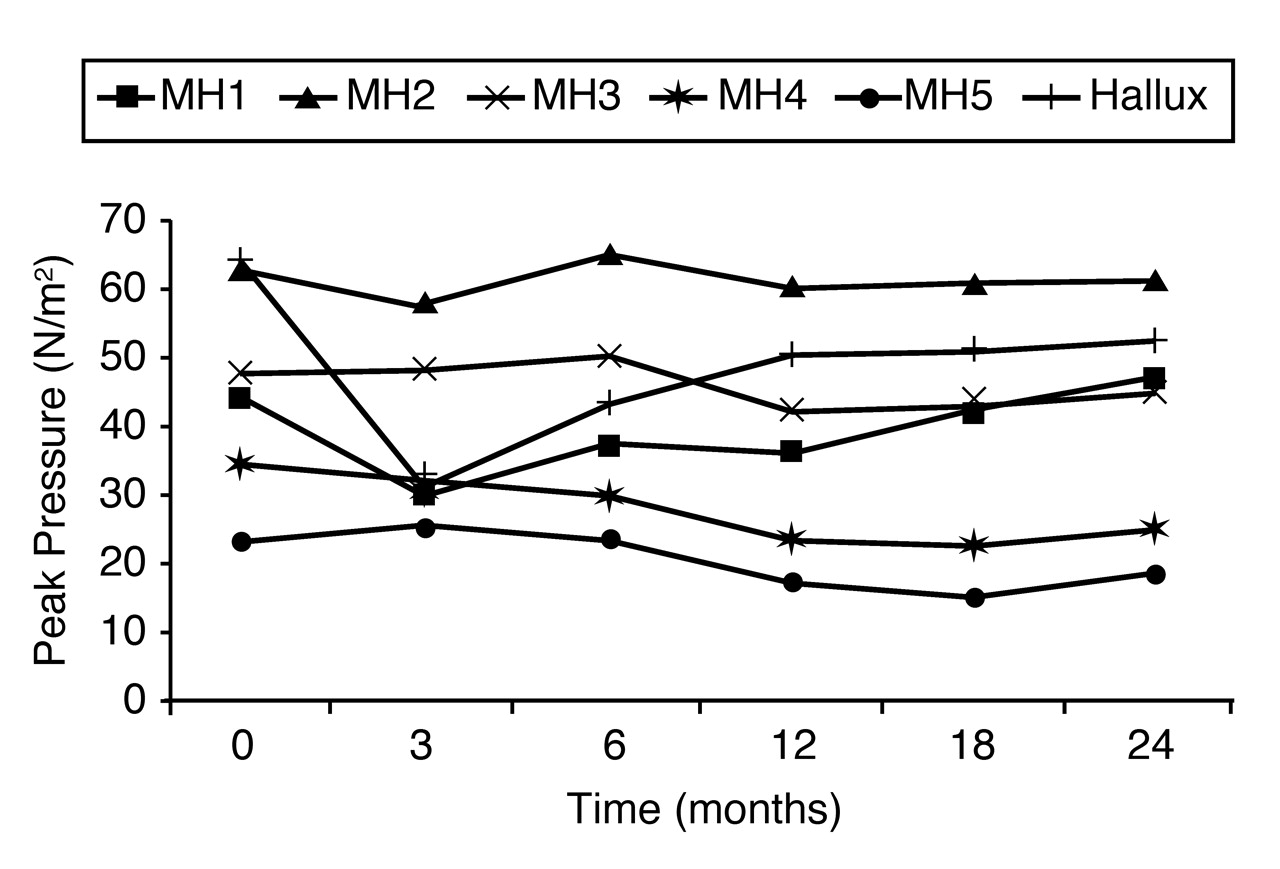
During the period of observation, significant changes in peak pressure measurements were found to occur beneath the hallux and the first, second, and third metatarsal heads. Temporal changes in peak pressure of the forefoot are presented in
Figure 1.
Figure 1.
Peak pressure changes over time in hallux valgus subjects after undergoing an Austin bunionectomy. MH, metatarsal head.
Figure 1.
Peak pressure changes over time in hallux valgus subjects after undergoing an Austin bunionectomy. MH, metatarsal head.
Peak pressure measurements of the hallux were significantly decreased (by approximately 53%) at the initial 3-month assessment after surgery and then increased significantly until 12 months, stabilizing at significantly lower levels (approximately 22%) compared with values before surgery. The first metatarsal head initially underwent significant peak pressure reduction (of approximately 33%) and subsequently increased during the following 3 months, stabilizing by 6 months. Peak pressures remained constant until 12 months, when there was a gradual increase until 18 months to levels similar to those before surgery.
By comparison, second metatarsal head peak pressures remained relatively constant throughout the observation period. Peak pressure values of the third, fourth, and fifth metatarsal heads remained relatively constant until 6 months after surgery, when significant reductions were seen. Pressures gradually increased to preoperative values by 12 months, except for the fourth metatarsal head, which remained at significantly lower levels (approximately 29%) 24 months after surgery.
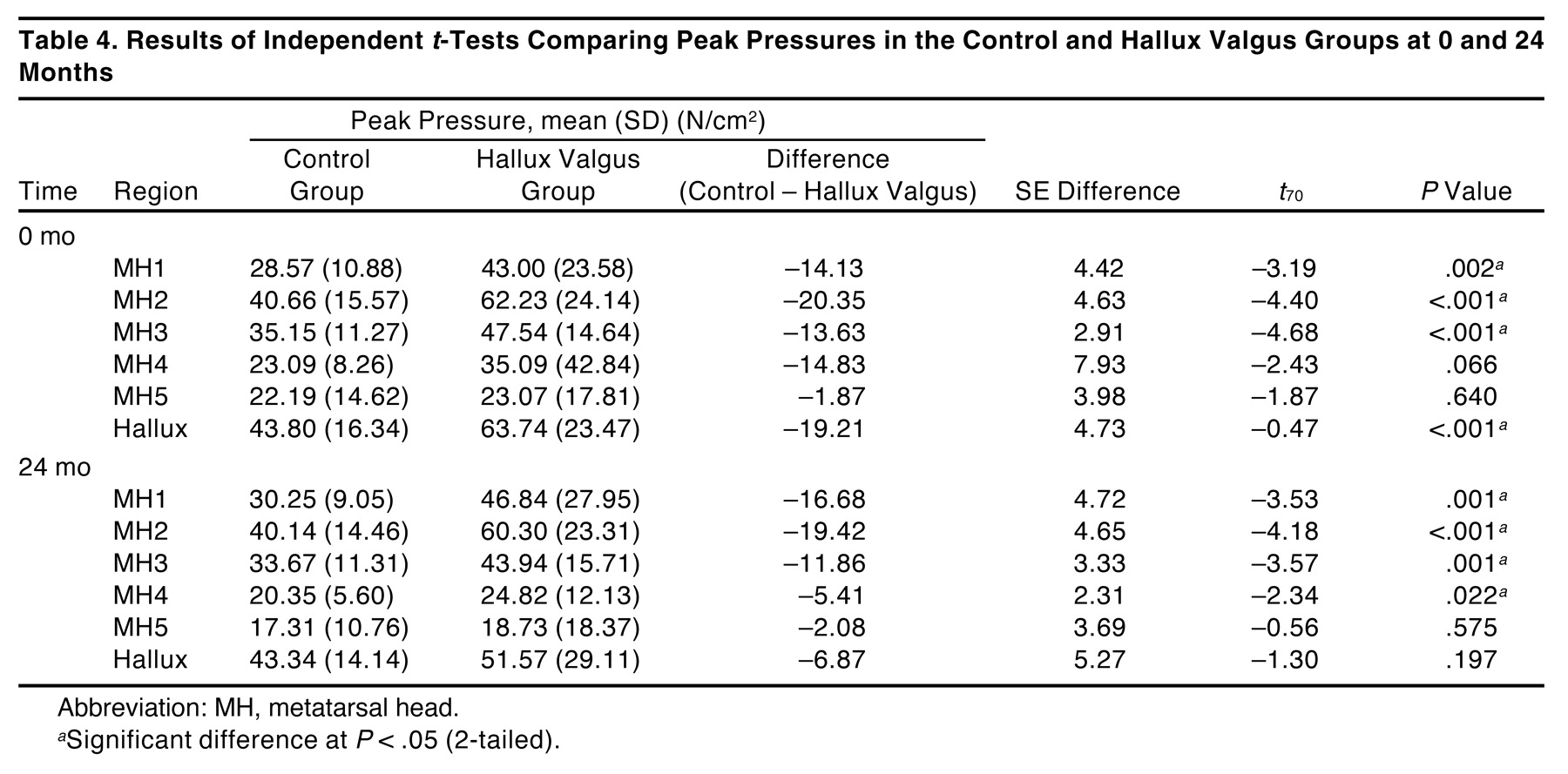
Control and hallux valgus peak pressures were compared 0 and 24 months after surgery using independent
t-tests. Levene’s test for equality of variance was used to test for homogeneity of variance for all pressure variables. Thirty-six control subjects were compared with the same number of randomly selected hallux valgus subjects. The results indicated that in the hallux valgus group, peak pressure beneath the hallux significantly deceased from preoperative levels to “normal” by 24 months. Peak pressure measurements beneath the fourth metatarsal head decreased significantly after surgery, whereas pressures beneath the first, second, and third metatarsal heads remained unchanged but significantly higher than in the control group (
Table 4).
Table 4.
Results of Independent t-Tests Comparing Peak Pressures in the Control and Hallux Valgus Groups at 0 and 24 Months.
Table 4.
Results of Independent t-Tests Comparing Peak Pressures in the Control and Hallux Valgus Groups at 0 and 24 Months.
Univariate contrasts of mean forefoot peak pressure measurements before and 24 months after surgery demonstrated a 20% decrease to the hallux (F1,22 = 8.55; P = .005) and fifth metatarsal head (F1,22 = 18.08; P < .001) regions.
Hallux Valgus Radiographic Data
Weightbearing dorsoplantar radiographs were taken in all hallux valgus subjects before surgery and again a minimum of 24 months after surgery (mean ± SD, 33.52 ± 4.72 months; range, 24–40 months). Intraclass correlation coefficients were generated to test intra-tester measurement reliability for metatarsus primus varus, hallux abductus, and first metatarsal protrusion distance; they showed satisfactory ICCs between 0.91 and 0.96.
Bivariate Pearson product moment correlation coefficients were generated for preoperative and postoperative radiographic measurements (
Table 5). As might be expected, before surgery, there was a strong positive correlation between metatarsus primus adductus and hallux abductus angles and a weaker but positive correlation between first metatarsal protrusion distance and hallux abductus angle. After surgery, no correlation was found between any of the measured radiographic variables. This finding is almost certainly because all mean postoperative radiographic measurements were less than the usual reference range values.
Table 5.
Correlation of Preoperative and Postoperative Radiographic Measurements in Hallux Valgus Subjects.
Table 5.
Correlation of Preoperative and Postoperative Radiographic Measurements in Hallux Valgus Subjects.
Changes to Radiographic Measurements After the Austin Bunionectomy
A paired
t-test comparing preoperative and postoperative radiographic measurements was conducted. Descriptive statistics and the
t-test results for the radiographic changes to hallux valgus subjects demonstrate significant decreases in hallux abductus angle, metatarsus primus adductus angle, and first metatarsal protrusion distance measurements to below-normal values (
Table 6).
Table 6.
Comparison of Radiographic Changes in 44 Hallux Valgus Subjects Before and 34 Months After Surgery.
Table 6.
Comparison of Radiographic Changes in 44 Hallux Valgus Subjects Before and 34 Months After Surgery.
Correlation of Hallux Valgus Pressure and Radiographic Measurements
Bivariate Pearson product moment correlation matrices were generated for preoperative and postoperative radiographic and plantar pressure measurements. Before surgery, metatarsus primus adductus was weakly positively correlated with peak pressure of the first metatarsal head (0.360; P = .016), and hallux abductus angle was moderately negatively correlated with hallucal peak pressure (−0.509; P < .001). After surgery, no meaningful significant correlation was found among plantar pressure measurements of any region of the forefoot and the postoperative radiographic parameters tested.
Correlation of Hallux Valgus Pressure Measurements with Hallux Range of Motion
The passive range of dorsiflexion and plantarflexion of the hallux was measured with the foot in a non-weightbearing neutral position. Before surgery, a correlation was found for dorsiflexion of the hallux with peak pressure (0.397; P = .008) with the first metatarsal head. It is likely that dorsiflexion of the hallux facilitates greater plantarflexion of the first metatarsal, increasing its load capacity. After surgery, there was no meaningful significant correlation between any pressure variable and motion of the hallux.
Summary of Results for the Hallux Valgus Group
Plantar pressure measurements in 44 hallux valgus feet studied demonstrated significant changes in plantar pressure distribution in the forefoot after the modified Austin bunionectomy. The most obvious changes occurred to the hallux, demonstrating marked reductions in peak pressure measurements 3 months after surgery, which gradually increased until 12 months, stabilizing at below-normal peak pressure values.
Postoperative peak pressure variables for the first, second, and third metatarsals measured at 24 months were largely the same as those measured before surgery, remaining significantly higher than control values. This finding suggests that the operation performed does not influence medial and central metatarsal forefoot pressure distribution. Accordingly, the modified Austin bunionectomy should not increase the likelihood of adverse long-term postoperative metatarsalgia, and neither should the operation be considered a possible remedy for central metatarsalgia. Peak pressure measurements of the medial forefoot beneath the first, second, and third metatarsal heads remain significantly higher than control values, which may suggest that feet with hallux valgus function in a more pronated or abducted manner than normal feet.
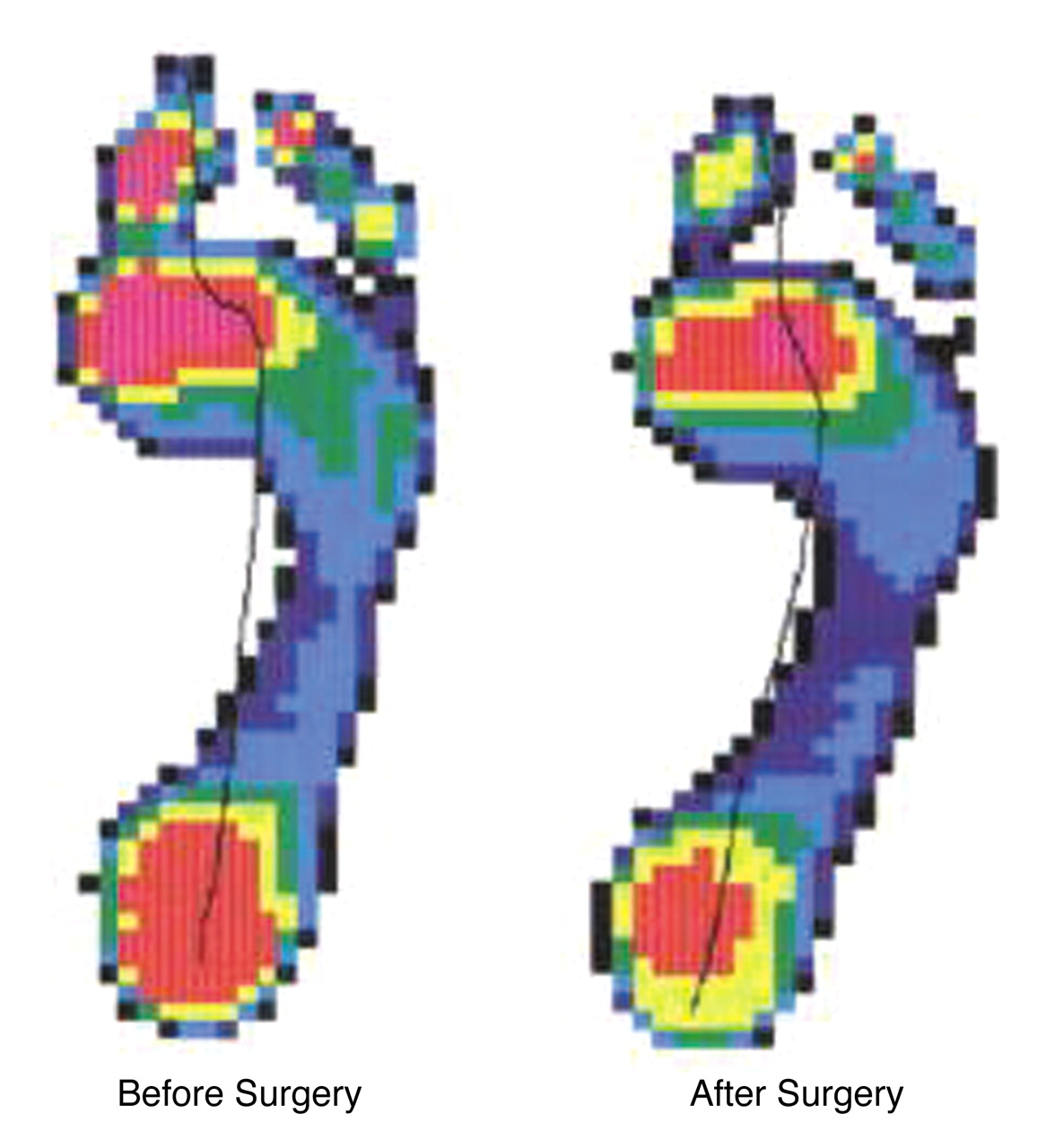
Representative two-dimensional EMED footprints demonstrating peak pressure distribution of a typical hallux valgus subject before and 24 months after surgery are illustrated in
Figure 2.
Figure 2.
Qualitative two-dimensional peak pressure footprints from a typical hallux valgus subject before and 24 months after surgery. Peak pressure scale: pink>red>yellow>green>light blue>dark blue.
Figure 2.
Qualitative two-dimensional peak pressure footprints from a typical hallux valgus subject before and 24 months after surgery. Peak pressure scale: pink>red>yellow>green>light blue>dark blue.
With respect to radiographic measurements, the results suggest that a positive correlation exists between hallux abductus and metatarsus adductus and between hallux abductus and first metatarsal protrusion distance. Postoperative radiographic measurements were reduced to below-normal values, and, after surgery, no correlation could be found between plantar pressure distribution and range of motion of the hallux.
Discussion
Although some of the surgical subjects underwent bilateral procedures, the first postoperative plantar pressure measurement session was delayed until 3 months had elapsed to minimize the effects of bilateral surgery on the patient’s ability to walk in a relatively asymptomatic, “normal” manner, as is supported by clinical experience. No cases of postoperative infection, delayed union or nonunion of the osteotomy, or any other serious complications were encountered. With respect to subject demographics, the control group represented a more even sex balance, whereas a female bias was seen in the hallux valgus group. The mean age and body mass index of the control group were less than that of the surgery group, but these factors were not found to correlate with any pressure variables tested in the control group. Therefore, given the relatively modest differences involved and the absence of any demonstrable effect in the control group, age and sex differences are unlikely to have adversely affected pressure measurements in the test group.
Plantar Pressure Measurement Changes to the Hallux Valgus Group
Plantar pressure measurement of the hallux after surgery demonstrated significant initial decreases in peak pressure at 3 months, which then rose significantly and stabilized by 12 months at a level significantly lower than preoperative measurements and approximating normal values. These findings are similar to the lower postoperative pressures of the hallux found by Resch and Stenstrom [
9] and Hutton and Dhanendran [
6]. Clinically, symptomatic medial-plantar callus of the hallux is a common finding in hallux valgus feet [
3,
27] that often disappears after surgery and is in keeping with the findings of reduced peak pressure beneath the hallux.
Peak pressure of the first metatarsal was similar to that recorded at the hallux in that a significant decrease until 3 months was followed by a significant increase until 6 months, followed by a continued gradual increase until 18 months, when pressure remained statistically similar to preoperative levels and significantly higher than control group values. Pressure changes to the hallux and first metatarsal head areas were most noticeable during the first 12 months after surgery and can be explained in terms of the postoperative reparative process. The modified Austin bunionectomy involves an osteotomy of the head of the first metatarsal that requires approximately 2 months for osseous healing to occur. Although weightbearing on the foot is permitted immediately, during this time the patient will tend to guard the area of surgery, and a more natural style of walking will develop progressively as the foot recovers and the level of discomfort related to weightbearing decreases.
Peak pressure levels for the second metatarsal head remained relatively constant throughout the test period. Peak pressure measurements of the third metatarsal showed a gradual but not significant increase immediately after surgery, which decreased significantly during the 6- to 12-month period to preoperative levels. These findings are similar to those of Yamamoto et al [
10], who found that peak pressure beneath the second and third metatarsals increased initially after surgery and then returned to preoperative levels 26 months after surgery. In general, the findings relating to the second and third metatarsals are in keeping with the recognized complication of metatarsalgia of the central forefoot that sometimes follows bunion surgery and is thought to be related to first metatarsal shortening [
4,
28]. In the hallux valgus subjects studied, the mean amount of postoperative first metatarsal shortening was 5.2 mm, although no statistically significant correlation could be found between first metatarsal protrusion distance and any pressure variable for any region of the forefoot.
Plantar pressure measurements of the fourth metatarsal head showed no significant change overall in peak pressure before and 24 months after surgery. Peak pressure levels of the fifth metatarsal head, however, showed a significant reduction in the 24 months. These findings are contrary to those of earlier studies by Stokes et al [
5] and Hutton and Dhanendran [
6], who found increased peak pressures beneath the fourth and fifth metatarsal heads, albeit after the Keller arthroplasty procedure.
The findings from this study show that feet with hallux valgus have significantly higher peak pressure values beneath the first, second, and third metatarsal heads than do normal feet, supporting a pronatory etiology for hallux valgus. Furthermore, after 12 to 18 months of transitional changes in plantar pressure distribution, there remained a medial locus of peak pressure distribution in the forefoot. These results are in keeping with those of Yamamoto et al [
10].
Changes in Radiographic Measurements After Hallux Valgus Surgery
Radiographic changes after surgery that indicated significant reductions in metatarsus primus adductus, hallux abductus, and first metatarsal protrusion distance were seen. The approximate decrease in hallux abductus angle was 18°, in metatarsus primus adductus angle was 7°, and in first metatarsal protrusion distance was 5 mm. These findings were similar to those of previous studies of the Austin bunionectomy [
29–
32]. These findings suggest that the surgical procedures produced radiographic measurements consistent with accepted postoperative normal values.
Conclusion
The modified Austin bunionectomy for the correction of hallux valgus deformity induced significant initial reductions in peak pressure to the hallux and first metatarsal head. The surgery results in significant long-term reductions in hallucal peak pressure that may lead to a reduction in deforming forces acting on the hallux. This finding, together with essential radiographic measurements that returned to normal values, is suggestive of favorable long-term prognoses. The feet of hallux valgus subjects demonstrated significantly higher medial forefoot pressures beneath the first, second, and third metatarsal heads compared with normal feet before and after surgery, which suggests that the surgery does not alter core foot function.
Possible limitations of the study were that although the principal researcher performed surgery on approximately 75% of the hallux valgus subjects, using a standardized surgical technique, a single podiatric surgeon did not perform each operation in exactly the same manner. In addition, the postoperative management of each subject, although essentially similar, was not necessarily identical and may have also influenced the results. Finally, although a standardized radiographic technique was used, not all of the radiographs were taken by the same person using the same equipment.