Next Article in Journal
Plantar Pressure and Radiographic Changes to the Forefoot After the Austin Bunionectomy
Previous Article in Journal
Use of Laterally Wedged Custom Foot Orthoses to Reduce Pain Associated with Medial Knee Osteoarthritis
 
 
Journal of the American Podiatric Medical Association is published by MDPI from Volume 116 Issue 1 (2026). Previous articles were published by another publisher in Open Access under a CC-BY (or CC-BY-NC-ND) licence, and they are hosted by MDPI on mdpi.com as a courtesy and upon agreement with American Podiatric Medical Association.
Article

Efficacy of Fifth Metatarsal Head Resection for Treatment of Chronic Diabetic Foot Ulceration

by
David G. Armstrong
1,2,3,*,
Mark A. Rosales
1 and
Agim Gashi
1
1
Department of Surgery, Podiatry Section, Southern Arizona Veterans Affairs Medical Center, Tucson
2
Dr. William M. Scholl College of Podiatric Medicine at Rosalind Franklin University of Medicine and Science, Chicago, IL
3
Department of Medicine, Manchester Royal Infirmary, Manchester, England
*
Author to whom correspondence should be addressed.
J. Am. Podiatr. Med. Assoc. 2005, 95(4), 353-356; https://doi.org/10.7547/0950353
Published: 1 July 2005

Abstract

This study compares the potential benefit of fifth metatarsal head resection versus standard conservative treatment of plantar ulcerations in people with diabetes mellitus. Using a retrospective cohort model, we abstracted data from 40 patients (22 cases and 18 controls) treated for uninfected, nonischemic diabetic foot wounds beneath the fifth metatarsal head. There were no significant differences in sex, age, duration of diabetes mellitus, or degree of glucose control between cases and controls. Patients who underwent a fifth metatarsal head resection healed significantly faster (mean ± SD, 5.8 ± 2.9 versus 8.7 ± 4.3 weeks). Patients were much less likely to reulcerate during the period of evaluation in the surgical group (4.5% versus 27.8%). The results of this study suggest that fifth metatarsal head resection is a potentially effective treatment in patients at high risk of ulceration and reulceration. (J Am Podiatr Med Assoc 95(4): 353–356, 2005)

In the neuropathic diabetic foot, high plantar pressure due to structural pathology is a critical causative factor leading to ulceration.[1] To date, a multitude of modalities have been described to externally reduce pressure.[24] Unfortunately, structural pathology and associated biomechanical abnormalities still exist after the off-loading device is removed.[5] Healing and preventing recidivism after conservative treatment is an ongoing struggle for the clinician treating the diabetic foot. Internal modulation of pressure, or surgical intervention, is sometimes considered to assist in healing and in reducing recurrence.[612]
Areas on the forefoot that are prone to ulcerations coincide with biomechanical deformities. Some of the most common areas for ulceration include the plantar aspect of the fifth metatarsophalangeal joint, the hallux, and the first metatarsophalangeal joint.[11,13,14] Previous studies have evaluated various types of forefoot surgery, including various metatarsal procedures. Metatarsal head resections are often lumped into one category despite the fact that each metatarsal may play a very different functional role. Although ulcerations beneath the fifth metatarsal head are common, we are unaware of any reports in the literature that have evaluated the efficacy of isolated fifth metatarsal head resection to treat plantar ulcerations. Furthermore, we are unaware of any studies that have compared patients undergoing resection with similar patients not receiving surgical intervention. Therefore, the purpose of this case-control study was to evaluate outcomes of conservative treatment and surgical intervention for ulcers beneath the fifth metatarsal head.

Methods

This retrospective cohort study evaluated 40 patients with diabetes mellitus (mean ± SD age, 65 ± 8.7 years). Patients whose data were abstracted met the following criteria: 1) a diagnosis of diabetes mellitus by their primary-care provider, 2) neuropathic ulceration on the plantar aspect of the fifth metatarsal head, and 3) the ability to walk unassisted. The study protocol was reviewed by the institutional review boards of both the University of Arizona and the Department of Veterans Affairs; it was classified as “exempt,” as no unique patient identifiers were used.
Patients were followed for 6 months. All ulcerations were classified using the University of Texas wound classification system and were identified as either 1A or 2A (ulcerations did not probe to bone, and none had concomitant infection or ischemia).[15] Data were collected during a 4-year period for patients who had fifth metatarsal ulcerations. During that time, 22 patients who met the criteria described in the previous paragraph received surgical intervention. These patients were compared with 18 control subjects who received standard wound care that consisted of wound dressing changes, aggressive offloading, and weekly debridement.
Vascular status was evaluated by pedal pulse palpation. The diagnosis of ischemia was standardized in the facility where data were abstracted and was made by the absence of more than one foot pulse or a nonaudible signal on Doppler ultrasonography of the dorsalis pedis or posterior tibial pulses in the affected extremity. This method of evaluation, although arguably not as sensitive as other noninvasive methods, such as transcutaneous oximetry, segmental extremity pressure studies, or laser Doppler flowmetry, has the benefit of having been performed systematically on all of the patients in this study.[1619]
All procedures performed fell into diabetic foot surgery class 3 (curative) using the classification described by Armstrong and Frykberg.[10] The fifth metatarsal head resections were performed by one of two attending surgeons. The technique, which was standardized, consisted of an approach through a dorso-lateral incision that extended from the distal one-third of the fifth metatarsal to the proximal one-third of the base of the proximal phalanx. The metatarsal head was exposed and resected at the surgical neck, thus eliminating the source of pressure responsible for the ulceration. All procedures were performed with the patient under sedation, with local anesthetic infiltrated regionally. Postoperative care for all patients was similar, consisting of standardized removable cast walker off-loading (DH Walker; Royce Medical, Camarillo, California). Patients were followed on a weekly basis. At approximately 2 weeks, the surgical patients had their sutures removed. All plantar ulcers were debrided of nonviable tissue at each visit until wound healing.
Healing was defined as complete epithelialization over the former defect. When the ulcer sites were clinically healed, patients were placed in depth inlay shoes with multidurometer, multilaminar inlays. These patients were followed monthly, as is the protocol for patients in international diabetic foot risk category 3.[20,21]
All data are reported as mean ± SD. For all analyses of continuous data, we used a t-test. For dichotomous analyses, we used a χ2 test with 95% confidence intervals (CIs) and odds ratios. The α was set at 5% for all assessments.

Results

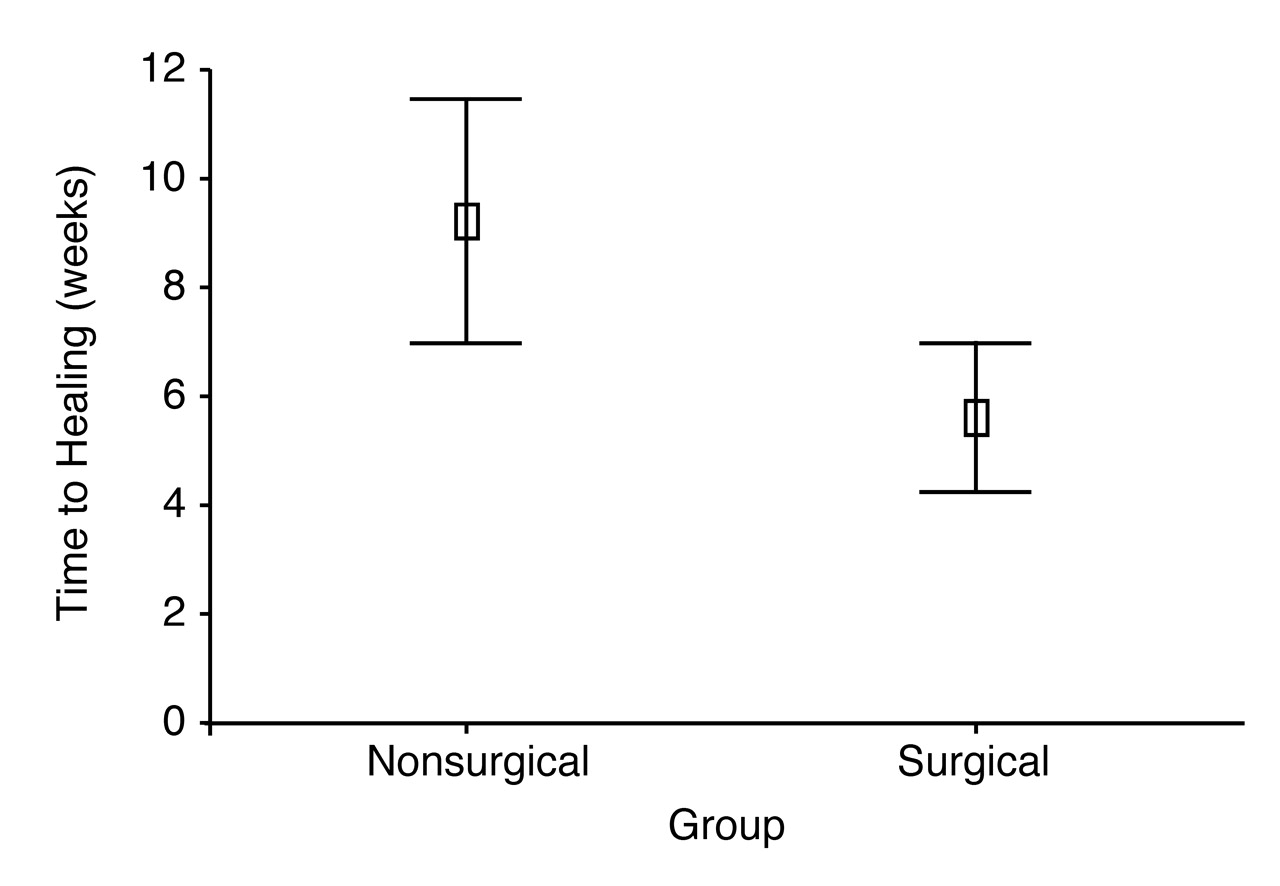
Descriptive statistics for this population are given in Table 1. There were no significant differences between the two groups in age (P = .5), duration of diabetes mellitus (P = .4), level of glycosylated hemoglobin (P = .9), or sex (P = .9). Individuals who underwent fifth metatarsal head resection healed significantly sooner than those who received nonsurgical therapy only (5.8 ± 2.9 versus 8.7 ± 4.3 weeks; P = .02) (Fig. 1). Significantly fewer patients reulcerated during the 6-month follow-up after resection of the fifth metatarsal head (4.5% versus 27.8%; P = .04; odds ratio, 8.3; 95% CI, 1.1–76.9).
All of the patients who were treated conservatively and who had recurrent ulcerations did so at the plantar aspect of the fifth metatarsophalangeal joint. No significant differences were found in percentage of patients diagnosed as having an infection during follow-up (18.2% versus 22.2%; P = .8) or in percentage of patients who underwent amputation (4.5% versus 11.7%; P = .4).

Discussion

The results of this study suggest that isolated fifth metatarsal head resection may be associated with a shorter time to healing and a reduced risk of recurrence of diabetic foot ulceration. Although other studies in the literature have evaluated generalized outcomes of metatarsal head resection, none has specifically focused on a single anatomical site. We contend that peak plantar pressures and the time that these pressures are applied in gait are different on different parts of the forefoot. Therefore, it would be prudent for the surgeon to critically evaluate outcomes in discrete anatomical sites because the outcomes (and therefore the efficacy) of these procedures could be expected to vary based on site.
A recent report by Wieman et al[14] documented an 11-year retrospective study that evaluated 101 patients with diabetic foot ulcers. All of the patients were treated with surgical resection of the prominent metatarsal head to facilitate wound closure. In this study, 88% of the ulcers healed. Although they evaluated a relatively large number of patients, outcomes were spread across all metatarsal heads, thereby limiting the analytic power and therefore the ultimate conclusions drawn from the data for any specific anatomical site.
A logical question that might arise and a standard problem with any case-controlled study of surgical outcomes involves the criteria at a single center for one patient to have surgical intervention and the other to undergo conservative treatment. The rational explanation of this query is the difference in philosophy between the two attending surgeons, both similarly trained, who managed the clinic. During the period of review, one favored a primarily surgical approach to this type of deformity and the other a primarily nonsurgical approach.

Conclusion

Fifth metatarsal head resection is a potentially safe and efficacious procedure that can be used to facilitate wound closure in patients with chronic or recurrent neuropathic ulcerations. The surgical technique is relatively basic, with very few apparent complications. We believe that this surgical procedure should be considered as a therapeutic option in appropriately selected patients.

References

  1. Boulton AJ: Lowering the risk of neuropathy, foot ulcers and amputations. Diabet Med 15(suppl 4): S57, 1998.
  2. Armstrong DG, Nguyen HC, Lavery LA, et al: Offloading the diabetic foot wound: a randomized clinical trial. Diabetes Care 24: 1019, 2001.
  3. Armstrong DG, Lavery LA: Evidence-based options for off-loading diabetic wounds. Clin Podiatr Med Surg 15: 95, 1998.
  4. Armstrong DG, Short B, Nixon BP, et al: Technique for fabrication of an “instant total-contact cast” for treatment of neuropathic diabetic foot ulcers. JAPMA 92: 405, 2002.
  5. Armstrong DG, Lavery LA, Kimbriel HR, et al: Activity patterns of patients with diabetic foot ulceration: patients with active ulceration may not adhere to a standard pressure off-loading regimen. Diabetes Care 26: 2595, 2003.
  6. Armstrong DG, Lavery LA, Stern S, et al: Is prophylactic diabetic foot surgery dangerous? J Foot Ankle Surg 35: 585, 1996.
  7. Frykberg R, Giurini J, Habershaw G, et al: “Prophylactic Surgery in the Diabetic Foot,” in Medical and Surgical Management of the Diabetic Foot, ed by SJ Kominsky, CV Mosby, St Louis, 1993.
  8. Laing P: “Prophylactic Orthopaedic Surgery: Is There a Role?” in The Foot in Diabetes, 3rd Ed, ed by AJM Boulton, H Connor, PR Cavanagh, John Wiley & Sons, Chichester, England, 2002.
  9. Nicklas BJ: “Prophylactic Surgery in the Diabetic Foot,” in The High Risk Foot in Diabetes Mellitus, ed by RG Frykberg, p 537, Churchill Livingstone, New York, 1991.
  10. Armstrong DG, Frykberg RG: Classification of diabetic foot surgery: toward a rational definition. Diabet Med 20: 329, 2003.
  11. Armstrong DG, Lavery LA, Vazquez JR, et al: Clinical efficacy of the first metatarsophalangeal joint arthroplasty as a curative procedure for hallux interphalangeal joint wounds in persons with diabetes. Diabetes Care 26: 3284, 2003.
  12. Mueller MJ, Sinacore DR, Hastings MK, et al: Effect of Achilles tendon lengthening on neuropathic plantar ulcers: a randomized clinical trial. J Bone Joint Surg Am 85: 1436, 2003.
  13. Vijaykumar PG, Weisman JT: Effect of metatarsal head resection for diabetic foot ulcers on the dynamic plantar pressure distribution. Am J Surg 167: 297, 1994.
  14. Wieman TJ, Mercke YK, Cerrito PB, et al: Resection of the metatarsal head for diabetic foot ulcers. Am J Surg 176: 436, 1998.
  15. Armstrong DG, Lavery LA, Harkless LB: Validation of a diabetic wound classification system: the contribution of depth, infection, and ischemia to risk of amputation. Diabetes Care 21: 855, 1998.
  16. Bongard O, Krahenbuhl B: Predicting amputation in severe ischemia: the value of transcutaneous PO2 measurement. J Bone Joint Surg Br 70: 465, 1988.
  17. Hauser CJ, Klein SR, Mehringer CM, et al: Assessment of perfusion in the diabetic foot by regional transcutaneous oximetry. Diabetes 33: 527, 1984.
  18. Forst T, Pfutzner A, Bauersachs R, et al: Comparison of the microvascular response to transcutaneous electrical nerve stimulation and postocclusive ischemia in the diabetic foot. J Diabetes Comp 11: 291, 1997.
  19. Wyss CR, Matsen FA, Simmons CW, et al: Transcutaneous oxygen tension measurements on limbs of diabetic and nondiabetic patients with peripheral vascular disease. Surgery 95: 339, 1984.
  20. International Working Group on the Diabetic Foot: International Consensus on the Diabetic Foot, International Working Group on the Diabetic Foot, Maastricht, the Netherlands, 1999.
  21. Armstrong DG, Harkless LB: Outcomes of care in a diabetic foot specialty clinic. J Foot Ankle Surg 37: 459, 1998.

Table 1. Descriptive Characteristics of the Study Population
Japma 95 00353 i001
Figure 1. Mean time to wound healing in the surgical and nonsurgical groups. P = .04, difference in healing between groups. Error bars represent SEM.
Japma 95 00353 g001