When our bodies function as we intend them to, we tend to take them for granted [
1]. However, when “normal” bodily functions are restricted, this has a major impact on our perception of health. Although problem-free feet are taken for granted and largely ignored, more than 50% of people older than 45 years perceive that they have a foot problem [
2]. Individual perception of foot health has a significant effect on the demand for foot-health services [
3]. There were 2.4 million users of National Health Service podiatry services in 1997 and 1998. In 1999, the National Health Service employed 3,700 state-registered podiatrists for a population of 58 million [
4]. Four of five people 65 years or older have at least one foot problem, and approximately half need the podiatry service, but only half of these people currently receive treatment [
5,
6]. Although the degree of pathologic change may affect the patient’s mobility, comfort, and freedom of choice, the patient’s perception of his or her foot health does not necessarily relate to the level of foot pathology as assessed by medical practitioners [
2]. This is an important phenomenon, and if evaluative research in podiatric medicine is to advance, then the development of patient-generated foot-health outcome measures that capture the patient’s foot-health expectations, perceptions, and experiences is an urgent task [
7].
Currently, the foot-health assessment tools that have been designed tend to reflect professional views of what matters to patients in terms of their foot health rather than starting with what patients report as being important. Such tools predominantly serve to ration access to podiatric medicine [
8]. Moreover, the severity scores achieved in this way frequently relate poorly to the level of severity perceived by the patient [
9]. The Bristol Foot Score (BFS) was designed specifically to tackle this problem and to produce a measure that quantifies, from the patient’s perspective, the impact that foot problems have on everyday life. To ensure that the measure was truly grounded in patients’ rather than clinicians’ perceptions, patients were consulted at all stages of the development process of the scale. This approach ensured impartial assessment of the subject’s perception of his or her own foot-health status, and the structure and phrasing of the BFS reflect this goal. This approach contrasts with the development of existing alternative measures, such as the Foot Function Index [
10] and the Foot Health Status Questionnaire [
11], which were designed by groups of professionals and then pilot-tested on patients. Some clinicians object to patient ratings on the grounds of their subjectivity. This subjectivity, as it reflects the patient’s point of view, should be viewed as a strength. There is now general recognition among health-services researchers that measures of health outcome should incorporate the patient’s perspective [
12] and that this approach enables the provision of more responsive, equitable care [
13].
Methods
Development of the BFS
The BFS was developed with the help of patients and staff in the Podiatry Department at the United Bristol Healthcare National Health Service Trust. The content of the BFS was developed using information gathered during in-depth, topic-guided interviews with a variety of podiatric patients. Topics covered included the nature and duration of the foot problems, what the patients (and others) did to help the problems, any family history of foot problems, and how they would like things to change. These interviews were relaxed and informal and were conducted in all cases by the lead researcher (S.B.), who was introduced as a research student rather than as a podiatrist. The interviews were audiotaped, and reflective notes were taken during the session. The interviews were then transcribed verbatim and were checked by two of us (S.B. and R.C., a social scientist) for accuracy. Interviews and preliminary analyses were undertaken sequentially to allow emerging themes to influence subsequent interviews. Interview transcripts were read repeatedly, and emergent themes were used to code sections of the text, which were copied to new word processing files. Codes were applied to subsequent interviews, and further codes were added as new themes emerged, ac-cording to the constant comparative method [
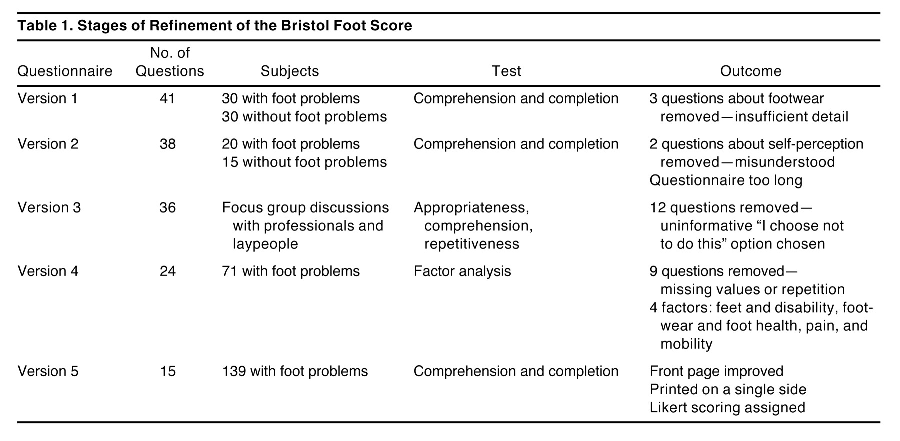
14]. Concepts and themes that emerged from the interviews, including phrases used by the interviewees, were used to inform the initial wording and format of the BFS. The instrument was pilot-tested using an iterative process of administering the questionnaire to a variety of subjects, analyzing their responses, and further refining the questionnaire (Table 1).

Testing the BFS
Principal components analysis was used to explore the dimensionality of the BFS, and the Cronbach α was used to assess internal consistency. To evaluate the test–retest reliability of the BFS, the Bland and Altman technique [
15] was used to assess agreement between measurements made using the BFS at two points (2 weeks apart) in a group of new patients on the podiatry waiting list. Sensitivity to change was assessed using scores obtained before and after treatment in two groups of subjects: one group receiving surgical intervention, in whom improved scores after healing would be expected, and a second group receiving maintenance podiatric services, in whom the previous expectation was that scores would not deteriorate but would remain stable. Finally, a comparison between patient scores on a standard Chiropody Assessment Criteria Score [
16] and the BFS was made using the Spearman rank correlation (ρ). Quantitative data analyses were conducted using SPSS 9.0 for Windows (SPSS Science, Chicago, Illinois). The research study protocol was reviewed and approved by the local research ethics committee based at the United Bristol Healthcare National Health Service Trust.
Results
Initially, a purposive sample of ten patients (seven women and three men) registered with the Podiatry Department were interviewed in their own homes. Subjects were selected with the intention of achieving a maximum variation sample. The interviewees ranged in age from 24 to 89 years, and all had foot pathology and had received treatment. Three subjects had concurrent systemic disease (one had diabetes mellitus, one had rheumatoid arthritis, and one had osteoarthritis). After ten interviews, no new themes emerged, only confirmation of themes and concepts from previous interviews. Approximately 90 statements about foot problems were produced in this way, and these were then grouped under five headings, on which the BFS was based:
Mobility (eg, “I can’t walk with my feet, I get frightened going across the road” and “Oh dear, I don’t want to walk anywhere”)
Pain (eg, “I’m aware of them all the time, it’s especially bad on bumpy surfaces” and “So you can tell how bad it was, ever since I’ve been really painful”)
Footwear (eg, “I buy them even if I can’t wear them” and “I’ve never been able to wear decent shoes see, I’m going to a wedding, blinking great big laceup shoes is not nice is it?”)
Foot health and disability (eg, “I don’t want to have to stop walking, I’d hate to be in a wheelchair if it gets worse, I’d hate to be dependent” and “It slows me down, the rest of the family go rushing off and leave me”)
Perception of self as a result of foot problems (eg, “They let me down, otherwise I’m pretty good” and “They are so ugly, I can’t wear sandals; I have to hide them in shoes”)
The initial version (version 1) of the BFS consisted of 41 questions, all using a Likert [
17] response format, involving levels of agreement or disagreement with an initial statement. Respondents were asked to reflect on how their feet had been during a reference period of the previous 2 weeks.
The questionnaire was repeatedly pilot-tested on patients who attended routine podiatry clinics in the United Bristol Healthcare National Health Service Trust and on people without identified foot problems (staff of the United Bristol Healthcare National Health Service Trust). In all cases, podiatry patients completed the questionnaires before they were treated. One of us (S.B.) observed patients while completing questionnaires, and notes were made if patients had difficulty with aspects of the questionnaire layout or problems with specific questions. The completed version 1 questionnaires were then assessed predominantly to judge the ease of completion, time required to complete, number of missed answers, and comprehension problems. Three questions were removed that related to details about footwear. These could not be made sufficiently detailed to suit each subject without becoming too complicated. In version 2 (38 questions), two questions pertaining to perception of self were removed because their meaning was reported to be unclear. Then, in version 3 (36 questions), large percentages of respondents selected the “I choose not to do this” option, making 12 questions uninformative (Table 1). This tendency had been observed for these questions in the two previous versions as well; thus these 12 questions were removed.
Version 4 of the BFS was then pilot-tested on a convenience sample of 71 podiatry patients (age range, 13–90 years; mean age, 58 years; 48 females and 23 males). Data from these questionnaires, which at this stage contained 24 questions, were analyzed using factor analysis and reliability procedures in the software. The last question, which assessed general health, was excluded from these analyses. An initial principal components analysis suggested four underlying dimensions but that there was one dominant underlying factor, “concerns about feet and disability,” which explained 53.8% of the variance.
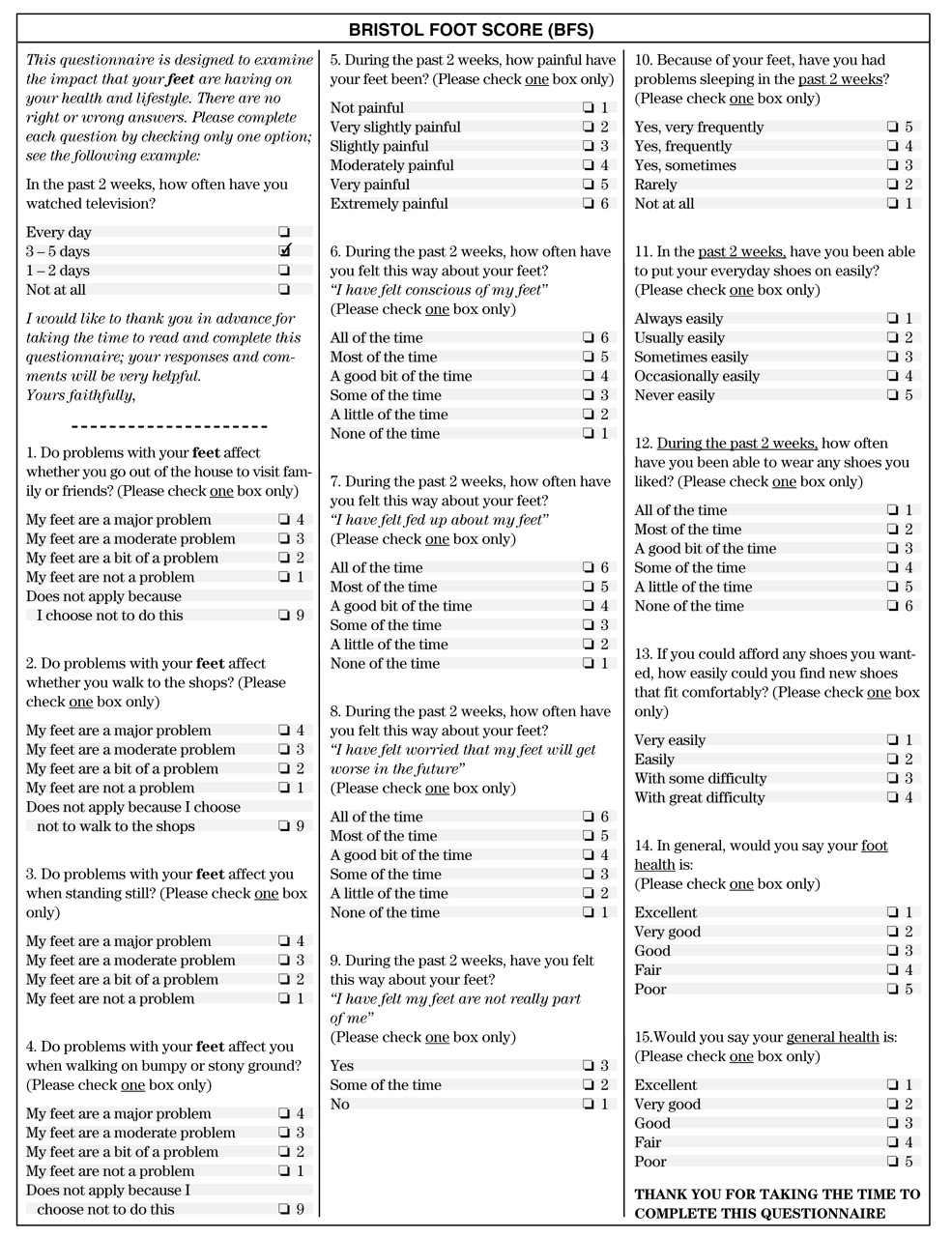
Questions that attracted a significant proportion of missing values or that duplicated other questions were then removed, reducing the number to 15 (version 5). The scoring system of the BFS assigns a score from 1 (best possible situation) to 4, 5, or 6 depending on the number of subcategories (worst possible situation). This gives the possibility of a range of scores between 15 (best) and 73 (worst). When the “I do not choose to do this” category was chosen, the subject was assigned the mean score for the group response to that question [
18].
A principal components analysis based on responses to the 15 questions indicated three underlying factors (Table 2). The questions that contributed to these three factors suggested that the first factor focused on concerns about feet and pain, the second on footwear and general foot health, and the third on mobility. Again, the first factor was the most powerful, explaining 50% of the variance in responses to the set of 15 questions. The second and third factors explained 10% and 9% of the variance, respectively.

Following a slight change in layout, the final 15-question version of the BFS (
Figure 1) was then administered to 139 routine podiatry patients (before treatment) (age range, 16–88 years; mean, 55 years; 86 females and 53 males) to assess internal consistency, comprehension, and completion rates. Again, the question about general health was excluded. All questions gave a corrected item total correlation greater than 0.5, except the questions that stated, “I have felt my feet are not really part of me” and “How easily could you find new shoes that fit comfortably.” Overall, the combined reliability coefficient (α) was 0.904 (Table 3). Factor analysis indicated that the BFS loaded on two factors: strongly on the factor that addressed feet and disability and more weakly on the factor that addressed footwear and foot health. Although two underlying factors were detected, the dominance of the first factor suggested that the BFS was essentially a unidimensional scale. It was, therefore, treated as such in all subsequent analyses.

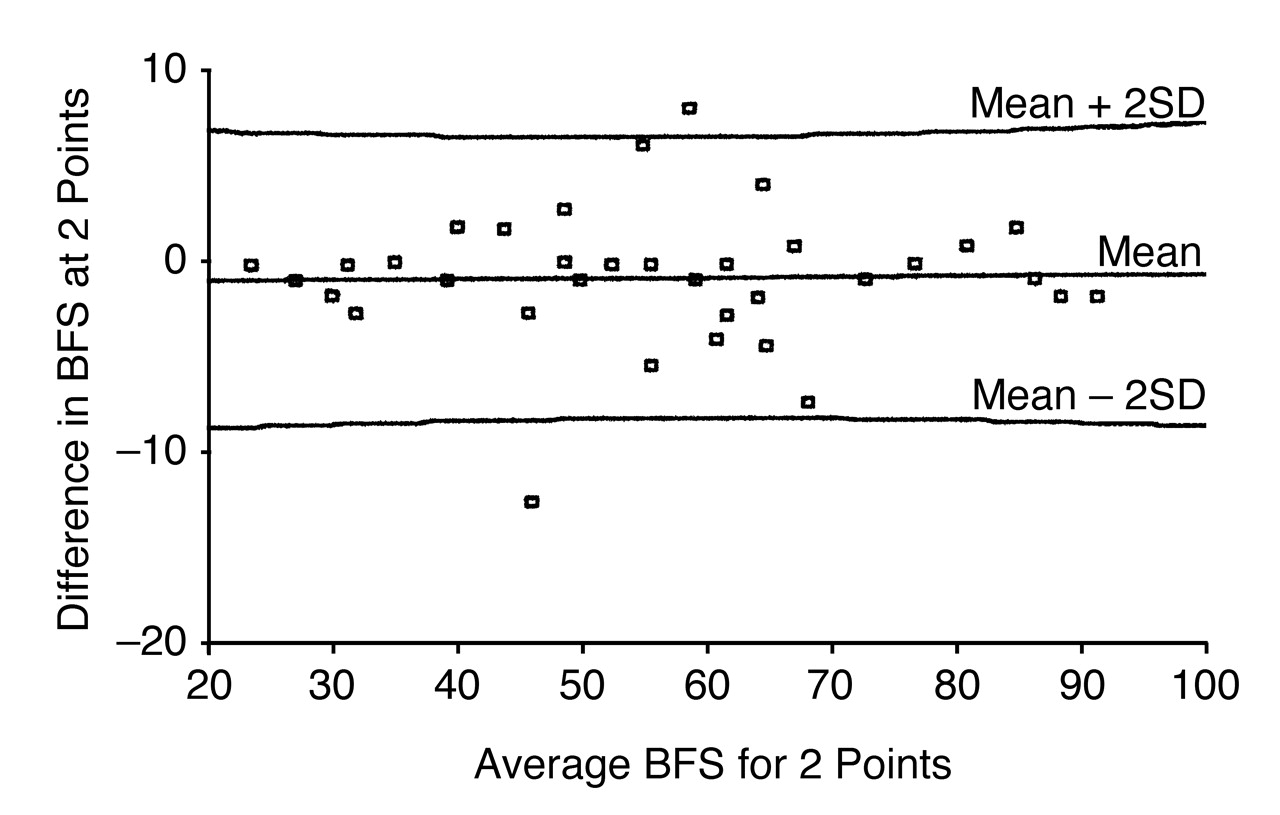
To determine the test–retest reliability of the BFS, 58 new podiatry patients (age range, 58–76 years; mean age, 66 years; 41 women and 17 men) on the waiting list for assessment and treatment were sent the BFS for completion and return in an enclosed self-addressed stamped envelope. Forty-four of these patients returned the first BFS fully completed. Two weeks later, this group of 44 patients, who had still not received podiatric treatment, were sent a second copy of the BFS along with a self-addressed stamped envelope for return. Thirty-six fully completed BFS forms were returned (age range, 58–76 years; mean age, 68 years; 27 women and 9 men). Using the Bland and Altman technique,15 a reasonable degree of agreement was found between the two scores, with a mean (SD) difference of –0.83 (3.94). However, the BFS was not stable over time for all cases: two subjects fell outside the mean ± 2 SD (
Figure 2). Further examination proved that one of these subjects was very frustrated to still be on the waiting list for treatment, and she felt that her foot health had severely deteriorated. The other subject felt that he no longer required treatment because the foot pathology had significantly improved.
Two groups of patients were used to ascertain sensitivity to change in the BFS. Seventy routine podiatry patients who were seen regularly were given the BFS to complete immediately before their routine treatment. Two weeks after receiving this treatment, these 70 patients were sent a second copy of the BFS by mail along with a self-addressed stamped envelope for return. Fifty-four patients returned fully completed BFS forms (age range, 20–89 years; mean age, 71 years; 41 women and 13 men). Mean scores for the two periods were compared using the paired t-test. No significant difference was found (Table 4). The second group of patients were those undergoing toenail surgery. Fifty-two patients completed the BFS immediately before undergoing partial nail avulsion with nail matrix phenolization. They were then asked to complete a second copy of the BFS 6 weeks after surgery while waiting for a follow-up visit. Forty-nine patients returned fully completed pairs of BFS forms (age range, 14–68 years; mean age, 34 years; 25 females and 24 males). The BFS scores showed a substantial improvement after surgery (Table 4). This difference was statistically significant (P < 0.001).

Data from the group of 54 routine podiatry patients were also used to determine the degree of concordance between the BFS and the routine assessment tool used by the United Bristol Healthcare National Health Service Trust Podiatry Department (
Figure 3). This comparison was made to explore similarities and differences in measurements achieved by the two tools. All podiatry patients in the United Bristol Healthcare National Health Service Trust are assessed by a podiatrist using a standard Chiropody Assessment Criteria Score [
16] (
Figure 3) and are consequently assigned a severity score between 0 and 23 (a score of >4 entitles the subject to treatment). This score determines who receives treatment and who does not; subsequent changes in the score are used to assess the efficacy of podiatric treatment received. The scores assigned to each of the 54 patients in this group were compared with their BFS values before podiatric treatment. There was a negligible correlation (
r = 0.135) between the two scores that was not statistically significant.
Discussion
The BFS displays good internal reliability, loading predominantly on a single factor that addresses feet and perceived disability, with a second, weaker, factor that addresses footwear combined with perceived foot health. The presence of statements about self-restriction and social restriction in both sections demonstrates the blurring of the boundaries between physical body and society [
1]. This reflects the patient-based origins of the BFS; questions are structured from the patient’s perspective rather than from the professional’s perspective, which gives good content validity. As a result, the score achieved reflects the patient’s true perception of his or her foot health and the lifestyle limitations imposed as a result. This enables the provision of patient-centered care and services that respect people as individuals and are arranged around their needs [
19].
Discrepancies between professional-and patient- perceived need for foot-health care have been observed in other studies [
2], and, anecdotally, medical practitioners often observe that patients with the least severe foot pathologies seem to be troubled beyond professional expectations. This information provides a valuable additional contribution to professional foot-health-status scores and potentially uncovers subtle psychological factors that influence behavior and outcomes. The National Service Framework for Older People [
20] has identified the need for a patient-centered approach to care, stating that the National Health Service will shape its services around the needs and preferences of individual patients. To achieve this, managers and professionals will be required to listen to older people and to recognize individual differences and specific needs [
21].
Currently, three patient-completed foot-health questionnaires have been published. The Foot Function Index [
10] was designed specifically to examine the efficacy of foot orthoses in patients with rheumatoid arthritis. Items that compose the Foot Function Index were selected and grouped into subscales by an expert professional panel that included a rheumatologist, a physical therapist, and two podiatrists. Items were chosen to reflect the precise impact of foot problems on pain and function. A visual analog scale was used to rate all items, and once the questionnaire was fully developed, it was administered to the study patients. The Foot Health Status Questionnaire [
11] was developed using the expert opinion of podiatric surgeons, who determined the content of the questionnaire. Once fully developed, the questionnaire was administered to podiatry patients. The Manchester Foot Pain and Disability Schedule, produced by Garrow et al [
22], was designed to assess disabling foot pain. Following a series of open-ended interviews with various podiatry patients, this questionnaire was developed for use in a population survey. The primary objective was to enable identification of individuals with a wide range of disabilities associated with their foot pain rather than to produce a tool that was sensitive to change.
The BFS is most similar to the Manchester Foot Pain and Disability Schedule in that it was developed from the patient’s perspective; however, rather than being a tool designed for identification purposes only, the BFS is also designed to measure change. The high sensitivity to change in the study group that received toenail surgery indicates that the BFS can detect change after surgical intervention. The lack of change in scores among the routine podiatry patients was not unexpected and reflects the fact that these patients have settled into a routine of visiting the podiatrist for treatment at intervals that suffice to maintain comfort at a constant level. Therefore, in a successful podiatry service, the previous expectation would be that the BFS would remain stable.
The poor correlation between the BFS and the severity score assigned by podiatrists indicates that the two tools are measuring different things. The Chiropody Assessment Criteria Score [
16] is completed by podiatrists and is unlikely to capture the patient’s own perception of their foot health. Use of both tools would almost certainly lead to a more accurate assessment of patient need for podiatric services.
The BFS is self-administered, removing the risk of interrater variations. The good test–retest properties indicate that the BFS produces consistent information. The entire questionnaire can be completed within 3 to 5 min, encouraging better response levels. As a generic foot-health outcome measure, the BFS can be used for all types of patient groups, all aspects of foot pathology, and all therapeutic and surgical interventions. The National Service Framework for Older People [
20] demands that more standardized assessment processes, in which patients play a full part in self-assessment, are in place across all areas and agencies. It also specifically mentions the role of professional foot care and footwear in maintaining and enhancing quality of life. The use of a well-accepted and freely available outcome instrument should enable evaluation of the effectiveness of foot-health interventions. Properly targeted assessment and active care management may allow provision of service appropriate to need [
23]. Systematic assessment has been shown to be valued by older people,24 and proven assessment scales and tools should be used to carry out this process.20 The BFS is one such tool.
Conclusions
The BFS is a freely available, fully validated assessment tool. It is designed purely to measure individuals’ perception of their foot health, including changes over time. This is a valuable addition to assessment scales available to both the researcher and the clinician.