


Abstract
The current literature shows that proper alignment of the lower extremity allows for greater function throughout the gait cycle. Therefore, realignment should be one of the primary goals in the surgical management of lower-extremity deformities and pathology. Multiplanar radiographic angular relationships should be critically evaluated to appropriately identify the level and extent of the deformity before performing realignment procedures. This article describes a systematic approach to deformity evaluation through a comprehensive radiographic assessment of the rearfoot, ankle, and lower leg.
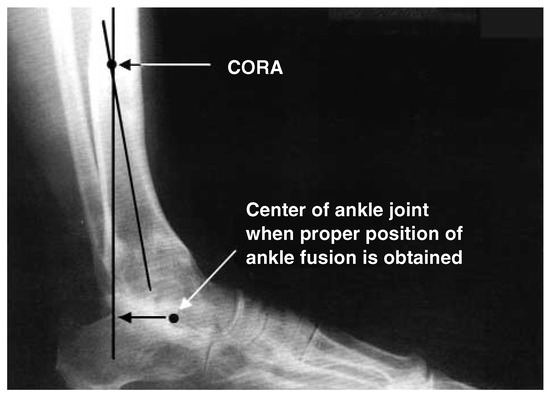
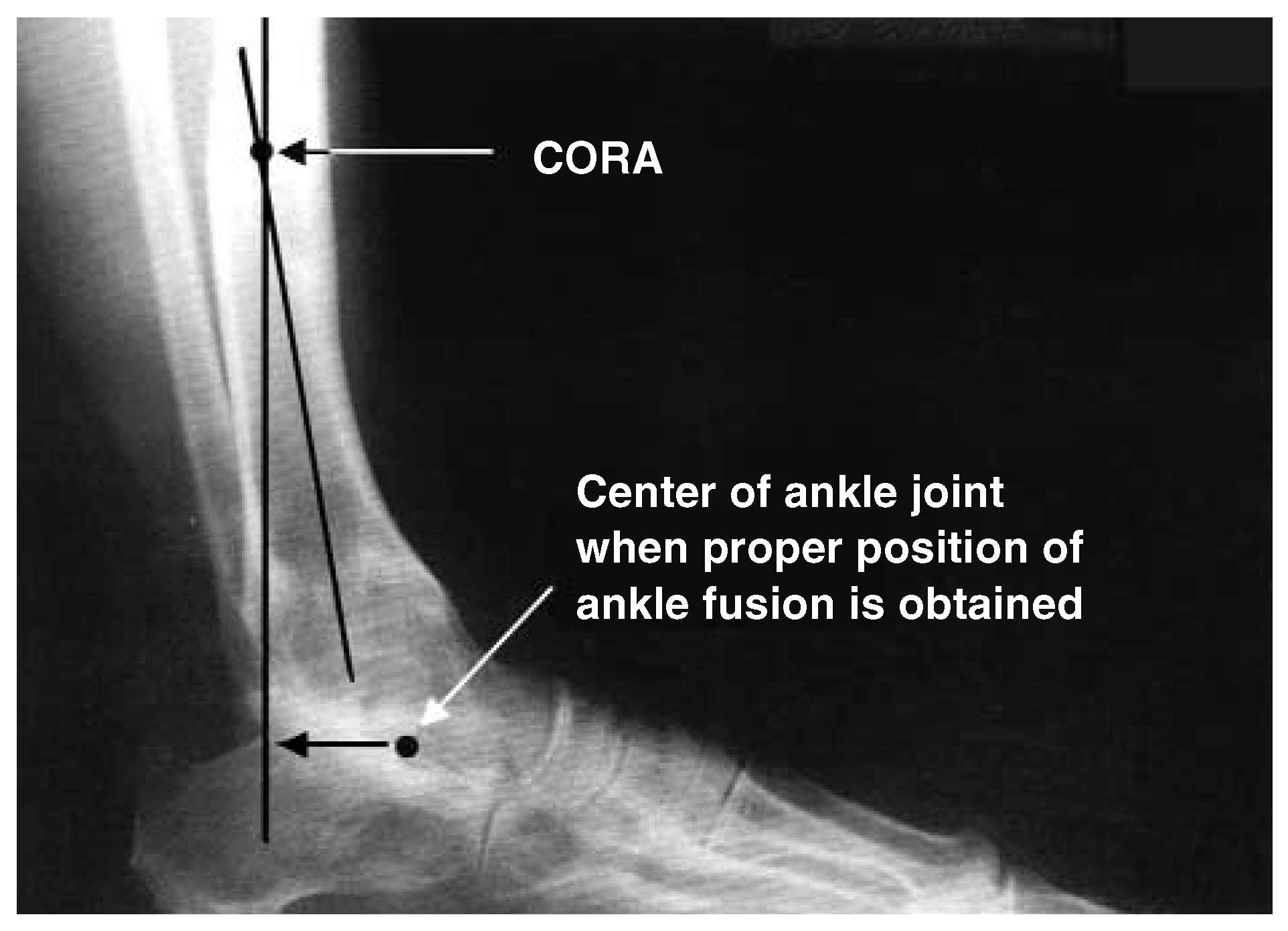
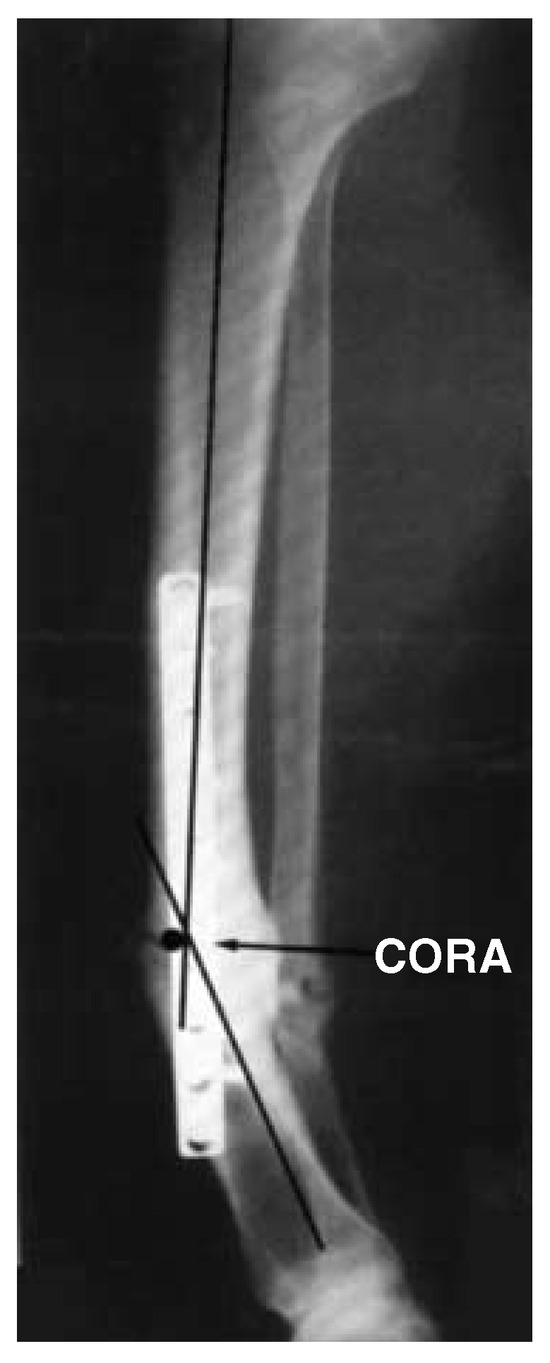
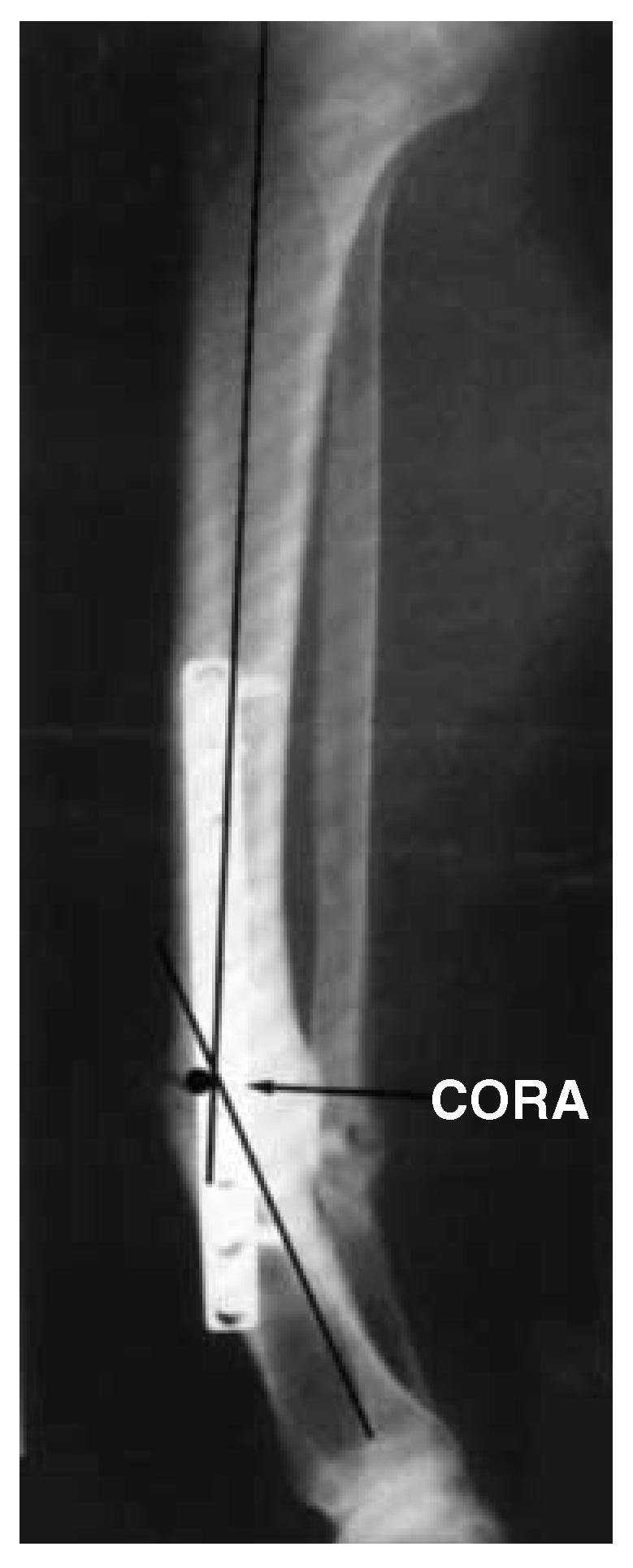
The multiple axes of the lower extremity are designed to function as a unit, and any deviation can have detrimental effects on the function of one or more joints, potentially leading to degeneration, dysfunction, or pain. In addition, inadequate surgical correction of any malalignment may result in continued symptoms and may exacerbate the degenerative process in adjacent joints (Fig. 1). Whether the malalignment was unrecognized before surgery or was iatrogenic, symptoms may not be evident for months to years after the surgical procedures. Therefore, it is essential to correctly assess lower-limb deformities before and during surgical reconstruction.
Figure 1.
Lateral radiograph of a patient referred for revisional surgery showing a malaligned ankle arthrodesis causing stress and degeneration of the joints of the midfoot. CORA, center of rotation of angulation.
Realignment principles should ensure that the ankle and rearfoot are aligned with the leg and that the forefoot is aligned with the rearfoot. Specific angular relationships are important in appropriately identifying the level (or levels) of deformity and its effect on limb function.[1] Foot, ankle, and lower-limb deformities are often multiplanar, so it is essential to evaluate the position in each plane during preoperative planning and surgical reconstruction.
Radiographic assessment should include frontal and sagittal plane views of the foot and leg and transverse plane views of the foot. Sagittal plane radiographs should include lateral views of the foot, ankle, and distal leg. The radiographic angles assessed should include 1) the anatomical anterior distal tibial angle, 2) the calcaneal inclination angle, 3) the talar declination angle, 4) the talocalcaneal angle, and 5) the talar–first metatarsal angle.
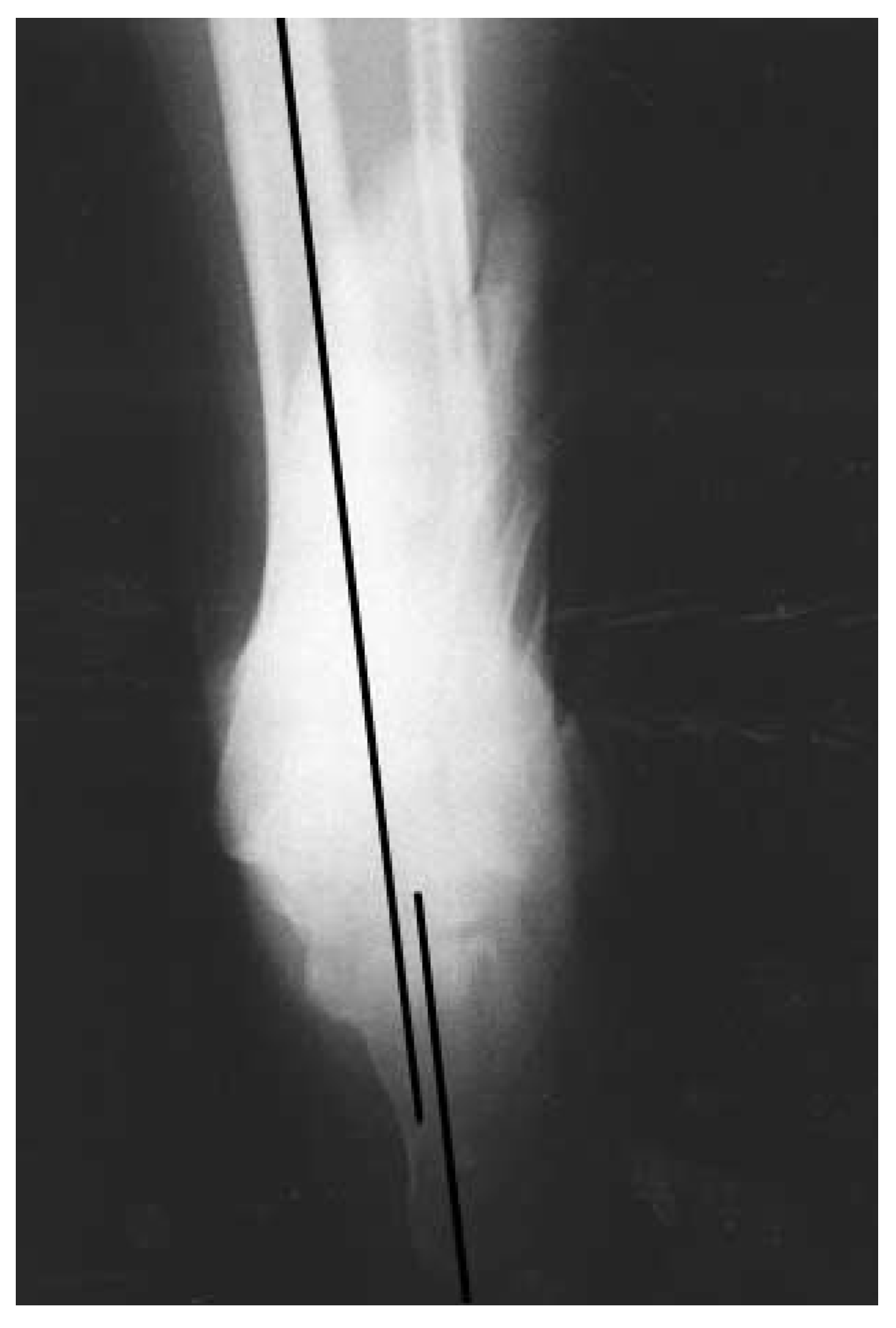
Frontal plane radiographs should include anteroposterior views of the ankle and distal leg. The long leg calcaneal axial view and the rearfoot alignment view are also important during assessment. The radiographic angles assessed are 1) the anatomical lateral distal tibial angle and 2) the mid-diaphyseal line of the tibia to the mid-diaphyseal line of the calcaneus. These measurements are used to comprehensively evaluate alignment during lower-limb, ankle, and rearfoot reconstruction. In addition, full-leg radiographs (tibia including knee and ankle) and, occasionally, hip radiographs (full leg from the ankle to the pelvis) are necessary for evaluation of the proximal limb and its potential pathology.
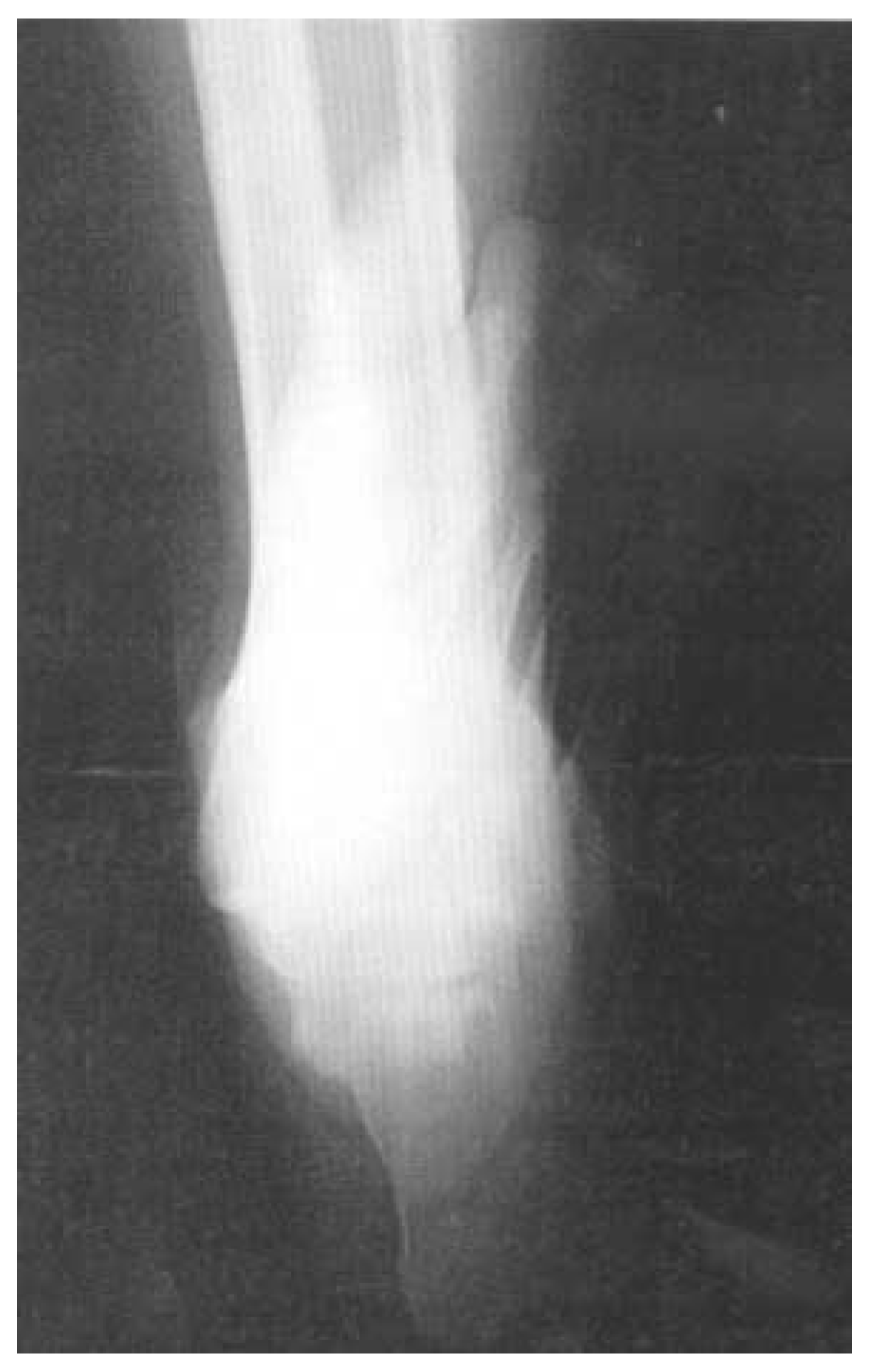
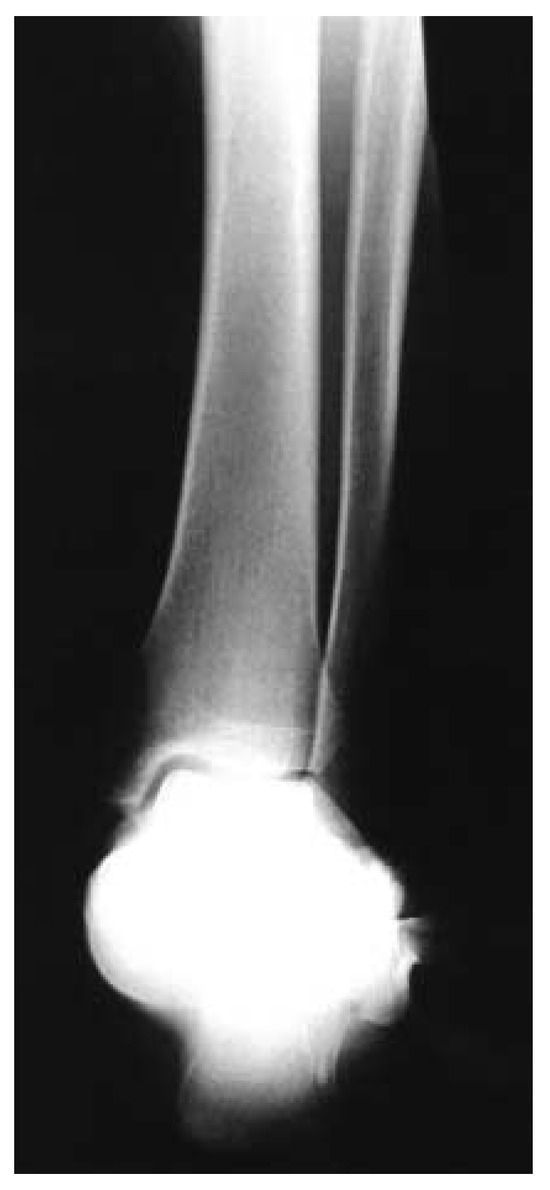
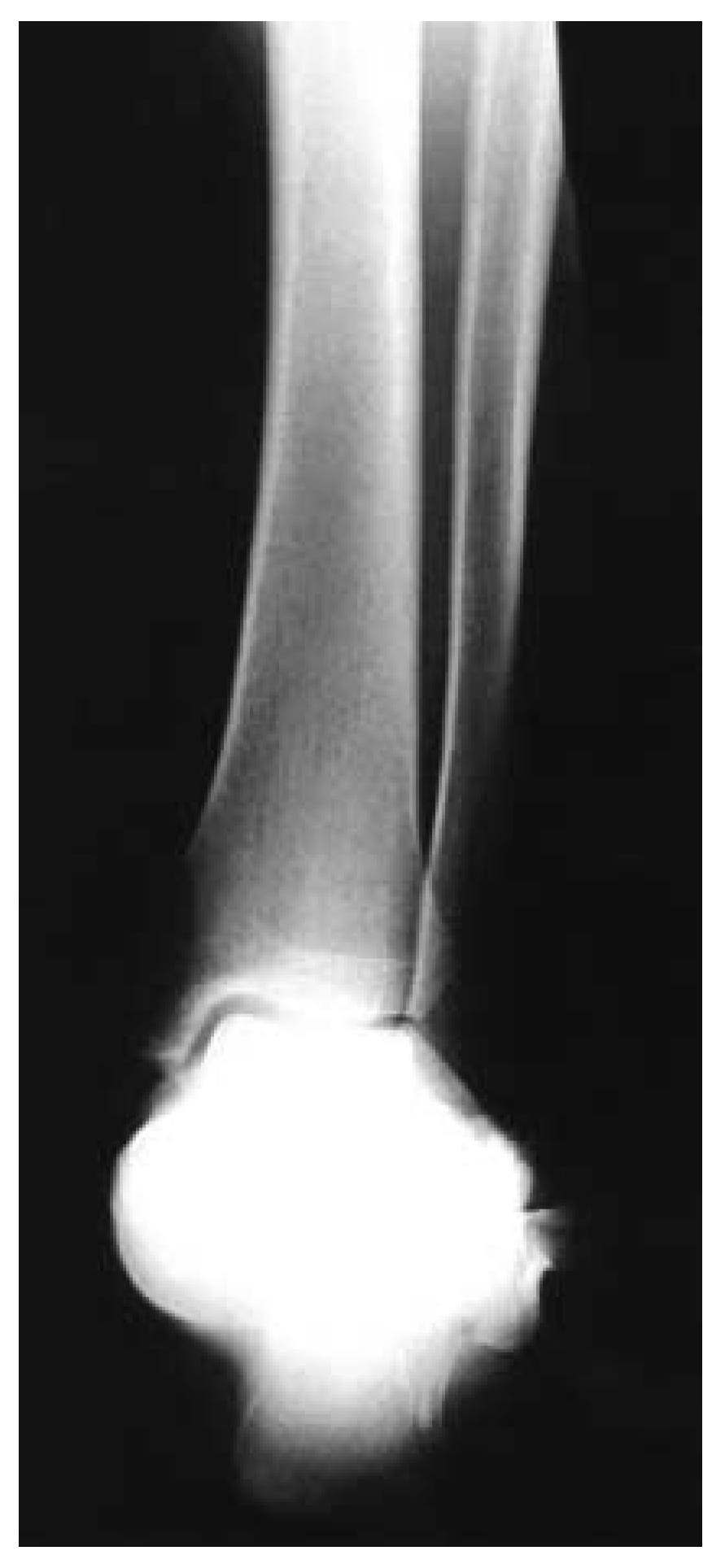
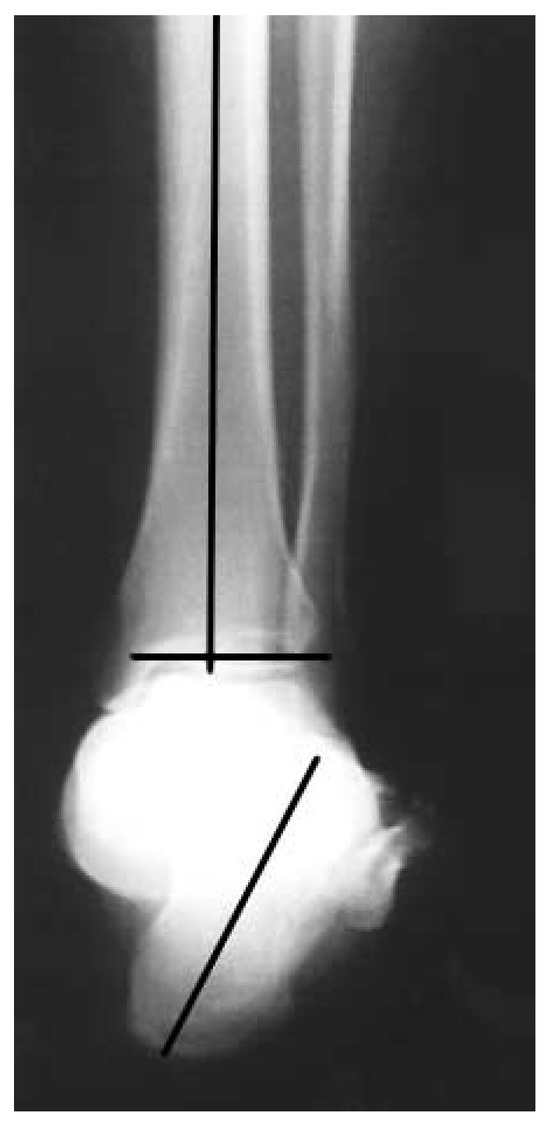
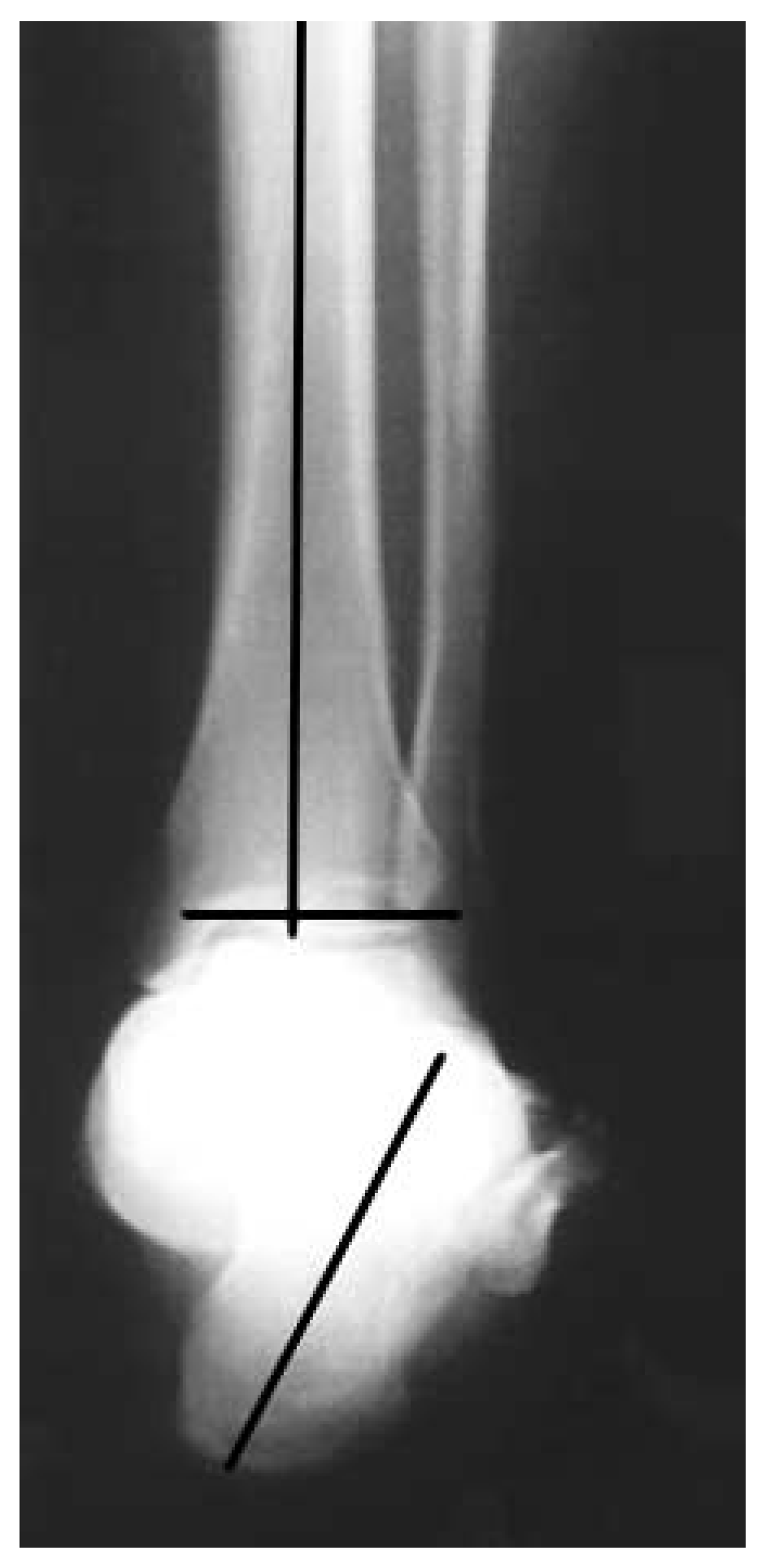
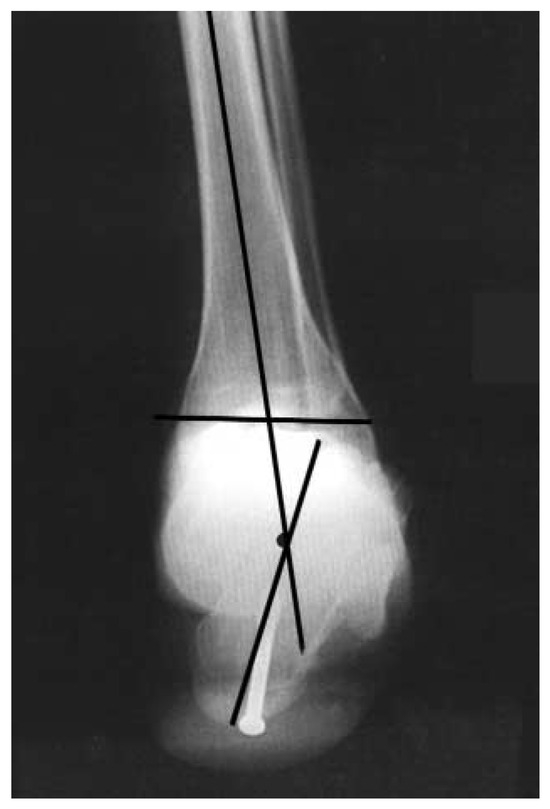
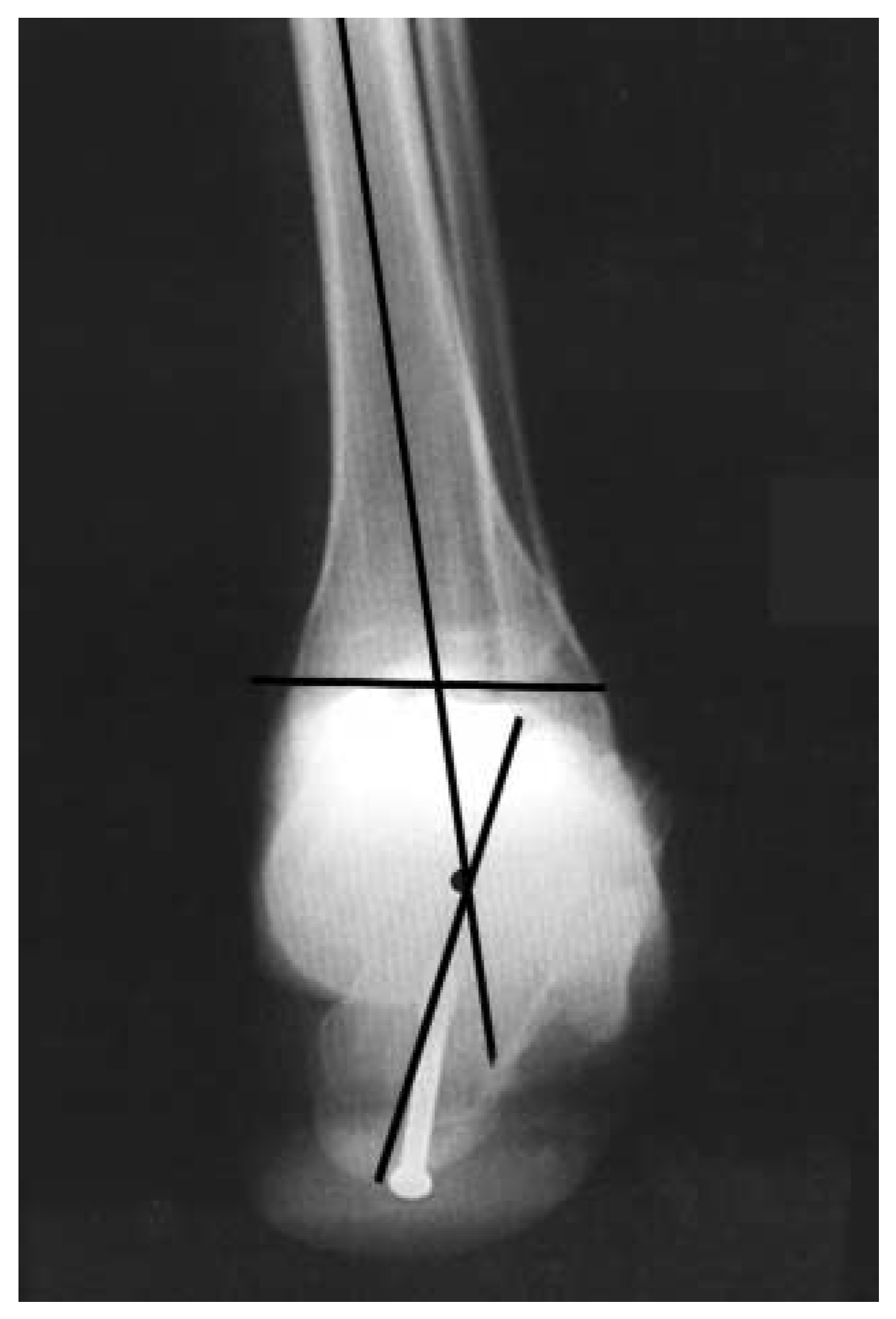
Specialty frontal plane images are being used more frequently and should be standard views when assessing the rearfoot. These projections are the long leg calcaneal axial and rearfoot alignment radiographs. The long leg calcaneal axial image shows the relationship of the calcaneus to the leg and best visualizes the subtalar joint (Fig. 2). The rearfoot alignment view also shows the relationship of the rearfoot to the leg but best visualizes the ankle joint (Fig. 3). Johnson et al[2] demonstrated intrarater and interrater reliability for the rearfoot alignment radiographs. Lamm et al[3] also showed the reliability of the long leg calcaneal axial and rearfoot alignment radiographs in evaluating resting calcaneal stance position. However, the literature provides limited information on use of these frontal plane radiographs when considering surgical reconstructive procedures of the foot and leg.
Figure 2.
Long leg calcaneal axial radiograph showing the relationship of the calcaneus to the anatomical axis of the tibia. This radiograph is also the best for visualizing the subtalar joint for deformity.
Figure 3.
Rearfoot alignment radiograph showing the relationship of the rearfoot to the anatomical axis of the tibia. This radiograph is also the best for visualizing the ankle joint for deformity.
The anteroposterior view of the foot allows one to evaluate for any transverse plane deformity. The radiographic angles assessed are the talar–first metatarsal angle and the talocalcaneal angle.
Angular assessment should be performed to determine the level of the deformity. The goal of any surgical procedure should be to restore these angles to realign the foot, ankle, and leg. It is important to adhere to realignment principles and to understand the radiographic assessment when performing procedures such as ankle, tarsal, or midfoot osteotomies and arthrodesis.
Radiographic Techniques
The standard anteroposterior and lateral radiographs of the foot and ankle are easily obtained in an office setting and are performed in a consistent manner. The lateral ankle and foot (sagittal plane radiograph) is best visualized if taken on a full 10 × 12-inch cassette and in such a way as to visualize the distal one-third of the tibia. If these radiographs are taken in the radiology department of the hospital, a larger (14 × 17-inch) film is helpful in visualizing more of the tibia.
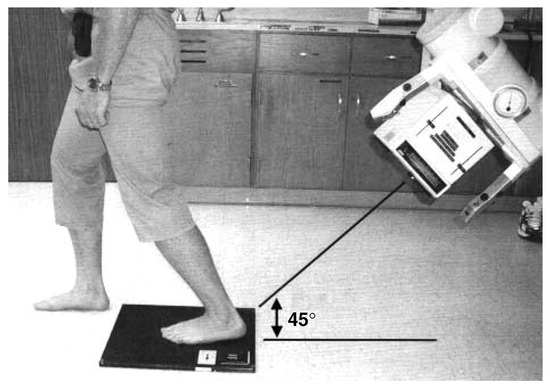
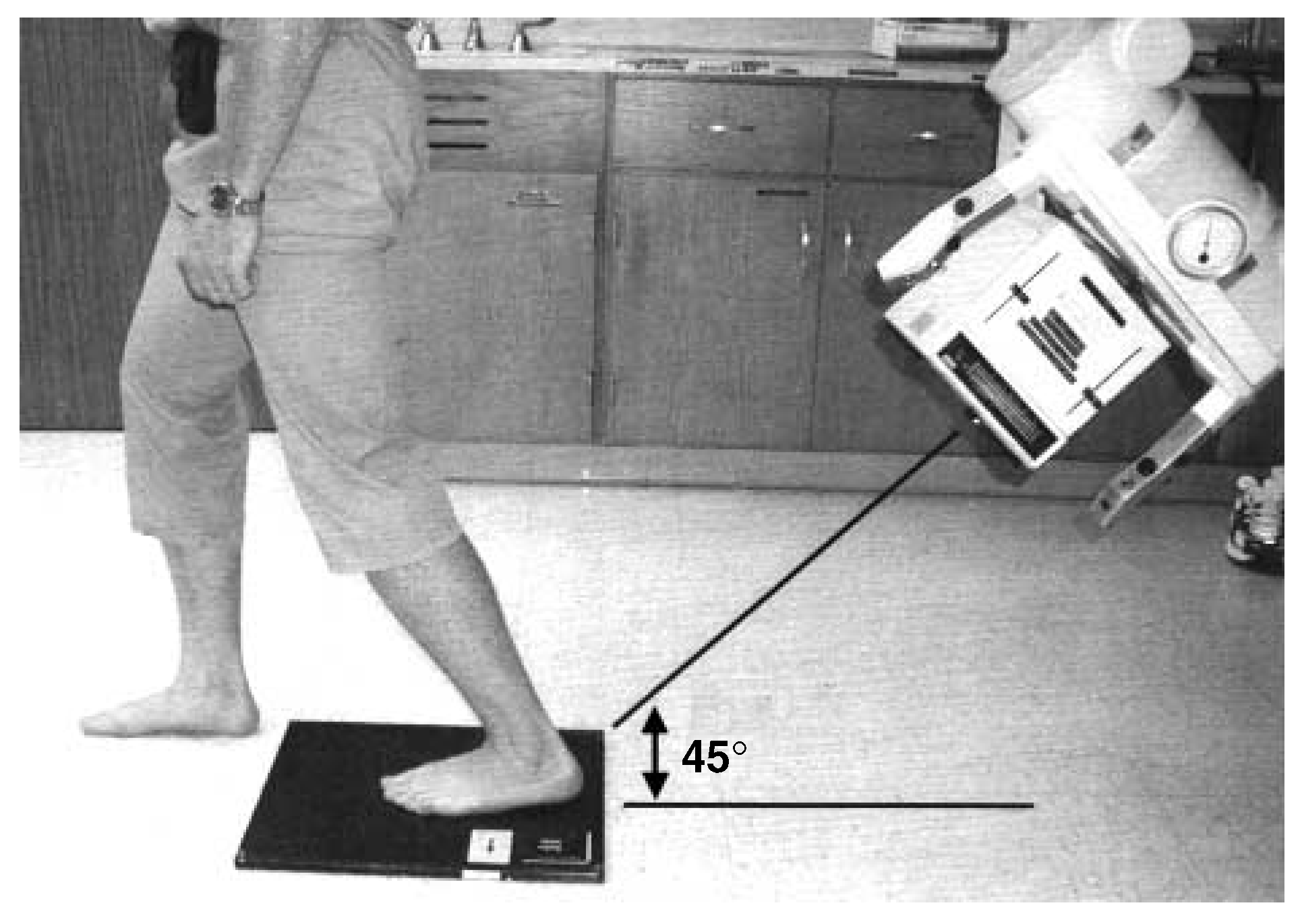
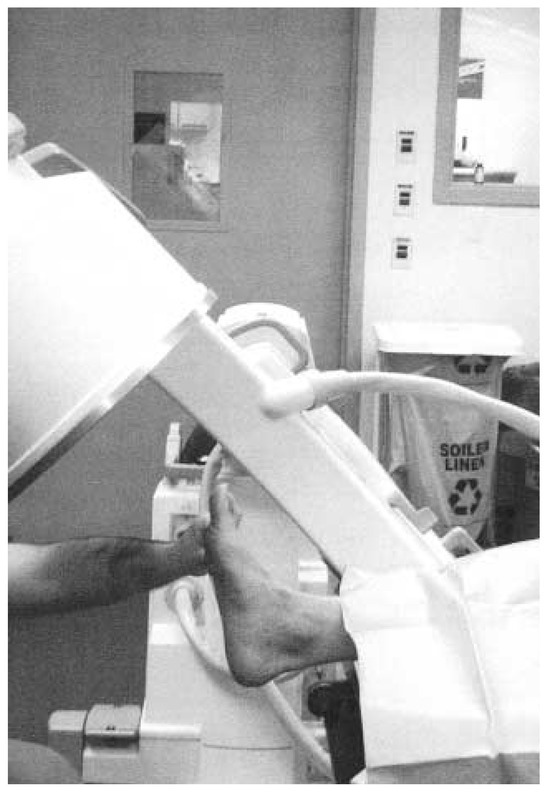
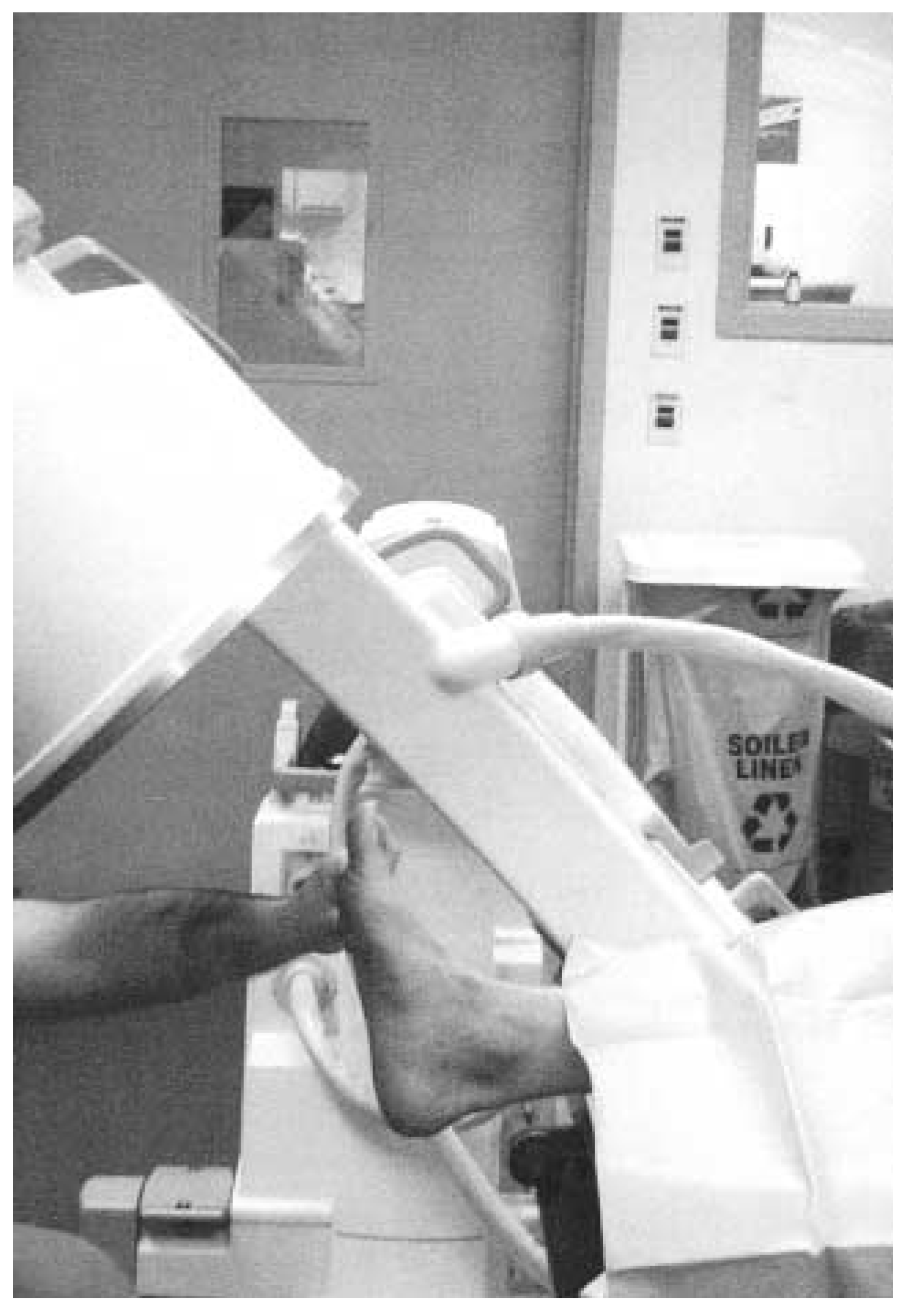
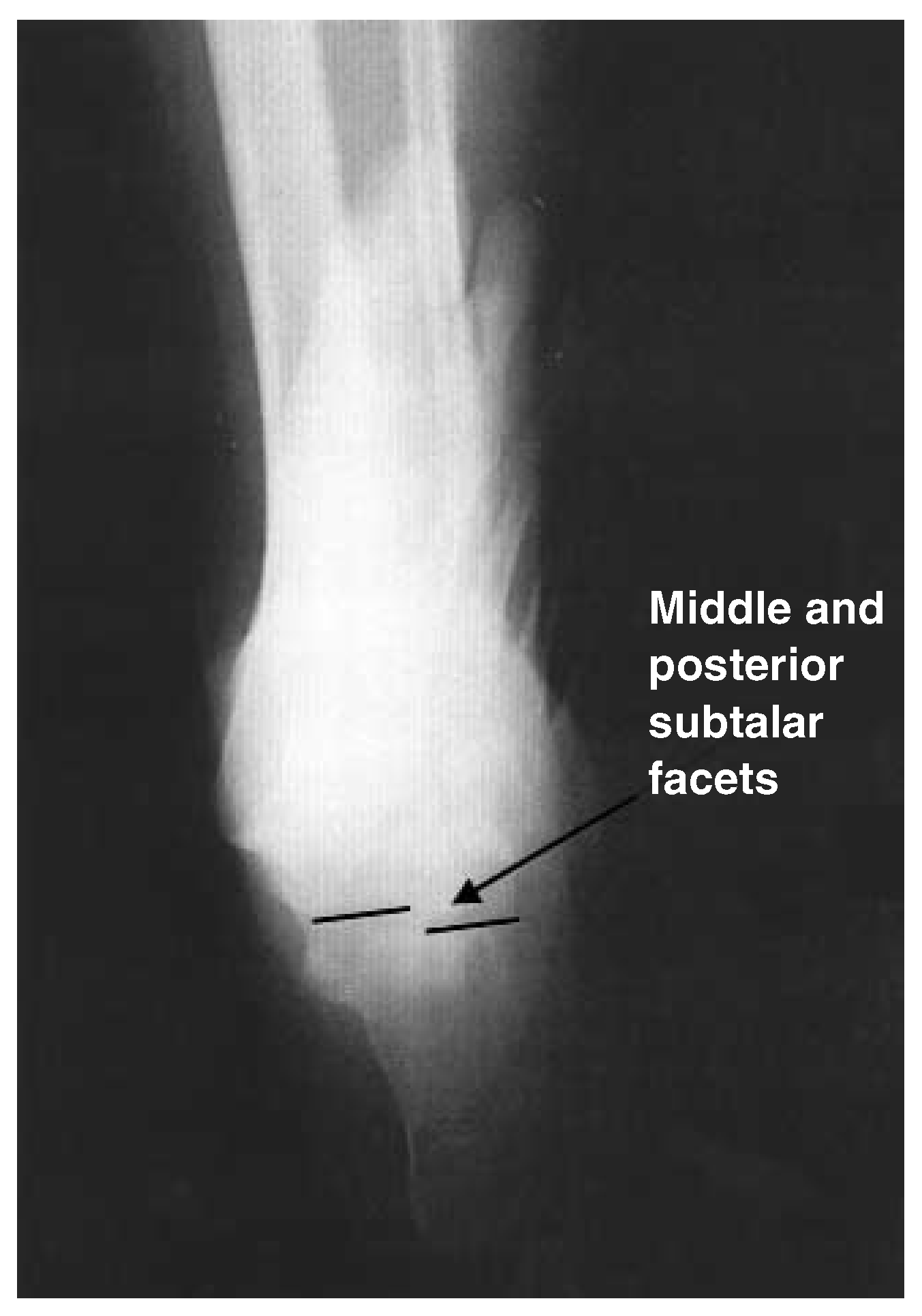
Frontal plane radiographs include the ankle anteroposterior view, the rearfoot alignment view, and the long leg calcaneal axial view. The ankle anteroposterior view is a standard radiograph. However, this view should include the distal one-third of the tibial shaft to determine the relationship of the tibia to the ankle joint. The radiograph is best when projected onto a 10 × 12-inch or larger cassette. The long leg calcaneal axial radiograph is a weightbearing frontal plane radiograph. The cassette is placed on the floor and the tube head is angled at 45° to the film (Fig. 4). This radiograph is preferably taken on a 14 × 17-inch x-ray film but can sometimes be captured on a 10 × 12-inch cassette. The x-ray beam is centered at the subtalar joint. The nonimaged foot is placed in front of the patient for balance. The imaged foot should have 10° of dorsiflexion at the ankle, and the knee should be extended. The radiographic settings should be 6.4 mA sec and 65 kVp. This allows one to visualize the subtalar joint (varus, valgus, and coalition assessment), the relationship of the calcaneus to the distal one-third of the tibia, and any deformity that may exist within the calcaneus itself (Fig. 2). The long leg calcaneal axial radiograph can be reproduced in the operating room with a beam passing from distal superior to proximal posterior. The beam should pass through the plantar aspect of the foot at an angle of 45° to the table (Fig. 5).
Figure 4.
Patient positioning for the long leg calcaneal axial radiograph.
Figure 5.
Intraoperative positioning for the fluoroscopic long leg calcaneal axial radiograph.
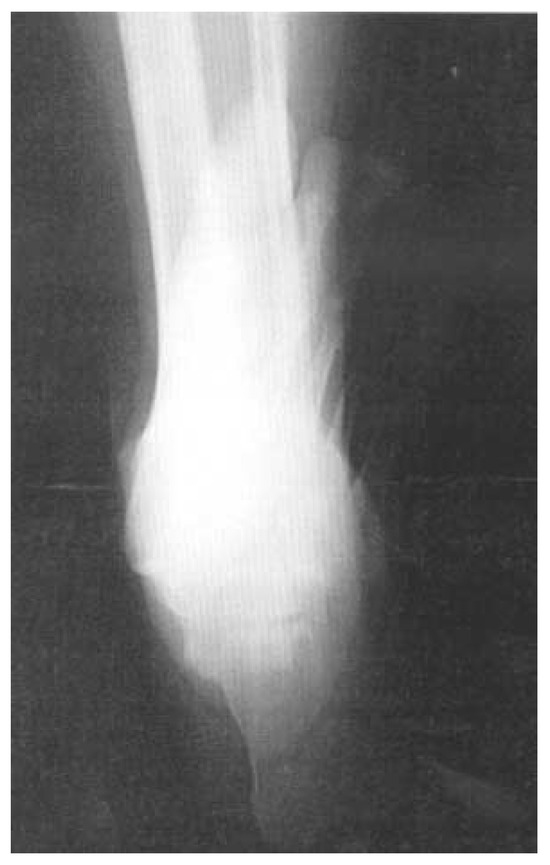
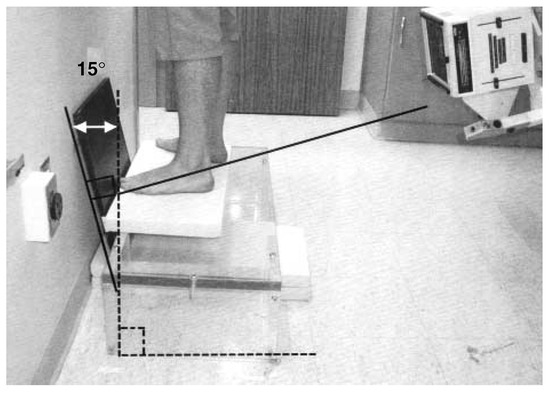
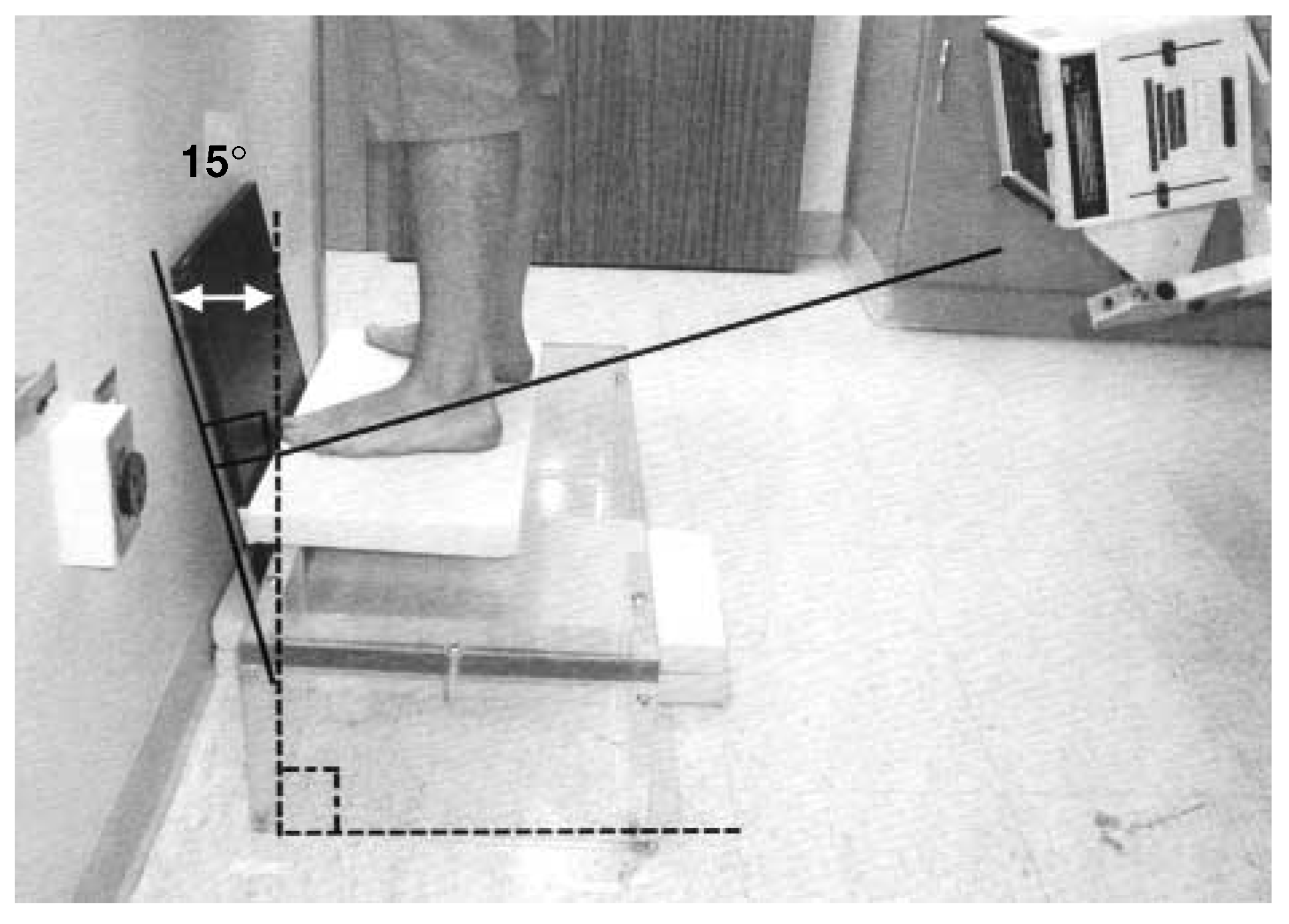
The rearfoot alignment view is also a weightbearing frontal plane radiograph.[2,4,5] It is taken with the tube head at 90° to the film cassette and centered on the ankle joint. The film cassette is angled 15° from vertical (Fig. 6). A special Plexiglas (Röhm, Darmstadt, Germany) platform is necessary to allow projection of the rearfoot onto the film. This may preclude performance of this view in the office or the hospital. The patient’s toes are placed against the cassette in the angle and base of gait. The midline of the foot should be perpendicular to the cassette. The ideal size of the film cassette is 14 × 17 inches. The radiographic settings should be 6.4 mA sec and 65 kVp. The rearfoot alignment view allows for visualization of the ankle joint space (varus or valgus assessment) and, like the long leg calcaneal axial view, shows the relationship of the calcaneus to the leg (Fig. 3).
Figure 6.
Patient positioning for the rearfoot alignment radiograph.
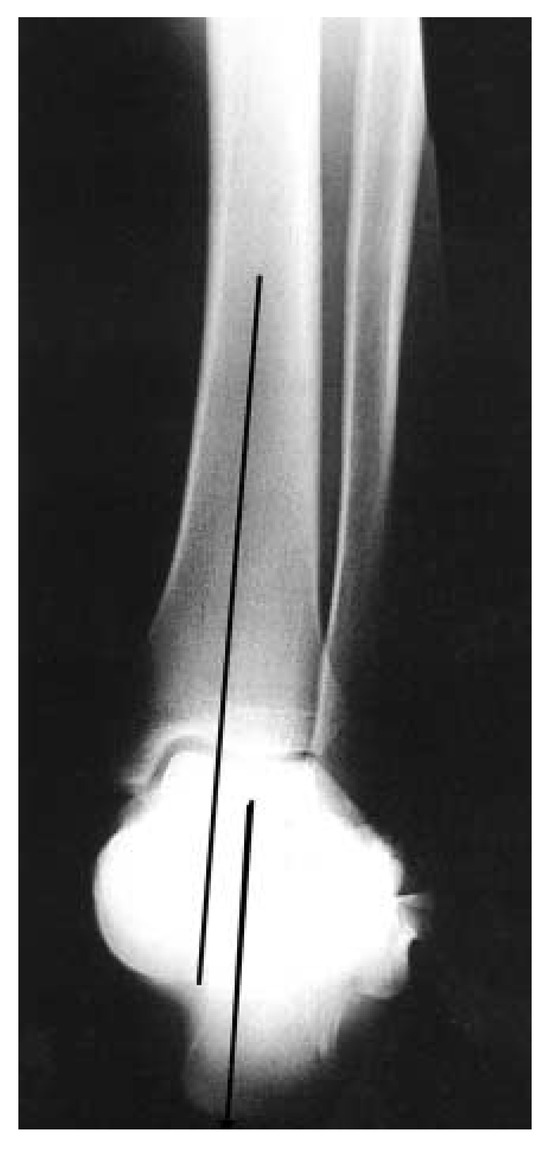
Evaluation of the rearfoot alignment and long leg calcaneal axial radiographs helps to determine the level of deformity. The rearfoot alignment view is used to determine distal tibial, ankle, or calcaneal deformities. If no tibial deformity exists and the ankle joint is congruous, the deformity must be distal to the ankle joint (Fig. 7). The long leg calcaneal axial view is used to evaluate calcaneal or subtalar joint deformities (Fig. 8). Deformities can present at multiple levels; therefore, a combination of these two views may be important to assess deformities at the distal tibia/ankle and subtalar joint/calcaneus.
Figure 7.
Rearfoot alignment radiograph demonstrating a deformity in the rearfoot distal to the ankle joint.
Figure 8.
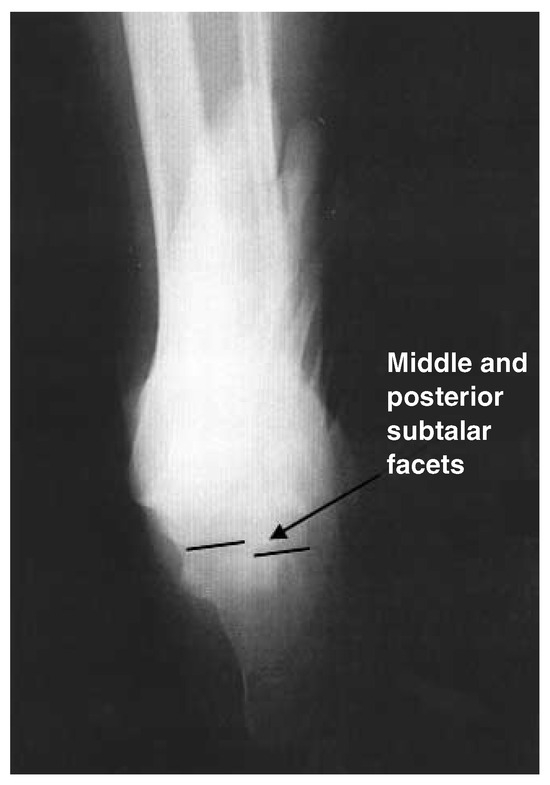
Long leg calcaneal axial radiograph demonstrating the ability to evaluate the subtalar joint. This particular radiograph shows a normal relationship between the middle and posterior facets.
If a proximal deformity is suspected, full-leg radiographs that include the knee and, in instances of limb-length discrepancy, the hip may be necessary. These radiographs should be taken with the patella facing forward.[6]
The weightbearing anteroposterior radiograph of the foot is used to evaluate the transverse plane. This is also a standard weightbearing radiograph. It is best when projected on a 10 × 12-inch cassette. The standard radiographic settings are 15 mA sec and 65 kVp. This radiograph allows evaluation of the relationships of the forefoot to the midfoot and the midfoot to the rearfoot.
Terminology
A few basic terms must be understood before beginning radiographic evaluation (modified from Paley[6]):
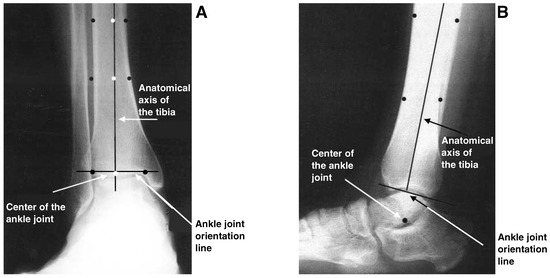
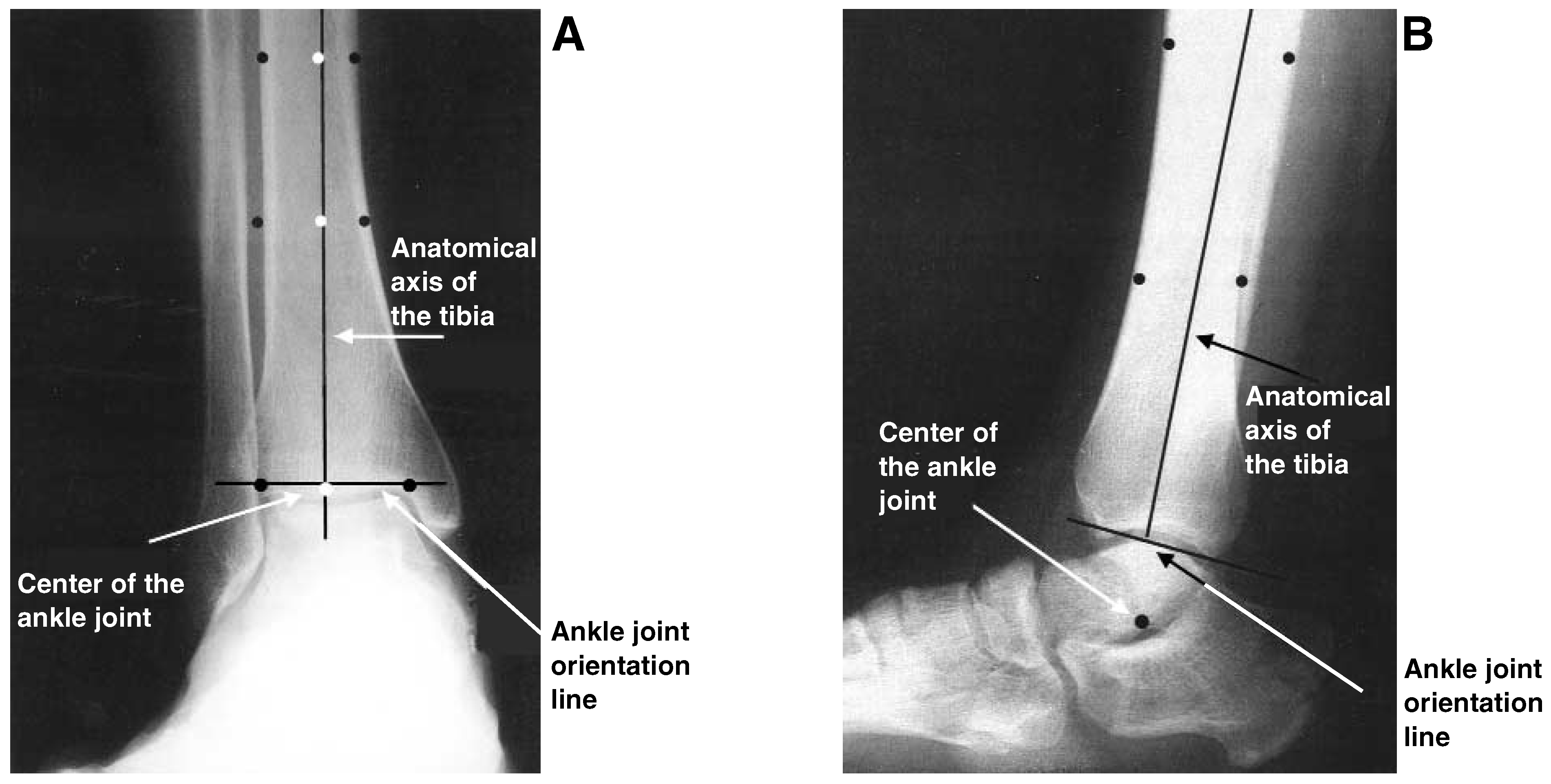
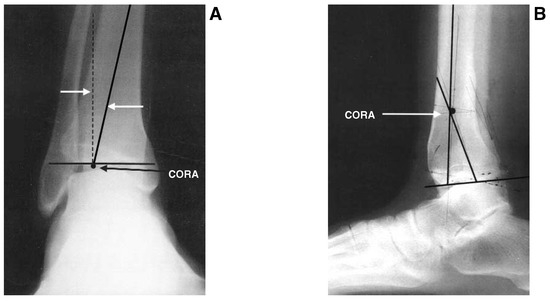
Center of the Ankle Joint (Fig. 9): On the anteroposterior radiograph of the ankle, it is the center point of the distal tibial colliculus and the lateralmost aspect of the tibial plafond or the center point of the talar dome. On the lateral ankle radiograph, it is represented by the lateral talar process when the foot is at 90° to the leg and no tibia deformity is present. This center point on a lateral radiograph should also be in line with the mid-diaphyseal line of the tibia.
Figure 9.
Anteroposterior (A) and lateral (B) radiographs of the ankle demonstrating key points in limb deformity evaluation.
Anatomical Axis of the Tibia (Fig. 9): The mid-diaphyseal line of the tibia.
Joint Orientation Line of the Ankle (Fig. 9): In the frontal and sagittal planes, it is a line represented by the distal tibial articular surface.
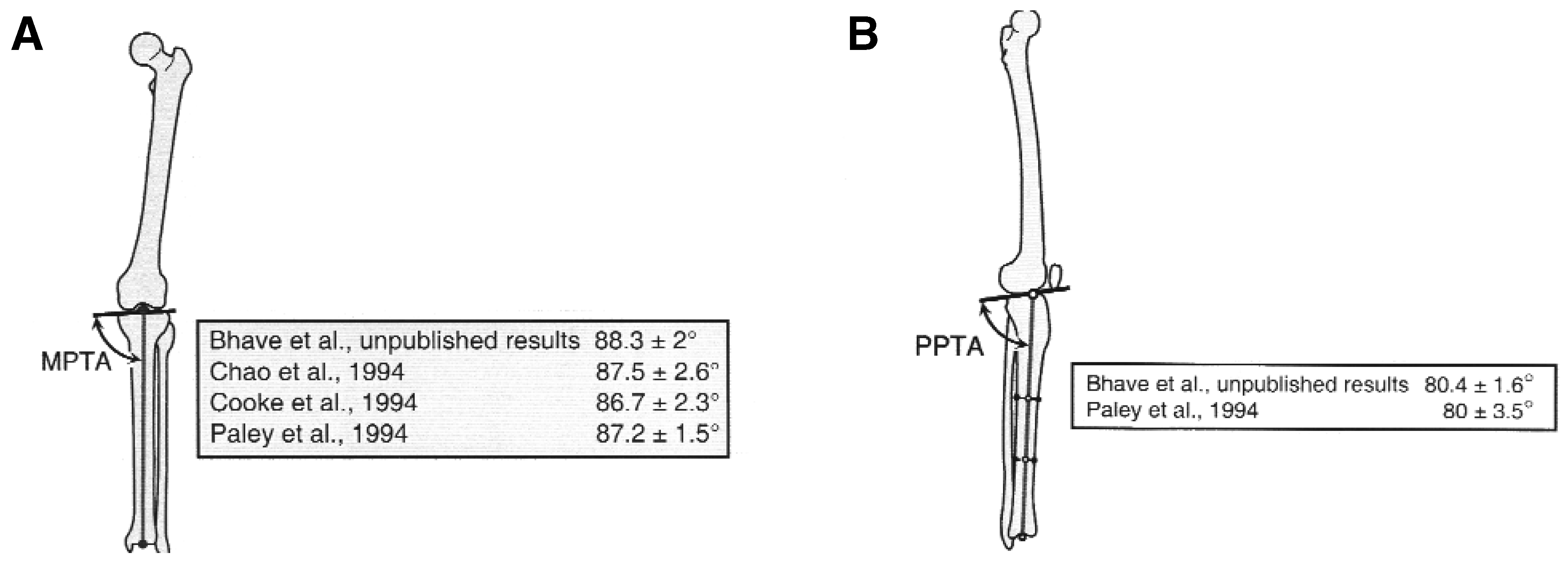
Joint Orientation Line of the Knee (Fig. 10): In the frontal and sagittal planes, it is a line through the tibial plateau.
Figure 10.
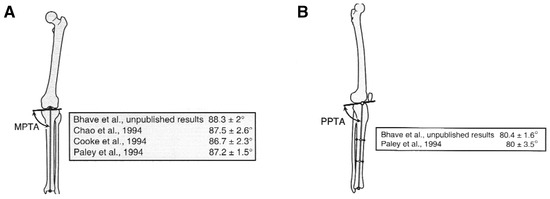
Anteroposterior radiographic angles of the tibia (A) and lateral radiographic angles of the ankle (B) demonstrating proximal tibial assessment for deformity. (Reprinted with permission from Paley.[8]) MPTA, medial proximal tibial angle; PPTA, posterior proximal tibial angle.
Joint Orientation Angle (Fig. 9): The angle formed between the anatomical axis of the tibia and the joint line, whether in the frontal or sagittal plane.
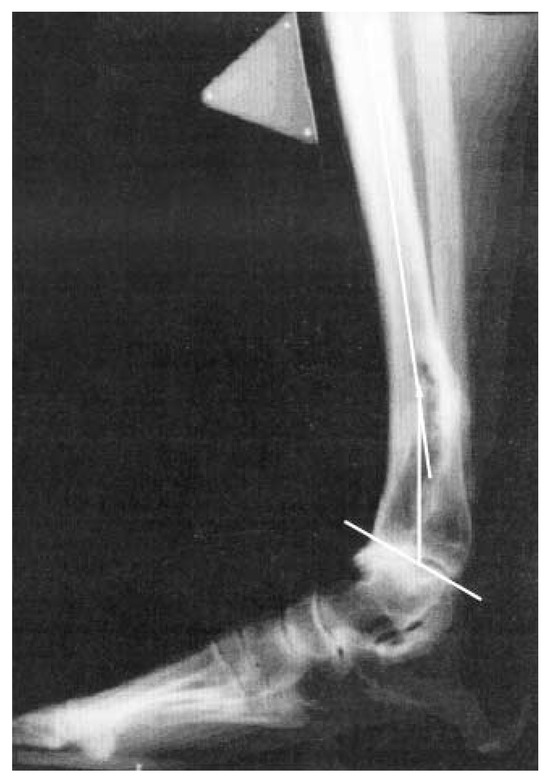
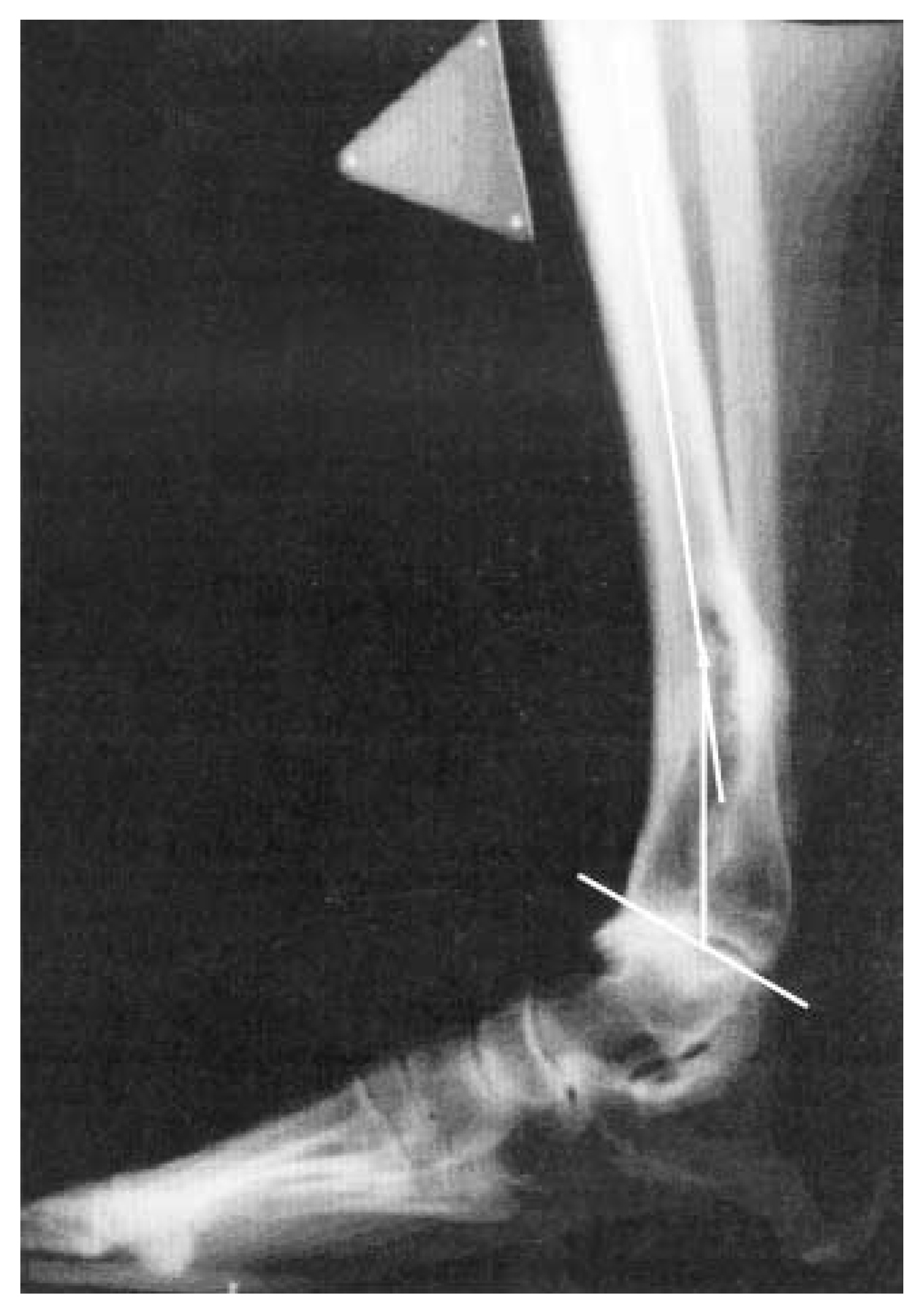
Recurvatum Deformity: A joint deformity that occurs when the cartilage articulates in a more posterior position than normal. The cartilage, therefore, is oriented in a more anterior direction than normal (decreased anterior distal tibial angle) (Fig. 11).
Figure 11.
Lateral radiograph of a patient referred for ankle pain showing a distal tibial deformity resulting in a recurvatum ankle deformity. Note that the anterior distal tibial angle is decreased. (Reprinted with permission from Paley.[8])
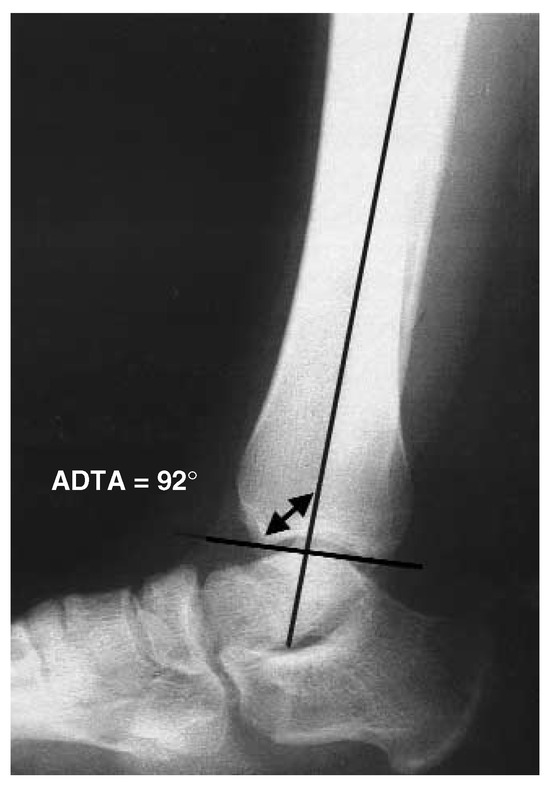
Procurvatum Deformity: A joint deformity that occurs when the cartilage articulates in a more anterior position than normal. The cartilage is oriented in a more posterior direction than normal (increased anterior distal tibial angle) (Fig. 12).
Figure 12.
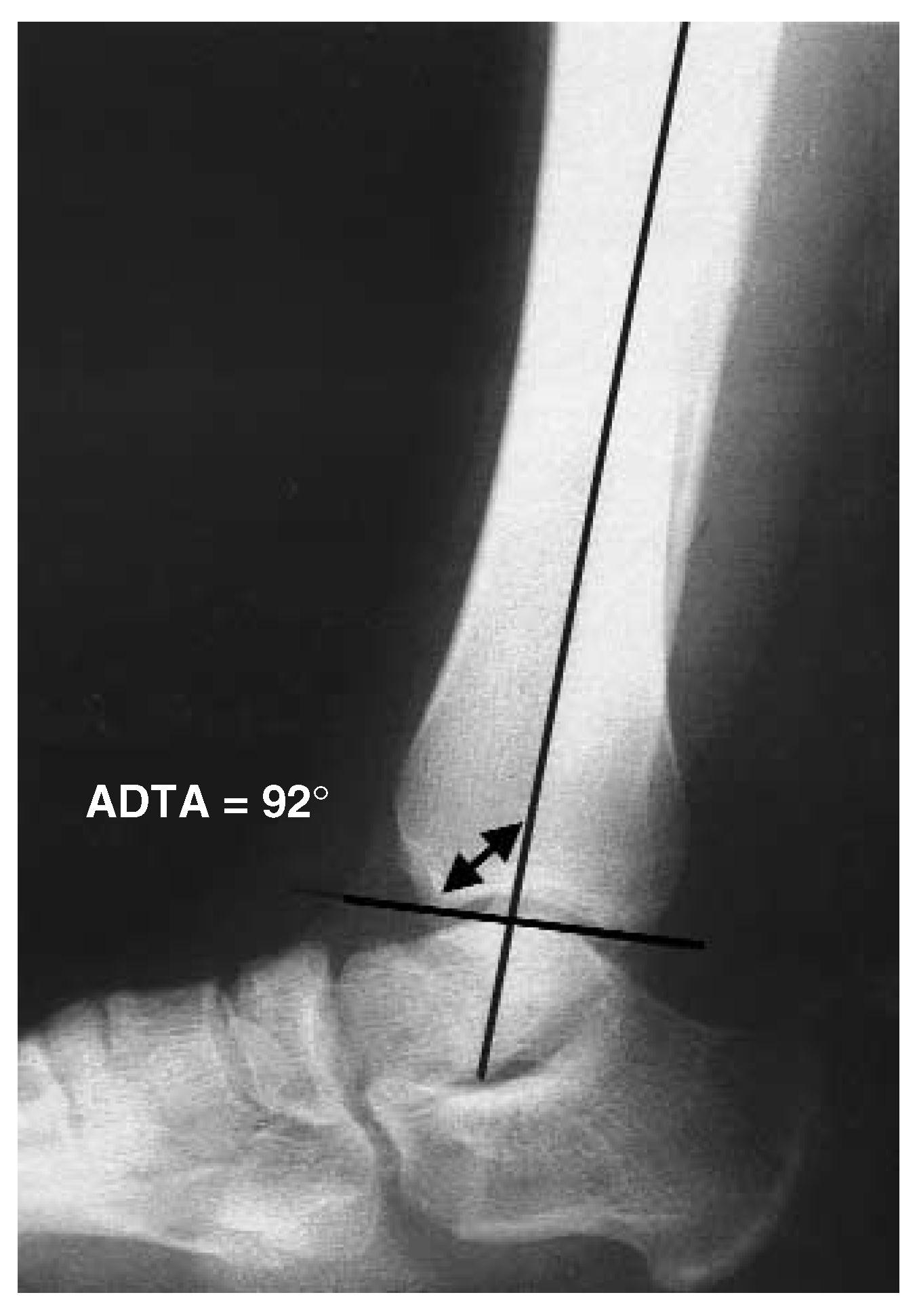
Lateral radiograph showing a procurvatum ankle deformity. Note that the anterior distal tibial angle (ADTA) is increased.
Angles
Frontal Plane
Medial Proximal Tibial Angle (Figure 10A): The angle formed by the anatomical axis of the tibia and the joint orientation line of the knee in the frontal plane (mean ± SD normal, 87° ± 2.5°).
Lateral Distal Tibial Angle: The angle formed by the anatomical axis of the tibia and the joint orientation line of the ankle in the frontal plane (mean ± SD normal, 89° ± 3°). This can be measured and evaluated on Figure 9A.
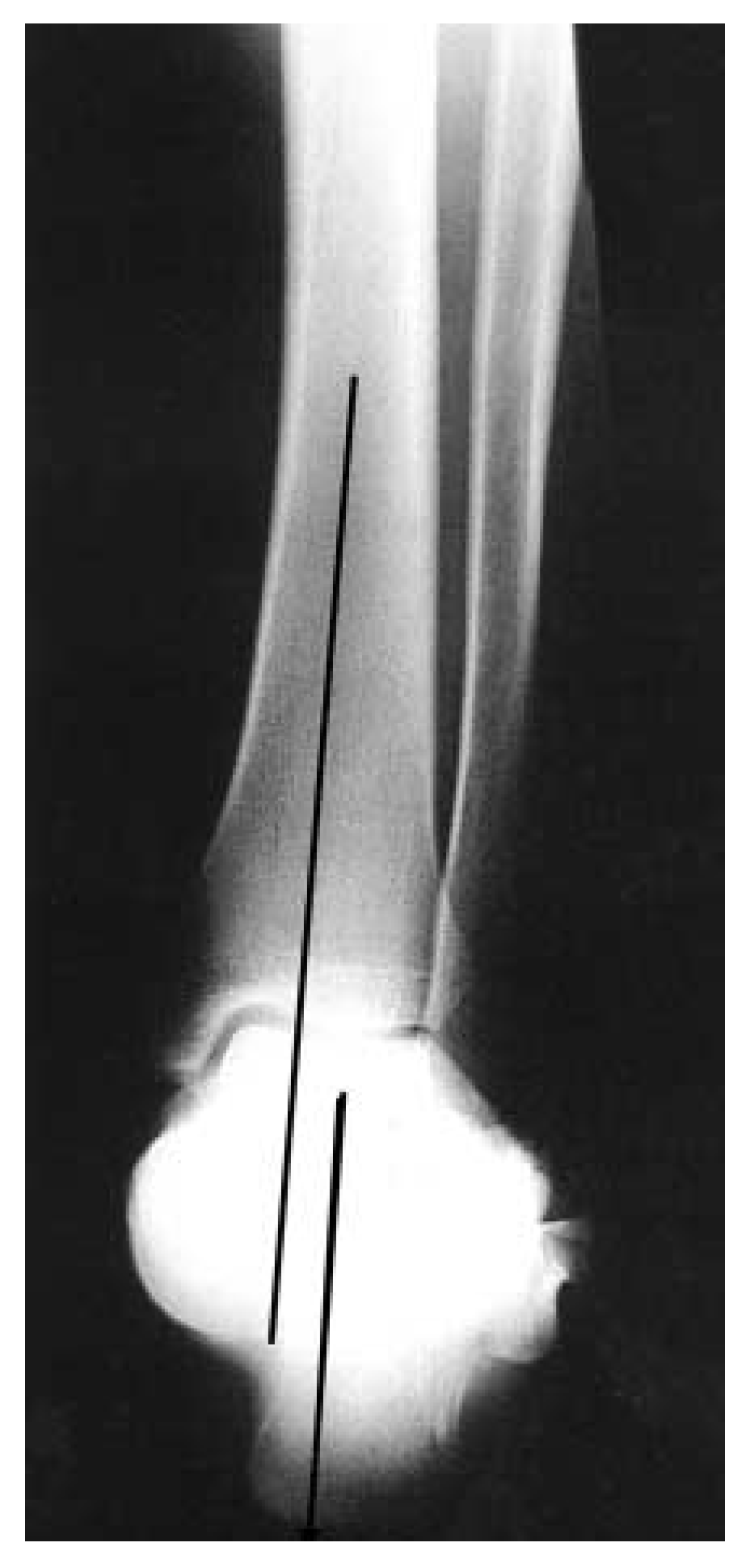
Tibial Calcaneal Angle: The angle formed by a line representing the mid-diaphyseal line of the tibia and a line representing the mid-diaphyseal line of the calcaneus as measured on the long leg calcaneal axial and rearfoot alignment views. The bisection of the calcaneus should be parallel to the mid-diaphyseal line but lateral to it by 5 to 10 mm (normal, 0° or parallel) (Fig. 13).
Figure 13.
Normal rearfoot alignment radiograph demonstrating the anatomical axis of the tibia parallel to the calcaneal bisection. Note that the tibial anatomical axis passes through the center of the talus and that the calcaneal bisection line is 5 to 10 mm lateral to the tibial line.
Sagittal Plane
Posterior Proximal Tibial Angle (Figure 10B): The angle formed by the anatomical axis of the tibia and the joint orientation line of the knee in the sagittal plane (mean ± SD normal, 81° ± 4°).
Anterior Distal Tibial Angle: The angle formed by the anatomical axis of the tibia and the joint orientation line of the ankle in the sagittal plane (mean ± SD normal, 80° ± 3°). This can be measured and evaluated on Figure 9B.
Calcaneal Inclination Angle: The angle formed by the line from the plantar aspect of the calcaneocuboid joint to the plantar medial calcaneal tubercle and a line representing the weightbearing surface of the foot (normal, 18° to 20°).
Talar–First Metatarsal Angle: The angle formed by a line bisecting the talar neck and a line bisecting the first metatarsal on the lateral view. These lines should be parallel (normal, 0° or parallel).
Talocalcaneal Angle: The angle formed between a line connecting the plantar aspect of the calcaneo-cuboid joint and the plantar medial calcaneal tubercle and a line bisecting the talar neck on the lateral view (normal, 25° to 45°).
Transverse Plane
Talocalcaneal Angle: The angle formed between a line bisecting the calcaneus and a line bisecting the talar neck on the anteroposterior view (normal, 20° to 35°).
Talar–First Metatarsal Angle: The angle formed by a line bisecting the talar neck and a line bisecting the first metatarsal on the anteroposterior view. These lines should be parallel.
Radiographic Assessment
Deformity planning is easiest when performed in a systematic manner from proximal to distal. It is imperative to thoroughly evaluate all radiographs, because there can be more than one level or location of deformity. It is best to draw all of the axis lines and to measure the angles before beginning to evaluate the radiographs. The deformity and its corrective procedure then become evident by processing all of this information at once.
When performing the systematic approach, one should start with the anteroposterior radiograph of the ankle. Attention can be directed to the distal one-third of the tibia if no gross deformity is noted. The mid-diaphyseal line (anatomical axis) of the tibia is found in much the same way as one would evaluate the first metatarsal. Two bisection points are identified proximally and distally on the medial and lateral cortices, and a line bisecting these two points forms the axis (Figure 9A). This line should pass through the center or just medial to the center of the ankle joint. A joint orientation line is drawn, and the lateral distal tibial angle is measured.
One can obtain the same axis on the rearfoot alignment view. This anatomical axis of the tibia should pass through the midline of the talus (Fig. 13). The calcaneal bisection line should be parallel to this axis and should fall just lateral to this bisection of the tibia by 5 to 10 mm. This view allows visualization of the ankle joint and evaluation of the relationships of the tibia to the calcaneus and the calcaneus to the ground.
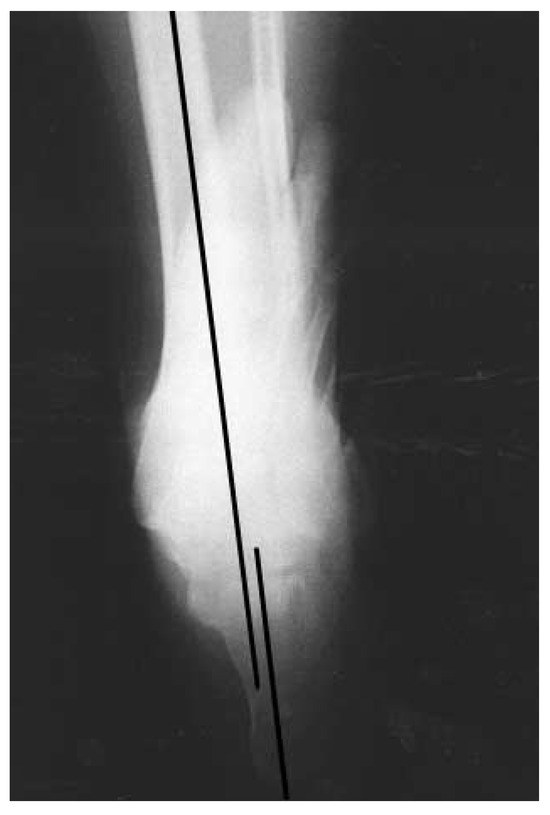
The long leg calcaneal axial view is also used to assess the frontal plane relationship of the calcaneus to the long axis of the tibia. In addition, it allows good visualization of the subtalar joint. The calcaneal bisection should be parallel to the distal one-third of the tibial bisection (Fig. 14).[7] The middle and posterior subtalar facets are easily visualized on this radiograph. Normally, these facets are parallel to one another.
Figure 14.
Normal radiograph of a long leg calcaneal axial view.
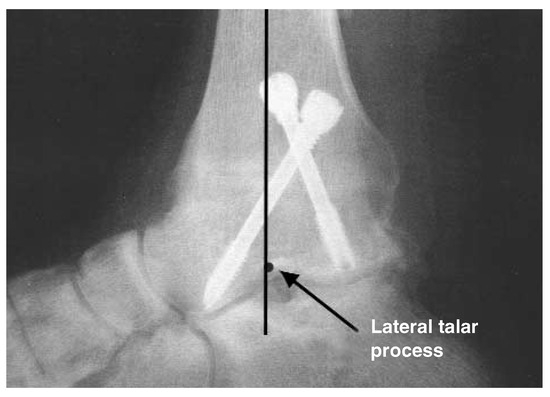
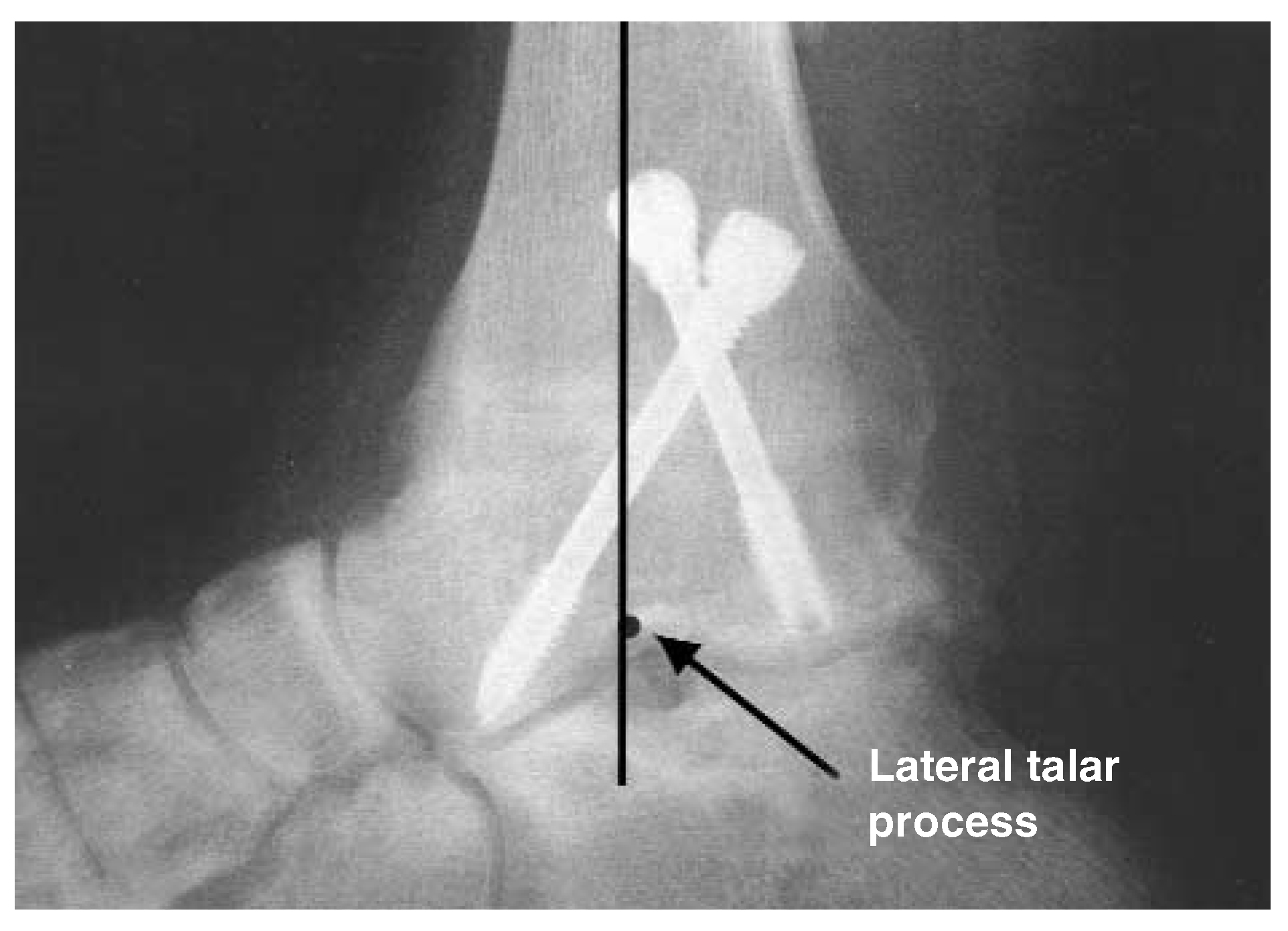
In the sagittal plane, the mid-diaphyseal line of the tibia (anatomical axis) is drawn. The anatomical axis in the normal extremity should pass through the lateral process of the talus. The lateral talar process is the center point of the ankle joint range of motion when the foot is perpendicular to the leg in the sagittal plane.[8] This relationship is important when performing ankle arthrodesis or a distal tibial osteotomy (Fig. 15). The anterior distal tibial angle is formed by the anatomical axis of the tibia and the joint orientation line. The lateral foot radiograph is also used for sagittal plane evaluation. The lateral talar–first metatarsal angle, the lateral talocalcaneal angle, and the calcaneal inclination angle are measured on this view.
Figure 15.
Lateral radiograph showing proper positioning of the lateral talar process, as it is positioned directly in line with the anatomical axis line of the tibia.
The anteroposterior view of the foot is used to evaluate the transverse plane. The talocalcaneal and talar–first metatarsal angles are then measured on the anteroposterior view of the foot as previously described.
Biomechanical Considerations of the Angular Relationships
Once these angular relationships are known, it is easier to understand how the foot functions in relation to the leg. In the frontal plane, the medial proximal tibial angle is essentially 3° in varus (medial proximal tibial angle, 87°), and tibialis anterior and the extensors fire during the swing phase of gait, causing the heel to contact laterally at strike. Because of this varus attitude, tendon firing, and the calcaneal bisection being lateral to the tibial axis, the heel will evert at strike to midstance. Once the weight is transferred anteriorly on the foot with progression, the heel will invert because all of the long flexors are medial and provide the foot stability during push-off.
In the sagittal plane, the proximal and distal tibia articular surfaces are sloped at roughly 20° to the axis of the tibia, which does not make sense biomechanically for weightbearing (posterior proximal tibial angle, 81°; anterior distal tibial angle, 80°). However, it makes logical sense when one considers when the stability is necessary during gait. This occurs in single-limb weightbearing from heel strike to midstance. During this period, the knee is flexed approximately 20° and the ankle is dorsiflexed at 20°, thus having the widest part of the talus (anterior talus) in contact with the tibia and giving the ankle maximum stability. It is at this time that the proximal and distal tibial articulations are parallel to the weightbearing surface, thus providing stability to the limb.
Finding the Center of Rotation of Angulation
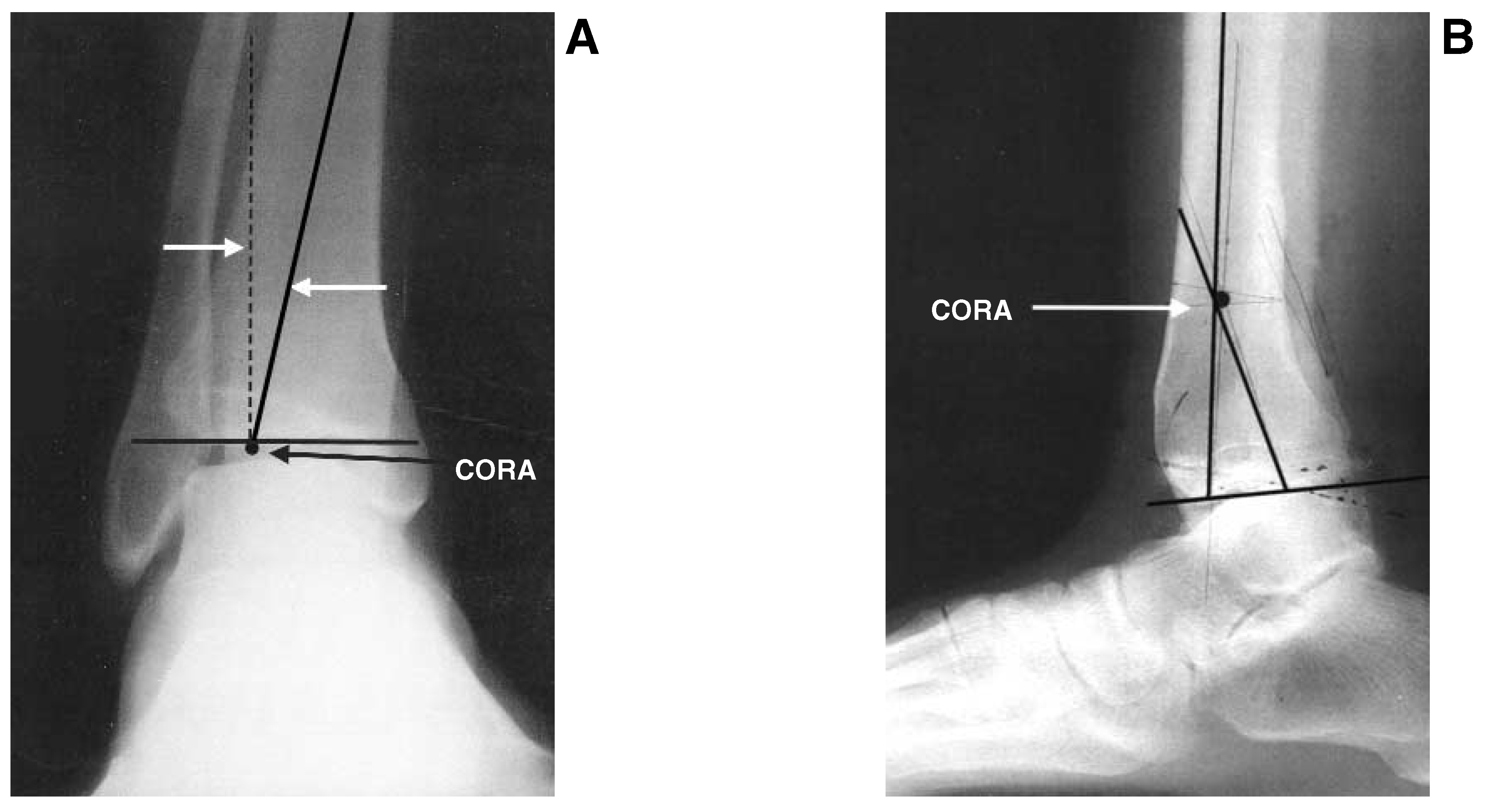
Deformities typically are located at the center of rotation of angulation.[9] The center of rotation of angulation is found at the intersection of the proximal tibial anatomical axis and the distal tibial anatomical axis in either the frontal or the sagittal plane (Fig. 16). The center of rotation of angulation can also be found in the rearfoot at the intersection of the bisection of the calcaneus and the anatomical axis of the tibia on the rearfoot alignment or long leg calcaneal axial radiograph (Fig. 17). It can also be found in the foot with any abnormal angular relationships. The goal of any angular correction is to perform an osteotomy, arthrodesis, or corrective procedure as close as possible to the level of the center of rotation of angulation to prevent or minimize translation.
Figure 16.
Sagittal plane assessment of the center of rotation of angulation (CORA). The anatomical axis is plotted above and below the deformity. The intersection of these lines is the location of the CORA.
Figure 17.
Rearfoot alignment radiograph demonstrating a center of rotation of angulation located in the rearfoot. Note the normal lateral distal tibial angle but the abnormal calcaneal-to-tibial relationship.
The center of rotation of angulation may not be grossly obvious, especially when it is near the joint or is articular. Deformities that are distal or proximal to the joint can be identified by finding the anatomical axis of the midshaft of the tibia and the respective joint orientation line. When an abnormal angle is found near a joint, draw a normal angle from the joint line. When near the ankle, the line should originate from the center of the joint. The intersection point of the normal joint reference angle and the anatomical axis is the center of rotation of angulation (Fig. 18). A similar method can be used to analyze proximal tibial deformities.
Figure 18.
A, Frontal plane assessment of an intra-articular or near articular center of rotation of angulation (CORA). The ankle joint line and anatomical axis are plotted. A normal angle is then drawn from the ankle joint. The magnitude of the angle created between the normal line and the anatomical axis line is the magnitude of the CORA. B, Sagittal plane assessment of an intra-articular or near articular CORA. The ankle joint line and anatomical axis are plotted. A normal angle is then drawn from the ankle joint. The magnitude of the angle created between the normal line and the anatomical axis line is the magnitude of the CORA.
Radiographic Findings
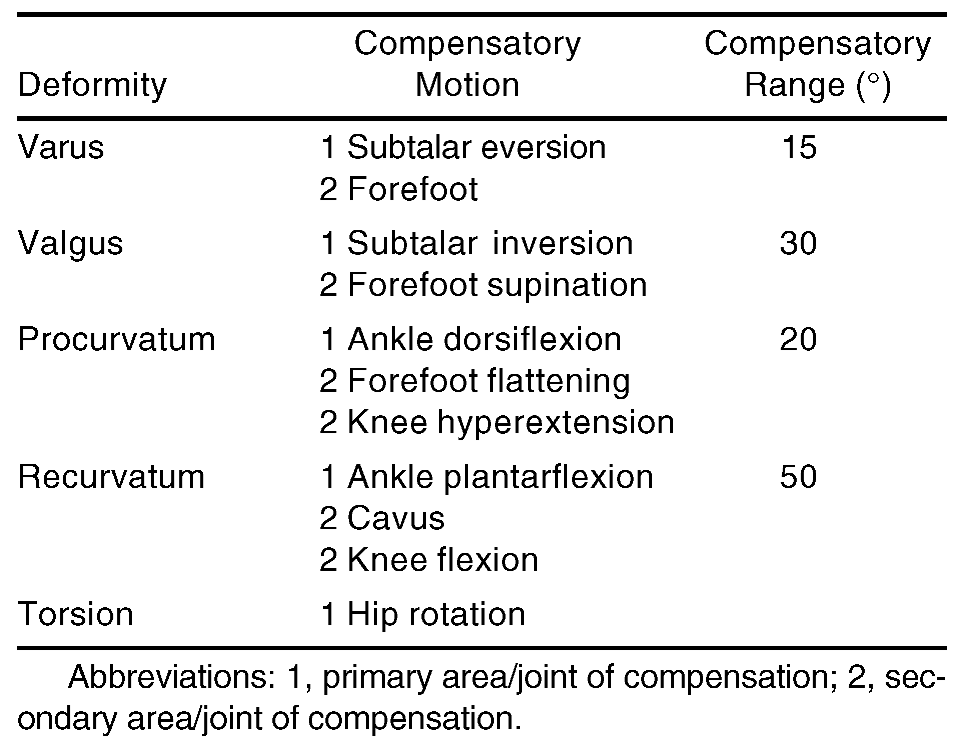
Distal tibial deformities occur in all four basic planes: frontal, sagittal, oblique, and rotational (Table 1). Frontal plane abnormalities are represented by a varus (increased lateral distal tibial angle) or valgus (decreased lateral distal tibial angle) deformity. These deformities are compensated for by the subtalar, midtarsal, and forefoot joints, depending on the mobility of these joints. It is important to remember that there is up to 15° of eversion and up to 30° of inversion available for compensation at the subtalar joint. Even small angular deformities can be problematic when there is inadequate compensatory range of motion. Therefore, evaluation of subtalar joint range of motion is essential because distal tibial osteotomies may unmask an uncorrected subtalar deformity or contracture that, if not addressed, may lead to further degeneration, deformity, or pain. Deformities have a tendency to be well tolerated when a compensatory mechanism is available but often become painful when the deformity falls outside of the compensatory range of motion.[8]
Table 1.
Distal Tibial Deformity Compensation Ranges and Associated Joints.
Adequate compensation allows the foot to be placed into a plantigrade position. When this compensation is available, it can mask malalignment and result in future degenerative changes, joint contracture, and subluxation. Compensation at adjacent joints must be considered before any realignment procedure. For example, if there is a 25° valgus deformity of the distal tibia and it is compensated for by 25° of inversion at the subtalar joint, the patient must be able to evert 25° from this inverted position (get back to neutral or slight valgus) before undergoing a corrective osteotomy. Malalignment and associated symptoms may persist but are now at the subtalar region because the foot could be left in a varus position. Solutions could include complete reduction of the compensatory motion, distraction or subtalar joint release during the corrective osteotomy, osteotomy at the calcaneus/subtalar joint, or correction of the deformity only to the amount of reduction of compensation that is available.[8] Thus evaluation for surgery can be a very complex decision for what seems to be a simple deformity.
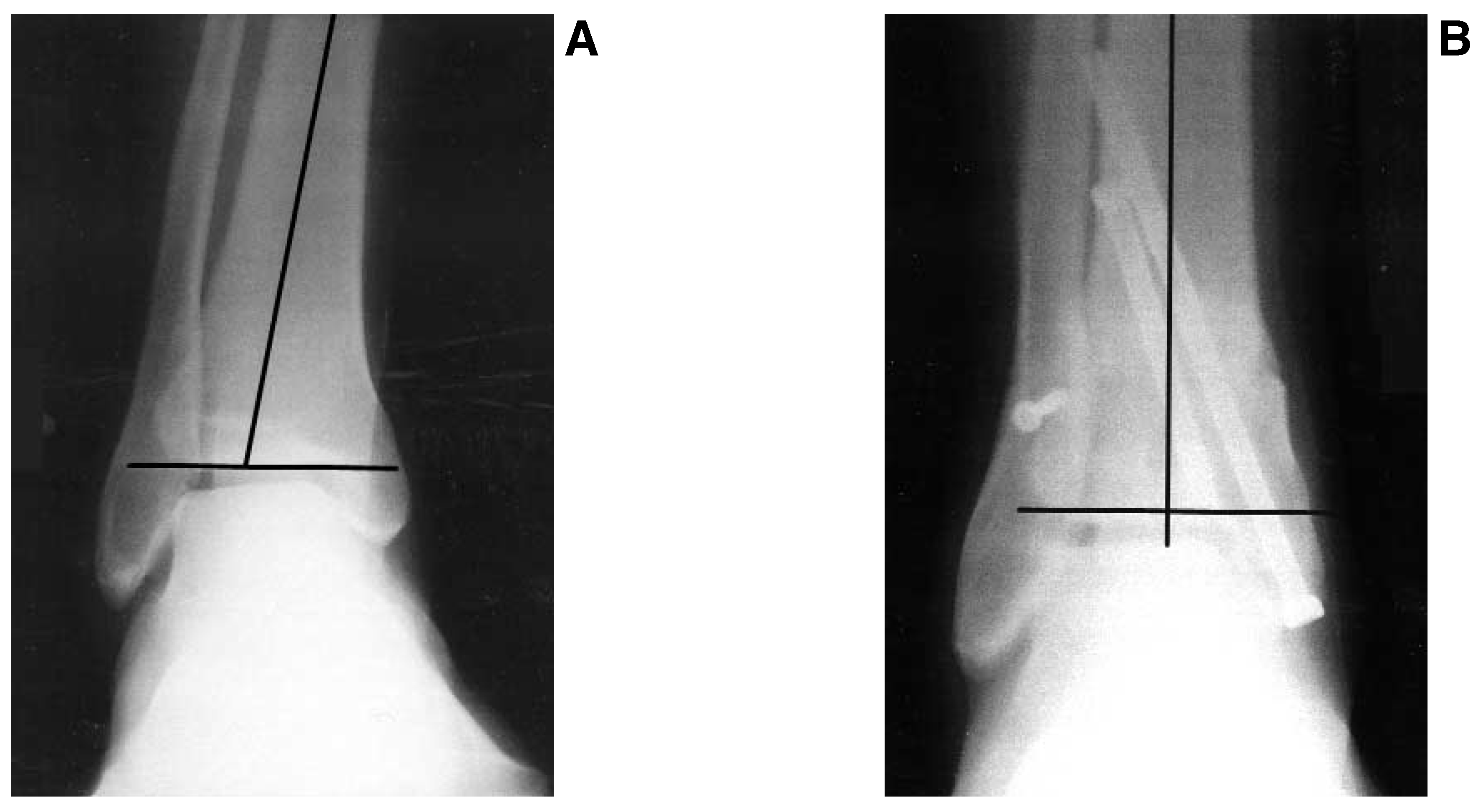
In general, valgus deformities are better tolerated than varus deformities because more subtalar joint inversion is available to compensate for this malalignment. It is the valgus deformity, however, that leads to earlier ankle joint degeneration.[8] Symptomatic varus/valgus deformities at the ankle joint may require a supramalleolar or tibial osteotomy for correction (Fig. 19).
Figure 19.
Preoperative (A) and postoperative (B) radiographs of correction of ankle varus by supramalleolar osteotomy.
Sagittal plane abnormalities of the distal tibia and ankle include procurvatum, recurvatum, equinus, and calcaneus deformities. Motion in the normal adult ankle is approximately 20° of dorsiflexion and 50° of plantarflexion. Recurvatum deformities are better compensated for than procurvatum deformities because of the greater degree of ankle joint plantarflexion that is available. In the recurvatum ankle, the cartilage of the ankle joint articulates in a more anterior angulated position (Fig. 11). The anterior distal tibial angle is decreased, and degeneration of the joint occurs earlier because of shear forces that occur during compensation. Nevertheless, this deformity is better tolerated earlier on because of the increased plantarflexory compensatory range of motion that is available at the ankle joint.
In the procurvatum ankle deformity, the cartilage of the ankle joint articulates in a more posterior angulated position than normal (Fig. 12). The anterior distal tibial angle is increased, and degeneration of the joint occurs later because of less motion available at the ankle joint and the fact that the talus and tibia articular surfaces are well protected from any shear forces. This deformity is less tolerated and more painful owing to anterior ankle impingement or talotibial syndrome.
Procurvatum and recurvatum deformities are compensated for by the subtalar, midtarsal, and forefoot joints and the knee. Degeneration occurs when adequate compensatory range of motion does not exist.
Oblique plane deformities are a combination of frontal and sagittal plane components (biplanar angulation). Osteotomies for these deformities can be performed between the frontal and sagittal components but are more efficiently performed as a single angular osteotomy in the oblique plane.
Deformities that are at or distal to the ankle joint are more common. Anteroposterior ankle and foot, lateral ankle and foot, rearfoot alignment, and long leg calcaneal axial radiographs are obtained to evaluate the deformity. One should first evaluate for any ankle deformity on anteroposterior ankle, lateral ankle, and rearfoot alignment radiographs. If no deformity exists, then the long leg calcaneal axial view should be evaluated. If the long leg calcaneal axial view is normal, then the deformity is located at the calcaneal tuber or in the midfoot. Specialty radiographs, such as the Coleman block, may be considered when evaluating the midfoot/forefoot, but they are not discussed in this article.
Conclusion
Reconstructive procedures should restore or greatly improve abnormal angles and should realign the leg, ankle, and rearfoot joints to allow for proper biomechanical function. A significant angular deformity may cause destruction not only at the joint near it but also at adjacent joints. Procedures such as a supramalleolar osteotomy, ankle fusion, triple arthrodesis, and calcaneal or midfoot osteotomy are very powerful tools for correcting malaligned foot and ankle pathology. However, if performed without realignment considerations, these procedures can have suboptimal or even detrimental effects on adjacent structures. Proper preoperative evaluation is essential. In addition, intraoperative fluoroscopic imaging should be used to assess the correction.
A simple stepwise protocol can be followed for any patient with a possible lower-leg, ankle, or rearfoot deformity. The level of the deformity becomes evident as this evaluation process is completed. The proper surgical procedure may then be selected. However, all considerations, including compensation, structures at risk (excessive tension on neurovascular structures), gradual or acute corrections, external or internal fixation, patient medical status, and postoperative convalescence, must be addressed, increasing the complexity of surgical realignment. Proper evaluation of these radiographic and clinical considerations will increase the success of surgery and minimize related complications.
References
- Paley D, Herzenberg JE, Tetsworth K, et al: Deformity planning for the frontal and sagittal plane corrective osteotomies. .Orthop Clin North Am25::425. ,1994. .
- Johnson JE, Lamdan R, Granberry WF, et al: Hindfoot coronal alignment: a modified radiographic method. .Foot Ankle Int20::818. ,1999. .
- Lamm B, Catanzariti AR, Mendicino RW: Static hindfoot alignment: a comparison of radiographic angular measures vs. clinical foot function measures. Poster presented at the American College of Foot and Ankle Surgeons Annual Meeting and Scientific Seminar, February 26–March 2, 2002, Beverly Hills, CA..
- Buck P, Morrey BF, Chao EYS: The optimum position of arthrodesis of the ankle. .J Bone Joint Surg Am69::1052. ,1987. .
- Saltzman CL, el-Khoury GY: The hindfoot alignment view. .Foot Ankle Int16::572. ,1995. .
- Paley D: “Normal Limb Alignment and Joint Orientation,” in Principles of Deformity Correction, ed by JE Herzenberg, p 1, Springer, New York. ,2002. .
- Paley D: “Radiographic Assessment of Lower Limb Deformities,” in Principles of Deformity Correction, ed by JE Herzenberg, p 31, Springer, New York. ,2002. .
- Paley D: “Ankle and Foot Considerations,” in Principles of Deformity Correction, ed by JE Herzenberg, p 571, Springer, New York. ,2002. .
- Paley D: “Frontal Plane Mechanical and Anatomic Axis Planning,” in Principles of Deformity Correction, ed by JE Herzenberg, p 61, Springer, New York. ,2002. .

© 2005 American Podiatric Medical Association