Residency Document Revisions
The standards, requirements, and procedures of the Council on Podiatric Medical Education (CPME) are reviewed and revised on a regular basis. The Council’s current schedule includes the review of publications related to residency evaluation and approval (CPME 320, Standards, Requirements and Guidelines for Approval of Residencies in Podiatric Medicine, and CPME 330, Procedures for Approval of Residencies in Podiatric Medicine). In keeping with its procedures for document review processes, the Council appointed an ad hoc advisory committee that met between June 1999 and October 2001 to prepare documents for consideration by the Council in October 2001.
The Council reviewed the draft documents at its October 2001 meeting and requested further information from the American Board of Podiatric Orthopedics and Primary Podiatric Medicine (ABPOPPM) and the American Board of Podiatric Surgery (ABPS). The Council adopted the proposed documents in January 2002, requested written comments from the residency community of interest in a February 2002 memorandum, and made the proposed documents available on its Web site. At its April 2002 meeting, the Council considered the comments from the community of interest and acted to reject the proposed revisions to the residency documents. Based on its own review of the documents and comments from the community of interest, the Council determined that the documents required further revision, a process that would again include participation of the ABPOPPM and ABPS.
In September 2002 the Council adopted proposed drafts of CPME 320, Standards and Requirements for Approval of Residencies in Podiatric Medicine and Surgery, and CPME 330, Procedures for Approval of Residencies in Podiatric Medicine and Surgery. The Council again requested written comments from the residency community of interest in an October 2002 memorandum and made the proposed documents available on its Web site. Following the conclusion of the comment period, the Council conducted a conference call in January 2003 to consider all correspondence received from the community of interest. The Council adopted final documents in January 2003 for implementation effective July 1, 2003.
During both comment periods in 2002, the Council expressed its appreciation of the thoughtful letters and e-mails provided by numerous individuals and organizations in response to the requests for comment on the proposed documents.
Colleges of Podiatric Medicine
The Accreditation Committee is responsible for recommending to the Council candidacy of new and accreditation of existing colleges, schools, and programs leading to the professional degree in podiatric medicine. The Committee reviews evaluation reports, progress reports, and other information submitted by the institutions within its review area. The Committee may recommend to the Council minor or emergency modifications in policies, standards, requirements, and procedures and recommend to the responsible ad hoc advisory committee modification of policies, standards, requirements, and procedures relative to the areas of responsibility of the Accreditation Committee.
Every six years, the standing committee responsible for accreditation or approval in a particular area conducts an interim review of the appropriate standards, requirements, and procedures. The purpose of the interim review is to “fine-tune” any areas of the documents that may not be functioning appropriately, rather than to propose major changes in direction or philosophy, which would be within the purview of an ad hoc advisory committee. At its April 2002 meeting, the Council accepted changes to the college documents recommended by the Accreditation Committee and then forwarded the proposed changes to the community of interest. At the Council’s October 2002 meeting, the changes were reviewed in light of comments received from the community of interest and the revised CPME 120, Standards and Requirements for Accrediting Colleges of Podiatric Medicine, and CPME 130, Procedures for Accrediting Colleges of Podiatric Medicine, were adopted, effective January 1, 2003.
At its April and October 2002 meetings, the Council reviewed either a progress or special report from six of the seven colleges of podiatric medicine. The Accreditation Committee reviewed the Annual Summary Data Report submitted by each of the colleges.
At its April 2002 meeting, the Council extended probationary accreditation of the California College of Podiatric Medicine and accreditation of the New York College of Podiatric Medicine. At its October 2002 meeting, the Council extended probationary accreditation of the California College of Podiatric Medicine and granted provisional approval of the merger of the California College of Podiatric Medicine and Samuel Merritt College. The Council conducted a comprehensive on-site evaluation in November 2002 of the California School of Podiatric Medicine at Samuel Merritt College.
Table 1,
Table 2,
Table 3,
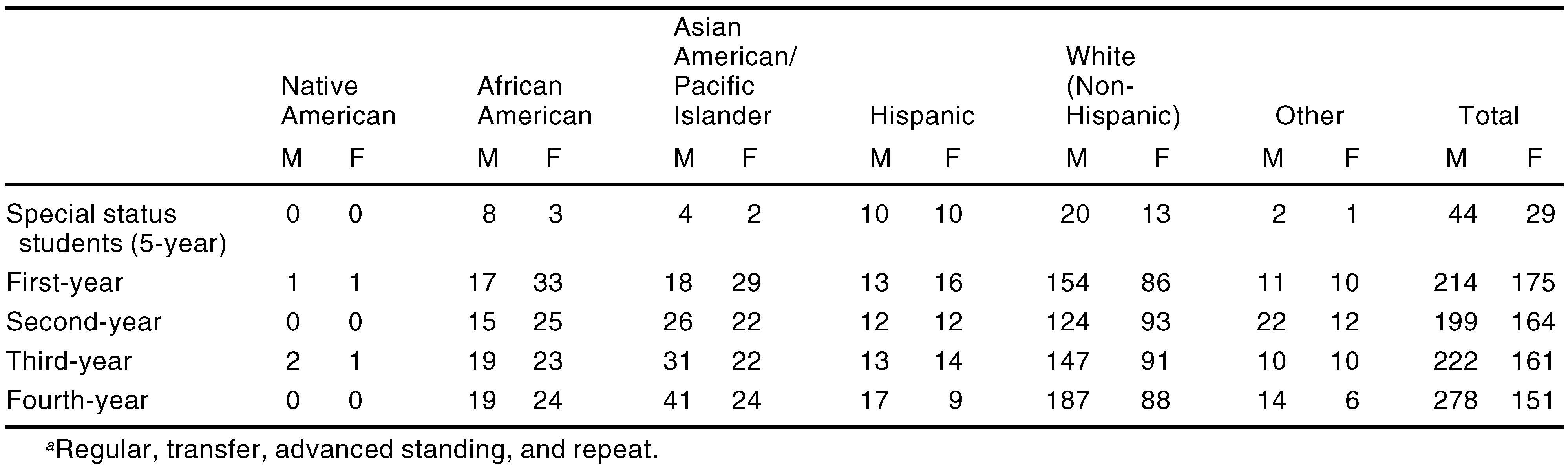
Table 4,
Table 5,
Table 6,
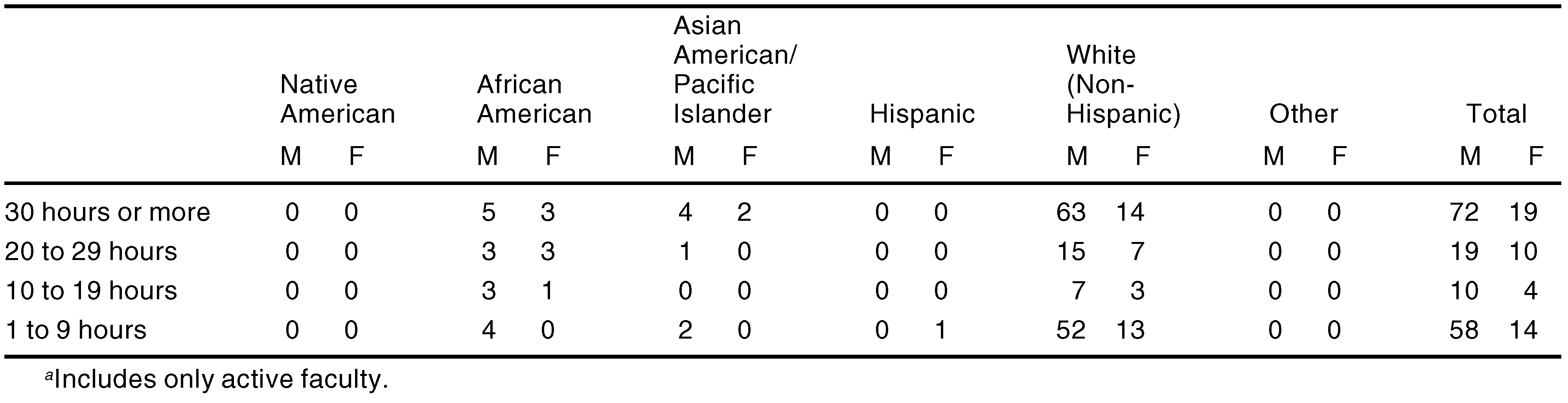
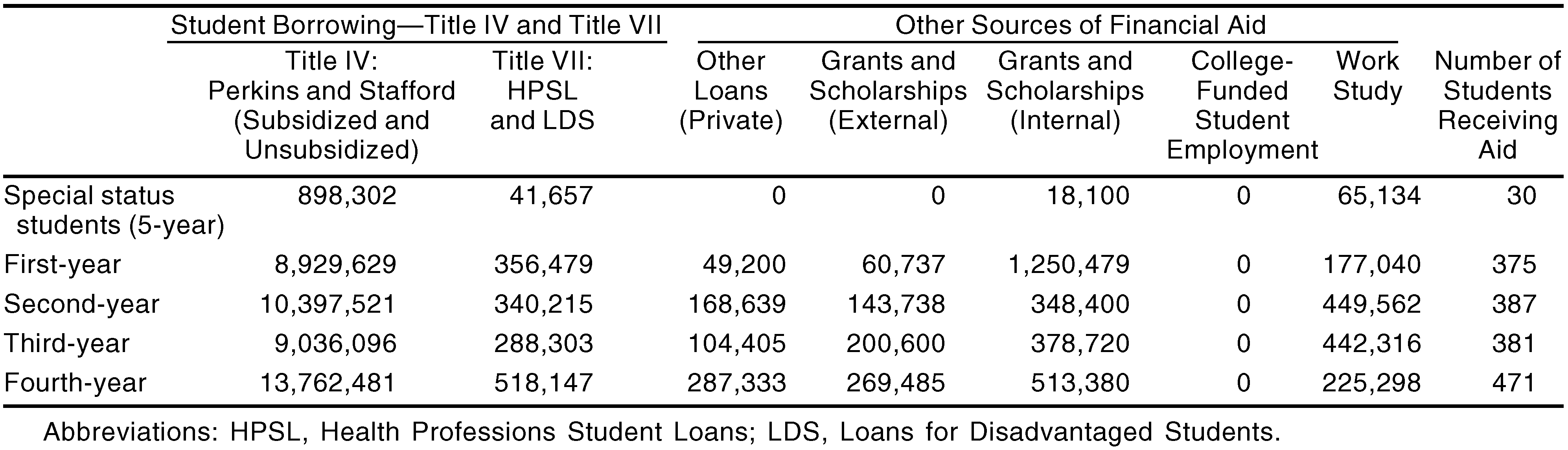
Table 7,
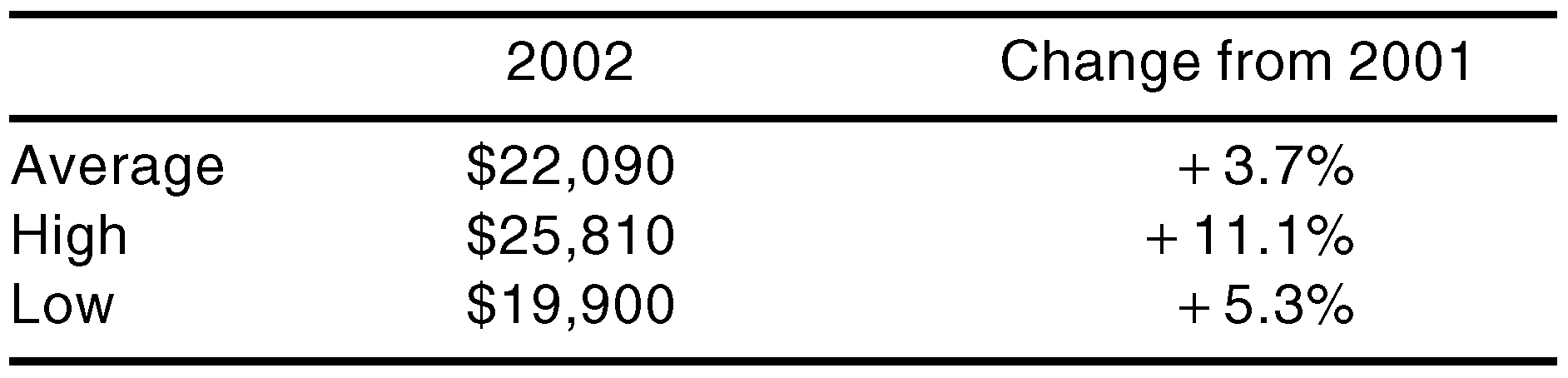
Table 8 and
Table 9 summarize data collected for the colleges of podiatric medicine related to faculty size, student admissions, student enrollment, student attrition, student indebtedness, tuition, and undergraduate grade point average for the entering class.
Table 1.
Full-time and Part-time Basic Science Faculty of Colleges of Podiatric Medicinea
Table 1.
Full-time and Part-time Basic Science Faculty of Colleges of Podiatric Medicinea
Table 2.
Full-time and Part-time Clinical Faculty of Colleges of Podiatric Medicinea
Table 2.
Full-time and Part-time Clinical Faculty of Colleges of Podiatric Medicinea
Table 3.
Class of 2006 Student Admissions Data
Table 3.
Class of 2006 Student Admissions Data
Table 4.
Number of Students Enrolled in Colleges of Podiatric Medicinea
Table 4.
Number of Students Enrolled in Colleges of Podiatric Medicinea
Table 5.
Attrition of Students Enrolled in Colleges of Podiatric Medicinea
Table 5.
Attrition of Students Enrolled in Colleges of Podiatric Medicinea
Table 6.
Attrition of Students Enrolled in Colleges of Podiatric Medicinea
Table 6.
Attrition of Students Enrolled in Colleges of Podiatric Medicinea
Table 7.
Sources of Financial Aid (in Total Dollars)
Table 7.
Sources of Financial Aid (in Total Dollars)
Table 8.
Annual Tuition and Fees per Student
Table 8.
Annual Tuition and Fees per Student
Table 9.
Undergraduate Grade Point Average for Class of 2006a
Table 9.
Undergraduate Grade Point Average for Class of 2006a
Residency Programs
The Joint Residency Review Committee (JRRC) is a collaborative effort of the specialty boards and the CPME. The JRRC functions as the body that reviews, takes actions on, and makes recommendations concerning podiatric residency programs in accordance with procedures and requirements set forth by the Council. The JRRC is subdivided into two sections: podiatric medicine and orthopedics, and podiatric surgery. Program actions and recommendations emanating from these sections are viewed to be actions and recommendations of the JRRC. The JRRC meets semiannually to deliberate and recommend approval of residency programs.
In 2002 the Council, in collaboration with the JRRC, completed on-site evaluations of 125 residency programs at 88 hospitals, colleges, and surgical centers across the United States. The Council anticipates that its 2003 schedule will include evaluations of residency programs in approximately 60 institutions. The decrease in the number of institutions scheduled for on-site evaluation during 2003 is attributable to implementation of the Council’s revised residency documents and the desire of the Council to slowly introduce the documents both to the programs and to the evaluators conducting the on-site visits.
The number of authorized entry-level residency positions exceeded the number of individuals graduating from colleges of podiatric medicine in 2002 by approximately 52%, despite the largest decrease ever witnessed in the number of approved entry-level positions. The Council has authorized 725 entry-level residency positions in the United States, representing a decrease of 57 entry-level positions from the number presented in the Council’s 2001 annual report. The JRRC also has granted candidate status to institutions sponsoring residency programs with an additional 21 entry-level positions. As of the beginning of the 2002–2003 training year, a total of 274 institutions in 38 states and the District of Columbia were recognized as sponsors of approved podiatric residency programs.
The Council conducted a workshop for new residency program evaluators for podiatric surgery in July 2002. Fourteen podiatrists participated in the workshop. The Council conducted a workshop for new residency program evaluators for primary podiatric medicine in September 2002. Seven podiatrists participated in the workshop. Each workshop consisted of informal presentations and discussion about the process for residency evaluation and approval, history and overview of the administrative structure of the JRRC, explanation of the protocol established for the conduct of on-site evaluations, and review of residency approval standards and requirements.
Table 10 and
Table 11 summarize data on entry-level residency positions and residency placement for the graduating class of 2002.
Table 10.
Entry-Level Residency Positions by Category
Table 10.
Entry-Level Residency Positions by Category
Table 11.
Class of 2002 Residency Placement
Table 11.
Class of 2002 Residency Placement
Fellowships
A podiatric fellowship is an educational program that provides advanced knowledge, experience, and training in a specific content area within podiatric medical practice. Fellowships, by virtue of their specific content concentration, seek to add to the body of knowledge through research and other collaborative scholarly activities.
Following four years of professional education, most podiatric medical graduates complete at least two years of postdoctoral training. Podiatric fellowship education is a component in the continuum of the educational process, and such education occurs after completion of an approved specialty residency.
The new process requires a fellowship program to be sponsored by a hospital, college, academic health center, or surgery center that sponsors an approved podiatric residency. Following the anticipated adoption in 2003 of revised residency standards, requirements, and procedures, the Council has agreed to discuss the possibility of extending sponsorship to institutions that do not currently sponsor approved podiatric residency programs.
The Council has approved six fellowships with a total of seven positions.
Continuing Education
The Council approves sponsors of continuing education that demonstrate and maintain compliance with the standards and requirements identified in CPME 720, Standards, Requirements and Guidelines for Approval of Sponsors of Continuing Education in Podiatric Medicine. Approval is based on programmatic evaluation and periodic review by the Council and its Continuing Education Committee. The Committee reviews applications for approval of new sponsors, petitions for continuing approval, evaluation reports, applications for change of scope, progress reports, and other information submitted by the sponsors.
The primary purpose of approval is to promote and ensure high-quality education and continuous improvement in educational programs. Approval also ensures the quality of continuing education programs to the public, the podiatric medical profession, and the state boards for examination and licensure.
The Council assigned an ad hoc advisory committee the responsibility to review standards, requirements, and procedures pertaining to sponsors of continuing education. The results of a comprehensive survey conducted in the fall of 2002 of the Council’s community of interest and an extensive review of the documents utilized by other professions will guide the work of the advisory committee. The committee plans to hold at least two meetings in 2003.
The process of review and revision of the continuing education standards, requirements, and procedures should result in the review of revised documents by the Council in October 2003, with drafts of revisions to be circulated for comment to the community of interest by the end of 2003. Implementation of the revised standards, requirements, and procedures may begin in the spring of 2004.
As of October 2002, the Council approved 63 sponsors of continuing education in podiatric medicine. Of the 63 sponsors, 52 were approved as sponsors of courses only, 2 were approved as sponsors of instructional media only, and 9 were approved as sponsors of both courses and instructional media.
Recognized Specialty Boards
The Joint Committee on the Recognition of Specialty Boards (JCRSB) is responsible for granting new and continuing recognition to specialty boards in podiatric medicine, formulating criteria and procedures for recognition of specialty boards subject to the final approval of the Council and in accordance with the broad policies for certification as adopted by the House of Delegates, and exploring areas of mutual cooperation to the benefit of the recognized boards, the podiatric medical profession, and the public.
Certification processes currently are identified for podiatric medicine and orthopedics and podiatric surgery. The Council recognizes the ABPOPPM and ABPS.
Of 60 candidates, 39 successfully completed the 2002 podiatric medicine and orthopedics certification examination and were granted diplomate status. A total of 2,582 individuals currently hold diplomate status in primary podiatric medicine and/or podiatric orthopedics.
Of 246 candidates, 171 successfully completed the 2002 podiatric surgery certification examination in foot surgery and were granted diplomate status. Of 53 candidates, 29 successfully completed the 2002 podiatric surgery certification examination in foot and ankle surgery (or ankle surgery only) and were granted diplomate status. A total of 5,659 individuals (3,074 in foot surgery, 2,386 in foot and ankle surgery, and 199 in foot and reconstructive rearfoot/ankle surgery) currently hold diplomate status in podiatric surgery.
Council on Higher Education Accreditation
The CPME holds recognition from the Council on Higher Education Accreditation (CHEA) through 2003 as the specialized/professional accrediting agency for colleges of podiatric medicine, first professional degree of Doctor of Podiatric Medicine, and the preaccreditation category of “candidate status” for developing colleges of podiatric medicine. CHEA was to consider the Council’s eligibility application at its March 2003 meeting and the Council’s petition for continued recognition at its November 2003 meeting.
Although the primary purpose of CHEA is to recognize accrediting bodies, CHEA also proposes to coordinate research and debate to improve accreditation, serve as a national advocate for voluntary self-regulation, collect and disseminate data about accreditation, mediate disputes between and among accrediting bodies, and coordinate and work to preserve the quality and diversity of colleges and universities.
US Department of Education
The CPME holds recognition as the accrediting body for first professional degree programs in podiatric medicine from the US Department of Education, appearing on the list of nationally recognized accrediting agencies that the US Secretary of Education identifies as reliable authorities concerning the quality of education offered by educational institutions or programs.
The Council submitted a petition for continued recognition in the fall of 1999 to the US Secretary of Education’s National Advisory Committee on Institutional Quality and Integrity. Based on review of the petition by the Advisory Committee in December 2000, Secretary Richard W. Riley granted the Council the full 5-year period of recognition as the accrediting agency for colleges of podiatric medicine. In the Secretary’s January 12, 2001, letter indicating that recognition had been extended for 5 years, the Council was advised that it would need to demonstrate full compliance with one matter related to the training of members of college on-site evaluation teams as part of an interim report to the US Department of Education due on December 13, 2001.
The Council submitted the requested information, which was considered at the May 2002 meeting of the National Advisory Committee. The Committee recommended that the Secretary of Education accept the interim report submitted by the Council. The chair, vice-chair, and director of the Council appeared before the meeting in Washington, DC, on June 5, where the Advisory Committee concluded that the Council was in full compliance with the Secretary’s Criteria for Recognition of Accrediting Agencies. No remaining issues or problems were cited. Secretary Rod Paige accepted the recommendation of the Committee.
The Advisory Committee’s acceptance of the interim report indicated that the Council has demonstrated full compliance with the recognition by ensuring that a) all decision-making and evaluation-making personnel will be fully trained in the agency’s accreditation standards and in its policies that affect the accreditation process, and b) all monies collected by CPME are available to and used by the Council for the completion of its accreditation activities.
The Council has appeared on the Secretary’s list of nationally recognized accrediting agencies since the recognition process was first legislated in 1952.
Association of Specialized and Professional Accreditors
The Council is a charter member of the Association of Specialized and Professional Accreditors (ASPA), which was established in 1993 as an umbrella organization to represent the interests of specialized accreditation.
Meetings of the Council
The CPME held its 2002 meetings at APMA headquarters in Bethesda, Maryland, on April 18–20 and in Vancouver, British Columbia, on October 16–20.
Dr. Daniel J. Bareither retired from the Council following distinguished service to the Council.
At the April 2002 meeting, Dr. Kathleen M. PyatakHugar of Bloomingdale, Illinois, was re-elected by the Council as chair, and Dr. Stuart J. Wertheimer of Harrison Township, Michigan, was re-elected as vice-chair. Dr. Kathleen M. Pyatak-Hugar was re-elected by the Council for a 3-year term of office as an at-large member. Dr. Timothy M. Yoho of Des Moines, Iowa, was elected by the Council for a 3-year term of office as an at-large member. Dr. Carl H. Stem of Lubbock, Texas, was re-elected to the postsecondary educator position on the Council.
The following individuals were members of CPME committees as of October 1, 2002:
Accreditation Committee: Dr. Daniel J. Bareither, Chair; Dr. Stephanie Belovich, Dr. Oleg Petrov, Dr. Stephen H. Powless, Dr. Carl H. Stem, and Dr. Robert M. Yoho.
Budget Planning and Executive Committees: Dr. Daniel J. Bareither, Chair; Dr. Sandra L. Martin, Dr. Kathleen M. Pyatak-Hugar, and Dr. Stuart J. Wertheimer.
Continuing Education Committee: Dr. Sandra L. Martin, Chair; Dr. Raymond P. Esper, Ms. Carolyn J. Harding, Dr. David M. LaPorta, Ms. Susan K. Nedved, Dr. Kenneth Philips, and Dr. Robert A. Scudder, Jr.
Joint Committee on the Recognition of Specialty Boards: Dr. Vincent J. Hetherington, Chair; Dr. Jean Bartels, Dr. Albert E. Burns, Dr. Michael P. DellaCorte, Dr. Eric E. Leonheart, Mr. Bernard Moore, Dr. Marshall G. Solomon, and Dr. Frank A. Spinosa.
Joint Residency Review Committee: Dr. Stuart J. Wertheimer, Chair; Dr. Charles T. Arena, Dr. Harry B. Burke, Dr. William E. Chagares, Dr. Michael P. DellaCorte, Dr. Jonathan A. Haber, Dr. Charles M. Lombardi, Dr. John J. McGarry, and Dr. Brad Naylor.
Nominating Committee: Dr. Kathleen M. Pyatak-Hugar, Chair; Dr. Karen E. Brooks, Dr. Irvin O. Kanat, Dr. Thomas V. Melillo, Dr. Phillip E. Ward, and Dr. Stuart J. Wertheimer.
Respectfully submitted by the Council on Podiatric Medical Education 2003:
Kathleen M. Pyatak-Hugar, DPM, Chair
Stuart J. Wertheimer, DPM, Vice-Chair
Harry B. Burke, DPM
Raymond P. Esper, DPM
Jonathan A. Haber, DPM
Sandra L. Martin, DPM
Stephen H. Powless, DPM
Robert A. Scudder, Jr., DDS
Carl H. Stem, PhD
Andrew A. Weiss
Timothy M. Yoho, DPM
Alan R. Tinkleman, MPA, Director
Elizabeth Udris Dorcey, MA, Associate Director
Heather L. Alderman, MA, Assistant Director
Loretta C. Waldron, MBA, Assistant Director
Sandy B. Saylor, Administrative Coordinator
Janice C. James, Administrative Assistant
Roberta McVeigh, Staff Assistant