Next Article in Journal
Human Skin Equivalent in the Treatment of Chronic Leg Ulcers in Sickle Cell Disease Patients
Previous Article in Journal
Plantar Fasciitis. A Degenerative Process (Fasciosis) Without Inflammation
 
 
Journal of the American Podiatric Medical Association is published by MDPI from Volume 116 Issue 1 (2026). Previous articles were published by another publisher in Open Access under a CC-BY (or CC-BY-NC-ND) licence, and they are hosted by MDPI on mdpi.com as a courtesy and upon agreement with American Podiatric Medical Association.
Article

Lichen Planus. A Case Study

by
Ramyar Moussavi
Temple University School of Podiatric Medicine, Philadelphia, PA. Mailing address: Angeles Foot and Ankle Institute, 1551 W Olympic Blvd, Los Angeles, CA 90015
J. Am. Podiatr. Med. Assoc. 2003, 93(3), 238-239; https://doi.org/10.7547/87507315-93-3-238
Published: 1 May 2003
Lichen planus was first described in 1869 by Erasmus Wilson, who reported 50 cases of the disease [1]. Characterized by pruritic, polygonal, violaceous, scaly papules and plaques, the disease may have a chronic or an acute course, possibly remitting within 1 year. Lichen planus is mostly found in middle-aged populations and has no predilection based on sex or race. Idiopathic lichen planus occurs in 1% of healthy individuals globally. The presentation consists of shiny papules, which are found symmetrically on the wrists and forearms, genitalia, lumbar region, oral mucosa, lateral and medial ankles, shins, and feet.1 Nail involvement is often present, with distal growth of the cuticle resulting in pterygium [2]. Lichen planus of the foot is usually seen on the dorsum and the sole [3]. Panconesi [4] reported the clinical manifestations of lichen planus as polygonal papules with a pinkish-red tint. Behrman et al [5] described the presentation as flattopped, purplish papules and plaques, which often occur bilaterally and are pruritic.
Lichen planus begins with the appearance of a few discrete lesions on the feet and ankles, followed by development in 2 to 5 weeks of generalized involvement of the extremities and torso. More than 50% of cases subside within 9 months, and 85% subside within 18 months [1,6]. Histologic findings of lichen planus, according to Ellgehausen et al, [7] include the following six cardinal features: hyperorthokeratosis or hyperparakeratosis, acanthosis, hypergranulosis, vacuolar degeneration of the basal cell layer, sawtooth configuration of the rete ridges, and bandlike upper dermal infiltrate of T lymphocytes [6].
The etiology of lichen planus is unknown. Certain drugs [7], graft-versus-host reaction [8], systemic diseases (lupus and hepatitis), alopecia [9], and neuropsychiatric disorders [4] have been hypothesized to be possible causes of lichenoid eruptions. According to de Jong and van de Kerkhof [3], lichen planus of the soles of the feet is uncommon and usually presents with violaceous erosions. They also noticed the presence of plantar lichen planus with discoid lupus erythematosus. Lupus, unlike lichen planus, occurs on sun-exposed surfaces of the skin.

Case Report

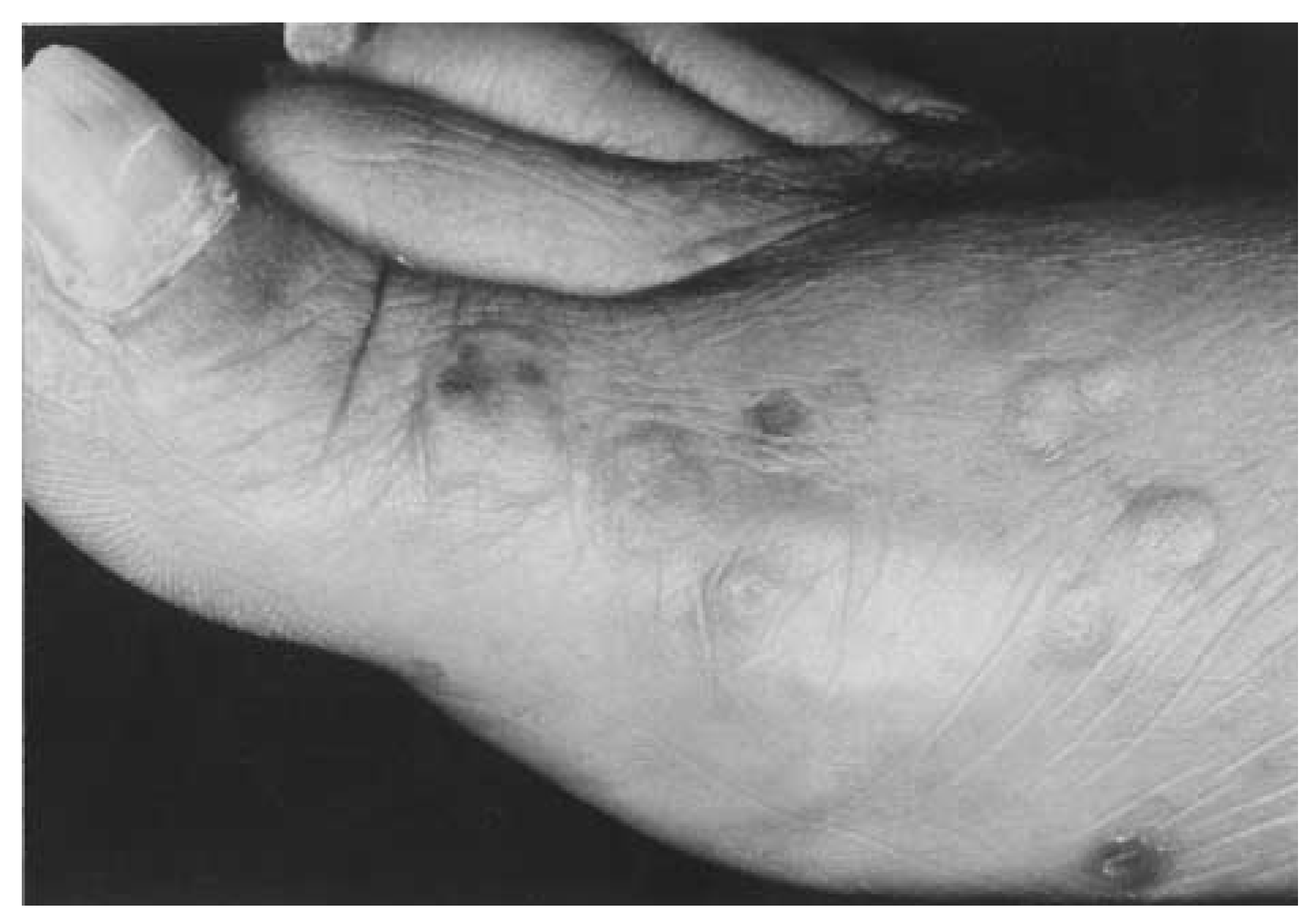
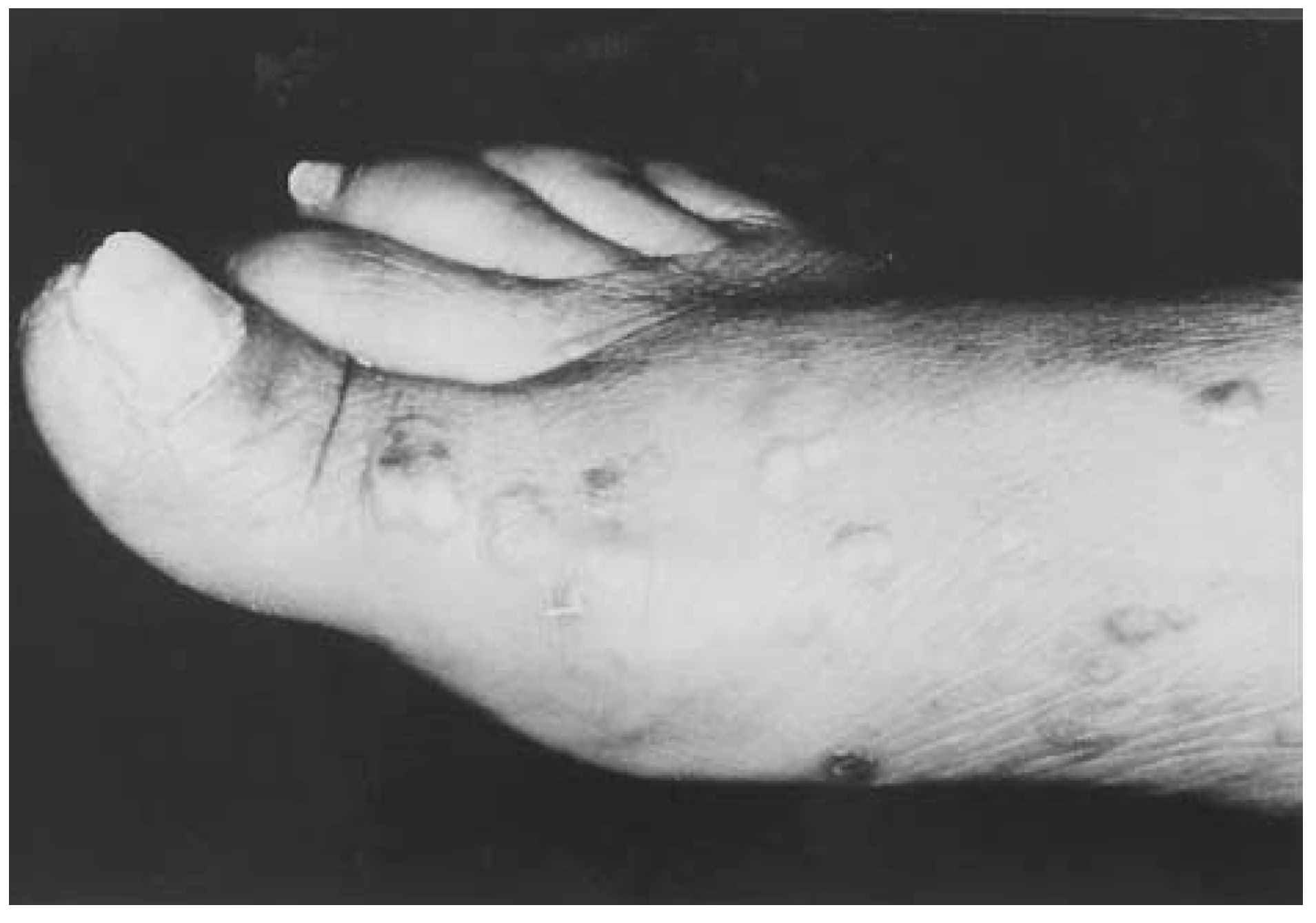
A 56-year-old man presented with pruritic polygonal papular eruptions limited to the dorsal aspects of both feet (Figure 1). The lesions were flat-topped and violaceous and exhibited an overlying fine scale (Figure 2). No other pertinent dermatologic findings were noted on examination. The patient’s medical history was unremarkable, and he was taking no medications at the time.
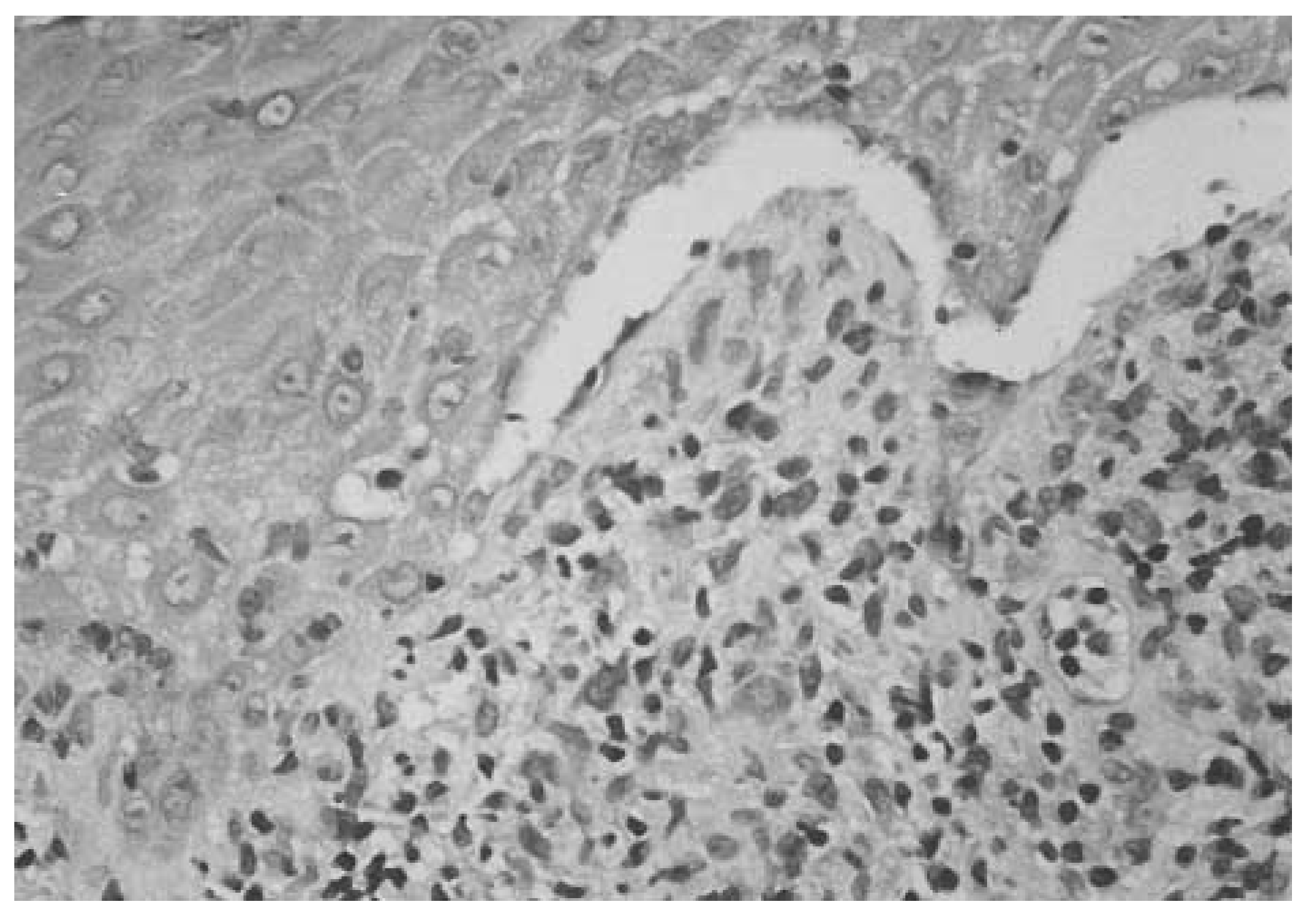
Punch biopsy of the lesions revealed bandlike lymphohistiocytic infiltrate in the papillary dermis, hugging the overlying epidermis. Erosions of the rete ridges were noted, with some ridges exhibiting a sawtooth appearance consistent with sawtooth acanthosis. Spaces below the epidermis, known as Max-Joseph spaces, were also seen (Figure 3).

Comment

Clinically, this patient presented with pruritic, violaceous, flat-topped, polygonal papules on the dorsa of the feet. Histologically, the dermal bandlike infiltrate was observed hugging the overlying epidermis with sawtooth acanthosis, corresponding with the cardinal histologic findings in lichen planus [7]. With no history of collagen vascular diseases or drug-induced lichenoid eruptions, this is a classic clinical and histologic case of lichen planus.

References

  1. OLBRICHT, S.; BIGBY, M.; KENNETH, A. Manual of Clinical Problems in Dermatology; Brown & Co: St Louis, 1992. [Google Scholar]
  2. Stewart, W.; Danto, J.; Maddin, S. CV Mosby, 4th Ed ed; St Louis, 1978. [Google Scholar]
  3. DE JONG, E.M.; VAN DE KERKHOF, P.C. Coexistence of palmoplantar lichen planus and lupus erythematosus with response to treatment using acitretin. Br J Dermatol 1996, 134, 538. [Google Scholar] [CrossRef] [PubMed]
  4. PANCONESI, E. Fundamentals in Dermatology, p 114; JB Lippincott: Philadelphia, 1984. [Google Scholar]
  5. Behrman, H.; Labow, T.; Rozen, J. Grune & Stratton, 3rd Ed ed; New York, 1978. [Google Scholar]
  6. GOLDSTEIN, A.; GOLDSTEIN, B. Practical Dermatology ; Mosby– Year Book: St Louis, 1992. [Google Scholar]
  7. ELLGEHAUSEN, P.; ELSNER, P.; BURG, G. Drug-induced lichen planus. Clin Dermatol 1998, 16, 325. [Google Scholar] [CrossRef] [PubMed]
  8. TOURAINE, R.; REVUZ, J.; DREYFUS, B. Graft versus host re- action and lichen planus. Br J Dermatol 1975, 92, 589. [Google Scholar] [CrossRef]
  9. PARODI, A.; CIULLA, P.; REBORA, A. An old lady with scar- ring alopecia and an ulcerated sole: ulcerative lichen planus. Arch Dermatol 1991, 127, 407. [Google Scholar] [CrossRef]
Figure 1. Polygonal papules on the dorsum of the foot representing the clinical presentation of lichen planus.
Japma 93 00238 g001
Figure 2. Flat-topped papules with an overlying adherent scale.
Japma 93 00238 g002
Figure 3. Histologically, sawtooth acanthosis noted at the epidermal–dermal junction is consistent with lichen planus (H&E, ×10).
Japma 93 00238 g003