The rearfoot complex of the foot has been the subject of a great deal of biomechanical research because it is widely believed to have a significant effect on foot function and its dysfunction is related to a range of lower-limb pathologic conditions. The axis of rotation of the subtalar joint has received a considerable amount of attention.[
1-
9] Traditionally, the axis of rotation of the subtalar joint was modeled as a hinge joint, and it has been described as having an orientation to all three body planes. The most commonly recognized model of the axis is oriented 16° from the sagittal plane and 42° from the transverse plane. However, these values represent the mean found in research on cadavers,[
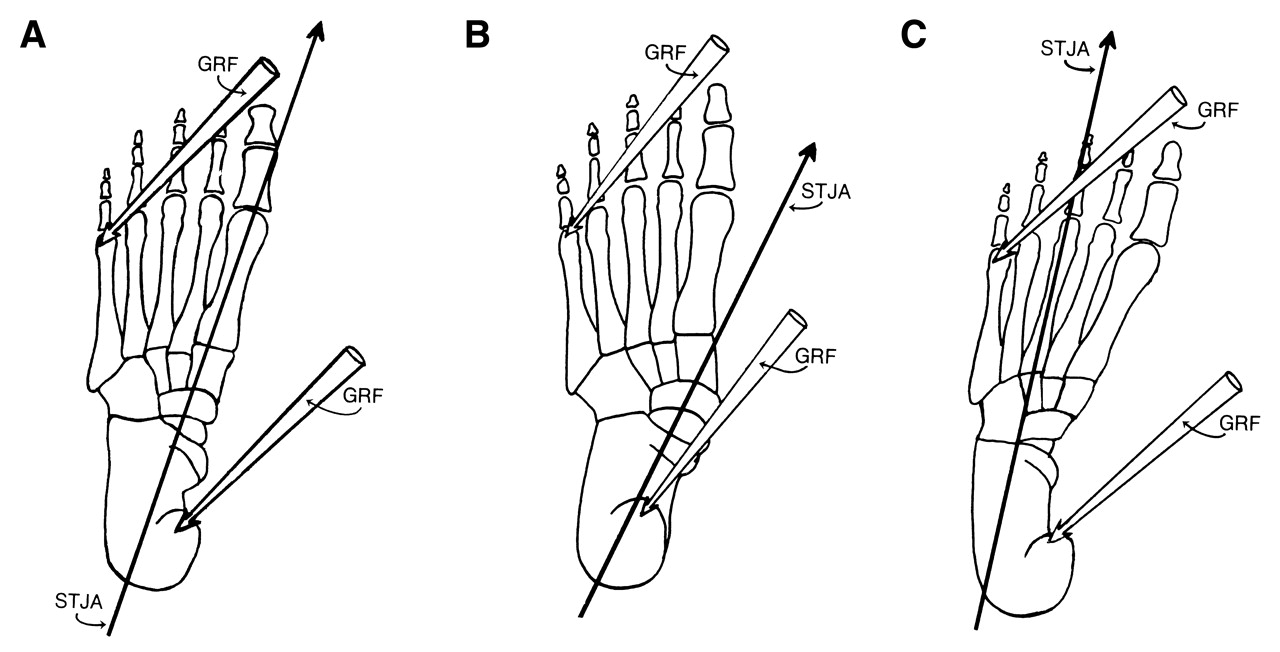
1,
4] and there is great variation from individual to individual. It is assumed that the axis can vary in its angulation to any of the body planes and can be translated in any of the body planes. For example, in the transverse plane, the subtalar joint axis could be more medially or laterally deviated from the population mean relative to the sagittal plane and more medially or laterally translated relative to the population mean in the transverse plane (
Fig. 1). This variability is thought to have clinical implications.
Variations assumed to occur in this hinge model of the subtalar joint axis have been thought to be responsible for different amounts of calcaneal inversion-eversion relative to leg internal-external rotation[
10-
13] and different locations of injury[
14] and have been related to knee loads in cyclists.[
15] Variations in the orientation of the assumed subtalar joint axis have been theoretically linked to different aspects of prescribing foot orthoses.[
16,
17]
Although variations in subtalar joint axis position have implications for foot function, lower-limb injury, and prescription of foot orthoses, the more sophisticated laboratory techniques for determining this position[
3,
18] are not suitable for routine clinical use. Kirby[
19] described a nonweightbearing method for clinically determining the transverse plane position of the subtalar joint axis. Phillips and Lidtke[
5] developed Kirby’s method further to give a three-dimensional position of the axis. However, given the complexity of the kinematics of the rearfoot complex and differences between open- and closed-chain function, it is not clear whether the techniques described are actually measuring the position of the subtalar joint axis or a rearfoot complex axis that is a composite of the talocalcaneal, talocrural, calcaneocuboid, and talonavicular joints. The morphologic features of the subtalar joint have a large effect on the directions of these motions, but during clinical determination of the axis, significant movement is occurring at the talonavicular joint, which would also affect the location of the assumed axis position. It may be more appropriate to consider clinical determination of the axis as being the location of a nonweightbearing rearfoot complex axis,[
2] but the axis is widely referred to in the literature as the subtalar joint axis, and so this term will be used here.
Kirby[
16] proposed use of the medial heel skive to increase the supinatory moment from foot orthoses when the subtalar joint axis has a more medial location. Similarly, an assumed increased magnitude of supination moment can also be obtained with the inverted technique[
20] or DC wedge type[
21] of foot orthosis. These types of devices are thought to apply a greater amount of force in the decreased surface area of the foot that is medial to the joint axis when the axis is in a more medial location (
Fig. 1B). A problem of the inverted device is that its exact prescription seems to be based on trial and error.[
22] If the transverse plane position of the subtalar joint axis can be related to the amount of force needed to supinate the rearfoot, more accurate prescription of foot orthoses and, therefore, better prognoses may be achieved. The aim of this project was to determine the relationship between the position of the subtalar joint axis and the amount of force needed to supinate the foot.
Methods
Subjects were recruited from the undergraduate student population at La Trobe University, Victoria, Australia. Individuals with a history of lower-limb trauma or surgery that interfered with motion of the rearfoot were excluded. Age, gender, and body weight were recorded for each subject.
The transverse plane position of the subtalar joint axis was determined by two experienced clinicians (C.P. and S.M.) independently using the method originally described by Kirby.[
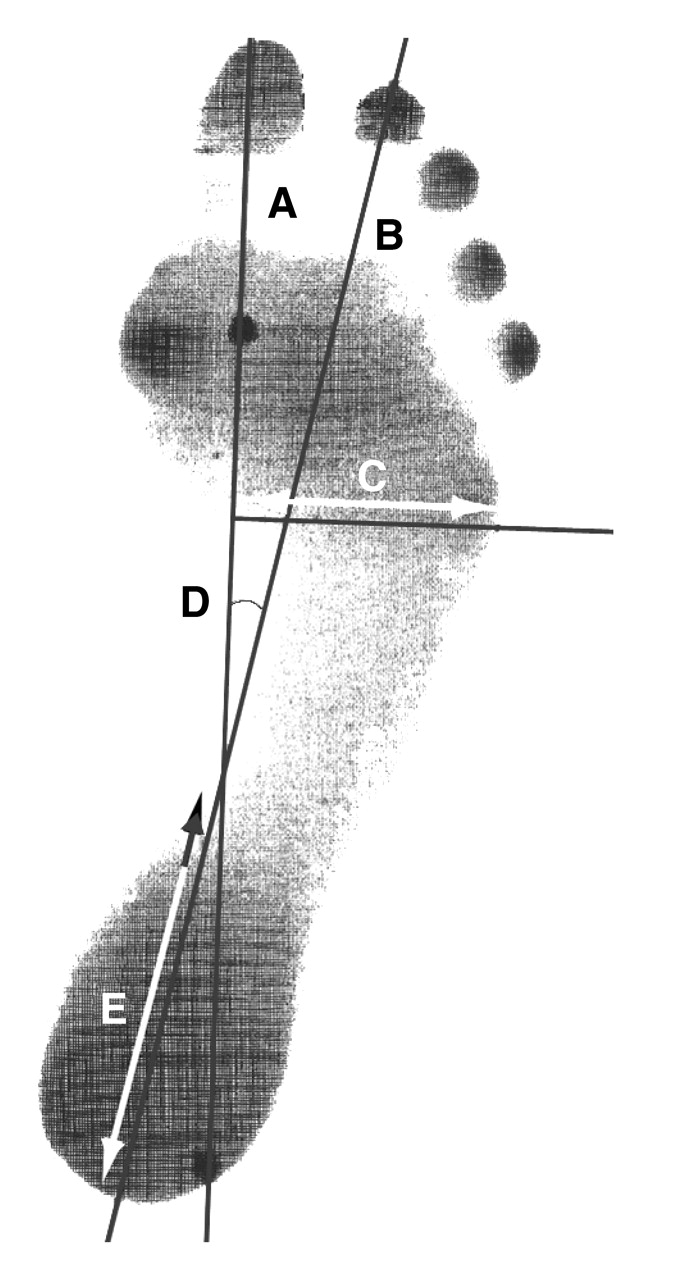
19] The line representing this axis was marked on the plantar surface of the foot with a water-based ink pen so that the line could be transferred to a footprint. Subjects then stepped onto an inked footprint system so that the footprints could be recorded. The inked mat was covered with a clear sheet of plastic so that the inked line on the plantar surface of the foot could be recorded. A pin was used to pierce the overhead transparency so that the orientation of the axis could be transferred to the inked footprint. To obtain a measurement for the axis position, a bisection of the midline of the foot was drawn on the footprint by bisecting the center of the posterior aspect of the calcaneus and the center of the second toe. Three measurements were taken to describe the axis position (
Fig. 2). The angle that the axis made with the foot bisection was measured. The distance between the axis and the lateral aspect of the fifth metatarsal head was measured along a line drawn perpendicular to the axis. The distance between the posterior aspect of the calcaneus and the point where the axis bisected the midline was also measured. The distance from the fifth metatarsal head and the distance from the posterior aspect of the foot were normalized by dividing by the foot length. Foot length was measured from the footprint. The means of the two clinicians’ measurements were used for the calculations. Intraclass correlation coefficients (ICCs) were used to determine the interobserver reliability of the measurements of the axis position taken by the two clinicians. As a check of reliability of the measurements taken from the footprints, another experienced clinician (K.M.) repeated the measurements on 15 of the footprints.
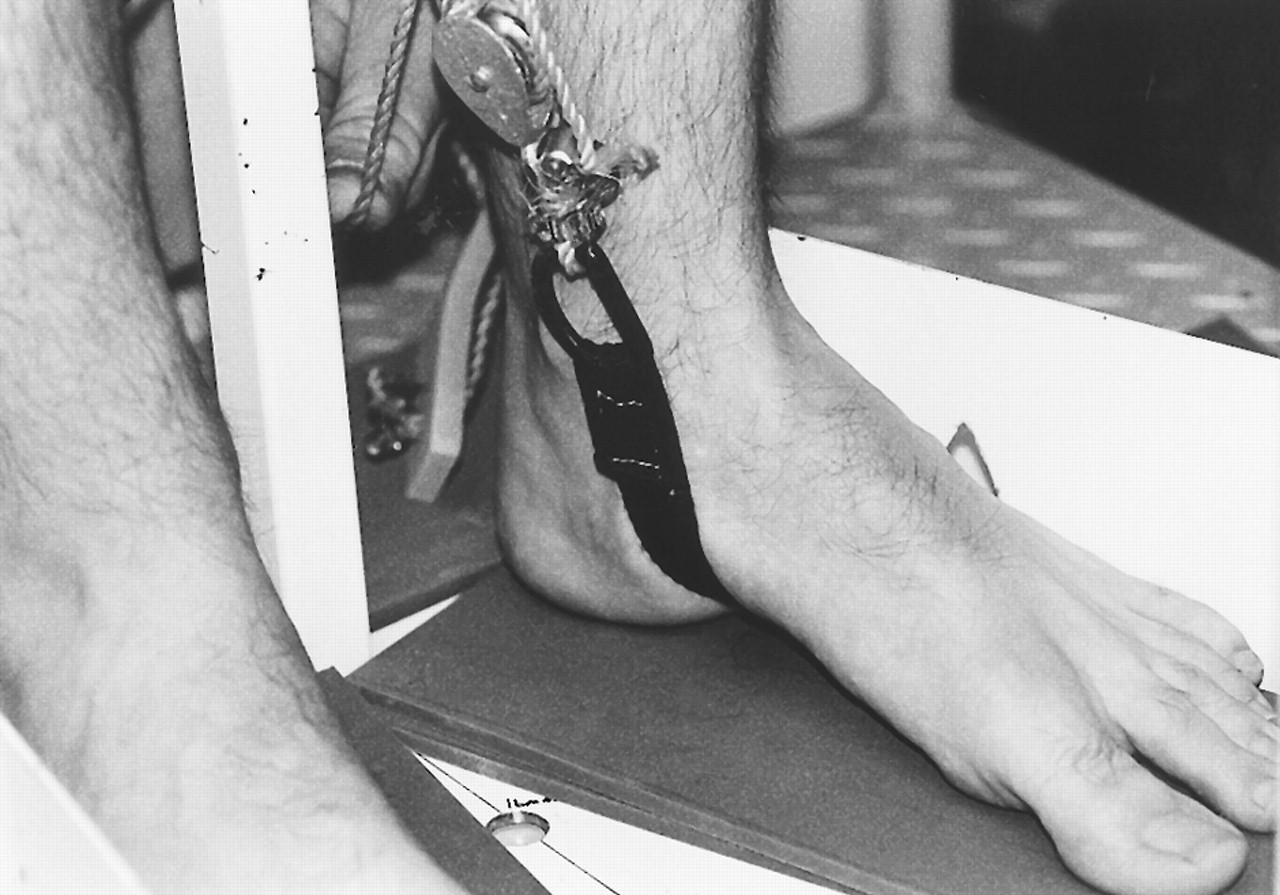
To measure the amount of force needed to supinate the rearfoot, a supination resistance device (
Fig. 3) was constructed based on the manual supination resistance test described by Kirby and Green.[
23] This device allowed the subjects to stand in their normal angle and base of gait. A 25-mm-wide piece of nonstretchable woven fabric (similar to seat belt material) was fixed to the base of the platform lateral to the foot in the region of the calcaneocuboid joint. It passed under the foot medial to the talonavicular joint and then proximally to be attached to a pulley system and a force gauge (Mecmesin, Horsham, England) that measured the maximum force. The pulley system was used to apply a force to just overcome the inertia needed to invert the calcaneus as the investigator observed a bisection that was placed on the posterior aspect of the calcaneus. Participants were instructed to stand relaxed and not to assist the investigator. If any assistance was detected (eg, muscle contraction), the test was repeated. The test was repeated ten times for each subject, with the mean used for analysis. For 13 subjects, the supination resistance test was repeated 1 week later to determine the repeatability of the device.
The Pearson correlation coefficient (r) was used to determine the relationship between the amount of force needed to supinate the foot and body weight, the transverse plane position of the subtalar joint axis, and the sagittal plane position of the subtalar joint axis. Type (2,1) ICCs were used to determine the reliability of the measurements.
Results
A total of 47 subjects (25 women and 22 men) were recruited for the study (mean ± SD age, 22.3 ± 5.3 years; weight, 69.2 ± 16.9 kg). The mean ± SD transverse plane position of the subtalar joint axis was offset 8.9° ± 4.2° from the midline of the foot, 67 ± 17 mm between the fifth metatarsal head and the joint axis, and 77 ± 48 mm from the posterior aspect of the heel and the point where the subtalar joint axis bisects the line representing the midline of the foot. Because both of the latter parameters would be affected by differences in foot size, they were normalized by dividing by foot length (determined from the ink footprint): a value of 0.434 ± 0.178 was obtained for the analysis of the distance from the fifth metatarsal, and a value of 0.473 ± 0.407 was obtained for the distance from the posterior aspect of the calcaneus to the bisection. The mean ± SD of the ten trials for supination resistance was 167 ± 71.6 N (range, 66 to 438 N).
The ICCs (95% confidence intervals [CIs]) for the comparison between the two clinicians using the three measurements of the subtalar joint axis were 0.86 (0.67–0.97) for the angle of the axis, 0.81 (0.69–0.92) for the intersection of the axis and long axis of the foot, and 0.79 (0.65–0.86) for the distance to the fifth metatarsal. The measurements taken on 15 of the footprints were repeated by a different clinician, and the ICCs (95% CIs) of these measurements were 0.98 (0.92–0.99), 0.98 (0.91–0.99), and 0.97 (0.89–0.99), respectively. The repeated measurements 1 week later on 13 subjects for supination resistance had an ICC of 0.95 (95% CI, 0.88–0.98).
The correlations between the axis measurements and supination resistance were as follows: axis angle, r = 0.118 (P = .49); distance from the posterior heel, r = –0.29 (P = .59); distance from the fifth metatarsal head, r = 0.59 (P = .02); and body weight, r = 0.52 (P = .001).
Discussion
The results of this study show that of those variables measured, body weight and the perpendicular distance between the measured subtalar joint axis and the lateral aspect of the fifth metatarsal head are associated with greater force needed to supinate the foot in static stance. It was not surprising that body weight was a factor in the amount of force needed to supinate the foot, as the greater the body weight, the more force assumed to be needed. The greater force needed to supinate the foot when the subtalar joint axis has more of the foot lateral to it (
Fig. 1B) is likely to result from a greater lever arm and moment causing the pronatory force.[
24] When a foot requires a higher magnitude of force to supinate it, this might indicate that a larger posterior tibial muscle force or larger supination moment from a foot orthosis is required.
Kirby[
19] used a simple hinge model to describe the significance of differences in orientation of the subtalar joint axis for foot function. The clinical method described in the article by Kirby was used to determine the subtalar joint axis in the present study. This model is a nonweightbearing open-chain model that has not been shown to be representative of the weightbearing closed-chain situation in dynamic function. In the nonweightbearing position, calcaneal motion on the talus clearly represents subtalar joint motion, but in the weightbearing situation the motions of the ankle, subtalar, and midtarsal joints have a complex interrelationship. Dynamically, the rearfoot functions in a more complicated way than a simple hinge model,[
3,
8,
9,
18] and the axis moves through different positions during the stance phase of gait. To the authors’ knowledge, the relationship of the clinical determination of the subtalar joint axis based on the simple hinge model to the kinematic function of the rearfoot complex has not yet been investigated to validate the clinical methods described by Kirby[
19] and used in the present study. Motion about the subtalar joint is better described as a bundle of instantaneous axes.]
2,
8,
9]
This research has potential clinical implications despite the validity issues regarding the model on which the subtalar joint axis is based. Kirby[
16] suggests the use of foot orthoses that provide greater supinatory moment when the assumed axis is located more medially. This is assumed to be provided by orthoses with a medial heel skive[
16] or a DC wedge[
21] or an inverted device.[
20,
22] These suggestions, based on clinical experience, are consistent with the research presented here in that subjects with a more medially located subtalar joint axis needed more force to supinate the foot in static stance using the supination resistance device. Additional research generating kinematic data is still needed to further validate these concepts, but they may be clinically applicable when making decisions about prescribing foot orthoses.
Conclusion
This study found an experimental correlation between the position of a nonweightbearing subtalar joint axis as described by Kirby[
19] and the amount of force needed to supinate the foot in static stance. The technique of clinically determining the axis position can be useful in helping clinicians decide how much supinatory force may be needed from foot orthoses.