Next Article in Journal
External Thermoregulation of Wounds Associated with Lower-Extremity Osteomyelitis. A Pilot Study
Previous Article in Journal
Variability of Neutral-Position Casting of the Foot
 
 
Journal of the American Podiatric Medical Association is published by MDPI from Volume 116 Issue 1 (2026). Previous articles were published by another publisher in Open Access under a CC-BY (or CC-BY-NC-ND) licence, and they are hosted by MDPI on mdpi.com as a courtesy and upon agreement with American Podiatric Medical Association.
Article

Knowledge of Aging and Attitudes Toward Older People. A Survey of Australian Podiatric Medical Students

by
Hylton B. Menz
1,2,*,
Francis A. Stewart
1 and
Matthew J. Oates
3
1
School of Exercise and Health Sciences, College of Social and Health Sciences, University of Western Sydney, Campbelltown, New South Wales, Australia
2
Prince of Wales Medical Research Institute, High St, Randwick, New South Wales 2031, Australia
3
Department of Podiatry, School of Human Biosciences, La Trobe University, Bundoora, Victoria, Australia
*
Author to whom correspondence should be addressed.
J. Am. Podiatr. Med. Assoc. 2003, 93(1), 11-17; https://doi.org/10.7547/87507315-93-1-11
Published: 1 January 2003

Abstract

Podiatric medical students in Australia were surveyed to evaluate their reasons for entering podiatric medicine, knowledge of aging, attitudes toward older people, perceptions of treatment efficacy, and desire to specialize in geriatrics. Few students plan to specialize in geriatrics upon graduation (4%), with most preferring general practice (25%) or sports medicine (21%). However, knowledge of aging was good, and students had favorable attitudes toward older people and considered treatment of older people to be effective. Few age- or gender-related effects were observed. It is concluded that students’ lack of desire to specialize in geriatrics may be due not to unfavorable perceptions of older people but rather to the low profile and limited development of geriatrics as a specialty area within the podiatric medical profession.

Australia’s population is relatively old by world standards, and the proportion of people 65 years of age and older is projected to double between 2001 and 2051 to reach approximately 24% of the total population.[1] This dramatic shift in population demographics is part of a worldwide trend toward increased life expectancy and low fertility,[2] and it raises a number of important issues about resource allocation in health care. Given the high rates of foot problems in older people,[3] and the fact that at least half of the caseload of Australian podiatric physicians is made up of people over 65 years of age,[4] podiatric medical students must graduate with an appropriate level of geriatrics knowledge and have favorable attitudes toward older people.
Previous studies have suggested that many health-care providers do not enjoy treating older people,[5-7] and podiatric physicians are no exception. A survey of undergraduate podiatric medical students conducted in the United States by Chumbler and Robbins[8] reported that few students were interested in specializing in geriatrics, and many held unfavorable attitudes toward treating older people. Similarly, a focus group study by Landorf[9] revealed that undergraduate male podiatric medical students in Australia had highly stereotypical views of older people and were more interested in specializing in surgery or sports medicine than in geriatrics.
The underlying reasons for the apparent lack of interest that podiatric medical students have in treating older people have been addressed in some detail by Chumbler and Robbins[8] and Chumbler et al.[10] These survey-based investigations found that students are more likely to have favorable attitudes toward older people if they visited their grandparents frequently, had good geriatrics training during their undergraduate education, and entered the profession for intrinsic reasons (eg, desire to help people) rather than extrinsic reasons (eg, income and prestige). A gender influence was also observed: Female students were more likely to work in primary care and enter the profession for intrinsic reasons. Similar observations have been made in studies of medical students.[11-13]
A potentially important component not addressed in previous studies of podiatric medical students is the contribution of general knowledge of aging to the formation of students’ perceptions of older people. It is likely that an individual’s perceptions of older people will be strongly influenced by his or her general knowledge of the effects of the aging process; that is, if students have inaccurate beliefs about aging, this may manifest as a negative stereotype of older people. An inaccurate understanding of the aging process may also influence students’ perceptions of the efficacy of podiatric care for older people.
The aim of this study was twofold: to determine whether the findings of previous studies also apply to Australian podiatric medical students, and to evaluate whether attitudes toward older people and perceptions of treatment efficacy are influenced by the level of general knowledge of aging. It was hypothesized that the gender influence reported in previous studies would also apply to Australian podiatric medical students, with male students more likely than female students to enter the profession for extrinsic reasons, exhibit less favorable attitudes toward older people, and be more likely to specialize in sports medicine and surgery. It was also hypothesized that good general knowledge of aging would be associated with favorable attitudes toward older people and more positive perceptions of treatment efficacy.

Methods

Subjects

Podiatric medicine is a 3- or 4-year bachelor’s degree program in Australia. The sample for this study consisted of 81 students in their third or fourth year of study at two institutions that offer 4-year programs: La Trobe University in Bundoora, Victoria, and the University of Western Sydney in Campbelltown, New South Wales. None of the students had previously undertaken any specific geriatrics education in their podiatric medical degree program, although all students had experienced some exposure to treating older people in their clinical rotations. A summary of the sample characteristics of the subjects is shown in Table 1.

The Survey Instrument

A survey instrument was developed on the basis of a combination of previously validated tests. The first section requested the student’s age, sex, year of study, number of times they visit their grandparents annually, career aspiration (in what environment the student hoped to be working most of the time after graduation), and preferred area of specialization.
Reasons for entering podiatric medicine were evaluated using a modification of a series of questions reported by Chumbler and Robbins.[8] Students were asked to rate the importance of six factors that influenced their decision to enter the podiatric medical profession. The factors were introduced with the phrase “I chose to enter podiatric medicine, . . .” and each factor was rated on a scale ranging from 1 (strongly disagree) to 7 (strongly agree). The factors were as follows: 1) to ensure a stable future, 2) to help other people, 3) to earn a good income, 4) to work with people, 5) to achieve a respected position in society, 6) because of its importance to society.
Factors 1, 3, and 5 represent extrinsic rewards, whereas factors 2, 4, and 6 represent intrinsic rewards. To simplify these responses, a ratio of extrinsic to intrinsic rewards was calculated by dividing the sum of the extrinsic factor scores by the sum of the intrinsic factor scores. The resultant ratio represents an overall indicator of the students’ motivation for entering the profession. Scores of less than 1 indicated greater importance placed on intrinsic rewards, whereas scores above 1 indicated greater importance placed on extrinsic rewards.
Attitudes toward older people were assessed using the Aging Semantic Differential described by Rosencranz and McNevin,[14] which consists of 32 polar-adjective pairs scored on a 7-point scale. Examples of the polar-adjective pairs include progressive–old-fashioned, rich–poor, friendly–unfriendly, and happy–sad. Students were instructed to mark their perceptions of an average older person on the scale for each pair of adjectives. The overall scale ranges from 32 to 224, with high scores on the instrument indicating negative perceptions of older people and low scores representing positive perceptions.
Knowledge of aging was assessed using Palmore’s Facts on Aging Quiz I.[15] This instrument consists of 25 true-or-false statements about basic physical, social, and mental capabilities of older people that have widely accepted answers. Because the quiz contains US terminology and statistics, an Australian version previously validated by Luszcz[16] was used. The number of correct answers was recorded and expressed as a percentage.
Perception of treatment efficacy for older people was evaluated using a series of questions previously used by Chumbler and Robbins.[8] Students were asked to rate their level of agreement with the following statements on a scale from 1 (strongly agree) to 7 (strongly disagree):
1) A great number of older people have health problems for which podiatrists cannot give much help.
2) Preventative podiatric care is less relevant for elderly persons, considering their chronic conditions.
3) Considering the health problems typical of older people, it is less gratifying for a podiatrist to treat them.
4) With elderly patients, it is more satisfactory for podiatrists to undertake treatment of acute diseases than chronic conditions.
An overall score of perception of treatment efficacy was calculated by summing the responses to these questions. A score of 4 represented a perception that treatment is largely ineffective, whereas a score of 28 indicated a perception that treatment is highly effective.
The survey instrument was administered during a lecture to all students enrolled in a compulsory geriatrics course at their university. A follow-up investigation was planned to determine the effect of geriatrics education on knowledge and attitudes toward older people. Therefore, students were asked to include their student number on the survey so that the follow-up survey could be matched with the initial survey. La Trobe University students returned their surveys to one of the authors (M.J.O.), who input the results into a spreadsheet file and submitted them to the primary investigator (H.B.M.). University of Western Sydney students returned their surveys to the student investigator (F.A.S.), who input the results into a spreadsheet file. Using this protocol, the primary investigator was unaware of the identity of the students. Students were informed of this protocol before completing the survey in order to minimize the possibility of completing the questions in a manner they might consider more satisfactory to their lecturers.

Statistical Analysis

All data were explored for normal distribution prior to analysis. Three variables exhibited positively skewed distributions: age, frequency of grandparent visits, and the ratio of extrinsic to intrinsic rewards for entering podiatric medicine. Log10 transformation resulted in near-normal distributions for frequency of grandparent visits, thereby enabling parametric analysis. However, age and the ratio of extrinsic to intrinsic rewards remained positively skewed and were therefore treated in a nonparametric manner.
Differences in frequencies for cross-tabulated categorical data (university, gender, career aspiration, and area of future specialization) were determined using the χ2 test. Differences between groups were determined using independent t-tests for parametric data and the Mann-Whitney test for nonparametric data. Associations between variables were assessed using Pearson’s r for parametric data and Spearman’s p for nonparametric data. The level of significance was set at α = .05.

Results

Institutional Differences

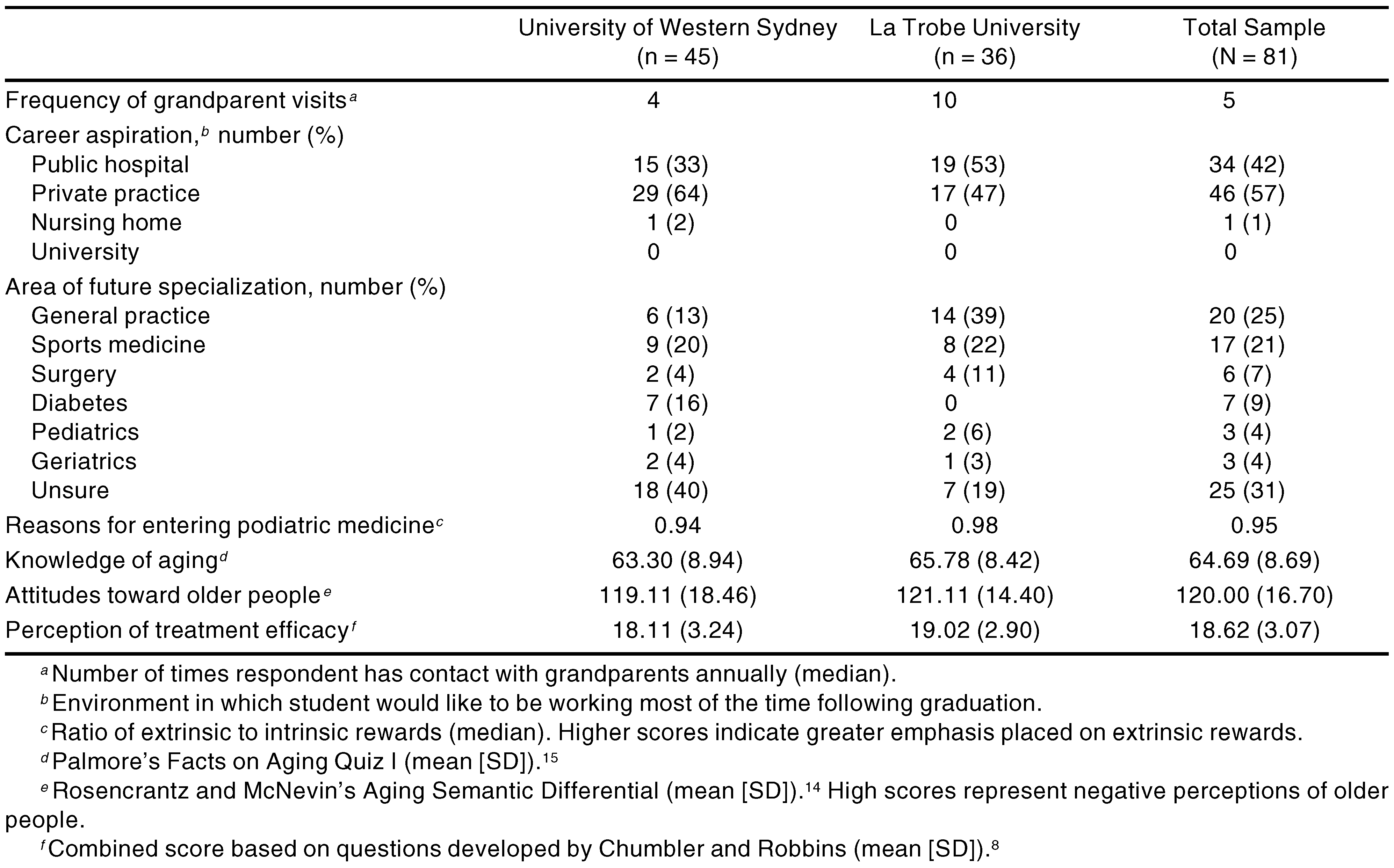
Table 2 summarizes the results tabulated according to university, alongside the total combined sample. There were no significant differences between the universities with regard to any of the survey variables, with the exception of area of future specialization. La Trobe University students were more likely to want to work in general practice following graduation (39% versus 13%, χ2 = 7.02, df = 1, P < .05), whereas University of Western Sydney students were more likely to be unsure about their future area of specialization (40% versus 19%, χ2 = 3.96, df = 1, P < .05). There were inadequate numbers to apply inferential statistics to any of the other areas of specialization. Given the homogeneity of results from the two institutions, subsequent analyses were performed on the total combined sample.

Career Aspirations and Area of Future Specialization

Private practice was the career aspiration for a majority of the students (n = 46, 57%), followed by working in a public hospital (n = 34, 42%) and a nursing home (n = 1, 1%). None of the students planned to be employed in the university sector. Many students were unsure of their area of future specialization (n = 25, 31%), and a large proportion planned to work in a general practice (n = 20, 25%). Of those who planned to specialize, the most popular specialty area was sports medicine (n = 17, 21%), followed by diabetes (n = 7, 9%), surgery (n = 6, 7%), pediatrics (n = 3, 4%), and geriatrics (n = 3, 4%).

Reasons for Entering Podiatric Medicine

The ratio of extrinsic to intrinsic rewards of entering podiatric medicine is shown in Table 2. This ratio ranged from 0.19 to 2.22, indicating a broad spread of results from highly altruistic students to highly self-focused students. On average, students rated intrinsic rewards slightly higher than extrinsic rewards, as evidenced by the median value of 0.95. Reasons for entering podiatric medicine were not associated with knowledge of aging, attitudes toward older people, or perceptions of treatment efficacy.

Knowledge of Aging and Attitudes Toward Older People

Knowledge of aging, as determined by Palmore’s Facts on Aging Quiz I,[15] ranged from 44% to 88%, with a mean score of 65%. The most commonly held negative misconceptions about aging were that the majority of older people have incomes below the poverty line (72% of students), are set in their ways or unable to change (44%), work less effectively than the young (37%), and become more religious with age (36%). The most commonly held positive misconceptions about aging were that the five senses do not decline with age (28%) and that older people do not take longer to learn something new (27%).
Student attitudes toward older people, as determined by the Aging Semantic Differential,[14] ranged from 62 to 157, with an average of 120, indicating neither overly positive nor overly negative perceptions of older people.
There was a weak but statistically significant association between knowledge of aging and attitudes toward older people (r = –0.29, P < .05), indicating that students with a greater knowledge of aging had more favorable attitudes toward older people. The number of times students visited their grandparents was not associated with knowledge of aging or attitudes toward older people.

Perception of Treatment Efficacy

Efficacy of treatment scores ranged from 11 to 24, with an average score of 18.62, indicating that students generally considered podiatric medical treatment to be effective in older people. There was no association between perception of treatment efficacy and either knowledge of aging or attitudes toward older people.

Age and Gender Differences

There were no differences in median ages with regard to career aspiration or area of future specialization. Age was not associated with reasons for entering podiatric medicine, knowledge of aging, attitudes toward older people, or perception of treatment efficacy.
There were no gender differences with regard to career aspirations, with approximately equal numbers of male and female students wanting to work in private versus public sector settings. There were also no gender differences with regard to future area of specialization; however, the sample size was too small to apply inferential statistics to most categories. There were no differences between male and female students with regard to reasons for entering podiatric medicine, knowledge of aging, or attitudes toward older people; however, female students perceived treatment of older people to be slightly more effective than did male students (t = –2.31, df = 78, P < .05).

Public versus Private Sector Differences

There were no differences between students planning on working in the public versus private sector with regard to any of the survey variables.

Discussion

Geriatrics does not enjoy a high profile in podiatric medicine in Australia. While a range of special-interest groups exist for sports medicine, pediatrics, and diabetes, and there are professionally recognized specialist colleges for sports medicine (Australian Academy of Podiatric Sports Medicine) and surgery (Australian College of Podiatric Surgeons), no such organizations exist for geriatrics. Furthermore, at the most recent national conference, only 5% of papers directly pertained to treatment of older people, suggesting a low level of research activity in this area.[17] This is despite the fact that a large proportion of a podiatric physician’s workload involves treating older people, and this is certain to increase with the aging of the population.
Given that geriatrics is not well recognized as a specialty area, it is perhaps not surprising that few students (3 of 81 in the current study) consider it to be a preferred career option. However, the results of this study do not suggest that podiatric medical students lack knowledge about aging, have negative attitudes toward older people, or perceive treatment of older people to be ineffective. While the average knowledge of aging score (65%) could be improved, this result is similar to that reported in previous studies pertaining to other professions,[16,18-25] with only nursing students and registered nurses consistently scoring higher (Table 3). The attitudes toward older people score reported here, however, indicates that Australian podiatric medical students have more favorable perceptions of older people than do many other health-profession students, including medical students (Table 4).[25-27] The association between knowledge and attitudes is consistent with the hypothesis of this study and the results of previous studies,[23,25] suggesting that students with a greater knowledge of aging have more favorable attitudes toward older people.
This study’s findings differ from those of Chumbler and Robbins[8] and Chumbler et al,[10] who reported that students who entered the podiatric medical profession for extrinsic reasons (income, prestige, and financial security) were more likely to have negative attitudes toward treatment of older people. No such association was found in this study, nor was any relationship between reasons for entering podiatric medicine and knowledge of aging or attitudes toward older people. These conflicting results may be due to differences in the podiatric medical profession between the United States and Australia. In Australia, podiatric physicians have a very limited surgical scope of practice, and the vast majority of clinical practice involves conservative management of foot conditions. It is likely that Australian schools of podiatric medicine attract a different type of student than their US counterparts, with Australian students having little interest in surgery and possibly being less focused on income and prestige. Contrary to previous studies of medical students,[11-13] the current study failed to show a gender effect on career aspirations, knowledge of aging, or perceptions of older people. The only significant difference between male and female students was that female students considered treatment of older people to be slightly more effective. Again, these results may be due to the conservative nature of the podiatric medical profession in Australia and the attraction of a different type of student than in US schools.
Overall, the results of this study are positive and suggest that podiatric medical students in Australia have a reasonably accurate understanding of older people and favorable attitudes toward them. Although the small number of students planning to specialize in geriatrics is a concern, it is important to note that most students aspire to work in general practice instead of specializing, with sports medicine being the only specialty identified by a significant number of students. It is likely that geriatrics is viewed as a “default” specialty, that is, an area of practice recognized as a ubiquitous component of podiatric medicine rather than an area to specifically choose to work in. Nevertheless, older people do have special foot-health needs,[28,29] and the body of knowledge and practical skills required to effectively address these needs justifies the recognition of geriatrics as a valid specialty area within the profession.[30-32] Thus future development of the field of podogeriatrics is certainly warranted.
These findings must be viewed in light of the study’s limitations. First, the sample population was derived from only two of the six schools of podiatric medicine in Australia, so the results reported here may not reflect the student population as a whole. Second, the sample consisted of students in their third and fourth years of study, who all had some experience in dealing with older people during their clinical rotations. It would be of interest to follow the students from their first year of study through graduation to assess how knowledge and attitudes change over time, as experiences with healthy elderly people have been shown to positively influence attitudes toward aging.[33] Finally, given that students completed the survey at the end of a lecture series on geriatrics, a Hawthorne effect cannot be ruled out: The students may have provided the answers they thought were expected of them, rather than their honest opinions. However, the authors tried to minimize this as much as possible by blinding the primary investigator and informing the students that their survey results would have no impact on their course assessment; thus there was no incentive for students to answer the questions dishonestly.

Conclusion

This survey has shown that although few podiatric medical students in Australia wish to specialize in geriatrics upon graduation, they have a reasonable general knowledge of aging, hold favorable attitudes toward older people, and consider treatment of older people to be effective. The main conclusion to be drawn from this information is that the apparent lack of desire to specialize in geriatrics may be due to the low profile and limited development of geriatrics as a specialty area in the podiatric medical profession. There is a need to more actively promote geriatrics as a valid specialty given the increasing demand for podiatric medical services due to the aging of the population.

References

  1. Australian Bureau of Statistics: Population Projections, ABS Catalogue No. 3222.0, Canberra, 2000.
  2. World Health Organization: Towards Policy for Health and Aging. Available at: http://www.who.int/hpr/aging/index.htm. Accessed September 12, 2001.
  3. Gorter KJ, Kuyvenhoven MM, de Melker RA: Nontraumatic foot complaints in older people: a population-based survey of risk factors, mobility, and well-being. JAPMA90: 397, 2000.
  4. Australian Bureau of Statistics: National Health Survey: Summary of Results, ABS Catalogue No. 4368.0, Canberra, 1997.
  5. Kiyak HA, Milgrom P, Ratener P, et al: Dentists’ attitudes toward and knowledge of the elderly. J Dent Educ46: 266, 1982.
  6. Dunkie SE, Hyde RS: Predictors and subsequent decisions of physical therapy and nursing students to work with geriatric clients: an application of the theory of reasoned action. Phys Ther75: 614, 1995.
  7. Morris ME, Minichiello V: Why choose to work in geriatrics? Factors which influence physiotherapists’ decisions to work in geriatrics. Aust J Physiother38: 21, 1992.
  8. Chumbler NR, Robbins JM: Podiatric medical students’ views toward geriatrics and elderly patients: a preliminary study. JAPMA84: 338, 1994.
  9. Landorf KB: Attitudes of male podiatry students to treating older people: a pilot study. Australas J Podiatr Med31: 39, 1997.
  10. Chumbler NR, Robbins JM, Poplawski ME: Rewards of entering podiatric medicine and attitudes toward older adults. JAPMA86: 288, 1996.
  11. Hojat M, Gonnella JS, Veloski JJ, et al: Differences in professional activities, perceptions of professional problems, and practice patterns between men and women graduates of Jefferson Medical College. Acad Med65: 775, 1990.
  12. Walters BC: Why don’t more women choose surgery as a career? Acad Med68: 388, 1993.
  13. Bickel J, Ruffin A: Gender associated differences in matriculating and graduating medical students. Acad Med70: 552, 1995.
  14. Rosencranz HA, McNevin TE: A factor analysis of attitudes toward the aged. Gerontologist9: 55, 1969.
  15. Palmore E: Facts on aging: a short quiz. Gerontologist17: 315, 1977.
  16. Luszcz MA: Facts on aging: an Australian validation. Gerontologist22: 369, 1982.
  17. Australasian Podiatry Council: Book of Abstracts from the 19th Australasian Podiatry Conference, Australasian Podiatry Council, Melbourne, 2001.
  18. McDowell J: Factors related to misconceptions about ageing among nurses. Cited by: Palmore E: Facts on aging: a short quiz. Gerontologist17: 315, 1977.
  19. Ramon P: Knowledge about ageing among nursing home staff. Cited by: Palmore E: Facts on aging: a short quiz. Gerontologist17: 315, 1977.
  20. Lusk SL, Williams RA, Hsuing S: Evaluation of the Facts on Aging Quizzes I & II. J Nurs Educ34: 317, 1995.
  21. Williams RA, Lusk SL, Kline NW: Knowledge of aging and cognitive styles in baccalaureate nursing students. Gerontologist26: 545, 1986.
  22. Sheffler SJ: Do clinical experiences affect nursing students’ attitudes toward the elderly? J Nurs Educ34: 312, 1995.
  23. Shahidi S, Devlen J: Medical students’ attitudes to and knowledge of the aged. Med Educ27: 286, 1993.
  24. Rumsey KE: Are optometric faculty guilty of ageism? Optom Vis Sci70: 205, 1993.
  25. Edwards MJ, Aldous IR: Attitudes to and knowledge about elderly people: a comparative analysis of students of medicine, English and computer science and their teachers. Med Educ30: 221, 1996.
  26. Adelman RD, Fields SD, Jutagir R: Geriatric education: part II. The effect of a well elderly program on medical student attitudes toward geriatric patients. J Am Geriatr Soc40: 970, 1992.
  27. Fields SD, Jutagir R, Adelman RD, et al: Geriatric education: part I. Efficacy of a mandatory clinical rotation for fourth year medical students. J Am Geriatr Soc40: 964, 1992.
  28. Helfand AE: Health promotion and podogeriatrics: a conceptual design for preventative services. JAPMA80: 100, 1990.
  29. Bruno J, Helfand AE: Physical medicine considerations in managing the older patient. JAPMA80: 364, 1990.
  30. Helfand AE: Podogeriatrics. JAPMA77: 401, 1987.
  31. Helfand AE: A conceptual model for a geriatric syllabus for podiatric medicine. JAPMA90: 258, 2000.
  32. Helfand AE: A conceptual model for a geriatric fellowship in podiatric medicine. JAPMA90: 313, 2000.
  33. Greenhill ED, Baker MF: The effects of a well older adult clinical experience on students’ knowledge and attitudes. J Nurs Educ25: 145, 1986.

Table 1. Sample Characteristics of Study Population
Japma 93 00011 i001
Table 2. Summary of Results
Japma 93 00011 i002
Table 3. Knowledge of Aging Across Various Studies
Japma 93 00011 i003
Table 4. Attitudes Toward Older People Across Various Studies
Japma 93 00011 i004