To the Editor:
Complications contribute substantially to the morbidity and cost of diabetes mellitus.[
1] Foot problems in patients with diabetes are frequently complicated by secondary infections. Such complications may have profound emotional and economic consequences, sometimes leading to hospitalization or even amputation.[
2] Onychomycosis, a common condition in diabetic patients, increases the risk of secondary infections and complications such as gangrene.[
3,
4]
Predisposition to secondary infections is a natural consequence of the diabetic condition. Excessive gait pressure[
5] and shoe irritation are compounded by the peripheral neuropathy and circulatory insufficiency associated with the disease. In effect, neuropathy allows a foot lesion to develop unnoticed by the patient, while the impairment of blood flow results in a diminished capacity for healing that, in severe cases, can lead to gangrene and subsequent amputation.[
2,
6]
Traditionally, both conservative and surgical approaches have been used to treat onychomycosis in diabetic patients. In the conservative approach, the physician reduces the size and thickness of the nail by manual debridement. In 1996, Medicare remitted over
$240 million under debridement codes, with more than 99% of mycotic nail procedures billed by podiatrists.[
7] In cases of severe nail pathology, surgical approaches such as partial or total nail avulsion or matrixectomy may be indicated.[
8] In many diabetic patients, however, existing vascular complications make such surgical approaches impractical. Treatment remains imperative, however, as secondary infections can cause complications that compromise the limb. Unfortunately, the sole course of action for the severely compromised limb may be proximal limb amputation.
The availability of newer oral antifungal drugs such as itraconazole and terbinafine may help to reduce the need for limb amputation in diabetic patients with severe complications of onychomycosis. These agents lack the toxicity and equivocal results associated with earlier antifungals such as ketoconazole and griseofulvin and so may represent a cure for onychomycosis in contrast to the merely palliative therapy of traditional nail debridement.[
7] In some cases, surgical and pharmacologic treatment should be combined. Total avulsions should be augmented with antifungal treatment so that recurrence is less likely.[
9]
Although the newer oral antifungal drugs are relatively safe, clinicians need to be aware of possible interactions with other drugs. In general, antifungals of the imidazole class (eg, itraconazole) have a greater potential than allylamine terbinafine for clinically significant interactions with other medications.[
10] In choosing an oral antifungal agent to treat onychomycosis, the physician must consider the patient’s current regimen of pharmacotherapy as well as issues regarding efficacy, toxicity, and ease of treatment. Such issues become key concerns of treatment when the diabetic patient takes other medications concurrently.
In the following cases, the oral antifungal therapy terbinafine was used to treat onychomycosis and prevent complications in patients with diabetes.
Case 1
A 51-year-old woman with hypertension and type 1 diabetes mellitus of 18 years’ duration was receiving several medications, including insulin, diltiazem, and metoprolol, when she presented to the office of the lead author (J.J.A.) with a complaint of yellowing and “looseness” of her hallux toenails for several years. She had a history of an infected ingrown toenail that had been treated by partial, nonpermanent nail removal. She had received several months of topical treatment for nail fungus a few years earlier without success. The looseness of the toenails was worrisome for her, since the nails had a tendency to tear off when she put on her socks. She was very apprehensive about cutting her own nails. Her circulatory status was intact, but the clinical examination revealed marked onychomycosis and onycholysis of both hallux nails, and she was concerned about possible secondary infection. The direct potassium hydroxide (KOH) preparations were positive for hyphae, although the fungal culture failed to yield an organism. Her hepatic function panel was normal.
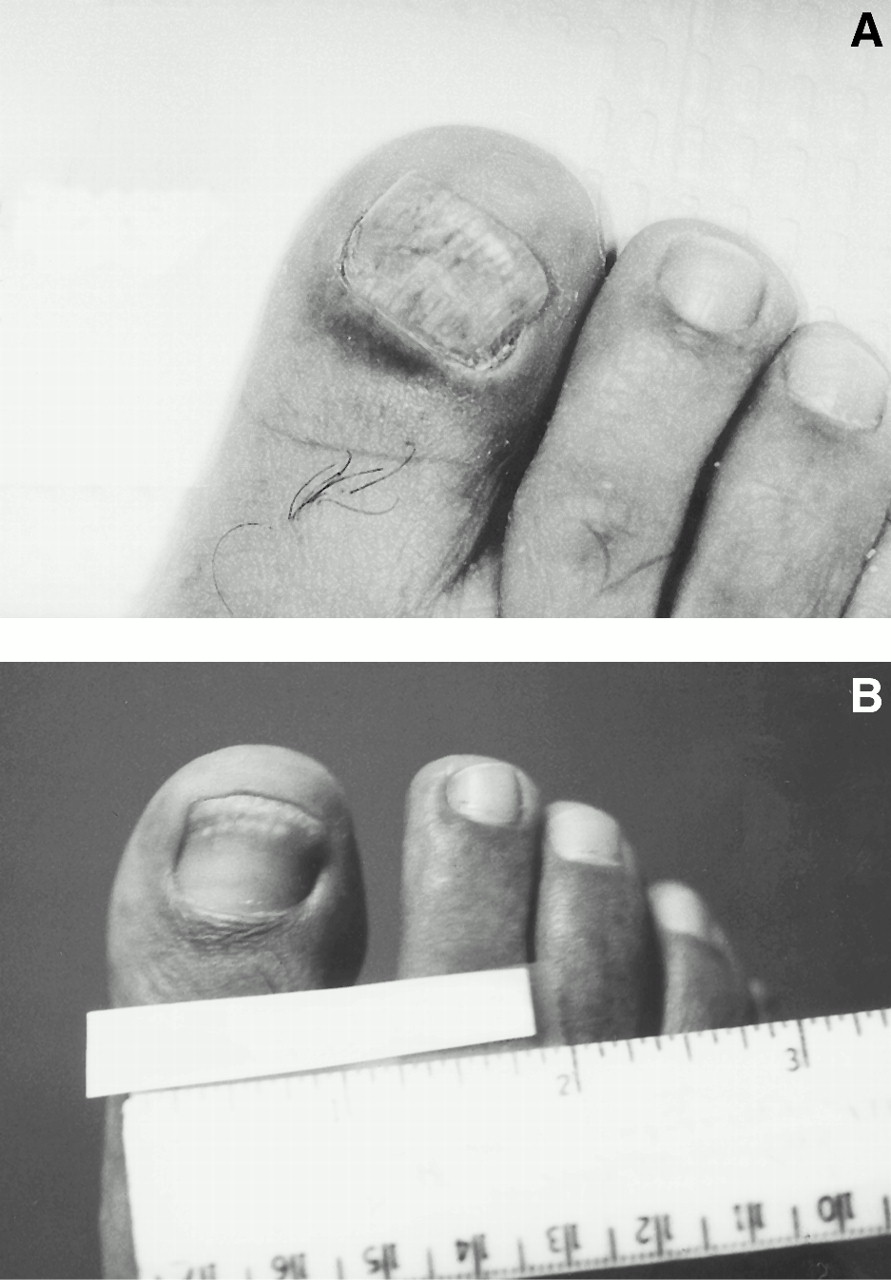
Terbinafine 250 mg once daily was initiated for a standard 12-week course, and the patient returned monthly for follow-up visits. She reported no adverse effects after starting treatment with terbinafine, and her hepatic function tests remained in the normal range. After almost 6 months from the initiation of the 12-week course of terbinafine, the appearance of the target hallux toenail had improved dramatically (
Fig. 1), with the nail plate adhering to the nail bed completely. The area of toenail involvement, about 100% before treatment, had diminished to 20% at the time of the final evaluation. The patient was extremely pleased with this result.
Figure 1.
Treatment of patient for onychomycosis. A, Hallux toenail before initiation of antifungal treatment; discoloration, nail thickening, and onycholysis are present. B, Hallux toenail approximately 3 months after a 12-week course of terbinafine (250 mg once daily) administration; the nail appears normal.
Figure 1.
Treatment of patient for onychomycosis. A, Hallux toenail before initiation of antifungal treatment; discoloration, nail thickening, and onycholysis are present. B, Hallux toenail approximately 3 months after a 12-week course of terbinafine (250 mg once daily) administration; the nail appears normal.
Case 2
A 56-year-old man with type 2 diabetes mellitus of 1 year’s duration presented with severely deformed nails of several years’ duration. The patient was receiving oral antihyperglycemic medication. The left nail had been partially avulsed in a surgical procedure for an infected ingrown toenail and was still painful at the nail border. Physical examination revealed marked onychomycosis and onychodystrophy in the hallux nails. The patient had received topical treatment for several months, but the infection persisted. The patient was concerned about the appearance of his nails. His circulatory status was good. Fungal culture revealed the presence of Trichophyton rubrum, and tests of liver function were unremarkable.
The patient was treated with terbinafine 250 mg once daily for a standard 12-week course, and he returned monthly for follow-up. He reported no adverse effects from the terbinafine, and tests of liver function remained unremarkable. At 6 months of follow-up, physical examination revealed that approximately 90% of the target nail had been cleared of onychomycosis. The patient was extremely pleased with the increased clarity and smoothness and the reduced thickness of the nail.
Discussion
These two cases illustrate the success of oral terbinafine therapy for treating onychomycosis in patients predisposed to diabetic complications. Both cases underscore the importance of prompt diagnosis and intervention to resolve fungal infections, thereby preventing secondary infections and potentially limb-threatening complications. There are approximately 15 million diabetic patients in the United States, and more than 50,000 lower-extremity amputations are performed on these patients each year.[
4] Since mycotic toenails, which are associated with complications, are observed in 98.9% of diabetic patients with foot disorders,[
11] aggressive treatment of this condition may lead to a reduction in the incidence of amputation. Education of diabetic patients plays a central role in the long-term management of the disease. Both of the patients presented here were instructed on issues of hygiene and foot care. The use of orthoses should be recommended as an additional preventative measure against the pedal manifestations of diabetes.
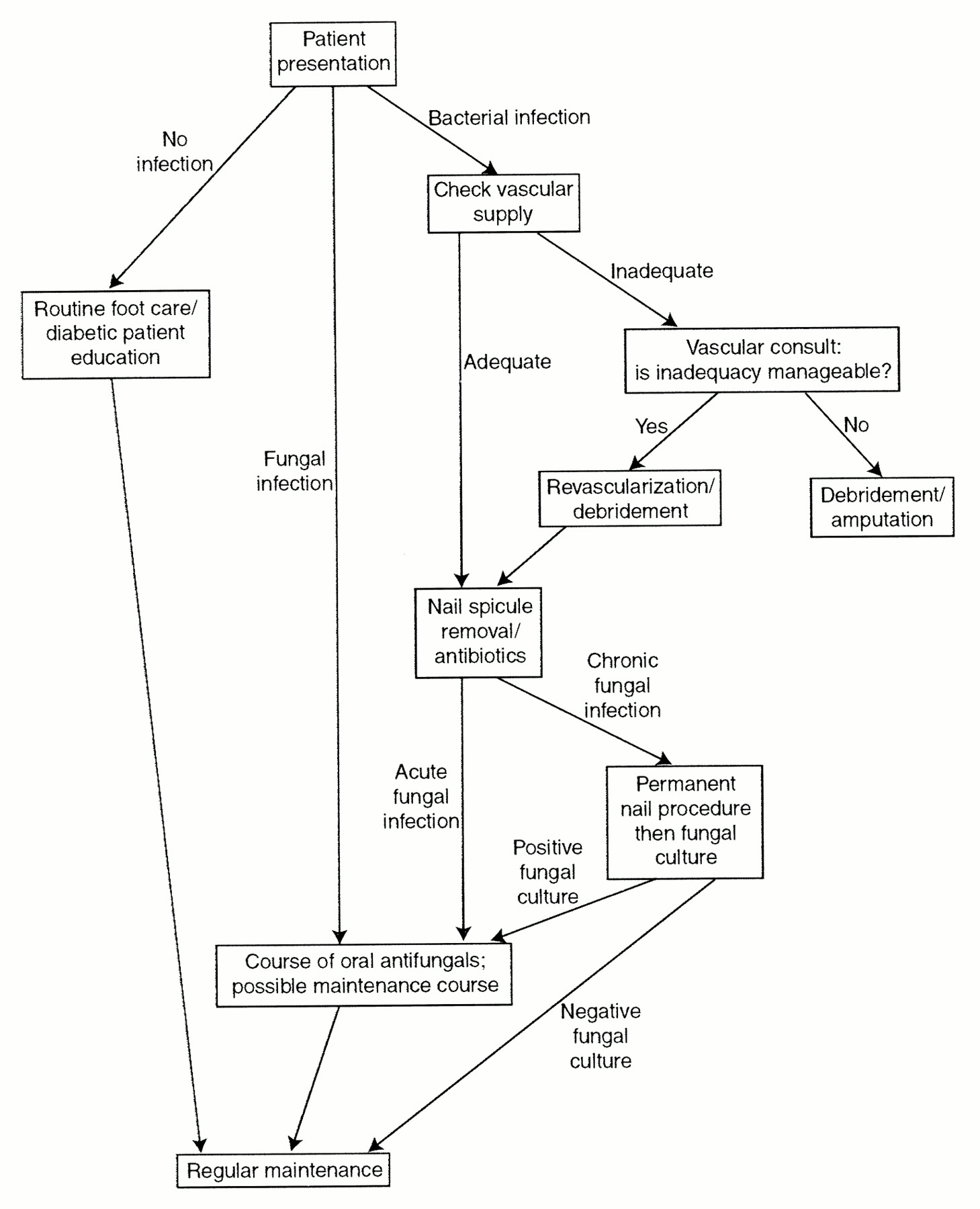
Figure 2 depicts an algorithm used by the authors for management of diabetic patients with nail pathology. This strategy is designed for diabetic patients in whom multiple risk factors increase the complication rate. Yet such risk factors are not restricted to the diabetic population. Many other conditions, especially among the elderly and patients in long-term facilities, are associated with circulatory insufficiency, peripheral neuropathy, or both. In addition, numerous drugs interact with griseofulvin, itraconazole, ketoconazole, and fluconazole, including drugs used for AIDS therapy, regulating cholesterol, sedation, and oral contraception.[
10] In patients requiring medications that may interact with oral antifungal agents, terbinafine would be the oral antifungal agent of choice. An integrated approach that includes curative oral antifungal therapy should help prevent complications of onychomycosis in such patients with comorbidities.
Figure 2.
Treatment algorithm for diabetic patients with nail pathology.
Figure 2.
Treatment algorithm for diabetic patients with nail pathology.