To the Editor:
Medical conditions associated with voodoo are not uncommon in Haiti. Voodoo is a folk religion that emerged from the interaction of West African ethnotheologies and European Christianity.[
1,
2] Haitian voodoo priests, known as “bokors” or “houngans,” practice both healing and poisoning.[
3,
4] Their remedies and poisons are usually derived from plant sources, and 161 of these have recently been studied and classified.[
4]
People in the rural villages of Haiti often hire voodoo priests to poison their enemies. Such poisonings are done with inhalation, oral, and cutaneous agents.[
2] After the poison is prepared, the voodoo priest or one of his assistants administers it to the victim. The inhalation poisons are made into powders and blown into the victim’s face. The oral poisons are secretly added to food. The cutaneous powders are thrown onto the victim’s body, secretly applied to clothing, or placed on the ground around the victim’s residence.[
3]
One of the most commonly used cutaneous poisons is known in Creole as “mashasha.” It is derived from the leaves of
Dalechampia scandens[
3] and it is rapidly caustic to the skin. If the victim can be treated quickly in a clinical situation, activated charcoal can be used topically to deactivate the chemical. Since this option is usually unavailable in Haiti, first aid is administered by applying soil to the involved skin. There is no specific treatment for mashasha poisoning described in the literature.
Ironically, just as voodoo can be both benevolent and malevolent, the leaves of
Dalechampia scandens also yield an oral potion that voodoo priests use medically as a cough suppressant.[
4]
Case History
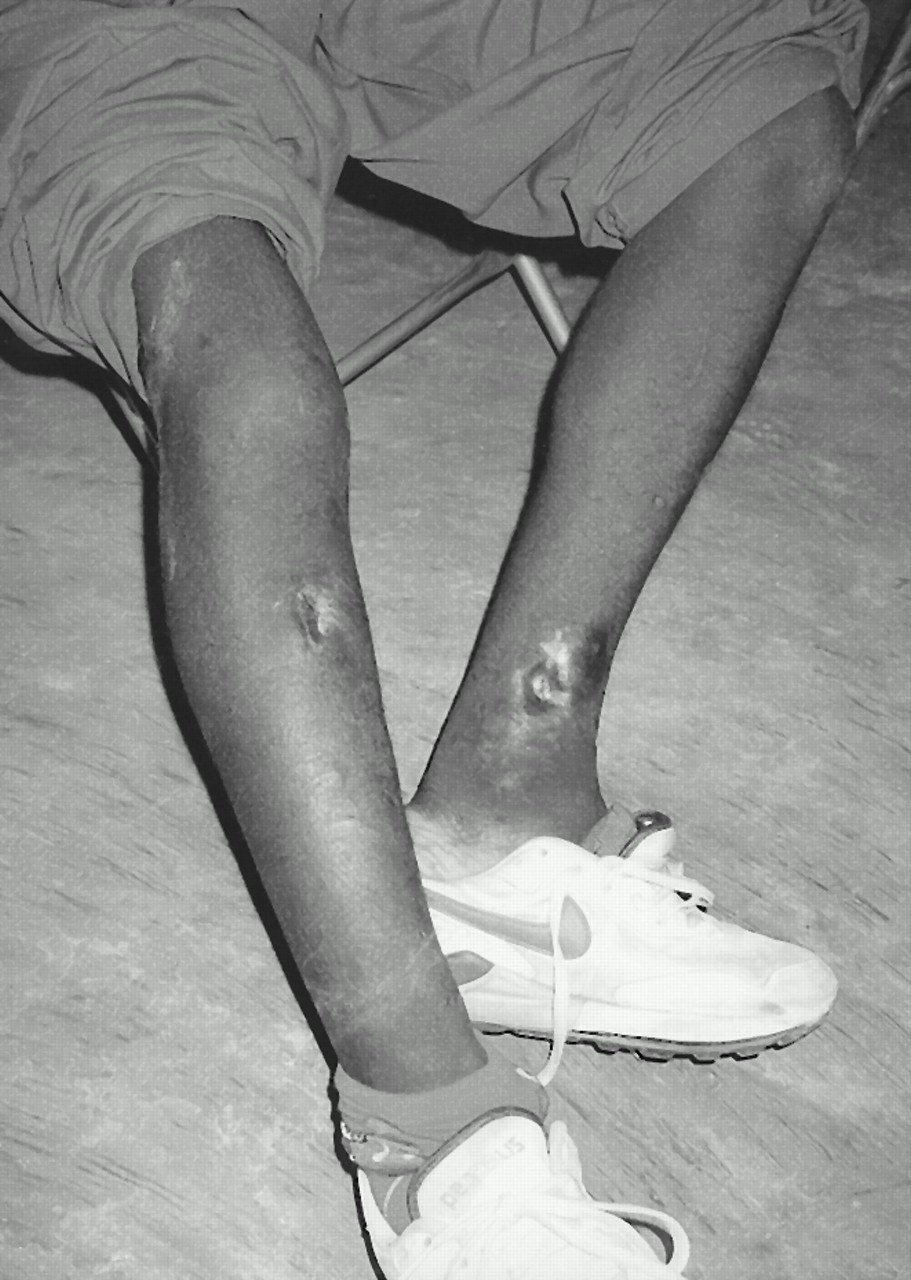
An 11-year-old boy presented to the Clinique Bethel in Campeche Dumay, Haiti, in the company of his parents. His chief complaints were painful ulcers on each leg, and ankylosis of the right knee. Upon examination, he was noted to have two grade 1 ulcers with considerable fibrin and necrotic tissue present. Each was approximately 2.5 cm in diameter. One was located in the medial aspect of the right leg and the other was proximal to the left medial malleolus (
Fig. 1). In addition, the patient’s right knee was ankylosed in 20° of flexion.
The patient’s parents related that the ulcers had been present for 6 months, and the knee ankylosis for about 4 months. The ulcers began after the patient stepped in caustic “voodoo powder” that had been sprinkled on the ground around his hut by a voodoo practitioner hired by enemies of his parents. Apparently, the child suffered numerous chemical burns, some of which were represented by visible scars on the legs, and others that remained as the chronic ulcers. The etiology of the knee ankylosis was uncertain, but may have resulted from a possible septic arthritis.
The ulcers were treated with debridement and application of topical antibiotic cream and dressings. Dressing materials and antibiotic cream were dispensed to the parents, who were then instructed to change the dressings daily. They were also referred to a charity hospital in the capital city for orthopedic consultation for the knee ankylosis.
Figure 1.
Leg ulcers caused by chemical burns from voodoo powder. Also note ankylosis of the right knee.
Figure 1.
Leg ulcers caused by chemical burns from voodoo powder. Also note ankylosis of the right knee.
Conclusion
This case is significant in illustrating two important points for practitioners. First, we must have an awareness of local folk customs when treating patients in other countries. Second, the secret societies that voodoo priests belong to exist in Haitian communities in the United States and Canada,[
5] and North American practitioners treating patients from these populations may well encounter such a condition.