Next Article in Journal
A Conceptual Model for a Geriatric Syllabus for Podiatric Medicine
Previous Article in Journal
Multiple Neuromas Coexisting with Rheumatoid Synovitis and a Rheumatoid Nodule
 
 
Journal of the American Podiatric Medical Association is published by MDPI from Volume 116 Issue 1 (2026). Previous articles were published by another publisher in Open Access under a CC-BY (or CC-BY-NC-ND) licence, and they are hosted by MDPI on mdpi.com as a courtesy and upon agreement with American Podiatric Medical Association.
Case Report

Origin of Foot Ganglion

by
Harvey Lemont
and
Marc A. Sabo
Laboratory of Podiatric Pathology, Temple University School of Podiatric Medicine, Philadelphia, PA 19107, USA
J. Am. Podiatr. Med. Assoc. 2000, 90(5), 256-257; https://doi.org/10.7547/87507315-90-5-256

Published: 1 May 2000
Intraneural ganglion of peripheral nerve is an uncommon disorder.1-3 According to recent review articles, fewer than 80 cases have been reported in the Englishlanguage literature, with the majority occurring in the common peroneal nerve as it courses laterally about the fibular neck [1,3,4,5,6,7,8]. Less common sites include the radial, ulnar, median, sciatic, and tibial nerves [1,3,9]. Since Duchenne’s characterization of this lesion in 1810, the pathogenesis of intraneural ganglion has been a subject of dispute [3,8]. The literature offers two main theories of intraneural ganglion etiology: de novo origination and synovial invasion [3,5,6,7,8,10,11,12,13,14,15,16,17,18,19,20,21].Neither theory satisfactorily explains all described cases.
The de novo theory explains ganglia as arising from a cystic degeneration of epineurium or perineurium [5,6,7,10,12,13,14,15,16,17,21]. In support of this theory, authors have related that in up to 25% of cases, patients recall direct trauma preceding ganglion formation. These authors believe that the percentage of cases involving trauma could be much higher because of subtle, unrecognized, repetitive low-level injury [1,5,7,13].The synovial invasion theory states that ganglia arise from nearby periarticular tissue that tracks along a small articular nerve and eventually invades a major nerve sheath [3,5,7,8,11,17,18,19,20]. Supporters of this theory cite surgically confirmed pedicles, thin synovial ducts connecting ganglion cysts to neighboring joint capsules [3,5,7,8]. These pedicles have been observed during surgery in approximately 40% of cases [5,7,8]. Proponents of this theory believe that the pedicles occur with much greater frequency but that discontinuity may occur naturally or iatrogenically, through nonmeticulous surgical technique [20].
Ganglionic cysts are commonly encountered, often on the dorsolateral aspect of the foot. Many patients present with paresthesia adjacent or distal to the mass. Traditionally, this has been attributed to external compression of sensory nerves by the adjacent ganglion [22]. Following is a description of a surgically excised ganglion submitted for histopathologic analysis.

Case Presentation

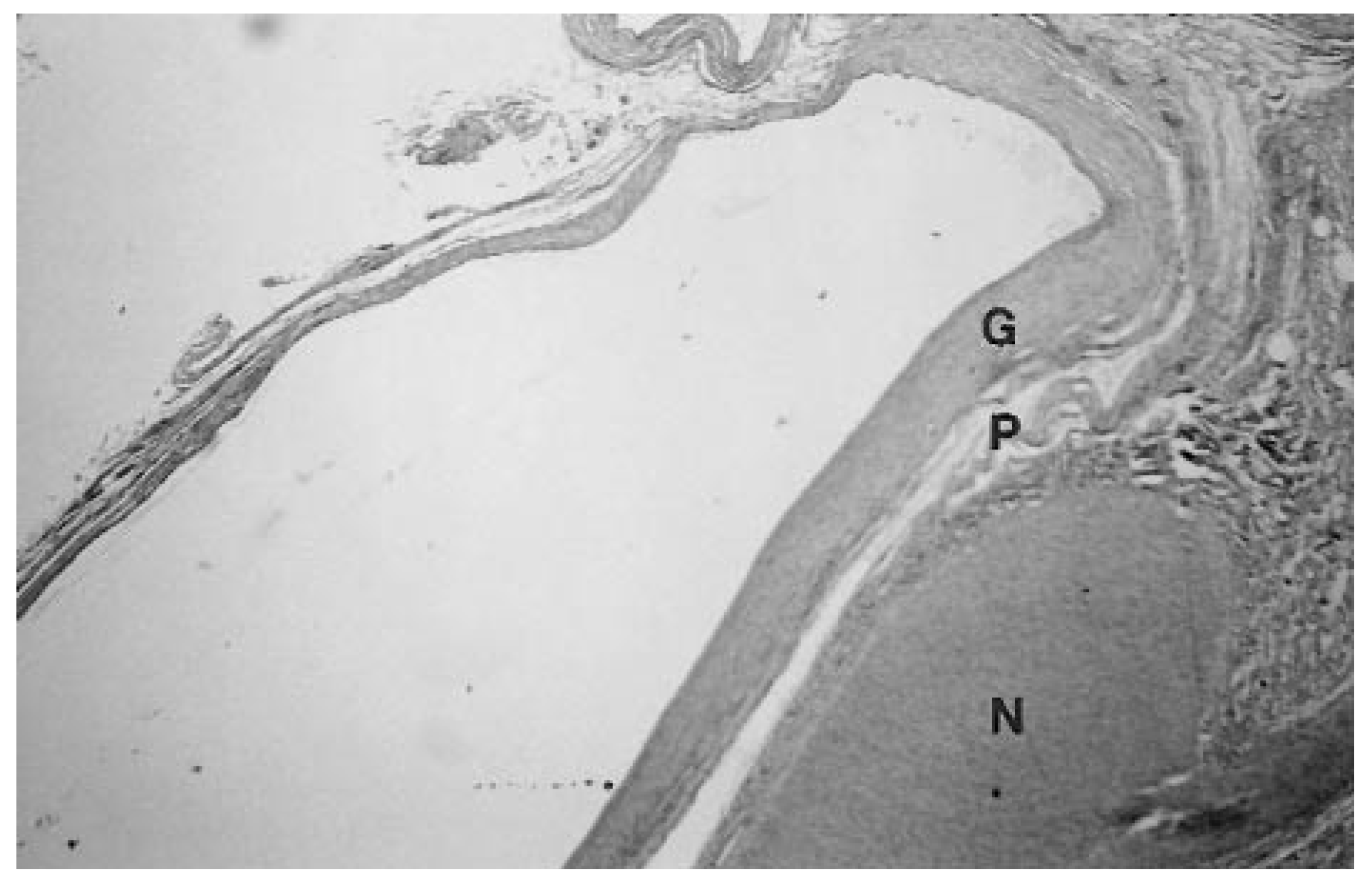
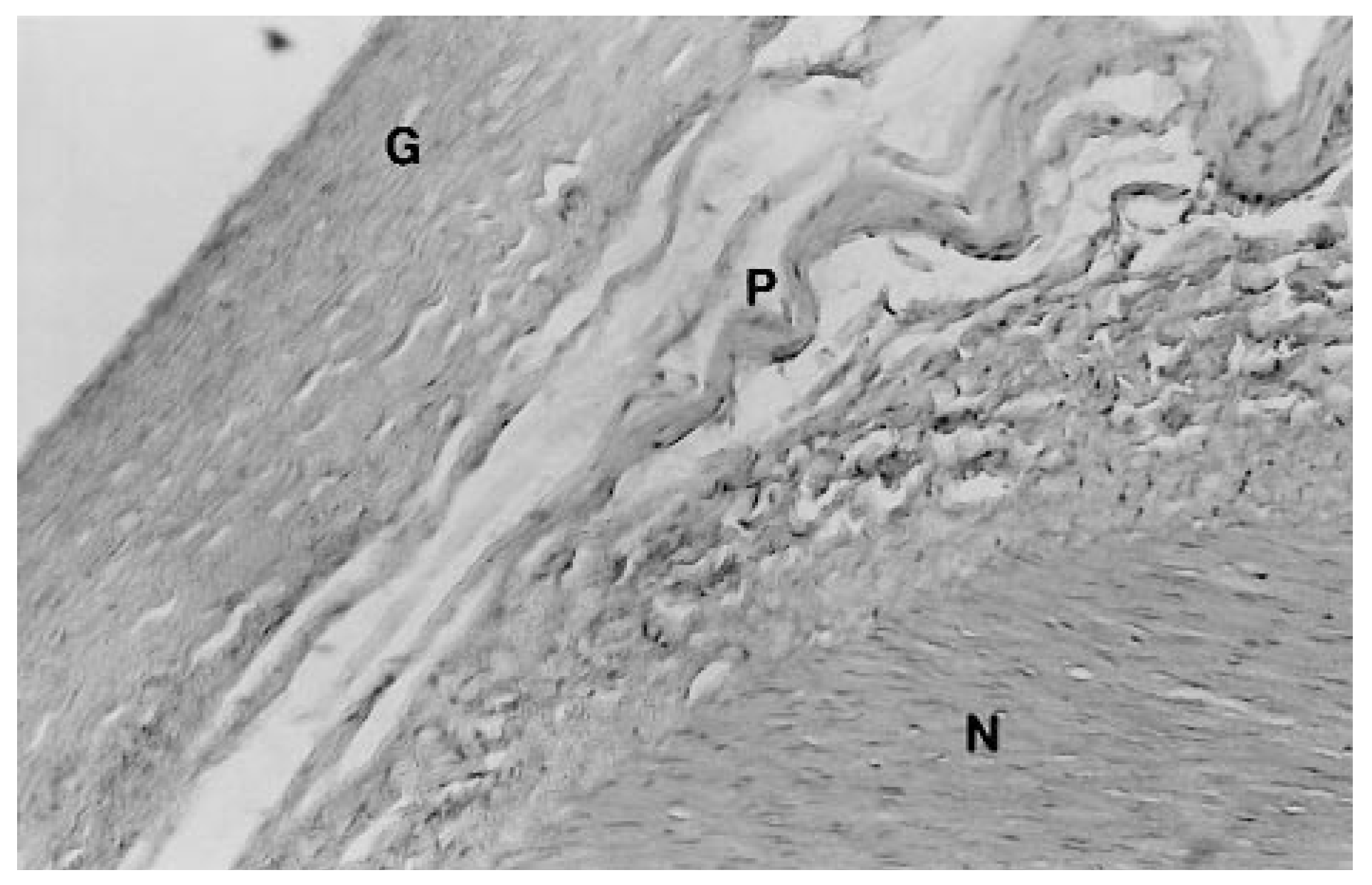
A specimen with a clinical diagnosis of “ganglion, dorsolateral foot” was submitted to the authors’ laboratory for microscopic analysis. A centrally located large cystic cavity consistent with ganglion was seen to be contiguous with the perineurium of a large adjacent cutaneous nerve (Fig. 1). A high-power view revealed the intimate relationship between the nerve, perineurium, and ganglion (Fig. 2). The authors classified this lesion as an intraneural ganglion because of its location within the neural sheath. The mass had been located along the expected distribution of the intermediate dorsal cutaneous nerve.

Comment

Intraneural ganglia are uncommon lesions of uncertain etiology, which are reported to have an affinity for the common peroneal nerve. Although they have been well documented elsewhere in the body, the authors have found no mention in the literature of intraneural ganglion of the intermediate dorsal cutaneous nerve of the foot. In the authors’ experience, histologic sections of ganglion removed from the dorsolateral aspect of the foot commonly reveal an intimate relationship with cutaneous nerves. The purpose of this report is not to refute the prevailing etiologic theories of intraneural ganglion, but to report a largely unrecognized relationship that may exist between ganglion and nerve in the foot. These observations also cast doubt on reports that cite extraneural compression as being solely responsible for ganglion-related paresthesia in the foot.
Figure 1. Large cystic cavity consistent with ganglion (G) is contiguous with perineurium (P) of cutaneous nerve (N) (H&E, ×10).
Japma 90 00256 g001
Figure 2. High-power view demonstrates the intimate relationship between nerve (N), perineurium (P), and ganglion (G) (H&E, ×40).
Japma 90 00256 g002

References

  1. HARBAUGH KS, TIEL RL, KLINE DG. Ganglion cyst involvement of peripheral nerves. J Neurosurg 87: 403, 1997.
  2. O’BRIEN, DF; KAAR, TK; MCGUINNESS, AJ. Interneural ganglion of the peroneal nerve: a case report. Ir Med J 1995, 88, 131. [Google Scholar] [PubMed]
  3. UETANI, M; HASHMI, R; HAYASHI, K. ET AL: Peripheral nerve intraneural ganglion cyst: MR findings in three cases. J Comput Assist Tomogr 1998, 22, 629. [Google Scholar] [CrossRef] [PubMed]
  4. ADAMS, R; VICTOR, M. Principles of Neurology, 4th ed.; McGraw-Hill: New York, 1989. [Google Scholar]
  5. NUCCI, F; ARTICO, M; SANTORO, A. ET AL: Intraneural synovial cyst of the peroneal nerve: report of two cases and review of the literature. Neurosurgery 1990, 26, 339. [Google Scholar] [CrossRef] [PubMed]
  6. DUBUISSON, AS. STEVENAERT A: Recurrent ganglion cyst of the peroneal nerve: radiological and operative observations. J Neurosurg 1996, 84, 280. [Google Scholar] [CrossRef] [PubMed]
  7. SCHERMAN, BM; BILBAO, JM; HUDSON, AR. ET AL: Intraneural ganglion: a case report with electron microscopic observations. Neurosurgery 1981, 8, 487. [Google Scholar] [CrossRef] [PubMed]
  8. NICHOLSON, TR; COHEN, RC; GRATTAN-SMITH, PJ. Intraneural ganglion of the common peroneal nerve in a 4-yearold boy. J Child Neurol 1995, 10, 213. [Google Scholar] [CrossRef] [PubMed]
  9. KING, E. The pathology of ganglion. Aust N Z J Surg 1931, 1, 367. [Google Scholar] [CrossRef]
  10. BARRETT, R; CRAMER, F. Tumors of the peripheral nerves and so-called “ganglia” of the peroneal nerve. Clin Orthop 1963, 27, 135. [Google Scholar] [CrossRef] [PubMed]
  11. BROOKS, DM. Nerve compression by a simple ganglia: a review of thirteen collected cases. J Bone Joint Surg Br 1952, 34, 391. [Google Scholar] [CrossRef] [PubMed]
  12. CLARK, K. Ganglion of the lateral popliteal nerve. J Bone Joint Surg Br 1961, 43, 778. [Google Scholar] [CrossRef]
  13. COBB C, MOIEL R. Ganglion of the peroneal nerve: report of two cases. J Neurosurg 1974, 41, 255. [Google Scholar] [CrossRef] [PubMed]
  14. ELLIS, VH. Two cases of ganglia in the sheath of the peroneal nerve. Br J Surg 1936, 24, 141. [Google Scholar] [CrossRef]
  15. FERGUSON, LK. Ganglion of the peroneal nerve. Ann Surg 1937, 106, 313. [Google Scholar] [CrossRef]
  16. GURDJIAN, ES; LARSEN, RD; LINDNER, DW. Intraneural cyst of the peroneal and ulnar nerves: report of two cases. J Neurosurg 1965, 23, 76. [Google Scholar] [CrossRef] [PubMed]
  17. KATZ, MR; LENOBEL, MI. Intraneural ganglionic cyst of the peroneal nerve: case report. J Neurosurg 1970, 32, 692. [Google Scholar] [CrossRef] [PubMed]
  18. PARKES, A. Intraneural ganglion of the lateral popliteal nerve. J Bone Joint Surg Br 1961, 43, 784. [Google Scholar] [CrossRef] [PubMed]
  19. PARKES, AR. Intraneural ganglion of the lateral popliteal nerve. J Bone Joint Surg Br 1960, 42, 652. [Google Scholar] [CrossRef] [PubMed]
  20. SEDDON, HJ. Surgical Disorders of the Peripheral Nerves,, 2nd ed.; Churchill Livingstone: Edinburgh, 1975. [Google Scholar]
  21. WADSTEIN, T. Two cases of ganglia in the sheath of the peroneal nerve. Acta Orthop Scand 1931, 2, 221. [Google Scholar] [CrossRef]
  22. PONTIOUS, J; GOOD, J; MAXIAN, SH. Ganglions of the foot and ankle: a retrospective analysis of 63 procedures. JAPMA 1999, 89, 163. [Google Scholar] [CrossRef] [PubMed]