This study investigated the efficacy of gait plates in an intervention aimed at reducing the amount of transverse plane pathology and symptomatology associated with such pathology. The first description of the gait plate inlay appeared in the literature in 1967 [
18], although that article claimed that the device was in use as early as 1958. Conventionally, the gait plate is a rigid plastic plate worn in the shoe, covering the entire sole of the foot up to the metatarsal heads. For control of in-toeing gait, the device is extended forward onto the fifth toe while on the medial side it is cut back at an angle of 45° to behind the first metatarsal, as previously described [
19]. For a fuller description, together with a discussion of the proposed mode of action, its relationship to the therapeutic effect, and the role of heel-to-toe gait, the reader is directed to these two previous articles [
18,
19].
Results
The sample yielded complete data for 18 children. There were 12 girls and 6 boys, a finding consistent with previous reports in the literature suggesting a significant preponderance of females presenting with this condition [
1,
11]. The mean (±SD) age of the sample group (N = 18) was 30 ± 9.6 months (range, 18–47 months).
As reported previously [
19], there was a small but statistically significant improvement of 6° in the median foot placement angle with gait plates
in situ. The data on foot placement angle, however, should be considered of little clinical importance unless they are accompanied by an improvement in the symptoms associated with the in-toeing gait. The questionnaire explored these factors further.
Questionnaire 1: Before Intervention
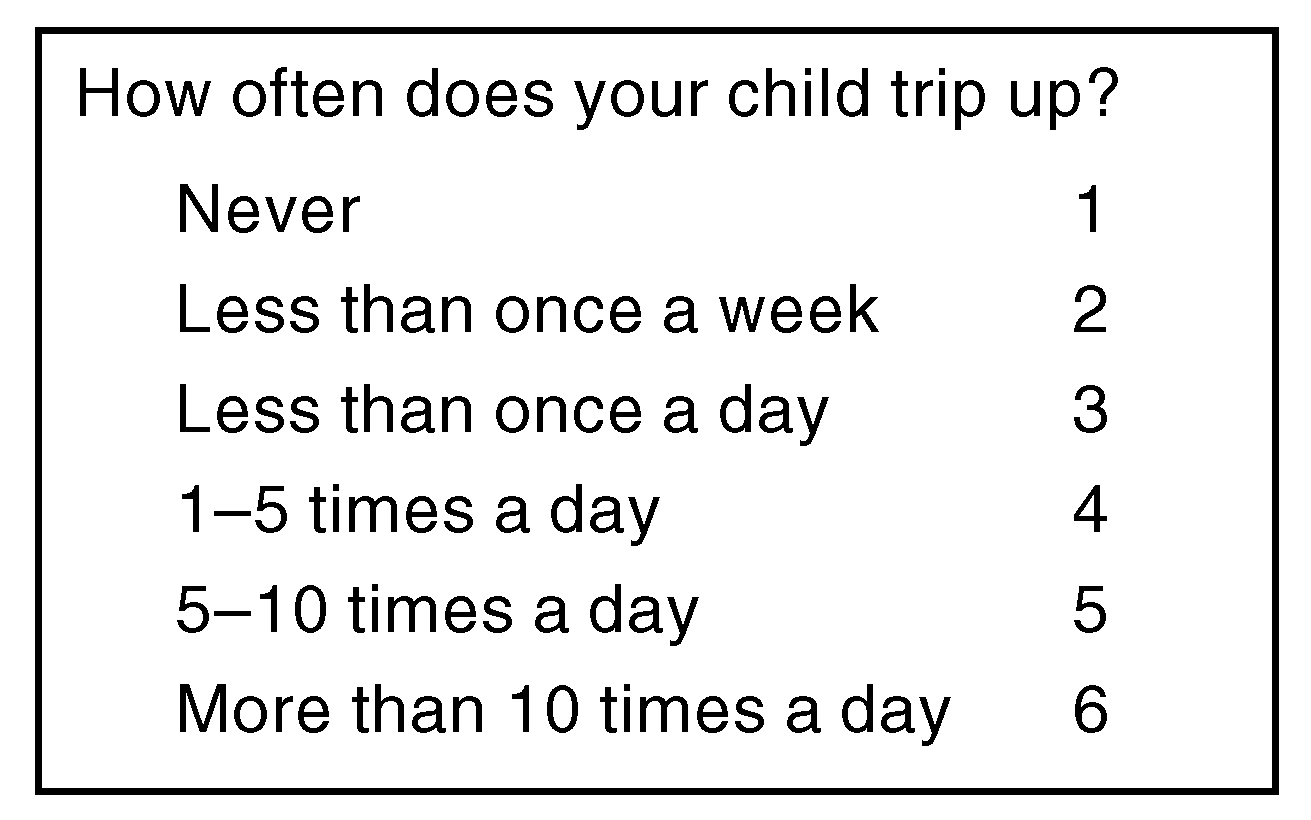
Tripping. Parents were asked how often their child tripped “for no apparent reason.” This question took into consideration the fact that all participants were selected on the basis of some recurrent tripping. As the tripping questions were repeated in the second questionnaire, the tripping data from both sets of responses are dealt with in detail in the section on the second questionnaire.
Injury. Eleven respondents reported that their child suffered some injury as a result of the spontaneous tripping. An additional six respondents reported that the child was injured “often” to “very often.” Only one parent reported that the child suffered no injuries as a result of the tripping.
The respondents reported a range of mainly minor injuries: bruises, grazes, and cuts. The site of these injuries was of more concern, with five parents reporting injuries to the head and face. Nine reported what are arguably more predictable injuries to the legs and knees, and three to the arms and hands.
Sleeping Position. It is commonly reported anecdotally that in-toeing children have a tendency to sleep in the prone position. The parents in this study were given the option of choosing one or more sleeping positions: front, side, back, or no consistent position. Four reported front sleeping; six reported side sleeping; five reported back sleeping; and five reported no consistent sleeping position.
Parental Concern. The responses indicated that 17 of the parents of in-toeing children felt that their child’s in-toeing was severe enough for the parent to be concerned about it. One parent responded independently for each of her child’s limbs and expressed concern about just one limb. Six respondents reported being “very worried.”
The Child’s Concern. Fifteen parents reported that the affected children remained unconcerned. Only one parent reported that the child was apparently “very concerned” about the in-toeing.
Questionnaire 2: 1 Month After Intervention
Overall, the parental responses suggested a high degree of satisfaction with the effect of the intervention on the in-toeing and the resultant tripping.
In-toeing. One parent reported no difference in one limb only. All other respondents reported some improvement, with eight reporting a great difference.
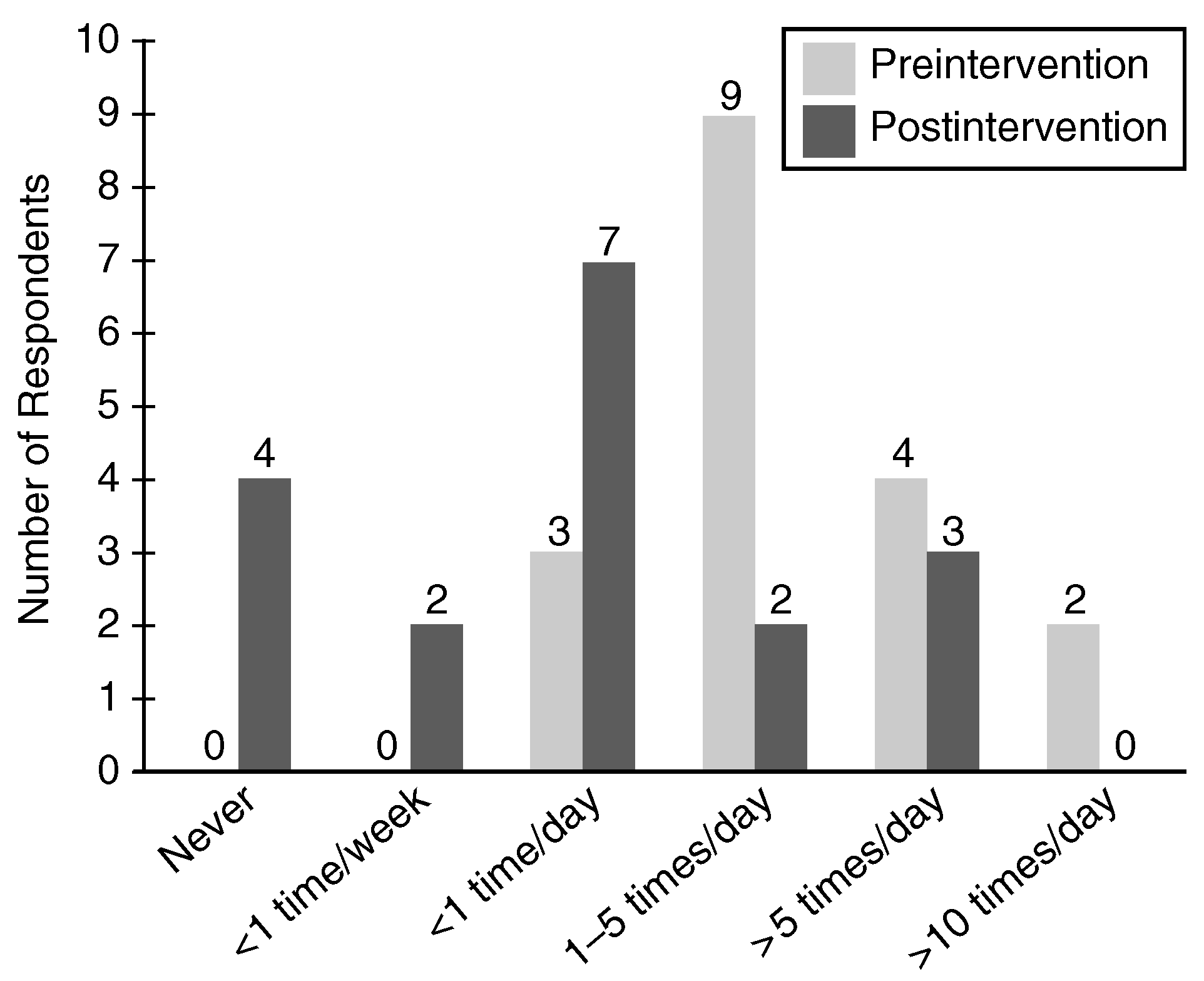
Tripping. All but one respondent reported an improvement in the frequency of tripping: 12 reported great improvement, and 5 some improvement. Comparison of the results of the independent numerical estimates of tripping from the two questionnaires revealed that 14 of the 18 respondents also quantified the tripping rate (without looking at the first questionnaire) as being lower following 1 month of intervention (
Fig. 2).
The median preintervention response was one to five times per day, which fell to less than once daily in the postintervention group. The Wilcoxon signed rank test for this difference yielded a z score of −4.324 (P < .001).
Clinical Event Indicators: Odds Ratios, Risk Reductions, and Numbers Needed to Treat.
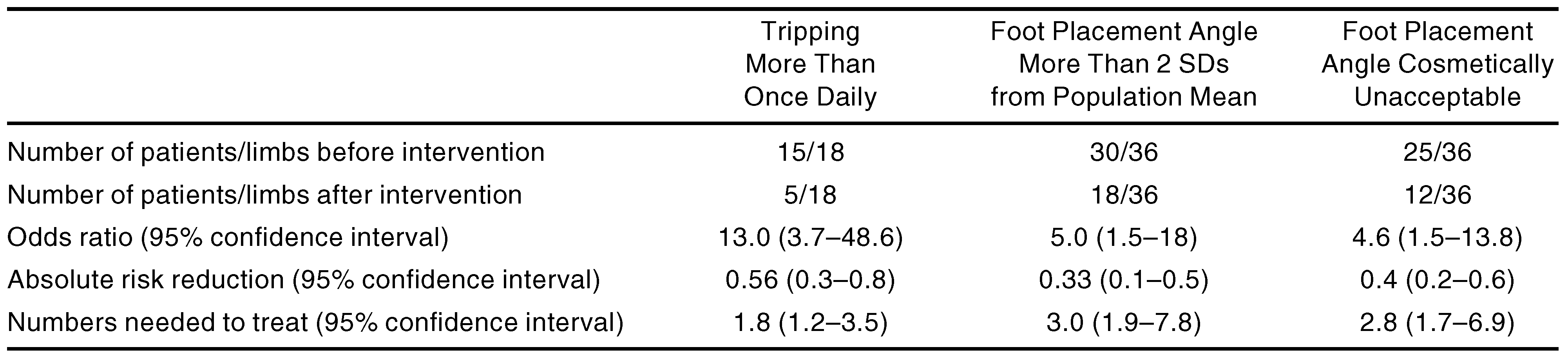
Three clinical event thresholds were identified: 1) tripping more than once per day; 2) in-toeing angle of at least −3°, the lower limit for the normal population [
20]; and 3) an angle of in-toeing considered cosmetically unacceptable (set at −5°).
Elimination of each of these was defined as a baseline goal for determining the clinical efficacy of the gait plate therapy. For each of the events, the odds ratio was calculated, as were the absolute risk reduction and the corresponding numbers needed to treat (NNT), all with 95% confidence intervals (
Table 1).
Parental Satisfaction with Gait Plate Intervention. In the final question, the parents were asked to rate their overall satisfaction with the gait plate therapy.
Figure 2.
Reported frequency of tripping before and after intervention.
Figure 2.
Reported frequency of tripping before and after intervention.
Table 1.
Clinical Event Indicators.
Table 1.
Clinical Event Indicators.
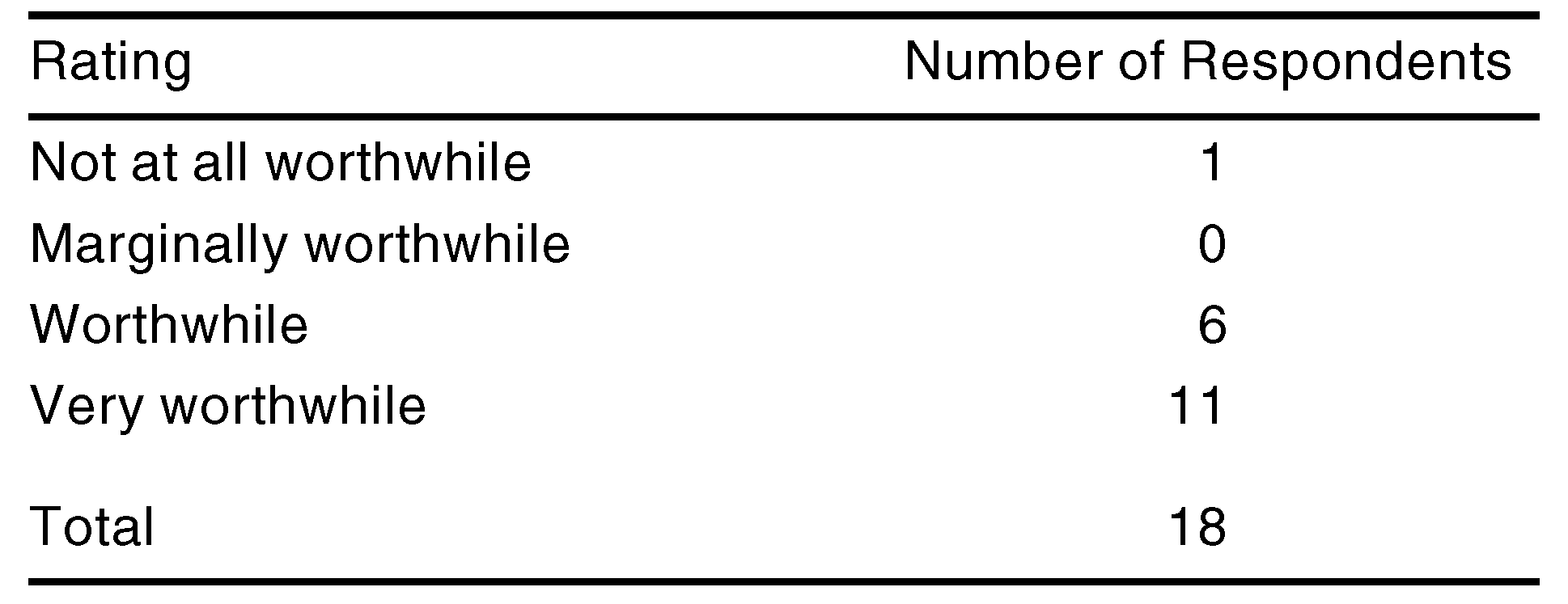
Only one respondent considered the gait plate treatment to have been not worthwhile (
Table 2). All other respondents felt that the gait plate intervention had been worthwhile or very worthwhile.
Discussion
As mentioned previously, the rationale for using patient-oriented indicators was based largely on the limitations of the measure of the foot placement angle as a clinically relevant end point. Practitioneroriented, “surrogate” end points [
25], such as the foot placement angle in this study, are widely employed in medical research because the associated objective data are convenient to manipulate and apply. In the case of these children, however, the primary reason for presentation was parental concern regarding the symptoms associated with the in-toeing, not the foot placement angle itself. There was thus a clear need to consider the data on foot placement angle in parallel with more clinically meaningful data, in order to better understand the broad range of issues associated with this therapeutic intervention. The author recognizes that undertaking such evaluations raises issues about the subjectivity of such data. However, the emotions surrounding the provision (or nonprovision) of therapy to what may be considered a temporarily abnormal child should be addressed; they should not be ignored merely because they are difficult to objectify.
Table 2.
Parental Satisfaction with the Gait Plate Intervention.
Table 2.
Parental Satisfaction with the Gait Plate Intervention.
The subjective data were derived from a series of questions, all of which were presented in a similar style. A Likert-type format had been considered but was rejected in favor of the more individualized question structure in the final implementation. This decision meant that both the format and the content of the questionnaire needed substantial evaluation for reliability and validity, but in all of the preliminary tests applied to this questionnaire set, reliability and validity were determined to be good.
Overall, the responses in both questionnaires were favorable. While it is hoped that the responses reflect genuine satisfaction with the treatment, other possibilities must also be considered. One important influence may have been the fact that responses were confidential but not anonymous, although responses were given in private, were coded, and were not overtly identified with specific patients until the data analysis. The lack of guaranteed anonymity may have affected the responses. The positive skewness may also have been due to the placebo effect: parental responses to individual factors may have been contaminated by other emotions, such as relief at being offered any alternative to benign neglect. The author fully acknowledges this placebo effect and recognizes that it highlights the problems associated with the lack of a randomized, controlled protocol in the study. The results have been reported here because the degree of reported satisfaction, associated with the improvement in the objective data on foot placement angle, makes the data of clinical interest and relevance despite the acknowledged methodologic shortcomings.
In the responses on the preintervention questionnaire, a number of interesting features were evident. Of particular note was the significant difference between the concern expressed by the parent and that expressed by the child. The parents appeared to worry greatly over the clinical presentation while freely admitting that the same problem was of little or no concern to the child. Of course, this sample was self-selecting, in that by definition the parents bringing their children for evaluation would be expressing concern. However, the degree of difference between the two sets of responses is worthy of comment.
Sleeping posture is commonly suggested in the anecdotal literature as being the cause of many of the rotational abnormalities seen in young children [
1,
3,
26,
27]. More recently, there has been some reinterpretation of this view, with the suggestion that sleeping position may prevent resolution of the deformity, rather than being its sole cause. With few exceptions, however, this remains an area where opinion is dictated primarily by anecdote rather than by scientific study. That postures maintained over the long term can have an influence on the developing leg is not in doubt [
28]. However, in accordance with the findings of Widhe et al [
29], the participants in this study demonstrated no consistent, deforming sleeping position associated with their in-toeing. In the absence of substantive evidence supporting a clear association between sleeping posture and deformity, the causal relationship between sleeping position and resultant postural deformity claimed in the anecdotal literature must be viewed with skepticism.
One of the more alarming findings of this study lies in the reports of the injuries that the children had suffered as a result of what was apparently spontaneous tripping. While all active young children will trip periodically, these parents, many of whom had older children, clearly expressed concerns that these in-toeing children tripped more than their peers. This again is an area where commentary is freely given in the anecdotal literature, with a roughly even division between the proportion arguing that there is an increased frequency of tripping associated with in-toeing gait and the proportion dismissing such a link. Once again, in the absence of substantive evidence, this author would contend that we should not automatically assume that individual clinical opinions, diverse as they are [
12], should supersede the strong anxieties of parents. At the very least, when the lack of data regarding overall tripping frequency is viewed in the context of the frequency of injuries in this sample, it is clear that the area warrants further investigation. When one further considers that five parents from this small sample had reported injuries to their child’s head and face, the case against complacency is strong, if not compelling.
With respect to the intervention itself, there were some interesting trends in the reporting of the improvement in in-toeing. Notable was the overreporting of improvement when compared with the corresponding measured foot placement angle. A number of factors may contribute to this finding. First, the data on foot placement angle were collated from two individual trials randomly ordered to the treated and untreated state. All of the data on foot placement angle demonstrated high variability, and the consistency of children’s gait over repeated trials is questionable in any circumstances. It is thus possible that the random error associated with the representative foot placement angle “snapshot” simply underrepresented the overall change in foot placement angle. This is possible, although the consistency of change (31 of the 36 limbs demonstrated an improved foot placement angle with gait plates in situ) suggests that the observed effect was consistent and real, if variable in magnitude. An alternative explanation lies in the potential discussed earlier for either a parental gratitude effect due to a general appreciation for being offered an intervention or, more specifically, a positive feeling being carried over from the improved tripping rates. As was mentioned earlier, when coupled with the lack of strict anonymity in the questionnaires, this may have skewed the parental perception of the change in foot placement angle relative to the measured data. Overall, however, the effectiveness of gait plates in managing the tripping is supported both by the parentally reported improvements in the specific postintervention question and in the comparison of the frequency estimates before and after intervention.
The final stage in the analysis was to combine the objective and subjective data into three clearly defined clinical event indicators against which the clinical outcomes of the intervention could be assessed. The three events were chosen because of their relevance to both the patient and the practitioner. The daily tripping threshold is self-explanatory, while the two events chosen that relate to the foot placement angle warrant further discussion.
The first foot placement angle threshold chosen was the lower limit of the “normal” range as defined in the inclusion criteria (within two SDs of the mean). Success in returning the foot placement angle to normal limits was considered an ideal, but possibly beyond the scope of a conservative therapy in such a short time frame. Therefore, a second event was identified: the return of the foot placement angle to a cosmetically acceptable angle, arbitrarily set at −5° of residual in-toeing (foot placement angle of −5° or better). The analyses demonstrated that the two foot placement angle–based event thresholds actually demonstrated similar improvement rates, probably reflecting the closeness of the two threshold points.
Both NNTs were close to three; that is, for every three in-toeing children treated with gait plates, one would be expected to have a postintervention foot placement angle brought to within the normal population range. This figure compares quite favorably with many interventions currently employed in medical practice [
23]. The NNT for the tripping outcome was more successful, at just under two, meaning that for every two tripping children treated with gait plates, one will be expected to trip less than once daily after intervention. These rates suggest that gait plates may warrant further investigation as an alternative to observational management. This last assertion is supported by the positive responses given by the parents regarding their satisfaction with the intervention. It is notable that when given the opportunity, the respondents in this study gave the clear and probably unsurprising message that parents are interested in an alternative to controlled observation.
While it would be inappropriate to draw wideranging inferences from a sample of this size, the study does appear to highlight several interesting and clear trends with respect to the parental perceptions of a condition that is often managed by passive observation. It is recognized that the majority of children with postural pathologies require no active intervention, and many curative approaches have been rightly criticized in the past for intervening needlessly [
2,
7,
30]. The discerning practitioner should, however, also be prepared to acknowledge and further investigate the real concerns felt by the parents of these children. The high compliance rate of the study was due partly to the simplicity of the treatment protocol and short time frame, but may also reflect the parents’ real anxieties and in some cases relief at being offered a viable alternative to blanket nonintervention. The 18- to 47-month age range of the sample appears to correlate with anecdotal reports of the highest incidence of in-toeing gait pathologies, although it is recognized that in-toeing gait is also seen in some children from the onset of walking. It is probable that for many of these children, the in-toeing will spontaneously resolve by 5 to 6 years of age. However, it is also likely that for some, this 2- to 3-year interval may be a period of both physical trauma for the child and emotional trauma for the parent. The age range of the children in this study was intended to reflect not only the peak incidence of pathology (ie, children younger than 5 years of age), but also the age of onset of heel-to-toe gait [
31] and hence the earliest time at which gait plates may be effective. Burnett and Johnson [
31] concluded that independent walking commenced at a mean of 12.5 months of age, with a heel-to-toe gait pattern demonstrable at a mean of 22 weeks after independent walking commenced (overall onset of heel-to-toe gait, mean of 18.5 months). The inclusion criteria were therefore defined with the lower limit set at an age at which the majority of younger children included would have commenced a heel-to-toe gait pattern.
The primary weakness of this study is the lack of a randomly allocated control group, omitted because of reluctance by the institutional administration to depart from an existing management protocol, as well as the hugely time-consuming process of data acquisition associated with the foot placement angle arm of the study. While the results of this study are revealing, an additional randomized clinical trial should be conducted prior to allowing results such as these to substantially influence clinical practice.