To the Editor:
Until the mid-1980s, reconstruction of large foot wounds in patients with diabetes mellitus was uncommon [
1]. Diabetes has traditionally been considered a contraindication to microvascular free tissue transfer [
2]. Diabetic patients were thought to have an increased risk of small-vessel disease, which could lead to flap failure. Recently, however, studies have shown that diabetic patients with occlusive disease have greater involvement of the tibial and peroneal arteries than patients without diabetes [
3]. This finding prompted more aggressive approaches to the treatment of diabetic foot wounds [
4].
Only a few studies of free tissue transfer in patients with diabetes have been reported. A study conducted by Lai et al. [
2] demonstrated the success of reconstruction using free muscle flaps. The effectiveness of the free muscle flap in the management of extensive defects of the foot and infected wounds, including those caused by osteomyelitis, has been well established [
5].
Shallow wounds with intact paratenon may be safely closed with split-thickness skin grafts [
6]. In cases of exposed bone and tendon (without paratenon), flap coverage is required. A flap is a mass of tissue (skin, muscle, or bone) for grafting that either retains its own blood supply (in the case of a pedicled flap) or has its blood vessels reattached to local vessels (microvascular free flap). Local flaps are developed from tissues near the wound being reconstructed. Distant flaps are developed at some site distant from the recipient wound. Pedicled flaps are transposed to the recipient wound bed. Free flaps have their original vascular pedicle divided and re-anastomosed to vessels near the recipient wound bed. Free tissue transfer offers many advantages for foot and ankle reconstruction in the patient with diabetes. Free tissue transfers are not dependent on the vascularity of the wound bed [
6].
The muscles frequently used for free tissue transfer are the latissimus dorsi, rectus abdominis, and gracilis muscles [
6]. These donor sites heal with little deformity other than a linear scar. The latissimus dorsi is large and thin, providing coverage of most foot defects. The vascular pedicle is dependable, with largecaliber vessels for microsurgical transfer. The rectus abdominis is intermediate in size, but provides coverage of extensive wounds as well. Typically, the flap has two venae comitantes of sufficient caliber for anastomosis. The gracilis is a long, narrow muscle with a pedicle of only about 8 cm in length, and thus with less vasculature available for anastomosis at a distant site.
The presence or absence of vascular disease often dictates the type of reconstruction that can be performed, because the majority of flaps suitable for plantar foot reconstruction are based on blood flow through the posterior tibial artery and its medial and lateral branches [
6]. Therefore, patients who have recently undergone distal vascular bypass may not be good candidates for local arterial flaps. These wounds may require free tissue transfer. When distal bypass surgery has been performed, direct arterial anastomosis to the bypass graft is always preferable. If more proximal revascularization is performed, the distal vasculature must be evaluated for its suitability to receive transplanted tissues. This evaluation is best accomplished with a combination of arteriography and duplex imaging.
Postoperative management is critical to the recognition and control of potential complications. Splint immobilization, elevation, and strict bed rest are necessary for 7 to 10 days. Areas of skin grafting are left undisturbed for 4 to 5 days. Interventions to decrease the likelihood of anastomotic thrombosis include aspirin, intravenous heparin, and dextran. Flaps are evaluated hourly with Doppler ultrasonography for 24 to 48 hours to assess viability, as evidence of arterial or venous compromise requires immediate operative intervention. Activity is increased gradually, starting with progressive dangling of the extremity with compression to control edema. With the assistance of physical and occupational therapy, non-weightbearing ambulation is begun. Weightbearing is delayed until wound healing is complete.
Case Report
A 50-year-old man was referred to the emergency department at New York Hospital in New York City by his primary-care physician because of an ulcer on the dorsum of the right foot that was associated with fever, chills, swelling, pain, and erythema. Five days previously, he had noticed a blister on the medial dorsum of the right foot after a period of wearing tight shoes. The blister ruptured, and a nonhealing wound developed, followed by swelling, erythema, pain, fever, and chills. The patient’s medical history was significant for diabetes mellitus, which was controlled by diet.
On admission, the patient had a temperature of 37.7°C; it subsequently rose to 39.4°C. The blood pressure was 139/77, the pulse was 96, and respirations were 18. The right foot had a 5 × 3-cm partialthickness ulcer with moderate edema and erythema, and there was a palpable dorsalis pedis pulse. There was no exposed bone or muscle and no purulent drainage. There was a mild decrease in sensation. An x-ray was negative for osteomyelitis. The patient’s white blood cell count was 12,400/mm3, and his blood glucose level was 437 mg/dL.
After consultation with a vascular surgeon, a subcutaneous abscess was drained. Local wound care with wet-to-dry dressing changes, intravenous broadspectrum antibiotics, and control of blood glucose level were begun. The patient remained febrile, and his white blood cell count increased to 15,400/mm3. Upon surgical exploration, extensive necrotic tissue and multiple abscesses were found. The patient underwent radical debridement of soft tissue, including the extensor tendons of the great toe. Intraoperative cultures revealed group B streptococci, staphylococci, and Proteus organisms, and intravenous antibiotics were adjusted. The temperature and white blood cell count entered normal ranges, the cellulitis resolved, the edema decreased, and the wound began to granulate.
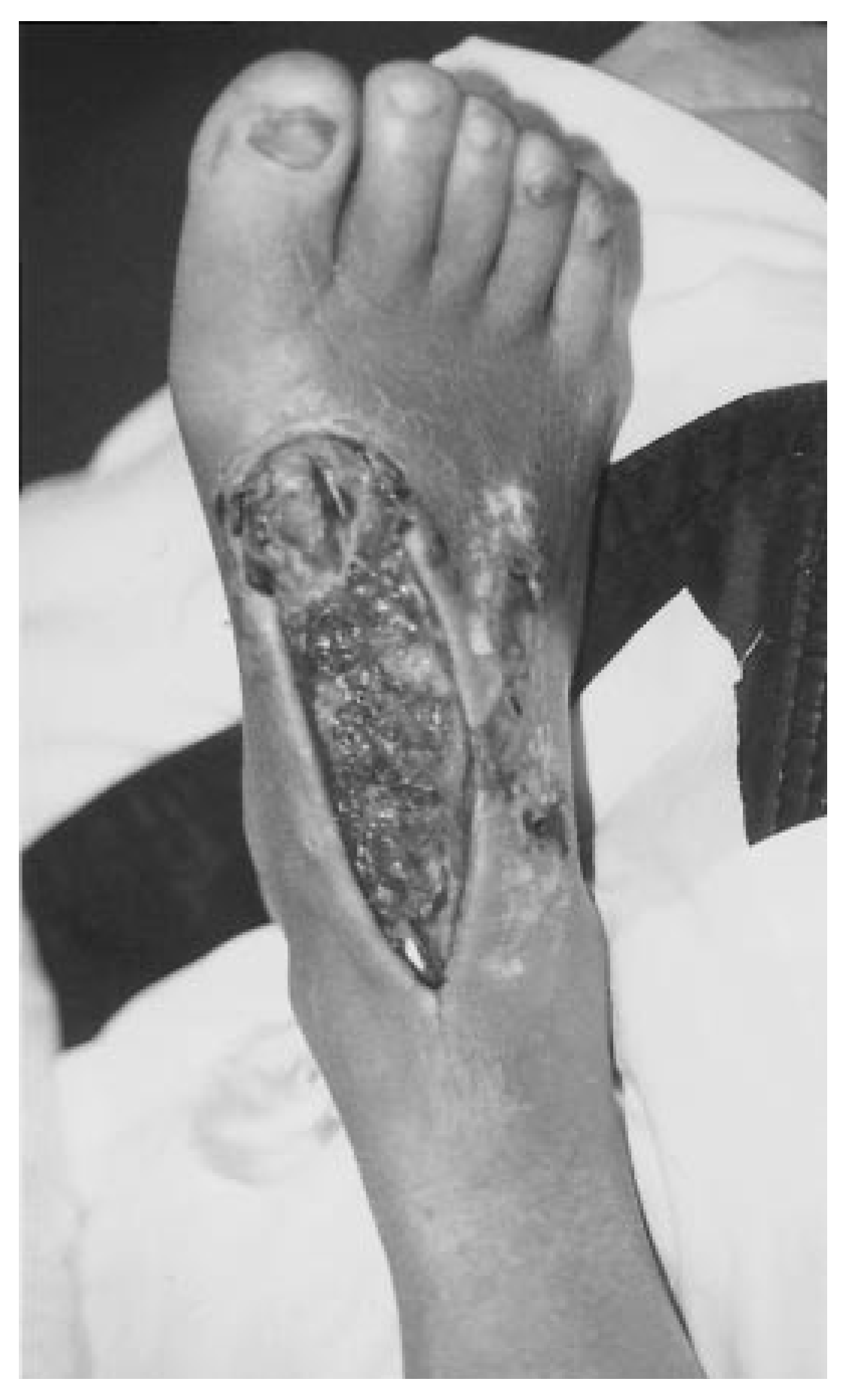
A plastic surgery consultation was requested to evaluate a 10 × 8-cm full-thickness wound with an exposed distal first metatarsal for wound coverage (
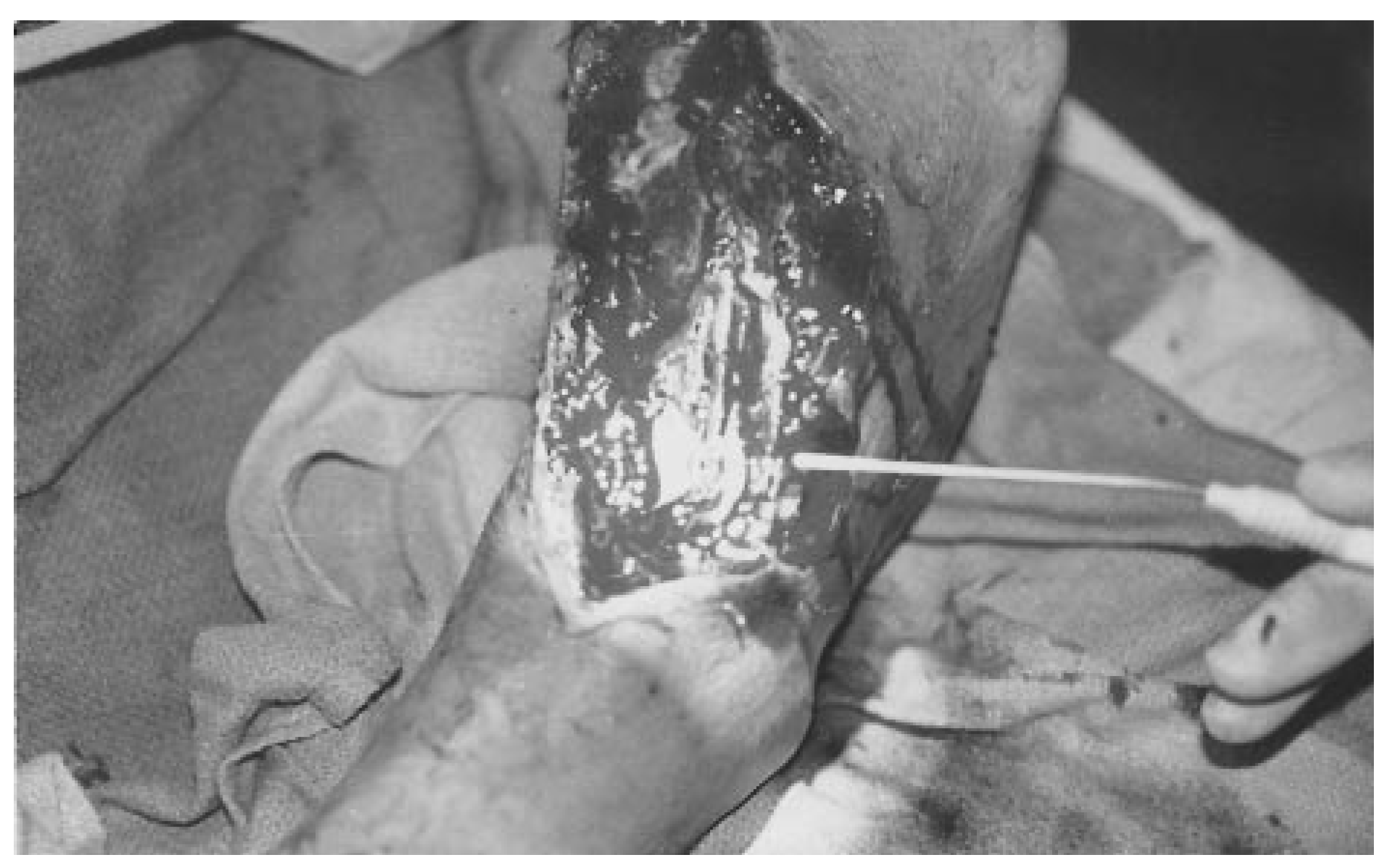
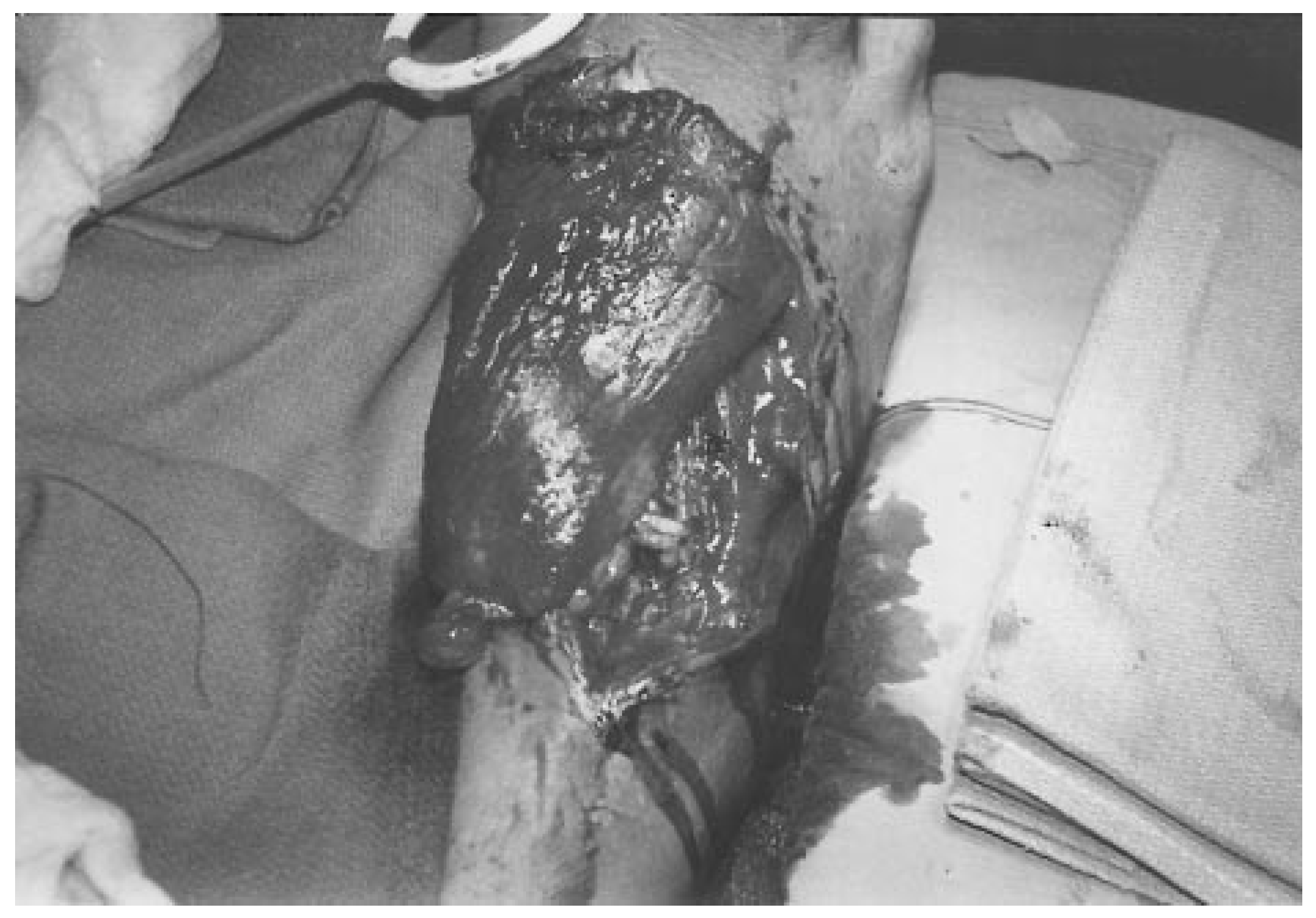
Figure 1). A right lower-extremity angiogram was normal. The patient then underwent debridement, irrigation, and wound coverage with a rectus abdominis muscle free flap (
Figure 2 and
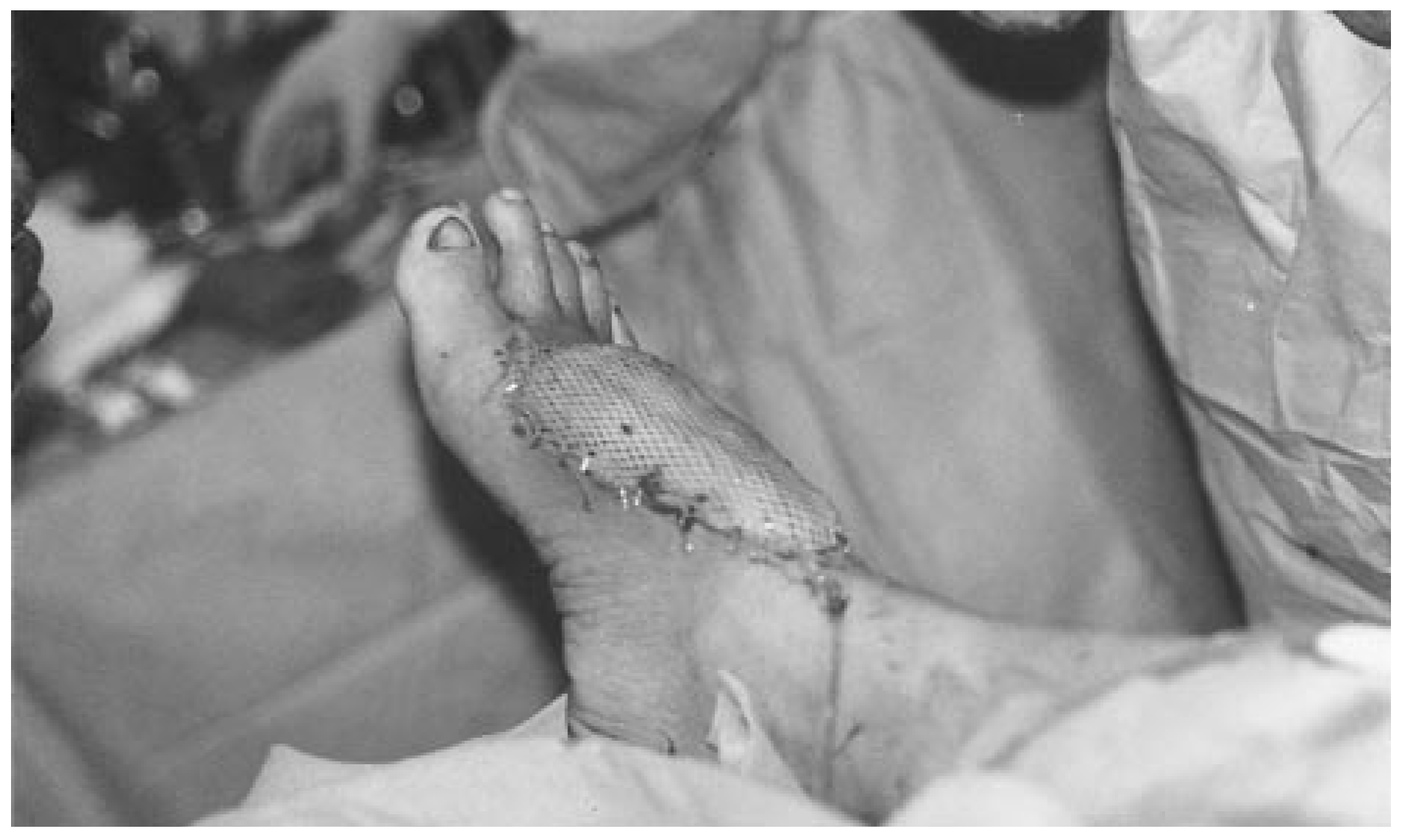
Figure 3). The deep inferior epigastric vessels were anastomosed to the anterior tibial vessels, and the muscle was covered with a split-thickness skin graft from the right thigh (
Figure 4). The abdominal wound was closed primarily, and the skin graft donor site was covered with a nonadherent dressing. Perioperative intravenous antibiotics were administered, and the flap viability was monitored by means of Doppler ultrasonography. Low-molecular-weight dextran, chlorpromazine, and aspirin were used to increase anastomotic patency. The patient did well and was discharged 2 weeks after admission.
Discussion
This case report has described the use of free tissue transfers in the treatment of diabetic ulcers with exposed bone. Free flaps allow immediate closure of wounds, speed wound healing, and limit the potential for bone infection, thus reducing the chances of more extensive amputation.