The assessment of dynamic motion of the foot is extremely important for clinicians involved in the evaluation and treatment of foot and ankle pathologies. Central to this task is the determination of whether the motion observed is typical. Throughout this article, the authors use the word “typical” rather than “normal,” which has proved to be a very elusive concept with little consensus among practitioners. One of the earliest reports that attempted to document typical motion of the foot was that of Wright et al. [
1]. They recorded motion of the rearfoot using an electrogoniometer aligned to the estimated axis of the subtalar joint in two male subjects as they walked barefoot. Inversion and eversion movement of the rearfoot was measured during gait by using each subject’s resting-standing position as the neutral reference position. The importance of this 1964 study is shown by its frequent citation by later authors in discussing what constitutes normal motion and the clinical implications of motion that deviates from these limits [
2,
3,
4,
5].
Although the article by Wright et al should definitely be considered a landmark study in the literature on lower-extremity biomechanics, it is severely limited by its extremely small sample size, exclusion of women, and reliance on a static position of the subtalar joint axis that has since been shown to be incorrect [
6]. The definition of neutral position of the subtalar joint put forth by Wright et al was misinterpreted by Root et al [
2,
7] in their subsequent work on normal and pathologic biomechanics of the lower extremity as subtalar joint neutral rather than the resting-standing position. Subsequent authors have perpetuated this misinterpretation in a wide variety of publications [
3,
4,
5,
8].
Since that 1964 study, rearfoot motion has been recorded numerous times, but usually in the process of studying the effectiveness of foot orthoses [
9] or footwear modifications [
10]. It was not until relatively recently that attention was given to determining whether the original report of Wright et al was correct. Over the last 7 years, several two- and three-dimensional studies have been published that address what should be considered typical rearfoot motion [
11,
12,
13,
14,
15].
The first of these recent studies was by Scott and Winter [
16] in 1991. They documented rearfoot motion relative to the lower leg during the stance phase of walking using three-dimensional (3-D) video analysis in three barefoot subjects. Despite the technological superiority of their study to that of Wright et al, its clinical utility remains severely limited by the extremely small sample size. In 1994, McPoil and Cornwall [
11] published the first of two articles examining typical rearfoot motion during the stance phase of walking. Their first study included 50 subjects (19 men and 31 women) and involved two-dimensional (2-D) frontal plane measurement of the calcaneus relative to the lower leg. Although it is widely accepted that 3-D kinematic measurement is more accurate than 2-D measurement, the results of their study have been shown to be comparable to 3-D video analysis between 6% and 60% of the stance phase [
17]. Perhaps the most important finding of that first study was that rearfoot motion did not seem to function about subtalar joint neutral, but rather about each subject’s resting-standing position.
This finding was essentially repeated in a second study involving 31 subjects, which confirmed the findings of the first study as well as those of the early study by Wright et al. These findings were investigated further by Pierrynowski and Smith [
13] in 1996. They studied 3-D movement of the rearfoot relative to the lower leg during walking on a treadmill in nine subjects. In their study, they related the resulting motion patterns to each subject’s subtalar joint neutral position rather than resting-standing position. The results of their study confirmed the previous findings of McPoil and Cornwall [
11] and cast further doubt on the utility of using subtalar joint neutral as a reference measure for determining either foot abnormality or treatment direction. In addition, their study was the first to utilize a treadmill for the investigation of typical dynamic foot function during walking.
Although the vast majority of foot kinematic studies have utilized overground walking, research has shown that there is little difference between the motion patterns recorded during overground walking and walking on a treadmill [
18]. Two additional studies have added to this growing database of typical rearfoot motion during gait. The first, by Mosseley et al [
15], employed 3-D video analysis of 14 healthy individuals, and the second study, by Liu et al [
14], involved 9 subjects. Both of these studies used a reference point that was completely different from that of McPoil and Cornwall11 or Pierrynowski and Smith [
13]. Instead of relating rearfoot motion to either subtalar joint neutral or resting-standing position, they chose a position in which the foot was plantigrade to the supporting surface and the tibia was vertical. The results of their research demonstrated motion patterns very similar to that previously reported, but because of a different reference point, the angle of the rearfoot at foot contact and the absolute magnitude of motion were different.
The composite of all of these studies provides a fairly good understanding of typical rearfoot motion relative to the lower leg during walking. The studies demonstrate that, depending on the reference position chosen, the calcaneus is either slightly everted or inverted at the time of heel strike and then everts during most of the stance phase. Reinversion of the foot, regardless of the reference position used, generally does not occur until the heel rises off of the supporting surface. The maximum amount of eversion is between 6° and 9°, again depending on the reference position used. Total rearfoot excursion, however, is fairly constant between investigators and averages approximately 9°. Lundberg et al [
19] demonstrated in eight healthy individuals that most of the motion in the foot occurred in the talonavicular joint, with the next greatest amount occurring in the talocalcaneal joint. They found that the joints proximal and distal to the medial cuneiform also contributed substantially to total foot motion. Although their study provides important kinematic information about the foot, it does not address dynamic motions such as walking or the possible influence of the neuromuscular system.
Kinematic research on the foot has typically focused on the calcaneus relative to the lower leg. This focus may be due to the close relationship of the calcaneus to the subtalar joint and the relative ease with which the calcaneus can be measured during walking. Consequently, however, information on the motion produced in the rest of the foot during typical walking is sparse. This is especially true for the midfoot and forefoot. In addition, there is a dearth of information on the relationship between movement of the rearfoot and that of its proximal and distal segments.
Although the principal segments of the foot are frequently referred to as the rearfoot, midfoot, and forefoot, Huson [
20] proposed terminology related to the anatomic relationships of the segments. He referred to the rearfoot as the tarsal mechanism, the midfoot as the tarsometatarsal mechanism, and the forefoot as the metatarsophalangeal mechanism. He further proposed that these three mechanisms or units work in unison to permit the foot to provide certain functions necessary for dynamic movement. These functions include providing stability to the body by permitting the plantar surface of the foot to accommodate to the supporting surface as soon as possible after contacting the ground; assisting the body in cushioning impact forces applied through the lower extremity at foot contact; and improving the efficiency of propelling the body forward in space prior to the foot’s leaving the supporting surface. The purpose of the present article was to present data in support of Huson’s idea that foot pronation and supination result from all foot segments working together rather than separately during dynamic movement.
Materials and Methods
Subjects
Participating in this study were 153 individuals (55 men and 98 women) between the ages of 18 and 41 years (mean, 26.2 years). Subjects were chosen from a larger pool of volunteers because they had no history of congenital deformity, pain, or traumatic injury to either of their lower extremities for at least the 6 months preceding the start of the study.
Table 1 shows demographic information on the subjects who participated in the study. This study was approved by the institutional review board at Northern Arizona University before the start of data collection, and all subjects provided informed written consent.
Instrumentation
Movement of the rearfoot, midfoot, and forefoot segments of each subject’s right foot was investigated by measuring movement of the calcaneus, navicular, and first metatarsal bones relative to the tibia. This analysis was done with the 6D-RESEARCH
® (Skill Technologies, Inc, Phoenix, AZ.) electromagnetic motion analysis system. This system is based on the Fastrak
® (Polhemus, Colchester, VT.) tracking device and uses an electromagnetic transmitter with up to four electromagnetic sensors. The transmitter as well as each sensor consists of three orthogonal coils. Near-field, low-frequency, magnetic-field vectors are generated from the transmitter, with each sensor detecting these field vectors. Thus the sensor creates an embedded coordinate system that is equivalent to using three markers on the surface of the body segment. The detected signals are entered into a digital signal processor that computes the sensor’s position and orientation relative to the transmitter. Its effective accurate range is a radius of 76 cm from the transmitter. Within this range it is accurate to within 0.8 mm and 0.15°. Although this range is too small for analysis of a full walking stride, it is sufficient for analyzing the stance phase of walking [
21].
For the present study, the electromagnetic transmitter was positioned at a height of 96 cm at the midway point of a 6-m raised walkway. The walkway was raised to a height of 76 cm to avoid any possible distortion of the electromagnetic fields caused by metal reinforcement in the laboratory’s concrete floor. Four electromagnetic sensors were used to collect angular position data for the tibia, calcaneus, navicular, and first metatarsal bones during walking. A joint coordinate system as proposed by Grood and Suntay [
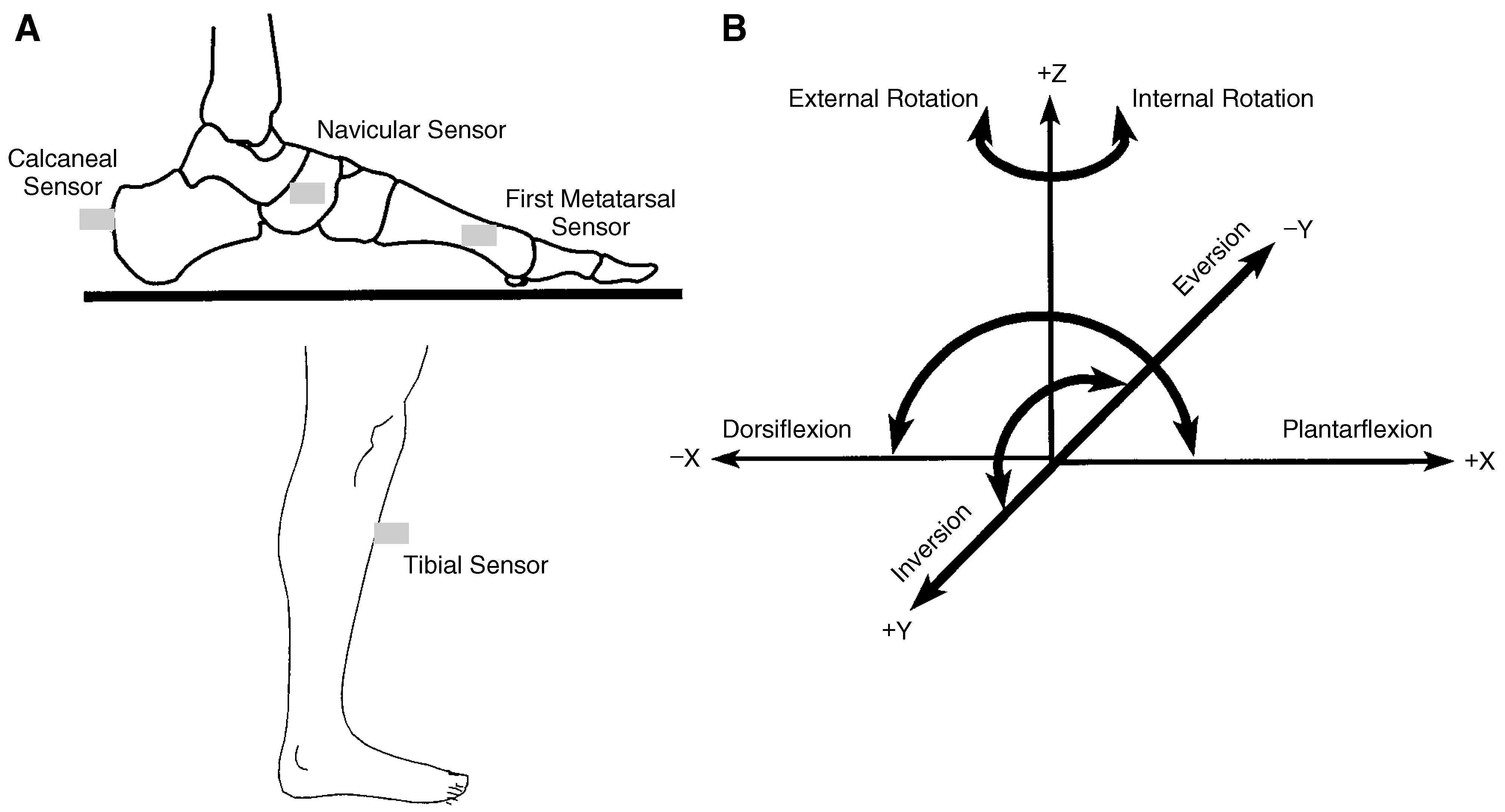
22] was used to define motion of the calcaneal, navicular, and metatarsal sensors relative to the tibial sensor. Movement about the x-axis was defined as dorsiflexion/plantarflexion, and movement about the y-axis was defined as inversion/eversion. Movement about the z-axis was defined as external/internal rotation.
Figure 1 illustrates the definition of the angles measured in this study and the position of the sensors on the subject. The definition of angular displacements relative to the tibia was chosen in order to facilitate interpretation of the results by using a method commonly employed for the calcaneus as well as to maintain measurement consistency for all segments studied [
13,
14,
15]. The sampling rate for all sensors was 60 Hz, and the resulting angles and displacements were smoothed using a 6-Hz low-pass Butterworth digital filter.
To record the temporal occurrences of heel strike, foot flat, heel-off, and toe-off, four force-sensing switches were secured to the plantar surface of each subject’s heel, first metatarsal head, fifth metatarsal head, and hallux with double-sided adhesive tape. The signal produced by each switch was recorded and synchronized with the kinematic data.
Procedure
For each subject, height and weight were recorded and then the four small (2.8 × 2.3 cm) electromagnetic sensors were attached to the right lower extremity. Sensors were placed on the tibial tubercle, the posterior calcaneus, the navicular tubercle, and the distal first metatarsal shaft (
Figure 1). These locations were selected because of minimal presence of soft tissue and thus the reduced possibility of sensor-skin movement during walking. The sensors were connected to a microcomputer for data collection by means of a 30-foot serial cable. The subject then stood relaxed with the knees extended and feet positioned parallel to the plane of motion while the orientation of each sensor relative to the laboratory reference frame was initialized to zero. This position was used as the reference point for all angular measurements.
After the sensors were initialized, each subject walked along the walkway at a self-selected speed. The subject was observed constantly during testing to ensure the consistency of the walking speed. Any questionable trials were repeated. Five consecutive walking trials were recorded for each subject. Angular movement of the calcaneus, navicular, and first metatarsal relative to the tibia was calculated and the data were stored for later analysis.
Data Analysis
Type (2,1) intraclass correlation coefficients were used to assess between-trial reliability of the duration of each subject’s stance phase [
23]. Consistency of the motion patterns obtained by the electromagnetic system was estimated using the average standard deviation and standard error of the mean values for the entire subject pool. Coefficients of multiple correlation as described by Kadaba et al [
24] were also calculated for each motion pattern.
The motion of each foot sensor relative to the tibial sensor about the three principal axes was first plotted to display the typical joint angle movement. A series of Pearson’s correlation coefficients were calculated to determine the degree of relationship between the motion patterns measured. Finally, the angle of each foot segment relative to the tibia at the instant of heel strike and the magnitude of angular displacement in each of the three planes of motion were determined. The temporal occurrence of these maximum displacements was also determined. The calculation of these variables permitted further comparison of the foot segments measured and analysis of the interrelationship of the segments. A series of correlated
t-tests were used to determine whether significant differences existed between the three foot segments on any of the variables measured. Because of the large number of
t-tests performed, an alpha level of .01 was used to determine statistical significance and thus reduce the experiment-wise error rate [
25].
Results
The intraclass correlation coefficient calculated for between-trial reliability of stance phase durations was found to be 0.872. The overall average standard deviation, standard error of the mean, and coefficient of multiple correlation values for the dynamic motion patterns of the calcaneus, navicular, and first metatarsal relative to the tibia are shown in
Table 2. All standard deviation values were found to be less than 0.36°, and the amount of mean measurement error for these angles was less than 0.03°. The coefficient of multiple correlation values ranged from 0.775 to 0.965. The pattern with the greatest variability was inversion/eversion of the first metatarsal. On the basis of these values, the authors believed that there was sufficient between-trial consistency to warrant further analysis of the data.
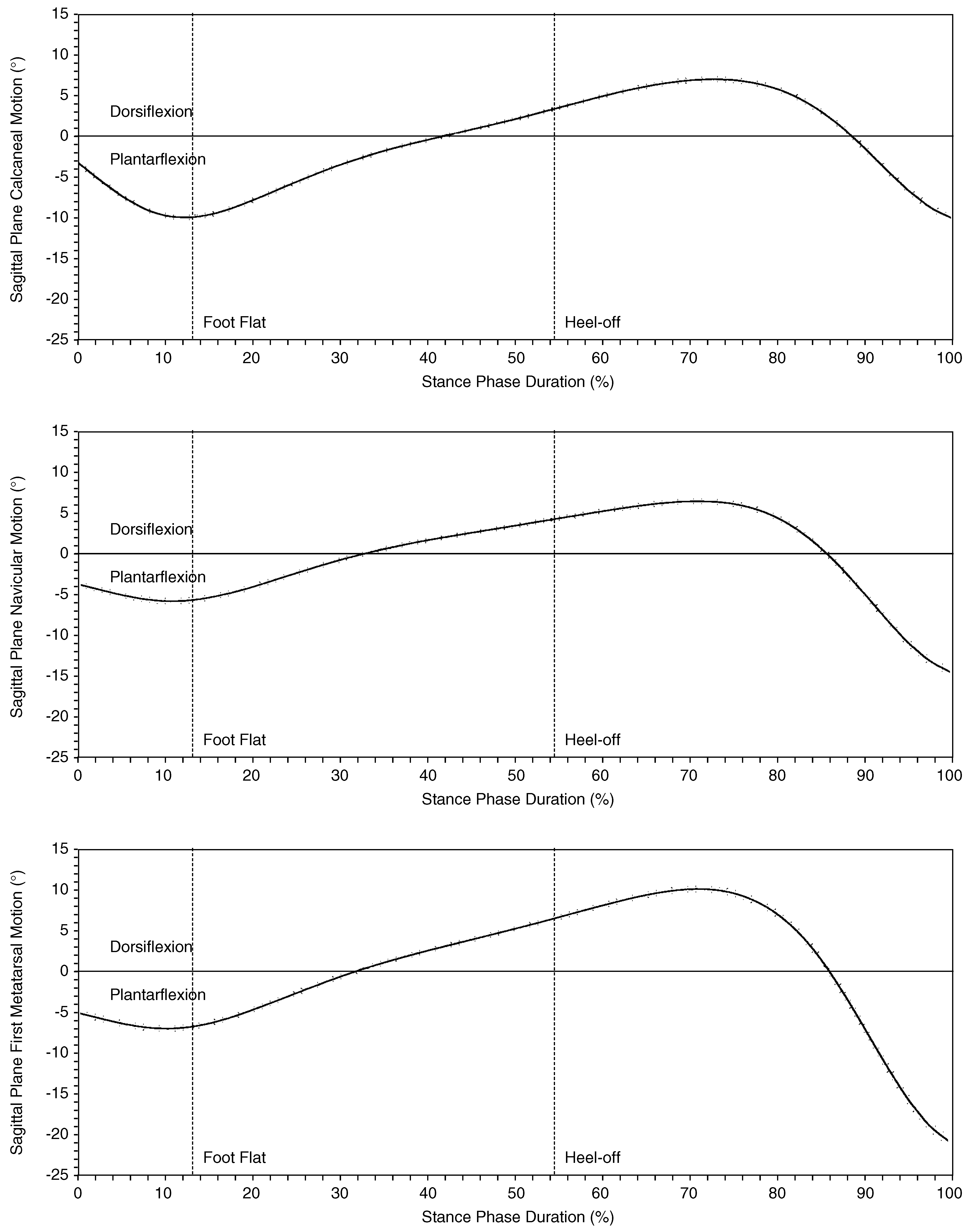
The angular movement of the calcaneus, navicular, and first metatarsal relative to the tibia in the sagittal plane is shown in
Figure 2. Although the magnitudes of movement are different for each foot segment, the patterns of movement are very similar.
Figure 2 and
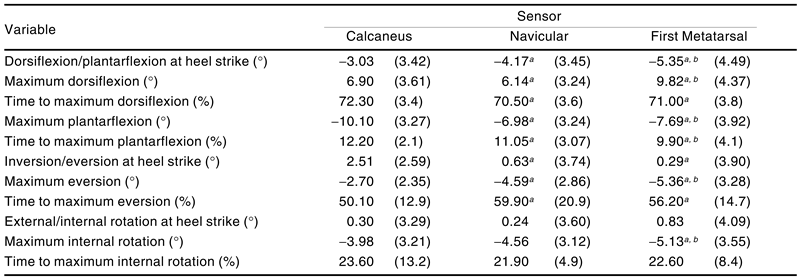
Table 3 show that dorsiflexion/plantarflexion patterns for the three foot segments, although similar, are not identical. The first metatarsal undergoes the most dorsiflexion and the navicular has the least dorsiflexion and plantarflexion motion compared with the other segments. Each segment essentially undergoes the same pattern of dorsiflexion/ plantarflexion, inversion/eversion, and external/internal rotation relative to the tibia.
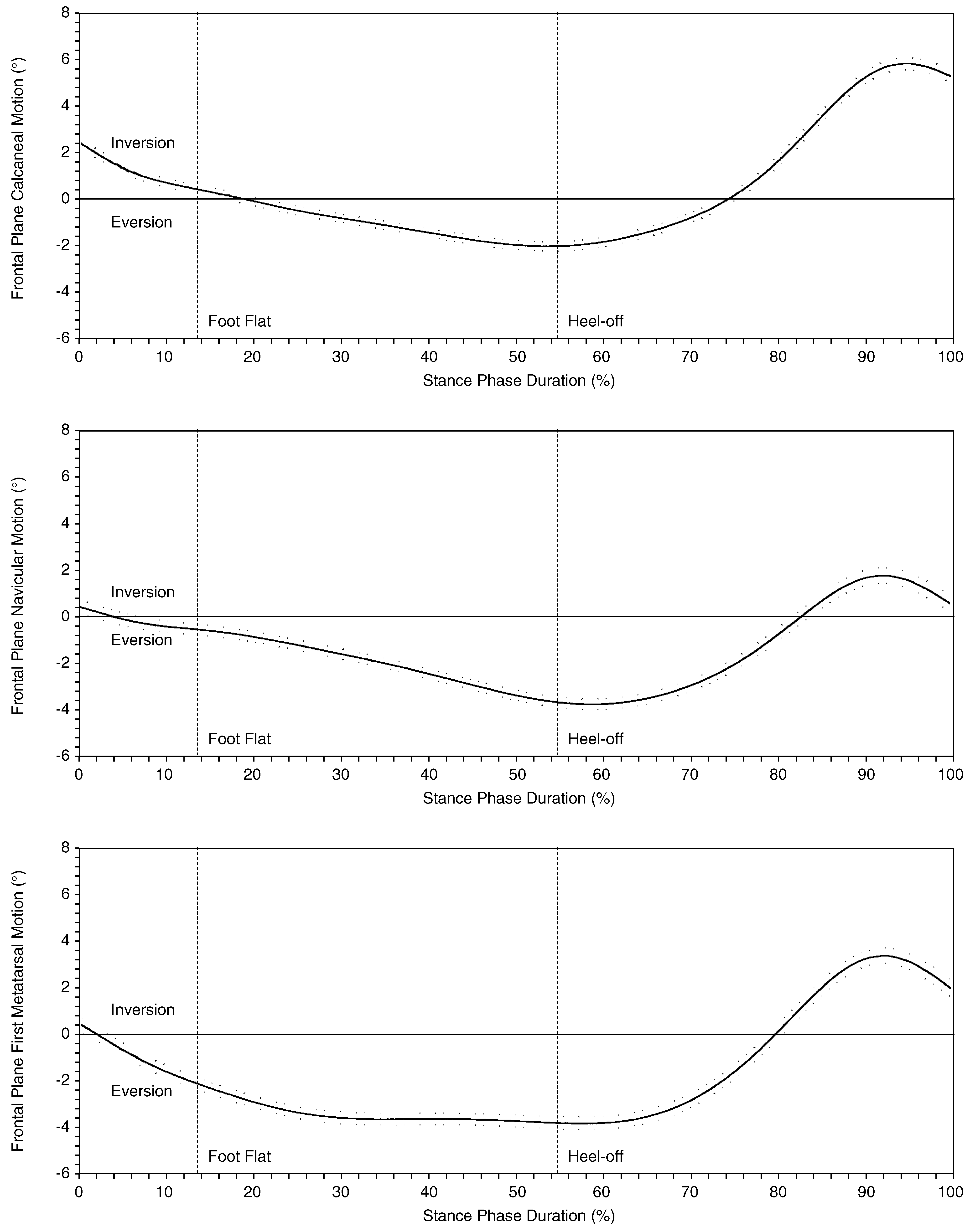
One major difference seen with inversion/eversion is that, as is typical, the calcaneus is inverted relative to the subject’s resting-standing position at the time of heel strike and then undergoes its customary eversion. The navicular has an almost identical pattern of movement. The first metatarsal, however, undergoes a much quicker eversion and essentially remains maximally everted for the entire midstance phase of gait (
Figure 3). The results of the Pearson’s correlations between the eversion/inversion patterns of each foot sensor and the external/internal rotation of the tibia (calcaneus) are shown in
Table 4. The correlations for all three sensors were extremely high.
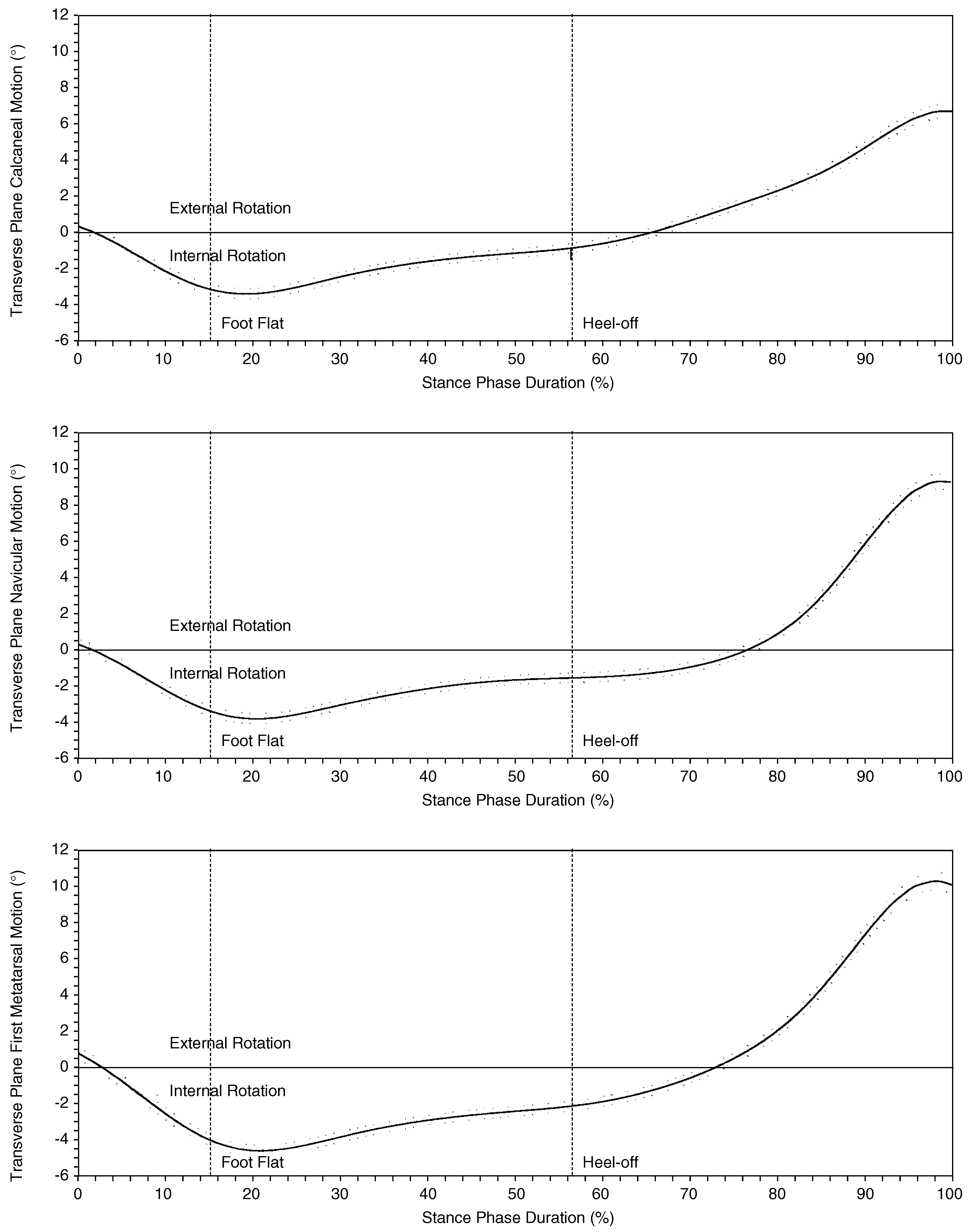
The analysis of internal/external rotation of the three foot segments reveals the greatest similarity.
Figure 4 and
Table 3 show that the first metatarsal had significantly (
P < .01) greater rotation than either the calcaneus or the navicular. The timing of this maximum rotation, however, was not significantly different (
P > .01) from that of the other two segments.
Discussion
The between-trial reliability of the duration of the stance phase measurements for this study as measured by the intraclass correlation coefficient value was “almost perfect” when the criteria suggested by Landis and Koch [
26] are used. The repeatability of the dynamic angular movements was considered very good by the authors of this study, as the mean variability of the patterns was very small, less than 0.36° (
Table 2). The coefficient of multiple correlation values found in the current study were also very good and are comparable to those reported by Kadaba et al [
24] and Liu et al [
14]. The authors believe that these measurements of reliability and consistency support the use of the 6D-RESEARCH electromagnetic motion analysis system used in this study as well as the data-collection protocol followed.
The motion patterns obtained for the calcaneus relative to the tibia in this study, for each of the cardinal planes, are very similar to those reported previously [
13,
14,
15]. The position of the rearfoot at heel strike and the absolute magnitude of motion vary from those reported in these other studies because of the difference in reference position chosen.
The results of the present study—that the three foot segments measured undergo essentially the same pattern of motion—support the idea of “foot” inversion/eversion proposed by Huson [
20], rather than separate subtalar or midtarsal inversion/eversion. As previously mentioned, Huson, in his treatise on functional anatomy of the foot, described three different, but closely related, osteoligamentous mechanisms: the tarsal, tarsometatarsal, and metatarsophalangeal mechanisms. Huson characterized the tarsal mechanism as consisting primarily of the subtalar and talocalcaneonavicular joints, which are kinematically coupled together. This strong kinematic coupling suggests that the mechanism was constrained, “producing exactly defined and therefore predictable inversion/eversion motions” [
20]. The tarsometatarsal mechanism, on the other hand, consisted of more independent motions and was labeled “nonconstrained.” Either muscular or external forces are needed to determine its eventual motion, principally pronation and supination “twist” of the forefoot.
In the current study, measurement of the calcaneus can be thought of as providing information about the subtalar joint of the tarsal mechanism. The navicular, because of its anatomic location, provides information concerning the talocalcaneonavicular joint of the tarsal mechanism. Finally, the first metatarsal provides information about the tarsometatarsal mechanism. The authors believe that the findings of this study are consistent with the description of Huson, who indicated that the tarsal mechanism (subtalar and talocalcaneonavicular joints) would have consistent, predictable, and interdependent motion during walking. The tarsometatarsal mechanism, on the other hand, would not have this strong kinematic coupling and would therefore produce a more independent movement.
The very similar patterns of inversion/eversion shown by the calcaneus and navicular bones relative to the tibia and the high positive correlations obtained between the frontal plane motion of these segments and transverse movement of the tibia (
Table 4) provide evidence of the kinematic coupling within the tarsal mechanism discussed by Huson [
20]. The first metatarsal bone, although similar to the navicular and calcaneus, has a motion pattern that is independent of the two proximal foot segments. Its rapid eversion early in the stance phase illustrates the “pronation twist” of the tarsometatarsal mechanism described by Huson [
20].
The authors believe that the finding that the magnitude of navicular (midfoot) movement is greater than that of the calcaneus (rearfoot) illustrates the importance of the midfoot for typical foot function during walking. It should be noted, however, that although mean navicular eversion was significantly greater than calcaneal motion, 18.3% of the subjects analyzed in this study had navicular motion that was less than calcaneal motion. In addition, maximum eversion of the navicular happens later in the stance phase, indicating that, although it is closely linked with the calcaneus, the respective primary roles of these bones are at slightly different portions of the stance phase.
When interpreting these results, it is important to keep in mind that the angles measured in this study were measured relative to the tibia and therefore do not reflect motion of either the navicular or the first metatarsal bones relative to their most proximal segment. Such information would be extremely useful and is currently the focus of ongoing research by the authors of this article.
Summary
Kinematic analysis of the calcaneus, navicular, and first metatarsal bones relative to the tibia was undertaken in 153 healthy individuals during typical walking. Mean 3-D motion patterns for each bone are presented. The results of this study provide additional information and understanding as to how the various segments of the foot function and interact with each other during typical gait. This information should help to define and refine clinical management strategies for treating foot dysfunction.