Torsion, or twisting of a long bone around its longitudinal axis, is a recognized normal characteristic of the human lower limb. One of the earliest references to femoral and tibial torsion was made by Mikulicz [
1] in 1887. In 1909, Le Damany [
2] described tibial torsion as the twisting that accompanies growth of the human tibia. The distal end becomes obliquely inclined, its axis lying anteromedially with respect to the axis of the condyles. In two separate studies, each of 100 adult human tibiae, Le Damany reported means of 23.6° and 20.0° of torsion. From these findings he apparently arbitrarily chose 20° as his estimate of normal tibial torsion in the adult.
In a further study, Le Damany [
2] found evidence that tibial torsion develops during infancy and early childhood. Tropometric measurements of immature human bones were made between the sixth fetal month and 14 years. From this study he concluded that tibial torsion develops between birth and 5 years of age. However, while the work of Le Damany is widely cited, his study of immature tibiae was conducted on a very small sample population using a nonevaluated technique. As part of the present study, a review of other published work was conducted: This revealed considerable disparity among findings, partly attributable to methodological variation. The disparity was most apparent in clinical
in vivo measurements of torsion, which vary considerably in selection of data points and in methods for measurement of torsion. In general, this particular field of anthropometry appears to have evolved without the establishment of stringent criteria to evaluate methods used to obtain data on which clinical standards have been based.
Techniques Used to Measure Tibial Torsion
The present study was prompted by a longitudinal study of growth in infancy that focused on lowerlimb growth and locomotor development. In order to measure the development of tibial torsion in infancy, various techniques and instruments were considered. The literature revealed a variety of methods for measuring torsion
in vivo. Radiography had been used in earlier studies [
3,
4,
5] but was considered unsuitable for a longitudinal study of healthy infants. Ultrasound, although safe and reliable in the measurement of femoral torsion [
6] and tibial torsion [
7], was eliminated because it is impractical for use with young, uncooperative subjects.
Various bony surface landmarks have been used to estimate torsion. Noninvasive
in vivo measurements have most commonly used the malleoli as distal landmarks and therefore define
tibiofibular rather than tibial torsion. There is less standardization in the selection of proximal reference points. Several studies have reported a simple method using the tibial tuberosity as the proximal datum [
8,
9,
10,
11]. This was considered to be more accessible to palpation than the tibial condyles used in dry-bone studies [
2,
8]. Dupuis [
8], investigating the reliability of surface landmarks, claimed that the tibial tuberosity was a reliable indicator of the position of the tibial plateau, rotation of the plateau being accompanied by displacement of the tibial tuberosity in the same direction. However, in his own clinical study of tibiofibular torsion, he chose an “indirect” method using the patella as the proximal reference point. Other proximal references have included the posterior surface of the knee joint in a cadaver study by Elftman [
12], and the thigh [
3,
13].
Materials and Methods
In the longitudinal study of growth, a reliable method of measuring tibial torsion quickly in noncooperative infants was sought. Among the methods tested was a specially designed apparatus involving precision alignment of the tibial tuberosity in relation to both malleoli. Its design was based on equipment used in previous clinical studies [
9,
10,
11]. However, in trials involving neonates this instrument was found to be unsatisfactory because it demanded some cooperation from subjects. Furthermore, position of the neonatal limb was found to be incompatible with the measurement procedure required by this method. A photographic technique [
13] was then investigated and finally a gravity goniometer [
14]; the latter was found to be the most suitable method for the purposes of this study.
Reliability of the Gravity Goniometer
The reproducibility of the gravity goniometer method was tested on 15 neonates measured on two separate occasions. The results were a mean measurement of 0.27° with a standard deviation of 1.58° and a standard error of measurement of 1.12°. On the basis of this level of reliability, the gravity goniometer was used along with linear measurements as part of the longitudinal study. However, when interim data were analyzed, it was found that while the group growth measurement data were cohesive and consistent with published standards, the torsion data were erratic, with no apparent incremental trend associated with age. These results could be interpreted as indicating either that the method was not in fact reliable or that tibiofibular torsion developed erratically.
Comparison of Goniometer Measurements with Computed Tomographic Measurements
To evaluate the anatomic accuracy of the gravity goniometer method, it was essential to find a means of directly comparing the surface goniometric measurements with the bone itself in living subjects. For this reason, it was decided to compare the goniometer measurements with measurements made on computed tomographic (CT) images of transverse sections of the same limb.
Subjects
Seven subjects (2 women and 5 men) with no known pathologies were examined. They ranged in age from 26 to 73 years, with a mean (±SD) age of 45±17.43 years. Informed consent was obtained from all subjects before the start of the study.
Goniometer Measurements
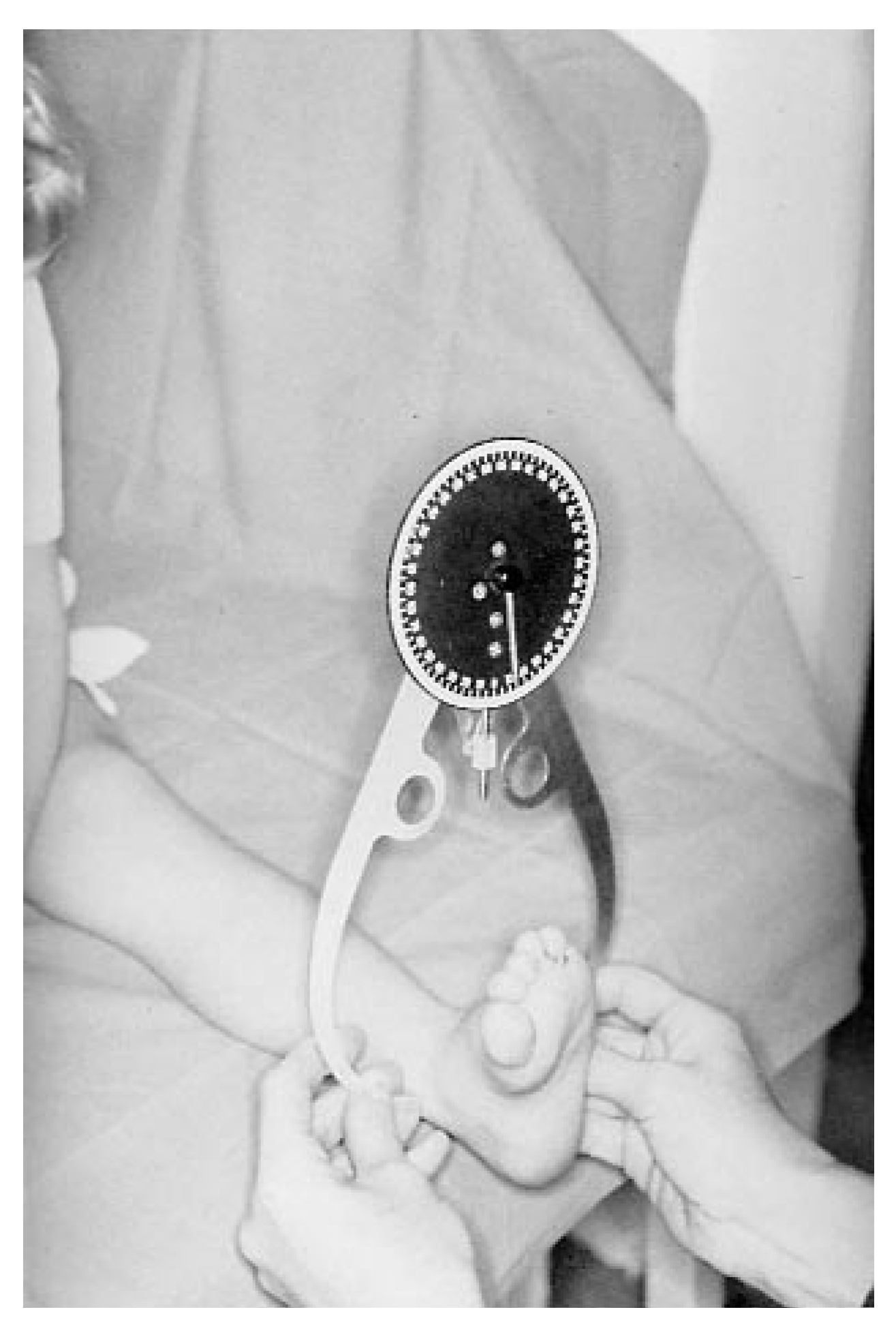
Bilateral measurements were taken for all subjects (14 legs). Subjects were measured by gravity goniometer on two separate occasions, with a minimum of ten readings taken on each limb and the mean recorded. Measurements were made according to the study protocol based on the method advocated by Wynne-Davies [
9] and also used by Kermosh et al. [
10] and Ritter et al. [
11] The tibial tuberosity was palpated and marked with a dermographic pen, and the limb was then rotated until the tuberosity was centered so that it was parallel to the sagittal plane and therefore at 90° with respect to the frontal plane of the body. Care was taken to place the points of the goniometer caliper precisely over the centers of the malleoli that had been marked with a dermographic pen (
Figure 1).
Computed Tomographic Scan Measurements
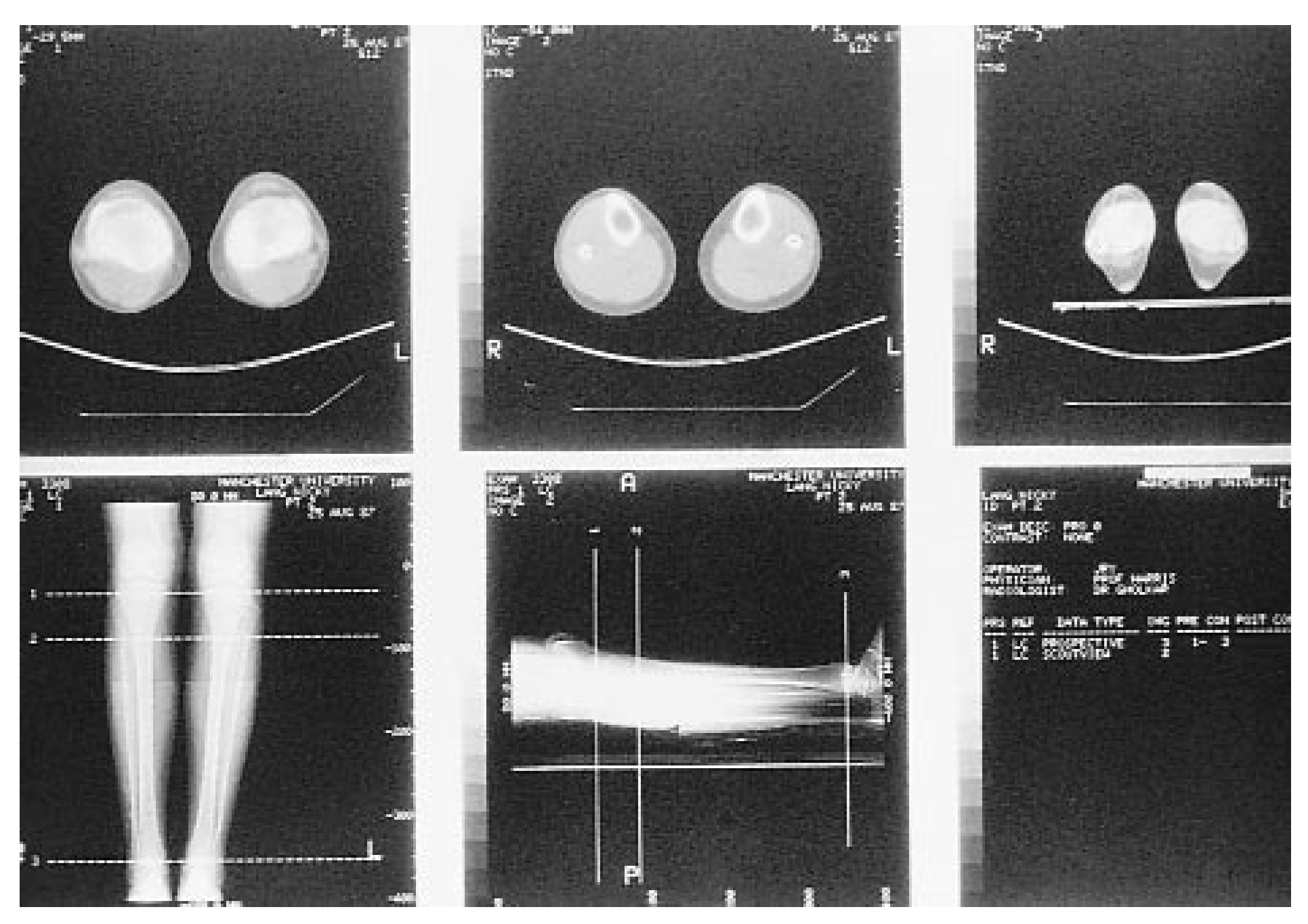
Computed tomographic sections were taken of each subject with the tibial tuberosity aligned in the sagittal plane (in the same position as for the goniometric measurements) and the feet strapped to a right-angled footplate to maintain the position of the limb during the scan. Computed tomography was used to image transverse sections of the leg at three levels corresponding to those bony sites in the leg used in surface measurement as described in the literature, namely, the tibial condyles [
2,
8,
14], the tibial tuberosity [
9,
10,
11], and the tibial and fibular malleoli (
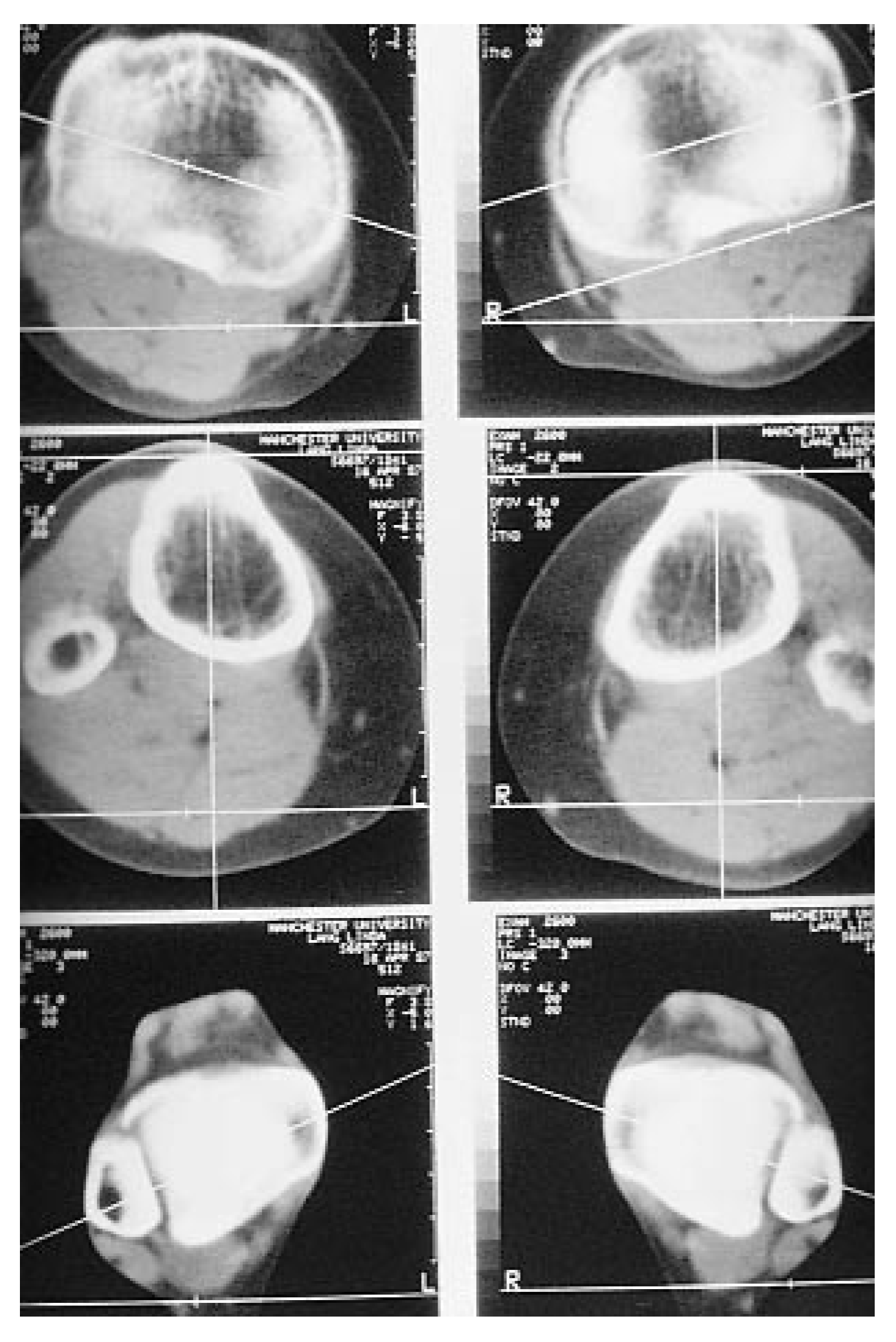
Figure 2). The scan sections were then inspected and computer-assisted axes drawn (
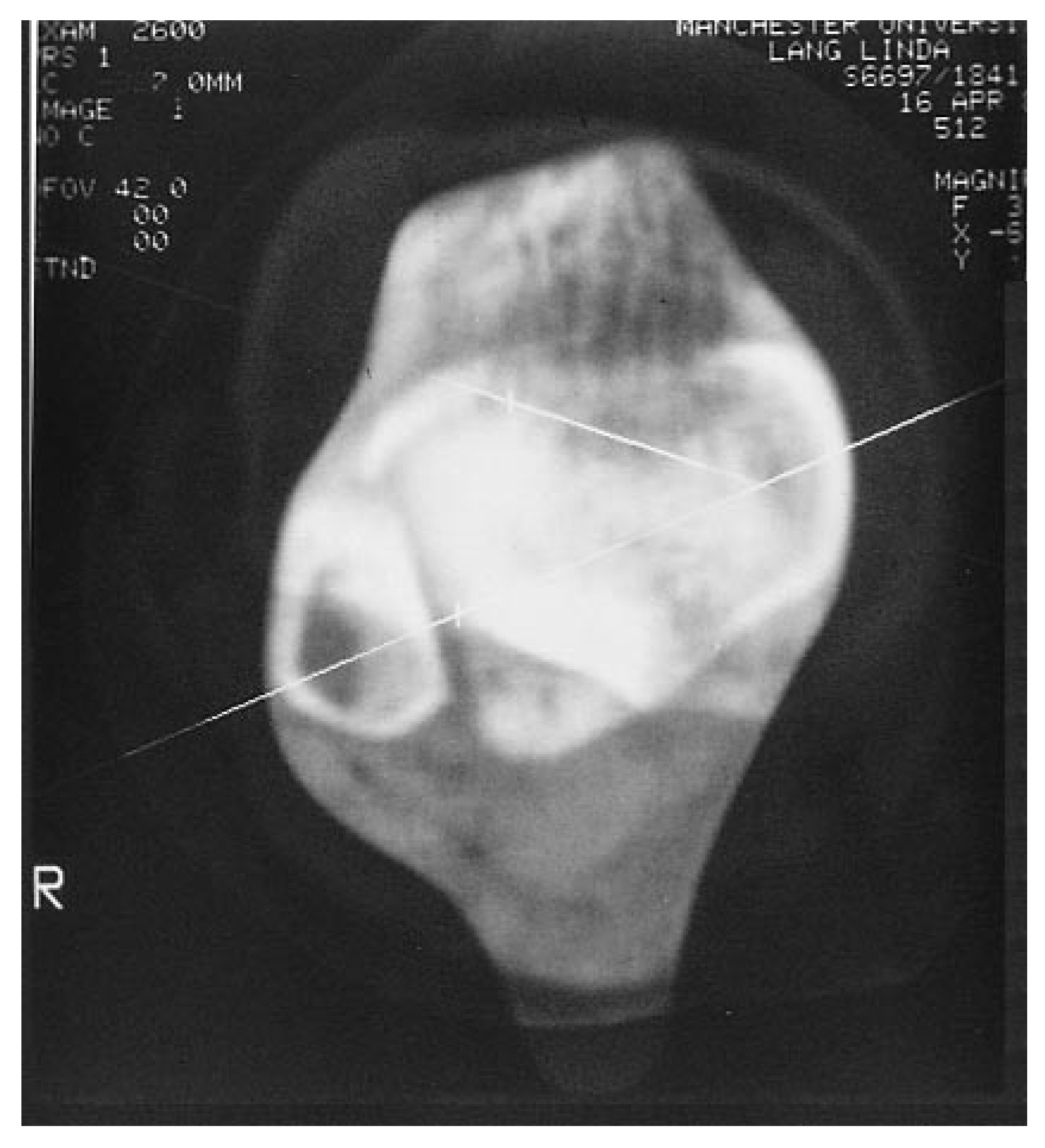
Figure 3) as follows: 1) across the posterior surface of the tibial condyles, 2) parallel to the sagittal plane through the tibial tuberosity, and 3) from the center of the tibial malleolus to the center of the fibular malleolus. The angle subtended by each axis in relation to a coronal baseline was measured for each of the scanned transverse sections. In addition, the transcondylar axis was superimposed on the transmalleolar axis, permitting a direct measurement of a torsion angle between these two reference points (
Figure 4).
Results
Table 1 shows malleolar-angle measurements for each of the seven subjects taken by goniometer and CT scan. The last two columns of the table show the difference between malleolar angle measured with reference to the tibial tuberosity and malleolar angle measured with reference to the posterior surface of the tibial condyles for the CT scan method for each subject.
Because the data numbers were too small to establish the normality of distribution, Wilcoxon’s signed rank test was used to determine significance levels between the results of the three measurements of malleolar angle. While individual variation was observed, no significant differences were found between left and right measurements. Therefore, the data for both limbs were combined. The means for the pooled measurements are shown in
Table 2.
Goniometer versus Computed Tomographic Measurements of Tibial Torsion
Surface measurements of malleolar angle obtained using the goniometer were compared with measurements made on CT scans using the same bony reference points. Wilcoxon’s signed rank test was applied to determine if the null hypothesis—that there was no significant difference between the malleolar angle as measured by gravity goniometer and CT scan using the same anatomic references—could be accepted or rejected. The results of Wilcoxon’s test were as follows: count = 14, mean = −3.07, SD = 8.24. The 95% confidence interval for the mean is −7.83 to 1.69; t = 1.395 (13 df); P = 0.186.
No significant difference was found between malleolar angles measured by gravity goniometer and CT using the tibial tuberosity as the proximal reference point. Therefore, the null hypothesis is accepted.
Malleolar Angle Measured by Computed Tomography: Comparison Between Proximal Reference Points (Tibial Condyle and Tuberosity)
The validity of the commonly used anatomic reference points as a surface guide to aligning the tibial plateau in the frontal plane of the body in the measurement of tibial torsion was investigated. The results of measurements made on CT scans with reference to the tibial tuberosity and the posterior surface of the tibial condyles were compared. Wilcoxon’s test was applied to determine if the null hypothesis—that there was no difference between malleolar angles measured with reference to the tibial tuberosity and those measured with reference to the posterior condyles of the tibia in the same subjects—could be accepted or rejected. The results of Wilcoxon’s test were as follows: count = 14, mean = −7.43, SD = 4.30. The 95% confidence interval for the mean is −9.91 to −4.94; t = 6.463 (13 df); P = 0.001.
A highly significant difference was found between measurements made using the two different proximal references. Therefore, the null hypothesis is rejected.
Discussion
The findings of the comparison between surface goniometric measurements and those obtained by CT scan using the tibial tuberosity as the proximal reference point show good agreement and confirm the accuracy of surface measurements.
However, when a comparison was made between the use of different proximal reference points, a highly significant difference was found between the malleolar angles measured from the tibial tuberosity and those measured from the posterior surface of the condyles. From these results it can be seen that measurements made using the condyles as the proximal reference are significantly greater than those using the tuberosity. The mean of 33.79° found in the present study is close to the figure of 30° found by Jakob et al. [
15] in their CT study of tibial torsion using an axis drawn across the widest part of the tibial condyles. Jakob et al. compared their findings with those of Le Damany [
2] and attributed their greater angle to the fact that their measurement was transmalleolar, whereas Le Damany’s was restricted to the tibia. In an earlier study using cadavers, Elftman [
12] also found a greater angle than Le Damany. Elftman concluded that malleolar torsion exceeds tibial torsion by 5°.
In a more recent CT study, Laasonen et al. [
16] compared the reliability of clinical measurements and those made on CT sections at various levels through the leg. They concluded that “the clinical methods had a relatively good reproducibility but the assumption of a uniform proximal tibial tilt of 0 degrees does not seem valid” [
16] (p329). However, their study was conducted on patients with structural abnormalities. Furthermore, their description of the clinical method that they used is incomplete.
The findings in the present study, which used normal subjects, support those of Laasonen et al. and indicate that the tibial condyles do assume an internal angle when the leg is aligned with the conventional body planes using the tibial tuberosity.
The authors conclude that the general assumption made in the literature that the condyles are aligned parallel to the frontal (coronal) plane when the tibial tuberosity lies in a sagittal plane is incorrect. In the present study, an axis drawn to the posterior surface of the tibial condyles formed a mean internal angle of 11.36° (SD 6.81°) with respect to the frontal plane. In 13 of the 14 tibiae, when the tibial tuberosity was oriented centrally, the posterior surface of the condyles was internally rotated with reference to the frontal plane. This angular relationship was inconsistent, with considerable variation observed within and between subjects (SD 6.81°). These findings probably reflect normal anatomic variations in position of the tibial tuberosity rather than the condyles themselves. The attachment of the ligamentum patellae makes this site particularly vulnerable to the influence of traction forces by the quadriceps femoris muscle, which may lead to variations in position of the tubercle from individual to individual. Electromyographic patterns have shown greater and more sustained activity in lower-limb muscles in infants within 30 days of the onset of walking [
17], and this is still apparent in thigh muscles in early childhood [
18]. The wide and abducted angle of infant gait, together with the normal development of genu valgum during the second year [
19,
20], may be associated with greater lateral advantage in the pull of the quadriceps. These forces acting directly on the unossified tibial tuberosity may explain its lateral position noted in all but one subject in the present study. Thus while the tibial tuberosity is readily palpable even in the neonate, its orientation on the tibia is variable between subjects.
Conclusion
The use of different proximal reference points, particularly in clinical studies, has contributed to the notable disparity in the values given for normal tibial torsion. The validity of the use of the tibial tuberosity as a proximal datum must be questioned. The problem may be further complicated by the fact that there have been differences in the use of distal reference points, notably between dry-bone (tibial torsion) and clinical (tibiofibular torsion) measurements.
It would appear that the disparity in measurements of tibial torsion reported by various investigators stems from variations in the use of reference points in the proximal and distal ends of the leg. The problem could be resolved by the use of standardized and proven reference points in any future studies. Measurements using the condyles are suggested subject to establishing reliable bony landmarks that are accessible regardless of techniques used.