Stress fractures are a consequence of the dynamic imbalance of bone resorption and replacement. They are commonly divided into two types: those caused by abnormal stresses exerted on normal bone, and those resulting from normal stresses placed on abnormal bone [
1]. In this article, the term “stress fracture” is used to indicate injury in a person with normal bone.
When one thinks of lower-extremity stress fractures in athletes, fractures of the tibia and metatarsals immediately come to mind. Fibular stress fractures are commonly overlooked, yet they occur with surprising frequency. Sullivan et al., [
2] in a report of stress fractures in 51 runners, found fibular stress fractures to be the second most common type of stress fracture, surpassed only by tibial fractures.
Although stress fractures of the fibula have been described in the literature for many years, the etiology of these fractures is still the subject of much debate. No single study or hypothesis provides a comprehensive answer to the question of what causes fibular stress fractures.3-6 Much controversy has arisen over the fibula’s significance in weightbearing as well as whether fibular function is static or dynamic in nature [
3,
5,
6,
7,
8].
The literature reveals wide variation in the conceptualization of fibular function. Anatomy texts describe the fibula as a strut of the lateral ankle joint and as an “outrigger” for muscle and ligament origin and insertion, implying static function [
7,
8]. A study by Lambert [
5] concluded that the fibula transmits approximately one-sixth of the weight transferred from the knee joint. Takebe et al. [
6] later published a study concluding that the fibula transmits 6.4% of the weight received from the knee with the ankle joint in neutral position. They also concluded that the fibula takes on proportionately more weight as the ankle joint progresses into dorsiflexion and less weight when plantarflexion occurs at the ankle. Devas and Sweetnam [
4] postulated that fibular function was dynamic, an inferior displacement of the fibula at the talocrural joint during ankle plantarflexion secondary to contraction of musculature arising from the fibula. Their results were confirmed by Scranton et al., [
3] who also concluded that there was simultaneous medial and distal migration of the fibula during ankle plantarflexion.
Devas and Sweetnam [
4] correlated dynamic fibular motion with 50 cases of fibular stress fracture in athletes. They found that a large portion of these fractures occurred during the winter and were located just above the tibiofibular syndesmosis. In winter, runners had to train on hard surfaces, forcing them to strike the surface toward the forefoot in an effort to increase shock absorption [
4]. This results in increased stress on musculature arising from the fibula. The stress fractures just proximal to the tibiofibular syndesmosis were felt to be secondary to increased stress caused by repetitive distal fibular dynamic motion [
4].
Clinical Presentation, Diagnosis, and Treatment
The patient is usually a physically fit runner, with no specific predilection as to age, race, or gender. A history of running more than 20 miles per week and changes in training intensity and habits are regularly found. The patient usually reports such training deviations as increased mileage and a switch to running on hard surfaces in the 3 months prior to the onset of the stress fracture. The patient generally presents a week or two after an insidious onset of symptoms and reports no acute trauma to the area. Patients commonly say that they have tried to run or work through the pain but that it has increased in severity. The pain is often posterolateral to the ankle, with acute pain on palpation of that area of the fibula and also on lateral-to-medial compression of the fibula. The most common area of tenderness is 4 to 7 cm superior to the tip of the lateral malleolus [
4]. The symptomatic area may also contain a focal area of mild pitting edema that may harden with time. The patient may present with an antalgic gait but certainly will experience discomfort at the fracture site while running or climbing stairs [
4]. Other reported factors that may predispose patients to fibular stress fractures include change of footwear, change in running speed, and pes planus [
2].
Radiographic evidence of fibular stress fracture is often delayed by up to 8 weeks, with periosteal callus formation being the primary early diagnostic finding. Magnetic resonance imaging and radionucleotide scintigraphy have been reported to be helpful in early detection of stress fracture [
9].
The treatment regimen for fibular stress fracture is the same as for any other type of fracture, primarily rest, application of ice, and immobilization. Immobilization does not necessarily mean casting. Casting may be used in cases of progressive, recalcitrant fractures and for overzealous, noncompliant athletes. With patient compliance, removable modalities such as air splints or casts and strappings may be used, allowing the athlete to cross-train or train on a limited scale until symptoms disappear [
4]. Rest from the sport is essential. Healing time may vary from 6 to 8 weeks. Without rest and immobilization, these injuries can worsen, disabling athletes for long periods and leaving them with chronic symptomatology.
Case Report
A 24-year-old female medical student presented to the sports medicine clinic of the Foot and Ankle Institute at the Pennsylvania College of Podiatric Medicine with a chief complaint of pain in the lower external portion of the right leg of 4 weeks’ duration. The patient is a fitness runner who generally runs between 15 and 25 miles per week.
During one of her winter runs, the patient experienced an ache above her right ankle; she thought that she had strained her ankle while running over ice. She was treated at her student health service for a grade I ankle sprain and released. After a week, the patient resumed her training runs; however, she experienced a dull ache in the lower third of her outside leg. The pain became progressively worse with running over the next week. She returned to the student health service, where an orthopedist examined her leg and diagnosed the injury as a peroneal muscle contusion. Rest, ice packs, and an anti-inflammatory drug were prescribed.
The patient resumed her running program after 2 weeks’ rest and again experienced the same pain in the lateral portion of her right leg. The pain increased to the point that the patient could no longer run comfortably.
The physical examination revealed a healthy woman who had no known allergies and was taking no medications. Her history of lower-extremity disorders consisted of several ankle sprains and a recent episode of plantar fasciitis.
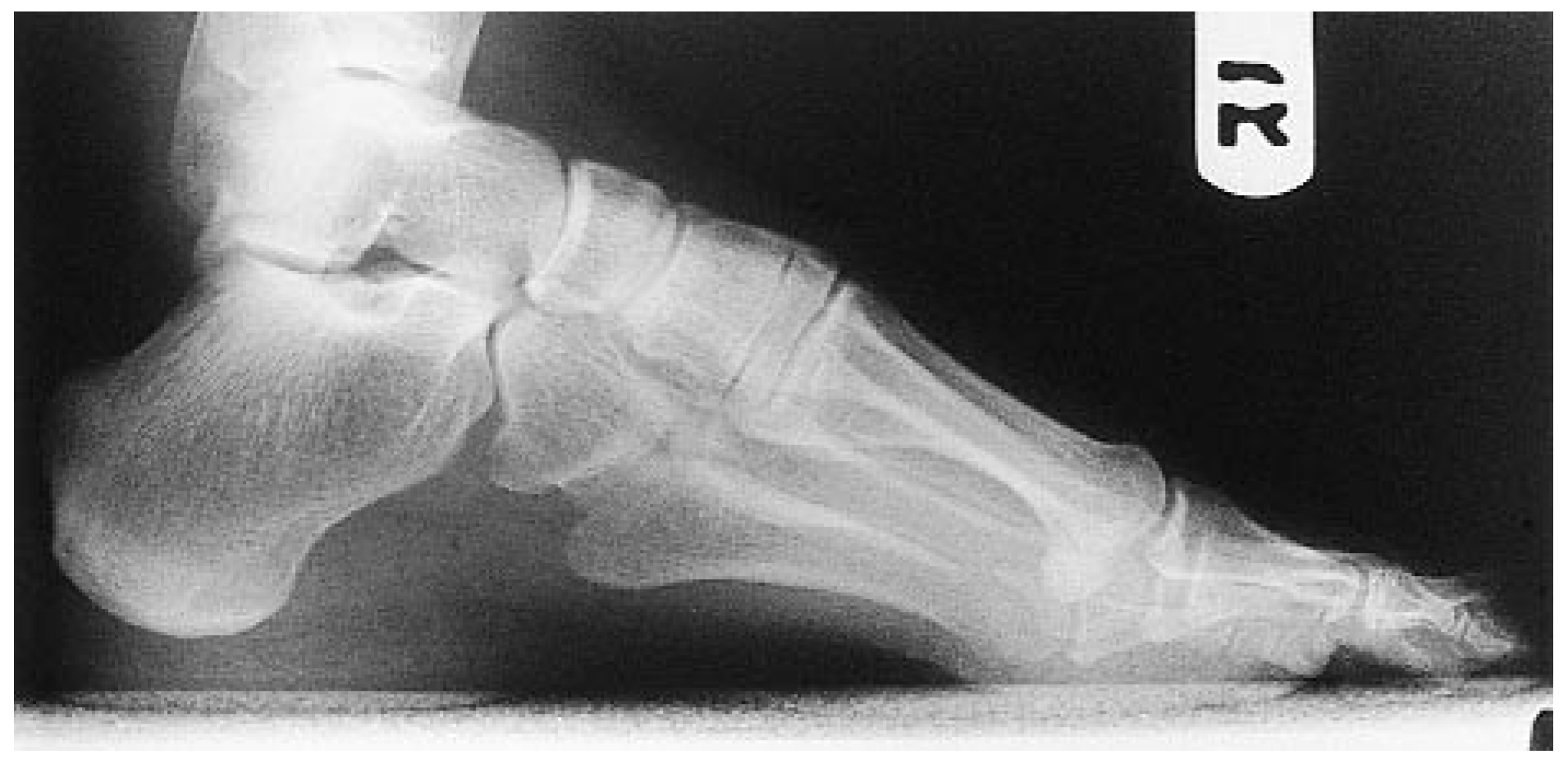
Biomechanically, the patient’s foot type was classified as pes cavus with a rigid forefoot valgus and a partially compensated rearfoot varus bilaterally (
Fig. 1). The resting calcaneal stance position approximated 3° of inversion, and an equinus of 5° with the knee straight was present. The patient had been successfully treated with functional foot sports orthoses for plantar fasciitis.
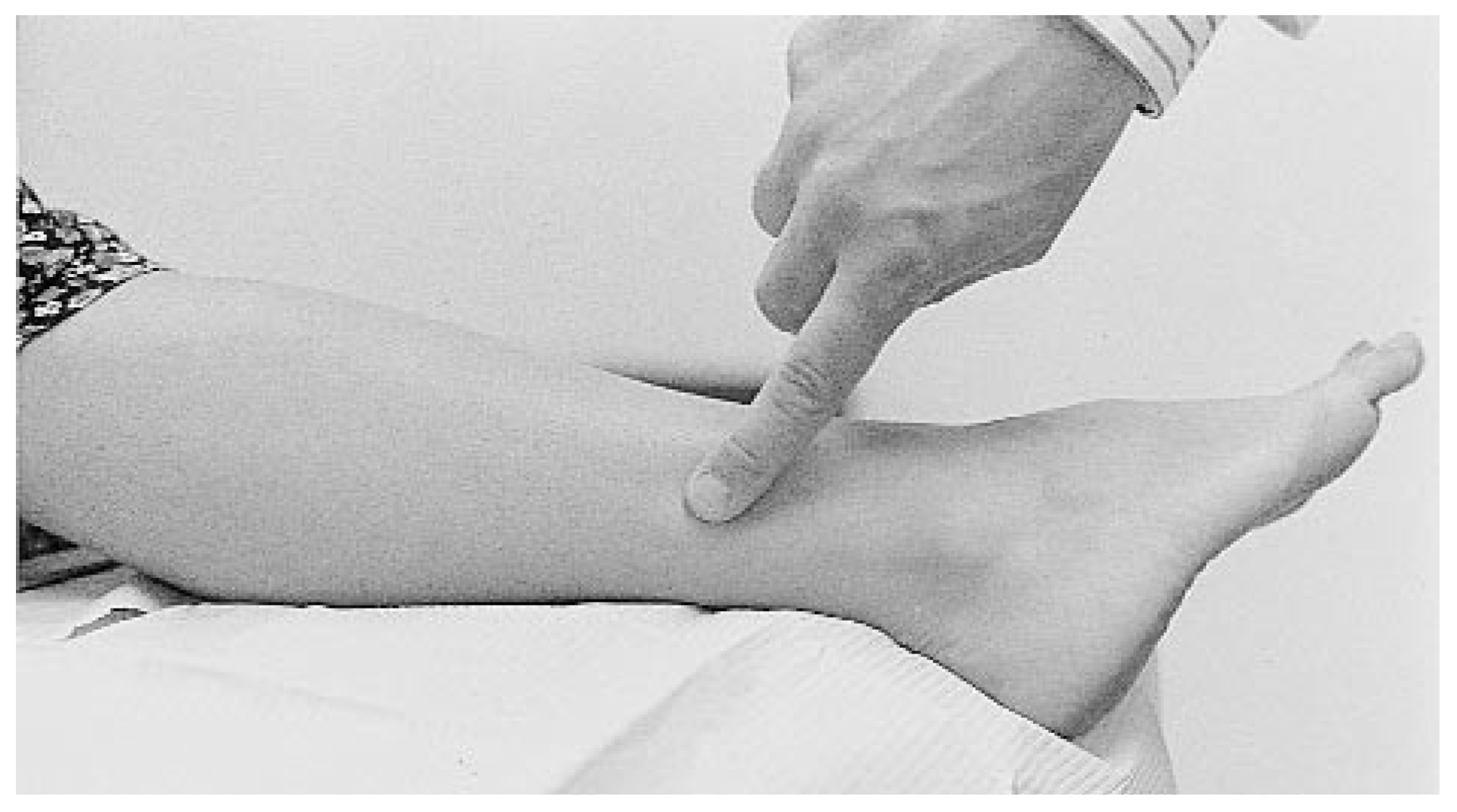
The clinical examination revealed a pinpoint area of palpable pain approximately 7 to 8 cm proximal to the tip of the lateral malleolus overlying the shaft of the fibula (
Fig. 2). With forceful pressure, the patient instinctively recoiled from the pain. No edema or ecchymosis was present.
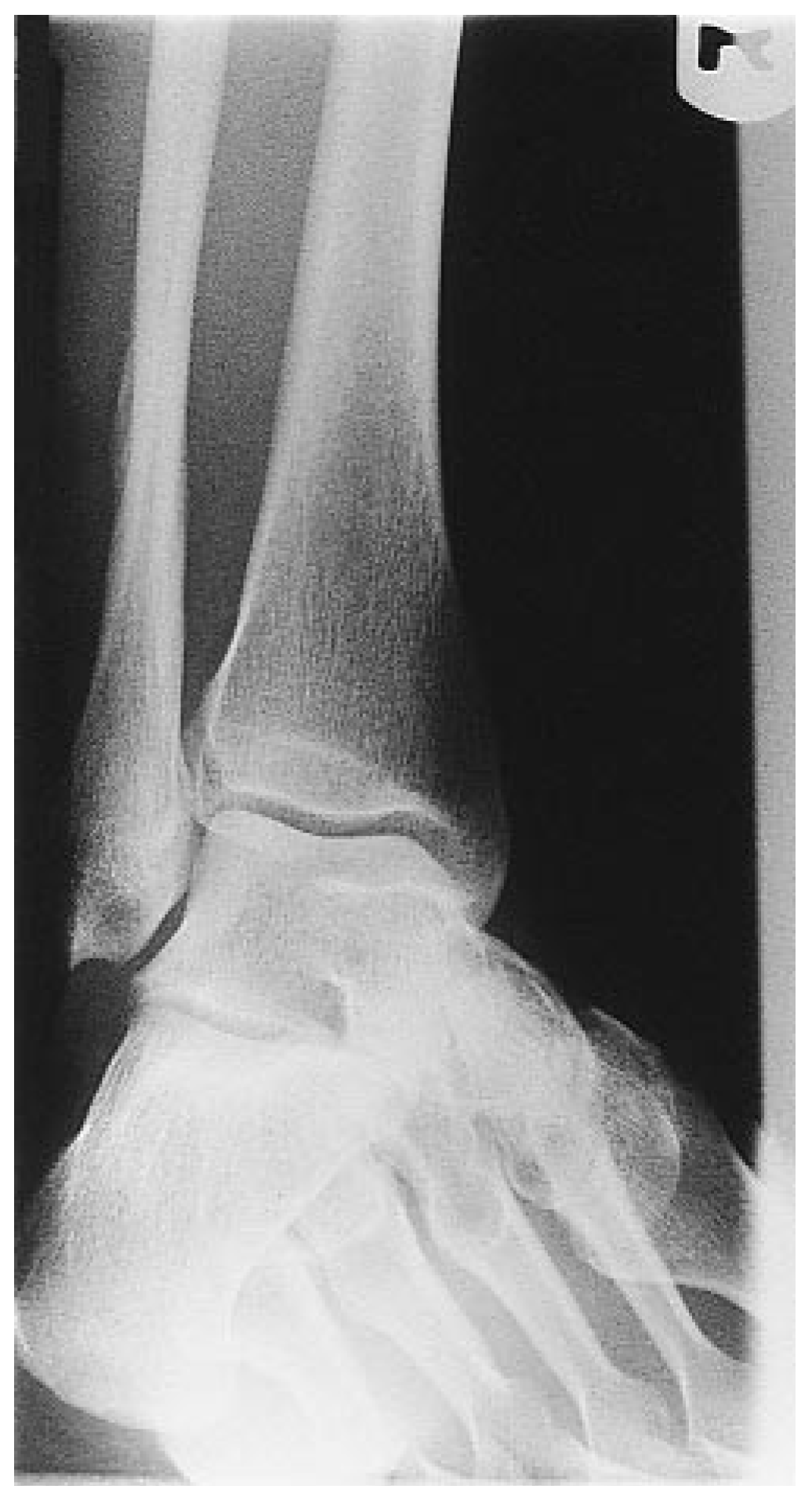
Diagnostic x-rays of the ankle and leg were taken showing the anteroposterior, lateral, and oblique views. The films revealed a periosteal bone callus formation 8 cm proximal to the distal tip of the lateral malleolus (
Fig. 3). The finding was consistent with fibular stress fracture.
Figure 1.
Pes cavus foot type with rigid forefoot valgus and partially compensated rearfoot varus.
Figure 1.
Pes cavus foot type with rigid forefoot valgus and partially compensated rearfoot varus.
Figure 2.
Pinpoint area of palpable pain 7 to 8 cm proximal to the distal aspect of the fibula.
Figure 2.
Pinpoint area of palpable pain 7 to 8 cm proximal to the distal aspect of the fibula.
Figure 3.
Periosteal bone callus formation indicative of a fibular stress fracture.
Figure 3.
Periosteal bone callus formation indicative of a fibular stress fracture.
The patient was eager to return to training, but feared prolonging or exacerbating the condition. Treatment consisted of continuing ice packs for pain and inflammation as well as nonsteroidal anti-inflammatory drugs. In addition, an Aircast® (Aircast, Inc, Summit, NJ.) stirrup training brace was prescribed. The purpose of the brace was to support and protect the leg and allow the patient to train safely. The incorporated air bags absorb and dampen shock that normally would be transferred up the fibula during foot strike.
The patient returned safely to training and experienced complete healing within 3 weeks.
Discussion
Fibular stress fractures are often misdiagnosed, and occur with greater frequency than has been recognized. The prognosis is very good when the injury is diagnosed correctly and treated promptly. Unfortunately, even the most astute clinicians and medical personnel commonly fail to recognize this injury, and chronic disabling sequelae often develop.
For many years, the fibula’s dynamic role and weightbearing function have been misunderstood. This lack of understanding has led to misdiagnosis and mistreatment of fibular disorders. Although full understanding of fibular function remains elusive, enough information is available to indicate that the fibula functions as more than a static rudimentary strut or outrigger for ankle stabilization and soft-tissue attachment. Acceptance of fibular function as dynamic creates new opportunities for exploration of fibular, ankle, foot, and lower-extremity biomechanics and pathology.
Conclusion
A fibular stress fracture in a 24-year-old female runner has been described. Although the diagnosis was originally incorrect, the problem soon became apparent as the runner tried to continue her daily workout routine and pain and symptoms increased.
Once the diagnosis was made by radiograph, normal treatment for a stress fracture was instituted, including rest, ice packs, nonsteroidal anti-inflammatory drugs, and a cross-training program. Normal healing ensued. The use of an air-inflated leg brace allowed the runner to return to training earlier than usual and with the area of injury fully protected.