Sickle cell anemia is a hereditary disease occurring in patients homozygous for the hemoglobin S gene. This abnormal gene is responsible for producing hemoglobin S, which supplants normal hemoglobin A. Hemoglobin S differs molecularly from hemoglobin A by the substitution of valine for glutamic acid at the sixth position of hemoglobin’s beta chain. Occurring in 1:625 black children, this genetic error is characterized by crescent-shaped red blood cells after blood deoxygenation occurs [
1].
Under normal circumstances, red blood cells with hemoglobin S molecules are biconcave discs. However, several factors promote structural molecular changes in the hemoglobin S molecule causing red blood cell elongation and sickling. These factors include high altitude, circulatory stasis, decreased pH, deoxygenation, drug therapy, fever, dehydration, percentage of hemoglobin S in red blood cells, and trauma [
2]. This sickled configuration reduces pliability of red blood cells and obstructs small arterioles and capillary flow. The resultant hematologic stasis induces oxygen transfer from red blood cells to adjacent tissues. This, in turn, sickles more red blood cells causing localized microinfarctions that may develop into larger ischemic events with necrosis and organ damage [
1].
There are several clinical presentations and complications of red blood cell sickling, which include aseptic necrosis, cardiomegaly-failure, cerebrovascular events, cholecystitis, cholelithiasis, chronic renal failure, infection, splenomegaly, among others [
2]. Well recognized pedal manifestations of sickle cell disease include the hand-foot syndrome (a disorder of infants), hematogenous osteomyelitis, and bone infarction. The hand-foot syndrome may provide initial diagnosis of sickle cell disease in infants [
2]. Hematogenous osteomyelitis of the foot predominantly affects the calcaneus, with
Staphylococcus aureus and
Salmonella sp. being the most common pathogens [
3,
4]. Pedal bone infarction secondary to vascular occlusion tends to involve the calcaneus.
An uncommon complication of sickle cell anemia is myonecrosis. Sickle cell-associated myonecrosis has been reported in ten cases; however, none of those cases involved the foot.
In 1985, Dorwart and Gabuzda [
5] described the first cases of sickle cell myonecrosis. Their sickle cell anemia patients were young black males, ages 22 and 26 years with recurrent and symmetric proximal (deltoid and quadriceps) myonecrosis with edema. Six myonecrosis events were observed during a 2-year period.
Each event was preceded by an acute sickle cell pain crisis, and each patient underwent a quadriceps fasciotomy for symptoms of compartment syndrome.
Subsequent cases of sickle cell-associated muscle infarction reveal similar findings [
6,
7,
8,
9]. Overall, the average patient age is 28.4 years (range 4 to 44 years) and is male (seven male:three female). The frequent presentation is recurrent, symmetric, and proximal myonecrosis of the upper or lower extremity musculature following painful sickle cell crisis. Most often, patients present with acute pain and edema in a specific muscle group; however, chronic manifestations (eg, muscle induration and joint contractures) have been described [
7].
Only one case described distal sickle cell myonecrosis below the knee [
9]. This patient had unilateral anterior leg myonecrosis with compartment syndrome. The diagnosis was assisted with magnetic resonance imaging and confirmed by biopsy, after compartment syndrome fasciotomy.
The etiology of acute sickle cell myonecrosis appears to be secondary to microvascular occlusion by sickled red blood cells [
5,
6,
7,
8,
9]. Biopsy results of acute myonecrosis specimens support the vascular infarction theory. One histopathologic report cited intravascular sickling adjacent to muscle necrosis [
5].
Chronic muscle changes (induration) following acute infarction are attributed to subsequent intramuscular fibrosis [
7,
10]. Another etiology of chronic muscle induration and joint contracture, which must be considered, is repeated intramuscular narcotic injections in sickle cell patients. These chronic changes can occur in the specific muscle groups that are habitually injected. Almost any drug can produce this form of myopathy, but most commonly intramuscular antibiotics and narcotics (eg, meperidine and pentazocine) have been described [
11,
12,
13]. After reviewing these reports, the myopathy associated with intramuscular narcotic injections is primarily associated with narcotic addiction rather than repeated injections in patients with sickle cell anemia.
The diagnosis of sickle cell myonecrosis is based on the clinical findings in conjunction with the imaging findings, particularly magnetic resonance imaging findings. However, sometimes surgical biopsy is required for definitive diagnosis. The history of recent painful crisis muscular trauma and intramuscular injections is significant. Muscular involvement should be isolated and evaluated for edema, pain, and function. Compartment syndrome needs to be considered since three out of ten reported cases required fasciotomies [
5,
9]. In the majority of cases, creatine kinase and lactic dehydrogenase levels were much lower than expected for myonecrosis (less than or equal to 2 to 3 times normal). However, in one case with compartment syndrome, the creatine kinase was elevated ten times normal [
9]. This patient did have several intramuscular injections, which also have been associated with increased creatine kinase and lactate dehydrogenase levels [
6]. Rhabdomyolysis was not present in any patient and urinary myoglobin levels remained normal in all patients.
Three of the ten reported sickle cell myonecrosis cases were diagnosed without muscle biopsy [
6,
7,
8]. In two of these cases, biopsies of other structures, knee synovium6 and antecubital ulcer [
8], were performed. The third case did not describe a biopsy of any kind. In one of these cases, magnetic resonance imaging was used to assist with diagnosis [
6].
Imaging can provide valuable information in evaluating the myonecrosis patient. Magnetic resonance imaging is the preferred study because of its soft tissue contrast characteristics allowing for specific identification of involved muscle groups. Radionuclide studies using technetium Tc 99m methylene diphosphonate will show increased radionuclide activity in the muscles but does not allow specific muscle identification and is probably not as sensitive to subtle intramuscular edema as is magnetic resonance imaging. Magnetic resonance imaging has been used to evaluate sickle cell myonecrosis in two cases [
6,
9]. However, these patients also had biopsies performed. The patient discussed in this report was diagnosed with sickle cell myonecrosis based on clinical and magnetic resonance findings without a biopsy. Although no treatment protocol has been established, several modalities have been used to treat sickle cell myonecrosis [
5,
6,
7,
8,
9]. Hydration, oxygen, and intravenous narcotic analgesia are used to treat the acute crisis, and fasciotomy is indicated for patients with compartment syndrome. Nonsteroidal anti-inflammatory medications have been utilized along with continuous passive motion and aggressive physical therapy for treatment of affected muscle groups.
The prognosis for sickle cell muscle infarction patients is generally good, provided an early diagnosis is made and treatment instituted. Of the ten reported cases, six patients returned to normal, two had residual contractures, one had persistent drop foot after compartment syndrome, and one outcome was not described [
7,
9].
Case Study
In January 1993, a 22-year-old black male, homozygous for hemoglobin S, was admitted to the hospital for a painful sickle cell crisis that was refractory to oral analgesics. The patient had been admitted six times prior for sickle cell crisis with his most recent crisis having occurred 1 month prior. On all admissions, the patient’s pain was controlled with patientcontrolled analgesia, with no intramuscular injections given. Shortly after his discharge for the crisis in December 1992, the patient developed new intermittent right heel pain on the plantar aspect. The pain was described as a deep soreness that was more painful with ambulation and dependency. The pain, however, was inconsistent with symptoms worsening on immediate weightbearing or after walking for a while.
Mild edema was present involving the plantar aspect of the right heel extending to the midarch area. This edema was best appreciated when compared with the contralateral extremity. Pain was present with palpation across the plantar aspect of the right calcaneus at the level of the tuberosity, extending distally to the midarch region and along the plantar medial aspect of the calcaneus. A mild increase in temperature was also present at this level. Otherwise, the lower extremity examination was normal.
Significant admission laboratoy values were: cretine phosphokinase 35 (61-24) IU/L, lactic dehydrogenase 420 (94-172) IU/L, alkaline phosphotase 165 (37-107) IU/L, white blood count 12.5 (4.5-11.0), hemoglobin 10.5, and hematocrit 29.1. The patient’s urinalysis was normal.
The primary impressions were bone infarction versus hematogenous osteomyelitis. Other potential diagnoses were pain secondary to biomechanical function and primary bony pathology of the calcaneus. The x-ray study of the right foot revealed no abnormalities except slight prominence of the plantar muscle pad.
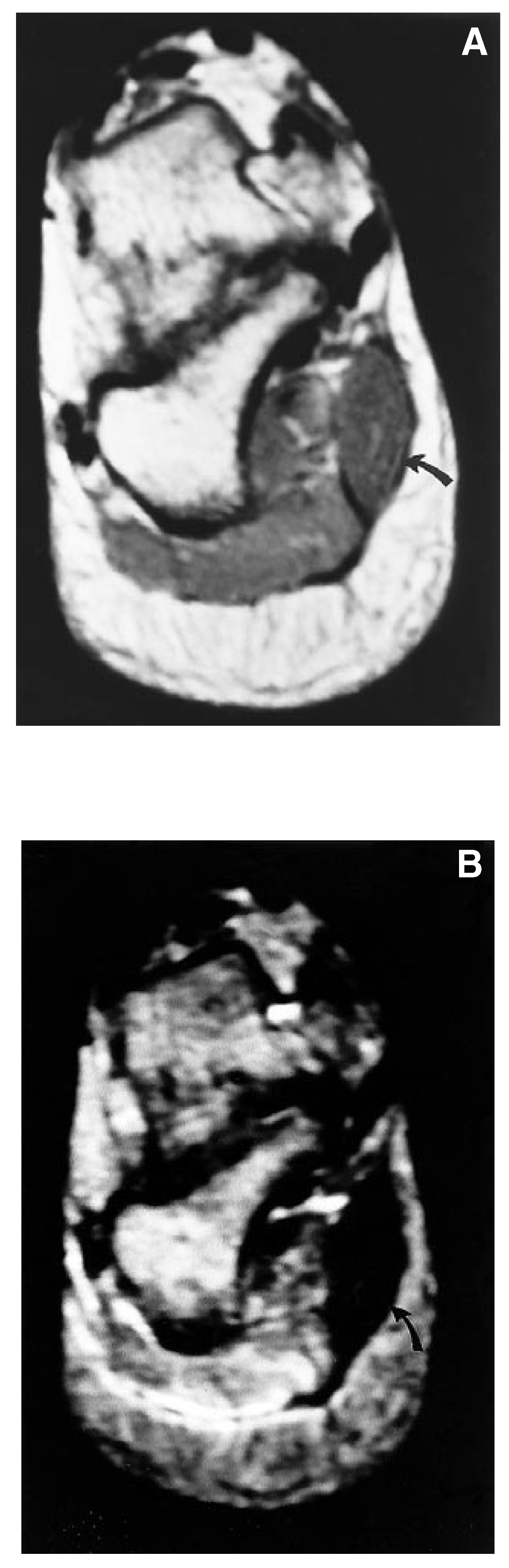
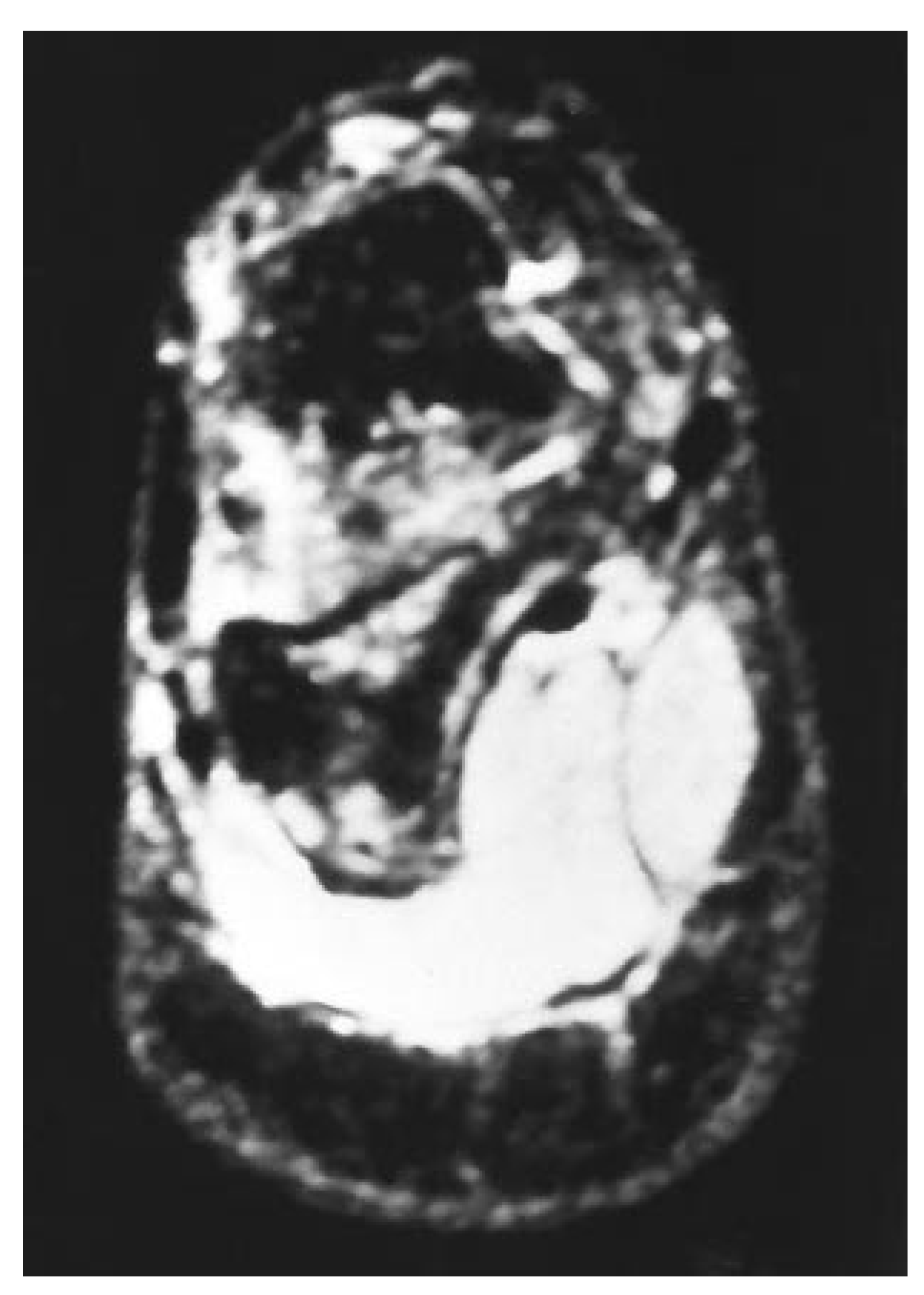
A magnetic resonance image was obtained which revealed increased signal intensity of plantar musculature (
Fig. 1 amd
Fig. 2). The increased signal pattern indicates increased water content in the muscles. This pattern can be seen in edema from myositis or can also be seen in muscle infarction. The latter shows increased signal secondary to cellular damage and vascular injury resulting in increased water content in the interstital spaces. Considering the patient’s known sickle cell disease, this study was consistent with soft tissue infarction of the right heel. The patient’s concurrent sickle cell crisis was managed medically by providing nasal cannula oxygen, patient-controlled analgesia hydromorphone, and hydration. The patient’s heel pain gradually resided with concomitant reduction in local temperature and swelling. The patient was maintained nonweightbearing for 2 weeks, then guarded weightbearing was allowed with a below the knee immobilizer for 2 more weeks. Range of motion exercises and massage therapy were used during this period. The patient’s right heel was free of pain within 1 month after discharge, and at this time has not had a recurrence of these symptoms.
Discussion
The authors report the first case of acute sickle cell myonecrosis involving the foot. This diagnosis, based on clinical and magnetic resonance imaging findings, was presumptive since confirmational muscle biopsy was not performed. There was, however, no indication for muscle biopsy in this patient as there was no compartment syndrome. In the appropriate clinical setting with typical magnetic resonance imaging findings, the authors believe the diagnosis can be accurately made in most cases. Surgical biopsy is not usually required and should be reserved for difficult cases. Surgical intervention is required in the presence of compartment syndrome.
Magnetic resonance imaging findings were crucial in the diagnosis of this case. However, acute muscle necrosis is a generalized magnetic resonance imaging finding and is not specific for any particular disease process [
9,
14]. Magnetic resonance imaging has been used to evaluate myonecrosis in two previously reported cases that described intramuscular sheets of irregular streaks of fluid with increased signal intensity and edema [
6,
9]. Spin echo T2-weighted sequences generally allow easy identification of intramuscular edema, showing it to be increased signal-producing white areas on the studies. However, the use of fat suppression with T2-weighting may increase the conspicuity of edema, making the white edema appear even brighter. Heavily T1-weighted sequences show increased water content as dark areas rather than bright areas. Although this low signal is usually detectable on T1-weighted sequences, the bright signal of T2-weighted sequences is more easily appreciated.
Conclusion
Acute muscle infarction in sickle cell patients has been attributed to intravascular sickling of red blood cells with vessel occlusion to the affected muscle. The incidence and prevalence of this condition is unknown and optimal treatment has not been defined; however, recognition and treatment of compartment syndrome, along with prevention of contractures, are paramount. The clinical situation in conjunction with magnetic resonance imaging can usually confirm the appropriate diagnosis allowing for prompt treatment. Biopsy is not usually required. Surgical intervention is required only in the presence of compartment syndrome.