Radiowave Surgery
Radiosurgery is an atraumatic method of cutting and coagulating soft tissue. The cutting effect is performed without manual pressure or crushing of the tissue cells. The resultant cut is produced from heat generated from the resistance the tissue offers to passage of a radiofrequency wave. The heat disintegrates and volitizes the cells in the path of the waves [
1,
2,
3,
4,
5,
6,
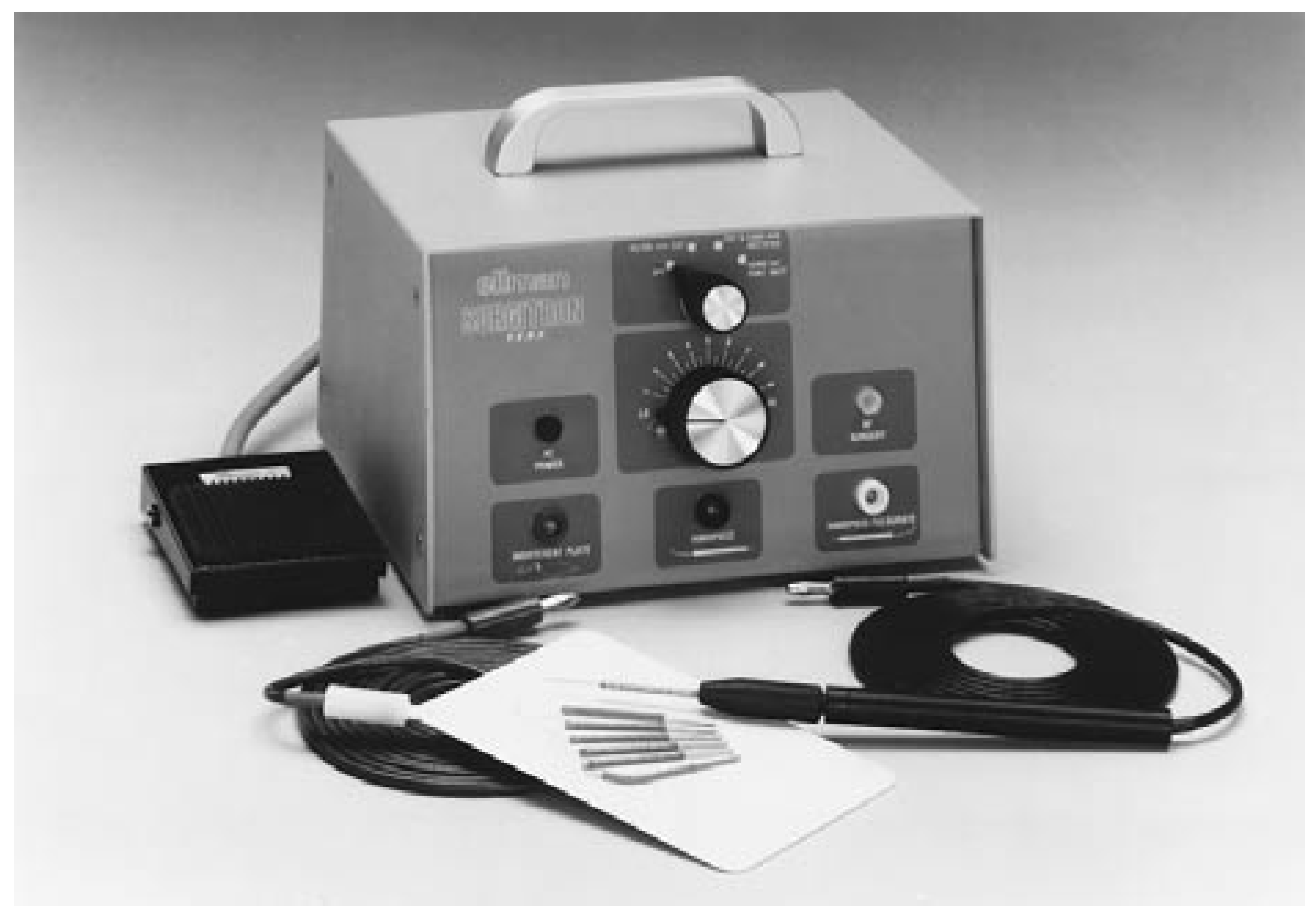
7]. The procedure in this case study was performed using the Ellman Surgitron electrosurgical equipment (
Figure 1). The unit converts electrical current into controlled energy in the radiowave frequency of the electromagnetic spectrum.
The Ellman Surgitron uses a vacuum tube within the unit to produce the higher frequencies and purer waveforms desired when using high-frequency radiosurgery. The frequency is stabilized by electronic circuits within the device itself. The electrodes are activated by stepping on the foot pedal connected to the unit. This causes emission of a filtered, fully rectified, or partially rectified output frequency of 3.8MHz [
1,
2,
3]. Certain electrosurgical units do function in the lower frequency ranges and require “grounding” of the patient so that there is no electrical shock sensation felt by the patient or surgeon. When frequencies above 500KHz are used, there should be no faradic effect, which is the involuntary twitching of surrounding nerves and muscles. Low-end frequency electrosurgery may still cause this effect. Radiofrequency waveforms, however, can achieve higher frequencies than electrosurgery and not cause any faradic effect [
2,
4,
8]
The atraumatic nature of radiosurgery is ideal for a number of incisional and excisional surgical procedures because of the lack of trauma to the surrounding tissues [
6]. The energy level rapidly diminishes with relation to distance from the active electrode. When “cold steel” type of incisions are made, there is a certain degree of crushing of the tissue cells as the blade passes through them. This is more pronounced as the blade begins to dull during the procedure. A radiosurgical cut, however, uses only energy to produce the cutting effect and therefore is less damaging to the cells in the surrounding areas of the incision.
An antenna plate should be used with each surgical procedure and may be placed under the patient’s leg or under the sterile drapes. It does not require direct skin contact, as it is not a ground plate [
1,
4]. The function of the antenna plate is to direct and focus the radio energy emitted from the handpiece and the electrodes. There is no danger if the antenna plate is not used, but power settings will need to be greatly increased [
2].
According to the manufacturer, “almost the only way that electrosurgery can create tissue damage is if heat is allowed to accumulate in the tissue to the point where excessive dehydration occurs and the tissue is destroyed.”[
2]. The accumulation of lateral heat in tissue depends on a number of factors that can be summarized in a mathematical formula:
The formula can then be broken down to understand how each factor can affect the outcome of the radiosurgery use. Electrode contact time is controlled by the surgeon. Greater lateral heat is produced by slower passages of the electrode through the tissue. Intensity of power is also controlled by the surgeon. A power setting should be chosen such that there is no tissue sparking (power too high) and no tissue drag (power too low). Electrode size is a product of necessity, but in general, the larger the electrode, the more lateral heat produced because of the larger power setting necessary to operate the given electrode. The nature of the waveform is also chosen by the surgeon based on the effect desired. Fully rectified filtered produces the least lateral heat, fully rectified produces less lateral heat, and partially rectified produces the most lateral heat. The last factor in the formula is a constant of 3.8MHz when using the Ellman Surgitron [
2,
4,
6,
7,
9].
There are three basic waveform settings used in radiosurgery. The first setting is the fully filtered waveform. This is a pure, continuous flow of highfrequency waves providing 90% cutting wave and approximately 10% hemostasis. This wave produces the least amount of lateral heat and tissue destruction. This is used in initial skin incisions where first intention healing is the primary concern. This waveform will not produce cautery artifacts on a specimen when used properly. The second setting is the fully rectified waveform. This waveform cuts and coagulates simultaneously, providing 50% cutting and 50% coagulation. The zone of coagulum produced is just enough to provide for adequate hemostasis without destroying surrounding healthy tissue. The third setting is the partially rectified waveform. This waveform produces an intermittent flow of high-frequency waves to produce approximately 10% cutting and 90% coagulation abilities. This setting is used primarily for surgical hemostasis [
2,
4,
6,
8,
9]. Some of the suggested uses of radiosurgery are listed in
Table 1.
As a general rule, higher-power settings are required as the size of the electrode increases. The active electrode actually remains cold during the procedure. The generation of heat occurs within the tissues and is then under the direct control of the surgeon [
3,
5,
7]. Radiosurgery requires virtually no pressure to produce the cutting action, so the surgeon’s hand should have some type of rest support to retain good control of the handpiece [
10]. An additional benefit to radiosurgery is that there is a sterilizing effect at the electrode tip when activated [
1,
2,
5].
Some basic precautions should always be observed when using radiosurgery. The electrode wire should always be held perpendicular to the tissue being cut [
3,
10]. If held at an angle, the radiowaves can precede the wire into the tissue, producing a less effective cut. Radiosurgery should not be used in patients who have a pacemaker because of the possibility of high-frequency interference [
2,
3,
9]. The radiosurgical instrument should not be activated in the presence of flammable liquid or gasses. The handpiece should be deactivated before changing the electrodes and the electrodes should not be used if any of the brass shaft is showing. If the electrodes are cracked or worn, a shock or burn may be felt by the surgeon or patient [
2,
9].
Plantar Fibromatosis
A 54-year-old female presented with a chief complaint of tumors on the bottom of her left foot. The patient related a history of previous surgical excision of similar masses on the left foot 6 years previously by an orthopedic surgeon. The patient was kept nonweightbearing for 4 weeks and had to use a cane during ambulation for an additional month as she increased weightbearing load to her left foot.
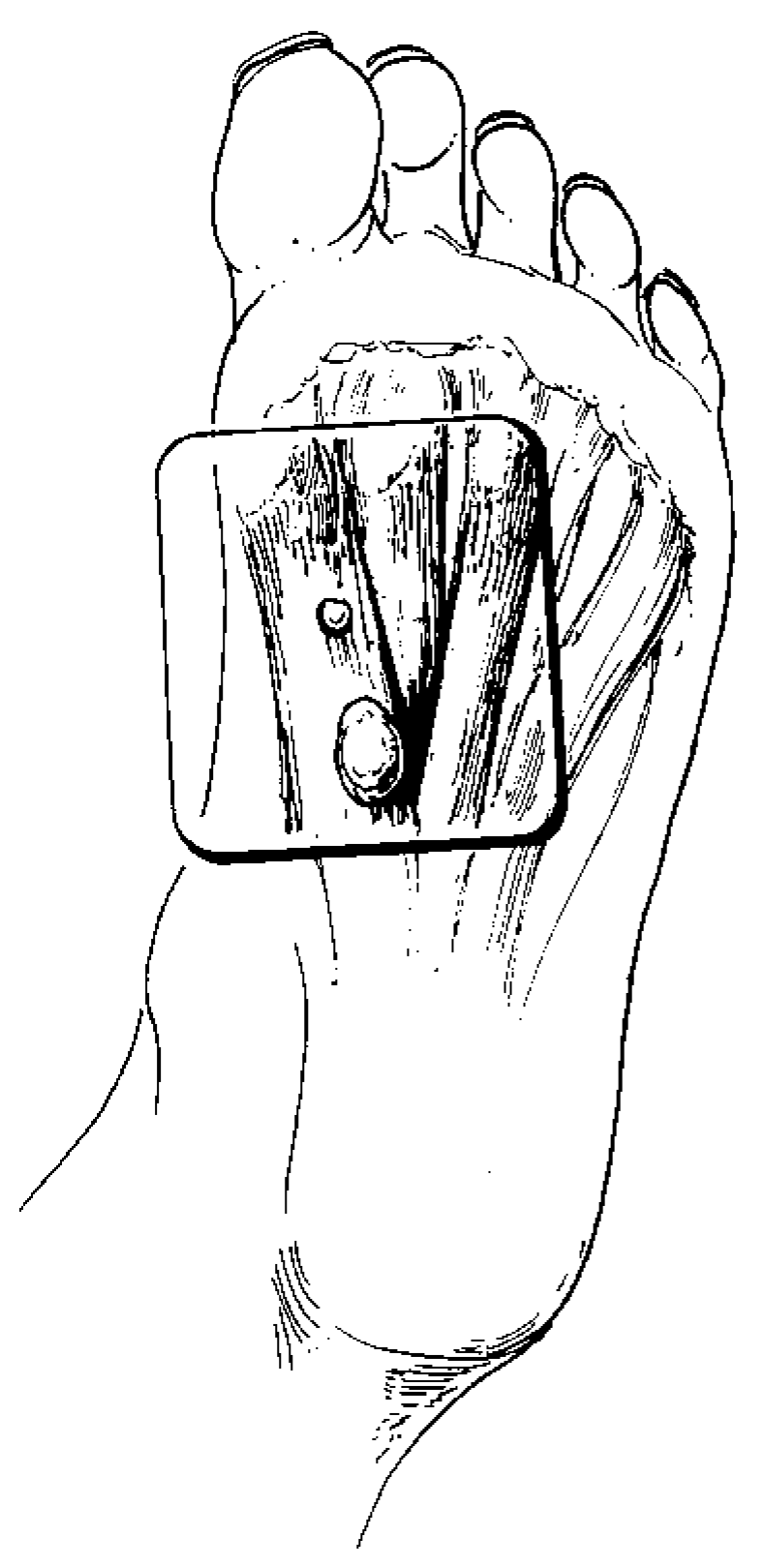
Physical examination of the patient showed two nonmobile, firm, subcutaneous masses along the course of the medial band of the plantar fascia of the left foot. The distal-most lesion was approximately 1 cm proximal to the surgical neck of the first metatarsal and measured approximately 0.7 cm in diameter. The proximal lesion was larger, measuring approximately 2.0 cm in diameter and was located approximately 2.0 cm proximal to the smaller lesion (
Figure 2). Aside from a previous history of plantar fibroma excision, the patient’s medical history was noncontributory.
Using radiowave technique, a 7-cm linear incision was made in the plantar medial arch area of the left foot. The incision was made with the Vari-Tip
® (Syntex Laboratories, Inc, Palo Alto, CA) electrode using the fully rectified current. The incision was deepened using blunt and radiowave dissection taking care to retract and protect the vital structures. All bleeders were coagulated with radiowave energy as needed using the ball electrode and a partially rectified current. Dissection was deepened until the mass was located. Special care should always be taken to avoid the medial plantar nerve and vessels that are often encountered during a plantar fibroma excision [
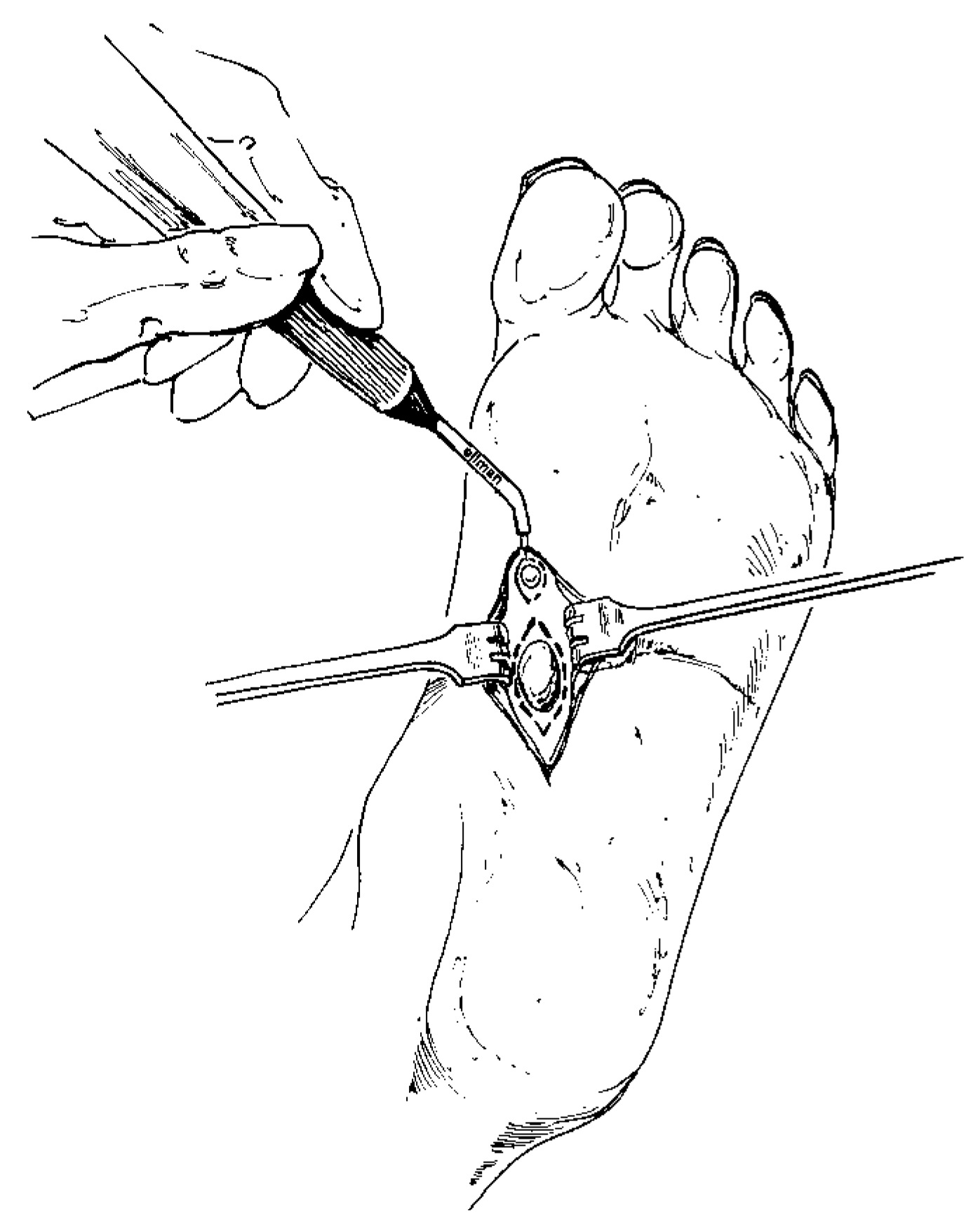
11]. The mass was underscored, retracted, and excised in its entirety using radiowave technique through the Vari-Tip electrode and the fully rectified current (
Figure 3). The mass measured approximately 2.0 cm in diameter and was approximately 0.5 cm in depth. A similar procedure was then performed on the distal lesion in the plantar arch area. The area was manually inspected for any additional masses. The skin edges were reapproximated with simple interrupted sutures of 3-0 nylon. Neosynalar
® (Schering Corporation, Kenilworth, NJ) cream was applied to the incision line. The wound was then covered with a sterile compressive dressing. An accommodative 1/4-inch felt pad was placed around the incision and incorporated into the dressing. Representative samples of the masses were sent for biopsy and pathologic study. All areas of surgical procedures were injected with 0.25 ml of dexamethasone phosphate and 0.25 ml of betamethasone acetate steroid solution.
The patient was allowed to walk to tolerance immediately postoperatively. She had minimal postoperative pain that was adequately controlled with Toradol-2® (Roche Laboratories, Nutley, NJ.) 10 mg every 4 to 6 hr as needed. The patient related very little postoperative swelling and little pain even with regular amounts of ambulation. The sutures were removed 16 days postoperatively. The patient applied Diprolene® (Schering Corporation, Kenilworth, NJ.) 0.05% cream to the incision line for the next 4 weeks to assist in the reduction of scar formation. All postoperative evaluations showed uneventful healing. For long-term evaluation, the patient was seen again at 1 and 2 years postoperatively and related no problems with regard to the excision of the two plantar fibroma masses. There was no pain elicited on firm direct palpation, and no recurrence of the masses was noted.
Pyogenic Granuloma
A 56-year-old female presented with a chief complaint of a wart on the bottom of the right foot. Examination revealed a 1.5-cm diameter pedunculated granulomatous mass on the plantar aspect of the right foot at approximately the midshaft level of the fourth metatarsal. The patient also related occasional bleeding of the area. There was no recollection of a precipitating traumatic event. She had been treating the site on her own using over-the-counter acidbased wart preparations for 3 weeks prior to her initial visit. The patient’s medical history was essentially noncontributory.
Using radiowave technique, the mass was dissected free using the Vari-Tip electrode and the fully filtered waveform setting. There was a connecting stalk at the base of the lesion, attaching the mass to the underlying tissues. The mass was grasped with forceps and the connecting stalk was cut at the level of the skin using the Vari-Tip electrode. The electrode was then changed and a loop electrode was used to excise the damaged dermal tissue surrounding the base of the lesion. The electrode was again changed to a ball electrode and the frequency was changed to the partially filtered setting. The base of the lesion was then superficially cauterized by activating the electrode and passing it quickly over the skin defect. All excised tissue was sent for biopsy and pathologic evaluation.
Triple antibiotic ointment was applied to the area and a sterile compressive dressing was applied. The patient was allowed to walk to tolerance. No postoperative analgesics were required at all and healing was uneventful. The patient was seen again 1 year postoperatively and there were no longer any problems with postsurgical scarring or recurrence of the lesion.
Thrombosed Varix
A 42-year-old female presented with a chief complaint of a painful mass on the bottom of the left foot. This was diagnosed as a plantar fibroma by another physician who recommended surgical excision. Examination of the area showed a firm, nonmobile mass of approximately 1 cm in diameter at the mid-shaft level of the third metatarsal area. Preliminary diagnosis was that of plantar fibroma. The patient’s medical history was essentially noncontributory and she was currently undergoing estrogen replacement therapy for early stages of menopause.
Using radiowave technique, a 4-cm linear incision was made directly over the mass on the left foot. The incision was made with the Vari-Tip electrode using the fully rectified current. The incision was deepened by blunt and radiowave dissection, taking care to retract and protect the vital structures. All bleeders were coagulated with radiowave energy as needed using the ball electrode and a partially rectified current. Dissection was deepened until the mass was located. During separation of the plantar fatty layers, a purple-colored mass was delivered into the wound. This was dissected free of the surrounding tissues using the Vari-Tip electrode and the fully filtered waveform. The mass was then excised in its entirety using the Vari-Tip electrode and a fully filtered waveform setting. The resultant excised mass measured 0.5 cm in greatest diameter. The entire area of the wound was palpated and found to be free of any additional mass that may have contributed to the patient’s complaint. The incision was closed with simple interrupted sutures of 3-0 nylon. A sterile dressing was applied and the patient was allowed to walk to tolerance immediately postoperatively. All excised tissue was sent for biopsy and pathologic evaluation.
Postoperatively, the patient took no pain medications at all. The sutures were removed 2 weeks postoperatively. The incision was reenforced with SteriStrips® (3M Co, St Paul, MN.) and the patient was allowed to return to all regular activities. The patient is free from any recurrence as far as 2 years postoperatively.
Summary
There are many factors to consider when dealing with a patient who suffers from painful soft tissue lesions of the foot. There are also additional considerations when considering surgical excision of the lesions. Most types of soft tissue surgeries of the foot can be performed with the use of radiowave surgical techniques. The major advantages are the ability to use a pressureless incision, the instrument sterilizes as it is being used, there is little damage to any surrounding tissues, the ability to cut and coagulate simultaneously, and the fact that a variety of electrodes are availably to perform virtually any desired soft tissue procedure.
Postoperative care should be geared toward the aggressiveness of the excision in each individual case. The use of radiowave surgical excision suits itself well to office-based work. It has been used for excision of ganglion cysts, neuromas, warts, nevi, nail matrixectomies, and numerous other soft tissue surgeries in addition to those presented here. With the use of radiowave bipolar coagulation, many procedures can be done without a tourniquet under regional or local anesthesia. Patients should be regularly monitored postoperatively to assess the success of the surgery and to check for any signs of early recurrence.
Radiowave surgical excision of soft tissue masses is, in the opinion of the author, superior to “cold steel” type of excisions because of the fact that there is no dulling of the instrument. All incisions are as sharp as is possible because there is only the use of energy to provide an atraumatic cut. This reduces postoperative swelling and pain. Radiowave surgical techniques should be considered as a favorable alternative when performing any soft tissue surgical procedures. This form of surgical technology is well suited for excision of any soft tissue lesions.