First approved for use in the US in 1996, terbinafine is the first oral antifungal agent in the class of compounds known as allylamines. This class provides fungicidal activity by inhibiting squalene epoxidase, an enzyme vital to ergosterol synthesis in the fungal cell membrane.[
1] Clinical trials have demonstrated mycologic cure rates of 70% for 12 weeks of treatment for onychomycosis of the toenail and 79% for 6 weeks of treatment of onychomycosis of the fingernail.[
2] The most prominent side effects in the clinical trials of terbinafine were transient gastrointestinal disorders and skin rashes.
This study was conducted to evaluate the safety and efficacy of 12, 18, or 24 weeks of treatment with terbinafine for onychomycosis of the toenails. Efficacy data will be reported when the follow-up portion of this clinical trial has been completed.
This article presents the pooled results of the safety component of this trial and includes separate analyses of two populations at increased risk of drugrelated adverse reactions: the elderly (those aged 60 years or older) and patients with diabetes mellitus.
Methods
Patient Population
The study sought to enroll at least 1,500 patients from as many as 300 centers in the US. All patients were adults with a clinical and mycologic diagnosis, verified at least by a positive potassium hydroxide (KOH) preparation (positive culture was not required), of dermatophyte-caused onychomycosis of the toenails. Each patient had toenails that the investigator believed to be capable of regrowth.
Exclusion Criteria. Patients were excluded from the trial for the following reasons:
Had received systemic antifungal therapy within 3 months, topical antifungal therapy within 1 month, or any investigational agent within 12 weeks before beginning treatment with terbinafine
Had psoriasis, mucocutaneous candidiasis, or known immunodeficiencies
Were pregnant or breast-feeding (pregnancy tests were performed on screening and at the end of treatment, and all females with childbearing potential were advised to practice contraception during the course of the study)
Had liver disease, nephropathy, or blood disorders that the investigator believed could alter the pharmacokinetic activity of terbinafine
Had any disease that could significantly impair gastrointestinal absorption of the drug
Had baseline hepatic enzyme test results greater than 1.5 times the upper limit of normalcy
Had any abnormal laboratory values that the investigator considered to be clinically significant
Had a history of alcohol or substance abuse
Mycologic Confirmation. At the screening visit, one of the two great toenails (or, if neither great toenail was involved, the toenail that was most severely affected) was designated as the target toenail for clinical and mycologic evaluation. Only patients with positive confirmation of subungual onychomycosis by KOH or toenail culture or both performed at a central laboratory were eligible to participate.
Treatment
Treatment in this open-label study consisted of a single 250-mg tablet of terbinafine, administered once daily. Patients with less than 50% involvement of the great toenail and those who had no great-toenail involvement but whose disease involved another site received 12 weeks of therapy. Patients with at least 50% involvement of the great toenail also received 12 weeks of therapy. At the 12-week evaluation point, patients in this latter group who demonstrated less than 25% improvement over their baseline disease received an additional 6 weeks of treatment. At the 18-week evaluation point, if these patients still showed less than 25% improvement, treatment was continued for another 6 weeks. The protocol specified that the maximum duration of therapy was 24 weeks. Treatment duration varied according to the severity of the disease and the response to treatment.
All medication was provided to patients in bottles that contained a 6-week supply with six extra tablets. At the end of 6 weeks, the patient returned all unused study medication and received another 6-week supply. This process was repeated at 6-week intervals consistent with the duration of therapy assigned to that individual.
Evaluation
In addition to the screening visit, all patients were evaluated at baseline, week 6, week 12, week 18, week 24, week 30 (patients receiving 24 weeks of treatment only), week 36, week 48, and week 72.
Safety Assessment
The safety of terbinafine was assessed by multiple measures. Blood drawn at the screening visit (complete blood count with differential and chemistry panel), at week 12, and at the end of treatment was analyzed by a central laboratory. Any abnormal results considered by the investigator to be clinically significant prompted repeated testing within 48 hours of receiving the result.
Physical examinations were performed at baseline, at week 6, and at the end of treatment.
Adverse events were reported by the patient or identified by the investigator through examination or general questioning, starting at week 6 and continuing through all subsequent evaluations. Investigators were asked to rate the severity of each adverse event on a four-point scale (mild, moderate, severe, lifethreatening) and to assess its relationship to terbinafine as “yes,” “uncertain,” or “no.”
Safety Outcome
The primary safety outcome was the incidence of adverse events, including severity and potential relationship to the study drug. Any abnormal laboratory value considered by the investigator to be clinically significant was included as an adverse event.
Results
Patient Population and Demographics
The safety analysis included 1,508 patients from 259 of the 300 centers enrolled, which represents the portion of the 1,549 patients enrolled in the study who received study medication and for whom case report forms had been received at the cutoff point for this safety analysis.
Table 1 highlights the demographics and extent of disease in this group. The majority were males (males, 1,015; females, 493), and the mean age was approximately 50 years. The disease in this population was both extensive and intractable, averaging over 11 years in duration.
Comparable numbers of patients completed 12 (±1) weeks (28.5%), 18 (±1) weeks (26.6%), and 24 (±1) weeks (25.5%) of terbinafine therapy. The nonevaluable patients consisted of 7.5% who completed less than 12 weeks and 9.4% who continued therapy beyond 25 weeks. The duration of the administration of study medication was unknown for 2.5% of the patients.
Incidence of Adverse Events
Table 2 lists the adverse events and causality as assessed by the investigator. The most frequent adverse events were skin, gastrointestinal, and respiratory problems. Respiratory problems were largely unrelated to the study drug. A total of 674 (44.7%) patients experienced an adverse event of some type during the course of terbinafine therapy. In 117 of these 674 patients (7.8% of the total study population), investigators reported a positive or uncertain causal relationship to the study drug. Adverse events reported in the other 557 patients were not considered by the investigator to be related to terbinafine therapy.
Skin. The most prevalent complaint in the 186 patients (12.3% of 1,508) with an adverse event involving the skin or appendages was skin rash, most often categorized as nonspecific dermatitis, which occurred in 62 patients, or 4.1% of the total population. The overall prevalence of causally related skin rash was 1.3% and 1.1% for positive and uncertain relationships to terbinafine, respectively. The second most frequent skin event was “nail disorder,” which occurred in 24 patients (1.6% of 1,508).
Gastrointestinal. The predominant complaints in the 173 patients (11.5% of 1,508) with gastrointestinal adverse events were nausea, diarrhea, dyspepsia, and abdominal pain. The overall prevalence of causally related gastrointestinal events was 3.9% (58 of 1,508) for positive and 4.3% (65 of 1,508) for uncertain relationships to terbinafine.
Other Events. Hepatic or biliary disorders occurred in 42 patients (2.8% of 1,508). The most frequent problem was abnormal liver-function tests, which occurred in 36 patients (2.4% of 1,508). Four patients had elevated aspartate aminotransferase; 10 had elevated alanine aminotransferase; 4 had elevated γ-glutamyl transpeptidase; 6 had increased hepatic enzymes; and 12 had abnormal hepatic function. The overall prevalence of causally related hepatic abnormalities was 0.7% (10 of 1,508) for positive and 1.1% (17 of 1,508) for uncertain relationships to terbinafine.
White blood cell disturbances occurred in 17 patients (1.1% of 1,508). None were positively related to terbinafine. Nine (0.6% of 1,508) were judged to have an uncertain relationship to terbinafine: three patients with eosinophilia, three of four patients with leukopenia, two of three patients with lymphadenopathy, and one patient with atypical lymphocytes.
Fifty patients (3.3% of 1,508) experienced headache, with an overall causality prevalence of less than 1% (5 patients each in positive and uncertain categories). Finally, a total of 21 (1.4% of 1,508) patients reported taste disturbances, all of which were believed by the investigator to be of positive or uncertain relationship to terbinafine.
Incidence of Serious Adverse Events
A serious adverse event was defined in the protocol as any experience that was fatal, life-threatening, or permanently disabling; that required or prolonged hospitalization; or that was a congenital anomaly, cancer, or an overdose. Patients with serious adverse events received appropriate remedial measures and were closely followed until data indicated that the problem had abated.
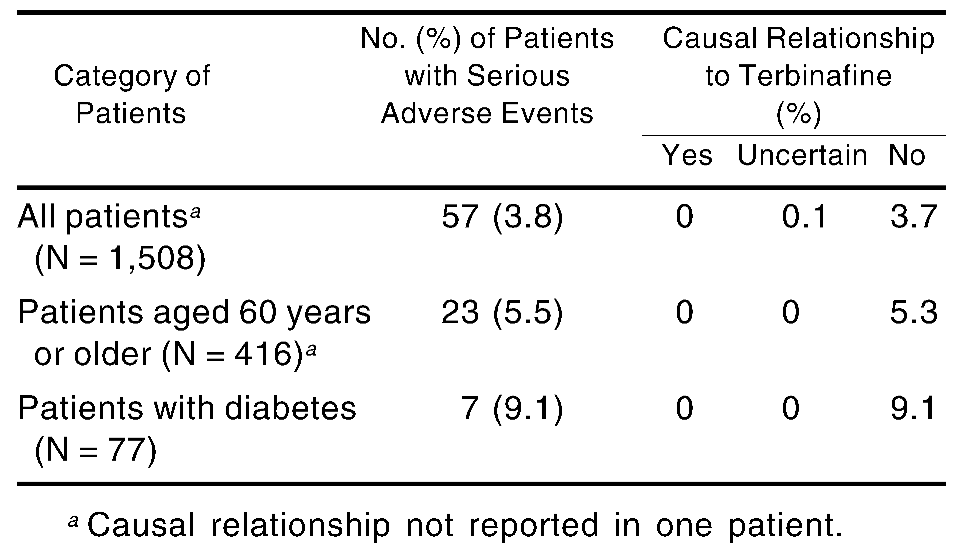
At least one serious adverse event occurred in 57 patients (3.8% of 1,508) (
Table 3). In no case did the investigator believe that the event had a definite relationship to treatment with terbinafine; the relationship was considered uncertain in one patient (0.1% of 1,508) with increased hepatic enzyme levels.
Discontinuations Because of Adverse Events
Of the 1,508 patients included in the analysis of safety, 88 (5.8%) discontinued the study medication because of adverse events, whether or not these events were related to the study medication.
Table 4 lists the adverse events leading to discontinuation. The most frequently cited events were gastrointestinal problems (27; 1.8%), primarily diarrhea and abdominal pain; skin disorders (24; 1.6%), particularly rash; general “body as a whole” complaints (16; 1.1%), including fatigue, headache, and malaise; and hepatic or biliary system disorders, especially abnormal liver-function tests.
Adverse Events in the Elderly
Of the 416 patients aged 60 years or older, 215 (51.7%) experienced one or more adverse events.
Table 5 lists the adverse events that occurred in this population and the causal relationship as reported by the investigator. For none of the 23 patients (5.5%) with serious adverse events were these considered by the investigator to be related to terbinafine (
Table 3).
Adverse Events in Patients with Diabetes Mellitus
Of the 77 patients with diabetes mellitus, 47 (61.0%) experienced one or more adverse events. Those of definite or uncertain relationship to terbinafine were primarily gastrointestinal problems (
Table 6). As shown in
Table 3, 7 (9.1%) of 77 patients with diabetes mellitus had a serious adverse event. The investigators noted no causal relationship between these events and the study drug.
Discussion
Onychomycosis is a common, chronic, and highly resistant fungal infection of the nails. The primary pathogens isolated in a recent large, multicenter US study were dermatophytes (95.0%), particularly
Trichophyton rubrum (97.4%). [
3] Nondermatophytic molds accounted for only 4.3% of fungal isolates, and yeasts, for only 0.7%. Organisms other than dermatophytes are generally considered to be contaminants and not causal for onychomycosis. Dermatophyte infection of the nail rarely resolves spontaneously and may advance to cause complete destruction of the nail plate. Clinically, the patient experiences discomfort, disfigurement, and, with the most severe conditions, pain and disability. Onychomycosis may occur in up to 20% of the general population [
4].
The cosmetic effects alone of a chronically infected toenail often motivate patients to seek medical advice. But onychomycosis also compromises proper nail hygiene, as it becomes increasingly difficult and ultimately impossible to trim a toenail grossly thickened by years of unremitting infection.
Onychomycosis treatment has historically been less than optimal. Topical antifungal agents have generally proven ineffective. The oral systemic antifungal agent ketoconazole has cure rates similar to those of the agent griseofulvin, but it never gained the US Food and Drug Administration’s approval because of the prolonged courses of therapy necessary to eradicate toenail infection and the risk of rare adverse reactions such as hepatotoxicity.
Until the last 2 years, when two new effective antifungal agents, terbinafine and itraconazole, were marketed, patients had to tolerate chronic disfigurement in lieu of potentially toxic or ineffective therapy. The options for patients in pain from onychomycosis were debridement, avulsion, or, in the event of severe pain, gross deformity, or both, nail matrixectomy.
The therapeutic possibilities have improved substantially with the advent of these new systemic antifungal agents. The results of this study suggest that terbinafine is an appropriate choice for treatment of onychomycosis of the toenails. It has demonstrated a good safety profile, with no known clinically relevant drug-drug interactions. The rate of adverse events caused directly by the drug is small and consistent with that reported in the clinical trials of terbinafine.
In the past, patients with diabetes mellitus have required repeated debridement to keep their toenails in manageable condition and thus reduce the risk of infection. However, the relative safety of terbinafine demonstrated in the patients with diabetes mellitus in this study makes treatment with terbinafine a more acceptable approach to long-term maintenance of healthy nails in this population. Patients with diabetes mellitus represent a significant portion of the podiatrist’s patient population. Clinical experience suggests that they tend to be more prone to fungal infections such as onychomycosis than are individuals without diabetes mellitus. Often the dermatophyte infection, especially when long-standing, provides the opportunity for superimposed bacterial invasion and infection. Coupled with the vascular complications and immunosuppression associated with diabetes mellitus, the consequences can be severe. For example, a chronically infected toenail may facilitate soft-tissue infection should the thick, elongated nail edge break the skin of the adjacent toe. These infections can quickly fulminate into ulceration.
Similarly, the safety profile of terbinafine in the elderly patients in this study makes it a promising treatment for a population at increased risk of the disease and of adverse events caused by drug-drug interactions. Elderly patients are often taking concomitant medications for chronic illnesses such as hypertension and heart disease.
Summary
This multicenter study evaluated the safety and efficacy of 12, 18, or 24 weeks of terbinafine treatment (250 mg/day) of onychomycosis of the toenails. This article presents the pooled results of the safety data for 1,508 patients (of the total 1,549 enrolled) with separate analyses of safety in patients with diabetes mellitus and in elderly patients. A total of 7.8% of the study population experienced an adverse event that study investigators reported to have a positive or uncertain causal relationship to terbinafine; the most frequently reported adverse events were gastrointestinal problems and skin reactions. No serious adverse events positively related to terbinafine were reported. The results of this study confirm the safety profile of terbinafine as demonstrated in previous registration and large-scale clinical trials for the treatment of onychomycosis of the toenails.