Mycotic infection of the toenails is a very common ailment of the foot. The dermatophyte family of fungi is the most commonly implicated group of organisms in onychomycosis. Such infections cause toenails to become thickened, discolored, brittle, and, at times, painful. Painful onychomycosis is usually associated with severe thickening of the nails and the increased pressure to the nail bed that follows. In situations in which toenails are congenitally dystrophic or malformed secondary to matrix trauma, the development of onychomycosis is even more likely to cause pain. Pain may be secondary to onychocryptosis or may result simply from nail-bed pressure exerted by the thickened nail while the patient is wearing shoes.
Despite renewed interest in the pharmaceutical treatment of onychomycosis, it is often still necessary to treat certain infections in a surgical manner. Such cases include the severely thickened, very painful, or severely dystrophic mycotic nail. In some instances, surgical treatment may be combined with pharmaceutical therapy. Following is a review of common surgical treatment options for onychomycosis.
Total Nail Avulsion
Total nail avulsion is an acceptable treatment option for the severely thickened, painful, nondystrophic mycotic nail. Complete removal of the nail provides a “fresh start” for the toenail to regrow and removes the cause of pain when this is an initial problem. However, avulsion of the nail without the use of adjunctive antifungal therapy only temporarily relieves the pain and is unlikely to result in a permanent cure. The reason is that dermatophyte infection of the nail unit includes not only the nail plate but also the nail bed and nail matrix. Thus total nail avulsion is commonly used in combination with antifungal therapy, either oral or topical or both. The avulsion addresses the largest focus of the toenail infection and, therefore, the primary cause of pain, while the adjunctive therapy addresses those areas likely to play a role in recurrence, the nail matrix and nail bed. Adjunctive therapy should be started shortly before or at the time of the avulsion. Oral therapy is based primarily on the fungal culture results, as discussed by other contributors to these special issues. Topical therapy can include antifungal creams or solutions. Since most cases are reported as being caused by dermatophytes, the authors typically use topical terbinafine 1% cream applied to the nail bed daily. Although no studies have compared topical and oral antifungal therapy after avulsion, oral therapy is probably the more effective method of eradicating fungus from the nail matrix.
Total nail avulsion, as well as other techniques discussed in this review, is easily performed with local anesthesia in a digital block technique. A simple two-point block is generally sufficient to anesthetize both dorsal and plantar digital proper nerves [
1,
2,
3]. The authors prefer to use bupivacaine 0.5% without epinephrine, as it provides long-acting anesthesia postoperatively. Minimizing the amount of anesthetic used is important in making the injection less painful and preventing a tourniquet effect on the toe. Generally, no more than 2 ml of anesthetic agent for a lesser-digit block and no more than 3 ml for a hallux block is necessary to achieve complete anesthesia. In situations in which multiple avulsions are necessary, an ankle block may be used as an alternative to multiple digital blocks.
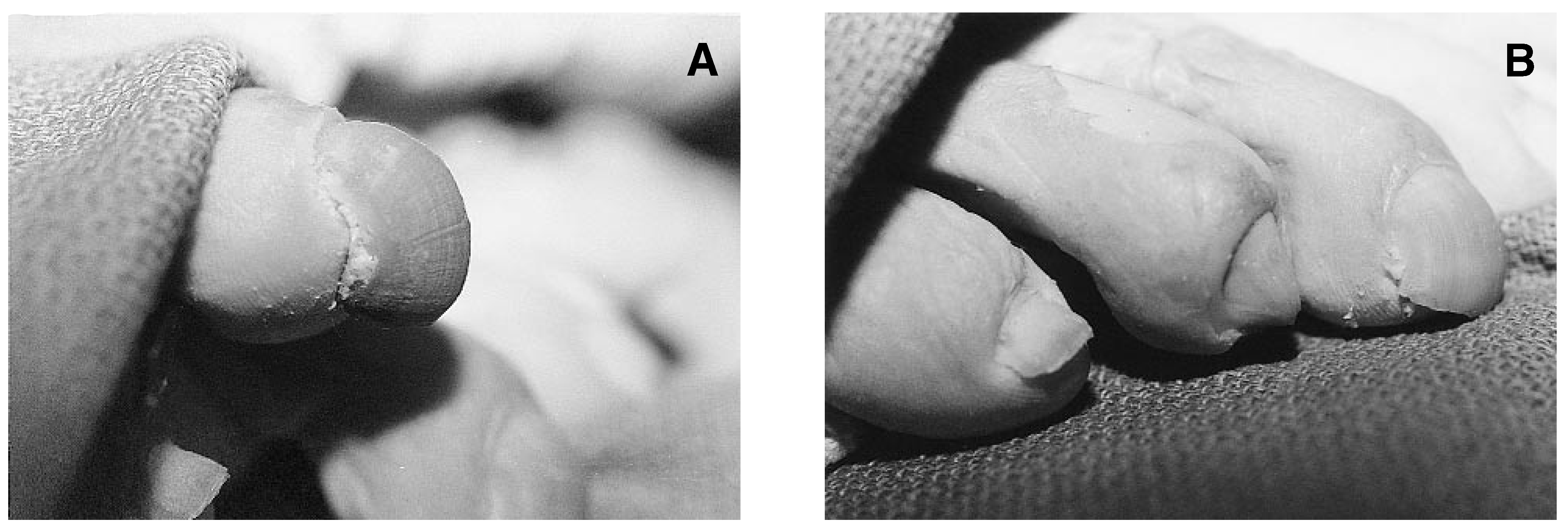
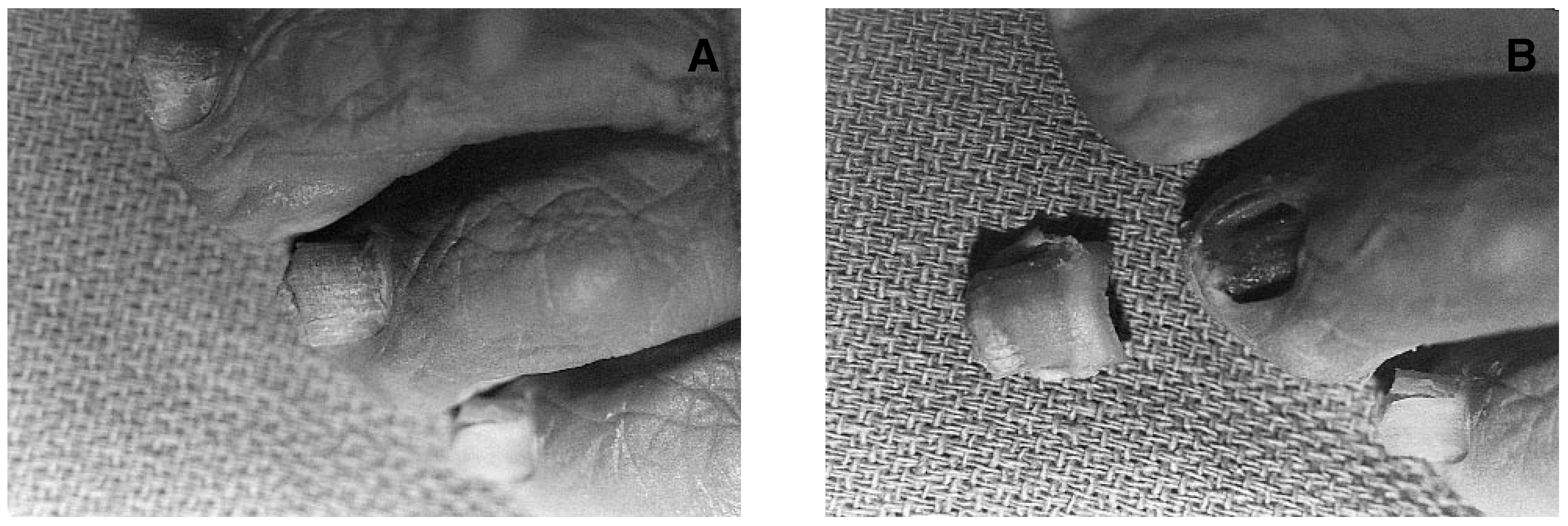
Once anesthesia is achieved, the nail may be avulsed. The authors prefer to use an elastic digital tourniquet; however, this is not mandatory, as with a chemical matrixectomy. A spatula or a similar instrument is used to free the medial, lateral, and proximal nail folds from the adjacent nail plate. A large straight hemostat is then inserted between the nail plate and bed at the hyponychium. The hemostat is gently advanced under the nail plate to separate it from the underlying nail bed. Care should be taken not to traumatize the nail bed when the hemostat is advanced, as this can lead to a disturbance of future nail growth. The hemostat is advanced deep to the eponychium, proximal to the visible nail plate. The nail is then firmly grasped with the hemostat in preparation for avulsion. The nail is gently lifted directly superiorly to provide for initial separation of the plate from the bed and to prevent excessive pressure of the hemostat on the nail bed. The surgeon’s hand is then brought inferiorly so as to lift the proximal nail away from the matrix and then lift the nail from the nail bed in a proximal-to-distal direction. The nail bed may then be gently curetted to remove any debris and to smooth the nail bed. The toe is then dressed with antibiotic cream, a nonadherent dressing, and covered with a small amount of gauze and a compressive wrap. The tourniquet is then removed (
Figure 1A,B and
Figure 2A,B).
Partial Nail Avulsion
The only indication for partial nail avulsion in onychomycosis is onychocryptosis of a nail, which is moderately affected by the mycotic infection. In such an instance, treatment is identical to that in nails without mycotic infection. When a fungally infected nail has become ingrown and symptoms are exacerbated by the thickness of the toenail, partial nail avulsion will provide temporary relief. The nail will probably regrow to the original thickness, and the offending margin may become problematic once again. Therefore, more definitive procedures such as partial matrixectomy, total avulsion combined with antifungal therapy, and total matrixectomy may be preferred.
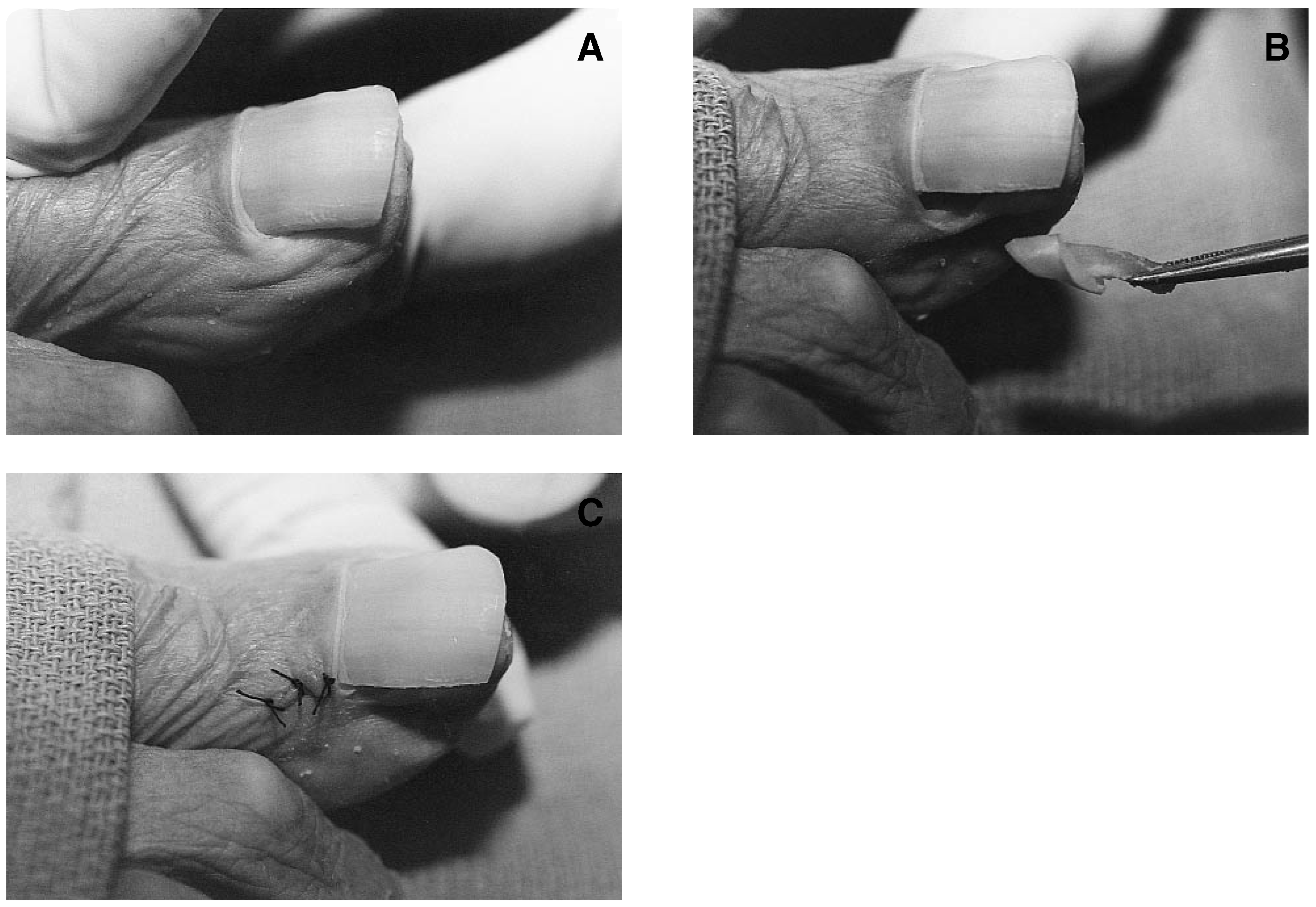
Local anesthesia is induced in a manner similar to that described earlier, but usually with less volume of anesthetic agent necessary to achieve the nerve block. Tourniquet use is again optional. The affected nail fold is gently freed from the nail plate. The proximal nail fold is freed from the nail plate along the area of nail margin to be avulsed. This is generally one-fifth to one-quarter the width of the nail plate. An English-anvil nail splitter is then used to begin the longitudinally oriented resection of the offending portion of the nail plate. This cut may be completed with the nail splitter or with a #61 or #62 surgical blade. The portion of nail to be avulsed is split from the hyponychium to an area proximal to the eponychium, but distal to the nail matrix. This is felt as a decrease in resistance with advancement of the blade. A large straight hemostat is then used to grasp the freed portion of nail plate. The partial avulsion is completed by simultaneously rotating the hand inferiorly and away from the affected nail fold: This delivers the offending nail margin from the nail groove and frees it from the matrix proximally. The exposed nail bed and nail groove are then gently curetted to remove debris and smooth the nail bed. The toe is then dressed as described earlier and the tourniquet is removed (
Figure 3A–C).
Matrixectomy
Before the recent introduction of the newer oral antifungal agents, matrixectomy was commonly used in the treatment of severe onychomycosis. In many instances of severely deformed and painful toenails, matrixectomy procedures may still be the treatment of choice. Matrixectomy eliminates the germinal matrix of the nail and prevents regrowth. This technique should eliminate the source of pain and all sources of potential infection. It obviates current or future antifungal therapy for that toenail. Various techniques for performing toenail matrixectomies are available. These include chemical [
4,
5,
6,
7,
8,
9,
10,
11,
12,
13], electrical [
14,
15,
16,
17,
18,
19,
20,
21], laser [
22,
23], and excisional procedures [
24,
25,
26,
27,
28,
29] As with toenail avulsions, either partial or total matrixectomies may be performed, with total nail procedures more commonly performed in cases of onychomycosis. The avulsion portion of the procedure is performed as described above, followed by the matrixectomy procedure of choice.
Chemical Matrixectomy
Chemical matrixectomy is the most popular method of nail-matrix destruction in general podiatric practice [
4,
5,
6,
7,
8,
9,
10]. The most commonly used agent is 89% phenol. When applied topically, the phenol creates a chemical burn that denatures the nail matrix and prevents regrowth of the nail [
1]. The phenol is applied topically to the matrix tissue with a cotton-tip applicator or simply by dripping the phenol into the proximal nail fold with a small needle and syringe. Three or four 30-second exposures to the phenol are typically used to ensure matrix destruction. Care should be taken during application of the phenol to avoid contact with adjacent nail-fold tissue and skin. The phenol is very caustic and will create unwanted burns in these unprotected areas. Adjacent tissues may be protected by placing a light coat of ointment over them prior to phenol application to deflect any chemical spill.
Hemostasis is extremely important in chemical matrixectomy. Blood in the area of the matrix will mix with the phenol and alter the pH of the agent. This is seen as a black discoloration of the phenol; with this increase in pH, the phenol becomes a less effective destructive agent. In addition to phenol application to the matrix tissue, the nail bed should also be lightly phenolized, as the ventral portion of the nail plate is formed from the nail bed itself [
20]. An optional step in the phenol matrixectomy is the application of alcohol after the application of phenol. Many physicians use this step to “neutralize” the phenol; however, chemically this does not occur. The alcohol acts merely to dilute the area by washing away excess phenol [
1]. Normal saline could be used as an alternative. After the application of phenol, the toe is dressed in identical fashion as with nail avulsion. Toenails that have been treated with phenol, because of the chemical burn imparted, may be more inflamed and painful and have more drainage postoperatively than those that undergo avulsion only. The use of postoperative foot soaks with lukewarm water and Epsom salt twice daily helps to minimize the drainage and helps cleanse the area and decrease subsequent inflammation.
The use of sodium hydroxide in chemical matrixectomy was first described by Travers and Ammon [
11] in 1980. A 10% sodium hydroxide solution is applied in a manner identical to that described for phenol. Curettage of necrotic tissue from the nail bed and matrix area between applications provides a fresh new surface for chemical application and decreases the time and number of applications necessary to destroy matrix tissue. After application of sodium hydroxide, 5% acetic acid is applied to the surgical site. Unlike the application of alcohol described above, the acetic acid application does neutralize the sodium hydroxide in an acid-base reaction. Proponents of the sodium hydroxide matrixectomy procedure claim a high success rate with less drainage and a faster healing time than seen with phenol matrixectomy [
11,
12,
13].
Electrical and Laser Matrixectomy
Less commonly used methods of matrixectomy that are effective include the use of negative galvanic current [
14,
15,
16,
17,
18,
19,
20], radio-wave electrical energy [
21], and the carbon dioxide laser [
22,
23]. While these methods have been shown to be highly effective, they require specialized equipment, instrumentation, and training.
Negative galvanic current has been used to destroy matrix tissue since 1935 [
14]. The technique has been more recently discussed and popularized by Abbott and Geho [
19] in 1980 and Bouché [
20] in 1986. The procedure uses small amounts of electrical energy in a negative galvanic current to destroy the matrix. A special galvanic generator designed specifically for matrixectomy procedures is used [
20]. This unit has a special probe-saber that is used to apply the current directly to the matrix tissue. Matrix tissue is destroyed by two mechanisms. The first is direct electrical heat from the unit. The second is the production of sodium hydroxide through electrolysis at the cathode (the probe-saber tip). Details of this alkaline reaction can be found in the article by Bouché [
20]. A very low electrical current is used in the procedure, normally 8 to 10 mA. A grounding pad is placed on the patient. It is important to keep the probe-saber in contact with tissue during application of the current. If the probe is pulled away from the tissue, the patient may feel an uncomfortable tingling sensation and the destructive effect of the current will be compromised. Typical application times for the current are 4.5 to 5 minutes for partial matrixectomies and 6 to 7 minutes for total matrixectomies. Because sodium hydroxide is produced at the cathode, the surgical site requires irrigation with acetic acid after the application of the current as with chemical sodium hydroxide procedures. The main advantage of the negative galvanic current matrixectomy is controlled application directly to matrix tissue. Excess chemical does not leak onto adjacent tissues. Frequent users of this technique report decreased postoperative pain, inflammation, and drainage in patients who undergo the procedure compared with those treated with chemical matrixectomy [
14,
15,
16,
17,
18,
19,
20].
The use of radio-wave electrical energy for matrixectomy was described by Hettinger et al. [
21] in 1991. A specially designed unit and probe are used to apply electrical energy in the radio-wave frequency directly to the nail matrix, resulting in destruction of the matrix. Application time is very short, only 2 to 4 seconds. The electrical energy of the radio wave provides hemostasis by an electrocautery effect. The technique should not be used in patients with pacemakers, as the radio wave may cause interference with the pacemaker device. Proponents of the procedure claim that it results in less postoperative pain, swelling, and infection than other methods of matrix destruction [
21]. No comparative studies have been performed, however.
Laser energy has also been used to perform matrixectomies. The carbon dioxide laser matrixectomy was described by Kaplan and Labandter [
22] in 1976 and by Apfelberg et al. [
23] in 1983. Nail-matrix tissue is ablated by means of the laser.
Partial Excisional Matrixectomies
An alternative to chemical and electrical techniques of matrixectomy is direct surgical excision of matrix tissue. The main techniques in use are the Winograd and Frost procedures. These techniques have the advantage of direct visualization of the matrix tissue, but require increased dissection and may have a slightly longer healing time than other matrixectomy procedures.
Winograd Procedure. Winograd [
24] described his technique for partial excisional matrixectomy in 1929, providing a follow-up report in 1936 [
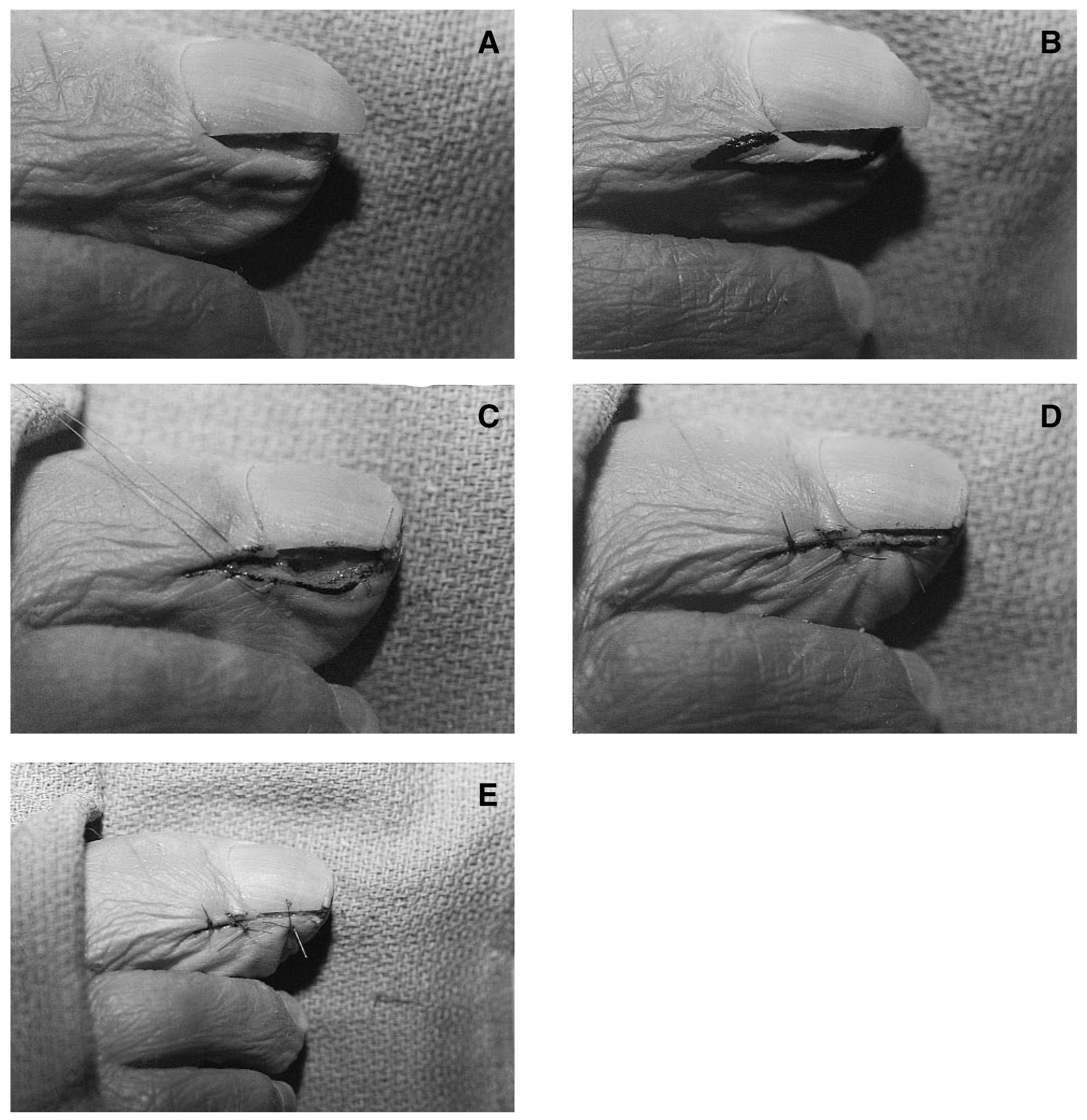
25]. In addition to splitting and excising the offending 1/4-inch portion of nail, the practitioner makes a semi-elliptical incision around the hypertrophied ungual labia of the nail. This incision is extended proximally to the level of the matrix to provide exposure for excision. The nail matrix is removed from the underlying phalanx by curettage. Thus the removed portions of tissue include the offending nail margin, the nail matrix, and a portion of the nail fold. The tissue edges are undermined and primarily closed with sutures of choice. The toe is dressed with a nonadherent dressing, gauze, and a compressive wrap. The dressing is kept dry until sutures are removed in 10 to 14 days (
Figure 4A–E).
Frost Procedure. The Frost procedure is a modification of the Winograd procedure; it was first described in 1950 [
26]. The Frost modification does not excise a semi-elliptical wedge of nail-fold tissue. Rather, the nail-edge resection is continued proximally as an incision over the matrix area. This incision is then carried toward the margin of the toe with a nearly right-angle course (
Figure 3C). This allows the nail fold to be lifted as a small flap to expose the underlying matrix. The matrix can then be excised. The rightangle flap created is then primarily closed with suture. Drill holes may be placed into the edge of the resected nail plate to facilitate suture passage for primary closure [
27]. Postoperative treatment is the same as with the Winograd procedure. The advantage of the Frost modification is improved visualization of the matrix tissue. The procedure, however, does not provide excision of the hypertrophied nail fold.
Total Excisional Matrixectomy
The total surgical excisional matrixectomy most commonly used is the Zadik procedure. This technique has been modified slightly but is essentially the original procedure.
Zadik Procedure. The procedure that has become known as the Zadik procedure was actually first described by Quenu [
28] in 1887. The results of the procedure were then reported by Wilson [
29] in 1944 and then finally by Zadik [
30] in 1950. In addition to providing for exposure for total excisional matrixectomy, the procedure includes removal of a portion of the nail bed, which produces the nail plate. This approach also offers exposure to the underlying distal phalanx and is useful in cases of subungual exostosis or osteochondroma.
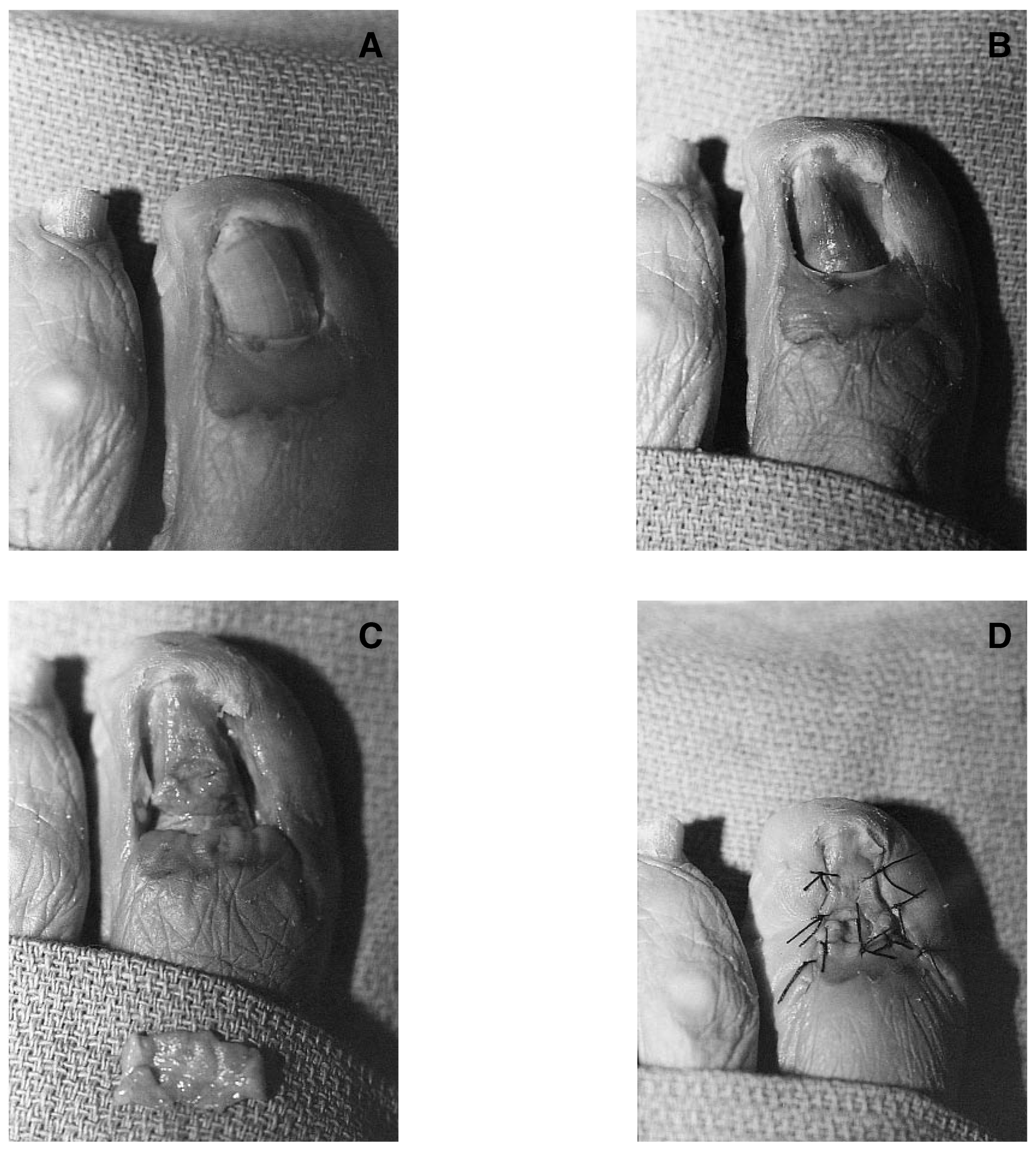
An H-shaped incisional approach is used. The long arms of the H are made on each side of the nail plate, extending from the distal edge of the plate to a location 1 to 1.5 cm proximal to the nail plate. The central arm of the H is made just proximal to the nail plate and connects the two long arms. The nail plate and underlying nail bed are excised, as is the matrix tissue proximally. This leaves two flaps, one proximal and one distal. The proximal skin flap overlies the distal phalanx where the matrix tissue has been excised. The distal flap consists of the distal digital tuft of skin, which routinely requires undermining for closure. The flaps are appropriately undermined until they can be advanced toward one another and sutured closed without tension. The advantages of this procedure are excellent exposure to the entire nail matrix, the ability to close the defect without resecting bone, and the ability to visualize and resect subungual exostoses through the incision.
A modification of the Zadik procedure consists oftotal nail avulsion combined with relaxation inci- tial excisional matrixectomies. A valuable adjunct to sions located medial and lateral to the proximal nail all total matrixectomy or total nail avulsion procefold [
1]. This creates a proximally located flap under dures is the application of porcine xenograft to the which exists the nail matrix. The matrix is easily nail bed postoperatively [
31]. This provides a biologic visualized and excised. The medial and lateral inci- dressing on the nail bed. In the authors’ experience, sions are then closed primarily over the resected patients have reported decreased pain, decreased matrix area (
Figure 5A–D). drainage, and faster healing with this technique. The
Postoperative care for total excisional matrixecto- porcine graft is usually rejected 4 to 6 weeks after my procedures is identical to that described for par- application; at that time, a healthy nail bed is present.
Summary
In recent years the treatment of onychomycosis has emphasized pharmaceutical methods because of the introduction of potent, safe oral antifungal agents. However, surgical intervention is often necessary for the treatment of severely thickened or painful mycotic nails. Surgical intervention may be combined with pharmaceutical therapy when appropriate. Many surgical techniques for partial and total nail avulsion and matrixectomy have been described in the literature. The procedures presented in this article are those favored and most commonly used by the authors.