Onychomycosis, while historically a banal subject among podiatric physicians, has in the last 3 years become one of the hottest topics in medicine. Newer developments in the field of medical mycology, coupled with the introduction of new oral antifungal agents, have resulted in a renewed interest in the subject of onychomycosis. Additionally, the inclusion of podiatric medicine in two major areas has brought added prestige to the profession. The first area is educational symposia, where podiatrists, dermatologists, and mycologists have stood as equals in the field of onychomycosis. The second area is consultation and investigation for the companies that are researching and marketing these new drugs, in which podiatric physicians are playing an increasingly important role.
Although the newer systemic antifungal agents have proven to be both safe and effective, in podiatric medical practice the mainstays of management of onychomycosis continue to be debridement and topical medication. For a variety of reasons, there is still much resistance among podiatric physicians to using these agents.
Clinical Problem of Onychomycosis
Podiatric physicians are confronted with onychomycosis every day. In most cases, it is the chief complaint; in others it is an incidental finding. Patients’ physical concerns include mild discomfort to severe pain, difficulty in cutting the nails, and accompanying dermatophytosis of the skin [
1]. Psychosocial concerns include embarrassment, fear of intimacy, and a general feeling of poor health [
1].
In the geriatric practice, particularly because of the attendant vascular and neurologic problems, along with concurrent illness such as diabetes mellitus, severe limb-threatening situations may develop from complications of onychomycosis. Many patients who have suffered a lower-extremity amputation relate histories of complications arising from one or more toenail infections, and onychomycosis is prevalent among this group. Virtually every podiatric physician has patients who have experienced this clinical tragedy. For this reason alone, onychomycosis, too long trivialized as only a cosmetic problem, must be aggressively managed. The traditional approaches to treating onychomycosis are debridement and topical therapy. While these approaches do not provide definitive cure, they do play a significant role in management of the condition and, therefore, the avoidance of serious morbidity.
Debridement of Mycotic Toenails
Though it is included as part of clinical training in podiatric medical school, manual debridement of toenails has received little attention in the literature. While every podiatric physician knows that a goodquality debridement is anything but a routine procedure, few if any descriptions of technique can be found. One dermatology text in widespread use offers the following instruction for debridement of a mycotic nail: “This can be accomplished by the use of nail clippers or filing or picking away with a
broken piece of glass, knife, or a motor-driven drill [emphasis added] [
2].” The author states that this procedure can be performed not only by the dermatologist or podiatrist but also by the patient!
Differing clinical presentations of onychomycosis require varying levels of debridement, from none at all to extensive. This discussion will be based on the most common presentation, that of the distal subungual variant of onychomycosis [
3]. In 90% to 95% of cases of distal subungual onychomycosis, the pathogens are dermatophytes, primarily
Trichophyton rubrum and
Trichophyton mentagrophytes [
4]. Zaias et al [
5]. more recently reported this percentage as 99%. The disease results in nails that demonstrate a number of familiar changes. It is important to remember that nail-plate changes in this disease are secondary to the dermatitis of the underlying nail bed produced by invading dermatophytes. Discussion of alternate pathogenic agents is beyond the scope of this article. The reader is encouraged to use the following descriptions in the clinical charting of this condition for proper and effective documentation:
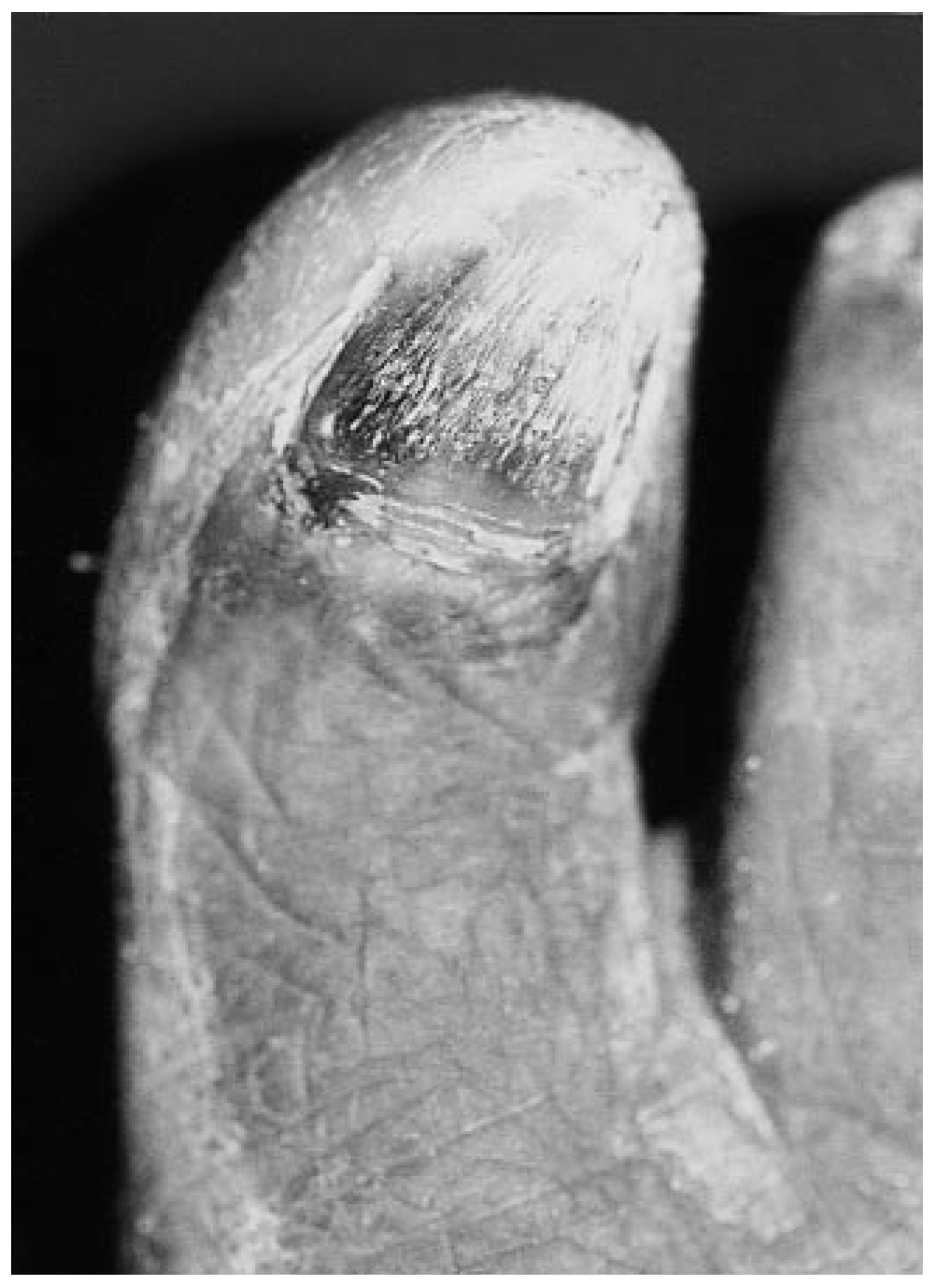
Discoloration. The usual color change is from essentially clear to varying shades of yellow to brown to black (
Figure 1).
Thickening. Although the nail appears to be thickened, there is actually very little thickening of the plate itself. Rather, the hyperkeratotic stratum corneum of the nail bed may be hard to distinguish from the plate, giving rise to the clinical description of thickening.
Subungual Hyperkeratosis. The degree of subungual hyperkeratosis is variable but usually quite high, and the condition may cause central nail pain. In the lateral nail folds, the subungual tissue often becomes painfully impacted as well. Subungual fluid dissection through this tissue is often missed until debridement defines a lysed area of nail plate where the fluid has accumulated over a superficial nail-bed erosion. This potentially dangerous complication is often painless in elderly patients, who may have diminution of sensation not clinically demonstrable on examination.
Lysis. Loss of adherence of the nail plate to the nail bed may be slight or extensive enough to involve the entire nail plate.
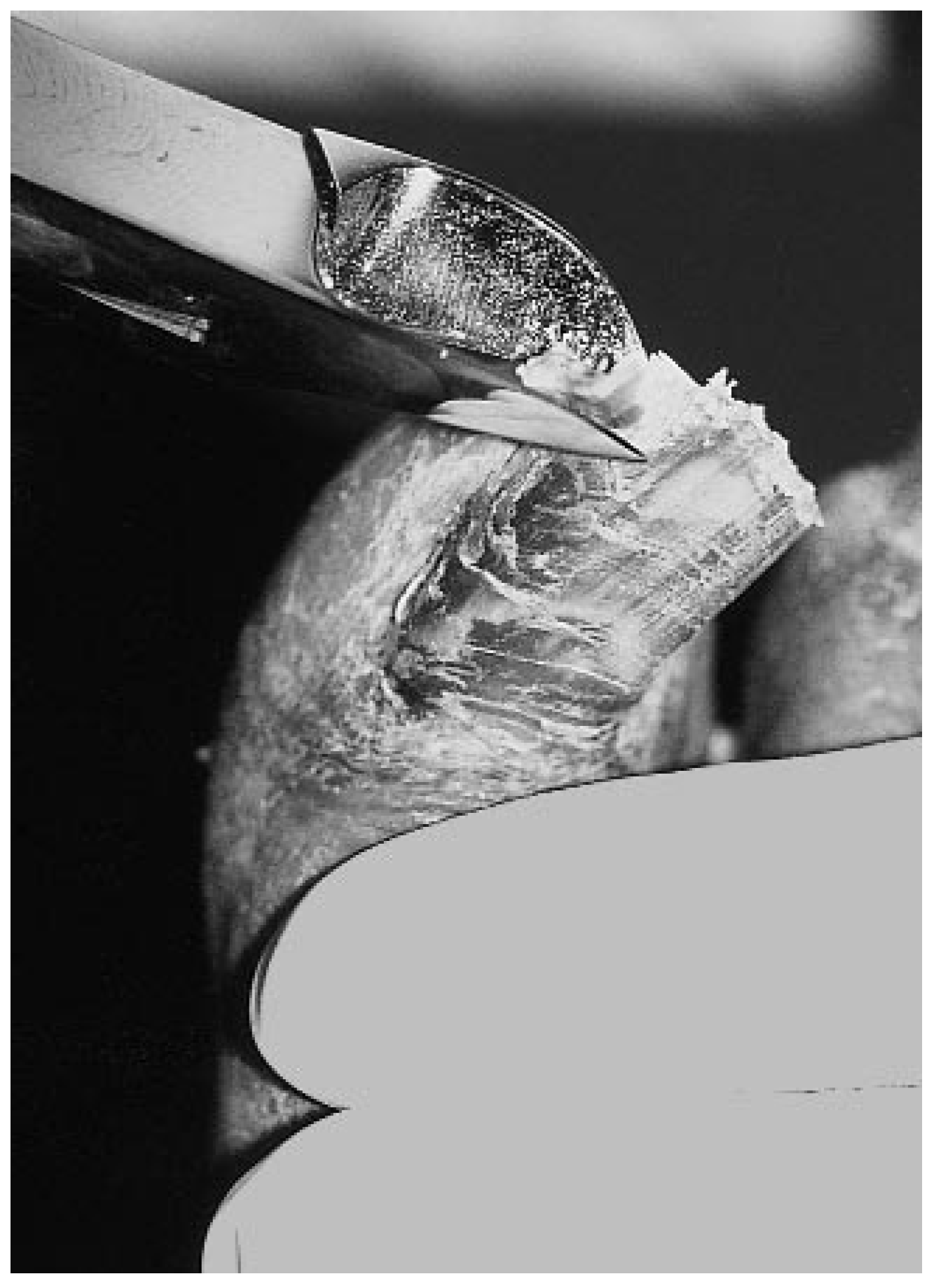
Hardness. Classically, nail plates are described by patients as “hard” and “impossible to cut” (
Figure 2). The degree of hardening actually varies widely depending on the organisms involved as well as external factors such as hydration, vascular status, and treatments applied. Nails are often described as brittle, friable, or crumbly.
Deformity. Nail-plate deformity may arise as a result of onychomycosis. These changes include sharp angulation of the plate to the proximal nail fold, incurvation, and varying degrees of tenting culminating in the pincer deformity that painfully incarcerates central nail-bed tissue. In these cases, it is particularly difficult to differentiate between the nail plate and nail bed, and bleeding may occur even with the most skilled and careful debridement. This is especially true when dealing with the lesser toenails.
Malodor. It is not uncommon for mycotic nails to have an odor, particularly during debridement. The odor is due to trapped debris and bacteria under the nail surface, which are exposed with debridement. Occasionally, malodorous, caseous necrotic material (degenerated keratin) is present, giving the false impression of suppuration.
Onychomycosis, then, presents with multiple clinical features that contribute to a painful, unsightly, and potentially hazardous condition for which selfcare is unwise. Self-care may be particularly imprudent in the face of vascular disease and neurologic deficit, failing vision, generalized arthritis, tremors, dementia, and a host of other common medical problems.
Depending on training and experience, podiatric physicians use an array of instruments to accomplish a nail debridement. The goal of debridement is to remove as much of the nail as necessary to provide relief of pain or fully expose eroded nail-bed areas for both observation and the rendering of appropriate therapy.
Some practitioners prefer working on softened nails; nails are softened with soaking or the application of water or other commercially available wetting agents. The senior author prefers not to have the nails softened, because in extensive subungual hyperkeratosis the tissue absorbs water and swells, thereby further blurring the distinction between the nail plate and underlying tissue.
Using a curette or the very tip of a flat-edge nail splitter, the practitioner should attempt to gently lift the plate off of the keratotic tissue. The clearly detached portion is then cut and removed. Often, in a brittle nail plate, the cut will extend beyond the edge of the instrument in an oblique direction. This property can be used to advantage to excise deeply incurvated portions of nail that often will flake off painlessly and provide substantial relief. Debridement should continue proximally until the area where the nail plate is firmly adherent to the bed is reached. The nail may indeed be lysed totally and thus be completely removed. Leaving obviously detached nail plate behind puts the patient at risk for a traumatic avulsion, usually caused by the distal edge of the remaining nail being pulled upward by a sock or pant leg.
In areas where nail-bed erosion is evident, debridement should completely expose the area so that topical therapy can be instituted. In the case of severe ischemia, where potential injury from the debridement procedure itself is a legitimate concern, topical urea preparations in strengths of 20% to 40% have been used to aid in the removal of nail-plate tissue. For very extensive mycotic changes, both permanent and nonpermanent surgical avulsion performed under local anesthesia are good alternatives when the clinician judges them to be necessary.
As the nail plate is reduced appropriately, the underlying keratotic tissue can be removed with a curette, splitter, or scalpel. It is this most proximal material that will give the greatest yield of positive fungal cultures. Distal nail-plate clippings are not good specimens.
Once the nail plate and underlying keratotic tissue are sufficiently debrided, a rotary burr may be used to remove any remaining small shards of nail and keratotic tissue to avoid injury from clothing. In the case of only one or a few infected nails, it is probably wise to use different instruments on the clinically normal nails.
As any practitioner knows, the above-described procedure may take considerable time. Although this procedure is considered ignoble by many podiatric physicians, it clearly requires the skill of a licensed provider because of the technical aspects and, even more, because of the knowledge requirements in complicated cases. Because of its high incidence in the everyday practice of podiatric medicine and surgery, no other specialist is better qualified and equipped to perform the nail-debridement procedure.
Traditional Oral Agents: Griseofulvin and Ketoconazole
Griseofulvin was discovered in 1939; in 1958, it became the first oral drug to be used in the systemic treatment of onychomycosis [
6]. It is derived from
Penicillium griseofulvin. Griseofulvin is fungistatic and not fungicidal even at high concentrations, and it is active only against dermatophytes. It has the most limited spectrum of activity of all available antifungal drugs [
7].
Griseofulvin works in vitro by inhibiting the formation of intracellular microtubules, probably via a direct effect on the structural protein tubulin [
8]. Griseofulvin is known to have a low binding affinity for keratin, which may explain why the drug has such a low cure rate in nail infections [
9]. Absorption of the drug is enhanced when it is given in ultramicrosize or microsize particle form and with food. The usual dosage of griseofulvin in microsize form is 10 to 15 mg/kg per day, which in most adults is approximately 1,000 mg daily, in divided doses with meals [
10]. Absorption may be increased if the drug is taken with a fatty meal and given at 6-hour intervals [
11]. Griseofulvin has a half-life in plasma of about 1 day, and approximately 50% of the oral dose can be detected in the urine within 5 days, mostly in the form of metabolites [
11]. Treatment is dependent on the rate of nail growth and is usually administered for 6 to 9 months in fingernail infection and for 12 to 18 months in toenail infection; it must be continued for 1 month after clinical clearance [
6]. Various studies have reported cure rates ranging from 10% to 50% at best without nail removal [
12]. The response depends on several factors, such as the penetration of the drug into nail keratin, the rate of nail growth, and the sensitivity of the organism to the drug minimum inhibitory concentration [
8]. Because of the required long-term dosing and low cure rates, this agent is not currently regarded as efficacious for onychomycosis. It is frequently used in dermatophyte skin infections, however, particularly tinea capitis.
The most common adverse reactions associated with griseofulvin are headache and gastrointestinal intolerance. Other common adverse effects include urticaria, photosensitivity, and erythema multiforme [
9]. Hepatotoxicity has also been observed; therefore, it is recommended that organ-system function be monitored periodically [
13]. Hematologic effects including leukopenia, neutropenia, and monocytosis often disappear despite continuation of treatment. Griseofulvin also tends to enhance the effect of alcohol. It induces the hepatic microsomal enzymes, thus increasing the metabolism of warfarin, and reduces the efficacy of oral contraceptives. Phenobarbital may reduce the absorption of griseofulvin as well as increase the metabolism of griseofulvin [
9].
Ketoconazole is the first orally active imidazole drug to be used for the treatment of superficial fungal infections, such as
Dermatophytes and
Candida species [
9]. It is fungistatic and slightly more potent than griseofulvin, but has an unsatisfactory cure rate for toenail infections: between 40.8% and 50% [
6]. The recommended dosage of ketoconazole is 200 mg daily administered with food, although the drug may be given twice a day [
7]. Absorption is influenced by gastric acidity and can be suppressed by cimetidine. The eccrine sweat gland appears to be the major route by which ketoconazole rapidly reaches the stratum corneum [
11]. It inhibits ergosterol synthesis in fungi by blocking cytochrome P450–dependent C-14 demethylation [
6]. The result is a decrease in ergosterol and an accumulation of lanosterol content in the fungal membrane, which alters the cell-membrane permeability, leading to cell lysis. One potential disadvantage of ketoconazole is possible testosterone or adrenal corticosteroid suppression, causing symptoms such as gynecomastia, impotence, menstrual irregularities, and an abnormal sperm count [
7]. These effects are mainly seen in doses in excess of 600 mg daily [
8].
The most alarming side effect of ketoconazole is an idiosyncratic form of drug-induced hepatitis. The risk increases in patients who receive more than 2 weeks of therapy, patients with preexisting liver disease, patients with alcoholism, and patients who received griseofulvin previously. Other common adverse side effects of ketoconazole include pruritus, fever, diarrhea, nausea, and vomiting [
9]. Gastrointestinal intolerance is less common than with griseofulvin [
6]. Hepatic function should be monitored repeatedly when this drug is prescribed. Ketoconazole should not be used in patients who are contemplating pregnancy; if patients become pregnant, treatment must be discontinued [
11]. When considering ketoconazole, the practitioner must address the toxic side effects. For these reasons, ketoconazole is seldom used today for onychomycosis.
Use of Topical Antifungal Agents
In cases of onychomycosis, it is common to elicit a history of use of one or more topical agents, either obtained over the counter or prescribed by a physician. While some patients report improvement in the appearance of the nail during use of these agents, few experience resolution of the problem.
Although it is generally accepted that topical antifungal therapy is not effective in curing onychomycosis, there are reports in the literature of various studies that have found some agents to have very beneficial effects, and some do refer to “cure.” The majority of these studies, however, involve small numbers of patients.
While cure for the white superficial variant of onychomycosis may be easy to achieve with topical agents, topical cure for the distal subungual form remains elusive [
5]. This is not surprising given that the infecting organisms in the white superficial variant are on the nail-plate surface, and not in the matrix and corneum of the nail bed under the plate as found in distal subungual onychomycosis. Regardless of the specific clinical type of onychomycosis, topical therapy is most effective when the degree of clinical involvement is small. When topical therapy is used together with oral therapy, the local effect of the topical agent may enhance the effect of the oral agent by decreasing the amount of diseased tissue.
Common explanations for the failure of topical treatment include lack of penetration of the nailplate keratin by the agent, required long duration of treatment, questionable efficacy, and, most important, the inability of these preparations to introduce drugs to the target tissue in high enough and persistent concentrations [
5]. The particular pharmacokinetics of the new systemic oral agents seem so far to have overcome all of these obstacles. Nevertheless, depending on the clinical picture and patient circumstances at the time the treatment decision is made, topical therapy may be the only option.
One topical treatment regimen that has shown consistent results is combined urea 40% and bifonazole 1% ointment. In 1988, Hay et al [
14]. reported a study in which two treatment regimens were used. The more effective proved to be daily application of the urea/bifonazole ointment by the patient, along with cutting back as much nail softened by the preparation as possible, for 1 week. The other regimen involved application of the ointment only under occlusion for 2 weeks. Both regimens resulted in substantial removal of nail-plate tissue. At the end of both regimens, patients applied bifonazole cream 1% to the nail bed and proximal fold. The first group (the group following the more effective regimen) was reported to have a 62.5% mycologic cure rate (mycologic cure equals negative potassium hydroxide [KOH] preparation and negative culture) at 12 weeks, which dropped to 46% at 24 weeks. The authors concluded that the results were impressive enough to include this as a viable treatment option.
In 1990, Hardjoko et al [
15]. reported on the same urea/bifonazole ointment and repeated the methods of Hay et al. They reported normal regrowth in 24 of 32 patients, concluding that it was a “procedure of choice.” In 1992, Fritsch et al [
16]. reported on nail-plate ultrastructural changes whereby the urea/bifonazole ointment resulted in disintegration of the corneocyte layer, with increased spaces between cells, allowing effective nail-plate penetration and fungal cell changes under the plate from the bifonazole within 5 days.
A study by Ishii et al [
17]. used a urea 20% and a tolnaftate 2% ointment preparation daily under occlusion in a group of 20 patients. Even though the study sample was very small, 14 patients were regarded as “responders.” These studies indicate that urea may be an extremely suitable vehicle by which newer therapeutic agents can be delivered in topical preparations.
Another study by Reinel [
18] involving 456 patients (70% with toenail involvement) examined the efficacy of amorolfine 5% nail lacquer. Two groups were studied, one group (223 patients) applying the agent once weekly and the other group (233 patients) twice weekly for 6 months. Interestingly, patients who had obvious matrix involvement were excluded from the study on the assumption that topical therapy in this situation is “generally unlikely to be successful.” In this study, “cure” was defined as clinical recovery and negative fungal culture. “Improvement” was defined as clinical improvement and negative culture. Any positive fungal culture indicated “treatment failure.”
Unfortunately, the results reported in the original article seem to be miscalculated, and are confusing. The author reports that in the once-weekly group of 223 patients, 58 patients were cured. Although this works out to be a 26% cure rate as defined by the author, it is reported in the article as 46%. Likewise, 77 patients, or 33%, in the twice-weekly group were cured, yet the cure rate is reported as 54.2%. It is also reported that the mycologic cure rate in the onceweekly group was 70.6%, and in the twice-weekly group, 76.1%. No explanation is offered for the substantially higher mycologic cure rates in both groups than would otherwise be evident from their respective cure rates. Nevertheless, the study does demonstrate reasonable potential for this preparation.
Other studies involving miconazole, clotrimazole, and ciclopirox olamine had very small sample sizes and less than mediocre results [
19,
20,
21,
22]. Any potentially encouraging results required very long duration of use.
Conclusion
As long as there is a need to treat onychomycosis, there will be research on topical medication, simply because of the urge to use efficacious agents with the fewest potential side effects, regardless of the safety of systemic agents. Painful, thick, dystrophic nails, mycotic or not, are problematic for both patients and podiatric physicians. A good manual debridement service, while very common, is the domain of the podiatric physician, who through proper technique will reduce the nail when necessary to avoid serious morbidity. Especially in the elderly population, self-care for this condition is dangerous, whether or not there are other systemic illnesses. The use of topical agents may result in softening of the nail plate and containment of the infection, making it easier to manage, and in certain cases a degree of cure. At present, newly available oral agents show great promise in changing the overall management of onychomycosis.