To the Editor:
The
Actinomyces organism is inherent in humans as normal flora found in the mouth. Outside of the mouth, this organism can cause actinomycosis in three clinical forms, the most common being cervicofacial, then thoracic and abdominal. The pelvic and disseminated forms are uncommon. The
Actinomyces organisms are gram-positive, nonsporeforming anaerobic bacilli.
Actinomyces israelii is most common cause of actinomycosis in humans, followed by
Actinomyces naeslundii,
Actinomyces viscosus,
Actinomyces odontolyticus, and
Actinomyces meyeri [
1,
2,
3,
4,
5,
6].
Typical course of development is a painless swelling of the soft tissue that becomes indurated, followed by a period of apparent inactivity; then draining sinuses appear, followed by sinus tracts and osteomyelitis. The appearance of sinus tracts indicates that the condition has become chronic. Osteomyelitis typically involves the mandible, vertebrae, and ribs, with the infection spreading through contiguous bony structures [
1,
2,
3,
4,
5,
6]. Therefore, involvement of the extremity is atypical and occurs under certain circumstances.
Transfer of the organism outside the typical environment must occur in conjunction with an opening in the skin [
1,
2,
3,
4,
5,
6]. Once inside the soft tissue, the typical course of development occurs. Although hematogenous spread of the infection is a possibility, review of the reported cases by Pang and Abdallah6, revealed that only 3% were hematogenously spread and no successful blood cultures of the
Actinomyces organism were reported.
Treatment
Surgical excision of any remaining soft tissue masses, all necrotic tissue, sinus tracts, and infected bone is recommended, followed by a postoperative course of antibiotics for a minimum of 6 months. Ampicillin is the first drug of choice, followed by clindamycin or chloramphenicol [
1,
2,
3,
4,
6,7].
Case Presentation
The patient was a 34-year-old female who presented complaining of a left foot that was painful only when wearing shoes. The patient preferred to go barefoot around the house and yard, wearing shoes only when leaving home. The problem began approximately 7 years ago, at which time a visibly apparent, localized, painless swelling was discovered on her left foot. Additional similarly painless, localized, indurated nodules began appearing in the following years, and made wearing shoes on her left foot progressively more painful.
Five years after the initial symptom appeared, she underwent surgery. Six months postoperatively, the patient noticed the gradual reappearance of the indurated nodules. Within 2 years, that area on her left foot had grown large enough to prohibit her wearing shoes. Return of foot pain was the patient’s chief complaint on this admission. The patient could not recall any specific incident prior to the onset of the swelling, or remember any fever or chills associated with the onset. She denied any drainage coming from the nodules during the time the nodules were present.
The remainder of the history was unremarkable. The physical examination was unremarkable except for the left foot, which presented nonpitting edema dorsally and plantarly centered over the fourth interspace.
Pressure applied to the dorsal aspect of the soft tissue mass distended the skin plantarly, and conversely with pressure applied to the plantar aspect. Attempts to aspirate the soft tissue masses were unsuccessful. Anteroposterior x-rays of the left foot revealed increased soft tissue density and widening of the fourth intermetatarsal space. The mass showed no bony involvement. Magnetic resonance imaging scans of the foot could not be performed for 6 months because of the tremendous backlog of patients. Routine preoperative laboratory work was unremarkable.
Under local anesthetic, the mass was removed
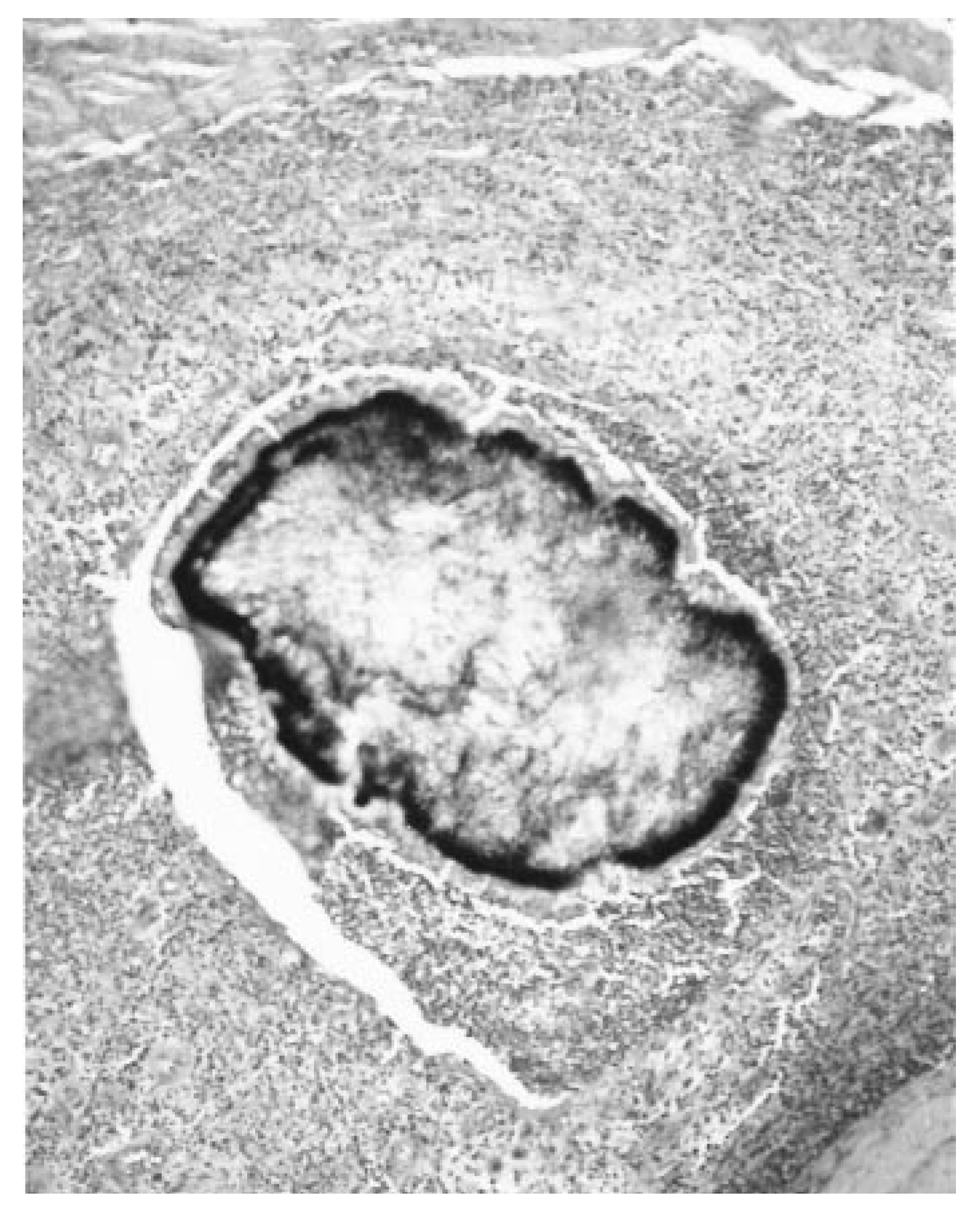
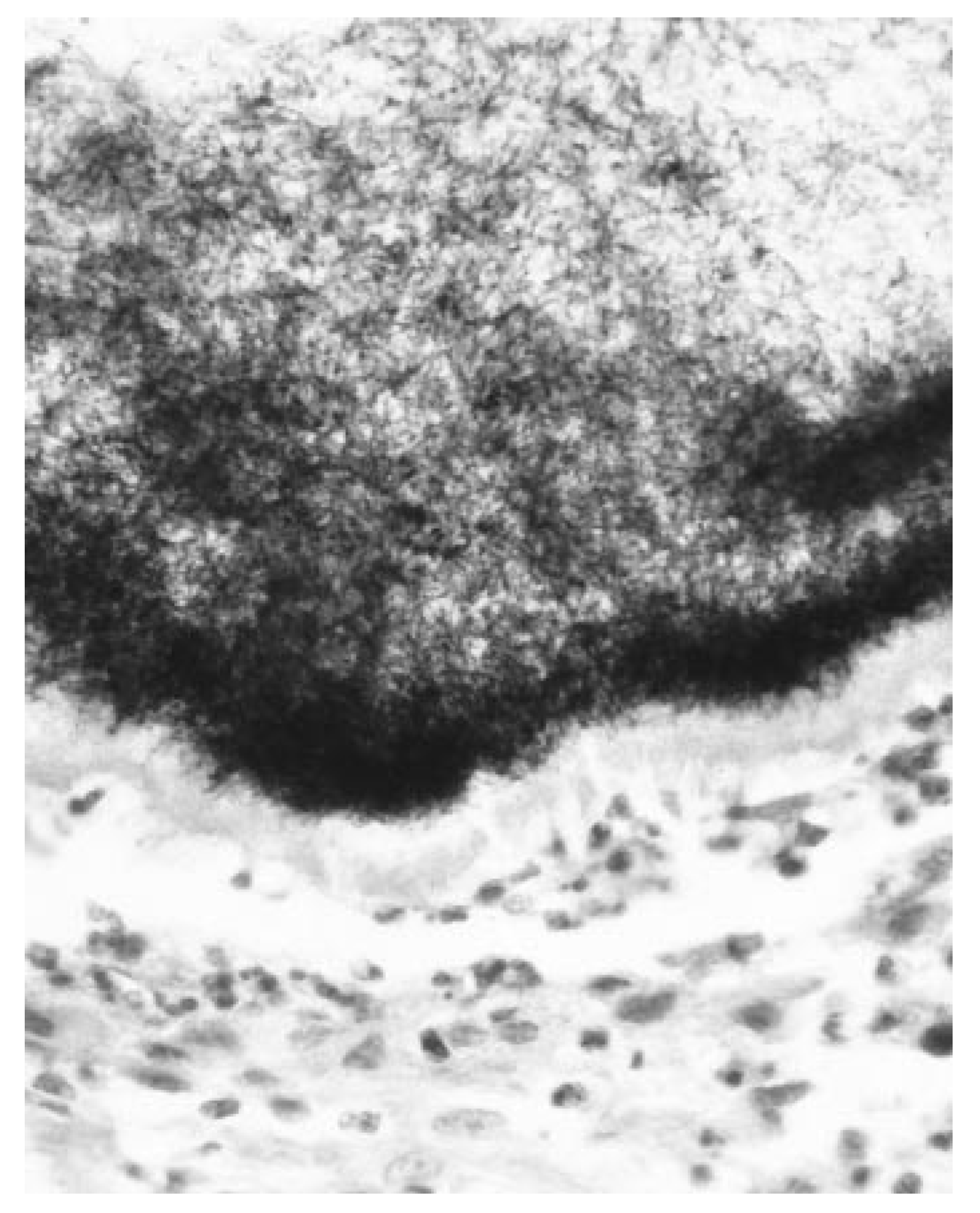
in toto from the left fourth interspace. The encapsulated mass occupied the fourth interspace from subdermis dorsally to subdermis plantarly and did not involve any vital soft tissue structures or bone. The mass measured approximately 5.0 × 3.5 × 3.0 cm. The pathologist’s microscopic description of the mass stated “multinodular, well capsulated, necrotizing granuloma with multifocal fungus colonies, consistent with
Actinomyces, surrounded by typical fungal filament and numerous polymorphonuclear leukocytes” (
Figs. 1 and
2). No cultures were done; therefore, the
Actinomyces species could not be identified. The patient was given ampicillin for 6 months, and the postoperative course was unremarkable when the patient was lost for follow-up care at 10 months.
Figure 1.
The characteristic granules of Actinomyces are enveloped by a dense, purulent exudate (H&E × 200).
Figure 1.
The characteristic granules of Actinomyces are enveloped by a dense, purulent exudate (H&E × 200).
Figure 2.
Peripherally, the granules are surrounded by amorphous eosinophilic material (H&E × 400).
Figure 2.
Peripherally, the granules are surrounded by amorphous eosinophilic material (H&E × 400).
Discussion
The soft tissue mass removed during the patient’s first surgery showed Actinomyces involvement, but duration of the appropriate antibiotic was suspended by the patient and could not be reinstituted when the patient was lost for follow-up care at 4 months. The exact mechanism of infection by Actinomyces in this patient is unknown.