To the Editor:
A unicameral cyst is typically a solitary cavity within bone filled with serous or sanguineous fluid and lined with a membrane of variable thickness. It has a predilection for long bones with approximately 72% of the lesions being located in the proximal humerus and femur. [
1] Occurrence in the foot is rather rare; the most common site when found there is in the calcaneus. [
2,
3] Most unicameral bone cysts are seen in the first two decades of life, males being twice as likely to be affected than females. [
4] They are usually asymptomatic when found in the foot and may be incidental findings on a routine radiograph. [
4]
On x-rays, they appear as ovoid to trapezoidal radiolucencies with a central void and a sclerotic margin. In 1974, Smith and Smith2 described the radiographic findings of solitary bone cysts located in the calcaneus.2 On lateral x-rays of the foot, they were located at the base of the calcaneal neck just inferior to the anterior portion of the posterior facet. The diameter of the cyst in every case was noted to be at least one third of the calcaneal length.
The etiology of unicameral bone cysts is unknown, although numerous theories have been set forth. Jaffe and Lichtenstein [
5] stated that disturbance in the growth plate accounted for the predilection of unicameral bone cysts at the end of long tubular bones. This theory, however, does not explain the presence of cysts in more anomalous locations such as the foot. Cohen [
6] studied the fluid inside unicameral bone cysts and discovered that it resembled serum in makeup. He postulated that a disturbance in venous outflow from the area surrounding the cyst would cause it to increase in size. [
3,
6,7]
Treatment for unicameral bone cysts varies from conservative measures such as mere observation to more aggressive forms of therapy such as surgical curettage and bone grafting to fill the defect. Some authors have recommended intralesional injections of prednisolone. [
8] In order to prevent pathologic fractures through the cystic lesion, surgical intervention is advised in young, active patients with cysts occurring in the calcaneus. [
4]
In a case seen at Broadlawns Medical Center, a 12-year-old male who underwent curettage and bone grafting of a calcaneal unicameral bone cyst was positive for growth of Salmonella on routine intraoperative cultures of the cystic fluid. This finding raises many interesting diagnostic and therapeutic questions.
Case Report
A healthy, 12-year-old male presented with a complaint of discomfort in his right heel of several months’ duration. He had seen his physician for the problem and was referred to the Broadlawns Podiatric Clinic. He presented in a nonweightbearing stance with a posterior splint because of pain while walking on the right heel. The medical history revealed normal development and no major illnesses.
Physical examination of the lower extremities showed pain on palpation of the right heel on the plantar medial aspect. Dorsalis pedis and posterior tibial pulses were palpable bilaterally at +2/4. All neurologic sensorium was intact bilaterally. Manual muscle testing revealed 5+ muscle strength in all groups with slight guarding of the affected side.
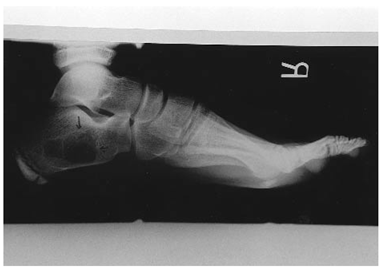
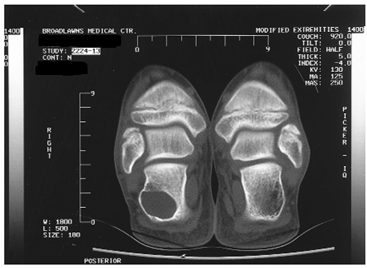
A lateral view of the right heel clearly shows a large cystic lesion involving the body of the os calcis (Fig. 1). Computed tomography of the right heel revealed a large benign appearing bone cyst in the calcaneus just inferior to the anterior portion of the posterior facet of the subtalar joint. No reactive changes were noted and the findings were consistent with a benign-type bone cyst (Fig. 2). Based on the physical findings, patient’s age, and the results of the diagnostic studies, surgical curettage and bone grafting were recommended.
Preoperative laboratory tests included a white blood cell count of 7,300/µl, hemoglobin of 14.3 g/dl, and hematocrit of 40.6%. Under a general anesthetic and the use of a thigh tourniquet, the lateral aspect of the foot was entered through a longitudinal approach.
After dissection of skin and subcutaneous tissues, the periosteal covering was incised. The periosteum was sharply reflected, revealing a bulging cortex with a hemorrhagic to cyanotic hue. A lateral cortical window was fashioned and removed. A large amount of hemorrhagic fluid was evacuated and sent for aerobic and anaerobic cultures and for pathologic examination. After removal of the membrane lining, the defect was filled with allogenic cortical struts and cancellous bone chips. The cortical window was repositioned and secured with bone wax. The wound was closed and the patient was sent to post-anesthesia recovery in good condition. The patient was released the following day.
Figure 1.
Lateral view radiograph of the right foot showing a large lytic lesion located centrally in the os calcis.
Figure 1.
Lateral view radiograph of the right foot showing a large lytic lesion located centrally in the os calcis.
Figure 2.
Frontal plane computed tomography view of both feet showing the extensive nature of the right calcaneal bone lesion.
Figure 2.
Frontal plane computed tomography view of both feet showing the extensive nature of the right calcaneal bone lesion.
Figure 3.
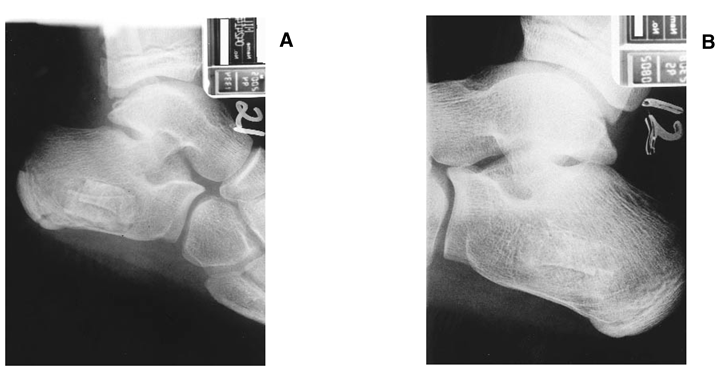
Lateral view radiographs of the right foot immediately postoperatively (A) and 4 months postoperatively (B). Note incorporation of the bone graft with resolution of the bone lesion.
Figure 3.
Lateral view radiographs of the right foot immediately postoperatively (A) and 4 months postoperatively (B). Note incorporation of the bone graft with resolution of the bone lesion.
The pathologic examination of the cyst lining revealed fragments of vascular connective tissue with hemosiderin-laden macrophages and cholesterol clefts. The findings were considered to be consistent with a diagnosis of solitary unicameral bone cyst. Microbiologic examination of the cyst fluid revealed positive growth of Salmonella spp. that was sensitive to all antibiotics against which it was tested. Further serologic testing confirmed the culture as Salmonella group B.
On the fourth postoperative day, blood was drawn for a sickle cell screening test (2% sodium metabisulfite) which was later reported as negative and a sedimentation rate reported as 36 mm/hr. A peripherally inserted central catheter line was placed in the patient’s right antecubital fossa and intravenous antibiotic therapy was started using ceftriaxone 1 g daily to be administered during home antibiotic therapy for 4 weeks followed by a course of oral antibiotic therapy.
The patient’s postoperative course was essentially unremarkable with the exception of the positive fluid culture. Serial radiographs showed progressive incorporation of the graft and resolution of the bone lesion (Fig. 3).
Discussion
The case above represents an atypical finding in the surgical management of unicameral bone cysts. Most patients with a positive
Salmonella culture from an osseous lesion are young, acutely ill, and have a history of sickle cell hemoglobinopathy.[
9,
10,
11,
12] The authors’ patient was 12 years old, very healthy, and negative for sickle cell hemoglobinopathy. The question is raised whether the
Salmonella was simply a contaminant. This seemed an unlikely contaminant for the type of surgery that was performed, and the assumption was made that the
Salmonella was present in the cyst before surgery. Because of the serious nature of any potential bone infection and considering the use of an allogenic bone graft, the decision was made to place the patient on an extended course of intravenous antibiotic therapy.