Munchausen’s syndrome was first reported by Asher [
1] in 1951. He described patients with dramatic but factitious illnesses, either self inflicted or feigned, who would repeatedly gain admission to the hospital. The syndrome has been studied extensively over the past 44 years; however, its diagnosis and management continue to challenge psychiatrists and other physicians. [
2]
While the medical presentation of Munchausen’s syndrome may be diverse, much attention has been focused recently on Munchausen’s syndrome by proxy, an especially malignant form of child abuse in which the carer (usually the mother) fabricates or exacerbates illness in the child to obtain medical attention, resulting in serious illness or even death of the child. [
3] It may be difficult to detect. [
4,
5]
The diagnostic features of Munchausen’s syndrome typically include: 1) feigned severe illness of a dramatic and emergency nature, the symptoms of which may or may not be borne out by physical examination; 2) factitious evidence of disease, surreptitiously produced by the patient; 3) evidence of many previous hospital procedures; 4) pathologic lying; 5) aggressive, unruly behavior and a mixture of truculence and evasiveness in manner; 6) departure from the hospital against medical advice; 7) background of many hospital admissions; and 8) the absence of any readily discernible ulterior motive. [
6]
Factitious subcutaneous emphysema was first reported by Gershwin et al [
7] in 1971, and other similar case reports involving self-injection of air have been published. [
8,
9,
10,
11] Two cases of soft tissue emphysema of the lower extremity caused by factitious illness of Munchausen’s syndrome are described.
Case 1
A 21-year-old obese female presented to the Botsford General Hospital emergency department with complaints of fever, chills, and a swollen, tender right ankle of several days’ duration. The patient denied any history of trauma to the affected extremity.
She had a history of hypertension but was not taking any medications. Her surgical history included a right ankle modified Watson-Jones stabilization and an incision and drainage of a right gluteal abscess 3 years previously and again 10 months prior to admission. She had returned from a trip to Honduras 3 months prior to admission.
Initial clinical findings included a slightly elevated temperature of 100.5° F, mild right calf tenderness, edema, and calor at the lateral right ankle. Radiographs revealed right ankle soft tissue edema and evidence of previous lateral ankle stabilization without soft tissue gas or bony pathology. All initial laboratory tests and cultures were essentially normal.
The patient was admitted to the hospital with a diagnosis of right lower extremity cellulitis and was placed on intravenous nafcillin empirically. Over the course of the next week, the extremity failed to improve despite changes in antibiotics. During this time, all laboratory and radiographic tests were normal. Consultations with the dermatology and rheumatology departments provided little insight into the patient’s condition.
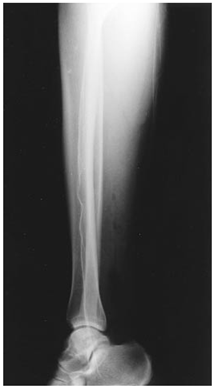
On the eighth day, the patient developed an acute onset of subcutaneous crepitance. Plain radiographs revealed soft tissue air around the right ankle and leg (
Fig. 1). Antibiotics were switched to clindamycin, gentamicin, and penicillin G. Incision and drainage were performed. Intraoperatively, the tissues in question appeared viable, without odor, necrosis, or purulence. Intraoperative blood and tissue cultures were sterile.
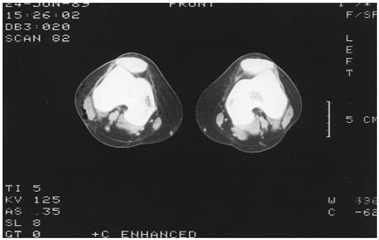
Four days after the first surgery, subcutaneous crepitation appeared proximal to the original surgical site. Computed tomography revealed subcutaneous air dissecting the muscular planes of the right knee (
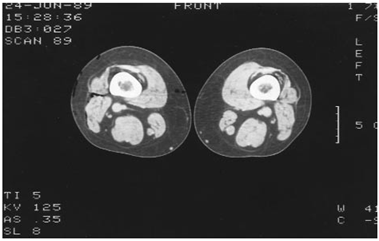
Fig. 2). Incision and drainage of the proximal right leg were performed. Similar to the first surgical exploration, the tissues appeared viable without evidence of an obvious infectious process. Within the next week, the patient complained of fever and abdominal pain. Soft tissue air had developed in her right thigh (
Fig. 3). Contrasted computed tomography revealed no evidence of abscess or fistula formation.
The Centers for Disease Control and Prevention was contacted with regard to the possibility of a rare presentation of a tropical disease acquired in Honduras; however, no unique pathogen was suggested. Without the confirmation of an infectious etiology following extensive microbiologic investigation, a diagnosis of self-injected air was considered and the psychiatry department was consulted. As the suspicion of self-inflicted illness became stronger, the watch over the patient intensified. Because of the implications of misdiagnosis and subsequent risk of further unnecessary surgery, a search of the patient’s belongings was undertaken. These objects were discovered: a syringe, needles, tourniquet, straw, and thermometer.
The patient was diagnosed with Munchausen’s syndrome, a strong attention-seeking personality disorder, which accounted for her self-abusive behavior and exaggeration of symptoms around physicians or family members. When the patient was confronted with the evidence and diagnosis, she became irritated, uncooperative, and released herself from the hospital against medical advice. Months later, it was discovered that a neighboring hospital had subsequently admitted the patient for a similar, factitious gas-producing infection.
Case 2
A 35-year-old female presented to the Botsford General Hospital emergency department complaining of a swollen, painful right foot, with shooting pains and numbness to all digits for the past several days. The patient related that 8 days previously, she had stepped on a piece of broken glass and that her foot became secondarily infected. Her primary care physician had given her a tetanus booster and prescribed oral and topical antibiotics.
The patient’s medical history included multiple hospitalizations and diagnoses of seizures, cerebrovascular accident, peptic ulcer disease, numerous transfusions, heart murmur, and eating disorder. She was on multiple medications and had an extensive list of allergies. Her surgical history included several exploratory laparoscopies, laminectomies, spinal fusions, tonsillectomy, and appendectomy.
Initial laboratory studies were unremarkable and the patient was afebrile. Radiographic studies revealed minimal soft tissue swelling of the right foot and ankle, without evidence of a retained foreign body. During clinical examination, the patient was notably impatient. The dorsal lateral aspect of the right foot had a small superficial abrasion with evidence of excoriations. The surrounding area was erythematous with a pinkish hue, edematous, warm, and tender. The remaining clinical examination was normal.
The patient was admitted to the hospital with the diagnosis of right lower extremity cellulitis unresponsive to oral antibiotics. The patient was placed on empiric intravenous antibiotics and the infectious disease department was consulted.
Because of the pinkish hue of the foot and the lack of supporting laboratory data, it was believed that the etiology was more of a dermatologic reaction than an infectious etiology. When this diagnosis was suggested to the patient, she became angry with the physician and requested another infectious disease specialist.
Over the next 3 days, the patient’s right foot failed to improve and the patient became very demanding of all involved in her care. She developed numerous other complaints including abdominal pain and apparent seizures. Numerous laboratory and radiographic studies were performed, but the etiology of her illness remained unknown.
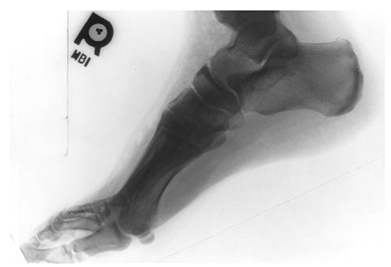
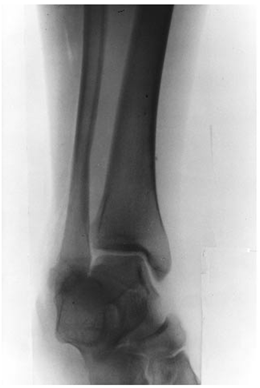
On the fourth day, the patient had a temperature of 102.9° F associated with an acute onset of subcutaneous crepitation of the right foot and ankle. Plain radiographs revealed soft tissue edema and air (
Fig. 4 and
Fig. 5). The patient was placed on vancomycin and metronidazole, and was scheduled for emergency incision and drainage.
In the preoperative holding area, the patient had what appeared to be a seizure; however, immediately following the seizure, she became responsive to name and commands. The neurologic evaluation was negative, with electroencephalograms that revealed no epileptiform focus of interictal or postictal abnormalities.
During the surgical preparation, the nursing staff noted that the pink color washed off of the right foot. Intraoperatively, two longitudinal incisions were created over the dorsum of the foot and a third incision was created posterior and inferior to the lateral malleolus. The tissues were surprisingly viable in appearance without odor, necrosis, or drainage. All intraoperative Gram’s stain and tissue cultures were negative.
Postoperatively, the nursing staff observed the patient removing the surgical dressing. When the patient was informed that an infectious process had not been identified, she became argumentative and notably upset.
A diagnosis of Munchausen’s syndrome with self-injection of air into the right leg was given. The patient’s belongings were not searched. When the patient was confronted with the diagnosis, she became belligerent and angry and refused further care from the infectious disease department and threatened to leave the hospital. The patient eventually requested a psychiatric consult to discuss “many unresolved childhood problems.”
Discussion
Two rare presentations of soft tissue emphysema of the lower extremity caused by factitious illness or Munchausen’s syndrome were reported. A gasproducing infection is a surgical emergency and should receive prompt medical and surgical attention. There are, however, several noninfectious presentations of gas in the tissues including trauma, entrapped air in wounds or ulcerations, irrigation with hydrogen peroxide, catheter placement, and self-injection of air. [
12]
Munchausen’s syndrome is a complex psychological disorder that continues to challenge psychiatrists and other physicians. [
2] This syndrome is often difficult to diagnose and treat, in part because most patients leave the hospital when confronted. Confrontation may lead to psychotic breakdown, and help can come only with long-term consultation and psychotherapy. [
13,
14,
15]
Conclusion
Awareness in both identifying and treating these patients is important. Most patients are sophisticated in their social communication skills, displaying an above average knowledge and history of medical employment. [
15] Certainly, these patients can have real medical problems during the course of their feigned illness, and this must be kept in mind in order not to overlook a treatable condition.
Once a real source of the complaints has been ruled out, psychiatric evaluation can be offered. [
15] Early recognition is essential to spare the patient unnecessary and potentially harmful diagnostic tests as well as to save both the patients and the hospitals the burden of financial responsibility.