To the Editor:
Aeromonas
hydrophila is a gram-negative bacillus; its name means, literally, “gas producing and water loving.” It is found in fresh water and soil, and is pathogenic to amphibians, reptiles, and fish. Although soft tissue infections caused by
A. hydrophila are uncommon, review of the literature indicates that 60% or more involve the lower extremity. [
1]
Aeromonas hydrophila was first reported in human feces by Miles and Halan in 1937. [
2,
3] Morphologically, the cells are thin-walled, varying from 1.0 to 4.4 µm, and are seen singly or grouped in pairs or short chains on Gram’s stain. [
2] There are currently seven aeromonad species in the family Vibrionaceae; the four most common of which are
Aeromonas salmonicida, A. hydrophila, Aeromonas sobria, and
Aeromonas caviae. Of these, only the last three are associated with human disease. [
3] An Australian study of human aeromonad infections indicated that the majority (71%) were caused by
A. hydrophila while 25% were caused by
A. sobria and the remainder were caused by other species. [
4]
Statistics from California, the first state to make
A. hydrophila infection a reportable disease, indicate that
A. hydrophila infections have an incidence of 10.6 cases per million persons with acute diarrhea affecting 81% and wound infection accounting for 9% of the total. Of the group with wound infections, 2% died, all of whom had underlying systemic illnesses.1 The incidence of
A. hydrophila infection increases during the summer months when temperature, rainfall, and humidity are at their highest levels. [
4]
Treatment of lower extremity infections includes antimicrobial and surgical therapies. Surgical therapy includes incision and drainage where localized abscesses are present and soft tissue and bone debridement as indicated. Recommended antibiotic coverage includes ciprofloxacin, norfloxacin, and trimethoprim/sulfamethoxazole (to which virtually all strains of
A. hydrophila are susceptible); second and third generation cephalosporins and amoxicillin/clavulanate constitute second line therapy with approximately 80% of isolates sensitive to these agents. [
5]
Case Presentation
A 73-year-old male presented to the Department of Veterans Affairs Medical Center at Newington with pain on the plantar aspect of his right foot. His past medical history was significant for non-insulin dependent diabetes mellitus and osteoarthritis of his right knee. Medications included glyburide, 10 mg twice daily, and ibuprofen, 600 mg three times daily as needed for knee pain. The patient related a history of gradually increasing pain in his right foot during the prior 2 days which had become unbearable. He denied any trauma to the foot or possible risks for puncture by foreign bodies.
The examination revealed the patient to be afebrile with neurovascular status grossly intact except for hyperesthesia of the plantar surface of his right foot. No erythema or calor were appreciated at the time, though three punctate hyperkeratoses were noted. During debridement of the hyperkeratoses, no sinuses were apparent and no drainage could be expressed althrough the underlying skin. The radiographic examination was unremarkable. He was prescribed oral clindamycin, 300 mg three times daily, and instructed to take ibuprofen for pain and return to the clinic in 2 days.
The patient returned the following morning with severe pain in his right foot. He was admitted to the hospital where clindamycin was continued and he was discharged the following day. However, he refused to leave the hospital on discharge because of his pain and fear of losing his limb to infection. Consequently, he was readmitted and given meperidine, 50 mg intramuscularly with hydroxyzine, 25 mg intramuscularly, every 3 to 4 hr as needed for pain, and was started on cefazolin, 1 g intravenously every 12 hr.
The podiatric medical service was consulted the following day. Erythema and inflammation were seen at approximately two of the three hyperkeratotic sites. A posterior tibial block was administered and, using aseptic technique, stab incisions were made into the two most erythematous areas. A substantial amount of purulent material was drained from each and submitted for Gram’s stain, culture, and sensitivity. Because there were abundant gram-negative bacilli seen on the Gram’s stain, the patient was started on oral ciprofloxacin, 750 mg twice daily, in addition to the other antibiotics.
Three separate abscesses eventually developed. Sinus tracts that could be probed to the deeper tissues were noted in two of the abscesses, and these produced considerable drainage, whereas the third abscess remained superficial. Cultures revealed a polymicrobial infection consisting of Enterobacter cloacae, Klebsiella oxytoca, Staphylococcus aureus, and A. hydrophila. At this time, the patient related having worked on his dock on an inland freshwater lake and using his bare right foot to compress sand and soil around the dock’s footers prior to the onset of his illness.
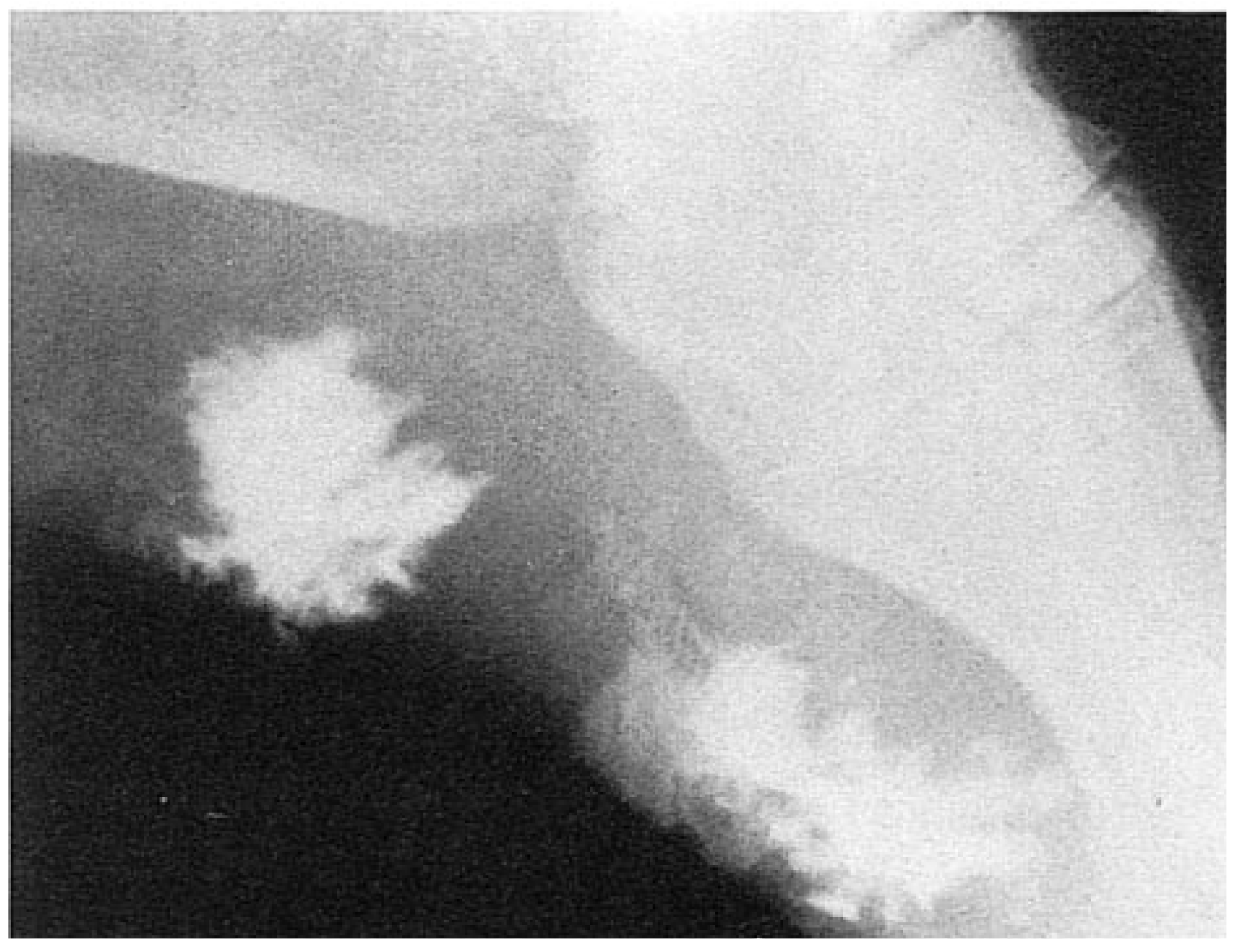
A fistulogram revealed two noncommunicating abscesses on the plantar aspect (Fig. 1). Under local anesthesia, each abscess was incised to the borders defined radiographically and packed open with iodoform gauze. Edema, erythema, and drainage gradually decreased and the patient remained in hospital for 19 days during which daily local debridement and dressing changes were performed. His maximum temperature during this admission was 100.6°F and his white blood cell count peaked at 10.6K /mm3.
Figure 1.
Fistulogram illustrating two noncommunicating abscesses on the plantar aspect of the right foot.
Figure 1.
Fistulogram illustrating two noncommunicating abscesses on the plantar aspect of the right foot.
He was discharged with a prescription for ciprofloxacin, 750 mg twice daily for 10 days, and was instructed to perform daily dressing changes. He was followed in the outpatient clinic for an additional 3 weeks before discharge during which time he was given extensive education about diabetes mellitus.
Discussion
The case presented herein is of a patient with diabetes who may have had some degree of immunopathy, although he did not become frankly septic. The high incidence of lower extremity infections reported in the literature is consistent with the injury presented here. Gold and Salit6 reviewed 11 cases of aeromonad infection in humans and found that 78% of the patients were exposed to fresh water prior to becoming ill and 82% sustained direct trauma prior to the onset of illness. [
6]
Exposure to contaminated water or soil is a common antecedent to human infection and typically results in one of four clinical syndromes. The first is diarrhea which is usually self-limited and of short duration. In children and those with chronic illnesses, this may require hospitalization but usually resolves within 2 weeks.
The second presentation is cellulitis that typically occurs after traumatic inoculation of the bacteria and which may progress to include osteomyelitis and myonecrosis. Patients typically present with an edematous and erythematous foot (though this picture may develop after the onset of deep pain) which exhibits copious purulent drainage on irrigation and drainage.
The last two syndromes include septicemia and other organ system involvement and are typically seen in immunocompromised patients. [
3] Immunocompromised patients have been infected as a result of trauma, consuming infected fish, or by using contaminated tap water in hot-moist packs. [
7,
8] Infections in immunocompromised patients can evolve into sepsis and may be fatal. [
9] Moreover, limb-threatening osteomyelitis may develop even in nonimmunocompromised patients. [
10] While between 18% and 36% of cases reveal only
A. hydrophila on culture, the majority of lower extremity infections are polymicrobial and involve mixed gram-positive and gram-negative environmental flora as was true in this case. [
6],11
While other imaging modalities (computed tomography, magnetic resonance imaging, ultrasound and radionucleotide studies) may be used to discern the presence of abscesses and assess the need for surgery, in this case, fistulograms were able to delineate the presence of abscesses adequately to allow for preoperative assessment and the design of appropriate surgical intervention; they should be considered when other modalities are not immediately available or access is limited by cost constraints or other factors.
This technique is accomplished by the slow infusion of radiopaque dye through a cannulated needle into the site of a suspected abscess after a small incision is made through the overlying skin and soft tissue. This procedure is best accomplished under fluoroscopic guidance with spot films being taken of the views most suited to aid in operative treatment.